Showing posts with label NonProfit. Show all posts

Wednesday, November 23, 2022

Thanksgiving. Now and Past.

I wish you all a safe, happy Thanksgiving. I and my family are in good health. My wife and kids have jobs. The mid-term elections had much better results for Democrats and Progressives than was expected. That's all good.

During the 17 years I worked in corporate retail advertising for Montgomery Ward I saw an annual repetition of the same type of ads at specific times each year. The ads for Thanksgiving and the Christmas holidays always looked the same and featured similar merchandise.

I mentioned to a senior VP how I thought the ads were redundant and he said, "While we may get tired of making them,  there are always new customers who will be looking for the merchandise we feature."

I feel the same way about my blog.

I've been writing this blog since 2005. I started sending e-Mail newsletters around 2002.  I sent print newsletters from 1993 until 2003.  They all followed the calendar with what I talked about.  

I featured volunteer recruitment in Aug/September; holiday giving around Thanksgiving, annual planning and process improvement in February, and  year-end celebrations and next-year planning in May-June.

So instead of writing a repetitive article today, I'm just going to invite you to read a few that I wrote at this time in past years.

In 2017 I wrote "My Life Since 2011 - Something's Missing" and talked about the tutor/mentor programs I led from 1975 to 2011. 

I used this 2020 article to review my use of maps to focus attention and resources to tutor/mentor programs in every high poverty area of Chicago and other places. 

In this 2014 article and this 2019 article I encouraged people to support youth tutor and/or mentor programs via the annual Give Tuesday campaign, which this year is on Nov. 29.  

In this 2012 article I reviewed the 38th Tutor/Mentor Leadership and Networking Conference, which I continued to host every six months until May 2015. 

This 2015 article was titled "Planning needed to fight war on poverty in big cities". 

This 2017 article's headline was "Stick your neck out and support a cause". 

Prior to 2011 I was still leading a two-part strategy of a site based Cabrini Connections tutor/mentor program and the Chicago-wide focused Tutor/Mentor Connection.

Thus, this article from 2009 used a graphic created by one of our students to encourage Thanksgiving donations. 

This 2008 article included another graphic created by students from our tech club at Cabrini Connections. 

In this 2007 article the title was "Let's redefine Christmas by putting more Thanksgiving into it." 

You can see the pattern here. I suspect next year and following years  you'll see more of the same.  

All of these articles are part of a "local-global" strategy launched in 1993.

Our single, small, Chicago-based tutor/mentor program was able to help change the lives of a few kids while our Tutor/Mentor Connection strategy aimed to help change the lives of thousands of kids located in different high poverty areas of Chicago and the world. 


I've constantly encourage others to take on the same role, but due to continuing competition for scarce resources, very few have done that.  

I wrote this "Can't drain the swamp?" article in 2012 to visualize the futility of doing "business as usual".  

Your Giving Tuesday and year-end giving, plus on-going giving throughout the year, can build financial stability in more programs, thus freeing them to adopt this two-part strategy themselves.

That would give myself, and millions of young people, much more to be thankful for at this time in future years!

Thanks for reading.

Please support my efforts through one of these giving options.

Dan's 76th birthday is Dec. 19 - click here

Help Fund Tutor/Mentor Institute, LLC - click here


Thursday, November 17, 2022

Mapping Complexity

Below is a post I saw on Twitter, showing a "Social Change Ecosystem Framework" developed by Deepa Iyer, of the SolidarityIs and Building Movement Project.  

Here's an article by Deepa Iyer that describes a use of this Social Change Map.  I love the "hub and spoke" design she uses and how this shows the range of people and networks who need to be part of any problem-solving ecosystem.  

I've used similar visualizations for more than 20 years.

You can see these in hundreds of articles on this blog.  I've posted several dozen articles since 2005 that I've tagged "complex problems".  And many more tagged "network building".  Plus a few more tagged "ecosystem". 

Below is a concept map created more than 10 years ago that shows the range of talents and networks that need to be involved in solving any complex problem.

All of these emphasize that no single person can solve the many complex problems we face locally and globally.  If you scroll through the articles tagged complex problems you'll find many visualizations showing complexity. 

I found another on my LinkedIn feed this week.

This graphic by Christian Sarkar can be viewed in an article titled "The Ecosystem of Wicked Problems".  

One of the features of this graphic is that it shows relationships and how the problems are inter-related to each other.  

What would have made it better (in my opinion) would have been links from each node, to web libraries with information about each problem.

For instance, here's my concept map showing the research section of the Tutor/Mentor Library.  At the bottom of each node is a link to a specific collection of websites.

Linking to libraries like this would expand the information anyone has to understand a problem, to connect with others who are also trying to solve the problem, and to find work being done in some places to solve the problem that might stimulate innovation and/or duplication in many other places.

The challenge, of course, is building and maintaining such libraries, and attracting people to use the information.  And, finding consistent funding to pay for the work.  I was never able to do that. 

I hypothesize that every link I point to from my library represents an ecosystem of many people working for that organization and an even greater number who that organization and its employees connect with.  

Looking at the graphics by Christian Sarkar and Deepa Iyer, imagine people from each of these nodes connecting with each other in on-going learning, innovation, resource development and problem solving.

Who are all of those people? Who are all of the organizations working in each category? 

Someone who's been doing some deep thinking about part of this is Greg Bloom, Founder of Open Referral. He was the speaker at the November 15, 2022 ChiHackNight event.  

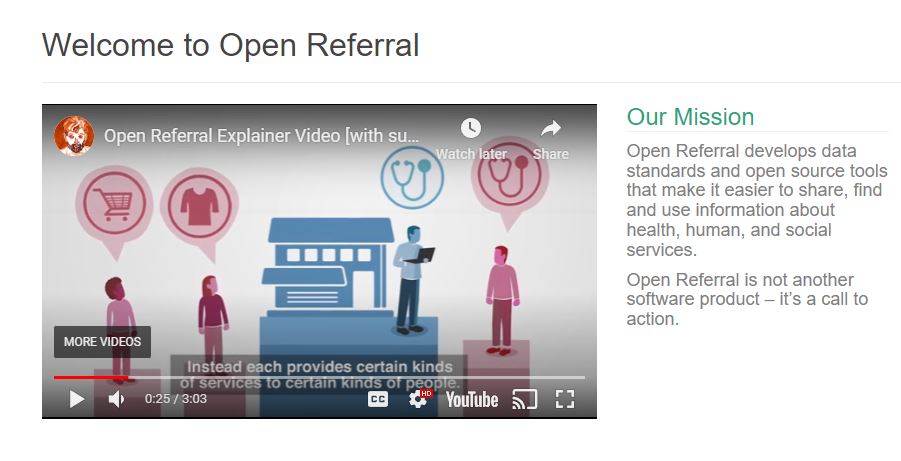
I encourage you to view the short video on the home page of the Open Referral website to understand the important work they are doing and the problems they are addressing. 


Greg's group has been bringing people together since 2012 to talk about the challenges of building and maintaining information directories and to "create a common set of data standards, that define and structure information, so that it can be readily transferred between systems".  Read through the FAQ questions and answers on the Open Referral website to understand this better. 

View Greg's Nov 15 presentation to ChiHackNight.  click here

That means many distributed directories could be connected in larger directories, making more information available to more people.

The Tutor/Mentor Connection, which I and a few others created in 1993 and launched in 1994, has been collecting information about Chicago area volunteer-based tutor/mentor programs for 30 years, along with building a library that represents the ecosystem of research, resources, funding, businesses and everyone else who needs to be involved in helping kids in poverty move more safely from birth-to-work.

We published our first printed directory of Chicago tutor and mentor programs, and the ecosystem of those who support them, in 1994 and updated it annually through 2003. After that all of our information was put on-line. 

We had others ask us to share the data, but who never offered to help pay the costs of collecting and maintaining it.  I never did this for fear of the larger organization eliminating the need for our work, and then at some point in the future, ceasing operation, so none of the data we had been collecting would remain available. 

Furthermore, if our data was owned by a national organization, the people who managed it would not have local passion, or local purpose, to use the data regularly to help existing programs constantly improve, nor to help new programs form where data analysis showed more were needed. 

That was why we were collecting the information in the first place!

Thus, I proposed there be a decentralized collection of data that was shared in a system similar to what Greg has been working on. Back in the 1990s the technology, or motivation, to do this was not available.

Thus, I fully understand the challenges Greg describes. For the past 10 years I've been a one-person army trying to maintain the library, share it, and get people to talk to myself, and each other.  If you read though this blog you can find hundreds of articles that relate to this.

Bringing people together.

When we were planning the Tutor/Mentor Connection in 1993 and talking about building a directory our PR partner from Public Communications, Inc. in Chicago, said "You've got to host a conference!".  

Using the contact information from organizations we learned about through our survey and our networking, we hosted a first Tutor/Mentor Leadership and Networking Conference in May 1994 and hosted one every six months after that until May 2015, at which time I had to stop due to lack of money.

In this article you can see a map showing participation over 20 years.  Here's a presentation showing how universities hosted these conferences and how I reached out to them for many years.  Between 1996 and 2002 attendance ranged from over 150 to over 300. Our mailing list grew from 400 to 14,000. This represented quite a large ecosystem, yet, it was not attracting business, philanthropy, government or university participants.   Thus, there were always too few of "the right people" to fully build the Tutor/Mentor Connection to what I hoped it would accomplish.

Since forming the Tutor/Mentor Institute, LLC in 2011 the range of people I've been reaching dramatically declined and conference participation dropped to around 100 per event. 

So let me sum up.

1) the world is dealing with complex problems and some people are creating great visualizations showing this complexity;

2) some people recognize the difficulty of collecting and sharing social service information and are trying to innovate new solutions;

3) knowing "who" should be included in a directory, or in an "invitation list" is part of the problem in a big city like Chicago;  getting them to come to "your event" or into "your conversation" is a huge challenge if you're not well-connected, or have a reputation that draws people to you.  Getting into "their conversations" and "being heard" is just as difficult.

4) I find very few people creating visualizations of who should be connected, or who they are bringing together via their events.

5) even if you have a list of "who" unless you do some sort of network analysis of event participation and/or social media conversations, you don't really know how well your network is connecting.

I'm sure readers might list more problems. I'd love to hear from you.

This has already been a long article, but if you've made it this far I encourage you to go one article further.  Review the 4-part strategy described in this concept map.

The "information collection" described in this article is just STEP 1. Getting people to look at the information (step 2) and helping them understand it (step 3) and use it (step 4) also need to be funded and supported as part of any problem-solving process.

Thanks for reading. I hope you'll share this.  I'm on Twitter, LinkedIn, Instagram, Facebook and Mastodon. (see links here).  Let's connect.

If you appreciate these articles please visit my FundT/MI page and send a small contribution. 


Wednesday, October 05, 2022

WE instead of, just ME, in collective efforts

This week I saw a post about a new campaign from the Chicago Independent Media Alliance aimed at raising needed operating funds for more than 30 different local media outlets.
Each of the participating organizations is using their own talents to draw attention to this campaign, and draw donations to themselves and their peers.  It's a great example of applying "WE, instead of just ME", in the social sector where the fierce competition for scarce funding usually has non-profit campaigns focusing only on self-centered fund raising.

My vision, since forming the Tutor/Mentor Connection in Chicago in 1993 has been to generate attention and more consistent support for EVERY youth tutor and/or mentor program in the Chicago region.  

Read about this vision below: 


This is one of many maps you'll find on this blog and on the MappingforJustice Blog, which zoom into a Chicago neighborhood and tell a story of "why" kids and families need more help, "what" help is already in that area, if any, in the form of organized volunteer based tutor and/or mentor programs; and "what assets" and leaders share the geography and could be doing much more to help change the conditions and improve the lives of people who live there.


click to enlarge
I created the Tutor/Mentor Connection (T/MC) in 1993 and Tutor/Mentor Institute, LLC (T/MI) in 2011 to support the growth of well-organized youth tutor/mentor programs in all high poverty areas of Chicago. This graphic shows four strategies that I've followed since they were developed in 1993.

While we accomplished much and built a huge resource library, we've never had consistent funding or significant leadership support from Chicago business, political, philanthropic or other sectors. Thus, what we wanted to accomplish is far less than what has been needed.

Data collection and GIS mapping have been at the heart of T/MC work since 1993. This graphic shows what the T/MC has been trying to do and what has not ever been accomplished.

Annual cycle of Tutor/Mentor Connection mapping. Click to enlarge 

We've built a list of youth tutor/mentor programs, organized bi-annual conferences (1994-2015) to bring leaders together, organized events to draw volunteers and donors to programs, generated considerable attention from local media, built a social media presence and more.  It's been too little to change the overall range of poverty in Chicago, but has had a positive affect on many individual lives.

I created this Wiki Page to show what we were trying to accomplish. Feel free to read it and offer your help, or create a similar strategy focused on your own city. 

When we started building a mapping capacity, and on-line program locator, the goal was that we could do more to support the fund raising capacity of programs in different parts of the city. 

There were three goals that never have been reached.

click here to view
1) There is a growing mountain of data showing levels of poverty and inequality in Chicago and the world.  In the concept map shown at the left I point so some of these data platforms.  The Tutor/Mentor Program Locator (since 2022 only available as an archive) used some of that data and like other platforms enabled people to zoom into small areas to look for the availability of tutor/mentor programs in small areas.

My vision was that we could create a form that would be accepted by grant makers, to show the need for tutor/mentor programs serving different age levels in different zip codes and/or community areas.  Right now every program has to build their own case statement showing why it is important for their program to receive funding. Some have greater talent to do this than others. It's a redundant and expensive process with too few consistent winners. Thus, creating a form where you'd only need to enter a zip code or community area, plus the age group you serve, and the type of program you offer, should generate a report showing that you are needed in that area.

7-29-2022 update - below is a video created by a company called RS21 who is building data mapping dashboards and using the data in an analysis process that determines where services are needed and where to put them. View the video at this link.  View other articles showing RS21 use of data - click here.


I point to the RS21 video because this is the type of analysis that was envisioned in 1993 when we began to plan the Tutor/Mentor Connection and it's use of maps.  We never reached the capacity to do this in all the ways imagined.

I'm  pointing today to the Chicago Independent Media Alliance because it's an example of what has been needed for the past 30 years and will still be needed for the next 30 years. 

If we had fully developed this capacity in the 2000s, it would have lowered the cost to individual programs and given grant makers a consistent way to help them decide where to provide funding and who to support in each area. 

click here to view

We got partially there in 2004 when we launched this on-line searchable program locator form (since 2022 only available as an archive).  However, the maps that this produced did not show demographic information or indicators such as poorly performing schools or violence.  The Interactive Program Locator that was built in 2008 provided this information. However, there was no "easy-to-use" narrative generated in a "form" that could be printed that someone could pull from the site and use in a grant proposal.

The financial melt down starting in 2008 led to this work being discontinued in 2009 and to updates being discontinued by 2013.

So this is one bridge that we never were able to cross.

2)  Motivating programs to provide data for the Tutor/Mentor Program Locator and keep it updated has always been a challenge. One way we partially overcame that was to have our annual survey included in the grant guidelines of the Chicago Bar Foundation's Lawyer's Lend A Hand Program. About 40 out of our list of nearly 200 programs submitted applications each year from 1995-20003 which I could use to update the list. However, that was too few and too time consuming for my small staff. Thus as we built the interactive portal in 2004 we developed an on-line form that programs could use to add themselves or update their data (not working since 2013).  However, this still did not provide "motivation".

Note: I was sorry to learn recently that the Lend A Hand Program has ceased making grants to support multiple tutor/mentor programs, and will instead focus only on their own program.  That's a perfect example of the "ME instead of WE" thinking.  

click to enlarge

My strategy for motivating programs to provide information and keep it updated is shown in this PDF. The graphic at the right is part of it. As on-line fund raising portals grew since the mid 2000s I felt that we might create a portal that would work with the Program Locator maps, to encourage donors to support programs in different parts of Chicago and give media a resource to use in developing stories following incidents of violence, reports on schools, reports on gangs, etc. 

On one level, we could draw from the list we were maintaining to give donors information to create the platform. However, on another level we felt that as programs began to generate donations, and learned to use the site to build their own campaigns, we'd create greater motivation to keep their data updated.  We could even organize events at different time in each year to draw volunteers and donors to the platform.

Imagine the potential of stories about tutoring and mentoring calling attention to our maps and database and drawing needed resources into every high poverty neighborhood.  Imagine the visibility this would generate if similar campaigns were happening in every city! 

This is another bridge that has not been crossed. This has never gotten further than me putting the idea into this PPT and sharing it on my planning wiki.

click to enlarge
Media stories continue to remind us that some people in Chicago and other cities live with fewer resources and fewer opportunities than do other people.  Thus, there's still a need for organizations that provide a bridge, connecting youth and families to resources and connecting people who don't live in poverty with people who do.

3) The final bridge - As we developed the Tutor/Mentor Connection in the 1990s we felt we could generate income to support our continued operations and innovation by making it available to other cities and offering our expertise to help them use it. When I formed the Tutor/Mentor Institute, LLC that continued to be the goal.  However, that has not happened.   Now my goal is to find people who will take time to understand what I've been trying to do and will want to take ownership and carry it into the future.   One idea that might offer promise is to make the code for the Program Locator and any new platforms freely available on GitHub, so it could be more easily applied in other cities, and to other causes.  That might attract more developers to help build in the features I've not been able to construct, and to keep updating it as technology and needs change.  Having parallel portals in every major city of the US and the world would certainly contribute to greater visibility and greater traffic, and thus a bigger flow of donations through the portal and the maps to individual tutor/mentor programs in different places.

That's always been the goal.  So far it's still a bridge to far to cross.

Does any of this interest you?  I'm on Twitter, Linkedin and Facebook. Let's connect.

Can you send a contribution to help fund this work? Click here to find a PayPal link. 


Monday, June 20, 2022

Follow up to JuneTeenth - Building the Network


I have been writing this blog since 2005, continuing work that I started in 1993, to help volunteer-based tutor/mentor programs reach kids in more places and help more of them move safely from birth-to-work.

Many of the articles written in past years are as important now as they were then, so from time-to-time, I repeat them.  

Here is what I wrote in December 2016 under the headline of "Building, Connecting Villages of  Hope and Opportunity".

---------------begin---------------

I am one of those people who fear what will happen to our democracy and freedom, and the planet's health, over the next few years.  In some of the posts I've read, writers say "don't lose hope" and "get involved locally with a cause you care about".

These prompted me to create the graphic shown below, which I'll explain in the following paragraphs.


Since forming the Tutor/Mentor Connection (T/MC) in 1993 (and Tutor/Mentor Institute, LLC in 2011), my goal has been to help mentor-rich, non-school tutoring and learning centers be available in a growing number of high poverty neighborhoods. Rather than start new programs, the strategy has been to identify existing organizations who already do some form of tutoring and/or mentoring and help them get a consistent flow of ideas, talent, operating dollars and other resources needed to build constantly improving programs.

When you look at the "oil well" images on the map I want you to think of the 12 years it takes for a youth to go from first grade to 12th grade, and the four to eight years after that to go through secondary education and find a job and/or be starting a career.

Since no program starts out as "the best" the flow of resources needs to help programs launch, then grow, then build and sustain multiple year connections with youth.

It takes a lot of different talents and skills to make this happen. I use the "it takes a village" graphic to visualize this.  In addition, I've created some concept maps that show the range of talent and community networks who need to be involved in supporting each program operating in each neighborhood.

Here's one of the maps in my library, showing supports kids need as they move through school.

Mentoring Kids to Careers - map

The concept map below visualizes a process that should be taking place in hundreds of locations, in the Chicago region, and in other cities, to help programs grow in places where they are most needed, and to help them become great at what they do to transform the lives of kids, families, volunteers and anyone who is involved.

See map at http://tinyurl.com/TMI-PlanningCycle-cmap

When I started leading a tutor/mentor program in 1975 I had a full time advertising job, we had no paid staff, and we already had 100 pairs of elementary school kids and volunteers involved. That number grew to 300 pairs by 1990 (with about 30 hours per week of part time college student staff).  I recognized that I could never touch and train every volunteer to know all they needed to know about why we were offering the program and what they could do to be effective tutors/mentors and program participants.  Thus I began to collect information that they could read and draw from to support their own efforts.

I started to create a "learning organization" well before this term was coined in business schools and trade magazines. This is one of many articles I've written to explain that idea.

In all my communications I was asking my volunteers to look for ways to help the kids we work with move through school. I was offering a library of articles (which was put on the internet starting in 1998) that they could read, share, discuss and learn from.  I focused on a process of improvement, or how do we get from "here to there'.  I organized social events, such as getting together for food and drinks after a tutoring session, or field trip, so that volunteers could form bonds with other volunteers and we could build an informal, on-going, discussion of what we were doing, and how they could help.

In 1990 we converted the company sponsored program at the Montgomery Ward headquarters into a non profit organization. From that point till today, my goal has been to bring donors, policy makers, media and other leaders into this same learning process.

Do a Google search for "tutor mentor" then look at the images. You'll find many graphics like this.


Chicago SunTimes, Oct. 1992
In November 1992 six volunteers and myself gathered and made a commitment to form a new program to serve 7th to 12th grade teens who had aged out of the original program.  At the same time a 7-year old boy from Cabrini-Green was shot and killed on his way to school.

The media were once again putting the "it's everyone's responsibility" message on the front page and in editorial stories. However, there was no master database of Chicago tutor/mentor programs so no leader could offer a strategy to fill ALL high poverty neighborhoods with great programs.

So we decided to also create the Tutor/Mentor Connection to fill the void.


In the years since then we have created a huge library of information, including a list of Chicago area tutoring and/or mentoring programs,  that anyone can draw from to understand where kids need extra help, who is already trying to offer that help, and what volunteers, donors and businesses could do to help programs grow.

Between 1994 and 2015 I hosted Tutor/Mentor Leadership and Networking Conferences to bring people together to share ideas for starting or building effective programs. I also developed a public awareness strategy to try to draw more attention to the web library and the list of Chicago tutor/mentor programs that I had been developing.


However, I was only reaching a few of the people who needed to be reached, and the system was not effective in connecting people (the village) from different programs with others within a single program, or with volunteers, donors, leaders, parents and students from other programs in Chicago......or with similar people from other cities who were doing the same work.


In the early 2000s I connected with a group of ESL educators (Webheads) who were located in different countries, and who were meeting weekly via the Internet, to share ideas and build relationships.

Over the past few years I've connected with another network of educators via Connected Learning MOOC formats, where people from many different places are sharing ideas and building relationships with each other.

I point to these in various blog articles because they are examples of how people can connect and learn from each other in virtual communities.

Most of my ideas for leading a single tutor/mentor program, or for helping build a city of great programs, have come from others who I've met over the past 40 years.  One entire section of the Tutor/Mentor web library is focused on "innovation, process improvement, mapping, knowledge management, etc" which are ideas anyone can use to build strong non-profits, or build strong businesses.


Look at the graphic at the top of the page once more.

The lines on this graphic illustrate how programs within a city need to be connecting with each other using on-line libraries, communities, blogs, annotation, Twitter, Facebook and other learning tools to constantly innovate ways to increase their impact on the lives of program participants.  The small map in the lower left corner illustrates that people in big cities all over the country need to be talking to each other in the same way.

When you look at web sites of youth serving organizations in the future, hopefully you'll see evidence that shows a program is bringing together a "village" of support for it's participants, and that the community surrounding each program is proactive in offering the time, talent and dollars each program needs to be great at what it does.

At some point in the future you should find maps of Chicago and other cities, with icons on the map showing places where "the village" or "networks of people" are working to help kids grow up, or help communities solve complex problems.  The Tutor/Mentor Program Locator (archive since 2020) interactive map can serve as a model for others to develop such maps.

The November 2016 election shows that we need to find ways to bring people from rural communities and Indian reservations into these same discussions.

We don't need government permission or support or funding to do this. We just need a commitment at the local level to build mentor-rich programs (villages) that build a culture of learning into their fundamental operating principles and then nurture this on an on-going basis.

We don't need to solve the world's problems every day. Just make a contribution to help solve a local problem.

Take a step every day and these add  up to mountains of impact over a lifetime.

----- end 2016 article ----

As you read my blog articles and/or follow my posts on Twitter, Facebook and LinkedIn, please take the role of the YOU shown on this graphic.

I'm just one person, with a small voice. Thousands of people need to be looking at the same information I am. Events like Juneteenth draw attention to issues of slavery, inequality and racism, but unless they multiply the number of people building an understanding of issues facing us, and working to get more people involved, too little will happen to change history for the better.

When I describe the Tutor/Mentor Connection as a "learning organization" I mean that we learn from work others have been doing and borrow ideas that we can apply to our own efforts.  Below is a recent Tweet showing the network of funders who have been supporting extremists organizations across the USA and the world.  
Scroll through posts on the seeshell Twitter account to see more maps like this. Then look at my graphic in the paragraph above. Is there a network of wealthy advocates that is as well established and focused in its own efforts to protect and expand democracy and create the true freedom that celebrations like JuneTeenth promise?  

Without that type of organization and network we face a difficult task.  

Thanks for reading. Please share this and other posts from this blog.

And, if you're able, visit this page and make a small contribution to help me fund this work. 

Thursday, March 25, 2021

Want to make a difference? ReThink Philanthropy

 One of the people I follow on Twitter is Vu Le, who posts Tweets like the one below:

I've focused on improving the flow of operating dollars to non-school, volunteer-based tutor, mentor and learning programs in every high poverty neighborhood of Chicago since starting the Tutor/Mentor Connection in 1993.  In one section of the Tutor/Mentor web library I focus on fund raising challenges faced by non-profit organizations.  

I've been using this "Mentoring Kids to Careers" graphic, along with various versions, since late 1990s to emphasize the on-going support kids need from pre-school through high school, then beyond, to assure that more of the youth who are born in high poverty areas are starting jobs and lives free of poverty when they are adults.

In the lower left corner is a map of Chicago, with high poverty areas shaded grey. These are the areas where mentor-rich programs are most needed.  In this article you can find my list of programs and see how I plot them on a map. This helps people find existing programs in different parts of Chicago and hopefully is used by planners to determine where more are needed.

Below I've created another version, highlighting one stage on this career ladder.

Kids grow one year at a time. Support  needed for many years.

It's great to be able to provide a youth tutoring and/or mentoring activity that lasts for one, or two years, but it takes 12 years to move from first grade through high school and four to six more years beyond that to be starting a job and career.

The challenge Chicago and other places face is building and sustaining k-12 support programs in every high poverty neighborhood.  

This means we needed to find money every year to pay the bills. That was always a challenge. The graphics below illustrate this challenge.


Note the inclusion of maps in these graphics. Unless donors use maps to assure a distribution of dollars into areas with high poverty, they may make billions of dollars in gifts and still miss  most of the areas where help is most needed. I've devoted the entire MappingForJustice blog since 2008 to show ways maps can be used. You can also see uses of maps in articles on this blog.

In past years a GIVING TUESDAY campaign has attempted to draw donor attention and increase giving to non-profit organizations.  I created the graphic at the lift a few years ago to visualize the need for year-round giving, making every day a "Giving Tuesday".  Much of what I write about on this blog focuses on ways to build the on-going public attention that would motivate such giving habits, as well as the program directories and maps needed to guide giving into every high poverty area, not just a few high profile programs. 


Between 2005 and 2015 interns spent time viewing articles like this, then created their own interpretations. You can find many at this link. Others who I've met via the Internet have also tried to help share these ideas. On this concept map I post links to some of their articles.
 
More people need to do this. Read this and other articles I've written, then create and share your own version. Let's join Vu Le in advocating for changes in how philanthropy works.

 
There's a tremendous amount of wealth in Chicago, and the US, but much of it is not yet being focused on helping build and sustain great learning and mentoring opportunities in all high poverty neighborhoods, reach kids at school, and in the non-school hours.

If these graphics resonate with you then let's find places on the Internet, and in Chicago, where we can begin to connect and look for solutions.  I'm on Twitter, Facebook, Linkedin and Instagram (see links). 

If you value what I'm writing about please consider a small contribution to help me keep doing it. 

Wednesday, April 15, 2015

Mapping Philanthropy - BMA Funders Map

If you've followed my articles you'll see that I'm passionate about mapping data that supports the growth of mentor-rich, volunteer based tutoring, mentoring and learning programs in high poverty areas. This graphic shows a the home page of the BMA Funders mapping platform. It's an innovative, interactive map, showing funding of programs that "offer Black men and boys in the U.S. greater access to the structural supports and opportunities needed to thrive. "

I encourage you to get to know this platform and learn to use it. At the same time, read the article I wrote at the Mapping for Justice blog, showing how this compares to the Tutor/Mentor Program locator map platform that I've been developing since the early 2000s.

I have been aggregating links to program locators and mapping platforms for more than a decade, with the goal that anyone building one of these would borrow ideas from others who are doing similar work. Better yet they might collaborate on efforts to secure funding, and technology talent, to help each other build the best platforms possible.

Finally, they might also collaborate on enlisting students from high schools, colleges, faith groups and existing youth tutor/mentor programs, to be story tellers, using the maps and the data to educate policy makers, donors and other volunteers so funding reaches every poverty neighborhood, and supports a wide range of needed youth and family supports.

If you're interested in helping me, or learning from my 20 years of experience, let's connect.