Showing posts with label A NEW T/MC. Show all posts

Monday, March 27, 2023

What is a Tutor/Mentor Learning Network?

I've used this graphic for many years to visualize the role of the Tutor/Mentor Connection (T/MC) (1993-present) and Tutor/Mentor Institute, LLC (T/MI) (2011-present) in connecting "people who can  help" with information they can use to support actions where they "help" people and organizations in places where maps show help is most needed.

In reviewing posts about Starting a new T/MC or About T/MI I saw that I've not included the presentation below, describing a Tutor/Mentor Learning Network.  


Tutor/Mentor Institute - Le... by Daniel F. Bassill


On page 12 of this presentation I show the graphic at the right.
 

I've been building a library of "everything we can know" since the early 1990s, which is the "information people can use" that I referred to above.

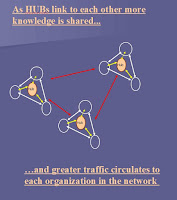
In this graphic I refer to "hubs" which are websites hosted by other people that are comprehensive resources focused on specific topics.  I don't need to host "everything" about a topic on my website if I can point to someone else who does.  Thus, today I added a link in the Prevention Resources section of my library to an organization called Start Your Recovery, which is a substance abuse resource. 

Many of the websites that I point to are "hubs" like this. 

On page 13 I show the graphic at the left.  If "hubs" link to each other more information is available through the network of libraries. 

Unfortunately, many of the people who I've added to my library, and/or who have asked to be added, do not have a section of resources where they point to my site, nor do they follow me on social media. 

That's true for the Start Your Recovery site, too. However, they do include an extensive directory, pointing to resources for substance abuse knowledge and recovery.  


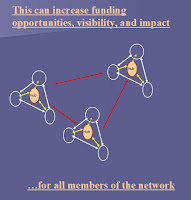
On page 16 I show the graphic at the right.   If everyone in my library, including "hubs" like Start Your Recovery, were pointing to myself and each other in our websites and our social media and newsletters, we could increase attention and funding for each of us.

On page 23 of this presentation I show that my goal is that the Tutor/Mentor Connection (T/MC) strategy be embedded in one, or many, universities, where student/faculty and alumni manpower can do the work much better than my small organization has the capacity to do.

The presentation below shows this "Invitation to Universities".


Forming a Tutor/Mentor Connection on a College Campus - click here

Take time to review these. Set up a learning group in your university network, your business or your community to read these presentations and consider how you'd adopt the ideas, and how a major donor might provide the seed money.

You can find me on Twitter, Facebook, LinkedIn, Instagram and Mastodon (see links here). I want to help people adopt these ideas and carry them forward, using the library and history I've established over the past 30 years as a building block.


As I share this information and seek leaders who will adopt and support this strategy in more places, I still rely on a small group of donors to help me pay the bills to continue operating the Tutor/Mentor Institute, LLC.

Please visit this page and consider sending a contribution. 

Thank you for reading and sharing this article. 

Tuesday, February 28, 2023

Borrow from Lessons of Tutor/Mentor Connection

Does Chicago have a Master Plan for saving its kids?  Does your city? 

That was the headline of a Chicago Tribune column about the Tutor/Mentor Connection back in 1995. 

It's what I've been sharing in these blog articles since 2005.  See this "Master Plan" article and PDF in my December 2020 article

I offer this blog and my website as a library that anyone can use to build a strategy that helps k-12 youth move through school and into adult lives, with the help of volunteer tutors and mentors who they meet in organized youth serving programs. 

In April 1997 I was one of 10 people representing Chicago at the President's Summit for America's Future, held in Philadelphia.  The Tutor/Mentor Connection was one of 50 Teaching Examples invited to have displays and present information at the Summit.

Below is a video that we shared at the Summit. It was created with much help from Public Communications Inc, who helped form the T/MC strategy in 1993 and was our pro bono PR partner through the 1990s.  


In the video we share strategies developed in 1993 and launched in January 1994.  I've described these in many articles on this blog, but here are four collections that I urge you to spend time viewing.


From 2006 to 2015 I encouraged interns who spent from a week, to a year with my organization, to dig into the blog articles and visual essays that I had created, then build a new presentation that shared their understanding.

Browse articles on this blog to see work they did.   This is a form of learning that can be duplicated in schools across the world, where young people do the first investigation, then share what they learn with their family, friends, teacher networks, etc. If done consistently it's a strategy that engages a growing community, which is essential for any long-term, city-wide strategy to be effective.  Read more about engaging students and universities - click here.

I urge you to invite youth and volunteers in your community to do the same.  Just use maps of your city instead of Chicago.

As you do your research read the T/MC Case Statement from 1997.  

T/MC is introduced with this description

"T/MC is a network that is inventorying every community in Chicago to identify afterschool tutoring/mentoring programs. It is continuously promoting the need for tutoring and mentoring and volunteer involvement so that more programs become available in each coming year. It is providing a means of sharing successful strategies among new and existing programs and will identify and focus public attention — on a continuing basis — on the areas where tutoring services are most needed." 

Then view this Tutor/Mentor Learning Network Proposal from 1999.

In the introduction it states".....


"At this time, the biggest obstacle to involving children and caring adults in tutor/mentor programs is the need for more of the programs themselves, as well as the need for a more consistent flow of resources (dollars, volunteers, training, technology, etc.) to existing programs. While most people look to the government to provide funding for schools, non profits and all other social problems, the reality is that there is not enough public money, nor taxpayer will power, to fund all schools to the level they need, let alone fund a comprehensive network of nonschool tutor/mentor programs to the level of funding they require to be effective — and available in all of the places where they are needed.

This obstacle is compounded by an even greater challenge. The issues of big city poverty are complex.

“In an era of globalization, when knowledge and scholarship are becoming increasingly universal and universally accessible, problems, too, with all their complexity, no longer recognize borders of geography, language, time, culture, or a myriad of other factors and so they demand an integrated approach. They demand the best ideas from all of us and the wisdom to work together to see that ideas turn into actions and solutions.” … Carnegie Corporation of New York: Meeting Challenges of the 21st Century.

Most leaders, donors, corporate sponsors and potential volunteers are only superficially involved in discussions of poverty, workforce development, school reform, racism and related issues which comprehensive “total quality” tutor/mentor programs can address. Too many tutor/mentor programs are isolated. Too little infrastructure exists. There is not enough time to get all of the right people in the same room often enough to come to a deep enough understanding of the problems and the solutions that already exist.

This makes it difficult, if not impossible, to build common understanding, and a convergence on solutions which need to be sustained for the 25 years it takes for just one child to move from birth in poverty to a first step on a career.

There are about 15 million children in America who need such help. While the Internet has great potential to offer virtual meetings, and collaborative action, too few dollars are available to innovate ways to bring disconnected stakeholders to on-line meeting places (see Policy Link 2001 report titled, "Bridging the Organizational Divide").

The Tutor/Mentor Connection (T/MC) was created as a response to these needs. The T/MC is an innovative, visionary effort to build tutor/mentor programs. The T/MC is not an effort to develop a single tutor/mentor program, or even a few tutor/mentor programs, that will serve a limited number of children who are referred for services. Instead, the goal of the T/MC is to support the development of an entire universe of tutor/mentor programs that will serve low-income children BEFORE problems occur."

------ end of introduction ----- 

In the final segment of the 1997 video shared above, I summarize the work being done by the Tutor/Mentor Connection and invite others to duplicate the strategy in their community and help me build it in Chicago.

I repeat that invitation today, but with 25 years of further experience beyond what we had in 1997.  

Please read the articles I point to and others on this blog.

Share them with your own network. I'm on Twitter, LinkedIn, Facebook, Mastodon, and Instagram and I invite you to bring your network and connect with me.

If you value the ideas and resources I'm sharing, please consider a small contribution to help Fund T/MI. Visit this page to learn more. 


Thursday, December 10, 2020

Want to Duplicate Tutor/Mentor Connection?

This story was in the Chicago Tribune in 1995, talking about the "Master Plan" the Tutor/Mentor Connection (which I created in 1993) had for saving kids in Chicago.


I've spent 27 years developing this strategy and trying to educate others so they would support it in Chicago and adopt it in other cities. Below is a presentation I created for the 1997 President's Summit for America's Future, which was held in Philadelphia. 


 While there are many articles on this blog, and the Tutor/Mentor Institute, LLC website, that describe what I've been trying to do, here are two concept maps to view.


The concept map at the right visualizes a 4-part strategy that I've piloted since 1993. Step 1 involves collecting and organizing information, or creating the knowledge base. Step 2 and Step 3 involve motivating a growing number of people to visit the library regularly and helping them find what they are looking for and understand how to apply the information in Step 4, different places where youth and families would benefit from organized, on-going, volunteer-based tutor, mentor and learning programs. Here's one article where I explain the four steps. 

b) layers of information on a program locator map.  

This concept map shows the 4-part strategy steps a different way, as layers of information on a map. 


View this concept map from left to right. The first step is creating a base map of the geographic region, like Chicago area, that you want to focus on.  Then add data layers showing indicators of need, like poverty levels, segregation, health disparities, school performance, etc.  Then add a layer showing organizations who are working to reduce those problems. In my case that would be non-school, volunteer-based tutor and/or mentor programs. The next layer would show assets, like banks, insurance companies, hospitals, faith groups, universities, etc. who could be helping youth programs grow in parts of the city where they have facilities.  This article explains this in more detail and points to a platform we built in 2008.

To duplicate what I've been doing for the past 27 years, you'd do the following:

a) start collecting research articles about poverty, inequality, education, etc. including those with maps that show the entire Chicago region (or your community) and where poverty is most concentrated

b) start building a list of services you feel are important to help kids and families grow out of poverty.  In my case, I focus on volunteer-based tutor, mentor and learning programs, most of which operate in the community and in the non-school hours. You could choose a different type of service to support.

Note: I focus on services that need to be located near where families live, thus many would be needed in a big city like Chicago.  A Tutor/Mentor Connection strategy would be less needed to support services where only one, or two, organizations might be needed for the entire city. 

c) start a media and public awareness campaign to draw attention to this information, and to draw volunteers and donors to existing programs. With your list of programs you can invite them to come together for collaborative efforts, like networking conferences, which I hosted every six months from May 1994 to May 2015, or Back-to-School Volunteer Recruitment Campaigns which I started organizing in 1995.  If you can enlist a public relations firm, or communications volunteers, to help you, you'll be much more successful.  This campaign needs to be on-going and sustained for many years.

Note: while I operated a single program myself the goal of the T/MC was to draw needed attention and resources to every program in the city, recognizing that good programs are needed in many places, not just one or two. 

d) motivate people to spend time learning what's in the library, and how to use it to help tutor/mentor programs grow, and help kids move through school and into adult lives and jobs, then helping others find and use the information.

Without finding ways to draw growing numbers of people to the library, and helping them understand how to apply the information, it has little value. 


The first two steps steps above are part of Step 1 of the 4-part strategy.  The third point is Step 2. The fourth is Step 3. 

As you collect this information you are building a database of stakeholders. You can share what you're collecting with this group via newsletters, blog articles and websites and you can draw viewers to those resources via your posts on various social media channels, or via YouTube videos, etc.  

I've done all of this over and over for 27 years, using different tools as the technology has changed and as my resources have gone up and down.


You need a team to help you.

When I launched the Tutor/Mentor Connection in 1993 I was also starting a new site-based tutor/mentor program. I had led a program serving 2nd to 6th grade kids since 1975, which had 440 kids and 550 volunteers participating weekly by spring 1992, so I had a wide pool of talent to draw on to help me launch the new program, and launch the Tutor/Mentor Connection.

I created the concept map at the right to visualize the range of talent needed to operate any non-profit, and to operate a Tutor/Mentor Connection.  If you already have a network and philanthropic and civic support when you launch your own version of this, you have much greater talent available to help you.  

If you're like me, a single person with a vision, but no source of consistent funding, you build from scratch and add to it from year-to-year based on what you are learning and the talent and resources you can find.  

Note: I don't think I would have succeeded in getting the Tutor/Mentor Connection started if I were not also leading a single program.  By operating a program I understood the benefits and the challenges. I also had a source of volunteers to help me do the work. The downside of this was that I was never able to give full attention to the T/MC and many donors could not see past our single program to appreciate the systems thinking of the T/MC.   

I was fortunate to have support from the Montgomery Ward Corporation who provide generous space for our program to operate and a $40,000 a year grant from 1993 to 2000 when they went out of business.  That $40k was 80% of our funding in 1993 and 30% in 1994 when we were just getting started.  Losing the donated space and funding in 2000 as the economy was declining was a huge negative impact. 

Thinking ahead to 2021 the reasons I had for starting the T/MC in 1993 are still with us. Thus, the work I've been doing still needs to be done by someone. Many do parts of what I do but almost no one does all four steps of the 4-part strategy, especially trying to help programs all over the city get needed resources. 

Since I already have a model in place, I encourage you to consider joining me. Help me upgrade it and make it work better in Chicago, then apply it in your own city.  The concept map below shows help needed at each step of the 4-part strategy. That help could come from any place in the world.


I had many people helping me build this strategy over the past 27 years. While I have far fewer helping now, I'm still supported by one person hosting the web library and others sharing my posts on social media and via their own blog articles. 

However, it's too little.  In a big city like Chicago this should have a budget of $300 to $500k annually. Between 1995 and 2011 I was able to raise $100 to $150k each year for the T/MC and a similar amount for our own tutor/mentor program. 

The inconsistencies of funding due to negative economic cycles what one of the big challenges that I've faced, and that you'd need to overcome.


The graphic at the right asks "What will it take to assure that all youth born or living in high poverty are entering careers by age 25?"

The information in the Tutor/Mentor web library, on the Tutor/Mentor Institute, LLC site, and on this and the MappingforJustice blogs are intended to help people find answers to that question.  

As people begin to find their own answers I encourage them to put them on websites and add them to libraries like mine. Over time, this means we can learn from what others are doing rather than constantly starting over.  I encourage you to use concept maps, like blueprints, to show all that needs to be part of the birth-to-work journey, then call on your network to help figure how to find the money and talent to make those things available in every high poverty zip code.

A Tutor/Mentor Connection-type organization does all that I've described and creates strategy presentations and blog articles that share what it is learning with others.  

I'm on Twitter, Linkedin, Facebook and Instagram. This page has links to those sites.  Please connect with me if you'd like to learn more and have me help you create a new Tutor/Mentor Connection in your city and/or in Chicago.  

In the meantime, if you have read this far, please consider a contribution to support my work.  There are two ways each December for you to help.

a)  support my 74th birthday campaign - click here
b)  contribute to the Fund T/MI campaign - click here


Wednesday, February 05, 2020

Making Youth Tutor/Mentor Programs Available to More Youth

Oct 15, 1992 Chicago Sun-Times
This was the front page of the October 15, 1992 Chicago Sun-Times which prompted the formation of the Tutor/Mentor Connection (T/MC). As leaders called for "action" we said "If  they don't know all of the youth tutor, mentor & learning programs operating in the city, who they serve and what they do, how can they ever know if their actions have resulted in more programs reaching youth in more areas of the city?"

I had led a youth tutor/mentor program since 1975 and had started drawing programs together to share ideas and support each other since 1976 so I had a good idea of the limited number of programs in the city. In my advertising role at Montgomery Ward I understood the need for regular communications to support multiple stores located all over the country. I felt that this type of leadership was needed.

click to enlarge
So we decided to fill the void.  We did the planning for the T/MC in 1993 and created the 10 point plan shown in this article. The plan focused on collecting information (step 1) that anyone could use to help build high quality tutor/mentor programs throughout Chicago, and that volunteers, youth and staff in these programs could use to help kids move through school and into adult lives.  Step 2 and 3 focused on getting people to look at the information and learn how to use it, to help programs grow in different places (step 4).

We decided to use maps to plot locations of programs and where they were most needed, as an easy to  understand visual tool.  By 1996 we had condensed the 10-points to this 4-part strategy which I've been following since then.

view 1997 Director
In January 1994 we launched our first survey and 120 programs responded.  With this information we hosted a first Tutor/Mentor Leadership and Networking Conference in May 1994 and published the first printed directory.  I've created an archive of these directories. You can see the 1997 Directory here. Every Directory followed this same format. If you'd like to see others, email me at tutormentor 2 at earthlink.net and I'll send you a link.

Unfortunately we were only able to send the printed directories to a few hundred stakeholders in Chicago each year from 1994 to 2002.  However, we began to put the information in the directory in a www,tutormentorconnection.org web site in 1998.

view at this link
Then in 2004 we launched a searchable on-line directory that also enabled us to more easily up-date the content on a regular basis.  That is still available although due to technical problems it has not been updated since 2013.

This offers many advantages over the printed directory. Now you could search for age group served (elementary, middle and high school), type of program (pure mentor, pure tutor, tutor/mentor) and location. Thus a parent or volunteer looking for a program in a specific zip code could use this to find if any were in our list.

Leaders could also use this to determine if there were enough programs in different places.

Browse list of map stories
In 2008 we launched an interactive map-based version of the Directory. The 2004 search platform worked like a Google search. If you knew what you were looking for you could put in the zip code or name of the program and find whatever information was in the Directory.  We reversed that by creating a map of the Chicago region, with searchable overlays. We also added an assets feature, showing banks, colleges, drug stores, hospitals, etc. Using this people could zoom into a section of the city and create a map showing the need for non-school programs, existing programs, plus assets who could help programs grow in that area.

Here's an article from 2010 that shows the directory and our use of maps.  In 2008 we also launched the MappingforJustice blog to share our maps. Since 2011 I've used this to share map platforms created by others, in addition to map stories created using the Program Locator.

Support Tutor/Mentor Institute, LLC
Due to the financial challenges of the late 2000s the mapping platform has not been updated since 2010 and the program data has not been updated since 2013.  However, this still works as a model that could be re-built and used in Chicago and every other major city in the world where poverty is a root cause of many problems and is usually concentrated in small sections of big cities.  I created the Tutor/Mentor Institute, LLC in 2011 to try to keep the T/MC alive in Chicago and help it grow in other cities.  I'm still trying.

Today I saw a commentary on Crains Chicago Business calling for more programs to help youth. I shared it on Twitter.


Without a T/MC type strategy it's not likely to ever result in enough programs in every high poverty neighborhood helping youth move through school and into work.


This is one of dozens of graphics that I've used to visualize the ideas I've been sharing since 1994. If you're creating similar graphics please connect with me on Twitter, Facebook and LinkedIN and share them.

If you're not, the please share my graphics and blog articles with your network.

Monday, December 26, 2011

Creating a Service and Learning Organization that Mentors Kids to Careers: 2012 Resolution

If you've read some of the messages I've posted to this Blog you'll see that between 1975 and June 30, 2011 I led a small non profit that seeks to connect workplace volunteers with children and youth living in neighborhoods of highly concentrated poverty.

I've been using this blog to share this message since mid 2005. I used an email and printed newsletter to share this in previous years. Following is an update of a message I First wrote in late December 2005

Our goal is to create an organized framework that encourages volunteers to serve as tutors, mentors, coaches, advocates, friends, leaders in on-going efforts that make a life-changing difference for these kids. By life-changing, I mean that the kids will not be living in poverty when they are adults because they will have the academic, social/emotional and workplace skills needed for 21st century jobs, plus a network of adults who can and will open doors to jobs and mentor them in careers.

I have spent time almost every day for more than 30 years trying to figure out better, more efficient, and lower cost ways to accomplish this goal.

I have learned to mine the knowledge and experiences of others to innovate strategies for tutoring/mentoring, rather than trying to develop my own solutions to problems. Using T/MC web sites, on-line networking and regular face-to-face training and mentoring, I am trying to share what I know, and the process of learning and service that I apply in my own daily routine, so that there are more people in more places accepting this role and responsibility.

So how do we make this vision a reality? We create a "learning organization", which is also the ideal of many of the best businesses in the world. We also create a "service culture" modeled after the work of heroes like Cesar Chavez, whose core values included sacrifice and perseverance, commitment to the most disadvantaged as well as life-long learning and innovation.

In a learning organization, everyone is engaged. In the world of Cesar Chavez, everyone is willing to make huge commitments, and sacrifices of time, talent and treasure to help disadvantaged people move to greater health, and greater hope and opportunity.

Our goal is to find ways to draw a growing number of our stakeholders into this learning process and to build an on-going commitment to service (as opposed to random acts of kindness). This process is intended to include students, volunteers, staff, donors and leaders, and members of the business, education, faith and media in the communities where our kids live.

It also aims to engage leaders and volunteers from other tutor/mentor programs in Chicago and in other cities, plus people and organizations in the communities that don't have high poverty, but benefit from a world envisioned by Dr. M. L. King, Jr. as well as a 21st Century America where there are enough skilled workers to meet the future workforce needs of American industry.

The Internet is our meeting place. It's a virtual library of constantly growing knowledge. On Tutor/Mentor Institute, LLC and Tutor/Mentor Connection web sites we collect and host information that shows why kids in poverty need extra help, where such help is needed, who is providing help, and what volunteer-based tutoring/mentoring programs can do to connect adults, kids and learning in an on-going, constantly improving process of mentoring kids to careers.

If we can find ways to increase the percent of our kids, our volunteers, and our leaders and donors who are drawing from this information on a weekly basis, and reflecting on this information in small and large groups, the way people in churches reflect on passages from the Bible each week, we can grow the amount of understanding we all have about the challenges we face and the opportunities we have. We can innovate new and better ways to succeed in our efforts.

This process has already started. We need to nurture and grow it in 2012.

Can you help?

Visit the various web sites at the left and start your own learning. I encourage you to read the Power Point Essay titled, Theory of Change which is one of several illustrated essays I've produced to illustrate our goals and the community that we seek to engage.

I'm no longer operating under the Cabrini Connections, Tutor/Mentor Connection (T/MC) non profit umbrella, due to strategic changes made in April-June 2011. I've created the Tutor/Mentor Institute, LLC in order to continue to support the growth of the T/MC in Chicago and similar organizations in other cities. I encourage you to read about this change and look for ways you might help me in the coming years.

Thank you all for reading my messages. I hope you share them with others. May God Bless you all with peace, good health and happiness in 2006.

Daniel F. Bassill
President
Tutor/Mentor Connection, formed 1993
Tutor/Mentor Institute, LLC, formed 2011
Cabrini Connections
Bookmark and Share

Saturday, July 30, 2011

Network Building - Who Is Helping?

This was the front cover of the Chicago SunTimes in October 1992 when I formed the Tutor/Mentor Connection. The editorial writer says ending this violence is "everyone's responsibility". For 18 years I've been reaching out to build a team out of "everyone" who would work collectively to make more and better non-school, volunteer-based tutoring, mentoring and learning centers available in all high poverty areas.

Due to recent changes I am creating a new organizational structure to continue this mission. It's called Tutor/Mentor Institute, LLC and is based on the ideas I've been sharing on this site and this blog for over a dozen years.

This is not a non-profit structure so the challenges I face in building a team of people to help me are different than when the Tutor/Mentor Connection has a non-profit status with the Cabrini Connections program. I intend to build a new leadership team and re-establish the T/MC as a Chicago non profit, but that will take up to a year. By creating the Tutor/Mentor Institute I can continue to support the T/MC web sites and can offer my expertise to help similar networks grow in other cities.

So "who is helping?" That's a question people have asked me for many years. I'm connected to so many people, and the way people help is often in short term bursts, that it's always been difficult to describe the range of help offered. So I've created visualizations to demonstrate this and I continue to look for volunteers who can convert these into interactive Social Network Analysis maps.

This graphic shows the range of talent needed in the Tutor/Mentor Institute and in almost any innovative social enterprise. You can see the live version here.

If you click on the nodes at the bottom of the different units on this map it will take you to groups on the T/MC Ning site where you can see people who are "members" of that group. You can also see links to Twitter, Facebook and Linked-in pages that point to groups of people, or individuals who are working more closely with me. Ultimately a visitor should be able to click on any of these boxes and find names, profiles, discussion groups filled with people who are working in various ways to help the Tutor/Mentor Institute achieve its mission. Right now few of the boxes are filled and updating this map is a time-consuming process.

While my maps are built using power point and a free c-map application, this video shows how networks can be visualized using emerging free applications. I'm trying to apply this technology to show the growth of the T/MC and the different constellations and networks of people within the network. I just need to find the talent, time and/or investment to build this.

Introducing Gephi 0.7 from gephi on Vimeo.


However, if you are already working with the T/MC or want to help me help volunteer-based tutor/mentor programs reach more inner-city youth in Chicago and other cities, you can show your involvement just by joining one of the Ning groups. As you take an active role, it will be demonstrated by the work you do in each group. For those who want to go to another level, you can even join the OHATS group on Ning and become a recorder to document your actions.

"Rome was not built in a day" is a saying that implies the long term effort to build anything that is great and stands the test of time. This map will not fill in in a few months and might take years. However, as it does fill in with partners, volunteers, investors and leaders who share the same vision what we do to change the path from birth to career for youth living in poverty will dramatically change.

Friday, July 22, 2011

Growth of the Network


This graphic illustrates the growth of my network since October 1992. At that time there just seven volunteers created Cabrini Connections, Tutor/Mentor Connection. However, as this timeline shows, I had been building a network since 1973.

What I've not been able to do is show the growth of this network, nor show what people and organizations have helped in the past, or are helping now. This article is a list of people and organizations who help in the 1990s.

Now I'm preparing to launch the Tutor/Mentor Institute, LLC, using the ideas we've been sharing on this site for over 12 years. Through the Tutor/Mentor Institute I'll continue to fund the web sites that support the Tutor/Mentor Connection and I'll continue to host conferences, one-on-one consultations, and on-line meetings and forums. My goal is to attract revenue from more than philanthropy so that the tools and services we build can have greater impact on the growth of tutor/mentor programs than we have been able to provide in the past due to lack of revenue and leadership support.

While many people have offered encouragement and some are more involved in helping me with this transition, I don't have a good way to visualize this, or to connect the people who are helping to each other.


I've been using concept maps to illustrate the range of people and organizations who need to take ownership of the ideas I've been sharing and how I've created the Tutor/Mentor Institute, LLC to support the growth of the Tutor/Mentor Connection in Chicago as well as similar groups in other cities.

This map is my first effort at showing the goals of the Tutor/Mentor Institute.

Today I'm working with a new concept map that illustrates the range of talents I need, and points to groups where I'm connected to people with that talent, as well as to some people who have stepped forward a bit to help me recently.

If you've been helping me already your name may show up in one of the nodes on this chart. If it's not there and you want to add it, just join one of the groups on the Tutor/Mentor Connection forum and take an active role, or join the Tutor/Mentor Institute Facebook group.

There is much to do and too many holes not yet filled on the talent chart. If you share the vision and want to take some ownership, please connect with me.

Tuesday, July 12, 2011

RIP Latino Education Alliance

I received this message in today's email: "Latino Education Alliance (LEA) is closing its doors after 10 years as a nonprofit serving Latino high school students and families in Chicago. The decision to close Latino Education Alliance follows a year-long effort to reduce costs, the exploration of an affiliation with other agencies and conversations with our historic funding partners."

If you've been following my blog you know that Tutor/Mentor Connection also faces an uncertain future. Funding challenges have led the Directors of the Cabrini Connections, Tutor/Mentor Connection to decide to no longer support the T/MC strategy. Friday, July 15, 2011 is my last day as President, CEO of the combined organization.

However, it's not yet the final act. I've decided to create Tutor/Mentor Institute, LLC to continue to innovate new products and services that can help cities support the growth of high quality, volunteer-based tutor/mentor programs that reach a growing number of k-12 kids living in high poverty areas.

For me to succeed I need to attract volunteers and leaders with the skills shown in this graphic and/or I need to attract investors and donors who will provide the funds for me to hire people with these skills.

This is not starting over, or even starting new. I'm continuing on the same road, just changing from one mode of transportation to another. For a while that might seem like a move from a used 2005 Ford to a used 1999 Chevy. But as long as I'm able to steer and stay on the road, I think I can find a newer vehicle to carry the T/MC forward in the future.

If you're interested in helping join in at the T/MC forum on Ning or lets connect on Skype. My handle is "dbassill".

Monday, April 25, 2011

A New Tutor/Mentor Connection


In the fall of 1992 a young boy name Dantrell Davis was shot and killed in Cabrini Green. I've posted this image of the front page on my blog often and used it as a reminder of a commitment I and the founders made during the weeks following this event, as we created Cabrini Connections and the Tutor/Mentor Connection.

Over the years we have realized that we had two "brands" and that many people did not understand the Tutor/Mentor Connection and why it was important to Cabrini Connections and every other tutor/mentor program in the Chicago region. I've created PDF essays like this to try to educate donors, and our own volunteers and leaders.

Because we have not been able to attract philanthropic investors to provide consistent support for the Tutor/Mentor Connection, the burden of raising funds has been with the volunteers and leaders of Cabrini Connections. It has been a single small tutor/mentor program trying to support the infrastructure needed to support all tutor/mentor programs in the entire region. A big challenge, and ultimately, too much of a burden.

Our funding challenges of the past decade and changes in leadership have finally caused the Board of Directors to decide to focus only on the Cabrini Connections part of the organization. I will be reforming the Tutor/Mentor Connection into a new organizational structure that I hope can do a better job of attracting investors and philanthropic support so we can have a greater impact in Chicago and share this impact in other cities. If we succeed, it will do more to provide support to Cabrini Connections and its students, volunteer and alumni, than if I stay with the organization for another few years.

We have a unique opportunity. The T/MC is recognized in many parts of the world and appreciated by many. The web resources including the Chicago Tutor/Mentor Program Locator and on-line documentation system are unique, and not available in this format or strategy in any other city. The year round event strategy and web library have been developed over a period of 18 years. It would be impossible, or financially improbable, for any city or any group in Chicago, to rebuild this from scratch. Thus, a new structure may enable us to find the capital needed to fully develop these resources and to make them available in more places than Chicago.

That structure is not yet clear. Instead of starting a new organization, we could move under the umbrella of another organization, or a university, or even a city like Chicago. However, if you know me you know that I have a wealth of ideas that only need volunteers and/or investors to bring them to life. By mid July I need to find donated space from which to operate, and a team of volunteers, advisers and supporters in place.

Thus I'm inviting any current and/or former Cabrini Connections volunteers and student alumni, as well as those I have connected with via the T/MC network who value the Tutor/Mentor Connection and have an interest in helping it move into the future to email me at tutormentor2@earthlink.net to offer your ideas.

To learn more about the goals and activities of the Tutor/Mentor Connection, review the essays in this Tutor/Mentor Institute web site.

Follow this blog over the next few months to see this exciting new structure develop.