Showing posts with label social capital. Show all posts

Monday, September 02, 2024

Labor Day - Now and In the Past

As I looked at articles I wrote on past Labor Day Holidays, I was trying to decide which I'd repost today. I decided I'd focus on this idea from 2011.


Do you think of Mentoring as a A Jobs Creation Strategy?

What if we could put thousand of unemployed people in long-term jobs while also helping more youth living in high poverty areas prepare for future jobs and careers?

In numerous articles being written on the 2011 Labor Day weekend the unemployment rate was stated as being between 9% and 16% reflecting people out of work, no longer looking, or under employed. In 2024 it is at 4.1% (see chart)

Many talk of rebuilding the nation’s infrastructure as a jobs creation strategy for putting people back to work. However, that does not address the large number of people who are in the birth to work pipeline who are not being adequately prepared for 21st century jobs and careers.

What if we had a jobs program that could create jobs for currently unemployed people and do more to help youth from inner city neighborhoods move successfully from high school to college and to jobs?

I’ve been aggregating information about poverty, poorly performing schools, social justice and workforce development for many years. This section of the Tutor/Mentor Connection web library contains many articles on this topic. (research library).

One article I found in 2011 is titled Overcoming Intergenerational Poverty (pdf). The writer (Donna Beegle, who you can find on LinkedIn) recounts her own struggle to get through college and does research to show the barriers others from areas with high concentrations of poverty face.

In one of the conclusions she says “"Mentoring and Social Capital
A strong link between mentor support and academic success emerged in my study of students from generational poverty. I found that if students had mentors early in life and in college, they were more likely to obtain a bachelor’s degree. Mentors facilitated their understanding of social capital possibilities, expanded their networks of support, and let them know about important resources. In addition, mentors helped generate trust, and once participants felt safe and trusted, they were able to share their poverty related experiences with others. As a result, they received more assistance.

Additionally, through their mentors, respondents learned new communication styles and behaviors that enabled them to communicate more effectively in the college environment. Mentors, and in most cases, the mentors’ connections, were pivotal when linking participants to information and contacts. This facilitated their success in achieving literacy and completing higher education. For example, mentors helped respondents understand the intricacies of filling out financial aid forms and taught them how to improve their study habits. In some cases, these resources reduced the stress of poverty and allowed the respondents to focus on their studies for the first time."”


Others are focusing on mentoring as a form of expanding social capital and my own view of a volunteer based tutor/mentor program shows youth surrounded by volunteers who come from diverse workplace backgrounds.  I've been visualizing this idea using the graphic below since the mid 1990s.


In a small tutor/mentor program with 50-70 pairs of youth and volunteers there could be five to 10 jobs. This infrastructure graphic shows what needs to be in place. 


The talent chart on page 5 of this Tutor/Mentor Institute PDF does the same. Most tutor/mentor programs don’t have this range of talent and they struggle. Our 1994 to 2010 surveys of tutor/mentor programs in Chicago shows many neighborhoods with few or no organized programs.

Since there are over 200,000 youth living in high poverty in the Chicago region, how many tutor/mentor programs might be needed to reach 50% of these? 500 programs with 75 youth each would cover the city and suburbs and still only reach about 38,000 kids.

How many jobs might be created if an effort were made to build a comprehensive network of tutor/mentor programs operating in all poverty areas of the city and suburbs. How many people might this put to work? How many internships might be created for youth in these programs? How might this contribute to the current economy in high poverty neighborhoods while also building the future workforce and lowering the costs of poverty at the same time?

Look at this article from 2022, with maps showing areas of concentrated poverty in the USA. 

Every one of these areas could use the strategy I piloted since 1993 through the Tutor/Mentor Connection, and have led through the Tutor/Mentor Institute, LLC since 2011. 

Maybe if we looked at this as a jobs and infrastructure program the government or some high profile foundations would take another look at this? What do you think?

I did not create the tutor/mentor programs I led, or the Tutor/Mentor Connection, by myself. I had lots of help from dedicated, talented people.  Since 2011 I've not had as much help, and thus resources that we built in the 2000s are now only available as archives.

For the past 10 years I’ve been trying to build a team of people that will help me think through these topics and will help generate the resources and public will needed to make more and better non-school tutor/mentor programs available.

I recently had a conversation with a supporter who said "I've suggestions for how you could do this better."   I responded, are you willing to do the work to put your suggestions into action?  


That's my invitation.  Create your own blog and/or video library.  Re-write my blogs. Create new versions of my videos.  Rebuild my websites.  Create new versions of the Tutor/Mentor Connection in communities across the country.

Connect them to each other,  using libraries like I've created, so that instead of competing, you're trying to help each other do more and more each year to help the kids in your community.

Connect with me on social media and ask me to ZOOM with you.  Join my forum on NING and ask me to help you.  

And, if you're able, visit this page and make a contribution to help me fund this work for the next few years so I'm here and able to help you and others. 

Thanks for reading.  Enjoy this Labor Day. 

Wednesday, April 24, 2024

Building Social Capital

I've been sharing pages from printed newsletters that I created in the 1990s in the past few blog articles, along with portions of e-Mail newsletters sent from 2000 to 2010.  These show a consistency in the advocacy I've been doing for 30 years, and the need for new leaders to carry this forward for the next 30 years.

Below are two pages from a 1999 newsletter. You can open the PDF at this link. 


In this page is a subhead that reads "Building 'social capital' for America's future." in this I wrote about hearing Dr. Robert D. Putnam speak in December 1998 at a  UIC Great Cities annual Winter Forum. I wrote that "Dr. Putnam's research shows that "Americans have dramatically deserted the voting booth, the family dining table, the church pew, the union hall, the PTA, and even the bowling league and coffee klatch" over the past 25 years. He suggested that new forms of social interaction must be generated in the coming years.  

I countered that "while most forms of social capital have declined, the number of students and volunteers participating in the 5pm-7pm tutor/mentor program sessions held at the Montgomery Ward headquarters in Chicago has increased. While other forms of networking have declined, this program's ability to connect adult volunteers from widely diverse social, ethnic, faith and geographic backgrounds has increased. Programs like this, which connect adults and children in weekly one-on-one and group settings --- where everyone has a shared vision of making life better for the children we serve --- is one of the best investments in social capital, diversity education and workforce preparation any company could invest in today."

I have continued to advocate for organized, volunteer-based, tutor, mentor and learning programs as a form of social capital since 1999.  In 2016 I wrote this article, pointing to Putnam's "Our Kids: The American Dream in Crisis" book.  It's one of more than 30 articles on this blog that focus on social capital. 

I think many organized tutor/mentor programs connect kids and volunteers the same way we did in the programs I led, but when I visit websites or look at social media posts, I don't find many describing what they do as a form of social capital building.  I hope my articles inspire more to adopt this thinking.

Maybe donors will begin to look for this and reward it with funding. 

The next page of that 1999 newsletter is shown below.


Once again you can see examples of how I've been using maps. 

Under the heading of "MENTORING WORKS, BUT....", I wrote "Communities need a strategy to help mentoring programs recruit, train and retain volunteers, to make sure programs are where they are most needed, and to make sure they receive ongoing funding, so they can stay connected with a child for as long as that child needs their help...even into a career."

They still do. 

Open the PDF and read the full article, and the rest of the news that we were sharing in 1999.

I've continued to repeat this call to action over the past 25 years.  Below is a graphic I created for this 2016 article. 


It's the same message, with a different visual presentation.  

That's the point of this and other articles that I've been writing. I've been preaching this message of building and sustaining organized, mentor-rich programs that reach K-12 kids in high poverty areas for 30 years. 

Yes, there are actually thousands of people calling for support for mentoring and tutoring programs. I point to hundreds of youth-serving programs at this link. Many have sophisticated, far-reaching advertising and PR strategies that call attention to their own programs.

However, I don't find any using maps to focus attention and resources on areas of high poverty within specific geographic regions, or calling on volunteers and donors to support programs in every high poverty area, the way we did from 1993 to 2011.  Nor do I find many using visualizations that show long-term support needed in every high poverty area.   Or who has piloted a year-round event strategy to help programs grow. Or who have led that strategy for 30 consecutive years.

So, I think I'm unique. In fact, one of my volunteers once accused me of being so far in front of other people with my ideas that no one was able to follow me.  That's why I've used my website, blog and visual essays to share ideas.

But I'm just one person. With the help of six other volunteers we created the vision of Cabrini Connections and the Tutor/Mentor Connection in November 1992.  We had no source of financial support. We launched the site-based Cabrini Connections in January 1993 with seven volunteers and five teens. We did the planning for the Tutor/Mentor Connection in 1993 and launched it in January 1994.

In the summer of 1993 Montgomery Ward made a multi-year commitment of $40,000 a year to fund our work and donated an entire floor of its corporate tower in Chicago for our operations.  In total that year we raised only $50,000 in cash, but the value of donated space and corporate services was much greater.

Each year from 1994 to 2000 we raised more money to fund our efforts and raised over $400,000 in 1999.  Then Wards went out of business and we lost their financial support and donated space and services. To stay connected to the kids we were were working with we had to rent space in the Cabrini Green neighborhood.  

This increase in expense and loss of income came as we endured the dot.com financial meltdown in 2000, and then entered 2001, and the 9/11 tragedy that led to a drastic reduction in funds available to us.  We cut expenses, such as ending our print newsletters and printed directory and moving almost entirely to a web-based communications strategy.  

By 2007 we had rebuilt our donor base and were receiving contributions as large as $50,000. Then the financial markets collapsed, and in 2009 and 2010 we struggled.  That led to my leaving Cabrini Connections in mid 2011 and forming the Tutor/Mentor Institute, LLC to continue the Tutor/Mentor Connection in Chicago and help similar intermediaries grow in other cities.

I say all this to emphasize that we never had much money for advertising and public relations. Our newsletters never were sent to more than 12,000 people, and then only three or four times a year.  

Too little to change the world.

A couple of weeks ago I published this article showing how I've reached out to universities for the past 30 years for the talent and manpower needed to expand the reach, frequency and impact of the Tutor/Mentor Connection and the ways we were helping our own teens through school and into college and careers.

Skim through this presentation and you'll see numerous examples of how student interns have helped.  

But is has not been enough.

As you look at my printed newsletters from the 1990s you see a problem that persists around the country in 2024, and will continue, unless more people adopt an information-based strategy like I've piloted and devote their own time, talent and resources to leading it for the next 30 years.


This 1998 story in Crain's Chicago Business described the work I had been doing since 1993.  It's one of dozens of stories I share on this page.

This could be YOU!  This could be a page on your university's website, showing work your students, faculty and alumni were doing.

It just takes two or three people, with a big commitment (and a major donor) to launch such a program. 

Thank you for reading this article. Please share it with others in your network,  particularly people who might bring my archives and lessons into a university in your city or state.  

Let's connect on social media.  Visit this page to find links to where you can connect with me.

If you're able, please visit this page and make a contribution to help me continue this work for another few years. 


Friday, March 24, 2023

Talking about social capital

I was invited to participate in a chat on Twitter this week, hosted by the Christensen Institute, using the hashtags #SoCapChat_CI  and #EconomicMobility.  Their goal was "to help connect the people/organizations who are discussing social capital and economic mobility".  Click on the links and scroll through the Tweets that were posted and you'll gain an understanding of what was discussed. 

As I participated, I shared ideas from my own collection of social capital articles on this blog. Below is one example. During the chat I posted a Tweet to my friends at @NodeXL and asked if they would create a graph showing participation.  Below was the result. You can view the graph as this link. 


This graph shows that 116 Twitter users participated in the chat. If you zoom in you can see who these people are and who they connected with. 

I think expanding networks of adults supporting youth in high poverty areas is important and that organized, volunteer-based tutor/mentor programs are one strategy for doing this. I created the graphic below in the 1990s to visualize the type of support network that such programs might provide.


Unfortunately too few people who lead youth programs include the idea of expanding social capital in the information they share on their websites.  Too few youth program representatives were in this week's chat, and too few donors, policy-makers and/or business representatives were participating.  

Hopefully a chat like this will be repeated every few months and more people from the ecosystem will show up on NodeXL maps.  I'll try to help make that happen.

Below is one of my concept maps, showing intermediaries who support youth serving programs in Chicago. 


Each node on the top half of this concept map includes links to the organizations shown.  I follow all of them on social media and participate in virtual events that they host.  I try to generate deeper conversations, such as one I had yesterday with a team from Northwestern and the Chicago STEM Co-op.  

Ideally there would be on-going chats hosted by these groups on Twitter and NodeXL type maps would show participation of multiple organizations from my concept map in each of these chats.  In addition, while many are now hosting face-to-face meetings, I urge them to add virtual components.  One reason is that COVID is not over for many of us. A second, is that I feel each participant in a virtual meeting has a closer connection to the speakers and to other participants.  In a room of 100 or more that is not happening. 

Chicago will have a new Mayor after the April election.  I've been sharing posts on Twitter, inviting the two candidates to look at strategies I've been sharing and incorporate those ideas in their own plans. 

I have been sharing these ideas since the mid 90s.  Maybe in the coming months and years we will see evidence that staff from the new mayor are looking at this blog and borrowing the ideas.

One piece of evidence would be chats about "how to help kids in Chicago" on Twitter, with NodeXL maps showing participation from a broad section of city leaders and citizens.

I'm available to help mentor that process.  Connect with me on Twitter, Facebook, Instagram, LinkedIn or Mastodon (or all of them). See links here. 

If you want to help me continue this work, visit this page and use PayPal to send a small contribution.

Thank you for reading. 

7-19-2023 update - read this new research report about mentoring, social capital and philanthropy. Download report at this site. 

Monday, January 16, 2023

Help Build Networks of Support for Youth in High Poverty Areas

Today and over the past weekend I've seen hundreds of posts about Dr. ML King Jr, like the one below. As you do service today, look for ways you can do service every day.  With that in mind I want to focus on efforts that expand the networks supporting kids in high poverty areas, which is a form of "bridging social capital".  

I've been using the graphic shown below for more than 20 years to visualize the range of adult support and learning that can be made available to youth via organized, volunteer-based tutor, mentor and learning programs.


The circle in the middle includes a pre school through work/career timeline. It shows public school support above the timeline and community support, through family, neighbors, faith groups and non-school programs below.  The spokes lead to the different sectors of the community, and the different career opportunities that might be modeled by volunteers who connect with youth via organized programs.  

I've been using maps since 1993 to focus attention on high poverty areas of Chicago, where organized tutor/mentor programs are most needed.  And, I've collected information about existing programs and plotted their locations, as overlays to the maps.  Then I've tried to draw attention to research showing where and why kids need extra help, so that more people would use their own time, talent and dollars to help tutor/mentor programs be available to more kids, and constantly improving, based on what they learn from their own efforts, and what they learn from others.


I share these ideas in the http://www.tutormentorexchange.net website and on my blogs.  As part of your service today, and throughout the year, spend time doing extra learning, and look for ways to apply the ideas in your own community. 
At the left are tags sorting articles by primary focus (although almost all focus on the overall goal of helping kids through school and into adult lives.")  Once a week click on a tab, then scroll through the articles to see what's included. As you do this share articles with your network and create a "study group" or "book club" so more people are reading these articles with you.

Over the course of a year, or several  years, you'll build a much broader and deeper understanding of actions that need to be taken in order to create the world Dr. King envisioned.  

The map below is from this article, which is one of many where I've focused on social capital.  It's an example of how maps can show where kids and families need extra help.  


Here's another article that invites you to "Dig Deeper into Social Capital Thinking."

The graphic below is from one article about "Total Quality Mentoring" which is a term I coined in the 1990s to convey the idea of on-going improvement based on learning from your own efforts, those of others, and by having consistent financial support for program operations. 


As you look at the first graphic I used in this article, then this one, think of the YOU being someone on each spoke, who shares information that gets more people from her industry, college, faith group, family, etc. involved in helping youth, by helping non-school and school-based programs grow in more places.

I'll close with two more posts from Twitter. 
This post encourages on-going service, which I what I also encourage.  "Today, tomorrow and every day, let's lift up his legacy"

Here's the second Tweet. From Vue Le. 
Follow the links and do deeper reading about what Dr. King said in the 1960s. 

Use the ideas I and others share to build an intentional strategy that expands social capital, opportunities, networks of support and the range of people who "open doors" for youth who have had too few people taking these roles for too many years.

Visit this page to view a list of Chicago youth tutor and/or mentor programs that you can support with time, talent and/or dollars. 

Thank you for reading.  I'll look forward to connecting with you on one of these social media platforms.


If you find value in these ideas please consider a small contribution to help Fund T/MI -  click here to learn more

Wednesday, August 03, 2022

Mapping Social Capital

Today I watched a panel of social capital researchers, featuring Robert D. Putnam, Richard Reeves, Raj Chetty and others who were sharing their thoughts on new research exploring the relationship between social capital & economic mobility.   Here's a Tweet with a clip from the discussion.


I'll post the link to the full video as soon as it's available. If you visit #SocialCapital on Twitter, and look at Tweets posted today, you'll understand more about what was discussed than what I am sharing in this article. 

During the presentation this Social Capital Atlas was described.  I've posted a few screenshots below.

This dashboard shows information about economic connectedness, cohesiveness and civic engagement for every county, every zip code, every high school and every college in the nation.  Just choose the category you want to view from the menu bar at the top left.


It's an interactive platform, so you can zoom into areas as small as a zip code and get data related to that specific zip code.


When you choose high schools, or colleges, you get a  map view like below, which shows high school in Chicago.  The different colors represent high or low levels of connectedness, cohesiveness or civic engagement. Click on an icon to get information for a specific school.  


This information is not new to me.  I've followed Robert D. Putnam since the early 2000s and wrote this article in 2015 and this article on this blog in 2018.  And, in 2019 I pointed to Raj Chetty in this article.
 
In 2018 I posted this article on the MappingforJustice blog, pointing to an Opportunity Atlas website, which is also a product of Opportunity Insights. However, the Social Capital Atlas is brand new. 

My goal is that people use these websites to create stories for blogs, Tweets, Instagram, videos, etc. that draw more attention to the inequalities in America, and more motivation to provide the time, talent and dollars to close these gaps, in EVERY zip code. 

Here's an article where I demonstrate using multiple platforms in one story. 

Here's an article where I combine maps from two platforms. One is based on my own database of Chicago youth tutor and/or mentor programs. 

Last week I posted this article showing my 30 years of using maps to try to draw attention and resources to high poverty areas of Chicago, to help youth tutor/mentor programs grow and have a greater impact on the lives of young people. 

Here's an article from last April, titled "Maps, Time, Social Capital" which uses the graphic shown below.


Click the social capital tag at the left and scroll through the articles. Visit this section of the Tutor/Mentor library to find more articles about social capital. Use this concept map to locate other data platforms that you can use in  your stories. 

Share these articles and help mobilizer more people who will work to close the opportunity and racial gaps that divide Americans from each other. Learn to use maps in stories, the way I've demonstrated, as part of a call-to-action that draws resources directly to the zip codes and community areas where help is most needed.

Thanks for reading. Please use these resources and connect with me on one of these platforms. 

Finally, please consider a small contribution to help fund the Tutor/Mentor Institute, LLC and my ability to keep aggregating information and sharing these ideas. 

8-17-2022 update - here's a blog article from Brookings.edu that summarizes the information in the webinar. It's titled: "Seven Key Takeaways from Chetty's New Research on Friendship and Economic Mobility".  click here to read. 


Monday, June 27, 2022

On-Line Opens 4th Timeframe to Connect with Youth

I saw this Tweet today, posted by Julia Freeland Fisher of the Christensen Institute.  It focuses on the opportunities to expand social networks offered by emerging education technologies. I encourage you to click through and read the article.

Maximizing on-line connections has been a passion of mine since going on-line in the late 1990s.  Here's a page where I posted e-learning goals for the ecosystem of people trying to help kids in poverty move through school and into adult lives. 

However, most of my focus has been to maximize face-to-face connections between youth in poverty and volunteers who they meet via organized, non-school, tutor, mentor and learning programs.

Below are three graphics that I've used for more than 20 years to show ways to increase face-to-face student support. 

The first shows three time frames in which kids need learning opportunities. The third time frame, after 5PM, evenings and weekends is when business volunteers are more available and more likely to make weekly commitments that last for many years. This does not mean that business volunteers and donations are not needed at schools and Boys & Girls Clubs during the school day, and right after school during the 3pm to 5:30 pm time frame.


This second graphic shows the same three timeframes, but on a chart that reinforces the need for learning supports and mentoring, starting in preschool and elementary school and staying connected to kids all the way through high school and college and into careers. In this graphic, parents, teachers, social workers, mentors, are all PUSHING kids to make good decisions that we know will help make their lives better. What we need is the partnership of businesses and universities who will use their resources (people, jobs, learning, dollars, technology, facilities) to PULL kids through school and into careers. When there are thinking teams in each industry, and in colleges, brainstorming ways to influence the decisions kids make, and the way the resources of the business and university are used to connect kids with non-school learning programs, there will be more leadership, and more good ideas, being circulated in more places.

The third is a map of Chicago. 

Generals use maps to position troops and supplies in their efforts to win wars. If leaders in business, philanthropy, government, entertainment, etc. learn to use maps like these, to focus resources and strategies in all of the high poverty neighborhoods of Chicago and other cities, so that a wide variety of constantly improving, mentor rich, volunteer-based programs grow AT THE SAME TIME, in all of these places, then they can mobilize resources from businesses, hospitals, universities, faith groups, etc. and point them to places where they are needed.

Finally, we don't need to reinvent the wheel. We don't need to build a new government in Iraq or Afghanistan, or any place else in the world. We need to help existing programs already operating in Chicago and other cities get the resources, ideas, volunteers, leaders, dollars they each need on a continuous basis to operate in one or more of these places, building and sustaining connections with kids and volunteers, and each other, that build quality and impact at the same time as the PUSH kids through school and PULL them toward careers.


Every city needs a Program Locator database (this was created in 2004 and rebuilt in 2008, but has been an archive since 2018) to help volunteers and donors locate existing tutor/mentor programs and to help Generals understand the existing deployment of troops, and where reinforcements are needed. See my current map and list of programs in this article.

If our leaders borrow some of these ideas instead of creating brand new ideas of their own, maybe they can make some progress over the next 8 to 12 years of winning this war.


Emerging technologies offer many new opportunities to connect learners with information and ideas and with places where these ideas need funding in order to be effectively implemented.

On-line spaces like Twitter, Facebook, LinkedIn, Instagram and other are places where anyone can be the YOU in this graphic, urging people they know to visit on-line libraries and then connect and talk about ways to use these ideas to create a brighter future.

Along the left side of this blog are tags to maps, strategies, articles, and links that we hope the staff of these new generals will read and use as ammunition for the upcoming battles.

I now lead the Tutor/Mentor Connection (created in 1993) via the Tutor/Mentor Institute, LLC (created in 2011).  I'd be happy to serve as mentors to these leaders or to anyone else who wants to become more strategic in mobilizing and sustaining resources to help kids through school and into careers.

Friday, May 20, 2022

Combatting extremism in USA - social capital thinking

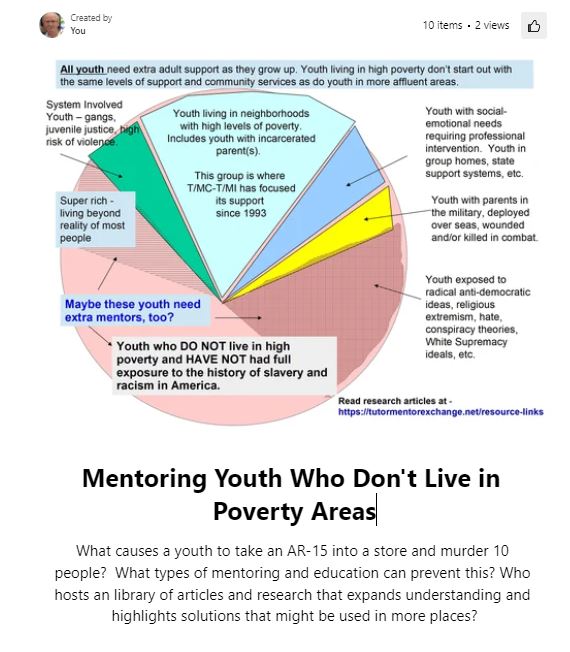
On Monday I included this graphic in an article titled "Kids not living in poverty need mentors, too."

This was in response to the most recent mass murder of 10 people in Buffalo, NY by a teen who had adopted White Supremist beliefs, was able to purchase an automatic rifle, then acted upon his beliefs. 

What caused this? What might prevent it? 

I'm going to point to a lot of information in this article, so I hope you'll bookmark it, then refer to it often.

At the right is a graphic that I've used for more than 25 years to show the role of mentors and extra adults in "pushing" kids through school and into jobs and careers and the role of businesses,  universities, hospitals, philanthropy and government in "pulling" kids through school, using mentoring as one important strategy.   Providing part-time jobs and internships is another. View the graphic in this article. 


Over the past 30 years I've used maps to focus attention and resources on high poverty areas of Chicago, where tutor/mentor programs are a place where kids can connect with volunteers from many different backgrounds and help kids on their journey through school, while also opening doors to jobs and college opportunities for many.  

I've come to understand this as a form of "bridging" social capital, and have been influenced by writers such as Robert D. Putnam.  In this article I point to several articles where I've written about Putnam's "Our Kids" book and "bridging" social capital.  

In all of these efforts, I've focused on expanding "who you know" for kids who's family and personal network has too few people modeling the many types of careers they might aspire to if they had a college degree, or advanced vocational training after high school.  

Here are three more articles that show this strategy:

Mentor Role in Larger Strategy - click here

Transforming Adults Involved in Volunteer-Based Tutor/Mentor Programs - click here

Understanding and Creating Bridging Social Capital - click here

Much of my motivation has come from seeing stories like this 1992 Chicago Sun-Times article in Chicago media, over-and-over, since the late 1970s.  Too many inner city kids are losing their lives.  Street killings are just the  most visible sign of this. Poverty leads to more stress, more severe illnesses, poor performance in school, involvement with juvenile justice, and other things, all which reduce future opportunities. 

Yet, most of the mass shootings have not been black and brown kids killing people of other races. Those have mostly been done by White kids.  (see data)

So far I've written about strategies that reach and benefit kids living in high poverty areas, who might be less prone to acts of violence against each other if they had more hope and opportunity.  Providing these opportunities continues to be my focus.

However, we have a problem in America.   In the graphic at the top of this article I ask "What about kids who don't live in high poverty?"

In the third extra reading articles above is a link to a paper titled "Social Capital: The Bonds that Connect", written by Michael Woolcock.   He provides clear definitions of "bridging" and "bonding" social capital.  So far, I've focused on "bridging".

Now let's focus on "bonding".

Woolcock writes "Bonding social capital refers to connections to people like you. For example, classmates, work colleagues, and neighbors.

The lives of the poor are largely characterized by a rich set of bonding relationships, but little by way of bridging and, especially, linking ties."

If you are poor you might not be able to place names of people you know in some of the categories on this chart, but you do have many close ties among family, high school, faith group and neighborhood.


What if these close ties are people who model anti-social, racist, anti-democratic, and/or religion-based extremist views?  In this article I quote Bob Pearlman, who wrote an article about social capital in the early 2000s.

He wrote "But the most significant finding in the study was that a student's social network can have a significant impact on his/her career choice. Students whose parents are both in high-tech careers are more likely to be interested in technology careers themselves. In addition, 83 percent of students rely on personal connections for career-related information and guidance." 

Youth emulate the beliefs of their parents.  Strong bonding ties, without bridging ties that expose kids to a wider range of thinking, can be a negative.

I'm now getting into areas where I don't have enough expertise.  In the article I wrote Monday, I asked "What should I do?"  I answered, "Collect information about this topic". 


I don't have a section in the Tutor/Mentor library that focuses on extremism so started aggregating a few links using Wakelet. Click here to see what I've collected so far.

I've been building a web library for 20+ years. It's organized by category. Here are a few examples:

Poverty & Crime Mapping - click here

Race, Poverty & Inequality - click here

Saving our Democracy - Political Resources - click here 

I'd like to find a web library with a similar set of links, focused on extremism and solutions. 

Now let's look at a some maps:

This is a Washington Post map showing segregation in Chicago and throughout the USA. Click here to view. 


This is a map showing faith groups in the Chicago region.  Open this link, then zoom into the Chicago region. 


Below is a map created using the same platform, but I've clicked on an area, then hit the "profile" button. I then get maps showing different demographics, income levels, etc.  The faith groups in the area are still shown. If I zoom in, I can identify individual groups.


Using the two data platforms, and others with similar information, we can see where more affluent people live and where poorer people live. We can also see the faith groups within these areas.  You can do this for any city in the USA.

Further research (by someone else) would need to determine which of these groups might be more fundamentalist in their teaching and beliefs, or might be among the groups that strongly support the former President.  What can be assumed is that children growing up in these faith groups are being "groomed" to the same beliefs as their parents and the rest of the congregation.

That could be a problem.

There are plenty of stories showing far right religious beliefs affecting state legislation and restricting voting rights.

Across the country certain groups are now beginning to ban teaching of certain topics in school and are banning certain books from school libraries. Over the weekend I saw that someone is suing a Barnes & Noble bookstore for carrying a specific book.   Will burning books in the streets be next? 


Now, please go back and read more of the articles, like this one, that I wrote following the release of the "Our Kids" book by Robert D. Putnam. 

Poverty reinforces poverty and affluence reinforces affluence.  Kids in affluent areas are not building much empathy for kids in poverty areas because they don't have close ties, or "bridging ties" to kids who are economically different from them, or who have different religious beliefs.  That influences how they see the world and what they will do as adults to solve problems in the world.

Kids who are part of faith groups that support radical right-wing conspiracy theories and White Supremist world views are being "groomed" to carry those beliefs into their adult lives, and to force their beliefs to others.  

Without some strategies to expose these kids to a wider range of ideas and beliefs, starting as early as pre-school (because that's when religious indoctrination is beginning), the tragedies like Buffalo are likely to grow even more frequent.

The challenges to our democracy are likely to become more dire. 

Are these things you're thinking about?  Have you found good, extensive, online resources that I can point to, or people with solutions that I can point to?

I'm on Twitter, Facebook, Instagram and LinkedIn. I'll look forward to connecting with you. 


Monday, April 04, 2022

Maps, Time, Social Capital

Below is a graphic that I've been working on this past week. If you work your way through it I hope you'll have a better idea, and commitment, to the work that needs to be done in many places.


At the top of the graphic I show an arrow, that represents support all kids need, for the first 20-25 years of their lives, to help them through school and then, into and through their adult lives. Some kids, like Bill Gates, or Jeff Bezos, or Elon Musk, had much greater support propelling them to career success. Those are extreme examples, but most kids have a larger natural network of support than kids in high poverty areas. 

That arrow comes from this "mentoring kids to careers" graphic, which I created in the late 1990s.  It shows first grade through 12th grade, then college or vocational training, as a series of steps. At each step kids need a variety of different supports and/or are influenced by people who work in occupations that youth might aspire to in their own futures.  If you open this concept map, you'll see a different version of this timeline.

As I said above, all kids need some of these supports and influences.  However, if you read many of the articles in this section of my library, you'll see plenty of evidence showing that kids living in high poverty areas don't have as many naturally occurring supports or career models as do kids in more affluent areas. That means someone, or many people, need to help make these supports available and keep them in place for 12 or more years.

This leads to the next element on the graphic, which are the maps.  


I've been using maps since 1993 to visually show areas of Chicago with high concentrations of poverty and many indicators showing kids and families need more help.  Without a map you could have a long list of places you're helping, but still be missing a larger number of other places that need the same help.

You can find the maps shown above in this article. You can find hundreds of articles on this blog, and the MappingforJustice blog, showing similar maps and encouraging leaders to use them to guide resources into all of these areas for many years. 

The map graphic I've used is a mashup of maps from three sources.  In this concept map you can find many data platforms that could be used to create similar map stories. 

We see media using maps every day to show troop movement in Ukraine. Why can't we see similar maps showing the growth of youth and family support programs in every high poverty area of the  USA?

My focus has been on helping long-term, volunteer-based tutor and/or mentor programs grow in all high poverty areas as a way of expanding the networks of support available to kids, helping them through school and beyond. 

Thus, the arrow, or timeline, indicates multiple years of support. The map illustrates that many places need the same type of support for many years.

The graphic below visualizes the need for every industry to have strategies that distribute volunteers, technology, dollars and more into every neighborhood...and for school and non-school programs to be places where kids connect with a wider range of learning and career opportunities than might be normally available in their own family and neighborhood. 


While I led a tutor/mentor program from 1975 through 2011, which collected inner city kids to a wide range of workplace adults, I did not start to understand this as a form of bridging social capital until the early 2000s.  

Here's a link to one of the earliest articles that have influenced my thinking about social capital. One introductory paragraph says:

“Social networks that can bridge across geography, race and class are key to success in the new economy”, says Professor Manuel Pastor, Jr., University of California, Santa Cruz, who has studied social networks in Los Angeles among Latinos. ‘Hard’ skills are essential, but it’s the connections and mentoring that provide information about what skills are necessary and a vision of how acquiring them can lead to new opportunities for all our residents”.

This was written by Bob Pearlman.  The research he points to can be found at this link.  His current website is at this link. 

Since then I've aggregated links to many articles about social capital, which you can find here, and have posted 30+ articles on this blog that focus on social capital.

Here's a TED talk about expanding students' social capital - click here

In this article I point to an earlier influence. It was a book that I read in the mid 1990s, titled American Apartheid: Segregation and the Making of the Underclass, by Douglas Massey. This book emphasized how disconnected people living in highly segregated, high poverty, neighborhoods were from the resources that might make lives in those communities better for residents.

I created this presentation more than 20 years ago to show why organized tutor/mentor programs are needed in high poverty areas and actions the Tutor/Mentor Connection had piloted since 1993 to help such programs get the attention and resources each needs to constantly improve.   The graphic I've included here visualizes some of the different types of learning, mentoring and tutoring that might take places in a site-based program.

These strategies have been based on the premise that areas of concentrated, high poverty, have too few people working in the wide range of careers that are modeled daily by parents, family and neighbors in more affluent places.  Thus, such programs need to be built in order to expand the social capital for kids in poverty areas.

However....  that does not mean there are "no people" living in high poverty areas who have jobs and careers.   That's the final element included in the graphic above.  Kids and adults need to learn "who you already know" who might be someone who can mentor them and help open doors to opportunity.


This was emphasized in a social capital research webinar that I attended last Friday. The speaker was Edward DeJesus, who leads a group called "Social Capital Builders".  He is teaching "social capital literacy" to businesses, organizations and young people.  

I encourage you to read this blog article by Edward, titled "The Case for Social Capital Literacy".  

You can also view the webinar, at this link. 

The need for social capital literacy is not really a new concept. Bob Pearlman's early 2000s article said, "Networking, or acquiring a social network, is a key skill of the 21st Century. It’s how you learn, and how you connect."  

What I'm trying to emphasize is that these skills are not being taught in enough places and that programs like Social Capital Builders are trying to do that.  If you're working with kids you should reach out to Edward and see if his lesson plans might be used in your own efforts. 

Here's another version of the "hub and spoke" graphics shown above. 

I share it in a presentation titled "virtual corporate office" and in these blog articles.  


This shows how different industries could "distribute" learning and mentoring opportunities to kids in all high poverty areas, via school and non-school programs.  Social capital literacy could be a separate box, or could be a part of the mentoring coming from each industry.

The map reinforces the need for these forms of learning and mentoring in EVERY high poverty neighborhood. The timeline emphasizes the need for such learning to be consistently available for many years.  The other graphics emphasize that businesses in every sector could be supporting organized, volunteer-based tutor/mentor programs in multiple locations, not just one or two favored programs. 

Let's look at the timeline arrow once more.  If you click and enlarge it you'll see different types of learning activities that are appropriate for different age levels.

Here's another quote from Bob Pearlman's article:

"But the most significant finding in the study was that a student's social network can have a significant impact on his/her career choice. Students whose parents are both in high-tech careers are more likely to be interested in technology careers themselves. In addition, 83 percent of students rely on personal connections for career-related information and guidance."


I believe that the earlier a young person becomes involved in a well-organized, mentor-rich non-school program, the more benefit that program will have. Stronger bonds will be built with mentors, and with the program itself.  That's important because while a volunteer might leave after a year or longer, the program's ability to provide continuity, and a replacement mentor, helps keep the youth involved.  As a youth moves from middle school to high school the support offered can lead to part time jobs, internships, college access, scholarships and ultimately job and career opportunities. 

The type of mentoring and social capital literacy Edward DeJesus teaches depends on the maturity and motivation of the mentee. This is true with most forms of workplace mentoring that I've looked at. 


Kids in primary school where fundamental learning habits can be reinforced, and career aspirations nurtured, don't yet have that level of maturity.  However, by middle school, and early high school, I think most kids would be ready to take more control over their own futures, if there were people helping them.  

We need to make that happen. 

This  has been a long post. Thanks for reading. I hope we connect on Twitter, Facebook, Instagram and/or LinkedIn.

If you want to support my work, please visit this page and use PayPal to send a contribution.