Showing posts with label virtual corporate office. Show all posts

Wednesday, December 20, 2023

Building Great Tutor/Mentor Teams

I created the graphic shown below in December 2016 for this article.  In today's article I'm going to re-emphasize the need to teams with a mix of talents and networks at every tutor/mentor program in Chicago and other places to help build and sustain long-term birth-to-work mentoring programs in high poverty areas.


Below is another graphic that I've used often.

I've been a football fan since the early 1960s and know that for a team to have a winning record, or be the champion of their league, they must have talented, highly motivated, players, with specific skills and experience, at every position on the offence, defense and special teams. Even the coaching staff needs special skills. 

It's the fans, owners, media and city leaders who provide the resources to build and sustain great teams.  As a long-suffering Chicago Bears fan, I recognize that this is not easy.

So let's look at another graphic.  In the upper left is a photo from the mid 1990s, showing teens and a staff member from the tutor/mentor program that I led from 1993 to 2011. At the lower right is one of those teens, in 2010 when she spoke at the program's year-end dinner.

I'm still connected to most of these teens, and many others who were part of tutor/mentor programs I led from 1975 to 2011 (I left the first program in 1992 and we formed the second program, which we named Cabrini Connections).  Visit this conversation on my Facebook page and you can see many student and volunteer alumni (and Claudia Bellucci, the staff member in the top left photo) posting "Happy Birthday" greetings to help me celebrate my December 19th birthday. 

If you rotate the graphic so that it is vertical, you'd see the message shown in the graphic below:


At every school and non-school program a range of age-level learning and enrichment opportunities are needed to help kids move from one grade to the next, then the next, until they graduate, more through college or vocational school, then into the workforce. Along the way volunteer tutors and mentors can provide support and open doors.

I was supported by many volunteers with many skills during the years I led a tutor/mentor program. That prompted me to create the two concept maps shown below:

Talent needed. Click here to open the concept map.


Network needed. Click here to open the concept map.   


These two concept maps show the different skills and networks that need to be involved at EVERY tutor/mentor program in the Chicago area.  They are also needed at the larger community area level, and citywide level, so that great programs grow in EVERY high poverty area.

If an organization can draw talent from a broader network they can accomplish much more than if all of their talent comes from one sector.

One of the challenges is that not every youth serving organization has the resources to hire this mix of talent, or the network needed to recruit volunteers to fill all of these roles.

That's why cities need a "Virtual Corporate Office" strategy that recruits volunteers with functional skills, from every industry, to support individual tutor/mentor programs.  


Between 1973 and 1990 I held various roles in the retail advertising department of the Montgomery Ward Corporate Headquarters in Chicago.  I learned how functional teams worked daily to support more than 400 retail stores in 40 states, while my advertising team worked to draw customers to those stores.  All of these roles were needed.

In the ROLE OF LEADERS essay shown below I encourage CEOs from every industry to take roles that encourage employees to take on roles that support tutor/mentor programs in different neighborhoods, with the goal that every program, in EVERY neighborhood, would have the mix of talent needed to do constantly improving work.

Role of Leaders - How CEOs ... by Daniel F. Bassill

There are dozens of other articles on this blog that relate to this article. I encourage you to spend a little time, over many years, reading and understanding them.  I urge donors to endow programs at universities where students study these articles over a period of years, so they  leave college knowing what it's taken me 50 years to learn.

That's because great teams require great leaders, with broad visions.  This country needs a disciplined, sustained effort to develop and support such leaders.  

If you understand this, then please share it with your network, via your own blog posts, videos, GIFs, podcasts, etc.  Help recruit the talent needed in Chicago and other cities with high concentrations of poverty to fuel a broad network of constantly improving, mentor-rich, youth serving programs.


Thank you to everyone who sent me birthday greetings and to those who also sent contributions to support my work.

Over the next two weeks and throughout 2024 I hope many readers will visit this page and make contributions to help fund the Tutor/Mentor Institute, LLC.  

Monday, October 02, 2023

Skills Youth Need

One of the groups I follow on LinkedIn and host in my library is the World Economic Forum (WEF).  Today I saw this video showing "what skills will be key in years to come".   I encourage you to look at it.


You can dig deeper by going to this page on the WEF website.

Ideally these would be skills that are being taught in every single school in Chicago and across the world. In reality, kids in more affluent areas, with better resourced schools, and more people modeling these skills in their family, and community, have greater access.

That's why I am so passionate about volunteer-based tutor, mentor and learning programs that operate in non-school hours, reaching K-12 kids in high poverty areas of Chicago and other places.

Below is a graphic I've used often to show how volunteers from different work/career backgrounds can bring creative learning opportunities to youth, even if they are not being taught in their local school.


I used this in a visual essay titled "Virtual Corporate Office" which you can view here.  

Why non-school programs?  No bureaucracy.  No one who says "You can't do that."  If a non-school program has a space where youth and volunteers can meet regularly, that space can be places where volunteers share their own skills and offer learning opportunities that may not be available in the local school.


In the tutor/mentor program I led at the Montgomery Ward Headquarters in Chicago, in the 1980s, volunteers set up a computer lab and each week helped students use computers in learning.

That continued in the 1990s when volunteers from Microsoft set up a computer lab at our new Cabrini Connections space on Huron Street.

These volunteers held full-time jobs. They would  not be available to the local school, during he school day, on a weekly basis. Yet, because we operated after 5pm, they and many others, were able and willing to volunteer.  

Unfortunately, as a small non-profit, we constantly struggled to find the money needed to operate, which made it more difficult to sustain our volunteer-based projects.  Furthermore, while we might have had a computer lab, a video creation club, a writing club and an art club for our students (in addition to one-on-one tutor/mentoring), there are too few youth programs in Chicago who do the same.  

That's just based on my looking at websites of more than 100 youth tutor/mentor programs over the past 25 years.  While we did surveys to determine if an organization offered on-going, volunteer-based tutoring and mentoring, and shared that information via printed directories and a searchable database (from 2004 to 2018), we never were able to add questions about other types of learning available at each program.

That's still a need.  So is a campaign, led by corporate CEOs of big and small companies, to encourage employees to volunteer and to provide annual operating dollars.  


Which is what I've campaigned for since launching the Tutor/Mentor Connection in 1993, and the Tutor/Mentor Institute, LLC in 2011.

I've aggregated a huge library of ideas and resources over the past 30 years. I've found creative ways to share these, but too few people have ever seen them since I never had advertising dollars or high profile advocates. 

So, now as I share information like the WEF video I'm also seeking institutions and leaders who want to adopt the work I've been doing and carry it forward into the next 20 years.  

You can find me on Twitter, Facebook, Instagram, LinkedIn and Mastodon. (see links here). Please connect. Please share my posts. Please help me find new leaders.

As you do this, please consider a contribution to help me continue this work in 2024 and beyond. Click here if you want to help. 


Friday, August 04, 2023

Be a Volunteer in Area Tutor/Mentor Program

School starts soon so volunteer-based youth tutor, mentor and learning programs are ramping up their volunteer recruitment efforts.

You can help them. 

Below is a PDF essay sharing tips for volunteer recruitment. This was created more than 10 years ago.

Strategies for recruiting v... by Daniel F. Bassill


While this focuses on helping individual programs recruit volunteers, my efforts have aimed to motivate businesses, professional groups, sports teams and others to use their media to mobilize volunteers, and donors, to support youth tutor/mentor and learning programs in every high poverty area of Chicago and other cities. Below is a PDF essay I title "Virtual Corporate Office".
   

Virtual Corporate Office: S... by Daniel F. Bassill


I worked at the Chicago headquarters office of the Montgomery Ward corporation from 1973 to 1990 and learned how functional teams, including retail advertising, worked to help all 400 of our stores be the best they could be at serving customers and attracting them with creative advertising and sales promotion.

Imagine if the talent of big and small businesses, universities, faith groups, sports and entertainment, professions, etc. were all working to fill high poverty areas of Chicago and other places with mentor-rich school and non-school programs that expand the network of adults and learning opportunities, helping more kids move safely through school into adult lives.


Please read and  share these with your network. Build the support systems I describe.  

Connect with me on Twitter, Facebook, LinkedIn, Instagram and Mastodon (see links here).

If you're able to help, make a small contribution to support my work and Fund the Tutor/Mentor Institute, LLC. 

Thank you for reading. 

Thursday, May 18, 2023

Chicago school closings. 2011 and now

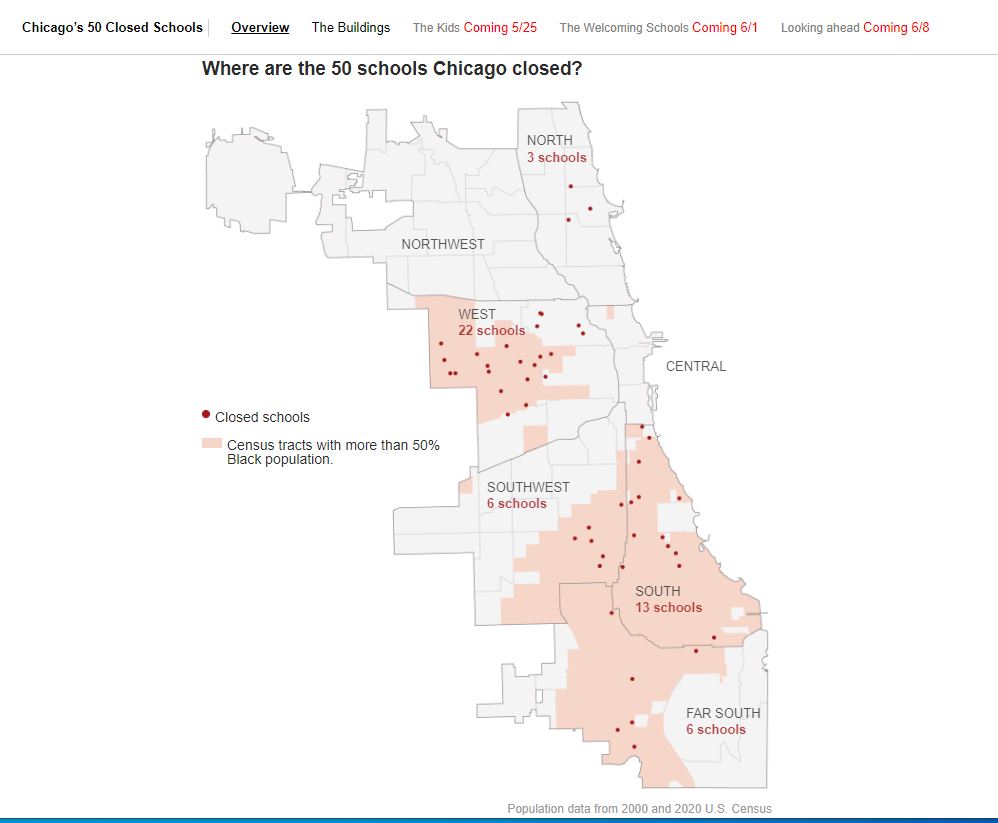
Today I read a WBEZ article titled "Chicago Closed 50 public schools 10 years ago. Did the city keep its promises?"  

Today's article is the first in a 3-part series and includes maps that show a majority of these schools were in areas with high concentrations of Black Chicago residents.

So far,  the answer to the question, is "No. Chicago did not keep it's promises."  I encourage you to read this article and the ones that will follow.

I was curious to see what I wrote about the school closings, back in 2011 when they were happening.  Below I've re-posted an article that I wrote in November 2011.

--- start 2011 article ---- 

Today's Chicago Tribune includes a feature article titled: CPS fails to close performance gap: Black students still losing academic ground despite reforms, study finds

It leads off saying:

Twenty years of reform efforts and programs targeting low-income families in Chicago Public Schools has only widened the performance gap between white and African-American students, a troubling trend at odds with what has occurred nationally.

Across the city, and spanning three eras of CPS leadership, black elementary school students have lost ground to their white, Latino and Asian classmates in testing proficiency in math and reading, according to a recent analysis by the University of Chicago Consortium on School Research.


It includes a statement saying:

"If school closings destabilized certain neighborhoods, other efforts were ineffective — millions of dollars pumped into countless after-school initiatives and tutoring and mentoring programs geared toward African-American students, only to see math and reading scores languish and many students fall further behind."

I challenge this statement of "countless after-school initiatives and tutoring and mentoring programs".

I've been hosting a database of non-school volunteer-based tutoring and/or mentoring program serving Chicago and have been using maps to show where these programs are needed, where existing programs are located, and where more dollars are needed to help programs constantly innovate ways to have a greater impact.

I tried to find census maps on the internet today to support this article. Here's one set of maps showing demographic concentrations in the Chicago region. This is from a U.S. Census Grids web site.


Here's a maps showing African American population concentrations in Chicago, created by the Tutor/Mentor Connection in the mid 2000s. On this map we've overlaid locations of poorly performing schools from the 2007 ISBE watch list. From both sets of maps you can see high concentrations of African Americans living in high poverty areas. You can also see a huge number of failing schools.

On this next map you can see locations of different non-school tutor/mentor programs in the Chicago area. You just don't see a large number of programs in many parts of this map. I encourage you to use the Interactive Program Locator (archive since 2018) and create your own map. Sort by type of program and age group served.

When trying to understand this information you need to think in layers. What is the distribution of tutor/mentor programs serving elementary school kids? Middle school? High school? In each neighborhood programs serving all three groups need to be equally available?

If "millions of dollars had been spent on countless non-school tutor/mentor programs" targeted at African American youth, the map should show many more programs in these neighborhoods than we show.

There may be more. This mapping project has never received funding from the city, the schools or major philanthropy. Thus, there may be programs we don't know about and some of our information is out-of-date. Furthermore, there needs to be many more questions asked, to know more about what these programs have in common, how they differ, what they need to find and retain quality staff and financial support, ways they can constantly improve.

The Tribune story offers a generalization that makes one think that millions of dollars were spent on a comprehensive tutoring/mentoring strategy. Millions may have been spent, but there is no evidence that any strategy has been used to assure that Chicago has a broad distribution of well-organized and constantly improving non-school tutor/mentor programs in high poverty neighborhoods.

This could change if the Mayor, a foundation or an investor were to become a partner and provide financial support to the Tutor/Mentor Institute, LLC so we can update the maps and launch an aggressive advertising campaign to help existing programs get the funding and talent they need to operate in more places and to constantly improve their impact over the next 10-20 years.

---- end 2011 article ----

If you've read any of the articles I posted before, or after, 2011, I've constantly encouraged leaders to invest in a city-wide network of non-school tutor, mentor and learning programs that reach K-12 youth in every high-poverty neighborhood.

No leader has yet embraced this strategy.  Maybe Chicago's new Mayor will make it part of his strategy, and his legacy.

He won't know about it unless you share this article with him or members of his team.  

You can find me on Twitter, Facebook, Instagram, LinkedIn and Mastodon (see links here). I hope you'll connect and invite your network to also connect.

If you'd like to help me keep writing articles like this and hosting the Tutor/Mentor Library, please visit this page and make a small contribution.

If you'd like to bring my archives into your university so students can study what I've been sharing and apply it to their own lifetime commitments, I'd really love to talk with you!  


Wednesday, December 21, 2022

Build Virtual Corporate Office to Support Youth In More Places

On most nights I dream about work I've done in the past to help build support systems for kids in high poverty areas.

Last night's feature was a conversation with people at the Sears corporate office. In that conversation I was showing the parallel of how the Tutor/Mentor Connection, created in 1993, (see 1994 news story) was doing to support hundreds of individual tutor/mentor programs in many different places, and what companies do to put retail stores close to potential customers and support them with a variety of functional teams, including millions of dollars of advertising.

This morning I was going to post a Tweet about this, and wanted to point to an article on my blog where I shared this concept.  Below is an article from 2013.  I hope you'll read it and share it.

----- start 2013 ____

When I came to Chicago in 1973 it was to start a job in retail advertising at the corporate headquarters of the Montgomery Ward Corporation. Over the next 17 years I was promoted often and by the early 1980s I was in charge of the creative development of all national retail advertising. Later I was also responsible for building the first draft of the company's 52 week advertising schedule. I started with a budget of around $250 million dollars and a blank set of papers then had to develop a weekly ad schedule that had variations for big stores, small stores, specialty stores, etc.

Other than differences in products and services, all stores are basically the same. They offer a "things" people near each store want to buy. This graphic illustrates the range of merchandise and services offered by every Sears retail store. Wal Mart, Target, Dayton Hudson, Macy's have similar selections.

If you do a search on Google for different stores you can find maps showing locations throughout the Chicago region. Each of these companies has a corporate office structure with teams that build and operate stores, provide well trained people, provide the merchandise and services that a store offers, and provide advertising that draws customers to each store. This is mass merchandising. It's efficient. Small "mom" and "pop" stores have a hard time competing with the major chains.


Because of my background, the strategies I have developed mirror some of the work done by the corporate office of big companies. The tutor/mentor program's I've led have been site-based, which means students and volunteers come to a program site each week. Because we have space to operate, we're able to offer more different learning and enrichment experiences to youth and more opportunities to volunteer for employees from the Chicago region.
I've used maps to show where tutor/mentor programs are needed, based on high poverty, poorly performing schools, violence and other indicators. I've overlaid on these maps locations of tutor/mentor programs from a directory I've been trying to maintain since 1994.

Many of the existing programs, including the ones I led, were like the small "mom" and "pop" stores. We never had a consistent flow of operating dollars thus worked at a level of poverty that would make it difficult for most businesses to succeed. Everything I've been doing for the last 20 years has intended to improve the flow of resources, the talent in programs, and thus each program's ability to have a greater impact on the lives of youth and volunteers who get involved.


I don't think any organization will ever have the money that corporate offices spend to support their stories. Yet, I feel that type of support is needed to help each tutor/mentor program operate more effectively. Thus, instead of trying to build a single corporate office, I've been focusing on building a "virtual" corporate office where volunteers from many different industries and backgrounds are taking on roles that traditionally are part of a single organizational structure.

I'm not suggesting that small non profits should be consolidated under larger operating umbrellas. Just the opposite. I think the success of a tutor/mentor program comes from a core group of dedicated adults making a long term commitment to do everything they can to help the youth in their program. We need to push resources to the program level and give maximum flexibility for how those resources are used to meet local needs.

At the same time, programs need to communicate a common vision and "what they do" on their web sites. I created this "shoppers guide" to illustrate some information that I feel would help donors choose programs if it were on the organization's web site.

I've been trying to find ways to communicate this concept and today created this PDF essay. I hope you'll take a look and let me know if it makes sense to you. If it does, share it with business leaders who might begin to encourage employees to take on these roles. If you can improve on this, please try, and send me a link to your own version.

____ end 2013 ___

In most of the articles posted on this blog I call on leaders to adopt the strategies I've been sharing.  Volunteers from different companies could be taking roles of functional teams within the "corporate office" to support the growth and long-term impact of volunteer-based tutor, mentor and learning programs within defined geographic areas.

What's critically important to understand is that I'm not talking about supporting one, or two programs in a few places.  I'm talking about filling a map area with high-quality, constantly improving, programs reaching k-12 kids in all high poverty areas within a geographic area like the Chicago region. 

Last Friday I wrote this article about the White House initiative to draw more youth into STEMM careers by 2050.  Unless leaders from every industry adopt the strategies I'm sharing it's not likely the opportunities for youth in 2050 will be much better than as we head into 2023.


Thank you for reading. I hope you'll be one of these leaders and will share this blog with others.

Furthermore, I hope a few of you will visit my "Fund T/MI" page and make a contribution to help me continue doing this work in 2023.

Tuesday, October 11, 2022

Greater Business Involvement in Youth Development

Last April I posted an article with photos of former President Obama, Education Secretary (and CPS CEO) Arne Duncan, and former CPS CEO Paul Vallas, who's now campaigning to become the next Mayor of Chicago.  

Today I posted this Tweet after seeing a story in the Chicago Tribune about Arne Duncan's strategy for reducing violence in Chicago.  

I've been sharing ideas on this blog, my website and in print newsletters since the 1990s showing strategies leaders should embrace.  I shared these personally with Arne and Paul Vallas in the mid 1990s when they were at Chicago Public Schools (CPS). I pointed Barack Obama to these ideas when he was the keynote speaker at a 1999 Tutor/Mentor Leadership and Networking Conference.  I also shared these ideas with Michelle Obama in the 1990s when she was working at the University of Chicago.

In the Tribune article, Arne Duncan says "we need violence prevention at scale, more effective policing and a major commitment from the business community".

I agree. However, I think he needs to offer a lot more detail.  I have the same thoughts for what I'm seeing for Paul Vallas.

So, here's one of my presentations, focusing on increased business involvement. 

Creating Virtual Corporate Office to Support Mentor_Rich Youth Programs in Multiple Locations from Daniel Bassill

Below is one of the slides from the presentation.  It includes a map of Chicago, showing areas of concentrated poverty.  In an article last month I pointed to research showing areas of concentrated poverty in cities across America.   Leaders in each city should be using maps the way I've been using them, to focus attention and resources to every high poverty area.


In the presentation I compare a site-based tutor/mentor program to a retail store, like a Walgreens, or a Wal Mart.  Leaders of these companies build stores in places where they see large numbers of potential customers.  Planning teams make sure the stores have merchandise customers want, and have friendly, courteous store staff, to ensure customers will return to the stores over, and over.   

Advertising teams publish weekly messages intended to draw customers to their stores and to sell specific products and services. 

A tutor/mentor program that offers a variety of learning and enrichment experiences, targeted to specific age groups, or to volunteers, provides reasons for them to come to the program and return every week.  I call this a "retail store full of hope and opportunity". 

Below is a chart that lists some of the "stuff" that each site-based program should have available.  It's also in the presentation. 

The reality is that few non profits have all of these elements. Nor do they have the resources to attract them.  Nor do they have advertising dollars to attract customers (volunteers, youth, donors, etc).

That's where businesses and their employee volunteers can make a difference.  Below is another presentation, titled "Role of Leaders".  


I encourage anyone who is reading my blog to take time to view these presentations, then create and share your own interpretation.  Apply the ideas to your own leadership strategies.  They are freely available to everyone, including Arnie, Paul, Barack and other visible leaders.

One first step for any leader is to build a resource page on their website, pointing people to learning that helps them better understand issues and opportunities.  Adding http://www.tutormentorexchange.net opens all of the resources I point to, including these PDF presentations, to their own followers.  

I'm on Twitter, Facebook, Instagram and LinkedIn. I hope you'll connect with me and share your own ideas.  I'd be happy to help you understand the thinking behind these presentations. 

If you appreciate what I'm sharing, consider a small contribution to help fund my work. 

Tuesday, July 20, 2021

Multiple Site Tutor and/or Mentor Programs in Chicago Metro

 Since 1993 the Tutor/Mentor Connection and Tutor/Mentor Institute, LLC have attempted to maintain a comprehensive directory showing every non-school, volunteer-based tutor and/or mentor program in the Chicago region.  That list now includes many school based programs, too.  These are all shown on the map below, which you can find at this link.  


If you know programs that should be added to the map, or programs that no longer offer tutor/mentor services, please help me update the database.  Email updated information to tutormentor2@earthlink.net.  

What this map does not show very well are organizations who operate multiple locations throughout the city.  In some cases, such as Tutoring Chicago, we show all four of their locations. In other cases, such as Big Brothers Big Sisters of Metropolitan Chicago, we only show their headquarters (and website) on our list.  Visit this page to see the T/MI's  list of multiple site programs in the Chicago region. 

Below I show maps and web pages for four of the largest organizations who offer multiple sites of youth tutoring and/or mentoring.

Big Brothers Big Sisters of Metropolitan Chicago (https://bbbschgo.org/programs/)

Boys and Girls Clubs of Chicago (https://bcgcc.org/clubs) 


Union League Boys and Girls Clubs (https://ulbgc.org/our-clubs/)

Chicago Youth Centers (https://www.chicagoyouthcenters.org/)


Help draw attention, volunteers and donors to these programs, and to the many other tutor and/or mentor programs that serve youth in different parts of the Chicago region.   Use your social media and traditional communications to point to individual programs, or to articles like this where I point to programs throughout Chicago. If you're in another city someone should be duplicating what I've been trying to do in Chicago. 


This graphic shows the public awareness strategy I've led since forming the Tutor/Mentor Connection in 1993.  Every day, or every year since then we've tried to connect "people who can help" to our list of programs and library of information, then directly to individual programs operating in different parts of the Chicago region.

In this concept map you can find the T/MI list of Chicago programs, organized by sections of the city, multiple-site and school-based. You can also find other resources that might help you located youth serving programs in Chicago, or any other city.


While most of these programs are recruiting volunteers and donors throughout the year, many work on a school-based schedule, so in August as schools are starting these programs are actively recruiting volunteers and students.

Visit their web sites. See where they are located. Look at what they do. (some websites are much better at communicating this than others). Find the "contact us" button and reach out to programs that interest you, to learn more, and to get involved.

If you're a foundation, philanthropist, or individual donor, look at maps that use indicators like poverty, poorly performing schools, violence, etc. to show where programs are most needed, then choose a neighborhood you want to help.  This concept map shows many platforms that you can  use. 


Then, use the T/MI map (or similar) to locate programs in that area. Visit their websites to see what these programs are trying to do and decide who, and how much, you want to help. Then send your contribution. 

DON'T WAIT FOR THEM TO SEND YOU A PROPOSAL.  If they have a program, and a website, they do need help from you, and many others, on an on-going basis.  They can't wait six to nine months to decide if you will, or will not help them.  Their website IS their proposal. 


When you look at websites you may feel that the program you're looking at is not as good as programs operating in different parts of the city. However, if that program is in the area you want to help, then use your talent to help them grow to become great at what they do.  If you're someone with communications, marketing, web design or other skills, you and your company could act like a "virtual corporate office" helping multiple youth tutor and/or mentor programs throughout the city.

Thanks for reading this and past articles. Almost everything I've posted since 2005  has this goal in mind.  It "takes a village" to raise a child and that means people from throughout the Chicago region need to help non-school youth tutor, mentor and learning programs be available to k-12 kids with high quality learning opportunities and adult support systems.

I'm on Twitter, Instagram, Facebook, Pinterest and LinkedIn. See web addresses here. I hope you'll connect with me and share these ideas. 


Saturday, August 01, 2020

What's Included in Birth-to-Work?

Programs needed in every
high poverty area
I've used this graphic for many years to visualize #birthtowork support needed to help youth in every high poverty area of Chicago. It uses a map to show a wide range of places where programs are needed. It uses a "village" graphic, to show that teams with a wide range of talents and skills need to be working daily to make such programs available and help them connect to ideas and resources that enable them to constantly improve.

On the graphic I use an oil well icon to convey the idea of a growing birth-to-work programs anchored in every poverty area shown on the map. Below is another graphic that visualizes this differently.

age level support needed

The arrow and the "staircase" both signal the need to help youth move through school and into adult lives.  If you click and enlarge the graphic you'll see suggested mentoring and learning opportunities that need to be available at each grade level.

Within the horizontal arrow I list some of these:

* Reading help (elementary school level)

* Enrichment, Mentoring, Tutoring (starting in elementary school and continuing through high school)

* Job shadowing, leadership clubs (starting in middle school and continuing through high school)

* Summer Jobs, Internships, Apprenticeships (starting in high school and continuing through college)

* Jobs, career networking (starting in high school and continuing through lifetime)

Each site based program could
include many of these activities
The graphic at the left visualizes how many of these activities, including technology and STEM learning, could be part of many site-based non-school programs.  Such programs need to be available to k-12 youth in every high poverty neighborhood.

The website of a program should show that they have a strategy to involve youth and keep them involved in age-appropriate learning for many years.

If you look at the websites of Chicago area youth tutor and/or mentor programs that I include in my library, you'll find that very few show this strategy.  That may not mean they don't do it. It may mean they don't have the talent/time on their staff to communicate their strategies effectively on their websites.

strategic business support

The strategy of the Tutor/Mentor Connection, launched in 1993, was a) build a list of existing programs; b) increase public attention for each program; c) try to help programs recruit business volunteers; and d) educate these volunteers so they'd go back to their companies and networks to recruit other volunteers; so e) they could bring these needed learning opportunities to programs in more places.

For that to happen people need to be looking at these ideas, and then starting conversations within their peer group, their business group, their family and alumni networks, asking "How can we help programs in different zip codes become mentor-rich programs with a wide range of learning that helps more kids through school and into adult lives?   How can our volunteers be there to help kids as they grow through this journey and be there to help when they begin looking for jobs and/or career advice?

create learning circles
That's what this graphic represents.  Learning circles, composed of people from the same industry (tech, finance, legal, arts, etc), faith group and/or alumni group, could be meeting regularly to innovate ways to create and distribute learning opportunities that help kids aspire to jobs in their industries, or areas of expertise. They then could be doing the work of embedding these activities in programs throughout Chicago and many other places. As kids get old enough they could be providing part time jobs, internships, college and career advice, and then interviews to jobs in their companies.

During the #Covid19 pandemic these conversations need to focus on ways to create virtual learning and mentoring that reaches youth in all high poverty places, as well as ways to help programs re-open safely as the pandemic receeds.

I'm sure some of this is happening, but have had no ability to do the research and aggregate links to places where people show how they are doing this work.

Tutor/Mentor Conferences 1994-2015

Between May 1994 and May 2015 I hosted Tutor/Mentor Leadership and Networking Conference every six months in Chicago. These were intended to draw program leaders and staff together to share ideas, and draw media, philanthropy, educators and business partners together to connect with program leaders. They also were part of the strategy of building media attention for Chicago tutor/mentor programs.  I've not done this since 2015 due to lack of funds and too many competing organizations who decided to "do their own thing" rather than "help build what was already in place".

web library
As we launched the Tutor/Mentor Connection and began to build a library of Chicago area tutor/mentor programs we also began to collect articles the people could use to learn ways to build better programs. We started putting this on-line in 2008 and I still maintain it, now as Tutor/Mentor Institute, LLC.

I had support from Illinois Wesleyan University as we launched the T/MC in 1993/4 and have had interns from various universities working with me at different times through 2015.  However, I've never found a department within a university that would adopt the T/MC strategy and lead it through the university. We came close with IWU between 1993-1996, and in 2004-5, when IUPUI was interested, but while that led to rebuilding the T/MC web site in 2006, it did not result in ownership of the strategy. This "Explore Chicago"class for first-year students at DePaul is another example of a promising start that did not continue.

Create university T/MC
This graphic is one of many that I've used to invite universities to create a student-led Tutor/Mentor Connection and that might motivate a wealthy donor to provide the money needed to make this happen.

Read these articles to learn more about a Virtual Corporate Office

Read these articles to learn about university involvement

Read these articles to see invitations to billionaires in Chicago. This Tweet shows that MacKenzie Scott (Amazon.com fortune) is making major contributions to universities.  If you have her attention, please share this idea with her.


I've been sharing ideas like this for more than 25 years (on this blog since 2005).  Please share them if you're concerned about creating birth-to-work learning and career opportunities for kids in high poverty areas. Make this part of your own Black Lives Matter commitment.

I'm on social media at these places. Please connect with me. Share your ideas and strategies and let's draw more attention to work that needs to be done.

If you value the work I'm doing please consider a contribution to help fund it. Click here to find a page with a PayPal button you can use to send your support. 

Wednesday, April 11, 2018

Building Support for Tutor/Mentor Programs in Different Neighborhoods

A couple of weeks ago I posted an  updated version of a report from 2013 showing the number of high poverty youth in each community area of Chicago.  Here's the link.

In this report I show different sections of Chicago with the number of high poverty youth age 6-17 who live in each area, and what percent that is of all youth in that area. With the new maps you can see changes from a few years ago (the blue boxes). This shows that in many areas there are less high poverty youth, and in some there are more.

My goal is that groups in each community area use this information, plus my database of Chicago non-school tutor/mentor programs (click here) to determine the following:

a) need for non-school tutor, mentor & learning programs in the area, based on indicators such as poverty, poorly performing schools, health disparities, violence, crime, etc.

b) availability of existing tutor/mentor programs in the area, based on age group served and type of program.  For instance, a program might exist that serves elementary school kids, but if there is no program in the area that serves these kids when they enter high school, this is a void that needs to be filled.   Or, there might be one or two programs, but they are difficult for kids in some parts of the area to reach, or they are too small to serve the  number of kids in the area who would benefit.

Between 2002 and 2008 I created an interactive search engine to help people determine this information. See it here. Unfortunately, I've not had help or resources to update this since 2013.

c) who are assets (businesses, faith groups, hospitals, colleges, etc) in the area who could help existing programs grow, or who could help new programs form in the area.  One section of the Tutor/Mentor Program Locator was intended to help people learn who some of the assets were in different parts of the city. This also is out of date, but it serves as a demonstration of what's needed to support this planning.

d) how well organized, experienced, effective are existing programs? What can be learned from programs in different places to help improve programs in other places?  I created this "shoppers guide" a few years ago to offer some ideas for what to look for on a program's web site.   The goal is not to penalize programs that may not be as well organized as others. It is to help every program, in every  neighborhood, be as good as they can be.

Vision for mentor-rich programs

With this information anyone can begin to tell stories about existing programs, or about the need for more programs. Anyone can begin to invite others to meet and talk about the need and what can be done to help programs grow in the area.

I've been using maps from the report in Twitter posts, to encourage youth organizations in different parts of Chicago to take a lead on this analysis and community building effort. Here's an example.


Today I've listened to a few of the live webcast of the 2018 Skoll World Forum, being held in the UK.  The theme is Power of Proximity.  Using maps you can take a systematic approach to learning who shares a community area with you and what types of youth programs may be needed to help kids in an area move more safely and successfully through school and into jobs, careers and adult lives.

Planning Cycle - click here
Using social media, traditional media, sermons, posts in church bulletins, company newsletters and old fashion door-to-door community organizing anyone can begin to bring a group of people and organizations together to talk about the need for non-school programs and ways to fill a neighborhood with enough needed programs and services to reach 25 to 50% or more of the k-12 youth in each community area.

While I focus on non-school tutor/mentor programs, this same process can be used to identify other needs for place based services or for the development of new businesses in an area.

Here's a link to the PDF. Feel free to create screen shots of pages in the report and use them in  your own Tweets, FB posts and organizing stories. 

Include @tutormentorteam in your Tweet and I'll re-Tweet your post and help you draw attention to it.