Showing posts with label blog exchange. Show all posts

Tuesday, January 27, 2026

Does your youth-serving org have a blog?

I've been sharing images from the Kumu.io project created by the IVMOOC student team at Indiana University in my last few posts.  Below is another.  This shows participation in the two 2011 conferences. 

I created this after spending time yesterday updating the list of blogs written by tutor/mentor program staff and leaders.  One was by a college student working at Femi Memorial Outreach.  I looked at the 2011 conferences to see if I could find the program and created this image. I circled Femi Memorial Outreach.  You can do the same.  Open the map at this link.

If you search the Femi blog for "tutor/mentor" you'll find a few articles written about the conference. 

In this one she wrote:

Keeping up the Tutor Mentor Connection
If you guys have been keeping up with our posts, you'd know that I mention the Tutor Mentor Institute more than any other organization. When I started working seriously with Femi Memorial Outreach, my first big non-profit conference was sponsored by the Tutor Mentor Institute. I think I learned more in that one, activity packed, day than I had in my first month as an administrator and program developer.

In this one she wrote:

This past Friday I went to the Tutor-Mentor Conference. There was an outstanding turnout from various different education and mentor programs from across the Chicago area. I don't think I fully realized the impact and breadth of education non-profits throughout the Chicago area until Friday.

On the surface, the scene looked like a group of regular people, sleepy eyed, and pounding back cups of coffee as the 8a.m conference began. But, throughout the day people slowly removed their shell and opened up about their projects: executive directors, media relation managers, tutors, and people with projects so new, they hadn't even started yet. The level of enthusiasm was unending.

If you explore the conference participation map you'll find many organizations who participated multiple times.  If you browse the conference tab on this blog, you'll see more than 200 articles.  In a few you'll find links to stories others wrote about their participation.

In 2014 Steve Sewell wrote this article and Valerie Leonard wrote this article.

Kelly Fair of Polished Pebbles wrote this article in 2014. 

I was prompted to look at the list after seeing an announcement from Jeffrey Beckham, Jr., the Executive Director of Chicago Scholars, introducing an article he posted on Substack.com.  It was titled, "The Democracy our Young People Deserve".  I hope you'll read it.

Sadly, my list of blogs has many that are no longer being written and too few from the more than 100 Chicago area youth serving programs on my lists.  

I look at the websites on my list at least once each year, just to make sure the links are working. I'm also trying to find out if they are writing blogs or are using media like Substack.com or YouTube to share their ideas. 

I need your help.  Please look at what local programs are doing and how they are sharing their "What works and what does not work." messages. If you find blog articles or other places where programs are sharing, please send the link to me via LinkedIn, Twitter, BlueSky or Facebook.

In response to the comment I posted on his article, Jeffrey Beckham, Jr. wrote, "And I deeply agree with your invitation. We need more tutor and mentor leaders telling their stories publicly through blogs and reflection. The narrative must belong to those building hope, not only those creating fear."

I agree.  

Are you hosting events and want to map participation? Visit this page to learn about the open source mapping tool created in 2025 by IVMOOC students at Indiana University.  

Thanks for reading.  If you're able to support my work with a contribution, please visit this page. 

Thursday, February 13, 2025

Happy Valentine's Day! Spread Hope & Opportunity to All.


This photo was taken more than 30 years ago. Yet it still symbolizes what volunteer-based tutoring/mentoring is all about. These are two kids who were part of the Montgomery Ward/Cabrini Green Tutoring Program which I joined in 1973. I became its leader in 1975. I was the primary photographer for the next 20 years.

What's great about this photo is that is shows the "love" that was represented in this program, and can still be found among alumni of the programs I led and in photos I see on websites of other volunteer-based tutor/mentor programs in Chicago and other places.

It's love that connects kids living in poverty with adults who don't live in poverty.

 
It's Valentine's Day, so I'm pointing to these graphics which were created by two interns from South Korea during a a seven week internship in 2012.  I wrote about it and included a link to the animation in this article.

This article from the DePaul University Center for Writing-Based Learning includes its own message of Love.  Another article, by Simon Ensor, a professor in France, communicates the same idea and points to ideas I've been sharing at this Tutor/Mentor blog.


Here's another graphic, also created by the 2012 intern team. Song Me Lee wrote this article, to show how the graphic was created, and to show what she'd been learning during her internship.  I encourage you to look at all of the messages posted by Song Me during her internship.  

On this page of the Tutor/Mentor Institute, LLC web site I post a list of interns from 2006 till 2015, with links to articles they wrote to introduce themselves at the start of their internship, and then links to final reflection articles.  Some provide more information than others, but all show an intent that the intern learn new ideas and new skills from working on their projects.

As I've interviewed students for these internships I've emphasized that one of my goals is that these students continue to stay connected to the Tutor/Mentor Connection library of ideas and to each other, so that in future years they become a community of people who help each other, and who apply these ideas to making the world a better place.

In many of my articles I've encouraged universities to establish a "Tutor/Mentor Connection" so more students are looking at my archives they way interns did who worked with me in past years.


I created this presentation to show a goal of having student-led Tutor/Mentor Connection-type teams growing on high school and college campuses throughout the US and the world.  Anyone who takes a few moments to view my blogs and then shares what I'm writing about, as Simon Ensor has done on his blog, is providing inspiration and motivation for one or many people to take this roll.


I'm still waiting for the first university or high school to adopt this strategy, and for the first corporation or benefactor to endow it with 10 years of funding, but as they say "Rome was not built in a day."   

I created this concept map to illustrate this vision. If you start writing about my ideas and/or creating your own visualizations, share the link in the comment box and I'll add you to this map.


Better yet, create your own map, and add my blog articles to it.  

Through the collective effort of many, we'll gather the bricks needed to build the "Rome" of this vision.

Thanks for reading. Enjoy your Valentine's Day with friends and special loved ones!  

Please connect with me on any of the social media platforms that I show on this page.

And, if you are able, please visit this page and make a contribution to support the Tutor/Mentor Institute, LLC.  


Thursday, June 27, 2024

Drawing from my archives

 I've spent time over the past months and years (since 2019) digitizing all of the paper files that I had accumulated in leading tutor/mentor programs since 1975 and the Tutor/Mentor Connection since 1993.  

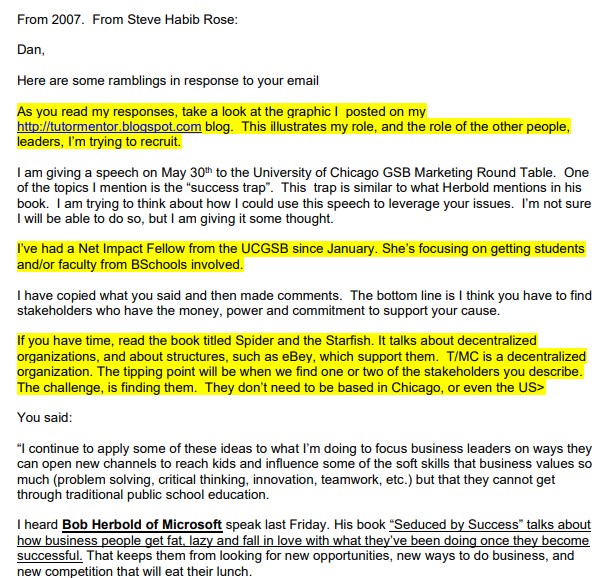
Yesterday I found a document with comments I'd made in response to a blog exchange held in 2007 with Steve Habib Rose. I show that below and you can view the PDF at this link.


The yellow highlights were my comments to what Steve had written.

I did a search on this blog to see if I'd written about this and, sure enough, found this article from March 4, 2007.  It's titled "Connecting Networks". 

In the first paragraph I wrote "I encourage you to read what Habib Rose is writing about networking and how this relates to connecting volunteers and leaders of tutor/mentor programs to each other."

When I clicked on the link, I found that it was broken. So I went to the Internet Archive, and found the article at this link. 


Then I looked at the TAGs on his blog and found several posts under "Tutor/Mentor Connection".   One is shown below.

These posts remind me of who I was connecting with in past years and how I was trying to build a network of people who would work to help kids in high poverty areas connect with volunteer tutors and mentors and extra learning opportunities in organized, on-going non-school programs. 

Some people I'm able to look up on LinkedIn and re-connect with. Others, like Steve Habib Rose, are no longer with us.  In fact, Steve died suddenly shortly after this blog exchange.  It's a reminder of how difficult it is to create a movement and sustain it for decades.

About the same time as I was connecting with Steve Habib Rose one of my interns gave me a book, titled "The Starfish and the Spider".   I pointed to that on this page of the Tutor/Mentor Institute, LLC website.


This book illustrates my role as a catalyst in building a decentralized network of leaders who support volunteer-based tutor/mentor programs.  My archives, this blog and my website are resources any one can use to draw people together, learn more about issues, see work others are doing, and innovate ways to help youth in their own community.

The final part of  "The Starfish and the Spider" talks about platforms, like eBey, which support millions of users.  If you go through my archives you'll see my efforts to create such platforms.  Most are now archives, except for my website library.  

Most are resources that you can find through your computer and the Internet, if you just make the time to look.

I've about eight boxes of paper files left to digitize, then a lot of organizing work to do. I hope to finish by this time next year.  I'll share some as I go, like I'm doing today. 

As you look at this, ask "Who will keep this resource available after Dan's no longer with us?"   I keep asking the same question.

7-14-2026 update - I've digitized most of my files and they are available via my Google Drive.  In this article I point to a couple of sections.  The graphic below is a small portion of all the maps shared in just one file!


Connect with me on social media channels (see links here).   

And, if you're able, visit this page and send a contribution, to help me sustain my work.


Tuesday, March 16, 2021

Role of Veteran Volunteers

 Last August I posted this article announcing that a Michigan consulting firm called Great Lakes Growth Works was interested in talking to youth program leaders about their experiences during Covid19.  Yesterday I received an email telling me the blog article showing the outcome of these conversations was now available. Then, today, I saw this post on Linkedin, by Phil Roos, leader of GrowthWorks, and a former volunteer with the tutor/mentor program I was leading in the 1980s.


Let's look at some history behind this.  I led tutor/mentor programs in Chicago from 1975 to 2011 and for many of those years I created a yearbook to end each year. These included photos and  names of each pair of kids/volunteers.  


About 10 years ago I began to go through the yearbooks to find names of volunteers. I then did a search on Linkedin and Facebook to see if I could find them.  I did the same with former students.

That's how I re-connected with Phil Roos several years ago. He was working at the Quaker Oats Company in Chicago in the mid 1980s when he was a volunteer.  That's him at the left with his mentee. 

We reconnected on Linkedin and Facebook and as I told him about my continued efforts to help tutor/mentor programs grow, he became an annual contributor to support the Tutor/Mentor Institute, LLC (click here to donate). 

As we've interacted I saw that Phil's consulting firm had started a series of conversations with community and clients in Spring 2020 to learn how Covid19 was affecting them and their businesses.  I suggested that interviewing leaders of tutor/mentor programs might provide some valuable insights and Phil agreed. His team worked with me to develop some questions and a list of people to interview. I announced this in a blog last August and in my eMail newsletter.  That led to the blog article Great Lakes Growth Works posted this week.

This is what I've encourage many other veteran volunteers and students to do. Use your talent to share your own experiences and to encourage people you know to support tutor/mentor programs in cities across the world. Take time to learn about the intermediary role the Tutor/Mentor Connection launched in 1993 and that I've continued via the Tutor/Mentor Institute, LLC since 2011.  If no one is building a library of youth programs and trying to draw attention and resources to those programs, then someone needs to duplicate the Tutor/Mentor Connection so that information is available.

I started the Tutor/Mentor Connection in 1993 at the same time as we were launching the Cabrini Connections tutor/mentor program, which I led until 2011.  We had no money and just 7 volunteers when we began. Thus, while we had an ambitious vision, we had few resources to tell people what we were doing.

From 1993 to 2002 we had support from a Chicago PR firm, who helped us develop a year-round event strategy, including networking conferences in May and November, a Tutor/Mentor Week in November, and a volunteer mobilization in August/September.  We published our list of programs in a printed Directory every year from May 1994 through 2002. We also published a quarterly printed newsletter which grew from 400 people in 1993 to 12,000 in 2002.  You can find past news articles here, and past newsletters here.  


However, all of this was too little to reach and influence the millions of people in Chicago and around the country who need to be strategically involved in  helping youth in poverty areas, via organized, volunteer-based tutor, mentor and learning programs.

In 1998 we began to put our library and list of programs on the internet, and use email newsletters to share ideas.  This enabled us to reach more people in all parts of the world, but was still only reaching a few people.  In addition, the loss of Montgomery Ward as host and funder, the dot-com financial meltdown, the 9/11 market collapse, then the 2008 collapse all increased our expenses but reduced the money we had to do all that needed to be done to support our Cabrini Connections kids, and the Tutor/Mentor Connection strategy.  

Since 2011 I've had even fewer resources to support the Tutor/Mentor Connection.  The Cabrini Connections program became Chicago Tutoring Connection, and is now struggling to stay alive.

Without money for advertising and public relations I've always encouraged our volunteers and students to help tell stories of the work we were doing, in an effort to increase the number of people we were reaching and who would support us, or other tutor/mentor programs in Chicago.

I created this concept map a few years ago to show how others have been helping me tell the story of the T/MC and Tutor/Mentor Institute, LLC and help others learn what I was doing and how they might duplicate it.

I added a node at the bottom left of this concept map today, showing the blog articles on the Great Lakes Growth Works site. I'd love to add more showing others who are helping make sense of the strategies I've been sharing and to find others who will apply them in more places while helping me re-energize them in Chicago.

Thank you Phil, Elizabeth, Taylor and the team at Great Lakes Growth Works. 

I'm on Twitter, Facebook and Linkedin. You can find links on this page. I'm looking forward to connecting with you. 


Friday, January 06, 2017

Dig Deeper into Tutor/Mentor Ideas and Articles

I've been writing this blog since 2005 and began putting ideas on the Tutor/Mentor Institute, LLC site in 1998 via embedded PowerPoint presentations. Earlier than that I was putting these graphics in printed newsletters.

This represents a lot of information, and few people are willing to make the time to read, digest and share the ideas. Thus, one strategy I've used is to engage interns from various colleges in short, or long, periods of study which results in presentations that they create to interpret what they read.  You can see the image shown above with a collection of other presentations on this page.

The inspiration for my articles and graphics has come from my own experiences in leading a tutor/mentor program in Chicago, as well as from how I'm continually connecting and learning from others. The web library that I've aggregated over the past 30 years is really a collection of links to people and ideas that I've found valuable, and that I feel others would also find useful.

Finding ways to motivate others to dig into this information and then share what they are learning with others has always been the big challenge. When I can, I try to point to others who are already doing this, as an example of what I feel many others can do.

Below is a screen shot of a video created last week by Terry Elliott, a college professor from Western Kentucky, who I first met in 2013 via an on-line Connected Learning, #clmooc.


Over the past couple of weeks Terry introduced me to an RSS feed aggregation called Inoreader. He first mentioned this on a Twitter message and when I asked for help understanding it, he created a video, which he then posted on Vialogues (no longer available) so I could ask questions and he could respond. Then he created this blog article to show several different uses of Inoreader.

A year ago I did not know anything about on-line annotation and Terry was the one who introduced me to this at that time.  In this Jan. 2016 article I share this introduction to annotation.  And in this Feb 2016 article I show many ways that Terry and others who I've met online are expanding my range of ideas.


What's even more important is that Terry has been expanding his own understanding of the Tutor/Mentor Connection and Tutor/Mentor Institute, LLC over the past four years and he is sharing this understanding with members of his own network via the blog articles he writes and our interactions on Twitter, Facebook and similar spaces.

Here's another example. When Terry introduced me to annotation last January I suggested that this would be a way for myself and others to share thinking from books and PDF articles we had read in the past.  I suggested that we look at a 1992 report from The Chapin Hall Center for Children at the University of Chicago, titled Redefining Child and Family Services: Directions for the Future.  

This was one of the primary resources that I used to show why the Tutor/Mentor Connection was needed and what it was going to do.

We were not able to do that then, but in the past month we were able to load a 1995 update and use Hypothes.is to add comments in the margins. Here's the link. Take a look.

Had more people adopted and supported the Tutor/Mentor Connection strategies from 1993-2016 I feel that there would be more supports in places helping kids in high poverty Chicago neighborhoods move safely from pre-school to jobs and careers and the strategy might have spread to other cities.

Part of the reason I did not get that support is that too few people actually knew the Tutor/Mentor Connection existed or what it was trying to do...because I did not have the tools now available to share my ideas, and did not have people like Terry Elliott, helping me build understanding and awareness in more places.

Poverty and inequality are still entrenched in Chicago and America. Thus, it's not too late for people to dig into these ideas and look for ways to apply them locally and globally.

Since I started the Tutor/Mentor Connection in 1993 I've encouraged colleges and high schools to adopt the T/MC strategy, with students doing the same work I do, but focused on the geography around their university.  This article from June 2015 shows that vision.

Over the past twenty years many people have done what Terry Elliott is doing, but few have done it consistently.  I created the concept map shown below as one way to aggregate links to people like Terry, so others could see what they are writing about, and connect with them, not just with me.

Anyone can take this role. The more who do, the greater will be the visibility and application of these ideas.  If you do start using your blog, videos or web site to share and interpret the ideas on my blog and web sites, send me a link and I'll add you to the map.

If you want to set up a student involvement project modeled after the T/MC I'd love to help you do that. 

Thanks to all who inspire my work on a daily basis by how you spend time networking and sharing your own ideas.


Thursday, February 11, 2016

Catch an Idea. Pass it On. Build the Network.

My friend Terry Elliott, a professor at Western Kentucky University, saw one of my Twitter posts, in which I shared a link to the concept map at the left. 

If you've followed my blog, you'll recall that Terry and I met through a Making Learning Connected cMOOC, and exchanged some visualization ideas last July in this article. We've continued to exchange ideas since then and Terry has repeatedly taken time to go through my stories then share them on his blog. I hope more people take this role.

Based on the map I shared via Twitter, Terry created a new version, which you can see below, and in this page on his blog. 

If you click on the image it will open in another screen, large enough for you to read what Terry wrote.  If you open Terry's blog you'll see that he imported the image from his Google drive, which enables you to zoom in and out, without needing to open a new window. I've not figured that out yet, but part of this idea exchange is a constant exposure to new ways of communicating an idea.

Toward the end of his article, Terry says "I hope Daniel revisits those fields".  I did. My response is the graphic shown below.

I said, "Me Too!" to Terry's hope that more people would do new versions of my map.  I also added a graphic from this page, showing work interns have been doing since 2007 to create new interpretations of the ideas I've launched.  I also included a graphic that illustrates the potential that any of us can have a powerful affect on many other people as we go through our lives, if only we will make the effort.  That graphic is from an article I titled "How Can One Person Change the Future?"

In the article I posted yesterday, I included a map of the world, illustrating the goal of having youth in schools, universities, faith groups and tutor/mentor programs located in many different places, creating their own versions of these graphics and articles, with much greater talent and energy than I've every been able to put into this. I outlined an idea for this on my planning wiki. It just needs a sponsor and partners to make it happen.

I'm attending a reception tonight in Chicago to meet the new President of Illinois Wesleyan University, which is from where I graduated with a history degree in 1968. In 2001 IWU, then led by Minor Myers, Jr., awarded me with an honorary PhD for the work I had done up to that point.  My hope is that a group of students and facility from IWU will join in on this exchange of ideas and purpose. 

Thank you to Terry Elliott and others who are already amplifying the ideas I share. You're providing a road map that makes it easier for others to follow.


I hope Daniel revisits those fields and replants them and husbands them in different ways.   - See more at: http://impedagogy.com/wp/blog/2016/02/11/never-the-same-river-never-the-same-man/#sthash.cnqEogTm.dpuf

Monday, November 02, 2015

Read my Lips. Remember that phrase?

I've been submitting guest blogs to the I-Open Network blog, and yesterday submitted a new article that started with "Repeat after Me". My articles are a collaboration. What I submit is reformatted, and edited, reflecting the understanding and goals of I-0pen. They do a good job.

I use a variety of graphics and maps in my article, to illustrate the need for long-term support for kids living in high poverty areas. Such support needs to be age appropriate, and accessible. In big cities that means hundreds of programs are needed, spread out into different parts of the city and suburbs...where ever the map shows a need for extra support.

This is just one example showing this as a process that starts as early as pre-school and continues for 15-20 years, or until students are in jobs and beginning to build careers. It reflects the "who you know" as equally important to "what you know" and emphasizes that volunteers who connect with youth as tutors, mentors, coaches and friends can become part of an extended family network, helping kids as they grow up, and helping them get interviews into jobs and career opportunities as they begin their adult lives.

I don't see many people writing about this long-term process, or emphasizing the proactive role that leaders in business, government, philanthropy and other sectors need to take on an on-going basis to help high quality programs become available in every high poverty neighborhood, then stay available for a decade or longer.

Thus, efforts like I-0pen, that share my ideas through their own network, are really important. This could be happening more often in Chicago, and it could be happening in every city of the country, led by many different leaders.

If you're interested in exploring ways to do this, you might become part of the Digital Writing Month event, that started yesterday. View the web site to see the goals and how to join (free). During the month I'm going to try to coach people in Chicago and across the country, to create their own versions of ideas I've launched on my blog, to share them with people in their own networks.

President George Bush, Sr. made the "Read My Lips" phrase famous as a "no new taxes" campaign pledge in 1988. I'd like to see thousands of leaders adopt this, with a goal of mobilizing millions of Americans to provide consistent, on-going support that helps economically disadvantaged youth from every city and state move more successfully through school and into adult jobs and careers beyond poverty.

Tuesday, January 20, 2015

A New Media Strategy for Community Problem Solving

It's National Mentoring Month, so at the left is a photo of myself and Leo Hall, who I first connected with as his mentor, in 1973. He celebrated his 50th birthday last August, and invited me to the celebration. He wanted to thank me for my influence in his life. While I was there, I thanked him for letting me have a part of his life, and of thousands of other young people and adult since then.

If you've followed my blog, and the Mapping for Justice blog, you've seen that I've followed media stories of violence and poorly performing schools in Chicago with efforts to influence how leaders and volunteers support the on-going operations of volunteer-based tutor/mentor programs in Chicago and other cities.

I've pointed out, with articles like this, that the problems we face in 2015 are the same ones we've faced since 1990 and earlier.

Last week I read this article, Why Journalists Don’t Seem to Care About the Tragic Massacre in Nigeria, which compared the lack of attention being given to thousands of murders and kidnappings in Nigeria to the attention given to the killings of less than two dozen people in France.

I've pointed out the lack of long-term focus from media, philanthropy, business and media in many past articles. My friend Steve Sewall, has written a long article describing this problem, and a proposed solution. I hope you'll read it.

What's missing in Steve's recommendation is a "call to action" that works like retail advertising to draw readers directly to information directories and maps that they can use to find tutor/mentor programs in different neighborhoods of Chicago and other cities to whom they can offer on-going talent, ideas, operating dollars, and other forms of support.

I've had interns working with me since 2006, who create visualizations and blog articles that help others understand the ideas I've been sharing. This morning I talked with my current intern about the role of "influence building" that leaders need to engage in daily if they want their agenda's to have the public support they need.

This graphic is one of many that shows the role of intermediaries, or third party actors who are committed to solving a particular problem. Every time you encourage someone you know to look at one of my articles, maps, graphics, etc. you are expanding the network of people who support youth in well organized, constantly improving, tutor/mentor and learning programs. You are part of the solution.

When I launched the Tutor/Mentor Connection in 1993 I recognized that long-term problem solving, such as helping youth from birth to work could never succeed as initiatives led by elected officials. No matter how well designed a project is, elected leaders keep changing. Thus, the consistent, long-term support I've always sought had to come from investors/partners who understand the strategy I was proposing and were willing to support it, as their own commitment, for one or two decades.

I've not found that support, yet I've found enough to still be sharing this idea more than 20 years after launching the Tutor/Mentor Connection with the help of six other volunteers who were also launching the Cabrini Connections tutor/mentor program in Chicago at the same time.

Here are some additional articles to read:

Building Super Bowl of support. (Jan 2014)

Expanding the Network - Decade Long Effort

Network Building - Talent Needed

Visit this page and see how interns have communicated these ideas. Youth in schools, non-school programs, colleges and faith groups could take this role, pointing to tutor/mentor programs in their own city or neighborhood, with a shared goal of building the on-going flow of resources needed to reach youth with high quality programs that help them move from birth to work.

Wednesday, November 12, 2014

Follow up to November 7 Tutor/Mentor Leadership and Networking Conference.

The 42nd Tutor/Mentor Leadership and Networking Conference since May 1994 was held last Friday. Between 80 and 90 people attended.

Several people took photos, which I'm aggregating into an album.
Here are links to a few albums and stories I've already received. I'll update this blog as I receive more:

JP Paulus of DoGooder Consulting posted photos here.

Steve Sewall wrote this article and posted photos here

Valerie Leonard, posted this article.

Cheryl Howard-Neal posted on the Illinois Mentoring Partnership Facebook page, "Great seeing everyone at the Tutor/Mentor Leadership and Networking Conference today. Lots of great information and a wonderful opportunity to network with other mentoring and tutoring programs. Many thanks to Dan Bassill for organizing and hosting this event."

Jordan Hesterman of Becoming We the People, who is a co-organizer of the conference, posted this comment on her Facebook page.

See conference photos posted by Jordan Hesterman on 11/17. See Twitter Storify created by Jordan.

Darryl Allen of The Mentorship Institute shared this photo of myself and Cliff Wright, Jr. and wrote "It was pleasure to participate and present at the Tutor/Mentor Conference - November 7, 2014. I found the participants very engaging and informed on a variety of topics. The presenters were passionate and knowledgeable in their particular disciplines."

As I receive pdf copies of workshop presentations I'll post them on the agenda page for the conference.

Thank you all who attended. While the next conference will be held on May 8, 2015 at the Metcalfe Federal Location, I hope to connect in one-on-one meetings with those who attended, and those who follow via social media, to talk of strategies that will help make volunteer-based non-school tutor/mentor programs more effective, and available to youth in more places. Just contact me to schedule a meeting.

Sunday, October 05, 2014

42nd Tutor/Mentor Leadership and Networking Conference since May 1994

I created the Tutor/Mentor Connection in 1993 to begin a formal process of collecting information about Chicago area tutor/mentor programs. In May 1994 I hosted the first Tutor/Mentor Leadership and Networking Conference, inviting programs that I had discovered to come together to network, share ideas, build relationships and work together to increase visibility and the pool of volunteers and operating dollars every program needs. I'm hosting the next conference on Friday, November 7 at the Metcalfe Federal building.

I've always shared maps during these conferences to emphasize that the goal was to help great programs become available in all high poverty neighborhoods, not just a few places.

I've never had significant sponsors dollars for this conference but it's been possible because all speakers have donated their time to do workshops. In 2011 I created the Tutor/Mentor Institute, LLC to continue support of the Tutor/Mentor Connection in Chicago and to help similar intermediary groups form in other cities. I have a different tax structure than in the past, but the mission is the same. The lack of money is even more severe than between 1993 and 2011.

Before and after the last conference in May 2014, several speakers posted blog articles talking about the Tutor/Mentor Connection, and/or the conference. You can see these on this article.

The agenda for the November 7 conference is posted here and already some of the workshop presenters have created blog articles to show what they will be talking about and to encourage others to attend. I show these below and as others are written I'll add them to this list.

Valerie F. Leonard, Expert in Community and Organizational Development - see article

E. Wilson, Tutoring For Excellence - see article

Mark Carter, One80 Consulting - Mentoring Programs That Answer WHY Before HOW Succeed More - Read article.

JP Paulus, Do-Gooder Consulting - see article

Mitchell Sholar, Executive Director of City Harvest Outreach Ministry uses the home page of his web site to talk about the conference and to invite people to be sponsors

Here's an article by Steve Sewall, of Chicago Civic Media, providing his explanation of what he sees on the Tutor/Mentor Institute, LLC web sites. I hope more will look at the side the way Steve has done, then spend time sharing what they are learning with their own network.

Here's one of several videos where leaders talk of why the value the conferences:


Conference Capacity from Cabrini Connections on Vimeo.

Registration is now open - click here to register

We have room for 125 people. The full registration fee is $80, but group rates are available for groups of 3 or more and $30 scholarship rates are available upon request. If you'd like more information connect with me on Twitter @tutormentorteam or on the Tutor/Mentor Institute, LLC Facebook page.


Wednesday, September 24, 2014

45 Years a Tutor/Mentor and Still Going Strong

Here is photo of Sean Mayfield and AJ Tyson. I've known Allen for 40 years since he was already a two-year veteran tutor when I joined the tutoring program at Montgomery Ward in 1973. Allen sent me this message last week to update me on the progress of a student he worked with in the Cabrini Connections program from September 2006-June 2012:

"I met with Sean recently and he's working at Weber Grill and will be entering his second year in college this fall. I tutored Sean for 8 years through the Tutoring Chicago and Cabrini Connections programs in Chicago. He always came to tutoring on time and with his homework. He is a bright young man. I was able to help him get a job interview at Weber Grill through one of my contacts. He got the job on his on. I'm very proud of him. He's doing well there. He will continue his studies in Chicago this fall. I've stayed connected with his Mom and Grandmother even though he finished high school in June 2012.

I'm now back at the Tutoring Chicago program and starting my 45th year of mentoring with my student from last year, Davion Willis. Erin McPartlin is the director and she's the one that got Sean and I together eight years ago when the program was called Cabrini-Green Tutoring Program, Inc."

I asked Allen if he was now raising money for Tutoring Chicago just as he did for Cabrini Connections when he was a volunteer there. He said, "Yes. I raised close to $10,000 last year."

Why does he continue to tutor, and why does he raise money for the programs? He said "I enjoy it! Once you're connected and see the benefit of what you do, it's easy to ask people you know to help."

I've included graphics like this on my blog for many years to illustrate the need to connect with youth when they are young, and stay connected to them for many years. Allen's involvement started with Sean when Sean was in 5th or 6th grade. It still continues today, after Sean has finished high school. In our conversation today Allen told me how he's reaching out to kids he tutored in the 1970s via Facebook. I'm doing the same. In this article I show how I've been connected to my first mentee for 40 years!

In this graphic I'm illustrating the need for volunteers from many industries to be involved in tutor/mentor programs all over the Chicago region, and for some of those volunteers to grow their involvement so they a) help kids into jobs, and b) help programs attract the operating dollars needed to keep these connections in place.

Allen and I both have longterm histories because the programs we were part of provided great support, and managed to survive on inconsistent funding and tremendous levels of volunteer involvement for all of these years. Just to be clear, I was the volunteer leader of the Montgomery Ward program from 1974 to 1990 and led the conversion into a non profit in 1990. I led it until October 1992 when I and six other volunteers left to create the Cabrini Connections program and the Tutor/Mentor Connection (T/MC). I led the CC program till June 2011 when I left and formed Tutor/Mentor Institute, LLC in order to continue the T/MC after the strategy was dropped from the Cabrini Connections program.

My ideas and passion come from leading these two programs and from the constant struggle to find and keep operating resources that were essential to supporting the involvement of hundreds of pairs of youth and volunteers.

I point to the Lawyers Lend A Hand to Youth via blog articles not because they are great, but because they have been working at raising money to support tutor/mentor programs in multiple locations for nearly 20 years! I want more legal and professional groups to duplicate this, and do it better! That's the only way to help more tutor/mentor programs grow. We need to build a generation of leaders who are proactive in what they do every day to encourage volunteer involvement and support it with dollars and talent from other volunteers.

I've written about this often and have probably spent more time thinking about this than most people in America. I really appreciate it when people like Steve Sewall, Mark Carter, Betsey Merkel, Kelly Fair, Steve Braxton, the Jefferson Awards Program and others post articles on their sites helping people understand what I'm doing.

Just as individual programs cannot operate effectively on an on-going basis without financial support, neither can I or other intermediaries.
If you want to help me, a tax deductible donation can be make as a conference sponsor, using this link.

If you're not concerned with the tax deduction, or my tax status (I'm a LLC) with no revenue, then use this form and become a supporter.

If you're a long term volunteer like Allen, I encourage you to create a blog and share your story. Encourage others to get involved, and encourage others to provide the talent and financial support every single tutor/mentor program in Chicago or any city needs to support these long-term connections.


Sunday, May 25, 2014

Conference Reflections. Network Building

On May 19 I hosted the 41st Tutor/Mentor Leadership and Networking Conference held in Chicago since May 1994. About 90 people attended. I'll be posting photos in the albums section on the Tutor/Mentor Forum and I'm adding presentation slides to the agenda page on the conference web site.

While I host these conferences as part of the on-going strategy of the Tutor/Mentor Connection (read here), I don't focus all of the attention at the conference on my own goals. Rather, this is an opportunity for others to share their strategies and expand their ideas of tutoring and mentoring. Thus, I was pleased when John Hosteny, Director of the Corporation for National and Community Service’s Illinois Office, Used his welcoming remarks to provide an overview of the T/MC's goals and strategy.

Prior to the conference we used Twitter and other social media to build attention for the conference and various speakers. I encouraged participants to use their own blogs to show what the would be talking about. In addition, I've encouraged participants to do their own reflections. Below are a few links to these articles:

Post conference:


Article introducing Tutor/Mentor Connection, written by Dominica McBride, CEO, of Chicago intermediary called Become.

Article about volunteer growth, written by Mark Carter, President of One80. Second article posted Sept. 4, 2014

Storify report showing Twitter conversation, created by Interns at Becoming We the People.

Charlene Dolan, Tutoring, Mentoring, and PBL

Illinois Mentoring Partnership, (Facebook Page)

Bishop Steve Braxton, posted this photo on Facebook and posted this article on his blog


Pre conference:

This is Kelly Fair's Blog article. Kelly is founder of Polished Pebbles

This is a blog article by Eric Davis, Executive Director of GCE Lab School.

See how City Harvest Headstart Ministry talks about the importance of the conference on their home page. Photo above shows Mitchel Sholar of CHOOM and Dr.

Here's a link to The Black Star Project newsletter. Each issue this week has included a message about the conference.

Others are also sharing information about the Tutor/Mentor Connection

Here's a blog written by E. Wilson, titled The T/MC Links Library: A Must-Use Resource for Tutors

Here's the I-Open blog, where two of my articles have been shared since January 2014.

I'll use this article as an archive for reflections from the May 19, 2014 conference. If you write one please send it to me and I'll post it here.

The next conference will be November 7th. Sponsors are needed. Workshop presenters can begin to contact me with ideas.

Thursday, March 27, 2014

Building Network to Solve Complex Problems

This graphic illustrates the need for youth to be surrounded by a wide range of age appropriate learning resources as the move from elementary school toward jobs and careers. Depending on the level of economic security a youth needs more of these because they are not naturally available in the community. I view volunteer tutors/mentors who connect with kids via organize tutor/mentor programs as "extra adults" who can help youth and families have greater access to some of these supports.

If you agree with that logic, then the next step would be to become part of efforts that help more volunteer-based tutor/mentor programs be available, so more kids are reached and more volunteers get involved.

I've written many articles trying to show the long term involvement needed by many people, in many places, to help tutor/mentor programs grow in high poverty neighborhoods, and become great at what they do. It's only when the begin to be "great" that the kids entering those programs have the best chance to benefit from the services they offer. If an organization can't keep it's talent, because it can't keep its funding, it's not likely to become great, or stay great.

I constantly hear people say we "want something to happen" but few share a map showing how they think we'll get from where we are now, with only a few people talking about the problem (or a lot of people talking about it, but in different silos), to where we want to be after a period of consistent effort.

I really appreciate it when other people help share these ideas via their own blogs. Today Betsey Merkel posted this graphic on the I-Open Blog. Betsey's in Ohio and hopefully leaders from Cleveland, Columbus, Cincinnati, and/or Toledo will see this and want to adopt the ideas in their own cities. If they do this well, and share what they do, perhaps that will influence how leaders in Chicago and other cities also view the ideas.

2024 note:  the tutormentor articles on the I-Open site no longer open.  I've posted a link from the Internet archive.

Wednesday, February 12, 2014

Jefferson Award for Public Service - 32 years later

On February 11 I was honored to be featured in this article on the blog of the Jefferson Awards for Public Service page.

I received this award in 1982, when it was the Chicago SunTimes Jefferson Award. You can see the newspaper story from then at this link.

I've received other awards since then, such as in 1999 when I received the Publisher's Clearing House Good as Gold Award on the Dec. 31 telecast of the Montel Jones TV show.

The best rewards for the work I've done have come from students and volunteers testimonials of how much a difference the programs I've led have had in their lives, or how much help the Tutor/Mentor Connection has offered to their own program-building efforts. I met my wife through the program at Montgomery Ward thus my two kids are also one of the unexpected rewards of doing this work.

I've never gotten rich. In fact, I've never earned as much since 1990 as I was earning in my last year with the advertising department at Montgomery Ward. However, I have a wealth of experience that I try to share via this blog and the Tutor/Mentor Institute, LLC web site. And a vast network of people who I've met and learned from, just as they have learned from me.

I've been putting as much of my ideas as I can on these web sites. I've also been working with interns to help create new interpretations of these ideas. Visit this site and see new work added every six months by interns from IIT and South Korea, and from other universities. Visit this page to see more work done by interns.

Thanks to everyone who has helped me do this work and thanks to those like the Jefferson Awards for Public Service who help us share our story with thousands of others.

Friday, February 07, 2014

Network Building - See example on I-Open Blog

I've written many articles about network building, collaboration, learning and complex problems, and how the ideas we share on web sites and blogs have little impact if too few people are looking at them.

I first started blogging in 2005 as part of a Non-Profit Blog Exchange. You can see my first articles here. I've done this consistently since then as a way of expanding my network, learning new ideas, and of attracting more readers to the ideas on my own blog.

Thus, I'm pleased to point to an article titled ACCELERATE ECONOMIC PROSPERITY IN YOUR NEIGHBORHOOD, posted on the I-Open blog. The leader of I-Open is Betsey Merkle, who I first connected with on Facebook in 2011. Betsy's base of operations is Cleveland, Ohio. However, through the internet she reaches people throughout the world. She is one of the most active network-builders I've met in the way she is constantly using social media to draw attention to people she has met, and to connect those people with each other.

I wrote this article about Network growth and this article about Unleashing Your Personal Power to illustrate the work that must be done if we're to attract millions of people, and thousands of leaders and decision makers, to the ideas we share on blogs and web sites which represent a "university of ideas" focused on closing the gaps between poverty and affluence by creating and sustaining mentor-rich support systems in thousands of high poverty neighborhoods of the US and other countries.

Without others sharing what I write, or me pointing to what they write, few of us have the advertising dollars, or celebrity visibility, to draw needed attention to these ideas on a single day, or a consistent basis.

I hope you'll read the articles I write, follow the links, and share this information with people in your own network. That's how movements grow and how change can take place in this world of many problems.