In many of my blog articles I show a 50 year strategy of "connecting people and ideas". I posted this article on the MappingforJustice blog this week to illustrate how I do this by adding links to my library.
Here's another example. I saw this post from the Prison Policy Initiative today on Twitter (yes, I still visit the site).
I've followed them for more than three years and added them to the Tutor/Mentor library in July 2022. When I did that I put them on a list of "new links added" that I had just begun.
Under the listing I included a "posted in this section" link, which pointed to the page in the library where I host that link, and many others with related information.
I've also added it to the list of resources that I share in my monthly e-mail newsletter, as you can see below and in my most recent issue.
And, I boost their posts when I see them on social media, hopefully drawing the attention of others to their work.
Why do I do this? The two concept maps below show why.
The first shows my goal of helping kids and volunteers connect in multi-year tutor, mentor and learning programs that help them through school and into adult lives. It also shows that kids in areas of persistent poverty face many challenges that they and their families cannot solve by themselves. View the map at this link.
The second shows the many different supports kids need at each grade level as they move from first grade to their first job and a career. All kids need these supports. However, kids in areas of concentrated poverty have fewer than other kids. That needs to change. Click here to view.
In the lower left corner of this map is a statement saying, "Volunteers who get involved as tutors/mentors learn about these issues, and help provide these other resources. In high poverty areas of big cities, structured programs are needed to connect youth with volunteers."
Unless volunteer-based programs have an on-going strategy that exposes their volunteers to this information, too few will take the extra steps that I describe in this concept map. My newsletters, website and social media posts are aimed at program leaders, board members, donors and educators who can help instill habits of "learning" among volunteers, not just students.
One way to know if they do that would be to look for a "resources" page on the youth program's website, to see if it points to libraries like mine, or if they have other strategies for educating their volunteers.
Below is a graphic that shows the role I've taken, of connecting "people who can help" with information, and with places "where help is needed".
The issues we're dealing with today have been with us for many years. Why? Because too few people who don't live in poverty care enough to devote time, talent, dollars and votes to build and sustain the programs and policies needed to help those who do live in poverty. And that means more than just building volunteer-based tutor/mentor programs. There are a wide range of issues that need to be addressed. None are short-term solutions.
The Prison Policy Institute does a great job of calling attention to one part of the problem, which is the massive incarceration rates of people in the USA. Another is the Incarceration Reform Resource Center, which I also list in my newsletter. Unless more people see the information they are sharing and hosting on their websites, too few will understand the problem and be motivated to do anything about it.
What's your role? Be the YOU in this graphic.
Share my posts. Share my newsletter. Share information in the Tutor/Mentor library. Start a learning circle in your family, business, social circle, faith group, college, etc. where you use the information I and others are sharing to become more informed and more active in finding, and funding, solutions.
As I write this, I'm not forgetting the huge challenge facing our freedom and democracy. Many of the policies being rolled out by the Administration hurt poor people, and people of color, more than others. They hurt all of us and are making the world an even less safe place. I started this section of the library during Trump's first term to help you find resources to improve our government. The links I include should also be part of your reading and learning circles.
Connect with me on LinkedIn, BlueSky, Facebook, Twitter, Instagram and Mastodon. (see links here)
And, if you value what I'm sharing, and the library I host, please visit this page and make a contribution to help fund the work.
Last May I posted an article with the headline, "Poverty in America. Why so Much?" I pointed to a presentation by Matt Desmond, and encouraged readers to watch it.
Today on Twitter (X) Matt Desmond shared a slide presentation that people can use as a study guide to understand poverty and take actions to reduce it. Here's the website where you can download the presentation.
Below is a slide from the PDF version. (scroll down to bottom of home page to find "Teaching Resources".
There are a lot of slides, with great visualizations, and each chapter has questions that can be used to stimulate discussion in learning groups.
The only thing missing from this is a chapter on social capital and ways volunteer involvement in on-going tutor/mentor programs can increase the number of people motivated to spend time reading Desmond's book and sharing these slides with their network.
6-30-2025 - visit the Othering and Belonging website and listen to a discussion of a new book titled "Structural Racism", by Stephen Menendian. Visit this page and read a paper titled "The Roots of Structural Racism Project". Scroll down to the bottom to see an extensive additional reading list.
8-7-2025 - view this video about "Structural Racism", by Stepen Menendian - click here
Below is a concept map that shows the birth-to-work timeline. If you view this in context of Menendian's book about "Structural Racism" one my frame the conversation about making these learning opportunities equally available to all kids, which would require different strategies for different places.
Look at the text box in the lower left corner, showing the role volunteers in tutor/mentor programs might take. Desmond's book mostly focuses on policy and what voters can do to reduce poverty. I'd like to see a chapter showing the support that needs to be made available, at each grade level, to every youth living in a high poverty area, and what policy, philanthropy and business involvement can do to make these supports available in more places.
Here's another concept map showing growth of volunteers who are well-supported in on-going volunteer-based tutor, mentor and learning programs.
I show this graphic in this blog article. I also show how interns created to animated versions of this graphic more than 14 years ago. It takes an intentional effort for leaders in volunteer-based programs to educate volunteers on this issue. It take consistent, flexible funding from donors for programs to hire and retain staff who do this well, and to make long-term, mentor-rich programs available in more places.
It takes network-building, like I keep repeating with this graphic.
Unless more people become personally involved, and get friends, family, co-workers and their professional networks involved, and stay involved for decades, we'll still see "poverty books" 20 years from now, with little change from today, or 30 years ago.
This is EASTER week. Millions around the world will be celebrating.
I've posted EASTER week articles almost every year. Here's one from 2018 which has a link to a PDF presentation with the maps shown above.
I've been preaching this message for 30 years. This blog and my website could be additional resources to people trying to understand the issues and solve such a complex problem.
However, too few have ever seen what I'm writing. You can change that if you share my blog articles and create your own versions to communicate these ideas.
Imagine a strategy in faith communities that engaged their congregations in an on-going study of poverty, using resources such as Matt Desmond's study guide and book. What if they created maps showing which of their congregations had such study groups in place?
I found Matt Desmond's post on Twitter (X). That's why I still use the platform. I'm also using many others. Find the links on this page.
Thanks for reading this article. If you want to help me continue this work, please visit this page and make a contribution.
In early May I watched a presentation hosted by the Urban Institute, featuring Matt Desmond, author of a new book titled "Poverty in America". Open this link to view the video of the presentation.
In a follow up email the Urban Institute summarized some of the key points of the webinar. They wrote: While no one policy is a silver bullet, Desmond suggests keeping these ideas in mind:
Social justice: “It’s impossible to write about poverty in America without writing about racism in America,” Desmond said. Black and Latinx families have lower incomes, a lower homeownership rate, less in savings, and ultimately less average wealth than white families. Therefore, any steps forward must come from the position of breaking down segregation and structural racism.
Targeted universalism: Rather than targeting one solution to each group or each problem, Desmond recommended identifying the desired societal outcome, then implementing many universal solutions that could address it.
Then, on May 21, an opinion article in Politico, by Sheryll Cashin, a law professor at Georgetown University and author of several books on racial justice and American democracy, provided an in-depth analysis in an article titled: America’s Poverty Is Built by Design: How did the U.S. become a land of economic extremes with the rich getting richer while the working poor grind it out? Deliberately."
I added links to Matt Desmond's website to the Tutor/Mentor Library. You can find them here, and here.
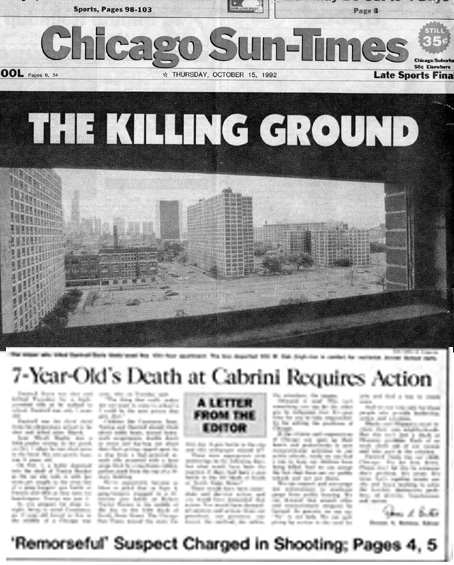
I and six other volunteers created Cabrini Connections (a site-based tutor/mentor program) and the Tutor/Mentor Connection in November 1992 following the shooting death of a 7-year old boy, in the Cabrini-Green area of Chicago. I've used this front-page story from the October 1992 Chicago Sun-Times as a reminder and motivation every year since then.
In the summary above Desmond is quoted as saying "individual actions can build political will for larger changes".
This is not a new problem. However, it's a problem that our leaders can't stay focused on every day, because there are so many other problems.
That's why I think it's important for another level of leaders to emerge, who are totally focused on building a better community understanding, and response, to the problems and solutions.
I've been issuing this invitation for the past 25 years, since we formed Cabrini Connections, Tutor/Mentor Connection, in the weeks following the shooting of Dantrell Davis in Chicago back in October 1992. I keep the front page of this Chicago SunTimes story in my office, as a reminder of my responsibility.
I've developed my own actions steps, and posted them on this blog in the past. Here they are again:
If we want to stop this violence, we have to act now, and keep acting to solve this problem for many years. We have to think spatially, that is, look at the entire city and suburban problem, not just one neighborhood. At the same time, we need to act locally, because none of us has the time, or the resources to help each of the kids in the entire Chicago region who live in neighborhoods where poverty is the root cause of the violence.
This animation was done by one of my interns after reading this article.
Here are some ways to remind yourself. Think of ENOUGH, is ENOUGH
E – educate yourself – most of us do not live in high poverty neighborhoods, so we only understand the root causes of senseless shootings from what we read in newspapers. We also only read negative news in the media, so we’re not really well informed on where these events are taking place most frequently. Finally, while there is a perception that there are plenty of youth programs, we really don’t have a good understanding of the distribution of different types of youth programs, to different age groups, in different zip codes. The only way this will change is if each of us pledges to spend one hour a week reading books, articles and web reports, that illustrate the root causes of these shootings, or of poor performance in schools. Through our learning we can draw ideas that we use in our own actions. We can also begin to contribute information that other people use to support their own decision making.
To help with your learning about race, poverty and inequality in America browse the different sections of the Tutor/Mentor library, shown on this concept map.
N – engage your network – find ways to draw others who you know into this shared understanding. Recognize people who volunteer time and talent, or who help kids through the programs they operate. If you are a business leader, or a church leader, engage your corporation or your congregation. You can use your web site, advertising, point of purchase materials, etc. to point to web sites that show all of the agencies in the city who do tutoring/mentoring, such as www.tutormentorexchange.net. If you do this weekly, year after year, your friends, coworkers and customers will become involved in solving this problem with you.
O – offer help, don’t wait to be asked. As you build your understanding of where poverty is most concentrated, and what social services are in those areas, choose a neighborhood, and reach out with offers of time, as a volunteer, talent, help build a web site, do the accounting, or offer Public relations services, and dollars, if the web site of an organization shows they do good work, you don’t need to ask for a proposal of how they would spend your donation, you need to send them a donation so they can keep doing that good work
U – build a shared understanding. Form groups of peers to share reading and learning assignments, just as you meet every Sunday to read passages of scripture and build the group’s understanding of the Word of God. Use the many different resources of the T/MC Links library as the starting point for your search for wisdom, and understanding.
G – give until it feels good – people who generously donate time and dollars to causes they believe in feel good about their giving. If we’re going to surround kids living in poverty dominated neighborhoods with extra learning and adult mentoring networks, donors will need to give more than random contributions of time, dollars and talent.
H – form habits of learning, and pass these on to your kids. Imagine how much more successful teachers were if youth came to school every day asking questions about where to find information, or how to understand information they had researched on the Internet the previous day? We can model that habit if we build it into our own activity. Keep a chart where you can document actions you take each week to same sure that this time ENOUGH, really means ENOUGH.
If you document actions, you can review what you’ve done at the end of each month, and each year, and begin to see a growing mountain of actions you have taken to solve this problem. Some of these will be actions that got other people involved, so that the good work you do is multiplying because of the good work others are also doing.
Through this process you help build this shared understanding, which will lead to better public policy. Without this habit of learning, and without learning to use the Internet to find good ideas from people in all parts of the world, we won’t be able to problem solve as well as we need to, and we won’t be able to teach this habit to our kids.
Share this post and the links I point to. Start discussions in your own circles of influence. Be the YOU in the graphic shown above.
If we do this, we’ll not only reduce the root causes of youth on youth violence, we’ll also address one of the growing issues facing America in a global economy. We will begin to create a nation of learners, problem solvers, creative thinkers and innovators, who use learning and information as the basis of creating opportunity and keeping America great.
How to use this blog: Each article includes graphics. Click on them to get enlarged versions. Each article has many links (which are often broken on older articles). Open the links to dig deeper in the ideas and strategies I share. On the left side are tags which you can click to find articles that focus on the same topic.
Note: the PO Box address shown w many graphics no longer is active.
Learn more about me at http://www.tutormentorexchange.net/dan-bassill.
I combine 17 years of retail advertising, 3 years in Army Intelligence and 40 years of leading site-based tutor/mentor programs, the Tutor/Mentor Connection and the Tutor/Mentor Institute, LLC. Few people in the US have a similar depth of involvement and experiences.
I describe my work as information-based problem solving and host a library of my own ideas plus links to more than 2000 other sites which people can use to build and sustain volunteer-based non-school tutor, mentor and learning programs in high poverty areas.
You meet me in Twitter, LinkedIn, Facebook or other links shown below.