Showing posts with label service. Show all posts

Friday, August 11, 2023

I Wrote this in 2005. Still Applies.

I often look at articles I wrote in past years and find that what I wrote still applies today.  So I share some of my posts on Twitter, then point to them in this blog.  I hope that encourages people to visit these older posts and apply the ideas to new actions.

Take a look. I started with this post.

 Then I added this. 

Then I added this.
Then I added this.

Then I added this. 

Then I added this post

Then I pointed to this 2006 article. 

I followed that with this post 

In 2005 and 2006 blogging was a new thing and if you look at my posts you'll see much more engagement on my articles then in the comment section than I have now. Yet the ideas are the same, and the problems I'm focused on are the same.

What's changed is that people's attention span is much more fragmented and my ability to purchase advertising and professional marketing support does not exist. Thus, unless readers share my Tweets or blog articles with their networks, the ideas just sit in a dark corner, waiting to be discovered.


At the left is a photo taken in 1993 or 1994 showing me surrounded by kids and volunteers from the new tutor/mentor program we had launched in late 1992, at the same time as we are launching the Tutor/Mentor Connection in Chicago.

My life has been shaped by such interactions, extending back to 1973 when I first became a volunteer tutor/mentor. 

My goal is that thousands of other people make the same life-long journey and that this leads to quantum changes in how we help kids in high poverty areas move through school and into adult lives and jobs that enable them to raise their own kids free of poverty.

Please connect with me on Twitter, Facebook, LinkedIn, Instagram, Mastodon and other social media platforms. See links on this page.


Sunday, January 16, 2022

Celebrate Dr. King's vision by adopting this commitment

I've posted articles during the Dr. Martin Luther King, Jr. holiday many years in the past. This was from January 2021.

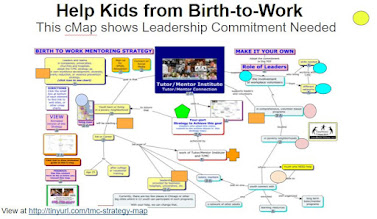
In all of these I've encouraged a day of learning, not just a day of service.  This week I created a new presentation, using Google Slides, to guide learning through a strategy map that shows commitments leaders can make to help kids in poverty grow from birth-to-work with support from business, volunteers, universities, philanthropists and more.

Open the presentation at this link.

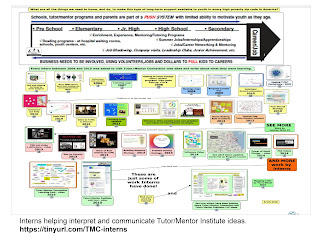
Between 2004 and 2015 interns from various universities in the Chicago region and as far away as South Korea were asked to review presentations like this, then create and share their own versions.  In the concept map shown below I point to some of their work. 

My invitation to all who celebrate Dr. Martin Luther King, Jr.  this weekend is that you and students you work with create your own version of the strategy map, showing your commitment to helping kids living in high poverty areas move safely through school and into jobs and careers which enable them to raise their own kids free of poverty.

Had people been doing this since the 1960's I feel the world would be a much different place now.


Friday, November 26, 2021

Creating service and learning organizations

If you've read some of the messages I've posted to this Blog since 2005 you'll see that I led a small non profit from 1993 to 2011 that connected workplace volunteers with children and youth living in neighborhoods of highly concentrated poverty.


This graphic shows some of the people who we connected to each other. These were from 10 to 25 years ago. I'm still connected to many via Facebook. I'm now seeing some posting pictures of their own kids as they finish high school or head to college. That was the goal.


While we led one small tutor/mentor program (called Cabrini Connections) we also led the Tutor/Mentor Connection, which aimed to help similar volunteer-based programs reach k-12 kids in every high poverty area of Chicago. I'm still leading that via Tutor/Mentor Institute, LLC.

Since forming this two-part strategy in late 1992 our goal has been to create an organized framework that encourages volunteers to serve as tutors, mentors, coaches, advocates, friends, leaders in on-going efforts that make a life-changing difference for these kids. By life-changing, I mean that the kids will not be living in poverty when they are adults because they will have the academic, social/emotional and workplace skills needed for 21st century jobs, plus a network of adults who can and will open doors to jobs and mentor them in careers.

This graphic visualizes the type of programs I've tried to encourage, based on the ones I led.


We recruited volunteers from various business backgrounds to be on-on-one tutor/mentor support and many of these began to organize extra learning, such as a computer lab, a video club, a writing club and a college access group.

I have spent time almost every day for more than 40 years trying to figure out better, more efficient, and lower cost ways to accomplish this goal, first by leading one small program at the Montgomery Ward corporate headquarters in Chicago, starting in 1975, then by leading the T/MC since 1993.

I have learned to mine the knowledge and experiences of others to innovate strategies for tutoring/mentoring, rather than trying to develop my own solutions to problems. Using T/MC web sites, on-line networking and regular face-to-face training and mentoring, I am trying to share what I know, and the process of learning and service that I apply in my own daily routine, so that there are more people in more places accepting this role and responsibility.


This graphic visualizes a service-learning loop formed when a volunteer enters an on-going tutor/mentor program. This video shows the graphic.

So how do we make this vision a reality? We create a "learning organization", which is also the ideal of many of the best businesses in the world. We also create a "service culture" modeled after the work of heroes like Cesar Chavez, whose core values included sacrifice and perseverance, commitment to the most disadvantaged as well as life-long learning and innovation.

In a learning organization, everyone is engaged. In the world of Cesar Chavez, everyone is willing to make huge commitments, and sacrifices of time, talent and treasure to help disadvantaged people move to greater health, and greater hope and opportunity.

Our goal is to find ways to draw a growing number of our stakeholders into this learning process and to build an on-going commitment to service (as opposed to random acts of kindness). This process is intended to include our students and volunteers, our staff, donors and leaders, and members of the business, education, faith and media in the communities where our kids live. It also aims to engage leaders and volunteers from other tutor/mentor programs in Chicago and in other cities, plus people and organizations in the communities that don't have high poverty, but benefit from a world envisioned by Dr. M. L. King, Jr. as well as a 21st Century America where there are enough skilled workers to meet the future workforce needs of American industry.

I use concept maps like this to visualize this goal.


Anyone can adopt this vision and lead it using their own talent and resources.

The Internet is our meeting place. It's a virtual library of constantly growing knowledge. On T/MC web sites we collect and host information that shows why kids in poverty need extra help, where such help is needed, who is providing help, and what volunteer-based tutoring/mentoring programs can do to connect adults, kids and learning in an on-going, constantly improving process of mentoring kids to careers.

If we can find ways to increase the percent of our kids, our volunteers, and our leaders and donors who are drawing information on a weekly basis, and reflecting on this information in small and large groups, the way people in churches reflect on passages from the Bible each week, we can grow the amount of understanding we all have about the challenges we face and the opportunities we have. We can innovate new and better ways to succeed in our efforts.

This process has already started. We need to nurture and grow it in 2022.

Can you help?

Browse the articles shown in the list on the left side of this blog and start your own learning.  I tagged this article with "learning" just as I have more than 300 previous articles.  I encourage you to read some of these on a regular basis. I also encourage you to read some of the Power Point Essay I've written, such as the one that shows our Logic Model

This and other PPT essays in the Tutor/Mentor Institute library illustrate the T/MC vision and the community of organizations that we seek to engage. Then share your own knowledge, time, talent and dollars to help us build this service and learning organization.

Thank you all for reading my messages. I hope you share them with others. May God Bless you all with peace, good health and happiness in 2022 and beyond.

Daniel F. Bassill
Tutor/Mentor Connection (1993-present)
Tutor/Mentor Institute, LLC (2011-present)

Friday, April 23, 2021

Follow Negative News with the "Rest of the Story"

There's plenty of bad news in the media and many non-profits working to change conditions that lead to these stories. I focus on volunteer-based youth tutor and/or mentor programs and have led a strategy for the past 28 years intended to help such programs grow in all high poverty areas of Chicago and other cities.  You can find more than 1200 articles on this blog that focus on this.

One challenge that most programs have is finding the operating dollars needed each year to host a space where kids and volunteers can meet, fill it with learning resources, such as computers and Internet access, and with paid staff who support both youth and volunteer involvement.

Most tutor/mentor programs are relatively small and don't have the type of staff most businesses do to advertise regularly and draw customers (donors, volunteers) to their locations.  Thus, they struggle to stay funded, or raise the level of funds needed.


Thus, in 1994 when I was launching the first survey of Tutor/Mentor programs in Chicago we began using maps to show where they were.  We published our list of programs in a Directory, starting in May 1994, and used maps to show where poverty was greatest and where existing programs were located.  We started putting this on-line in 1998 and launched an interactive program locator in 2004 and a map-based version in 2008.  Unfortunately after 2011 I was not able to keep these updated and the sites are now only available as an archive,.


I still plot program locations on a map, which you can find in this article, but no longer have the interactive features of the original program locator.

However, you can still zoom in and build an understanding of what programs are in different parts of the Chicago region.

We never had much money for advertising, and recognized that this was a weakness of many programs. Thus, we began a strategy I call "The Rest of the Story".  

When we saw media giving feature space attention to a "bad news" story, like one about poorly performing schools, gangs, or violence, we created a map showing where the incident took place, then used overlays to show the role of poverty.  We also showed locations of existing tutor/mentor programs in the area, and assets, like banks, drug stores, colleges, hospitals and faith groups, who are in the neighborhood and should be supporting efforts to make high quality, mentor-rich programs available to a growing number of k-12 youth.  

In the 1990s we put these map-stories in our newsletters and shared them at conferences.  We created maps for other youth programs, too.  In the 2000s we began to share these via email and our websites and in 2005 started putting them in blog articles.


However, too few people were seeing what we were publishing. Thus, I created a presentation showing how students and volunteers from schools throughout Chicago could be creating their own stories, modeled after the ones I've been doing.

Below is a presentation showing this strategy:


Note: I've been updating all of my Slideshare presentations and the ones I've embedded in past articles will no longer appear, since my updates have new locations.  I encourage you to visit my collection and bookmark it for future referral.

While I've struggled to keep my own mapping platform on-line others are creating robust data-mapping platforms.  Below is a concept map I created a few years ago to share some of these. 


Anyone creating "Rest of the Story" articles can use one or more of these platforms to build the base map you use in your article by zooming into the geographic area you're interested in, adding layers of information, then creating an image that you paste into Power Point or similar publishing tool. Then you can add additional information to the map. Once you're satisfied, save it as a JPG and you're ready to put it into a blog article, Tweet or Facebook/LinkedIn post.

If you're doing this please share your articles with me on Twitter or any of the social media platforms that you find in this link

If enough people adopt this strategy we can do much to make safe spaces available that help kids living in poverty areas move through school and into adult lives.


Monday, January 18, 2021

Service-Learning in Support of Dr. M.L. King, Jr's Dream


Millions around the USA are celebrating the life and words of Dr. Martin Luther King, Jr. today.  Here's an ESRI story map you might include in your learning.  

As in past years I'll be celebrating by learning and adding information to my web library.  Today I'm working on creating a page listing Instagram sites of Chicago area programs. 

I've been using this blog since 2005 to share what I've learned about leading a youth tutor/mentor program in Chicago from 1975 to 2011. I used an email and printed newsletter to share this in previous years.  

My goal (Tutor/Mentor Institute, LLC) is to create an organized framework that encourages volunteers to serve as tutors, mentors, coaches, advocates, friends, leaders in on-going efforts that make a life-changing difference for these kids. By life-changing, I mean that the kids will not be living in poverty when they are adults because they will have the academic, social/emotional and workplace skills needed for 21st century jobs, plus a network of adults who can and will open doors to jobs and mentor them in careers.

The graphic below visualizes my thinking. There already are many youth tutor/mentor programs operating in Chicago and other places, along with countless other non-profits aimed at helping reduce poverty and inequality in America.  Yet, if we plot where these organizations operate, and what age group they serve, or what they do on maps of Chicago, we quickly can see that there is a need for  more programs in many places.

Rather than start new programs from scratch, why not borrow ideas from what is already working? How can existing programs constantly improve? How can donors improve how they provide needed operating dollars? 


I have spent time almost every day for more than 40 years trying to figure out better, more efficient, and lower cost ways to accomplish this goal.

I have learned to mine the knowledge and experiences of others to innovate strategies for tutoring/mentoring, rather than trying to develop my own solutions to problems. Using T/MC web sites, on-line networking and regular face-to-face training and mentoring, I am trying to share what I know, and the process of learning and service that I apply in my own daily routine, so that there are more people in more places accepting this role and responsibility.

So how do we make this vision a reality? We create a "learning organization", which is also the ideal of many of the best businesses in the world. We also create a "service culture" modeled after the work of heroes like Cesar Chavez, whose core values included sacrifice and perseverance, commitment to the most disadvantaged as well as life-long learning and innovation.

In a learning organization, everyone is engaged. In the world of Cesar Chavez, everyone is willing to make huge commitments, and sacrifices of time, talent and treasure to help disadvantaged people move to greater health, and greater hope and opportunity.

For more than 40 years my goal has been to find ways to draw a growing number of our stakeholders into this learning process and to build an on-going commitment to service (as opposed to random acts of kindness). This process is intended to include students, volunteers, staff, donors and leaders, and members of the business, education, faith and media in the communities where our kids live.

It also aims to engage leaders and volunteers from other tutor/mentor programs in Chicago and in other cities, plus people and organizations in the communities that don't have high poverty, but benefit from a world envisioned by Dr. M. L. King, Jr. as well as a 21st Century America where there are enough skilled workers to meet the future workforce needs of American industry.

The Internet is our meeting place. Covid-19 has made this an even greater reality than in past years.  

It's a virtual library of constantly growing knowledge. On Tutor/Mentor Institute, LLC and Tutor/Mentor Connection web sites I collect and host information that shows why kids in poverty need extra help, where such help is needed, who is providing help, and what volunteer-based tutoring/mentoring programs can do to connect adults, kids and learning in an on-going, constantly improving process of mentoring kids to careers.

If we can find ways to increase the percent of our kids, our volunteers, and our leaders and donors who are drawing from this information on a weekly basis, and reflecting on this information in small and large groups, the way people in churches reflect on passages from the Bible each week, we can grow the amount of understanding we all have about the challenges we face and the opportunities we have. We can innovate new and better ways to succeed in our efforts.

This process has already started. We need to nurture and grow it in 2021.

Can you help?

Read past articles and visit the various web sites at the left side of this blog and start your own learning. Share these ideas with others via social media, ZOOM calls, videos and create  your own interpretation. Apply the ideas to your own city. 

I encourage you to read the Power Point Essay titled, Theory of Change which is one of several illustrated essays I've produced to illustrate our goals and the community that we seek to engage.

Since mid 2011 I've not operated under the Cabrini Connections, Tutor/Mentor Connection (T/MC) non profit umbrella, due to strategic changes made in April-June 2011. I created the Tutor/Mentor Institute, LLC in order to continue to support the growth of the T/MC in Chicago and similar organizations in other cities.  Thank you to those who have made contributions to help me continue this work over the past 10 years. 

Tuesday, December 08, 2020

Creating a Service Learning Organization that Mentors Kids to Careers


I started this blog in 2005 and often use past articles for new updates.  Below is a 2020 version of an article I wrote in December 2005, talking about "volunteering in tutor/mentor programs as a form of service learning".  If you've read some of the messages I've posted to this Blog since then you'll see that I led a small non profit between 1993 and 2011 that aimed to connect workplace volunteers with children and youth living in neighborhoods of highly concentrated poverty.

Our goal then, and now, is to create an organized framework that encourages volunteers to serve as tutors, mentors, coaches, advocates, friends, leaders in on-going efforts that make a life-changing difference for these kids. By life-changing, I mean that the kids will not be living in poverty when they are adults because they will have the academic, social/emotional and workplace skills needed for 21st century jobs, plus a network of adults who can and will open doors to jobs and mentor them in careers.

In the image above I show myself with Leo Hall who was in 4th grade, and living in the Cabrini-Green public housing development of Chicago, when I first became  his tutor/mentor in 1973.  We're still connected. He's living in Nashville and he and  his wife have raised two outstanding young men, who both have attended college. Here's an interview we did in 2016.   

I have spent time almost every day for more than 45 years trying to figure out better, more efficient, and lower cost ways to accomplish this goal.

I have learned to mine the knowledge and experiences of others to innovate strategies for tutoring/mentoring, rather than trying to develop my own solutions to problems. Using Tutor/Mentor Connection (T/MC) and Tutor/Mentor Institute, LLC web sites, on-line networking and regular face-to-face training and mentoring, I have been trying to share what I know, and the process of learning and service that I apply in my own daily routine, so that there are more people in more places accepting this role and responsibility.

So how do we make this vision a reality? We create a "learning organization", which is also the ideal of many of the best businesses in the world. We also create a "service culture" modeled after the work of heroes like Cesar Chavez, whose core values included sacrifice and perseverance, commitment to the most disadvantaged as well as life-long learning and innovation.


I created a ppt visualization of this strategy in the early 2000s, then in 2006 and 2010 two interns from Hong Kong and South Korea created animated versions.  One can be seen in this video

In a learning organization, everyone is engaged. In the world of Cesar Chavez, everyone is willing to make huge commitments, and sacrifices of time, talent and treasure to help disadvantaged people move to greater health, and greater hope and opportunity.


My goal has been to find ways to draw a growing number of our stakeholders into this learning process and to build an on-going commitment to service (as opposed to random acts of kindness). This process is intended to include students and volunteers, staff, donors and leaders, and members of the business, education, faith and media in the communities where kids in the programs I led were living. It also aims to engage leaders and volunteers from other tutor/mentor programs in Chicago and in other cities, plus people and organizations in the communities that don't have high poverty, but benefit from a world envisioned by Dr. M. L. King, Jr. as well as a 21st Century America where there are enough skilled workers to meet the future workforce needs of American industry.


The Internet has been a growing meeting place since the late 1990s. It's a virtual library of constantly growing knowledge. On T/MC web sites we collect and host information that shows why kids in poverty need extra help, where such help is needed, who is providing help, and what volunteer-based tutoring/mentoring programs can do to connect adults, kids and learning in an on-going, constantly improving process of mentoring kids to careers.

If we can find ways to increase the percent of our kids, our volunteers, and our leaders and donors who are drawing information on a weekly basis, and reflecting on this information in small and large groups, the way people in churches reflect on passages from the Bible each week, we can grow the amount of understanding we all have about the challenges we face and the opportunities we have. We can innovate new and better ways to succeed in our efforts.

This process has already started.  When I first wrote this in 2005 I was leading a non-profit organization with the capacity to raise money from individual donors, corporations and foundations.  Since forming the Tutor/Mentor Institute, LLC in 2011 I've not had a consistent source of funding, so much that was built through 2011 is now in need of new leaders and new life.

Yet the strategy remains the same. We need to nurture and grow it in 2020.

Can you help?

Visit the various articles shown at the left side of this blog, and the websites I point to, and start your own learning. I encourage you to read the Power Point Essay titled, Theory of Change . This illustrates our goal and the community that we seek to engage.

This and other PPT essays in the Tutor/Mentor Institute library illustrate the T/MC vision and the community of organizations that we seek to engage. Then share your own knowledge, time, talent and dollars to help us build this service and learning organization.


Every December I launch two ways for people to contribute money to support the Tutor/Mentor Institute, LLC.

1) make a birthday gift to support my Dec. 19 birthday. click here
2) contribute to the T/MI Fund  - click here

Thank you to the small group of people who have made contributions in past years. You're the reason I'm still able to collect and share this information.

Thank you all for reading my articles. 

Daniel F. Bassill
President
Tutor/Mentor Connection (1993-present)
Tutor/Mentor Institute, LLC (2011-present)

Wednesday, August 26, 2020

Help build the Chicago Tutor/Mentor Knowledge Base

Below is a graphic that visualizes almost all that the Tutor/Mentor Connection (1993-present) and Tutor/Mentor Institute, LLC (2011-present) have been trying to do for the past 25+ years to support volunteer-based tutor, mentor and learning programs in every high poverty area of Chicago.

In this post I'm going to show a role that volunteers, including students, can take to help me collect and maintain information that others can use to help youth in every poverty area of the Chicago region. 

The blue box in the middle of this graphic is where I've operated for almost 45 years. Initially I was connecting workplace volunteers with 2nd to 6th grade youth living in the Cabrini Green area of Chicago in weekly one-on-one tutor/mentor sessions held at the Montgomery Ward Headquarters in Chicago.

In 1993 I created the Tutor/Mentor Connection (T/MC) to try to help volunteers and donors connect with youth in all high poverty areas of Chicago, through organized non-school tutor, mentor and learning programs like the one I was leading. Since 2011 I've led the T/MC via the Tutor/Mentor Institute, LLC.

If the blue box on that graphic were a live link it would connect you to a vast library of information which I've been collecting formally since 1993.  The graphic at the right visualizes part of what's in the library.  It contains information about Chicago youth programs, including age group served, type of program, time of day, role of volunteers and location where services are provided.

Between 2004 and 2008 we built an interactive on-line program locator, which anyone could search to find specific programs in different zip codes of Chicago.  

Using this information anyone (see list at the right side of top graphic) can find places where they offer time, talent and/or dollars to help formal programs grow and help more kids and volunteers connect. Anyone, including program leaders and volunteers can draw from information in the web library to learn ways to constantly improve what they do to help kids.

While the library is vast (you can use this blog article to see various sections), I seek help in maintaining my list of Chicago area programs.  You can find this list in these places:

a) Chicago programs links in web library - click here. You can also see those programs on the map at this site

b) List of Chicago programs on Facebook - click here

c) Chicago programs list on Twitter - click here 

d) Chicago youth programs using Instagram - click here

My lists are organized by sections of the city (North, Central, South Central, South).  In the graphic at the top of this article you can see how I've created a grid, dividing the city into smaller sections.


My invitation is that groups in each section of Chicago will take on the role of reviewing links in my library to determine if those programs are still active.  If not, they will email me and I can remove those programs from my lists.  At the same time they will survey the neighborhood to determine if there are other programs that I should include in my lists.

NOTE: I'm not looking for every type of youth program in Chicago. I'm trying to find those who have a strategy that involves volunteers as tutors and/or mentors.  In the larger web library I have other sections where I point to other youth programs in Chicago and to others who are maintaining their own directories.

Anyone can do this work. It could be a class from a local school, a church group, an existing youth program, a civic organization, a business-sponsored club, or a college group.  

It's a great virtual learning project. All you need is a computer and internet access. You can work alone, or gather in a ZOOM group with your peers or mentors and discuss how you are locating programs and what you are finding.  You can share ideas for ways to draw attention to the programs in your area, then share those ideas with groups doing similar work in different parts of the city.


 If you want to take this role email me at tutormentor2 at earthlink.net and let's set up a ZOOM call where I can point you to the list and help you understand what I'm asking for.  Once you commit, I'll pin your organization to my map. Ultimately I hope to have groups in every part of the Chicago region.

As you learn about programs by looking at their websites I want you to use social media to tell others about them, what they do, where they are, who they help and how others can help them.  

That's the role of the BLUE box in the middle of the top graphic. I'm connecting people who can help with programs who need help in making a difference in the lives of kids living in high poverty areas. If you learn to take that role, and practice it for a year or more, it will become something you might do often throughout your lifetime.

That would dramatically change how non-profits are supported and how well they are able to do their work.

Not in Chicago? You can build a Tutor/Mentor Connection type strategy and take on the same role, to help youth tutor/mentor and learning programs grow in your own community. 

If you'd like to support me with a contribution, please visit this page

Wednesday, April 29, 2020

Engaging youth during Covid19 time at home

this graphic from
Genius Hour post
Earlier this week my #clmooc friend Sherri Edwards, a retired educator from Washington State, shared a link to an article titled "How You Can Support Genius Hour at Home".  I took a look and found it to be a creative way to engage student learners. So I'm sharing it.

In my email I received a message from a 10th grade student at Walter Peyton High School in Chicago. In response to Covid19, he and other 10th grade students have created Connect Chicago, "as a place to build friendships, supplement learning for CPS students, and improve the daily lives of those in need during a time of difficulty."

I agreed to help draw attention to their site, which I'm doing with this article, and my May 2020 email newsletter.


Open links under each
graphic - click here
As I learned about the student group at Walter Peyton I sent back an invitation, which I've also given multiple times to the #clmooc network of educators, and others, to engage students in learning the Tutor/Mentor Connection 4-part problem solving strategy and apply the process through their own actions.

At the right is a cMap I created to show some of the projects student interns have done in the past, which should be starting points to inspire what future students might do.

I shared this invitation last week, in this article.


Over the past few weeks I've seen dozens of articles showing how Covid19 has a greater negative impact on low-income people and people of color.  Here are just a few:

From The Economist: 4/27/2020 Closing schools for covid-19 does lifelong harm and widens inequality

From the World Bank: 4/15/2020  Poverty and Distributional Impacts of COVID-19: Potential Channels of Impact and Mitigating Policies

Human Rights Watch: 3/19/2020 US: Address Impact of Covid-19 on Poor

From Forbes: 3/29/2020 - 3 Ways Low-Income People Will Feel Heavy Impact Of Covid-19 Aftershocks

From the Shriver Center for Poverty Law: 3/23/2020 COVID-19 – Crisis Advocacy for Systemic Change

From Policy Link: 4/29/2020 - COVID-19 and Race Commentary

Anyone can do a web search and find dozens of similar articles. 

I've been aggregating articles that show inequality, racism and poverty in Chicago and America for many years in this section of the Tutor/Mentor library in an effort to make  it easier for people to find this type of information.

Description of 4-part strategy
Step 1 of the 4-part strategy that I've followed since 1993 involves collecting information and making it available to others.

Step 2 focuses on building greater daily public awareness so a growing number of people look at this information. Step 3 involves helping people understand the information in the library and learn how to apply it through their own actions.

Step 4 is the result of the first three steps. People apply the information in specific  places in a long-term effort to help kids move from poverty to jobs and lives beyond the negative grasps of poverty.

Students could be aggregating links to articles showing the negative impact Covid19 has on people in high poverty areas, then could be creating their own projects to share their understanding of the problem with others.

Look at ways students might communicate what they learn. click here
If you read the Genius Hour article imagine  how ever step could be applied to learning more about poverty, inequality and race issues in America and the world and actions each student could be taking throughout their lifetime to reduce these problems.  Think of how my 4-part strategy might align with the steps shown on the Genius Hour article.

Find your passion.
start here

There are other issues that students might research. I created the graphic at the right a few years ago to show how some of these issues are presented in the 17 United Nations Sustainable Development Goals (SDGs) and others show up on my race-poverty map.

None will be solved in a short time. All require the on-going and growing involvement of people throughout the world.  What better time to begin that journey than now when kids are not in school and educators and parents are looking for ideas to ignite their passion for on-line learning.

The more students read about the problems, look at work done by other students, and think through how they would communicate this through their own work, the more some will build a deep commitment to solving these programs and a life-long commitment to doing the work.

Connect people who can help
to places where help is needed.
What I add to this process is an on-going role of connecting people who can help (resource providers, volunteers, media, etc) to the information base, then directly to places where help is needed, using maps to assure a distribution to all places, not just a few high profile places.  This vision reduces the role of the "middleman" in deciding "who gets help" and increased the responsibility for resource providers to educate themselves and choose who to help, based on what they learn, and what a service organization shares on their website. 

I hope that many will use the articles on my blog and web sites as starting points and will share with me work that they and their students are doing. I'd be happy to talk with anyone about this idea.  Connect with me on one of these social media sites

4/30/2020 update - here's article from Denver Post Hispanic students disproportionately lack internet access. The problem is not limited to Chicago. click here

As we look at problems, look at paths to solutions, too.

5/3/2020 - How to Create Real Lasting Change After Covid-19 - RSA article. click here

5/3/2020 - Design for human and planetary health: a transdisciplinary approach to sustainability - click here (as you read this think of how this thinking might begin to be learned by kids, as early as elementary school)

5/3/2020 - The High Schooler Who Became a COVID-19 Watchdog - Fead about the high school  junior who recognized the Covid19 crisis in December 2019 and built a web site to aggregate information.  This is EXACTLY the type of student initiative and talent I think needs to be inspired and released in schools across the world.  click here to read article

3/23/2021 update - "Helpful education resources to teach students about the pandemic" from Educational Technology and Mobile Learning website.  click here

Tuesday, April 21, 2020

Reaching out to Universities - A Virtual Learning Opportunity

With colleges and k-12 schools closed across America, and the world, educators and parents are struggling to find motivating on-line learning activities.  Well, I've been sharing such an activity for more than 20 years. Maybe desperation will be the fuel for inspiration.


On-line learning
Below is an invitation I wrote in 2016.  As you read this (I hope) think of how students can work individually, or in teams, to learn what the Tutor/Mentor Connection/Institute has been trying to do since 1993. 

What am I talking about?
Look at this blog, started in 2006 by Michael Tam, an intern from Hong Kong. Browse articles since then and meet all the different interns who have spent time at a computer, learning about the Tutor/Mentor Connection/Institute, then sharing what they are learning through videos, animations, visualizations and/or blog articles.


Imagine your students doing this research and communications. Imagine a page on your web site sharing what they learn. Imagine you hosting ZOOM conversations where students and community members talk about what they are learning, like I did last week with students from Roosevelt  University.  Covid19 has highlighted the poverty and inequality in our country and in the world. 

Will we just talk about it, or will you create a student learning activity that creates current and future leaders, who map where the problem is, who is working to solve it, then creates on-going, student-generated, public education that draws more needed resources into each of these areas?


So here's what I wrote in 2016:

Here's a graphic that I created a few months ago in preparation for a meeting with some students and faculty at DePaul University in Chicago.


From top to bottom it illustrates a vision of creating youth serving organizations that help urban youth move more safely and successfully through school and into jobs and careers. It compares the planning to that involved in building tall sky-scrapers, where many talents are needed, much financing is needed, and where you work from the foundation to the top floor over a period of years.

The map in the middle illustrates that there are colleges and universities in different parts of Chicago (or other cities) who are full of student, faculty and alumni talent, and serve as anchor organizations able to support the growth of long-term tutor/mentor programs in the area surrounding their universities.

The last two graphics illustrate that while it takes daily effort by many people to build and sustain one, or many, youth serving organizations, this is just one issue that people are concerned with on a daily basis.,

Thus, part of the role of student teams on universities is to mobilize leaders who will focus their talent and resources on the youth development slide of the pie, while also connecting, sharing and drawing ideas from groups working on other problems, in other places.

Universities are critically important in this process because as we move through 2016 and into future years, there still is no body of knowledge that everyone draws from to build and sustain youth serving programs in high poverty areas that last for 10-30 years and show on their web sites the impact they have had over that many years.  Imagine if there were no thousand year history supporting architecture, engineering and the building trades, but that anyone who wanted to build a building, first had to figure out what talent was needed, and had to build training programs so the talent had the skills needed to build the building. Imagine them doing this while also trying to find the funding needed to develop the talent, and spread it to all the places where tutor/mentor "buildings" were needed.

I've created a huge library of ideas and information, with links to over 2000 other web sites, who each link to many thousand of additional web sites.  Working through this information will take years of study. Universities could make this a degree-earning process and provide manpower to support organization growth at the same time. Below is a presentation that outlines my goal. If you're connected to a university, or looking to put your name on a building at your alma mater, I hope you'll make this your mission.


I've written more than 1000 articles on this blog since 2005, and tagged most of them so you can view multiple articles focused on a similar idea. The tags are listed on the left side of this article. Below that are links to other web sites that contain additional information and resources.

--- end 2016 article ---


universities in Chicago
At the right is a map of Chicago, showing poverty areas, and university locations, created in 2008 by Mike Traken, who worked at the T/MC for 3 years (until the money ran out).  My goal since starting the T/MC in 1993 was that universities in every part of the city would have T/MC strategies, focusing on the area surrounding their university.  See Mike's map & article here.

Furthermore, my vision was that these universities would actually connect and share ideas and what they were learning, so each could have a growing impact on helping end poverty in the region.  

I've posted 77 articles on this blog since 2005, focusing on universities and roles they might take. This will be number 78.  Since every big city in the world has pockets of concentrated poverty, and universities, my invitation extends to the world. 

It's 2020 and that's still my hope.

Enjoy your reading. I'll look forward to hearing from you.

PS:  I just talked with Michael Tam a few days ago on Facebook. He's living in Hong Kong and serves as a curriculum development officer in the education bureau of the government. This is an example of the long-term connections I seek to foster.

Monday, March 23, 2020

Building learning habits during COVID19

Support learning
The image at the right shows volunteers and youth in the computer lab at the tutor/mentor program I led in Chicago from 1993 to 2011.  It's relevant now because it could be a room in millions of home throughout the world, where older youth and adults mentor younger youth and help them develop habits of curiosity and life-long learning.  Could we emerge from #COVID19 with a newly motivated culture of learning, where all are serving as coaches, tutors, mentors and guides?

In 2010 a volunteer who was looking at the resources of the Tutor/Mentor Connection wrote a blog article titled "Thinking like Google", in which he compared the T/MC to Google. He wrote,
It occurred to me that this forum is essentially modeled on a similar format as Google's. Tutormentorconnection.ning.com a) looks for information, or content, and people relevant to the cause of tutoring and mentoring; b) organizes, analyzes, and archives that information for future reference; and c) utilizes those references for targeted advertising campaigns, social networking, grant-writing, and the like. Even more to the point, this forum is a way of attempting to grow the idea of tutoring and mentoring to scale, or to a point where it "tips".

I've built a huge web library and I've created a variety of PDF essays over the past 20 years that are intended to help people learn ways to support the growth of volunteer-based tutoring, mentoring and learning programs in high poverty neighborhoods. While I point to these via email newsletters and social media, I've been looking for new ways to introduce these concepts.

How about a WebQuest?  How might I motivate students and adults to take Michael's advice and begin to journey through my web library, and as they do, share what they are learning with people in their own network, so they begin their own journey through this information.

Several years ago I began to learn about WebQuest and I created an animation to introduce this concept. You can view it on YouTube


Here are a couple of other animations introducing students to a web quest.

Making a map, class assignment, animation.

Doing a web quest.

Interns were on this journey for short bursts of time every year between 2006 and 2015.  Here's a page that shows work interns have done in the past to guide people through this information.

For the past 20 years, I've been updating the links on the web library so all are working, and I keep adding new links. I also keep adding new blog articles herehere and here. Some of the articles written 10-15 years ago are as relevant today as they were then, so while it's important that you subscribe and follow new articles, it's also important that you visit the past and read some of those articles.

learning communities
focused on specific geography
Here's a visualization done by one of our past interns that illustrates the goal of supporting groups of learners in many sectors, who each look at maps to determine where youth and families need more help, and what programs are already operating in those areas.....who need constant support to constantly improve and stay available.

The links in the web library point to more than 200 youth serving programs in Chicago and others around the country. They point to research articles and to business and foundation web sites.  They represent a large ocean of ideas you can use to help programs grow, by borrowing good ideas already working in different places, rather than by starting from scratch on an on-going basis.

Most of the links in the web library point to other people's ideas, not my own. This emphasizes the purpose of the library for myself, and others. We can do more by borrowing ideas from others than from constantly starting from the beginning.

However, some links point to my own ideas, which I've communicated with illustrated presentations which you can find in my blogs, and on this page and in libraries at Scribd.com and SlideShare.

Intern projects from 2004-2015
Students from around the world could be looking at the web library, and my articles, and could be creating their own presentations to draw adults and other students from their own community into this information, and into actions that lead to the growth of more programs in more places that help kids move through school and into careers.  Visit this page and see how past interns working with me in Chicago have already been doing this.

Pages like mine could be hosted on the website of every college, high school and middle school, showing work their own students have done to visualize solutions to complex local and global problems.

If you're hosting a web library, and creating visualized articles to motivate people to visit your library and support youth serving organizations in your community, please share your links so others can learn from you. If you're interested in exploring this idea with me, let's connect on Twitter, Facebook or LinkedIn.