Showing posts with label Chicago2011. Show all posts

Thursday, May 18, 2023

Chicago school closings. 2011 and now

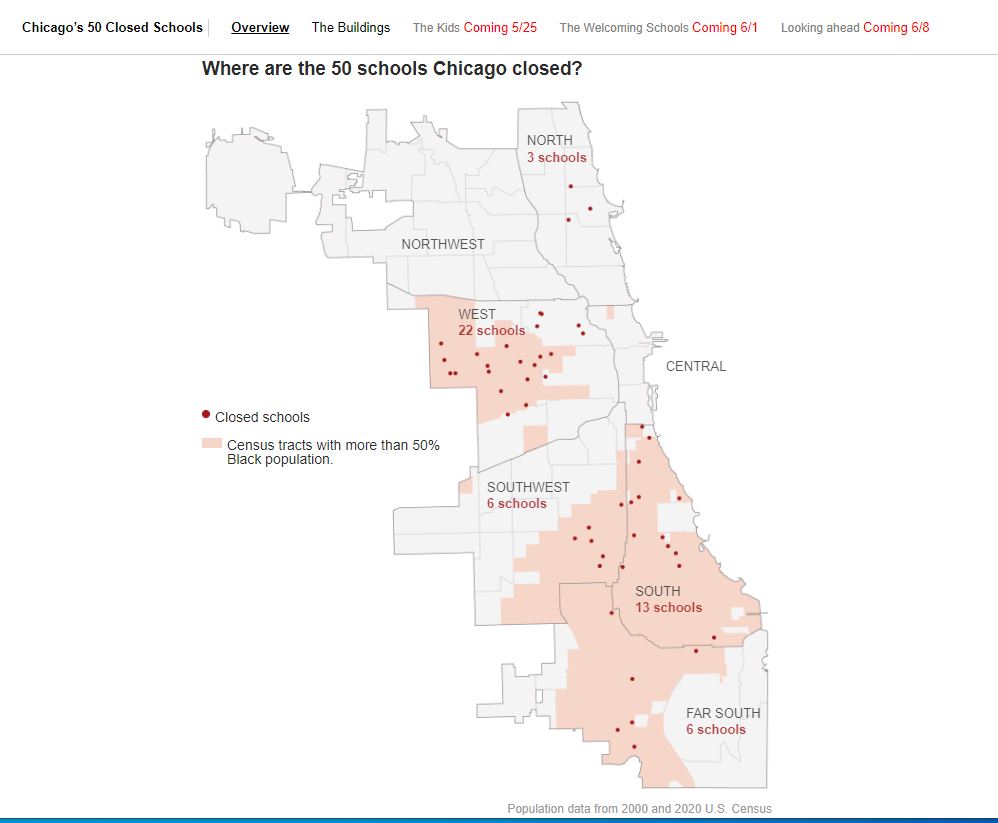
Today I read a WBEZ article titled "Chicago Closed 50 public schools 10 years ago. Did the city keep its promises?"  

Today's article is the first in a 3-part series and includes maps that show a majority of these schools were in areas with high concentrations of Black Chicago residents.

So far,  the answer to the question, is "No. Chicago did not keep it's promises."  I encourage you to read this article and the ones that will follow.

I was curious to see what I wrote about the school closings, back in 2011 when they were happening.  Below I've re-posted an article that I wrote in November 2011.

--- start 2011 article ---- 

Today's Chicago Tribune includes a feature article titled: CPS fails to close performance gap: Black students still losing academic ground despite reforms, study finds

It leads off saying:

Twenty years of reform efforts and programs targeting low-income families in Chicago Public Schools has only widened the performance gap between white and African-American students, a troubling trend at odds with what has occurred nationally.

Across the city, and spanning three eras of CPS leadership, black elementary school students have lost ground to their white, Latino and Asian classmates in testing proficiency in math and reading, according to a recent analysis by the University of Chicago Consortium on School Research.


It includes a statement saying:

"If school closings destabilized certain neighborhoods, other efforts were ineffective — millions of dollars pumped into countless after-school initiatives and tutoring and mentoring programs geared toward African-American students, only to see math and reading scores languish and many students fall further behind."

I challenge this statement of "countless after-school initiatives and tutoring and mentoring programs".

I've been hosting a database of non-school volunteer-based tutoring and/or mentoring program serving Chicago and have been using maps to show where these programs are needed, where existing programs are located, and where more dollars are needed to help programs constantly innovate ways to have a greater impact.

I tried to find census maps on the internet today to support this article. Here's one set of maps showing demographic concentrations in the Chicago region. This is from a U.S. Census Grids web site.


Here's a maps showing African American population concentrations in Chicago, created by the Tutor/Mentor Connection in the mid 2000s. On this map we've overlaid locations of poorly performing schools from the 2007 ISBE watch list. From both sets of maps you can see high concentrations of African Americans living in high poverty areas. You can also see a huge number of failing schools.

On this next map you can see locations of different non-school tutor/mentor programs in the Chicago area. You just don't see a large number of programs in many parts of this map. I encourage you to use the Interactive Program Locator (archive since 2018) and create your own map. Sort by type of program and age group served.

When trying to understand this information you need to think in layers. What is the distribution of tutor/mentor programs serving elementary school kids? Middle school? High school? In each neighborhood programs serving all three groups need to be equally available?

If "millions of dollars had been spent on countless non-school tutor/mentor programs" targeted at African American youth, the map should show many more programs in these neighborhoods than we show.

There may be more. This mapping project has never received funding from the city, the schools or major philanthropy. Thus, there may be programs we don't know about and some of our information is out-of-date. Furthermore, there needs to be many more questions asked, to know more about what these programs have in common, how they differ, what they need to find and retain quality staff and financial support, ways they can constantly improve.

The Tribune story offers a generalization that makes one think that millions of dollars were spent on a comprehensive tutoring/mentoring strategy. Millions may have been spent, but there is no evidence that any strategy has been used to assure that Chicago has a broad distribution of well-organized and constantly improving non-school tutor/mentor programs in high poverty neighborhoods.

This could change if the Mayor, a foundation or an investor were to become a partner and provide financial support to the Tutor/Mentor Institute, LLC so we can update the maps and launch an aggressive advertising campaign to help existing programs get the funding and talent they need to operate in more places and to constantly improve their impact over the next 10-20 years.

---- end 2011 article ----

If you've read any of the articles I posted before, or after, 2011, I've constantly encouraged leaders to invest in a city-wide network of non-school tutor, mentor and learning programs that reach K-12 youth in every high-poverty neighborhood.

No leader has yet embraced this strategy.  Maybe Chicago's new Mayor will make it part of his strategy, and his legacy.

He won't know about it unless you share this article with him or members of his team.  

You can find me on Twitter, Facebook, Instagram, LinkedIn and Mastodon (see links here). I hope you'll connect and invite your network to also connect.

If you'd like to help me keep writing articles like this and hosting the Tutor/Mentor Library, please visit this page and make a small contribution.

If you'd like to bring my archives into your university so students can study what I've been sharing and apply it to their own lifetime commitments, I'd really love to talk with you!  


Monday, August 22, 2011

Chicago Update - 100 Days

Last week the Chicago Tribune included an article about Mayor Rahm Emanuel's first 100 days.

Today's Chicago SunTimes has a 100 day report on the Chicago Police Department since Supt. Garry McCarthy took command.

In June I posted this article using a graphic I created to illustrate how the Chicago plan might be improved by using maps and graphics.

This this short PDF articlePDF expands upon this idea. Browse the various past article on this blog and you'll see many more visualizations and examples of how maps could be used.

I'm in the middle of my own FIRST 100 DAYS. I created the Tutor/Mentor Institute, LLC in mid July to provide a new structure to generate ideas like these and to mentor leaders into strategies that might support the growth of mentor-rich non-school k-16 programs in all of the high poverty areas of Chicago or similar cities.

My goal is to "Embed" myself and the ideas on the Tutor/Mentor Institute web site and this blog in the planning and strategy-making of many cities and organizations while providing direct support to the Tutor/Mentor Connection and its efforts to support the growth of tutor/mentor programs in Chicago.

If you can introduce me to others who might want to incorporate these ideas in their own strategies, or help me develop the mapping and visualization tools we show on the sites, please do. If you want to connect with these ideas join the Tutor/Mentor Forum or just post an introduction here.

Thursday, June 09, 2011

Equal Opportunity. Let’s Talk about it.

Earlier today I posted an article titled YouthMobs: Let's Talk About it. The headline was borrowed from a column by Richard Roeper from today's Chicago SunTimes. Below is a media map showing other articles in the SunTimes related to this story.

Since 1993 I've been creating map-stories following negative news, with the goal of enlarging the number of people who were doing serious thinking about ways to build a better distribution of non-school tutoring, mentoring, learning, career-development and enrichment activities for k-12 youth living in high poverty areas.

The articles I post are the result of leading a volunteer-based tutor/mentor program since 1975. That's over 35 years! Few people in the country have had to think of ways to connect youth and volunteers...and find donors and other support resources...for this many years!

During my first 17 years I held retail advertising jobs with the Montgomery Ward Corporation. From 1980-1990 I held different roles responsible for creative development of all print retail ads, or for building the annual advertising calendar that we used to draw customers to over 400 stores in 40 states.

I learned the power of central office planning and mass communications. By 1980 our tutor/mentor program at Wards had 200 pairs of youth and volunteers with no paid staff. I and others were the manpower leading this program. With a demanding job I had to find innovative ways to support our volunteers. Thus I borrowed from the mass communications strategies of Wards and other retailers to send print newsletters to our volunteers each week, pointing to information they could use to help them with their weekly tutoring/mentoring.

While my technology was a typewriter and duplicating machine in 1975-80 it became a Mac and PC in the 1980s along with a copy-machine. By the 1990s it became email and a web site.

The goal has not changed. As people are looking for information to show them what they can do we were collecting and hosting information that any of our volunteers and leaders could use to support their own involvement.

When we started the Tutor/Mentor Connection in 1993 we expanded on this. We built a database of more than 200 youth serving organizations in Chicago and thousands of potential supporters in Chicago and around the country. We began hosting this on the internet.

At Wards I had a $250 million budget to draw customers to our stores. In the T/MC I've never had an ad budget. We had a pro bono Public Relations firm help us for several years. However PR and media stories are not advertising. They don't have the reach and frequency to get customer attention and convert them to shoppers.

Thus we begin to follow negative news stories, such as the Youth Mob stories that are getting top media attention this week. When people are reading these stories the media are not pointing them to places where they can learn more about what they can do to build systems of support that might give youth better options.

We are. Browse the articles on this blog and the related links. Form a learning circle in your church, mosque, synagogue, college, business or political circle. Start learning from this information and begin to take on some of the leadership roles describe in this section of our web site.

As you know more, and do more, share your own strategies and work with us to get even more people involved. When the Mayor says "Chicago won’t move forward unless we all work to move forward together." we need to respond by learning where and how we can be involved, then acting every day in one way or another until the problems are solved.

This is not a short term solution, but if it has been supported since 1993 when we first began suggesting this way of working together to help inner city youth have more opportunities, we might be a lot further along now than we are.

Youth Mobs - It's News. Talk about it.

Richard Roeper's 6/9/2011 Chicago SunTimes column is titled "Yes, it’s news when mobs beat the innocent" He wrote, "The dominant conversation in Chicago these days isn’t about a New York congressman sending pictures of his maleness to women. It’s people telling each other to be alert and to be careful, even when in they’re in the nicest neighborhoods in the light of day."

So, if we're talking about it, how about talking about solutions?

The National Conference on Volunteering and Service was held this week. I attended in 2008 and wrote a series of blog articles following, that call on leaders to be more strategic in using volunteer resources to help solve community problems. This week Sam Lee, a student intern from Korea, created a summary of my articles. This graphic is from the first page. View the her presentation here.

Since this is NEWS, I encourage you to set up a discussion group in your church, business, college and political network. How can the ideas we share here become part of the Mayor's Chicago2011 Plan? What might be different today if Mayor Daley had began to adopt these ideas 20 years ago when I first began to share them with him and his staff?

Wednesday, June 08, 2011

Chicago2011 Transformation - Visualization

I've been writing about Mayor Emanuel's Transformation plan in a series of articles.

Throughout the plan are statements like:

Chicago can only succeed as a city if every part of Chicago succeeds.

Chicago won’t move forward unless we all work to move forward together. Success will be measured by asking whether all of our communities are thriving.

These plans are highly interdependent. For how can we even begin to think about the way our government should be structured and run without deep consideration of the supports that communities need and the best way to deliver those services? How can we grow without strong communities? How can we ponder what is best for our communities without thinking hard about the challenges our children face?


I've written about complex problems and visualization often in the past and I feel this plan needs some visualization to help people understand it.

So I've created this graphic to illustrate how the four parts of the Transformation plan are interconnected.
I've spent over 30 years thinking about some of the issues the new Mayor seeks to address. Thus, I'd like to be able to contribute to the planning. The graphic below illustrates some of the ideas we offer. All of the articles on this blog and in the Tutor/Mentor Institute represent ideas and strategies that need to be further developed and funded. If you can help us find investors or connect with people in government who might fund us as a consultant we can continue to develop and share these concepts.

Call 312-492-9614 or email tutormentor 2 at earthlink dot net to set up a meeting where we can begin to show you what these graphics mean and how you can apply them to your own learning, planning and leadership.

Monday, June 06, 2011

Chicago 2011 - my ideas

On May 15 I posted my first article about Chicago Mayor Rahm Emanuel's Chicago2011 strategy. Since then I've posted 11 more articles that can be used by the Mayor's team -- or any other leader -- to help make volunteer-based tutor/mentor programs more available in high poverty areas of Chicago and the suburbs.

While I'm trying to keep up with my writing, I'm also trying to figure out a new business strategy for the Tutor/Mentor Connection (T/MC), since the the T/MC will no longer be supported as part of Cabrini Connections, Tutor/Mentor Connection after June 30, 2011.

In the Mayor's Chicago2011 plan his goal for Children says "The path that leads a child through a post-secondary credential and into a career should be guided by a seamless education system that helps children access opportunities and find lifelong careers."

I would love to see the Mayor borrow this graphic to illustrate that idea. I'd love to see him using this concept map as a "blueprint" to illustrate the supports needed at each grade level for more kids to reach adults with a network of support that assure they have positive life-long careers rather than lives in the prison system and under-employment.

As I read Chicago2011 I just did not see a vision for "talent involvement" meaning the engagement of people from the workplace, colleges, the city and the suburbs in on-going efforts to build a system of supports that might send kids from high poverty neighborhoods to school better prepared to learn, and help them leave school with a broader network of people who can help them find jobs and succeed in careers.

I'd be happy to be a consultant to the Mayor and his planning team to help them integrate the ideas in the Tutor/Mentor Institute into his strategy. I'd love to have him "make a few phone calls" so I have the money needed to support the maps and conferences and other strategies of the Tutor/Mentor Connection so we can do more to help him achieve his own goals for Chicago youth.

Mayor Daley attended one or two Tutor/Mentor Conferences in the 1990s and signed a Tutor/Mentor Week proclamation each year from 1994-1999, but his support for the T/MC did not go beyond that. I hope Mayor Emanuel will see the potential and look for ways to incorporate our ideas into his strategies.

Update: I can now be reached at 847-220-2151 (cell phone). Give me a call.