Are you planning to march in a "NO KINGS" protest tomorrow? Have you been protesting already? I've been limited due to carrying an oxygen tank with me whenever I go outside, but I'm going to try to go out tomorrow. Be safe.
A few days ago I found this article on my LinkedIn feed.
I hope you'll read it. As the world descends deeper and deeper into chaos it is more important than ever that we find places to connect and learn from each other.
I've been building the Tutor/Mentor library since the 1970s, with books, videos, articles and research that I've found interesting and useful and have archived, to make it available to others. I started putting this on the Internet in the late 1990s and have added to it regularly since then.
Below is a map showing the entire library. Click here to view
This now has more than 2000 external links, plus hundreds of articles, visual essays and videos created by myself and interns who have worked for me in the past. Many of the websites I point to have their own extensive libraries.
Imagine all of the people who work in these organizations or write these article were connected in a huge information and problem solving web. Twitter had that potential. No longer. Other social media sites have also offered that potential. I started connecting with others in the 1990s via email list conversations, then Yahoo Groups, then Google+.
I built my library using this on-going question: "What are all the things we need to know and do to reach all kids in high poverty areas with organized tutor, mentor and learning programs that help them move safely through school and into adult lives, with jobs and careers that enable them to raise their own kids free of poverty?"
Each node on the concept map has a small box at the bottom that leads to an external web site or another concept map.
One section that I've been building for the past 10-15 years focuses on race, poverty and inequality, which are root causes for why we need extra programs and where they are most needed. This concept map show sections in this part of the library.
In 2016, after Donald Trump was elected to be President of the United States, I began building a list of articles on a DropBox page, showing the harm he was causing. I've expanded this list over the past nine years to show the forces that have put the rich in power over myself and the masses of ordinary people.
A mid 2024 addition was a video of the Midnight Kingdom Lecture Series, which is described as "a deep dive into the history of how our world was constructed using white supremist lies, religious mythologies, and poisonous conspiracy theories". It's based on a book by Jarod Yates Sexton.
Open this link to view Episode 1 of the series. I've only watched the first two videos so far, but it's already pretty depressing, and a strong reason to vote for Kamala Harris, just to slow the forces working against us.
That video is only the most recent of a long list of articles I've put on this page. The graphic below shows a few added in mid 2022.
In a July 2024 article I wrote about the Internet as a force for Change. By that, I meant that the Internet makes all of this information available to everyone with access. It's there, if you're motivated to look. It does what the printing press began to do about 550 years ago.
In Episode 2 of the Midnight Kingdom lectures Yates shows how those in power try to control media and all forms of learning to shape a world view that supports them staying in power. He also shows how people who are oppressed find ways to learn about issues and unite to create change.
The frightening thing is that they then become the ones in power, who apply the same tactics to stay in power. This is a constant, never-ending battle.
Now that Trump, and Project 2025 are in power, you can see them implementing the things Yates and others forecast in their articles and videos. People are rising to stop these actions.
That's where libraries like mine become important.
Here's a concept map showing another section of my library. It focuses on innovation, knowledge management, mapping, community building and collaboration.
While much information is available to show the problems we face, too little shows how we can learn, share and come together to try to solve these problems. The articles I point to in this section of the library can be used by people in any part of the world, to try to solve any complex problem. Open and close the links under each node, just to learn what's available.
As long as people make an effort to aggregate and archive resources that show what's happening and why, we have a slim chance of blunting the power-grabbing tendencies of those in power and give representation to the rest of us.
This only works if before and after we protest, we're spending time learning ways to be more effective.
Keeping this information available to you is an on-going effort. Since 2011 I've been the only one managing this effort (and paying for it from my own pocket and a small set of donations).
The history I point to extends back to the beginning of civilization when people in power began to use religion to force people to do the will of the people in power. It will continue into the future.
Beyond my lifetime. Maybe beyond the current version of the Internet.
Thus, I appeal to young people, future thinkers, technologists, etc. to reach out and take ownership of my archives (and those of others) to keep the library updated, and to move it to new platforms as the current ones are shut down.
You can find me on Twitter, Instagram, LinkedIn, BlueSky, Facebook, Mastodon, etc. See links on this page. Please share my articles so others have access to this information. Reach out if you want to help.
Finally, I appeal to you to join the small group of donors who make annual contributions to help me pay the bills. Visit this page.
In two days American's will celebrate the July 4th holiday. But with great fear among many of us, that this will be the last celebration of a democratic America.
November's elections will determine our future.
I've been posting articles around July 4th for many years. Below is what I posted in 2022, with a few updates.
Today millions of Americans are celebrating the founding of this country, while millions also are wondering when freedom and full rights of this country are available to them. Even more are fearing that freedoms that have been gained are now being taken away.
Many are sharing the quote from Benjamin Franklin, who said something like "It's a democracy, if you can keep it."
I'm often reminded of the image at the left. Is the person trying to stop a boulder from rolling downhill, to destroy everything below? Or is he trying to push it uphill, to achieve some lofty goal?
Maybe both. As you celebrate today, which role are you taking?
Below are a few concept maps that point to resources in my library that you and others can use to better understand the challenges we face and the opportunities that exist.
Since my focus for the past 30 years has been to help organized, volunteer-based tutor, mentor and learning programs grow in areas of persistent poverty, helping kids move from first grade through high school and into college and beyond, I've added another concept map from my collection.
This concept map shows challenges facing youth in high poverty areas as they move from birth to work.
The challenges shown on this map are also shown on the "POTUS TO-DO" list map shown above.
Getting people to vote has to be a priority over the next four months and next 40 years! Look at the work Rev. Dr. William J. Barber II is doing to unite poor and infrequent voters of every color, not just Black and Brown Americans.
Let's mobilize our power! Today, we’re having a #MoralMarchOnWashington & then working to reach 15 million poor & infrequent voters who can, in fact, be a major swing vote that can transform the political landscape in this country. #PoorPeoplesCampaignhttps://t.co/t2KWlhH54g
— Rev. Dr. William J. Barber II (@RevDrBarber) June 29, 2024
Look at the Twitter (X) feed for Dr. Barber, and see the ideas he is sharing.
As you gather with friends and family, or sit alone in your home, I urge you to take time bookmark these resources, then later take time to dig into the websites and articles I point to. Find ways you can help preserve and improve on what the founders created over 200 years ago.
Last May I posted an article with the headline, "Poverty in America. Why so Much?" I pointed to a presentation by Matt Desmond, and encouraged readers to watch it.
Today on Twitter (X) Matt Desmond shared a slide presentation that people can use as a study guide to understand poverty and take actions to reduce it. Here's the website where you can download the presentation.
Below is a slide from the PDF version. (scroll down to bottom of home page to find "Teaching Resources".
There are a lot of slides, with great visualizations, and each chapter has questions that can be used to stimulate discussion in learning groups.
The only thing missing from this is a chapter on social capital and ways volunteer involvement in on-going tutor/mentor programs can increase the number of people motivated to spend time reading Desmond's book and sharing these slides with their network.
6-30-2025 - visit the Othering and Belonging website and listen to a discussion of a new book titled "Structural Racism", by Stephen Menendian. Visit this page and read a paper titled "The Roots of Structural Racism Project". Scroll down to the bottom to see an extensive additional reading list.
8-7-2025 - view this video about "Structural Racism", by Stepen Menendian - click here
Below is a concept map that shows the birth-to-work timeline. If you view this in context of Menendian's book about "Structural Racism" one my frame the conversation about making these learning opportunities equally available to all kids, which would require different strategies for different places.
Look at the text box in the lower left corner, showing the role volunteers in tutor/mentor programs might take. Desmond's book mostly focuses on policy and what voters can do to reduce poverty. I'd like to see a chapter showing the support that needs to be made available, at each grade level, to every youth living in a high poverty area, and what policy, philanthropy and business involvement can do to make these supports available in more places.
Here's another concept map showing growth of volunteers who are well-supported in on-going volunteer-based tutor, mentor and learning programs.
I show this graphic in this blog article. I also show how interns created to animated versions of this graphic more than 14 years ago. It takes an intentional effort for leaders in volunteer-based programs to educate volunteers on this issue. It take consistent, flexible funding from donors for programs to hire and retain staff who do this well, and to make long-term, mentor-rich programs available in more places.
It takes network-building, like I keep repeating with this graphic.
Unless more people become personally involved, and get friends, family, co-workers and their professional networks involved, and stay involved for decades, we'll still see "poverty books" 20 years from now, with little change from today, or 30 years ago.
This is EASTER week. Millions around the world will be celebrating.
I've posted EASTER week articles almost every year. Here's one from 2018 which has a link to a PDF presentation with the maps shown above.
I've been preaching this message for 30 years. This blog and my website could be additional resources to people trying to understand the issues and solve such a complex problem.
However, too few have ever seen what I'm writing. You can change that if you share my blog articles and create your own versions to communicate these ideas.
Imagine a strategy in faith communities that engaged their congregations in an on-going study of poverty, using resources such as Matt Desmond's study guide and book. What if they created maps showing which of their congregations had such study groups in place?
I found Matt Desmond's post on Twitter (X). That's why I still use the platform. I'm also using many others. Find the links on this page.
Thanks for reading this article. If you want to help me continue this work, please visit this page and make a contribution.
In early May I watched a presentation hosted by the Urban Institute, featuring Matt Desmond, author of a new book titled "Poverty in America". Open this link to view the video of the presentation.
In a follow up email the Urban Institute summarized some of the key points of the webinar. They wrote: While no one policy is a silver bullet, Desmond suggests keeping these ideas in mind:
Social justice: “It’s impossible to write about poverty in America without writing about racism in America,” Desmond said. Black and Latinx families have lower incomes, a lower homeownership rate, less in savings, and ultimately less average wealth than white families. Therefore, any steps forward must come from the position of breaking down segregation and structural racism.
Targeted universalism: Rather than targeting one solution to each group or each problem, Desmond recommended identifying the desired societal outcome, then implementing many universal solutions that could address it.
Then, on May 21, an opinion article in Politico, by Sheryll Cashin, a law professor at Georgetown University and author of several books on racial justice and American democracy, provided an in-depth analysis in an article titled: America’s Poverty Is Built by Design: How did the U.S. become a land of economic extremes with the rich getting richer while the working poor grind it out? Deliberately."
I added links to Matt Desmond's website to the Tutor/Mentor Library. You can find them here, and here.
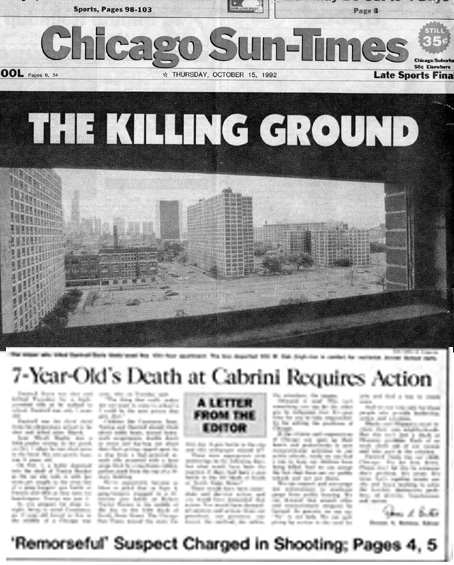
I and six other volunteers created Cabrini Connections (a site-based tutor/mentor program) and the Tutor/Mentor Connection in November 1992 following the shooting death of a 7-year old boy, in the Cabrini-Green area of Chicago. I've used this front-page story from the October 1992 Chicago Sun-Times as a reminder and motivation every year since then.
In the summary above Desmond is quoted as saying "individual actions can build political will for larger changes".
This is not a new problem. However, it's a problem that our leaders can't stay focused on every day, because there are so many other problems.
That's why I think it's important for another level of leaders to emerge, who are totally focused on building a better community understanding, and response, to the problems and solutions.
I've been issuing this invitation for the past 25 years, since we formed Cabrini Connections, Tutor/Mentor Connection, in the weeks following the shooting of Dantrell Davis in Chicago back in October 1992. I keep the front page of this Chicago SunTimes story in my office, as a reminder of my responsibility.
I've developed my own actions steps, and posted them on this blog in the past. Here they are again:
If we want to stop this violence, we have to act now, and keep acting to solve this problem for many years. We have to think spatially, that is, look at the entire city and suburban problem, not just one neighborhood. At the same time, we need to act locally, because none of us has the time, or the resources to help each of the kids in the entire Chicago region who live in neighborhoods where poverty is the root cause of the violence.
This animation was done by one of my interns after reading this article.
Here are some ways to remind yourself. Think of ENOUGH, is ENOUGH
E – educate yourself – most of us do not live in high poverty neighborhoods, so we only understand the root causes of senseless shootings from what we read in newspapers. We also only read negative news in the media, so we’re not really well informed on where these events are taking place most frequently. Finally, while there is a perception that there are plenty of youth programs, we really don’t have a good understanding of the distribution of different types of youth programs, to different age groups, in different zip codes. The only way this will change is if each of us pledges to spend one hour a week reading books, articles and web reports, that illustrate the root causes of these shootings, or of poor performance in schools. Through our learning we can draw ideas that we use in our own actions. We can also begin to contribute information that other people use to support their own decision making.
To help with your learning about race, poverty and inequality in America browse the different sections of the Tutor/Mentor library, shown on this concept map.
N – engage your network – find ways to draw others who you know into this shared understanding. Recognize people who volunteer time and talent, or who help kids through the programs they operate. If you are a business leader, or a church leader, engage your corporation or your congregation. You can use your web site, advertising, point of purchase materials, etc. to point to web sites that show all of the agencies in the city who do tutoring/mentoring, such as www.tutormentorexchange.net. If you do this weekly, year after year, your friends, coworkers and customers will become involved in solving this problem with you.
O – offer help, don’t wait to be asked. As you build your understanding of where poverty is most concentrated, and what social services are in those areas, choose a neighborhood, and reach out with offers of time, as a volunteer, talent, help build a web site, do the accounting, or offer Public relations services, and dollars, if the web site of an organization shows they do good work, you don’t need to ask for a proposal of how they would spend your donation, you need to send them a donation so they can keep doing that good work
U – build a shared understanding. Form groups of peers to share reading and learning assignments, just as you meet every Sunday to read passages of scripture and build the group’s understanding of the Word of God. Use the many different resources of the T/MC Links library as the starting point for your search for wisdom, and understanding.
G – give until it feels good – people who generously donate time and dollars to causes they believe in feel good about their giving. If we’re going to surround kids living in poverty dominated neighborhoods with extra learning and adult mentoring networks, donors will need to give more than random contributions of time, dollars and talent.
H – form habits of learning, and pass these on to your kids. Imagine how much more successful teachers were if youth came to school every day asking questions about where to find information, or how to understand information they had researched on the Internet the previous day? We can model that habit if we build it into our own activity. Keep a chart where you can document actions you take each week to same sure that this time ENOUGH, really means ENOUGH.
If you document actions, you can review what you’ve done at the end of each month, and each year, and begin to see a growing mountain of actions you have taken to solve this problem. Some of these will be actions that got other people involved, so that the good work you do is multiplying because of the good work others are also doing.
Through this process you help build this shared understanding, which will lead to better public policy. Without this habit of learning, and without learning to use the Internet to find good ideas from people in all parts of the world, we won’t be able to problem solve as well as we need to, and we won’t be able to teach this habit to our kids.
Share this post and the links I point to. Start discussions in your own circles of influence. Be the YOU in the graphic shown above.
If we do this, we’ll not only reduce the root causes of youth on youth violence, we’ll also address one of the growing issues facing America in a global economy. We will begin to create a nation of learners, problem solvers, creative thinkers and innovators, who use learning and information as the basis of creating opportunity and keeping America great.
Last night I had a detailed dream about the planning needed to solve complex problems. I wish I had my brain plugged into some type of Artificial Intelligence that could capture such dreams, and put them into text and graphic articles. Alas. I don't.
In the past few blog articles I've pointed to the #ETMOOC2 on-line learning community, which is digging deeper into AI and ChatGPT. In past years I've posted dozens of articles showing the value of online learning groups like #CLMOOC and #ETMOOC, with the goal that people working in the non-school youth development, tutor and mentor ecosystem might create similar on-going learning networks.
The goal would be "How can we do this better?" or how can we reach more k-12 kids with better programs that keep them safe and help them move through school and into adult lives where they can raise their own kids free of poverty?
Then, this morning, I thought of a graphic that I had created several years ago that shows steps in the journey from "here" to "there", or, "where we are now" to "where we want to be in the future". I found an article and video that I wrote in 2017. I'm re-posting it below.
---- start 2017 article ----
On Wednesday I posted an article about an on-line digital citizenship conversation, under the hashtag #digciz. I included a graphic from Kevin Hodgson's blog. Today I read another article from Kevin's blog, with a list of issues he is interested in.
Here to There Steps
That prompted me to look at some past articles I'd written, including this one titled "Social Media and Civic Engagement" where I point to another article by Kevin. In that article I also included this graphic.
Each text box on this graphic represents an issue that I feel needs to be part of any discussion of local-global problems and solutions. To me civic engagement is not just talking about who gets elected. It's talking to other people about ways we can use our own time, talent and dollars, as well as our votes, to bring solutions to some of those problems.
I created this graphic earlier this year to illustrate how much of our daily attention seems to be focused on what the new President of the US is doing, and what I and others should be doing to resist or elect different people to represent us.
However, the goal was to also show that we still need to provide daily attention to the problems we can solve, if we can just get more people to connect and work together, and more people to think creatively about ways they apply their time, talent and dollars.
In my article I wrote
I'm not just trying to motivate people to read and reflect. I'm trying to motivate on-going investments of time, talent and dollars to support the growth of youth serving organizations that help kids move through school and into jobs.
Thus, my list of topics is focused on problem solving, not just creating on-line discussions and learning opportunities.
I wasn't sure how to communicate what was shown on the graphic, so I decided to put the Lumin5 tool to a new test. Below is the video that I created.
Since 2005 interns have been looking at graphics and blog articles I've created and have then created their own interpretations, which I show here.
I think one thing educators and leaders of non-school tutor/mentor programs could do is to encourage youth to look at articles like mine, Kevin's and the #digciz community, then build their own interpretations and share them on various social media platforms. Others could do this, too.
For instance, take a look at the visualizations created during this Sketch50 event. Or look at the ideas Terry Elliott captured in the Storifyon his blog.
There are thousands of people creating visualizations daily. I'd like to focus some continuously on the graphics and ideas I've been sharing for the past 20 years in an effort to bring more people and resources to efforts that make mentor-rich school and non-school learning and youth development opportunities available to k-12 youth in every high poverty area of the country.
What do you think? Are your students doing this?
---- end 2017 article ----
I really hope you'll look at the video. I expand upon the thinking needed, and the resources, and timeframe, to help kids move through school and into adult lives.
Then look at the structure of the #ETMOOC2 event. It connects people from around the world, on many platforms, in on-going learning about AI and ChatGPT. This is a model that others could use in drawing people together to solve complex problems.
YOU could be the person or organization in your community that is building this type of community, or borrowing from #ETMOOC2 to expand what you're already doing.
I hope you'll share this and connect with me on Twitter, Facebook, Instagram, LinkedIn and Mastodon (see links here).
And, if you're able, send a small contribution to help me fund the work I'm doing. Click here to learn more.
This week I saw a post about a new campaign from the Chicago Independent Media Alliance aimed at raising needed operating funds for more than 30 different local media outlets.
— Chicago Independent Media Alliance - CIMA (@IndieMediaChi) October 3, 2022
Each of the participating organizations is using their own talents to draw attention to this campaign, and draw donations to themselves and their peers. It's a great example of applying "WE, instead of just ME", in the social sector where the fierce competition for scarce funding usually has non-profit campaigns focusing only on self-centered fund raising.
My vision, since forming the Tutor/Mentor Connection in Chicago in 1993 has been to generate attention and more consistent support for EVERY youth tutor and/or mentor program in the Chicago region.
Read about this vision below:
This is one of many maps you'll find on this blog and on the MappingforJustice Blog, which zoom into a Chicago neighborhood and tell a story of "why" kids and families need more help, "what" help is already in that area, if any, in the form of organized volunteer based tutor and/or mentor programs; and "what assets" and leaders share the geography and could be doing much more to help change the conditions and improve the lives of people who live there.
click to enlarge
I created the Tutor/Mentor Connection (T/MC) in 1993 and Tutor/Mentor Institute, LLC (T/MI) in 2011 to support the growth of well-organized youth tutor/mentor programs in all high poverty areas of Chicago. This graphic shows four strategies that I've followed since they were developed in 1993.
While we accomplished much and built a huge resource library, we've never had consistent funding or significant leadership support from Chicago business, political, philanthropic or other sectors. Thus, what we wanted to accomplish is far less than what has been needed.
Data collection and GIS mapping have been at the heart of T/MC work since 1993. This graphic shows what the T/MC has been trying to do and what has not ever been accomplished.
Annual cycle of Tutor/Mentor Connection mapping. Click to enlarge
We've built a list of youth tutor/mentor programs, organized bi-annual conferences (1994-2015) to bring leaders together, organized events to draw volunteers and donors to programs, generated considerable attention from local media, built a social media presence and more. It's been too little to change the overall range of poverty in Chicago, but has had a positive affect on many individual lives.
I created this Wiki Page to show what we were trying to accomplish. Feel free to read it and offer your help, or create a similar strategy focused on your own city.
When we started building a mapping capacity, and on-line program locator, the goal was that we could do more to support the fund raising capacity of programs in different parts of the city.
There were three goals that never have been reached.
1) There is a growing mountain of data showing levels of poverty and inequality in Chicago and the world. In the concept map shown at the left I point so some of these data platforms. The Tutor/Mentor Program Locator (since 2022 only available as an archive) used some of that data and like other platforms enabled people to zoom into small areas to look for the availability of tutor/mentor programs in small areas.
My vision was that we could create a form that would be accepted by grant makers, to show the need for tutor/mentor programs serving different age levels in different zip codes and/or community areas. Right now every program has to build their own case statement showing why it is important for their program to receive funding. Some have greater talent to do this than others. It's a redundant and expensive process with too few consistent winners. Thus, creating a form where you'd only need to enter a zip code or community area, plus the age group you serve, and the type of program you offer, should generate a report showing that you are needed in that area.
7-29-2022 update - below is a video created by a company called RS21 who is building data mapping dashboards and using the data in an analysis process that determines where services are needed and where to put them. View the video at this link. View other articles showing RS21 use of data - click here.
I point to the RS21 video because this is the type of analysis that was envisioned in 1993 when we began to plan the Tutor/Mentor Connection and it's use of maps. We never reached the capacity to do this in all the ways imagined.
I'm pointing today to the Chicago Independent Media Alliance because it's an example of what has been needed for the past 30 years and will still be needed for the next 30 years.
If we had fully developed this capacity in the 2000s, it would have lowered the cost to individual programs and given grant makers a consistent way to help them decide where to provide funding and who to support in each area.
We got partially there in 2004 when we launched this on-line searchable program locator form (since 2022 only available as an archive). However, the maps that this produced did not show demographic information or indicators such as poorly performing schools or violence. The Interactive Program Locator that was built in 2008 provided this information. However, there was no "easy-to-use" narrative generated in a "form" that could be printed that someone could pull from the site and use in a grant proposal.
The financial melt down starting in 2008 led to this work being discontinued in 2009 and to updates being discontinued by 2013.
So this is one bridge that we never were able to cross.
2) Motivating programs to provide data for the Tutor/Mentor Program Locator and keep it updated has always been a challenge. One way we partially overcame that was to have our annual survey included in the grant guidelines of the Chicago Bar Foundation's Lawyer's Lend A Hand Program. About 40 out of our list of nearly 200 programs submitted applications each year from 1995-20003 which I could use to update the list. However, that was too few and too time consuming for my small staff. Thus as we built the interactive portal in 2004 we developed an on-line form that programs could use to add themselves or update their data (not working since 2013). However, this still did not provide "motivation".
Note: I was sorry to learn recently that the Lend A Hand Program has ceased making grants to support multiple tutor/mentor programs, and will instead focus only on their own program. That's a perfect example of the "ME instead of WE" thinking.
click to enlarge
My strategy for motivating programs to provide information and keep it updated is shown in this PDF. The graphic at the right is part of it. As on-line fund raising portals grew since the mid 2000s I felt that we might create a portal that would work with the Program Locator maps, to encourage donors to support programs in different parts of Chicago and give media a resource to use in developing stories following incidents of violence, reports on schools, reports on gangs, etc.
On one level, we could draw from the list we were maintaining to give donors information to create the platform. However, on another level we felt that as programs began to generate donations, and learned to use the site to build their own campaigns, we'd create greater motivation to keep their data updated. We could even organize events at different time in each year to draw volunteers and donors to the platform.
Imagine the potential of stories about tutoring and mentoring calling attention to our maps and database and drawing needed resources into every high poverty neighborhood. Imagine the visibility this would generate if similar campaigns were happening in every city!
This is another bridge that has not been crossed. This has never gotten further than me putting the idea into this PPT and sharing it on my planning wiki.
click to enlarge
Media stories continue to remind us that some people in Chicago and other cities live with fewer resources and fewer opportunities than do other people. Thus, there's still a need for organizations that provide a bridge, connecting youth and families to resources and connecting people who don't live in poverty with people who do.
3) The final bridge - As we developed the Tutor/Mentor Connection in the 1990s we felt we could generate income to support our continued operations and innovation by making it available to other cities and offering our expertise to help them use it. When I formed the Tutor/Mentor Institute, LLC that continued to be the goal. However, that has not happened. Now my goal is to find people who will take time to understand what I've been trying to do and will want to take ownership and carry it into the future. One idea that might offer promise is to make the code for the Program Locator and any new platforms freely available on GitHub, so it could be more easily applied in other cities, and to other causes. That might attract more developers to help build in the features I've not been able to construct, and to keep updating it as technology and needs change. Having parallel portals in every major city of the US and the world would certainly contribute to greater visibility and greater traffic, and thus a bigger flow of donations through the portal and the maps to individual tutor/mentor programs in different places.
That's always been the goal. So far it's still a bridge to far to cross.
I sent out my monthly newsletter today. You can read it here.
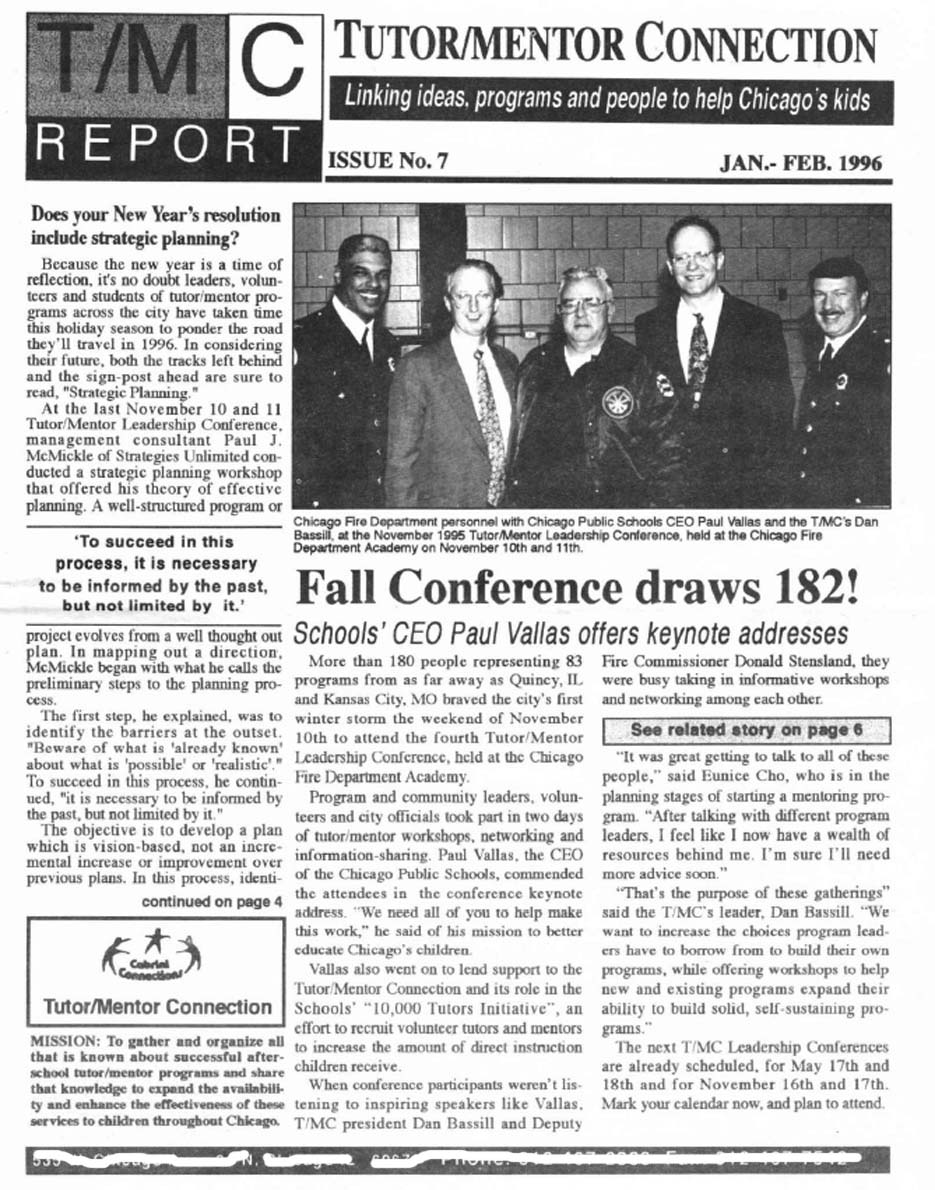
I've been sending out a newsletter, in print or email version, since forming the Tutor/Mentor Connection in Chicago in 1993.
At the right you can see the first page of the Jan/Feb 1996 newsletter, featuring a photo of Chicago Public Schools CEO Paul Vallas and leaders of the Chicago Fire Department. This was taken at the November 1995 Tutor/Mentor Conference, held at the Fire Department Academy. Vallas was the keynote speaker.
Below is a photo of former President Barack Obama, from 1999 when he was a speaker at another Tutor/Mentor Conference held in Chicago. See it on page 5 of this newsletter.
You can find archives of past newsletters on this page.
Here's another Chicago leader. When Arne Duncan was CEO of Chicago Public Schools he gave small grants to support the Tutor/Mentor Connection and spoke at the volunteer recruitment campaign kickoff in 2001. You can see this image in a 2016 blog article I wrote.
If you search for Arne Duncan, Barack Obama or Paul Vallas on this blog you'll find many articles where I've pointed to them.
There's a common theme. I point to information people can use to help build and sustain volunteer-based tutor/mentor programs in high poverty areas of Chicago. I point to research showing where and why such programs are needed. I point to articles showing how current fund raising practices don't do enough to support long-term programs. And I encourage people to use the information. Or if they pointed to maps the way I've done in more than 250 articles.
Below are recent Tweets featuring Obama, Duncan and Vallas.
There’s nothing I enjoy more than being with young people. And last week, I had a chance to speak with some of the bright students at Hyde Park Academy taking part in our Futures Series with the @ObamaFoundation.
Paul Vallas former CEO of the Chicago Public Schools Marc Sims talks with Paul Vallas about how the COVID19 pandemic is impacting public education.https://t.co/2xVSbj3n89
Now imagine how much more they might have accomplished over the past 25 years if they had been the authors of the newsletters I wrote, and the articles on this and the MappingforJustice blog. Of if they had consistently read the articles and then encouraged people they influence to also read them and apply the ideas.
Would more people have been investing in programs reaching K-12 youth in high poverty neighborhoods, helping kids through school and into jobs and careers?
Would more people "who can help" be responding to their appeals, and reaching out to offer time, talent and dollars to support school and non-school youth tutor, mentor, learning and jobs programs in every high poverty area of Chicago? Would this strategy have been duplicated in other cities and countries?
We will never know because they did not take that role, nor has anyone else of influence, celebrity status and power.
Well, it's never too late. Start now. Maybe in 2040 we'll see less poverty and violence, less structural racism and inequality, because of what our leaders, and others, do consistently, every week, for the next 20 years.
In my Twitter feed today I came across a post by Emlyn Cameron, containing a podcast essay that he wrote following the death in 2020, of his father, Charles Cameron.
I met Charles in the Social Edge forum in the mid 2000s and through conversations that he hosted there we developed a strong relationship that continued until his death. I did a search on my blog to see what I had posted that pointed to these conversations.
Since the Social Edge forum has not been active for the past decade I had to use the Internet archive to find links to some of the articles I had put in my blog prior to 2010. This led me to do some searching for articles including "Social Edge" and I found a couple using this graphic and the idea of Thomas Edison inventing the light bulb, then an industry to distribute light to every home.
Here's a 2008 article where I showed how this conversation on Social Edge about design thinking included this paragraph:
"Thomas Edison created the electric lightbulb and then wrapped an entire industry around it. Edison’s genius lay in his ability to conceive of a fully developed marketplace, not simply a discrete device. He was able to envision how people would want to use what he made, and he engineered toward that insight."
In an earlier article from 2006, I wrote this “After Thomas Edison invented the light bulb, he had to invent an industry to put light bulbs in every home. Imagine what it might have been like trying to think of every thing needed to make that happen, and not having much of a blueprint to follow.
I wonder how many are thinking like Edison, of all of the actions needed to end poverty and racism in America, or the world. For volunteer-based tutoring/mentoring to be part of the lives of more youth living in high poverty neighborhoods, and to stay engaged until each youth is starting a job/career, we need to be just as creative, and persistent as leaders like Edison and Dr Martin Luther King, Jr.
We need to build an industry that can provide the ideas, dollars, advertising, tech support and leadership needed by CBOs in every neighborhood in every big city. We need to make these resources continuously available for many years at thousands of tutor, mentor and learning programs in Chicago, in Detroit, New York and Los Angeles, and in every major cities around the world."
Since starting this blog in 2005 I've written hundreds of articles using maps to emphasize the need for well-organized, mentor-rich youth programs in every high poverty neighborhood. And I've used concept maps to visualize the team of talented people who need to be helping each program grow, as well as the many different types of mentoring, tutoring and learning each program needs to over, over many years.
As we head into another weekend and a new month I repeat these messages. I invite you to read some of my articles then share them with people in your network. Become the leader of groups who "think like Edison" and envision the "fully developed marketplace" of learning and enrichment opportunities needed in every high poverty area of the country.
Start conversations like this one hosted by Charles Cameron on Social Edge, in 2010. Its title was "Theory of Change: A Collaborative Tool?" Share the conversation on Twitter, LinkedIN and Facebook so I and others can find it and join in. That's what drew me to Charles back in 2005.
Thanks for reading and thank you for sharing. If you are able to help me pay the bills please visit this page and use the PayPal button to send a small contribution.
If you'd like my help understanding the ideas I'm sharing let's schedule a ZOOM call.
If you've read many of my blog articles you've seen this graphic, or a version of it. It shows a goal of helping kids born or living in poverty areas move through school and into adult lives, with skills and networks that enable them to have meaningful, decent-paying jobs, that enable them to raise their own kids free from the grip of poverty.
In this article I want to focus on skills. And habits.
Below is a Tweet that I commented on this week. I was listening to Patrick T. Harker of The Federal Reserve Bank of Philadelphia, on a @washingtonpost
live event. He was talking about an impending skills shortage in workforce.
Earlier that day I had received an email from Dr. Ed Gordon, of Imperial Corp. Consulting, with his latest White Paper, talking about the expected skills shortage. So I shared Ed's article in the Tweet, I hope readers will be interested enough to take a look at the video and Ed's White Paper.
Listening to Patrick T. Harker of Federal Reserve Bank of Philadelphia, on @washingtonpost live. He's talking about skills shortage in workforce.
Disclosure: I've known Ed since the early 2000s. For a few years he served on the Advisory Council of the Tutor/Mentor Connection. So he's been writing about this for more than 20 years.
10-2021 update. Here's a YouTube presentation of Ed Gordon introducing his Job Shock book.
So, what does it take to help kids develop skills and learning habits that would enable them to succeed in school (and meet business needs for skilled workers)? What motivates some kids to develop learning habits, while others seem indifferent? Educators have been struggling with this for decades.
Which comes first? Habits. Or skills?
Earlier this week my #clmooc network of educators shared a TED talk delivered by Laura Ritchie with an invitation to view her presentation and comment on it, using Vialogues. Laura's message of skill development was one of self-agency, "Yes, I can." was the message.
As I watched her TED talk, I thought back to the Illinois Wesleyan Commencement address which I watched on May 2. Geisha Williams, the first Latina CEO of a Fortune 200 was the speaker and her message was "Why not Me?"
I posted this Tweet with links to both.
As I listened to @laura_ritchie say "Yes, I can." I thought of a speech I heard a few weeks ago from Geisha Williams, the first Latina CEO of a Fortune 200 company. You can listen to her talk about the role of a mentor motivating her to ask "Why not me?". https://t.co/ljBEDcncQApic.twitter.com/XVRzOf6XGO
This is the challenge. All kids need to have the "Yes, I can" and "Why not me?" internal engines driving their learning. In the tutor/mentor programs I led from 1975-2011, the goal was to stimulate this thinking through the volunteer tutors and mentors we matched with kids and through the activities the program offered. At best, this was "hit and miss" with no "silver bullet" success that reached every participant.
I created this concept map several years ago to visualize the many different systemic barriers that kids in poverty have to overcome as they move through school and into adult lives. Volunteers and organized non-school programs are one resource that can help kids and families overcome these challenges, and my mission for the past 28 years has been to try to help such programs grow in more places.
However, the need to instill the "Yes, I can" and "Why not me?" spark in every child, reaches beyond poverty. Instilling in kids the habits, motivations, of learning is the challenge. Some kids seem to have this naturally, or it has been modeled for them by parents, siblings, neighborhoods, since birth.
What can we learn from others? The web library I've been building since the early 1990s is an attempt to aggregate information that anyone can use to try to understand the challenges facing youth, parents and educators and to learn how some people are addressing those challenges. If an idea is working in one place, why not borrow it and apply it to many places?
This concept map shows the four main sections of my library. Click on small boxes under each node to dig deeper.
I've been trying to make it easier for people to navigate my library for more than 20 years. I wrote this article last November, talking about learning libraries. I included the World Economic Forum (WEF) library as an example of what's possible. Below is a section that focuses on "Education and Skills".
When we created the first Tutor/Mentor Connection website in the late 1990s we used the hub/spoke design on the home page to help people navigate to different sections of the library. In the year's since I've seen other websites with this design feature, but have never been able to build that into my own library.
Thus, I keep pointing to what others are doing, and the information they host. These are just a few of the many, many libraries of information available to help people find better ways to help children become life-long learners, constantly supported by the "Yes, I can" and "Why not me?" internal motivations.
Finding time to dig into this information, make sense of it, then apply it in one or many places is a huge challenge. The graphic below shows a strategy I've recommended for many years.
The information available to everyone is represented by the circle at the right side of the graphic. Below the big circle are smaller circles, representing places where small groups of people can discuss the information in the library. To the left of the big circle are two graphics, representing what each person can do to encourage others to look at the information and join the discussion.
If you share this article in your social media you're taking the "YOU" role. If you start a discussion of this article in your faith group, workplace, fraternity, and/or family network, you're taking a deeper role.
If you discover other resources, such as more useful platforms/libraries, and you share them with me so I can add them to the Tutor/Mentor library, you're taking an even greater role.
If you do these steps regularly, perhaps we can get closer to answers that are used in thousands of places. That's the goal.
I'm on Twitter, Facebook, Instagram and LinkedIN. I look forward to connecting with you.
If you appreciate what I'm sharing, please visit this page and make a contribution to help fund my efforts. Thank you.
11-20-2021 update - The Infrastructure bill passed in 2021 does not include funds for training to produce workers to fill all the jobs created by the bill. Read commentary by JFF CEO
@MariaKFlynn
7-28-2022 update - not everyone thinks the problem is a skills shortage. Read this article by Harold Jarche
How to use this blog: Each article includes graphics. Click on them to get enlarged versions. Each article has many links (which are often broken on older articles). Open the links to dig deeper in the ideas and strategies I share. On the left side are tags which you can click to find articles that focus on the same topic.
Note: the PO Box address shown w many graphics no longer is active.
Learn more about me at http://www.tutormentorexchange.net/dan-bassill.
I combine 17 years of retail advertising, 3 years in Army Intelligence and 40 years of leading site-based tutor/mentor programs, the Tutor/Mentor Connection and the Tutor/Mentor Institute, LLC. Few people in the US have a similar depth of involvement and experiences.
I describe my work as information-based problem solving and host a library of my own ideas plus links to more than 2000 other sites which people can use to build and sustain volunteer-based non-school tutor, mentor and learning programs in high poverty areas.
You meet me in Twitter, LinkedIn, Facebook or other links shown below.






 Posts
Posts


