Showing posts with label STEM. Show all posts

Wednesday, March 05, 2025

STEM and Networks. Share These Resources.

Last week I participated in two webinars of interest. 


One was titled “State of STEM Ecosystems”. Visit this site for the video and a written summary of the ideas that were shared by panel members.

Then, visit this page on the STEM Learning Ecosystems website to view the resources they share.  

One other resource on the site that I want to draw your attention to is the map I show below. Open the link then click into any of the dots on the map and dig deep into work being done in each community in the network. It's extensive!


If you’ve read my blog for any length of time you have seen how much I value the use of maps. When I look at the STEM Learning Ecosystem map I ask, “How are these communities sharing ideas across the network, and within their own cities?” I also ask, “Do they have maps/directories that point parents, volunteers and donors to STEM programs in their communities?”  Are they educating donors to use maps to find STEM and other youth development programs to support?  How are they drawing attention to their libraries? 

The second webinar was titled, “Exploring Multiscalar Networks” with June Holley. 


It was hosted by Socialroots as part of the Network Coordination Commons. 

The full video from this webinar can be found at this link.  A shorter, 30 minute summary video is at this link.  And, slides from June Holley's presentation can be found on this page.  The three images shown in the graphic above are from June's slide deck.   Here's another review of June's presentation. 

Visit June's LinkedIn page and review her history.  She's been weaving networks for more than 40 years.  She created Network Weaver in 2018 to offer Network Weavers a hub of free information and resources to support their systems change endeavors. Beginning in 2021, Leadership Learning Community has managed Network Weaver in partnership with One Sphere, Ltd. Their vision is to empower network leadership as a catalyst for racial equity and justice, driving collective liberation through interconnected networks.

I’ve followed June Holley since the mid 2000s, but we’ve never connected in support of work either of us was doing.  Maybe it's due to her focus on helping networks grow and my more narrow focus on helping economically disadvantaged youth via long-term tutor/mentor programs.  You can read some of my articles about ecosystems here.   I've only learned about the STEM Learning Ecosystem recently. 

One of the STEM webinar panel members was Dr. Stephanie Rodriguez – Director of the STEMM Opportunity Alliance. During her presentation she shared the graphic below, showing questions that need to be asked and answered in each of these communities and across the entire ecosystem.


I watched the introduction to the STEMM Opportunity Alliance in 2022 and wrote this article, showing strategies that can be used to build STEMM learning programs in more places.  The ideas are as valid now as they were then.

The facilitator of the STEM webinar, ended with this question: "What will be our legacy in 10 years?"  

I was asked a similar question in 2014 and wrote this article, showing where I hoped the tutor/mentor ecosystem would be in 5, 10 and 15 years. 

In 2014 I wrote the following. I think these goals could apply to the STEM Ecosystem, too:

* In five years, the map of the Chicago region should show a growing density of needed youth and family services in areas where they are needed. These programs should have web sites that show what they are trying to do, and what they are accomplishing, using this Shoppers Guide as a checklist. 

* In ten years, the map should show an even greater density of programs in areas of need. Web sites of programs operating in 2014 and started over the next five years, should begin to show participation history, and stories of youth and volunteers who have been part of these programs and who now are further toward graduation and jobs. Programs started between 2019 and 2025 would show the same start-up information as programs starting in the first five years. 

* In 15 years the density of programs should reach all areas of need, and web sites of programs in place now should show a number of stories about alumni who have gone through the program and who are now adults who are working, raising families, and in some cases, providing support for the growth of the programs that were part of their lives as young people. If this strategy is supported consistently for the next 15 years, by donors, volunteers, media, business, etc. we should begin to see significant changes of where poverty is concentrated because there should be less in places where well organized programs are helping youth grow up, move through school, and find jobs. 

It’s 2025.  We are not close to achieving these goals. Maybe 2040?

One of the member communities is the South Side STEM  Opportunity Learning Landscape, which I wrote about in this 2023 article.  This is the direct link to their site. 


Then, this week I saw a report titled, “INCREASING STEM ENGAGEMENT THROUGH OPPORTUNITY LANDSCAPING” (on this page)

This paper on Opportunity Landscaping, co-authored by Nichole Pinkard, with Sheena E., Caitlin K. Martin, Yolanda J. Majors, PhD, & Natasha Smith-Walker, explores how we can better understand and design learning ecosystems to ensure equitable access to STEM and out-of-school learning opportunities. An example of this work is the Chicago South Side STEM Opportunity Landscape.

This information is all related.  Ideally, each community on the STEM Learning Ecosystem map would have a similar landscaping strategy in place, and would be constantly sharing what works, what doesn't, and what help is needed with others in the network.  Ideally, networks in each STEM community would be connecting with other youth development networks in the same community. 

This may already be happening. Is it? 

The sites I point to in this article aggregate information that can be used by members of their ecosystems and networks.  June Holley's presentation asks, "How do we connect across networks, to create "networks of networks".  I keep asking the same questions.

If you read my "Why do I blog" article you'll see my 2005 article, showing my goal of  creating a blogging space that links to the T/MC web sites, so that as people talk about tutoring/mentoring, we can use maps, charts and other web links to show them where, why and how they can be involved. 

As I listened to these two webinars I ask, "Where are people sharing these ideas in on-line conversations?  


I’ve shared my ideas and website with these networks for many years, but finding a place to interact has been difficult. I’m not part of the “in group” and never have been. That’s been a challenge since I started leading a volunteer-based tutor/mentor program in Chicago in 1975 while holding a full time retail advertising job with the Montgomery Ward corporation.

I post ideas here, and share links in my library, with the goal that a few people will see them and take them into these networks.  I put links to the STEM Learning Ecosystem in this section of my library and the Network Building resources in this section. I shared these in the webinar.

They area available to anyone in the world.  

Please share these resources. Help STEM programs grow in more places and help people in more places connect with ideas they can use to solve complex problems facing this planet.

Thanks for reading.  I look forward to connecting with you on LinkedIn, Mastodon, BlueSky, Insatragram, Facebook and even Twitter. 

Thursday, November 30, 2023

Data Platform Maps STEM Ecosystem in Nine Chicago Community Areas

I posted an article this morning on the MappingforJustice blog showing a  robust data visualization site created by Argonne Labs in partnership with Northwestern University’s Digital Youth Network.


I encourage you to read the article and think of ways you can create map stories using platforms like this, to draw attention and resources to specific neighborhoods where kids and families need more help moving through school and into adult lives and opportunities.

Friday, December 16, 2022

White House Summit on STEMM sets 2050 Goal

Below is a video of the December 12, 2020 White House Summit on STEMM. I did not watch it live, but viewed the recording. I encourage you to do the same. 


It's over 2 hours long, so you might want to watch it in smaller time frames. As you do, visit the STEMM Opportunity Alliance website.  The Summit stated goals for "Building a STEMM ecosystem rooted in equity, inclusion, and scientific excellence to power progress, innovation and prosperity for all by 2050."

As I viewed this I thought that leaders of this movement might benefit by borrowing some of the ideas piloted by the Tutor/Mentor Connection since it was formed in Chicago in 1993.  

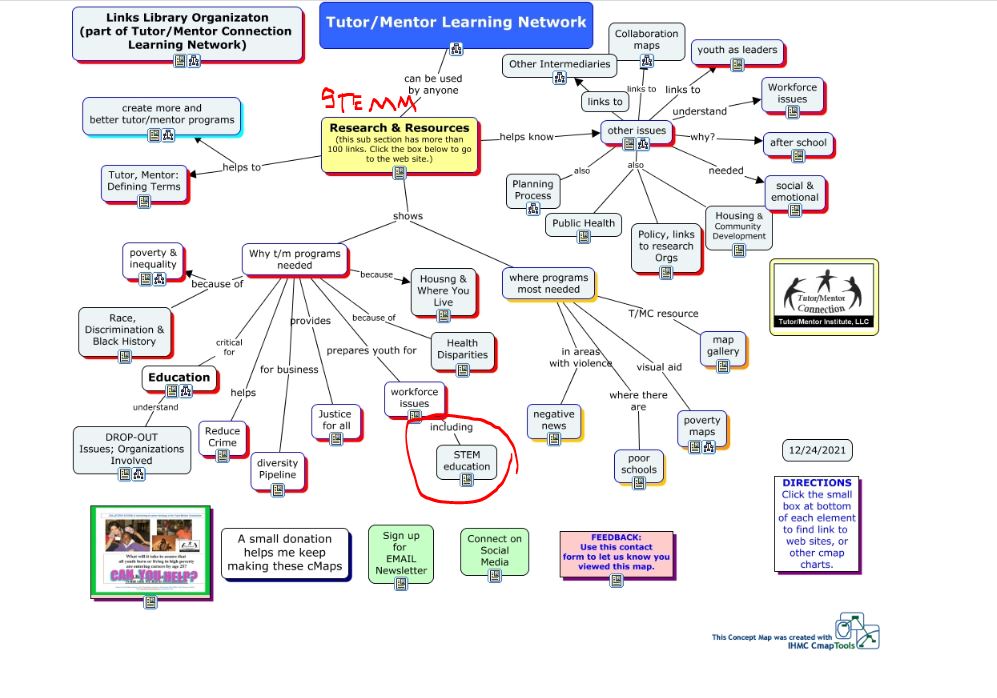
I used a red pen to highlight ways STEMM versions might be created out of concept maps I've used since 2006. 

Strategy map commitment:  (click on the graphic to enlarge).  View the original at this link. 

Read this concept map from the top blue box, going down to the left, then the right, then the center.  I've added "STEMM" to the job or career node and "STEMM" to the tutors/mentors node.  Every company, university, foundation, etc. who makes a commitment to the 2050 goal should create and share their own version of this concept map.  

Mentoring kids to STEMM careers: (click on the graphic to enlarge).  View the original at this link. 


This map shows supports EVERY youth need to move from first grade into a job/career over 25 years. That means that kids entering 1st grade in 2023 will be just starting careers by 2048.  It will require a huge ramp up of resources and support for that to be a reality.   I added "STEMM" to the elementary school, middle school, high school, college and life-long learning/re-skilling nodes. 

As a result of a concerted effort of STEM public and private sector leaders a map should be able to show mentor-rich STEM learning programs reaching k-12 kids in every high poverty area of Chicago, it's suburbs and other places with concentrations of  persistent poverty.


While I emphasize this focus on reaching youth in high poverty areas, it's obvious that a STEM initiative need to be reaching kids in all sectors and all income levels.  It's just that if we do not focus on poverty areas, these kids are likely to be left behind.

Strategic business investment in STEMM:  (click on the graphic to enlarge).  View the original at this link. 

The only addition I made to this map, showing reasons business should be strategically investing in all youth tutor and mentoring programs is to emphasize  "STEMM" careers in the yellow node at the bottom left.

Workforce Development strategy:  (click on the graphic to enlarge).  View the original at this link. 

On the right side of this concept map I emphasized that this strategy would lead to more "STEMM" workers.  Note the graphic at the lower left that emphasizes using all three time frames in a long-term strategy. 

4-1-2024 update - I added a link to an article titled "Early STEM education key to growing future chip workforce" to the workforce development links section of the library.  

It takes a Village. (click on the graphic to enlarge).  View the original at this link. 


One of the speakers in the video use this phrase to emphasize that people from every sector need to share this commitment.  I added "STEMM" to the center circle where it says "Pipeline to Careers". I also emphasized that I already show STEMM industries on this map.  

Who need to be involved:  (click on the graphic to enlarge).  View the original at this link. 

I added "STEMM" to the node showing "Business and Professionals".  Use this map along with the "village" map to emphasize that all sectors need to be involved. 

Who is supporting growth of STEMM programs in your community?  (click on the graphic to enlarge).  View the original at this link. 


This concept maps shows intermediary organizations in Chicago who support youth via organized tutor and/or mentoring.  It already has a link to the Chicago STEM Pathways Co-op.  Maps like this should be available in every city and state, pointing to local intermediaries and others who are supporting STEMM 2050 goals.

While these maps are aspirational, showing "who" should be involved, they also can show "who IS" involved, by placing links in each node to a "commitment" page showing a company's version of the "strategy map" shown first on this list.  Such maps are needed in every zip code of the country if ALL youth are to be reached.

4-Part Strategy to achieve the 2050 target: (click on the graphic to enlarge).  View the original at this link. 

I've been following this strategy since developing it in 1993 and launching Tutor/Mentor Connection in January 1994.  Step 1 focuses on collecting information.  I added an emphasize of "STEMM" to this node.  Step 2 and 3 focus on building attention and greater use of the information collected and helping people understand the information and how to apply it in their actions.

In Step 4 I added "STEM" to emphasize a desired result of building and sustaining STEMM learning, mentoring and career development programs in more places.

Building a library of STEMM research:  (click on the graphic to enlarge).  View the original at this link. 

This is part of Step 1 on the 4-part strategy map.  On this concept map I added "STEMM" to the "Research and Resources" heading in the yellow box and highlighted that I'm already collecting STEM links in the Tutor/Mentor Library.  In any STEMM  initiative a greater effort would be made to collect STEMM related research.

Support map-based inventories of existing STEMM youth serving organizations. 

This graphic is from a 2013 PDF report on the Chicago STEM Pathways Co-op website.  A new survey is being conducted now.  This type of information should be collected in every city, tribal area and Zip Code and used to a) understand availability; b) build support for existing programs; c) develop new programs in underserved areas.  

I already point to the Chicago STEM Pathways Co-op from this section in my library.  The STEMM Opportunity Alliance should have a research section with links to organizations like this in every city and state and should be hosting conferences, on-line forums, social media and other efforts that help people connect and learn from each other.

Resources to help STEMM programs grow in more places: (click on the graphic to enlarge).  View the original at this link. 

This is also part of Step 1 on the 4-part strategy map.  I added "STEMM" to the headings on this page and emphasized a need to add "STEMM" funding sources as a featured collection of links in the library. 

What I've shown above is just one set of resources that could be borrowed by the national STEMM initiative, or by any local initiatives.  I could do the work myself of creating versions of these concept maps showing the "STEMM" additions I've made.  But I think this should be work done by teams who are specifically focused on STEMM.

Mapping a path showing how communities get from "Here in 2022" to "There in 2050".  


This is just one graphic that I've created to emphasizes steps needed to achieve this goal.  View this graphic and video at this link. 

My focus is on helping kids in high poverty areas move through school and into jobs and careers.  I emphasize that with graphics like shown below. 


The STEMM Opportunity Alliance needs to have specific focus on these areas, with extra resources and investment, if more youth from high poverty areas are to be in STEMM careers by 2050.  However, it also will need to focus on other sub categories, which I emphasize in this article. 

Use all of the visualizations and ideas from this blog and the Tutor/Mentor Institute, LLC website. 

I've been thinking about systems needed to help all kids in high poverty areas move from birth to work, for more than 40 years. Thus I think there's a lot that others could borrow to support similar strategies focused on STEMM and other issues.  

However, my library points to more than 2000 links which have the ideas and thinking of OTHER people.  For the STEMM 2050 goals to be achieved information needs to be aggregated and programs need to be created that help people find,  understand, then apply that information.

If you've opened the concept maps and followed the links you'll see there already is a load of information that leaders can use to help build and sustain STEMM initiatives.  Thus, as you build your own strategy and resource maps, keep pointing to mine. 


I hope that over the next few years I can find blogs and websites with STEMM leaders standing in front of  maps and graphics pointing to where STEMM programs are located and where more are needed and strategies that help make each of those programs the best in helping kids through school and into STEMM careers.

Connect with me on one of these social media platforms.

Support the Tutor/Mentor Institute, LLC with a contribution on the FundT/MI page. 


Friday, October 17, 2014

CrowdFunding Tutor/Mentor Orgs in Chicago - Hive Chicago model

Yesterday I attended a Hive Chicago networking meeting, hosted at the offices of the John D. and Catherine T. MacArthur Foundation, which supports Hive as part of its Digital Learning Initiative, launched in 2005.

I encourage you to browse the Hive Chicago site. There is a lot to like about what they're doing to support digital learning opportunities for teens throughout the Chicago region and in other cities. One obvious benefit is that organizations approved as members are able to compete for funds made available for these projects.

The graphic above is from a crowdfunding platform supported by Mozella, another partner in the initiative.

I like this because it's what I've been trying to build for many years, as part of an effort I launched in 1993 to help constantly improving tutor/mentor programs grow in high poverty areas of Chicago. This graphic is from a mock-up I created three years ago to illustrate how a crowd funding platform could work with the Tutor/Mentor Program Locator Interactive Maps, to help draw needed operating dollars to programs in all high poverty neighborhoods, not just to a narrow segment of programs, or to high profile programs.

A couple of weeks ago I posted a blog article showing how data visualization could be tied to fund raising efforts, pointing to the Boston Indicators Project web site.

Editor note: Since writing this article the Donors Forum of Chicago has launched a campaign to encourage grant makers to share their grant making on a map platform hosted by the Foundation Center. This will be available for members of the Donors Forum of Chicago. See info here.

In this section of the Tutor/Mentor web library I show challenges non profits face, which primarily relate to finding consistent, flexible operating fund, and the talent to innovate solutions to complex problems.

Crowd funding sites that raise money for non profits AND for profits who are working to help improve the world are a step in the right direction.

I describe what I'm trying to build on this wiki page. By sharing this I realize I'm enabling others to borrow (steal) my ideas and move ahead of me on doing this work. I sure this would not be the first time. However, as the people in the Hive Chicago meeting said, this problem is too big for any one of us to solve. If my ideas inspire others to do work that needs to be done, I'll go to my grave a poor man, but knowing I've helped make the world a better place.

However, if anyone wants to provide talent and/or dollars to help me do this work, I'm looking forward to hearing from you. This link shows social media pages where you can connect with me.

Saturday, August 17, 2013

Building the Village of Youth Support in Chicago

On Wednesday, August 14 I attended the Why News Matters Summit in Chicago where a variety of speakers talked about "news literacy" and ways to make news literacy education available to youth and adults in more places.

As I registered for the summit I was congratulated by several people for my "letter to the editor" which had been posted in the August 12 issue of Crain's Chicago Business. A couple of people said "I passed this on in my network."

As I listened to the Why News Matters speakers I made notes to myself about how news literacy, and other forms of learning, might be made available to youth in Chicago neighborhoods via non-school, volunteer-based tutor/mentor programs. Last week I used this graphic in an article, to illustrate how volunteers from different work backgrounds could help build learning activities in different programs that would help build youth aspirations and skills for careers not modeled consistently by family or community in high poverty neighborhoods.

When I write about "business teams" my vision is that teams from media, arts, video, banking, engineering, etc. might work as a "virtual corporate office", with goals of identifying existing examples where youth already are exposed to different types of learning, such as the WhyNewsMatters program at Erie House, then recruit and support volunteers from their industry who would help embed these types of learning activities in other programs throughout the Chicago region (or in other cities).

I've already created a section of my web library with links to Chicago tutor/mentor programs, and with links to organizations that include health, STEM or arts as part of their activities. Existing programs can learn from what other programs are already doing. They can bring these ideas into their own programs if volunteers and business partners will help make that happen.

I've hosted a Tutor/Mentor Leadership and Networking Conference in Chicago for the past 20 years. It's goal has been to share ideas that work in some programs so that they can be duplicated in other programs, reaching more kids throughout the Chicago region. It's goal is also to find people who are looking at this from a much larger scale than a single program, or a single youth and volunteer. If you're WalMart, or any other big corporation, your "big question" is how to put profitable stores in thousands of locations. Through the conferences, social media, and constant network building, I'm trying to connect with people who are engaged in this kind of thinking.

How do we make mentor-rich programs available to k-16 youth in all place where they are needed? This can only happen if businesses, and business volunteers, help make that happen.

The next conference will be Monday, November 4, at the Metcalfe Federal Building in Chicago. I created this page on the conference web site to show a list of activities that could be demonstrated via workshops and panel discussions. If you have an arts, technology, writing, journalism, entrepreneurship, etc. component to your youth mentoring and tutoring strategy, please make time to organize a workshop and share your strategy with others.

Wednesday, September 12, 2012

Is the CPS strike addressing the US Skills Gap?

This info graphic is one parents and k-12 youth should be looking at. Policy makers should be asking schools what they are doing to motivate more young people to choose technical careers. Businesses should be building strategies that engage current workers as mentors who influence career choices of future workers.

America's Skills Gap
Infographic provided by WorkBoots.com

Look a these Leadership Ideas and build your employee engagement strategy to support your workforce development goals.

Thursday, February 09, 2012

Invitation to Engineering & Architecture Field

Last Friday I attended a STEM education summit and wrote a summary titled War on Poverty. Today I'm doing some follow up and reviewing my notes before I file them in one of my binders. Here's a couple of quotes/comments that I want to share.

"We need to develop habits of minds, persistence and problem solving."

"If we knew what it was we are doing, it would not be cause research."

"Imagination is more important than knowledge (Einstein quote). We want students to imagine a better world!"

"Engineering team works with scientists to develop a concept, then custom design and build the technology to implement the idea."

I wrote this while Dr. Ross Powell,a professor at NIU was describing the work done to develop the scientific research tools being used in a project to predict climate changes and future behavior of the Antarctic Ice Sheet.

The graphic I used in this article was created for me by an intern from IIT who goes to college in Korea. Imagine what type of blueprint, tools and strategies we might innovate if volunteers from STEM industries were working with us to "develop a concept" and "design and build" the programs and services needed to reach more of the kids who are not being reached with STEM mentoring and education opportunities.

I've been reaching out to STEM firms and volunteers for almost 20 years with an invitation to take on this role. I've been pointing to work done in the field with links in our library.

If you run a high school or college service learning/STEM education project, why not connect with me and let the ideas I've collected over the past 35 years support work young people and workplace volunteers do to design and build "a better operating system" for helping youth living in high poverty areas move through school and into STEM and other careers.

Saturday, February 04, 2012

Battle Plan for War on Poverty

I attended a STEM Education Summit in the Chicago area on Friday, hosted at Oak Park/River Forest High School. While the speakers at this Summit were not talking about the high school drop out crisis, which I've written about in past articles, they were talking about a workforce crisis that will result from baby-boomers retiring and not enough young people preparing to go into STEM (Science, Technology, Engineering and Math) related careers.

Over the past 18 years I've created a variety of graphics to illustrate this problem. The one below shows that the "pipeline to careers" is not working well enough to reach kids at an early age and provide a wide range of mentoring and learning supports that would result in a larger number finishing high school and post high school education and entering careers in STEM or any other avocation they choose.


In the conferences I go to and web sites I browse I don't see many who are using maps and charts and thinking about this problem the way generals and CEOs think about the distribution channels and logistics needed to win military wars, or business wars.

A few years ago I created a graphic that illustrates the planning that would need to take place to enable more and better mentor-rich programs to be in neighborhoods where kids don't have an effective entry point into the "pipeline to careers" nor to that have enough effective supports along the way. As a result, we're losing kids to street violence, bad health, poor nutrition, and lack of preparation for adult jobs and responsibilities.

I've been trying to think of a way to communicate this idea in an article that I could post on the Tutor/Mentor Institute, LLC web site or in the collection I've been building on Scribd.com.

If you look at this chart you'll see how I compare the planning process needed to support military forces in many places to that needed to make tutor/mentor programs available in many places. While many might want to create "pilots" or "demonstration projects" we can't really afford not to have some sort of learning support reaching K-12 kids in all of the high poverty areas of Chicago with intense forms of learning support and mentoring, while also providing needed supports to kids in all other neighborhoods who may need more inspiration and support to succeed in school and/or choose STEM careers.

Maps can help us focus our attention on specific parts of a problem. Out of all the people talking about education reform, perhaps some can focus just on high poverty neighborhoods, while others can focus on non-poverty areas. If we can segment our focus then we're talking about the same problems and able to converge on better solutions than if we have a mixed bag of discussion where the words are the same but the meanings are different, depending on what the economic and community support is for the kids you're talking about.

So, if we have a team focused on helping kids born in poverty be starting STEM careers in 20-25 years, the first step is to be building a library of information and ideas that the group can use to innovate new solutions that might generate more consistent support, and a better distribution of resources in more places.

To reach youth at every age level in more places with age-appropriate mentoring and learning a huge range of programs will be needed, meaning the planners need to be thinking of ways to recruit, train and equip thousands of program organizers, leaders, tutors, mentors, coaches, etc.

Imagine the logistics needed to put military forces all over the world and keep them supplied with food, weapons, ammunition, medicine, etc. The army of teachers, tutors, mentors and leaders needed to reach kids in every poverty neighborhood of the Chicago region requires the same type of on-going support.

The War in Iraq lasted over 8 years. World War II lasted 4 years. WalMart has been growing for more than 40 years! Imagine the thinking that is being done some place in the headquarters of the military and at companies like Wal Mart that enables them to constantly recruit and train new talent to take the place of those who retire, resign or are lost in combat. We need this same type of thinking preparing young people for STEM careers, and for careers leading programs that prepare young people for these careers!

We've spent billions of dollars fighting wars. Big business spends billions of dollars on their human resource development so they have well-trained people in the jobs that need to be filled in order for the companies to be successful. We need people who are innovating ways to generate revenue to support this massive infrastructure of youth development, mentoring and tutoring programs in just the same way.

It all comes down to how well you can build and sustain public attention, interest and support for the war effort. Companies spend millions of dollars on advertising and public relations to maintain support for their business strategies and to attract customers to their products and services. While there are events like National Mentoring Month, National Volunteer Week, Make A Difference Day, Black History Month, etc. where is the coordination and planning needed to turn these into an orchestra of events needed to build long-term public support for this battle plan to end poverty by help more kids through school and into 21st century jobs and careers?

I have been trying to map these ideas using the types of graphics I've used in this article, and using on-line platforms like this Debategraph tool.

I'm not sure how clearly I've communicated this idea. I invite others to do their own version of this story. However, while I may not be communicating as clearly as I'd like, I've spent more years thinking about this from a systems perspective than many others in this country. I've written more than 1000 articles on this blog alone, and created numerous illustrated essays posted on the Tutor/Mentor Institute, LLC site and in many other places.

If you're trying to develop a strategy to mentor kids to jobs and careers, I'd like to encourage you to read some of the articles I've written. I also encourage you to hire me to help you understand these ideas. I can come to you and talk about any of the articles on this blog, or that I've posted in the Tutor/Mentor Institute library or the Scribd.com library.

If you've been fortunate to amass great wealth and you want to leave a legacy, why not put your name on the Tutor/Mentor Institute, LLC or bring the Institute to alma mater where it can be integrated into the work a university does to prepare young people for adult roles.

If you'd like to connect, just post a comment or meet me on Twitter or Facebook.