Showing posts with label four part strategy. Show all posts

Monday, August 05, 2024

Adopt this 4-part strategy to help kids in YOUR community

All of the articles I've posted since starting this blog in 2005, and shared in the Tutor/Mentor Institute library since 1998, have focused on supporting non-school tutor/mentor and learning programs that connect with youth in elementary or middle school, then stay connected to help those youth through high school and into adult lives and jobs.

What are all the things we need to know and do to make effective, on-going volunteer-based programs available in hundreds of locations of a big city like Chicago?  I started asking that question in 1975 when I became the volunteer leader of a single program.  While starting a new site-based program serving Cabrini-Green teens, I and six other volunteers, created the Tutor/Mentor Connection in 1993 to build a library, sharing my experiences, along with those of others in Chicago and around the country. Instead of re-inventing the wheel, or starting from scratch, anyone should be able to borrow ideas from work already being done in different places.

We launched the T/MC with a 10-step plan, which we condensed to four strategies by 1995. These are shown in this concept map.  They need to be taking place within each individual tutor/mentor program, and at each resource provider, as well as in intermediary organizations.

Click this link to see the map.  Let's look at this in more detail.

The graphics below show each section of this map.

Step 1.  I've been collecting information about existing tutor/mentor programs in Chicago and showing that on maps since 1994, with the goal that volunteers, donors and leaders would use the maps to find programs in different neighborhoods that they could join and/or support, and that they could use to see where more programs are needed.  In addition, I've built a huge library of links to articles showing where and why these programs are needed along with ideas programs could use to build stronger organizations and that volunteers can use to be more effective tutors and mentors and advocates for strong programs.

When you go to the concept map you'll see small boxes at the bottom of each element of the map. The box on the left points to external web sites and the box on the right points to additional concept maps.  Thus under the Step 1 node you can find five additional concept maps that provide greater levels of detail and point into sections of the web library.

In this library you'll find links to youth serving organizations throughout the country as well as articles about philanthropy, fund raising and volunteer recruitment and training.

Step 2.  No mater how good the information in Step 1 is, it has little value if too few people are finding and using it. Thus, step two focuses on creating a daily frequency and reach of stories that talk about tutoring and/or mentoring and encourage people to visit the web library then search for programs they can support.  This page shows a list of newspaper stories generated as part of this step. This concept map shows some of the web spaces where we share this information.

Since the Tutor/Mentor Connection never had much money for advertising or public relations support, the strategies intend to recruit many leaders who will help create this public awareness, using their own visibility and communications tools.

Step 3.  With so much information available there is a need to help people understand and apply the information collected in Step 1.  This article and many that I've posted in the past are examples of how I do this, and how others could take the same role.  I hosted a Tutor/Mentor conference in Chicago every six months from 1994 through May 2015 to bring people together to learn from each other. I use social media daily to share information from the library, and to draw greater attention to tutor/mentor programs on my list.

The leadership strategies on this page show how this information facilitation role can happen at colleges, hospitals and businesses.  

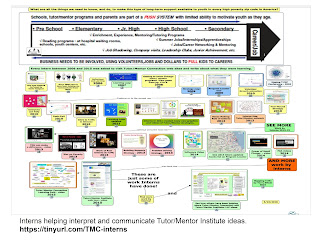
Visit this page and see how interns from many colleges have created blog articles, videos and visualizations to help people understand Tutor/Mentor Connection strategies.

View this concept map and see how others are using their own blogs to help people understand and use information collected in Step 1.

Step 4.   The result of better information (Step 1) and more people looking at it (Step 2) and more people understanding how to apply the information (Step 3) should lead to more people seeking out tutor/mentor programs in different neighborhoods to offer their time, talent and dollars to help programs constantly improve what they do to help kids connect with volunteers and learning opportunities and move more safely through school and into adult lives.

This is where the maps play an important role.  By mapping locations of concentrated poverty and other indicators showing where people need more hope, our goal is that more support flows to programs serving youth in every part of the Chicago region, not just to high profile neighborhoods or high profile organizations.

In some cases this means supporting well designed programs. However, in other cases it may mean trying to help programs become better than what they are today.

If you're not in Chicago you can use everything in this strategy. You'd only need to build your own directory of local programs, maps and indicators of need. 

This cycle repeats from year to  year.  As we help programs grow, and help them show their program design, strategies and successes on their web sites (see shoppers guide pdf),  we're also updating the information available in Step 1. Furthermore we're constantly adding new links to the web library, and almost every link we point to is also adding new information to their web sites.

Each year we need more leaders to make a commitment to helping kids in poverty areas move through school and into  jobs, using this four part strategy to achieve that goal.  As we succeed we provide continuous flexible funding and a flow of volunteer talent that helps every program, not just a few.

And that means we reach more k-12 youth, with better on-going support.

What can you do?

This article shows steps you can take.  Form a study circle in your business, faith group, high school, alumni or social group and read articles like this, or from the Tutor/Mentor library, on a regular basis, then discuss ways you and your group can use your own talent and resources to help programs in one or more parts of the region become the very best in the world at helping kids move through school and into jobs and adult lives.

Here's a short video showing these steps.


And here's a pdf presentation showing the four part strategy.  I also showed the four steps in this article.  Finally, below is another concept map visualizing help needed on every one of these steps, if we're going to have the impact we need to have, helping thousands of k-12 youth in  Chicago and its suburbs, and helping youth in similar cities around the country.


Read about the Tutor/Mentor Connection do-over.  Look at this PDF and see the value of the information being collected.   

If you want to offer your talent, become a sponsor, or support this effort in other ways please introduce yourself with a comment below, or email me at tutormentor1 at gmail.com.


Click here to see where you can find me on social media.


I've funded the Tutor/Mentor Institute, LLC since 2011 with the help of a small group of donors and by depleting my own savings.  Now, I'm beginning to have health issues and need to use some of these donations to help pay these expenses. 

Please visit this page and make a contribution.  Thank you. 

Friday, April 28, 2023

Building Attention for Youth Tutor/Mentor Programs - Strategy

In January 2019 I wrote an article titled "What the Heck Am I Trying to Do?" The graphic below is one of many that visualize the goal of drawing attention, ideas and resources to every volunteer-based youth serving organization in Chicago.  I've been trying to do this since forming the Tutor/Mentor Connection in 1993.

There are dozens of articles on this blog that share this strategy, and that encourage leaders in every big city with areas of concentrated poverty, to adopt it.  We launched the Tutor/Mentor Connection in January 1994 (after a year of planning), with the four-part strategy that I show with the concept map below.

While Step 1 of the strategy focuses on collecting information that can be used to build understanding and find better ways to help youth in high poverty areas connect with extra adults who help them move through school and into work, Step 2 focuses on public awareness, needed to get people to look at the information in Step 1.

While I've described the public awareness strategy in many ways, I realized today that I seldom shared the concept map that shows this strategy.  Take a look. 


This strategy is based on my 17 years working in retail advertising with the Montgomery Ward Corporation, between 1973 and 1990.  Every year we spent millions of dollars on weekly print, TV and radio ads intended to draw shoppers to the 400+ stores we had in 40 different states.  Every month our ads had different themes, timed to what customers were thinking about. So in August we had Back-to-School themes, while in May we had Mother's Day and Graduation themes. Obviously in December we had Christmas and Holiday gift-giving themes.  

So the T/MC built events that were timed to the rhythm of tutor/mentor programs. In August we focused on volunteer and student recruitment.  In November we drew programs together to share ideas while at the same time built awareness of the need for dollars to support every tutor/mentor program in Chicago, with the goal of influencing year-end giving.


While we never were able to get a radio campaign off the ground in February when programs were beginning to look for new volunteers to replace those who dropped out over the holidays, we did build on the January National Mentoring Month attention.  In May we held a year-end conference, to celebrate work done during the year, share ideas, and point people to work needed to launch improved programs when the cycle begins to repeat in August of the next school  year.

Without many dollars for advertising or public relations our strategy aimed to generate media coverage of our events. Our social media and newsletters aimed to draw visitors to our website, library and lists of Chicago youth programs.  

Our goal has been to influence actions people take to help others get involved, to help youth tutor and/or mentor programs grow in more high poverty areas of Chicago and other cities. 

On this page you can see news stories that were the result of repeating these events every year. 

Graphics like the one at the right try to visualize these ideas. You can see it in this article, and, in this article, you can see how interns shared it with their own projects. 


Another graphic that I've used often is the one below, emphasizing the 12 years it take for youth to move through school and the additional years it takes to get into a job and a career.  Kids who have a diverse network of adult support have better opportunities than those who don't.  Living in high poverty areas reduces the reach of your network. Being part of organized, on-going, volunteer-based tutor/mentor programs can help expand networks of support.


Through all of this I've tried to motivate other people to use their own media and celebrity status to draw people in their own network to this information.  

I'm still doing that. If you share this article, you're taking that role. 

Thank you for reading. I'm on Twitter, Facebook, LinkedIn, Instagram, Mastodon and other sites. Let's connect. See links on this page.

If you can help out with a contribution, visit my FundT/MI page, and use PayPal to send some help. 


Sunday, January 16, 2022

Celebrate Dr. King's vision by adopting this commitment

I've posted articles during the Dr. Martin Luther King, Jr. holiday many years in the past. This was from January 2021.

In all of these I've encouraged a day of learning, not just a day of service.  This week I created a new presentation, using Google Slides, to guide learning through a strategy map that shows commitments leaders can make to help kids in poverty grow from birth-to-work with support from business, volunteers, universities, philanthropists and more.

Open the presentation at this link.

Between 2004 and 2015 interns from various universities in the Chicago region and as far away as South Korea were asked to review presentations like this, then create and share their own versions.  In the concept map shown below I point to some of their work. 

My invitation to all who celebrate Dr. Martin Luther King, Jr.  this weekend is that you and students you work with create your own version of the strategy map, showing your commitment to helping kids living in high poverty areas move safely through school and into jobs and careers which enable them to raise their own kids free of poverty.

Had people been doing this since the 1960's I feel the world would be a much different place now.


Friday, September 24, 2021

Building knowledge-based ecosystem

I'm fascinated by their potential for bringing people together in ways that's not possible face-to-face. I've wanted to build this capacity into the Tutor/Mentor Connection for more than 25 years. 

I and six other volunteers created the Tutor/Mentor Connection in 1993 to "gather and organize all that is known about successful non-school tutoring/mentoring programs and apply that knowledge to expand the availability and enhance the effectiveness of these services to children throughout the Chicago region."

It's 2021. I'm still leading that effort, via the Tutor/Mentor Institute, LLC


1998 Crain's Chicago Business

I'd been leading a tutor/mentor program in Chicago since 1975 when we formed the T/MC. So I already had an extensive database of other programs in Chicago, as well as of foundations, businesses, volunteers and media. We did our research and planning, and developed a 4-part strategy in 1993. Then, we launched our first Chicago tutor/mentor program survey in January 1994 to systematically learn who else was offering non-school tutor and/or mentor services.


As we started reaching out to learn about programs we began sharing what we were learning with other programs, and with resource providers and other stakeholders, via printed newsletters. We began drawing stakeholders together to share and learn from each other via organized conferences in May 1994 and started organizing an annual Aug/Sept Chicagoland Tutor/Mentor Volunteer Recruitment Campaign in 1995.  You can view the goals of the conference here. See recruitment campaign history here.

We began sharing our list of Chicago tutor/mentor programs in a printed directory in 1994, but never circulated more than 500 copies a year. As we put our library on line in 1998, we also put our list of programs on line.

In 2004 we were able to launch an on-line portal where people could search for information about Chicago area tutor and mentor programs by zip code, type of program and age group served. In 2008 we launched a map based version of this.

With the maps we could show all the places where programs were needed, as well as what places already had service from existing programs.  Thus, our conversations were focused on a) helping existing programs get a more consistent flow of resources needed to constantly improve, while b) helping new program start where more are needed, borrowing ideas from existing programs, rather than starting from scratch.

The conferences and annual recruiting events we organized helped us generate a flow of print news stories, drawing attention to tutor/mentor programs throughout Chicago, not just to our own program (which I led until mid 2011). While we stopped our printed newsletter in 2002 we've been sending email newsletters every month since 2000. With our maps we crated map-stories following negative news, in an effort to draw more attention and resources to neighborhoods where help was needed.

I created this concept map many years ago to visualize how we were building a library of information that anyone can use to a) build and sustain volunteer-based tutor/mentor programs in high poverty areas; and b) understand root causes that created a need for tutor/mentor programs and placed challenges that made it more difficult to move safely from birth to work; so (c) more people who first became involved as tutors or mentors would become involved in building solutions that reduced, or removed, these systemic barriers.


Below I'm showing some elements of this concept map.

When I first created this chart I only included information that people could use to build and sustain volunteer-based tutor and mentor programs. (#1) on the graphic.  I updated that with the set of green boxes (#2) showing that the Tutor/Mentor library includes a much wider range of information about poverty, racism, inequality, challenges of funding, ideas for learning, and ideas for collaboration, knowledge management, etc.

Just getting a youth into a tutor/mentor program is often not a powerful enough influence to assure a successful  journey from birth-to-work. In high poverty areas there a many systemic barriers that need to be reduced, or removed.  Getting more people personally involved in the work needed to understand, then remove the barriers, can be one by-product of getting more  people involved as tutors/mentor and leaders in organized youth programs.  My own 40 year journey is an example of that.


The right side of the concept map shows two forms of learning, one formal, and the other informal.  Each are intended to support volunteer involvement that leads to a better understanding of the information in the library and the growth of more and better tutor/mentor programs in places where they are most needed.  

It also results in more people working to create systemic changes where those are needed.

Now look at the line across the top of the concept map.


Building the library is an on-going process, but it's only the first step in our 4-part strategy.  Getting people to look at the information in the library is an advertising and public awareness effort.  

Thus we published our list of programs in a printed directory from 1994-2002, then in an on-line map based directory through 2018. It's now available in an on-line list and a Chicago programs map.  I've used newsletters, blogs, social media, along with conferences and media events to draw attention to the library.

We began to use GIS maps in 1993 to show where tutor/mentor programs were most needed and where existing site-based programs were located.  We also started a "rest-of-the-story" strategy using maps to show where media stories focused on incidents of violence, or locations of poorly-performing schools.  We used these to who what assets (business, university, hospital, etc.) were in the area where the incident took  place, who could help tutor/mentor programs grow. This was part of our effort to draw greater attention to programs throughout the city.

We (#3) then organized May and November conferences to draw programs together to learn from each other and to provide information to help support volunteers and students in every program. This information was part of on-going formal and informal learning.  We organized annual August/September Chicagoland Tutor/Mentor Volunteer Recruitment campaigns to help programs find volunteer talent.  

Finally, we repeated this for 20 consecutive years.  

At the top right of the concept map I show events that we created in August, November and May to draw programs together and draw attention and resources directly to programs.  The May and November conferences were held every six months for 20 years. The Volunteer Recruitment campaign was a multiple-site event every year from 1995 to 2003 and has been an on-line activity, drawing attention to our on-line lists of Chicago area programs continually since 2003.

5-15-2026 update - see an updated description of this concept map in this Substack.com article. 

Ultimately my goal is that people from different sectors and different places are forming study and learning groups which draw from information libraries they find on line. While these groups engage in on-going face-to-face learning, they also engage in on-line conversations, with each other, and with people in other groups, expanding their  understanding of problems and solutions and building relationships with people who who might help...

....all with the goal of filling high poverty areas with needed programs and services that help kids move safely through school and into adult lives, jobs and careers  (see strategy map).

If you've read this far, thank you! I hope you'll visit some of the links and build your own understanding of the strategy I've piloted.  I hope you understand how this supports my own on-going learning and efforts to do "better today than I was able to do yesterday". 

While there are many intermediary  organizations in Chicago and around the country who focus on youth well-being and do some of the things the Tutor/Mentor Connection/Institute, LLC, have piloted, I don't yet see anyone including all of these steps, supported by a library with as much information as is included in the Tutor/Mentor Library.

Nor do I find anyone using concept maps as extensively as I have since 2005 to visualize strategy, process and information available.  

Yesterday the Ryan Family made a $480 million commitment to Northwestern University.  I dream of someone making a $100 million commitment to build a Tutor/Mentor Connection in every major city, supported by student/alumni teams from a local university.

That needs to happen soon so I can pass on all of my archives and enable people to build from what I've started, rather than start from scratch.  

If you'd like to help make such a community a reality, let's connect.

Sunday, May 16, 2021

Enough is Enough. Adopt this Strategy to Help Youth

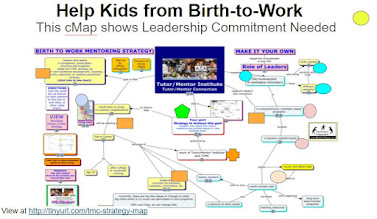
Below is a concept map that I've shared since 2005 showing a commitment I feel needs to be made by many leaders, if we're ever going to build the comprehensive system of supports kids living in high poverty areas need to move more safely and successfully through school  and into adult lives.

open concept map - http://tinyurl.com/tmc-strategy-map

I've listened to leaders for the past 30 years who talk about helping kids, but have not found any using maps or visualizations the way architects and engineers use blueprints to create a shared vision of work that needs to be done.  Or recruiting teams of people to support youth development, tutor and/or mentor programs reaching k-12 youth in EVERY high poverty area of cities where they live and/or do business.

Or using their media and visibility to draw volunteers and donors directly to programs already operating in their cities, the way this graphic visualizes. 


It's so easy to create a video, that I challenge leaders, from middle school through senior citizen, to create a video reading this strategy map to signal their commitment. 

I created three close ups, to provide a script for what people might say in such a video.

Look at the left hand side:  Follow the lines connecting the nodes on the map, which start at the top with "my goal is".


Then, look at the right hand side, showing that the strategy recruits workplace volunteers, to support comprehensive k-12 programs, that reach youth in high poverty neighborhoods with a range of needed supports.


Look back at the top of the graphic.  The vision is achieved by following a four-part strategy, shown by another concept map. The vision is also achieved by recruiting other leaders to also adopt the strategy.


The words are there.  This strategy applies in any city where there are inequalities and wealth gaps, with areas of people living in concentrated, segregated poverty.  That means youth or adults from any city could look at these maps, then create videos, animations or other types of communication, with their Mayor, local celebrities and sports stars, CEOs, faith leaders, and community activists sharing the message and the commitment visualized in this concept map.

If enough people make this commitment, and renew it from year-to-year for the next decade or two, we might begin to have more mentor rich learning programs in high poverty areas with the on-going support each needs to hire and retain talented staff, who can attract kids and volunteers, and keep them involved as the kids move from elementary school, through middle school and high school, then on toward jobs and adult lives.

Anyone can create such videos. It would be a great time for this video to appear on social media, with leaders showing their commitment to the strategy by saying "be a volunteer" and pointing to directories of youth serving programs in their communities, which were created as part of step 1 of the four part strategy.

It's not enough to wish more leaders would adopt this strategy, we need to know who is so we can recognize them in front of their peers, as a strategy to influence more people to also adopt the strategy.  Take a look at the concept map shown below:


I'm sure you've heard the "It takes a village to raise a child" statement.  What this map visualizes are the many different stakeholders in any community, organized in clusters.  If you've looked at my concept  maps, you'll see that at the bottom are nodes linking to other web pages, or other concept maps.  For instance, at some point in the future you might click on the circle with "legal community" and open a new map, where "legal community" is the  hub and the spokes lead to the many different types of businesses and professions make up the legal community.

Ideally, if you went to their websites you'd find a version of this strategy map, featuring the company leaders, signaling their commitment.   

Below is another presentation that shows ROLE OF LEADERS who adopt the commitment shown on this strategy map.  


If you've read this far, and opened the different links under each node on the strategy map,  you'll find this 4-part strategy. These are the actions that must happen in every city for leaders to be able to keep their commitment.

Read article outlining these steps - click here

Thus, if people were adopting the strategy map, and putting a version of it on their own web sites, we should be able to put links from this village map to their pages, thus aggregating links to leaders who are making a long-term, comprehensive commitment, to help kids grow up.

If you're tired of reading about violence and inequality, then say ENOUGH, and make an effort to adopt these ideas. 


I can't do t his by myself. I need the help of many to spread the word, gather the info, update the maps, etc.  

However, if you do adopt this strategy and put it on your web site, please send me a link so I can put a link to your site in my village map, share it with the world.

If you want to act as a producer and/or sponsor and help me re-do my own versions of these videos and strategy presentations, I want to hear from you. I need your help.
You can connect with me on Twitter, Facebook, LinkedIn, Mastodon, BlueSky or Instagram. Find links on this page.

If you're able, please visit this page and make a contribution to help fund the Tutor/Mentor Institute, LLC, so I can continue to manage this information and share it with the world. 


Wednesday, February 05, 2020

Making Youth Tutor/Mentor Programs Available to More Youth

Oct 15, 1992 Chicago Sun-Times
This was the front page of the October 15, 1992 Chicago Sun-Times which prompted the formation of the Tutor/Mentor Connection (T/MC). As leaders called for "action" we said "If  they don't know all of the youth tutor, mentor & learning programs operating in the city, who they serve and what they do, how can they ever know if their actions have resulted in more programs reaching youth in more areas of the city?"

I had led a youth tutor/mentor program since 1975 and had started drawing programs together to share ideas and support each other since 1976 so I had a good idea of the limited number of programs in the city. In my advertising role at Montgomery Ward I understood the need for regular communications to support multiple stores located all over the country. I felt that this type of leadership was needed.

click to enlarge
So we decided to fill the void.  We did the planning for the T/MC in 1993 and created the 10 point plan shown in this article. The plan focused on collecting information (step 1) that anyone could use to help build high quality tutor/mentor programs throughout Chicago, and that volunteers, youth and staff in these programs could use to help kids move through school and into adult lives.  Step 2 and 3 focused on getting people to look at the information and learn how to use it, to help programs grow in different places (step 4).

We decided to use maps to plot locations of programs and where they were most needed, as an easy to  understand visual tool.  By 1996 we had condensed the 10-points to this 4-part strategy which I've been following since then.

view 1997 Directory 
In January 1994 we launched our first survey and 120 programs responded.  With this information we hosted a first Tutor/Mentor Leadership and Networking Conference in May 1994 and published the first printed directory.  I've created an archive of these directories. You can see the 1997 Directory here. Every Directory followed this same format. If you'd like to see others, email me at tutormentor 2 at earthlink.net and I'll send you a link.

Unfortunately we were only able to send the printed directories to a few hundred stakeholders in Chicago each year from 1994 to 2002.  However, we began to put the information in the directory in a www,tutormentorconnection.org web site in 1998.

view at this link
Then in 2004 we launched a searchable on-line directory that also enabled us to more easily up-date the content on a regular basis.  That is still available although due to technical problems it has not been updated since 2013.

This offers many advantages over the printed directory. Now you could search for age group served (elementary, middle and high school), type of program (pure mentor, pure tutor, tutor/mentor) and location. Thus a parent or volunteer looking for a program in a specific zip code could use this to find if any were in our list.

Leaders could also use this to determine if there were enough programs in different places.

Browse list of map stories
In 2008 we launched an interactive map-based version of the Directory. The 2004 search platform worked like a Google search. If you knew what you were looking for you could put in the zip code or name of the program and find whatever information was in the Directory.  We reversed that by creating a map of the Chicago region, with searchable overlays. We also added an assets feature, showing banks, colleges, drug stores, hospitals, etc. Using this people could zoom into a section of the city and create a map showing the need for non-school programs, existing programs, plus assets who could help programs grow in that area.

Here's an article from 2010 that shows the directory and our use of maps.  In 2008 we also launched the MappingforJustice blog to share our maps. Since 2011 I've used this to share map platforms created by others, in addition to map stories created using the Program Locator.

Support Tutor/Mentor Institute, LLC
Due to the financial challenges of the late 2000s the mapping platform has not been updated since 2010 and the program data has not been updated since 2013.  However, this still works as a model that could be re-built and used in Chicago and every other major city in the world where poverty is a root cause of many problems and is usually concentrated in small sections of big cities.  I created the Tutor/Mentor Institute, LLC in 2011 to try to keep the T/MC alive in Chicago and help it grow in other cities.  I'm still trying.

Today I saw a commentary on Crains Chicago Business calling for more programs to help youth. I shared it on Twitter.


Without a T/MC type strategy it's not likely to ever result in enough programs in every high poverty neighborhood helping youth move through school and into work.


This is one of dozens of graphics that I've used to visualize the ideas I've been sharing since 1994. If you're creating similar graphics please connect with me on Twitter, Facebook and LinkedIN and share them.

If you're not, the please share my graphics and blog articles with your network.

Saturday, September 14, 2019

Five Dot Challenge from #CLMOOC

On Twitter - click here
If you've followed my blog for a few years you have seen me point to the Connected Learning #clmooc network that I'm connected to on Twitter, Facebook and via blog articles.

For the past week or so I've seen this invitation to participate in a five-dot challenge, which is illustrated by Kevin Hodgson in the Tweet at the left.

What you've also seen if you've read past articles is that I usually connect these activities to work I'm doing.  So, my five-dot challenge graphic is shown below.

My five dots are shown on the 4-part strategy map.  
The Tutor/Mentor Connection piloted this strategy in 1993 and I've followed it since then. You can see it on the strategy page of my main web site.  I wrote several blog articles describing the 4-part strategy. Here's one.  http://tutormentor.blogspot.com/2017/07/four-part-strategy-to-help-k-12-youth.html 

See intern visualizations
As I write my blog and share with educators and leaders of other youth tutor, mentor and learning programs in Chicago and other cities, one goal is that youth in these programs look at these articles, then create their own interpretations, using a variety of different media and communications formats.  Visit this page and see how interns from South Korean and US universities have interpreted the four part strategies of the Tutor/Mentor Connection (which I now lead via Tutor/Mentor Institute, LLC).

I've never had enough support to do all that I've been trying to do, and have believed that youth in high school and colleges throughout the country could provide manpower and talent to lead Tutor/Mentor Connection-type strategies in their own communities.  Below is another version of the four part strategy, which in this case, shows work youth could be doing.

Look deeply and see ways youth and others can help - click here

While I've tried to inspire people to share what they find on my web sites, blogs and social media post, those who have been doing that are pretty scarce.  Visit this cMap page and you can view blog articles that show how some people have been doing this.

View here

Thus, I've been really impressed by how Democratic Presidential Candidate Andrew Yang has inspired dozens (probably more) of people to create videos telling their #MyYangStory.  The one shown at the left is just one that you will find if you search #yanggang on Twitter. 

I've not made a commitment to vote for Andrew Yang. What I'm saying is that I'm really impressed at how he has inspired so many other people to help share his message.

Imagine if that many people were sharing the ideas of the Tutor/Mentor Connection/Institute, LLC.

Would that result in more people helping well-organized non-school tutor, mentor and learning programs reach k-12 youth in high poverty neighborhoods of the USA and the world?

Would it share ideas and generate resources so that in five or ten years we'd find stories on thousands of web sites showing kids and volunteers who have had their lives transformed as a result of being part of these programs?

That's the goal.

Thus, my five dot story is intended to inspire such actions.  If you create a post, share it on Twitter with me at @tutormentorteam.