Showing posts with label seniors. Show all posts

Friday, February 11, 2022

Connecting seniors with K-12 youth - program design

Today I read an article from the Churchill Fellows blog about "harnessing the assets of the older people in our communities, including those living in long-term care and those living with dementia, and supporting them to build deep relationships with children and young people who are experiencing poverty and disadvantage."

This article outlines strategies for doing this,  including "overcoming silos to make the most out of resources".

This is something I've thought about for a long time. Senior citizens have been volunteers in tutor/mentor programs I led in Chicago between 1975 and 2011, but there's never been a strategy that would connect seniors systematically in youth tutor/mentor programs throughout Chicago.

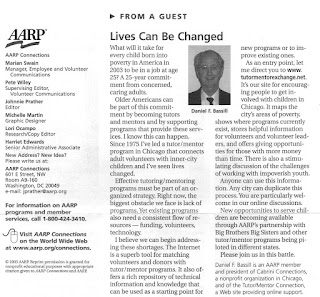
Below is a guest article I wrote for the AARP magazine in 2002.


I've followed the Churchill Fellows program for more than 20 years and hosted three different fellows between 1998 and 2006.  One was Clair Kime, who wrote this article summarizing her visit with myself and other tutor/mentor leaders in Chicago, Boston and New York in 2005.

AARP does encourage senior citizens to volunteer with youth, through programs like Experience Corps. However, I don't see a map-based strategy that connects seniors with youth the way the Churchill Fellows article envisions.  

When I say "map based" I mean leaders in different sectors should be innovating ways to make mentor-rich non-school tutor and/or mentor programs available in every high poverty area, for  many years.  

Such programs need a mix of volunteers working directly with youth, and working with program leaders to operate the program, raise needed funds, and build constant improvement.  Seniors have many work-backgrounds and a range of talents and could not only support individual programs, but lead city-wide efforts.

As you're doing your planning, take a look at the Churchill Fellowship article and think of ways you can involve seniors in many of the ways they describe. 

I'm on Twitter, LinkedIn, Facebook and Instagram. Let's connect and talk about these ideas. Find links here.


Friday, September 30, 2011

Get Seniors OnLine


This image is what I first saw when I visited Don Samuelson's Get Seniors Online blog today. I've known Don for more than 12 years but it wasn't until we had lunch today that I learned of this blog. It's quite interesting. And it gets regular feedback which I'd like to see more of on my own blog.

The focus of Don's blog is to help seniors learn the basic skills of navigating the internet high way, so that with their "Drivers License" they can take of on life-long learning road trips of their own choosing.

My interest is to provide a road map so that some of the seniors who already are online, or will get online because of what Don is doing will find the Tutor/Mentor Institute blog and web site and will begin to use the information posted to expand the role they take in making mentor rich, technology rich, non-school learning programs available to youth in high poverty neighborhoods all over the country.

In one blog post Don wrote he asked "What is the potential $$ value to seniors themselves?" from being an online senior? How might this affect healthcare costs, costs of entitlement programs, economic well-being, mental health? One respondent to Don's post said "It's Priceless" and went on to say "And what is the value to the resident who was closeted in her apartment and now she has come out for awareness raising and training, and is engaged in learning, saying hello to fellow residents, and is starting on her road back to "being connected?"

I'd go a step further and as "How much more value might be gained by connecting the talent, wisdom, love and involvement of a growing number of seniors in helping youth who need extra adults in their lives have places to connect with adults from 18 to 100?

I look forward to connecting Don's world of Seniors OnLine with my world of Tutor/Mentor Institute. I hope you'll join in.

Wednesday, December 15, 2010

Looking back at last 10 years - Cabrini Connections

Our mission at Cabrini Connections is to connect youth and volunteers in a structured set of activities where the volunteers serve as tutors, mentors, coaches, friends and make a life changing difference. Our roots go back to 1965 when employees from the Montgomery Ward Corporation in Chicago began to tutor elementary school kids in the Cabrini-Green area. View this chart to see growth from 1965 to 1992. View this chart to see growth since the formation of CC, T/MC in late 1992.

The two teens in this photo are 1999 graduates of Cabrini Connections. Both now have Master's Degrees and one is pursuing here MBA. Over the next two weeks I'm going to write a few articles showing what Cabrini Connections and Tutor/Mentor Connection have accomplished and the challenges we have faced in the effort.

Below is a chart that shows the number of teens on our active roster each spring since 2000. In 1999 we left 20,000 sq ft of donated space at the Montgomery Ward Corporate Headuarters in Chicago and began to rent about 2500 sq ft of space in Cabrini Green for the operations of Cabrini Connections. Thus, the number of students who could participate was reduced to a maximum of 80. Through the decade we've started each year with 75-80 students and kept most of them till the end of the school year.


This chart shows that 40-70% of the students in each year's class had participated for three up till six years. That means that not all kids who joined in 7th or 8th grade continued through high school. Some moved. Some went to scholarship programs like Highsight, with our help. Some decided this was not right for them.

Teens vote with their feet.
However, research shows that "Although the benefits of afterschool programs for older youth are abundant, and awareness of the need for afterschool is growing, many programs still struggle to recruit and retain older students." Thus, for Cabrini Connections to recruit these 7th to 12th grade students and keep so many participating for 3-6 years, the program must be offering perceived value to the youth who participate.


This next chart shows the number of seniors who finished high school each year. Many of these students have already finished college.


A study by Mark Cohen and Alex Piquiero from Vanderbilt Owen Graduate School of Management said, “We estimate the present value of saving a 14-year-old high risk juvenile from a life of crime to range from $2.6 to $5.3 million. Similarly, saving a high risk youth at birth would save society between $2.6 and $4.4 million.”

That means that based on the number of students who have participated in Cabrini Connections, and just those who we know have graduated from high school, we've potentially saved society $120 to $300 million dollars.

However, look at this chart that shows the money we've spent each year to provide Cabrini Connections. The amount we spend is based on how much we can raise. There were seven volunteers when Cabrini Connections started in 1993. They had no money to fund the organization. Every year we've had to raise the money to fund the operations of that year. While we had support from the Montgomery Ward corporation, and free space, until 1999, we lost that support when the company went out of business in 2000. Then the dot.com bubble burst, 9/11 happened, and then came tsunamis, hurricanes, earthquakes and a 10 year war. While we had $200,000 for operations in 2000 and 2001, we've spent between $150,000 and $175,000 each year since then....and almost 25% of this was for rent, insurance and utilities.


This final chart shows total expenses (including fund raising and administrative costs, which are under 20% of total expense each year). The chart shows that we spent more than we raised in 2003, so we cut costs dramatically for the next five years. We received several gifts of $30,000 to $60,000 in 2007 and 2008 that enabled us to invest more in our programs, but we've in the past two years we've spent more than we've raised.

That means unless we can find donors who value the long-term impact of a program like Cabrini Connections, and who will provide significant donations, we will cut back on staff, and services, and not be able to help these kids realize their great potential.


Please send your donations to Cabrini Connections, Tutor/Mentor Connection, 800 W. Huron, Chicago, Il. 60642. See our donation page at http://www.cabriniconnections.net/donate

Next I'll show the story of the Tutor/Mentor Connection and how the last decade has presented numerous challenges to our efforts.
Wednesday, May 13, 2009

We, the people in Illinois, must be leaders.

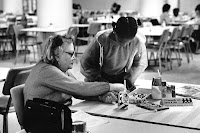
Engaging Seniors in Volunteerism and Community Problem Solving


I attended an event at the State Capital in Springfield, Illinois on Monday, focused on Civic Engagement of Older Adults. This was sponsored by the Illinois Policy Academy of the National Governor's Association.

I created the graphic a year ago following the National Conference on Volunteering and Service. I've written several articles about how to engage volunteers more strategically in long-term service and complex problem solving.

Thus, I was excited to participate in this event. One of the main organizers, was Jane Angelis, who I've known since 1994. She attended the first Tutor/Mentor Conference, and was one of the people who encouraged the publication of our tutor/mentor directory, which is now the on-line Program Locator. Jane has led the Intergenerational Initiative for as long as I've led the Tutor/Mentor Connection. It was in spring 1995, at a meeting she hosted, that the August/September Tutor/Mentor Volunteer Recruitment Campaign idea was given birth.

There were many good speakers, and great ideas shared at this event. I plan to add links to some on the Tutor/Mentor Connection library.

One speaker was John Sirek, director, Citizenship, McCormick Foundation. John's speech resonated with me in many ways. He led off with "We, the people in Illinois, must be leaders. We must be active and engaged." Here are some quotes I wrote down as he spoke

* be a good person; a contributor, and a good example

* I'm a product of the people who came before me. It is my duty to give back, pass it forward

* Begin every day by reminding ourselves of ways people can help build orderly neighborhoods

* Community building. That's what we're talking about

* Build upon previous learning

John concluded by saying "Why do I care so much about good citizens?" He answered by saying "We face many challenges. Who will take them on and say 'I will do everything in my power'? We cannot afford to leave a talented segment of society on the sidelines."

If you read some of the articles I've written for the past few years, such as this one, you'll see that John and I are on the same page.

There were others with great ideas to share.

For instance, Bob Gallow, state director for AARP, introduced Create the Good, which seeks to point AARP members to volunteer and service opportunities.

Scot Nierman and others from the Serve Illinois Commission, were their to share information about the State's Volunteer Inquiry portal.

Others shared information about the Illinois Worknet portal, which offers information for business and workers in the state.

One of the most unique programs was the Retirees Leading Initiative of Spoon River College. I liked this because it shows the university taking an active role in helping retirees learn leadership roles they could take in the community. I'd like to have this type of support for the Tutor/Mentor Connection.

Monday's meeting was part of a process, intended to develop public policy that engages the time and talent of older Americans in volunteer and community service, and/or in second careers. I hope that as such groups move forward, they will use the ideas of the Tutor/Mentor Connection.

We need adults of all ages, backgrounds, races, economic sectors working, and sacrificing, if we're to create a future that has more hope and opportunity for all Americans than the present offers.

I hope some of these groups will join with the Tutor/Mentor Connection in on-line forums, and at the May 28 and 29 Tutor/Mentor Leadership and Networking Conference.