Showing posts with label total quality mentoring. Show all posts

Wednesday, May 20, 2026

Influencing Career Aspirations - Role of Business & Mentoring

I originally wrote this article in 2013.  Since the ideas still apply, I'm sharing it again, with a few edits and additions.

--- begin 2013 article ----

In this UK report titled "Nothing in Common: The Career Aspirations of Young Britons Mapped against Projected Labor Market Demands (2010-2020)" the authors show that career aspirations for many youth do not align with available jobs and call for greater business involvement with education efforts to change this.

This lack of alignment is probably as common in the US as in the UK. So what are businesses and mentoring programs doing about it? Since I've led a volunteer-based tutor/mentor program for over 35 years I've come to believe that having mentors from different business and professional backgrounds involved with young people can expand the types of career choices youth might aspire to. The image below shows young people in the Cabrini Connections program engaged in performance activities. One of those young people, Tramaine Montel Ford, is now a professional actor in New York, who says his "acting bug" started with the video program at Cabrini Connections.


At Cabrini Connections every teen was in a one-on-one match with volunteers from different business backgrounds. However, since this was a site-based program, other volunteers were also able to participate, organizing small learning groups (we called clubs) focused on technology, art, video, writing, dance, etc. These never had funding for consistent staff support so the level of activity from year to year was inconsistent, but they all provided a range of extra learning opportunities for the teens who participated.

In the mid 1990s I tried to create a new term for this type of mentoring program. I called it "Total Quality Mentoring (TQM)" borrowing from the business concept of Total Quality Management. I was describing a type of mentoring that had many different influences, and was constantly looking for ways to improve its impact by engaging the talents of volunteers and youth in all phases of program operations. This graphic was created to demonstrate this program model.

The center of the "wheel" is a youth, with the spokes representing the different types of influences that a program might expose the youth to via the volunteers who participate and the activities the program offers. This graphic also is the model for a "program" which recruits volunteers from different work backgrounds and recruits youth in elementary or middle school and works to keep them involved all through high school. As the Internet became available, this vision extends to building a life-long network connecting youth and volunteers with each other in a virtual support system.

Each spoke of the wheel has an arrow going both ways. Every time a volunteer interacts with a youth in a weekly tutor/mentor session he/she is learning something about that child and the community he/she lives in. Every week that volunteer informally shares what is learned with his friends, family and co-workers. The longer the volunteer stays involved, the greater his empathy/understanding grows and the more he is willing to do to support the youth, and often the program. This animation illustrates this service-learning loop. If volunteers are well-supported by consistent staff involvement, they will stay involved longer and many will begin to bring other volunteers, other learning opportunities, and even financial support, to the organization.

Read this 2013 Education Week article about the "eight conditions for student success" and see how "belonging" and "heroes" influence student aspirations.  I was first introduced to this in 1999 at a conference in Portland, Oregon.  It changed my termination from "motivating" students to "building student aspirations".   

Every spoke in the chart also points to a specific industry cluster that has different workforce readiness needs. In this graphic I emphasize the 12 years it takes to go from first grade through high school and the ways business could support this journey with volunteer involvement, technology, ideas and on-going funding. If companies were to look at this strategically, they could be supporting volunteers with ideas they could take to their tutor/mentor sessions. Thus, volunteers from engineering and manufacturing could be using clay and animation to teach thinking skills to elementary school kids, that might motivate aspirations for these types of careers. They also might organize field trips and job shadowing during middle school years. In addition they might offer part time jobs and internships during high school years, and even provide scholarship money and summer jobs during college years.

Here's a visual essay showing the Total Quality Mentoring idea - click here

In the above graphics you'll see inserts with maps showing high poverty areas of Chicago.  While this article shares ideas for helping individual tutor/mentor programs constantly improve, the overall goal of my articles is to help motivate donors, policy-makers and business leaders to provide the on-going resources needed to make mentor-rich non-school learning programs available to K-12 youth in every high poverty area of the Chicago region.  


If political leaders recognized the importance of this strategy they could be recruiting and recognizing companies from every industry who were adopting this strategy. The result would be that volunteers and financial support would be coming to each program in the city from many different sectors, creating a broader base of funding needed to ensure that each program had talented staff that would stay with these programs longer, and that youth were surrounded with volunteers modeling many different career aspirations, not just one or two.

If you are a volunteer, alumni, student, parent, donor, etc. you can share this idea with people in your network who are involved in different industries, or who are in media, entertainment and/or politics and who might provide encouragement for companies to adopt the Total Quality Mentoring model.

If you're being asked to contribute $50 million for a new anti-violence strategy wouldn't it make sense if this was also a workforce development strategy?

--- end 2013 article ---

I wrote this 13 years ago yet, the need is as great, or greater, today than it was then.  And with COVID, distance learning, and artificial intelligence, there are new issues to understand.

Since last December I've been posting graphics like this, showing who participated in one, more more, of the Tutor/Mentor Leadership and Networking Conferences that I hosted in Chicago every six months from May 1994 to May 2015. Browse these articles to see some of these. 

As I post articles like this one, my goal is that readers will share it with their networks and that this leads to people using the Open Source Mapping Tool created by the Fall 2025 IVMOOC team at Indiana University, to show who's connecting around these ideas.  

If  you're using these ideas or creating your own versions please connect with me on LinkedIn, BlueSky, Instagram, Mastodon, Facebook and/or Twitter to share your work. 

Finally, I depend on contributions from a small group of supporters to keep doing this work. If you'd like to help, visit this page

Monday, April 29, 2024

Retaining Volunteers in Tutor/Mentor Programs

We're nearing the end of this school year and are at the end of the annual April Volunteer Recognition Month.  Volunteer-based tutor/mentor programs all over the country have been making an effort to recognize the people who have given time and talent over the past year, while are also (I hope) looking for ways to motivate many of those volunteers to return for another year when the 2024-25 school year begins in late August.

I've been digitizing newsletters and yearbooks from the two tutor/mentor programs I led between 1975 and 2011 and thought I'd do some volunteer recognition today.

Below is a page from the 1991-92 yearbook of the tutor/mentor program I led in Chicago from 1975 to the fall of 1992.  


This program was started in 1965. I joined as a volunteer in 1973 and became a member of the leadership committee in 1974. In the summer of 1975 I was chosen to be the leader when the incumbent announced during a summer planning meeting that he was "going to Europe and would not return for a couple of years".   When I took the lead the program was already recruiting 100 pairs of kids and volunteers at the start of the year.  In my last year, 1991-92, that had grown to 440 2nd to 6th grade youth and 550 volunteers.  You can see the yearbook PDF at this link

I left that program in October 1992 and with six other volunteers formed a new program, intended to help kids who aged out of the first program after 6th grade have similar support to help them through high school.  At the same time we formed the Tutor/Mentor Connection, to help similar programs grow in all high poverty areas of Chicago.

Below is a page from the 1999 Annual Report for that program.


Starting with only seven volunteers the program grew quickly, reaching nearly 100 volunteers by the end of the 1998-99 school year.  If you look at the list of veteran volunteers on this page and on the one from 1991-92 you'll see many of the same people. That's because many volunteers from the first program came to the new program with their students, as those kids joined Cabrini Connections.  You can see this Annual Report in this PDF

Note that by 1999 I was using the Total Quality Mentoring graphic to describe how we were recruiting volunteers from many different backgrounds.  That was true in the first program, too. 


In this PDF I describe the concept of Total Quality Mentoring.

By sharing my annual reports and newsletters I hope that I'm providing some inspiration for how others might build activities in their programs that help them recruit and retain students and volunteers for multiple years.  It's these long-term relationships that have the greatest benefit and it's the experience of veteran volunteers that helps newer volunteers become part of the program and stay involved longer.

You can view 1975 to 1992 yearbooks for the Montgomery Ward/Cabrini-Green Tutoring Program at this link.

You can view 1994 to 2009 annual reports for Cabrini Connections, Tutor/Mentor Connection at this link.  

As you look at these annual reports you'll see several thousand volunteers who participated for one or many years. I am tremendously thankful for the time each person contributed to helping create a brighter future for the kids we were working with.  

Now I want to share a President's Message from a January 2005 e-Mail newsletter.  You can open the PDF and read the full newsletter at this link


The heading of my message was "Competing for Attention" and it was written after a year of "unbelievable acts of violence caused by nature and caused by humans."

I wrote, "In the aftermath of these have come equally magnanimous acts of kindness and generosity.  While this leads me to be thankful at the same time as I fear what the next tragedy will be, I feel that we need to look at charity in new ways if we're to maximize the benefits of the generosity that is in this world."

I went on to write

----- begin Jan 2005 ------  

"This is why I participate in a variety of Internet forums that connect people from around the world with each other. 

I feel that out of the Tsunami tragedy will come some innovations that those of us working with kids might benefit from. Right now donations are coming from all over the world to a variety of charities serving the Tsunami because of the high public visibility the tragedy has generated. I feel that if we can create a portal that tells why it's important to help kids, with doors leading to each continent, each nation, each city, and each neighborhood where kids need help, this portal can serve as a funnel for dollars, volunteers and similar resources to go to individual programs in each neighborhood. While there are some on-line charity portals, like http://www.networkforgood.org, these promote all forms of charity, and thus don't have the passion and appeal that could be generated by having portals that focus on specific channels of service, like tutoring/mentoring. 

Rather than reinvent the wheel, my dream is that we could find people who share our passion for helping kids and will share their talent to build such a portal, or to make existing products available to other streams of service. I'm sure such people and organizations exist. We just have not connected yet. In the Discussion section of www.tutormentorexchange.net there is a database and a GIS discussion group where I'm gathering volunteers who might help with such a project.

Once we have the portal every organization that offers any form of tutoring, mentoring, career development, etc. can share in building visibility and traffic, knowing that this helps each of us increase the revenue pie that we end up splitting. In six months much of the attention to the Tsunami will be turned to some other tragedy and the people in these countries will be just like us, struggling to draw attention and consistent revenue to the work of rebuilding lives. The type of portal I'm trying to build could be a benefit to these countries just as much as it will be a benefit to you, me and thousands of others like us. 

This email goes to more than 3,000 people. A print newsletter goes to almost 14,000 people (when we can find the money to print it-the last print newsletter was sent in 2003). Some of you have been connected to me and the Tutor/Mentor Connection for more than a dozen years. Some are getting this email for the first time. While my intention is to share information that I hope you can use, this is also an invitation to everyone who reads this far on this email to contact me to explore ways we might work together. As Margaret Mead once said, "it only takes a few people to change the world". It only takes a few of you to join us in 2005 to make this a better year for thousands of organizations serving kids living in poverty. 

While it is almost impossible to have two or three thousand one-on-one conversations each week, it is very possible to meet in on-line forums where thousands of people can share ideas and unite in joint action. In the Discussion Section of http://www.tutormentorexchange.net a few such forums are listed. I hope you'll join some and that we can meet on-line.

---- end Jan 2005 ----

I've never been able to find a group willing to work together (of provide funding) to build the type of portal that I described in that 2005 newsletter.  I was able to build an interactive tutor/mentor program locator in 2008 and keep it available until 2018, but not able to update it after 2010.


On this planning page you can see the vision for the Chicago Tutor/Mentor Program Locator and find a link to a "next step" of adding a fund raising capacity to the platform, that would enable donors to directly donate to programs listed in the database. 

I've continued to use social media daily to share ideas and connect with others.  I'm still looking for program leaders who "share in building visibility and traffic, knowing that this helps each of us increase the revenue pie that we end up splitting."

In the Tutor/Mentor library I've three lists that point to organizations doing part of what I envisioned in 2005. Find those herehere and here.  If you know of others doing what I described, please share the link in the comments. 

As you read my newsletters I hope you'll share them in your own networks.

Thank you for reading today's post.

At this page you can find links to where I'm active.  Please connect with me and encourage your friends to do the same.

Finally, there's a cost for me to keep these archives available and to keep updating the Tutor/Mentor library.  If you can help fund the Tutor/Mentor Institute, LLC, visit this page and use the PayPal feature to contribute. 


Thursday, September 28, 2023

Borrow ideas from my visualizations

I've been updating my visual essays for the past two months and now include statements calling on other cities to adopt the strategies I've piloted since 1993 in Chicago. 

Below is a "War on Poverty" essay, which shows planning steps needed to assure that every K-12 youth living in a high poverty area has access to well-organized, mentor-rich, non-school, tutor, mentor and learning programs.

Planning Cycle - War on Po... by Daniel F. Bassill

Below is one of the slides from this presentation.


In my blog articles, social media posts, and essays I encourage leaders from Chicago and other places to share these presentations and use maps the way I demonstrate, to focus attention and resources on areas with high poverty and to do the planning necessary to fill every poverty area with high quality, long-term, tutor, mentor and learning programs.  Voters should reward political leaders who do this.

Another presentation uses the Total Quality Mentoring graphic that I created in the 1990s to show donors how the tutor/mentor program I was leading connected inner-city teens to a wide range of workplace adults and learning opportunities.


Every spoke on the wheel of this graphic could represent youth and adult leaders who were sharing this blog article with people in their work, family, religious, alumni and social networks.

I created the essay below to explain this Total Quality Mentoring idea.

Total Quality Mentoring (TQ... by Daniel F. Bassill


In many of my updates I've added the map shown below, which shows that many cities in the USA have areas of concentrated poverty.  These are places that could be using my archives to build their own Tutor/Mentor Connection-type strategies.  


You can view this map and find a link to the article if you visit this MappingforJustice page

You can find links to almost all of my PDF essays on this page.  


I'd love to find posts on social media showing teachers, leaders, students, etc. sharing these ideas with people they know.  You can find me on Twitter, Facebook, Instagram, LinkedIn and Mastodon (see links here).

I want to thank Joanne Telser-Frère of  Literacy Chicago, for reading my monthly newsletter, then sending me information about programs having moved to new locations, so I could update my map showing volunteer based youth tutor, mentor programs in the Chicago region.  I can't keep my information up-to-date without such help.

Thanks for reading. Please share.  Furthermore, if you can help fund the Tutor/Mentor Institute, LLC please visit this page.


Thursday, May 18, 2023

Chicago school closings. 2011 and now

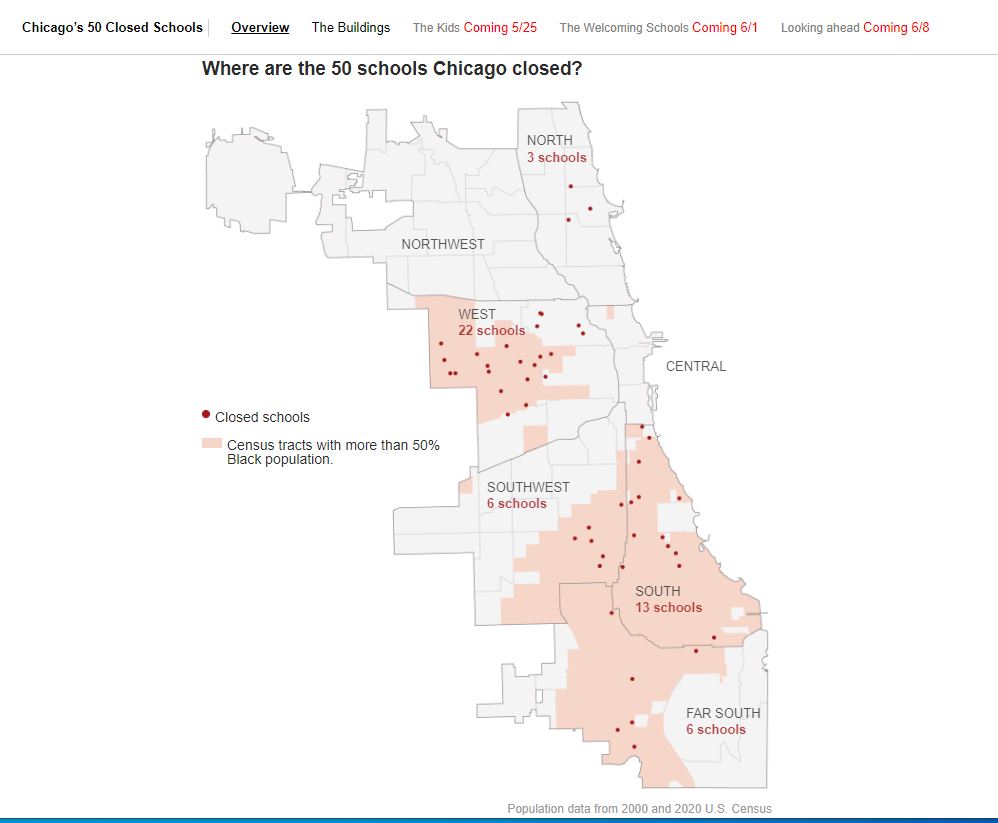
Today I read a WBEZ article titled "Chicago Closed 50 public schools 10 years ago. Did the city keep its promises?"  

Today's article is the first in a 3-part series and includes maps that show a majority of these schools were in areas with high concentrations of Black Chicago residents.

So far,  the answer to the question, is "No. Chicago did not keep it's promises."  I encourage you to read this article and the ones that will follow.

I was curious to see what I wrote about the school closings, back in 2011 when they were happening.  Below I've re-posted an article that I wrote in November 2011.

--- start 2011 article ---- 

Today's Chicago Tribune includes a feature article titled: CPS fails to close performance gap: Black students still losing academic ground despite reforms, study finds

It leads off saying:

Twenty years of reform efforts and programs targeting low-income families in Chicago Public Schools has only widened the performance gap between white and African-American students, a troubling trend at odds with what has occurred nationally.

Across the city, and spanning three eras of CPS leadership, black elementary school students have lost ground to their white, Latino and Asian classmates in testing proficiency in math and reading, according to a recent analysis by the University of Chicago Consortium on School Research.


It includes a statement saying:

"If school closings destabilized certain neighborhoods, other efforts were ineffective — millions of dollars pumped into countless after-school initiatives and tutoring and mentoring programs geared toward African-American students, only to see math and reading scores languish and many students fall further behind."

I challenge this statement of "countless after-school initiatives and tutoring and mentoring programs".

I've been hosting a database of non-school volunteer-based tutoring and/or mentoring program serving Chicago and have been using maps to show where these programs are needed, where existing programs are located, and where more dollars are needed to help programs constantly innovate ways to have a greater impact.

I tried to find census maps on the internet today to support this article. Here's one set of maps showing demographic concentrations in the Chicago region. This is from a U.S. Census Grids web site.


Here's a maps showing African American population concentrations in Chicago, created by the Tutor/Mentor Connection in the mid 2000s. On this map we've overlaid locations of poorly performing schools from the 2007 ISBE watch list. From both sets of maps you can see high concentrations of African Americans living in high poverty areas. You can also see a huge number of failing schools.

On this next map you can see locations of different non-school tutor/mentor programs in the Chicago area. You just don't see a large number of programs in many parts of this map. I encourage you to use the Interactive Program Locator (archive since 2018) and create your own map. Sort by type of program and age group served.

When trying to understand this information you need to think in layers. What is the distribution of tutor/mentor programs serving elementary school kids? Middle school? High school? In each neighborhood programs serving all three groups need to be equally available?

If "millions of dollars had been spent on countless non-school tutor/mentor programs" targeted at African American youth, the map should show many more programs in these neighborhoods than we show.

There may be more. This mapping project has never received funding from the city, the schools or major philanthropy. Thus, there may be programs we don't know about and some of our information is out-of-date. Furthermore, there needs to be many more questions asked, to know more about what these programs have in common, how they differ, what they need to find and retain quality staff and financial support, ways they can constantly improve.

The Tribune story offers a generalization that makes one think that millions of dollars were spent on a comprehensive tutoring/mentoring strategy. Millions may have been spent, but there is no evidence that any strategy has been used to assure that Chicago has a broad distribution of well-organized and constantly improving non-school tutor/mentor programs in high poverty neighborhoods.

This could change if the Mayor, a foundation or an investor were to become a partner and provide financial support to the Tutor/Mentor Institute, LLC so we can update the maps and launch an aggressive advertising campaign to help existing programs get the funding and talent they need to operate in more places and to constantly improve their impact over the next 10-20 years.

---- end 2011 article ----

If you've read any of the articles I posted before, or after, 2011, I've constantly encouraged leaders to invest in a city-wide network of non-school tutor, mentor and learning programs that reach K-12 youth in every high-poverty neighborhood.

No leader has yet embraced this strategy.  Maybe Chicago's new Mayor will make it part of his strategy, and his legacy.

He won't know about it unless you share this article with him or members of his team.  

You can find me on Twitter, Facebook, Instagram, LinkedIn and Mastodon (see links here). I hope you'll connect and invite your network to also connect.

If you'd like to help me keep writing articles like this and hosting the Tutor/Mentor Library, please visit this page and make a small contribution.

If you'd like to bring my archives into your university so students can study what I've been sharing and apply it to their own lifetime commitments, I'd really love to talk with you!  


Thursday, March 24, 2022

20 years of failed education reform - SSIR article

Last week I posted an article talking about the "Social Determinants of Education" and how important it is to look at the conditions of the community outside of a school to understand influences on performance of youth in the school. 

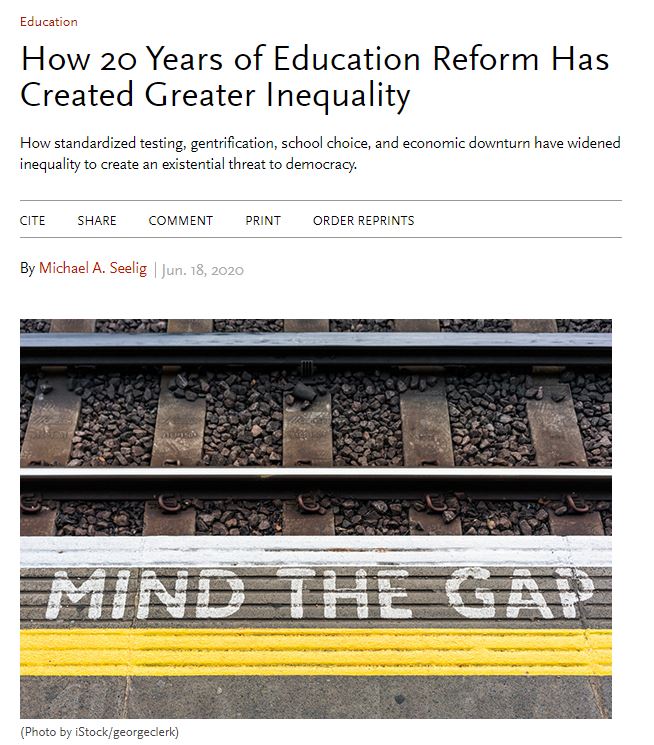
Today I read a 2020 article on the Stanford Social Innovation Review titled "How 20 Years of Education Reform Has Created Greater Inequality," written by Michael A. Seelig, Ed.D, the education policy director and senior advisor to the president of Medgar Evers College of the City University of New York,


This is a long article that shows "four major forces that converged since 2000 to shape how the school reform movement widened inequality: standardized testing, gentrification, school choice, and household economic downturn."

I highlighted text from the fourth factor:  


The highlighted text reads, "What renders so many education reform efforts futile from the outset -- so much so that we avoid talking about it -- is the fact that a student's academic achievement, with few exceptions, is completely tethered to the family's income and the opportunities it can provide."

Below is a paragraph from the conclusions part of the article:


The highlighted text says "We need much better measurement of organizational performance that both recognized the wider geography of schools and communities and accounts for the collateral damage we are leaving in the wake of our efforts." 

A process that collects information related to the "Social Determinants of Education" and a dashboard that measures progress toward goals would be a starting point. Take a look at the webinar that I point to in this article


This gap in opportunity between rich and poor was the theme of Dr. Robert D. Putnam's "Our Kids" book, which I wrote about in several past articles, starting in 2015. 

This gap can be shown on maps, which again is why I encourage you to read the article about "Social Determinants of Education" and look at the dashboard being suggested.  Since 1993 I've used maps to show the geographic gap between rich and poor in Chicago and other cities. I keep looking for other leaders to do the same on a consistent basis. 

Below I show a graphic that I've used since the mid-1990s to show the potential for non-school, volunteer-based tutor/mentor programs to help build a richer, more diverse community of support for kids in high poverty areas.  


Here's one article where I use this graphic.  This presentation shows it in another format. 

I recall one of my volunteers looking at this once and exclaiming, "You're trying to build a support system for these kids similar to what is already available to kids in wealthy, and more affluent neighborhoods!" 

Yes. That's been my purpose for more than 40 years, although I did not really begin to understand what it was that I was doing until the mid 1990s.  And it's taken many years of reading hundreds of articles like this SSIR article, for me to understand why this is so important.

I added the article to the research section of my library, where it joins more than 100 other articles. 

The problem, which I've focused on since forming the Tutor/Mentor Connection in 1993 is that "too few people really care" enough to make the changes needed.  

In fact, it may be that the self-interest of too many people means they work actively, or unconsciously, against needed reforms. 

Dr. Seelig's article ends, saying "We must recognize the existential threat a system that enhances inequality poses to democracy and need to push through the inevitable fatigue that emerges when we see something before us as too big, or too ambitious."  He ends with "American democracy depends on it."

If you've read this far, and you care about this issue, become the YOU in this graphic and share the article, my library and other articles like this with people you know and encourage them to do the same.

Keep doing it for the next 20 years.

I share my articles and highlight those of others on Twitter, Facebook, LinkedIn and Instagram.  (see links here).  I hope you'll follow me, share my posts, and introduce me to others who may be doing work similar to what I do.

Furthermore, if you are able, I'd appreciate a small contribution to help me continue doing this work Visit this page to learn more. 


Sunday, January 27, 2019

"Make the World A Better Place" - Jane Goodall

I spent about 25 minutes today listening to an interview with Jane Goodall, from last week's World Economic Forum

She's inspirational. I life well lived, and still going strong.

Take some time and view this yourself.  Share it with your students.

In the final 30 seconds she talks about a program called Roots & Shoot,  that seeks to inspire youth involvement, which she started many years ago. 


Roots & Shoots - visit site
I've written about annotation, and my connections to a #clmooc educator network.  The work of Jane Goodall, and Roots & Shoots, is the type of idea that should be spread through many networks.  The 23 minute interview is full of wisdom, which I'd mark up with a yellow highlighter if I were doing an annotation.

When I talk about mentor-rich k-12 tutor/mentor programs, I'm visualizing a safe place in a neighborhood where kids can connect with volunteers who open doors to a wide range of learning opportunities.  That's what the graphic below is intended to communicate.

See this graphic in this article
As a leader of a tutor/mentor program for more than 35 years I often had volunteers come to me and say "I have an idea for a  program. Can I start it?"  I almost always said "yes".  That's where our writing, arts, video, Spanish club, tech club, and college readiness coaching came from. 


I point to web sites of tutor/mentor programs in Chicago, and around the country, with the goal that these provide ideas that inspire work that could be done in many places. Many do a good job of sharing such information. Many others need help doing this.

Be like Jane.

Jane Goodal travels the globe raising awareness, and raising money, to support the work she does. I spend time every week, sharing ideas on this blog, and building a web library, for the same purpose.

She ended her video interview saying "when we start living for money, it all goes wrong"  but, "when we live for money to  help make the world a better place" that's when things get better.

The  Roots & Shoot program could be part of many schools, and non-school programs, along with many other forms of learning, if others will provide the talent and dollars to make it happen.

Can you look back on your life and see the same journey of helping others, and helping the planet, as Jane Goodall can?

Sunday, November 26, 2017

Connecting People and Ideas - A 20+ Year Journey

From T/MC 1998 web site
I've used this  hub/spoke graphic for more than 20 years to describe my efforts to connect people and ideas in an on-going effort to build greater support for non-school tutor, mentor and learning programs that reach kids in high poverty neighborhoods of Chicago and other cities, and help those kids move through school and into adult lives.

Hub represents an information source, a meeting place, an on-line community, etc. and the spokes represent the range of different people who need to be using this information, or who need to be helping kids in different places.  Below is another example of this graphic.


In this graphic I include a map of Chicago, with high poverty areas highlighted.  The hub of the wheel includes an image of a youth and volunteer and a time line that stretches from pre-school on the left and work/career on the right.  It shows the traditional public school as one source of support, and the family and community as another.  The spokes represent all of the people and influences that are present in the lives of most kids, but are missing for many kids living in high poverty.

I created this Total Quality Mentoring PDF to illustrate how companies in different industries, represented by the spokes, could be leading on-going efforts to help tutor/mentor programs in many locations have activities that help kids learn what these industries focus on (arts, health, engineering, technology, law, etc).

Below is another variation of this hub/spoke graphic:
In this example I'm showing that volunteers who become involved in different tutor/mentor programs can be reaching back on a regular basis and encouraging other people in their network to get informed about where and why these programs are needed, and ways they can use their own time, talent and dollars to help great programs grow in all poverty areas of a city.

The circles from the bottom of the hub represent on-going learning and discussions taking place in businesses, faith groups, media, universities, hospitals, etc. where people are talking about how to use the ideas to help youth tutor/mentor programs grow.

Last week I posted an article showing how I organized networking conferences in Chicago every six months from May 1994 through May 2015, in an effort to bring people together to learn and share and to build greater visibility for all of the programs operating in Chicago. I hope you will look at the conference goals.

I've used this hub/spoke concept in dozens of graphics. If you do a Google search for "Tutor/Mentor Connection Network Building", then look at the images, you can see many of these, and also visit the articles where the graphic was used.

Oct 15, 1992 Chicago SunTimes
This was the front page of the Chicago SunTimes in October 1992 when myself and six other volunteers decided to create the Tutor/Mentor Connection.  We did not have a template to follow. We just knew that a) there was no master database of non-school tutor/mentor programs operating in Chicago; and b) no one was leading an on-going campaign intended to draw more attention and resources to each existing programs, while also helping the programs connect and learn from each other so they all could constantly improve their impact.

Over the past 24  years there have been many challenges to doing this work, and since 2011 I've not had much help.  Yet the need for this still exists and I don't find anyone doing all of the things I've been doing (see 4-part strategy) to help high quality tutor/mentor programs reach k-12 youth in all high poverty areas.  You can test my claim by doing a Google search for any organization focused on well-being of kids, then look at the images feature. You won't see the same mix of graphics and maps, shared over many years, like you see with my sites.

While it might make sense to try to re-start the Tutor/Mentor Conference, I think it makes more sense to innovate ways to draw people together in on-line learning.  I've had this goal in mind for many years, but never had the partners and resources to develop this.

Thus, I'm calling on leaders to step forward and help re-energize the Tutor/Mentor Connection and carry it forward under their own power and leadership and help versions of this grow in every city in the world, not just Chicago. Read about the "do over" which I started writing about last March.

Reach out to me on one of these social media platforms if you want to help.

Visit this page if the help you can offer is a financial contribution to help me continue this work in 2018.

Monday, January 16, 2017

Still far to go to achieve Dr. ML King Jr's Dream

I'm looking at my Twitter feed and seeing a flow of inspirational Tweets related to Dr. Martin Luther King, Jr. and service to those in need.

I've been writing articles to encourage people to become involved in  helping kids living in high poverty neighborhoods move through school and into adult lives free of poverty since starting the Tutor/Mentor Connection in 1993. I started writing this blog in 2005 and if you look at January articles every year since then, you'll find articles that mirror these same thoughts, over, and over, again. Here's my January 2006 article.

Here's me at an event where I am showing a 1994 Chicago Tribune article, where the map shows poverty neighborhoods in the city, and the headline says "240,000 city kids at risk".

While we've made many gains, this nation and the world still have too many youth and families living lives with too much "inequality and lack of opportunity".  View maps shown here and in the MappingforJustice blog that point to where these places are.

I've used maps over and over to repeat this message and to motivate people to become involved in building and sustaining mentor-rich non-school tutor, mentor and learning programs for k-12 kids in high poverty neighborhoods of Chicago, its suburbs, and other cities and states.

In many articles I use visualizations like the one above, which was created by a student intern, and the one below, to illustrate a program design, with volunteers from many work backgrounds connecting in an on-going effort.  In the 1990s I tried branding this type of program as "Total Quality Mentoring (TQM)" since it borrows from business practices of constant learning and constant improvement.


I have created a variety of power point presentations to communicate these ideas. This presentation illustrates the idea of Total Quality Mentoring.  I keep looking for other youth serving organizations to show their program design and theory of change using maps and visualizations like this.  If you know of any who do this well, please share a link in the comment section below.


As you do  your service today, or on January 20th, when one organization is encouraging another day of service, look for ways you can use your time, talent and dollars to help others get involved in deeper learning, on-going actions and many places.

In 50 years let's show even more progress in the US and around the world than we have achieved in the past 50 years.

Thursday, October 27, 2016

Understanding and Applying Social Capital Concepts

Last week I sat in a workshop at an Afterschool Development Conference in Chicago where a discussion leader was telling others how I understand social capital.  I decided at that point to write this article, with the goal of expanding people's understanding social capital and of my perspective.

First, you need to understand the difference between the terms "bridging" and "bonding" social capital.  This page on the Saguaro Seminar at Harvard University site provides those definitions.  This video provides a quick understanding of bridging and bonding social capital.

In my work,  I focus on "bridging" social capital, or "social ties that link people together with others across a cleavage that typically divides society (like race, or class, or religion)."

I created the graphic below in the 1990s to illustrate the design of a mentor-rich, total quality, youth program, that connects youth to volunteers from many different work and career backgrounds, who can open doors to opportunities and experiences for youth in such programs.  You can see this concept in this pdf presentation.


Much of my thinking about social capital has been inspired over the past 15 years by books and articles written by Robert D. Putnam.  Instead of writing a 10 page article, which most of you won't take the time to read, and which might not do a complete job, I've created a concept map to guide you in your own learning journey. In the map I propose a reading of Putnam's latest book, "Our Kids: The American Dream in Crisis."  I've written articles about that several times on this blog.
In the concept map above I point to Putnam's book, and to a section in the Tutor/Mentor web library with more than 40 links to web sites and articles that provide a deeper understanding of social capital and how this applies to the different opportunities available to youth born in affluent areas and those born in high poverty areas. 


I urge you to form learning circles in your business, faith group, college or high school, and read these articles and discuss their meaning, and roles you and your group might take to help build "total quality mentoring" programs in many locations throughout your city or state.
As I was thinking about writing this article, my Twitter feed introduced me to an organization, The Center for Curriculum ReDesign, that is using interactive network analysis maps to show information within the Wikipedia universe.  The description on the map says 

"This graph shows the interconnections between knowledge disciplines contained within the links of Wikipedia. Similarly colored nodes belong to similar communities calculated within the entire network. The edge thickness indicates the weight of the connection or how strongly connected the disciplines are connected to one another. Click below for more information."

While social capital articles focus on people and how they are connected to each other, this shows how ideas are connected to each other, and how you can use social network analysis tools to draw out a set of ideas from a vast information library like Wikipedia.

I was excited to see this because while I've been creating concept maps to show the information and ideas in the Tutor/Mentor web library, I've constantly hoped to find someone who could create a map like this, to show the relationships between the ideas in the difference sections of my web library.


This "mentoring kids to careers" graphic is a different visualization of the Total Quality Mentoring graphic shown above, and of the mentoring-to-careers concept map that is embedded in the second graphic.

For kids born or living in highly segregated areas of high poverty, they often have strong bonding social capital but very weak bridging social capital.  Organized non-school, volunteer-based, tutoring, mentoring and learning programs are a strategy cities can use to help expand the networks of support available to kids with weak ties to people who can help them reach their full potential in life.

Such programs need to be available to youth in every poverty neighborhood, and stay available for the many years it takes for a youth to journey through school.  Building the public will to fund and sustain such programs is one of the topics I constantly focus on.


Let's just look at one more graphic. This also illustrates the goal of building richer networks of support for kids living in high poverty neighborhoods.

However, it also shows that the volunteers who become part of well-organized, on-going, programs also expand their own personal and professional networks.  I've posted many articles in the past showing the benefits to business of volunteer involvement in on-going tutor/mentor programs.

However, I've not yet found anyone who is surveying youth and volunteers when they join a program with the goal of creating network maps for each participant, and then repeating the survey in future years to show how, or if, the network has grown, and to identify milestones, like trips to the volunteer's company, or to a college campus, or graduation from middle school, high school, or college, that were aided by volunteers that the youth met while involved in these programs.

Or that have shown how volunteers have build life-long friendships with other volunteers they have met, or have gone from being a volunteer to being and advocate and a leader, as a result of their involvement.  Or, who have learned ideas or skills and built relationships that have aided them in their careers.  Such analysis might be a huge motivator for businesses to apply this Role of Leaders strategy, to support the growth of mentor rich programs around places where they do business.

These are all demonstrations of social capital put into action.

I hope you'll find some time to read, reflect and look for ways to apply these ideas.

7-14-2020 update - this article from The Christenson Institute is titled: The missing metrics:
Emerging practices for measuring students’ relationships and networks. It's one of the first that I've found that specifically is talking of social capital and ways to measure it.

12-11-2020 update - this paper discusses difference between bridging and bonding social capital. 

10-6-1021 update - this article titled "Breaking the Class Ceiling" urges research on social class differences when trying to understand inequality.  click here