Showing posts with label Wakelet. Show all posts

Sunday, December 03, 2023

Maps. Planning. Teach Youth to Do this Work

Last week I posted an article showing a new data platform created by Argonne Labs, in partnership with the Northwestern University Digital Youth Network.  In that article I asked "How will it be used to make STEM learning and career opportunities available to youth through out the area?"  

That's what I'm addressing with today's article.  As you look at the rest of this article, keep the concept map below in mind.


What are the actions and programs that are working in some places, that could work in many other places, to help kids in high poverty areas move from birth-to-work? Is someone aggregating these into a library that others can draw from in their own planning?  Will people who build the data dashboards, build these concept maps?

Below is a collection of articles about ways to use maps and data dashboards to determine where youth and families need more help as young people move through school and into adult lives,  jobs and careers.

Since forming the Tutor/Mentor Connection in 1993 and the Tutor/Mentor Institute, LLC in 2011 I've tried to teach people to use maps to focus attention and resources on specific places. This could be an entire city, or a small neighborhood.  This concept map is an example.

The articles I've shared in this collection are just a few of what you'll find in this blog, the Mapping for Justice blog and in the library of PDF essays on the Tutor/Mentor Institute, LLC site.

My hope is that educators at colleges, universities, junior colleges, high schools and other institutions will use these articles in curriculum that results in more people applying these ideas in more places.


I've been focusing on this problem for over 30 years and thus there is an extensive collection of ideas on these blogs and in my website.  I realize that very few people visiting this blog will take time to read more than a few articles, at most.  Thus, there needs to be another way to draw consistent, long-term, attention and reflection.  Creating a Tutor/Mentor Connection strategy, or embedding these ideas into a strategy with a different name, such as the Digital Youth Network, is my solution.

Between 2005 and 2015 interns from various universities spent time looking at my blog articles then creating visualizations, videos and their own blog articles to share what they were learning. You can see their work on this blog.

Imagine if you were able to find a blog like this Intern blog, embedded on the website of dozens of universities, junior colleges, high schools, etc. in 2035, showing 10 years of learning and actions. 

That could change the world.

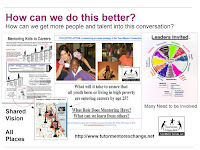
I created the concept map shown below to visualize the commitment leaders need to make to help kids born or living in high poverty areas of Chicago and other places be starting jobs and careers by their mid 20s. 


One role any of these leaders can take is to provide the funding that would motivate an institution to create a learning program based on the ideas in this blog.   That might not be YOU, but it might be someone you know. If you share this article with them, they might be inspired to take this role.

Thanks for reading. 


Connect with me on one of the social media platforms I show on this page.

Support my work in 2024 with a year end contribution to my Fund T/MI campaign

Or support Tutor/Mentor Institute, LLC with a gift to recognize my 77th birthday on December 19. 

Last week I posted an article showing a new data platform created by Argonne Labs, in partnership with the Northwestern University Digital Youth Network.  In that article I asked "How will it be used to make STEM learning and career opportunities available to youth through out the area?"  

That's what I'm addressing with today's article. While data shows "where" people  need extra help, we still need blueprints to show "what help" is needed, and in what sequence.  For instance, in building a tower you don't start on the 4th floor.


Thursday, January 13, 2022

Sharing work via Wakelet

 My #clmooc friend Terry Elliott introduced me to Wakelet a couple of years ago and recently demonstrated how you could aggregate posts in a single Wakelet. Here's one article on his blog that demonstrated it to me. 

Below are some examples you can find in my own Wakelet account

I've posted more than 1000 articles on this blog since starting it in 2005. They all focus on strategies and actions that help mentor-rich non-school programs grow in high poverty places and reach K-12 youth with on-going support intended to help more kids move safely through school and into work.

While I've tagged articles to help people narrow their reading focus, unless the Tutor/Mentor Connection (1993-present) is part of a formal course of instruction at the high school or college level, it's not likely that many people are going to dig through the blog to learn all that's available.

Thus, I've created a collection on Wakelet, each with 7-10 articles, that I hope will help narrow the learning path and engage more people from Chicago and around the world.

There are already many youth tutor, mentor and learning programs operating  in Chicago and around the country. However, few people are aggregating lists of programs and trying to use maps to show what area of the city the programs serve, or what age group.

Building that information base enables anyone to ask "How can we do this better?"  How can we help existing programs get the resources to operate and constantly improve by borrowing ideas from each other?

How can we help new programs form in areas where more are needed, then also get the continuous flow of resources needed to keep kids and volunteers connected from year-to-year? 

As you do your day of service to celebrate the Dr. Martin Luther King, Jr. holiday, spend some time looking at these articles and discussing them with friends, co-workers and others.  Put the ideas to work this year and next year celebrate what's been accomplished.