Showing posts with label maps. Show all posts

Tuesday, April 07, 2026

Making Out-of-School-Time Programs More Available

 Last week I shared the 2026 State of Chicago Youth report from A Better Chicago in this post.

One of the insights of the report focused on Out-of-School and Community-Based Programs and Spaces.  


Visit this page and open the PDF report to view this page. 

The text above says that "Citywide, during the 2024-2025 school year, 31% of CPS youth K-12 participated in out-of-school programs.  Students in grades 3-8 were the most likely to engage in out-of-school programs (37%) compared to k-2 (29%) and high schoolers (27%).   The North Central (39%) and Far South (34%) regions of the city had the highest percentage of youth engaged in out-of-school programming, while the Near South region had the lowest percentage (23%)."

What the report did not include was an interactive dashboard showing out-of-school programs in Chicago, with an ability to sort by age-group served and type of program.  I would loved to see a page on their website listing the programs that are included in the 31% where CPS youth were engaged.  

For instance, they could point to the MyCHI. MY Future program, which does have a searchable map. I show the result of using the menu at the far right and asking for 'reading and writing' programs for youth between age 16 and 18 in this graphic.


You can enlarge the map and zoom into a specific neighborhood. You can drag the map view so it shows a different part of Chicago. 

When you click on a circle representing a program, you can see a description and find a website.  That's good.  What I found is that many of these are programs hosted at Chicago Public Libraries. While the site has many categories, it does not differentiate between nonprofit youth serving programs and government funded services, like the libraries.  

One strength of MyChi MyFuture is the on-going effort to bring stakeholders together for citywide meeting and to share information via email newsletters, their website and social media.  Furthermore, they have empowered the formation of 14 neighborhood networks of stakeholders to support youth in their communities.  


Visit this page on the MyChi MyFuture website and look at the community plans developed in 2023 and 2024 by each of these networks.  I just finished skimming through them. Some have great data. Some have maps. Most list stakeholders involved.  Most have comprehensive plans that stretch into 2025.

However, I found no links to websites for each of these networks, where they were actively implementing the plans, learning from what works, and each other, and developing actions for 2026 and beyond.  If you have a list of these, please share it and I'll put the link in this article.

What I wanted to find when I looked at the websites of A Better Chicago and MyChiMyFuture was a site that worked like the Tutor/Mentor Program Locator, which was built for the Tutor/Mentor Connection in 2004.  Below is the screen users would use to search for tutor/mentor programs in different zip codes of Chicago.  Below that is the first page of a visual essay that shows features in this version of the Program Locator.


Open this PDF to see a description of how to use this Program Locator.   In 2008 this was re-built as a map-based directory.  This PDF shows its features. 

These were intended to help youth, teachers, parents, volunteers, donors, media and others find existing programs in different parts of the city, with features that narrowed the search by type of program (pure tutoring, pure mentoring, combination tutor/mentor) and age group served (elementary, middle school, high school). 

This page shows my long-term goal of "Using Maps to Build Capacity".  Due to funding challenges since late 2000s I've never been able to reach this goal, but still share it with hopes that it will inspire work of others.  

The report from A Better Chicago shows that "Chicago has a problem" and "They are part of the solution". And, it uses maps to show which parts of the city need more programs. However, it does not point to any listing or directory of existing programs, to help attract attention and resources to all of them.

The My CHI My Future site seems designed to help kids find opportunities.  I don't see any form of analysis that says "Do we have enough programs? or "Where are more needed?" Or for donors and volunteers to reach out and support existing programs.  I found this type of analysis on many of the community plans hosted by MyChiMyFuture, but in looking at the lists of stakeholders it seems that many of the organizations on my lists are not included in any of these efforts.  

Since I was looking at PDFs of plans developed in 2023-24, it's possible that a greater number of tutor/mentor programs are participating in these networks.

Below is the front cover of the 1995 Tutor/Mentor Connection Chicago Programs Directory.  It was created before we learned about the Internet. It used maps to show where programs were needed, and listed programs with the same sort features as the Program Locator that we put on line in 2004.


Here's a link to an archived version of the 1997 Director. We used this format each year from 1994 to 2003.  If you look at the listings in this Directory you can see the basic outline of the library that you can now found on the www.tutormentorexchange.net website. 

Below is a graphic showing year-round communications intended to draw people together to learn, share and generate resources for youth-support efforts in specific areas.


On this page I share strategies that the Tutor/Mentor Connection piloted, beginning in 1993 and that I still continue in 2026.  

In this article I show organizations who participated in each of the Tutor/Mentor Leadership and Networking Conferences that I organized between May 1994 and May 2015. 


Last week I included this map in my first article about the 2026 State of Chicago Youth report.


Ideally each year when I look at the community networks hosted by MyChiMyFuture I would find updated maps and graphics showing participation in their meetings and the sites of youth-serving programs in their community areas.  

And when I see new research from organizations like A Better Chicago, I'd find a page pointing to work being done by others to address the same issues.

Young people could be collecting and updating this information!  Maybe it's something the new Obama Center could champion.

Here's just one more map. 


This concept map shows intermediary organizations who support youth-serving programs in the Chicago region. It includes a link to the website of each organization, so that anyone finding my website and map can also learn about others working to make life better for Chicago youth and families.  Creating and constantly updating a concept map like this could be a project done by youth in each community area.

Read more
* 2019 article - What Tutor and/or Mentor Programs Operate in Chicago Region?

* 2019 article - "Now is the time for action. We can't let perfect be the enemy of good".  See the link to the LISC Chicago "Quality of Life Plans".

* 2020 article - "MyChi. MyFuture. Feedback"

* read these articles about "program design" and building a segmented understanding of what youth-serving programs exist, and where more are needed.

As today's article, and these articles from 2019 and 2020 illustrate, I've been sharing ideas that city leaders could be using for a long time.  

The challenge is motivating people to find time to read these articles and look at what others are doing.  I saw an announcement that "The Obama Foundation and After School Matters will provide paid out-of-school time opportunities to Chicago teens in surrounding communities on the South Side."  

This is exactly the type of program that could encourage teens to dig into articles I've been sharing and the organizations I point to in the Tutor/Mentor library.  As they do that they could be leading efforts that draw more people to the information and into actions that make more and better youth learning and development activities available during out-of-school hours.

That's something A Better Chicago's report is calling for.

Thanks for reading.  Please connect with me on LinkedIn, Facebook, Instagram, BlueSky, Twitter and Mastodon and share my posts with your networks.  

And, if you're able, visit this page and make a small contribution to help me pay the bills.

Wednesday, April 01, 2026

State of Chicago Youth - 2026 - Our kids need help.

I just read the State of Chicago Youth 2026 report published by A Better Chicago.  


Below is a paragraph from the introduction posted on Page 2 of the report.  It shows that Chicago has nearly 800,000 young people under the age of 25. But, "Opportunity remains out of reach for far too many youth, especially those in Black and Latinx communities on the South and West Sides."


I urge you to visit this page and download the PDF, then read the full report.

Then, take a look at what I wrote last April following the release of the 2025 State of Chicago Youth report.  Everything I wrote then applies now, except that due to ICE immigration raids in Chicago more young people are struggling to find their way through school.  Supportive adults in schools and non-school programs are needed more than ever, but too few still exist.

I think A Better Chicago is doing great work. Since 2010 they have provided more than $50 million in unrestricted funding and management support to help nonprofits in their portfolio grow.  Yet, that's not enough. Chicago (and many suburbs) need great tutor/mentor and learning programs in every high poverty neighborhood.  That means someone needs to be raising funds to help youth programs that are NOT in A Better Chicago's portfolio grow!

In 2011 I obtained data from the Heartland Alliance to create a series of maps showing the number of kids age 6-17 who were living in each Chicago Community Area. I updated that in 2018.  My goal was that planners in each community area would use this information to better understand how many youth-serving programs were needed, and what programs were already available to youth in their area.  


My 2011 (yellow boxes) and 2018 (blue boxes) versions show the total number of youth age 6 to 17 in each community area, and the percent of those youth who were at or below the poverty level.  Based on this planners could determine how many youth serving programs were needed in the area, just to serve a small percent of the kids living there.  

I used the Chicago Tutor/Mentor Program Locator map as the base, then added the yellow and blue data boxes using Power Point.  Then I published the report in this visual essay.

Unfortunately the Tutor/Mentor Program Locator is no longer available.  However, if I had updated data I could re-create this report using the map that I host on this page.  Below is an example.


Using this data and my lists of Chicago youth-serving programs, anyone could lead year-round public awareness campaigns intended to educate potential donors, volunteers and business partners and turn them into proactive supporters of existing, or new, programs.

When we were creating the Cabrini Connections tutor/mentor program in late 1992 we realized that one more great youth-serving program could be life-changing for the few youth and volunteers who become involved, but would have little impact on the more than 200,000 youth living in high poverty areas of Chicago.  So we created the Tutor/Mentor Connection in 1993, to help all programs, including our own, attract more consistent media and donor attention.


I led this two-part strategy until mid 2011 when the financial crisis that started in 2008 finally caused our board of directors to drop the Tutor/Mentor Connection and focus only on the kids program.  I created the Tutor/Mentor Institute, LLC to keep the T/MC available in Chicago to try to help similar strategies grow in other cities.  

However, I led this two-part strategy for almost 19 years!  Imagine how much impact might be generated if A Better Chicago and other youth-serving programs adopted this same strategy for almost two decades! 


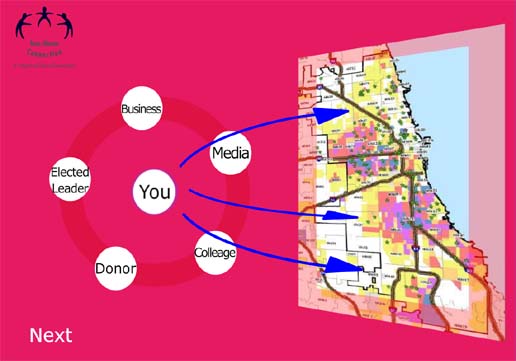
The top graphic shows that attention and resources will grow if the same events and "call to action" are repeated quarterly from year-to-year.  The bottom graphic shows how anyone can be the YOU who calls on their stakeholders to get informed, then get involved, supporting tutor/mentor programs in every high poverty area of Chicago.

What it takes:
As long as someone maintains a list of youth-serving programs and makes it available on a website, anyone can build a campaign that draws attention and support to these programs. That's what I have been doing.  You can find my lists on this page

Maybe in a few years one or more intermediaries will be able to create their own version of maps like the one below, which shows participation in the 1994-2015 Tutor/Mentor Leadership and Networking Conferences that I hosted in Chicago.  See the dashboard on this page


For most of the past 30 years I've focused strictly on programs that identified as some form of volunteer-based tutoring and/or mentoring based on this survey.  The programs on my maps are programs that fit this description.  However, I recognized in the late 2000s that I needed to be adding other types of youth-serving programs to my maps, but never was able to do that.  However, I have included many of them on lists found on this page

I'm now 79 and not in great health.  Someone needs to step forward and take ownership of my archives and responsibility for building a new youth-program resource that draws volunteers and donors directly to existing programs.

Until that happens, I'd appreciate any help you can offer to keep my lists up-to-date and to share my posts with more people.  That includes sharing them with people in other cities, where there also are concentrations of persistent poverty and too few youth-serving programs.

You can reach me on LinkedIn, Facebook, BlueSky, Mastodon, Twitter and Instagram.  See links on this page.

And, if you'd like to help me cover expenses, visit this page and make a contribution.

Saturday, March 21, 2026

Competing for Attention. Too Few Resources.

This week I read a five-part story about the demise of Local School Councils (LSC) in Chicago, written by Marcus Flenaugh who was defeated in this week's LSC election when only 30 people out of a school service area of about 27,000 residents took the time to vote.  In the 5th article  he concluded by urging people to mobilize and offered many specific suggestions.

That prompted me to look at a couple of visual essays that show a strategy that involves young people in community-organizing efforts.  

The first outlines a strategy that follows highly visible media stories with student generated stories. click here


The second shows an application of this strategy, focusing on the North Lawndale area of Chicago. click here


Below is the first part of an article I wrote in 2024, which points to similar articles from 2019 and 2012.

---- start 2024 -----


In October 1992, this was the front page of the Chicago SunTimes

The headline said "7-Year-Old's Death at Cabrini Requires Action".  

I had led a volunteer-based tutor/mentor program serving Cabrini-Green 2nd to 6th grade kids since 1975, so this hit hard.  I was in the process of creating a new program to help kids who aged out of the first program after 6th grade have similar support to help them from 7th grade through high school.  We called that program Cabrini Connections and launched it in January 1993. I led it until mid 2011.

However, this shooting was the catalyst for our creating a second program as we launched our site-based program.  That was the Tutor/Mentor Connection (T/MC). It's goal was to help on-going, volunteer-based tutor, mentor and learning programs reach K-12 youth in every high poverty area of the Chicago region.


As I write today's article (remember, this was prior to the Nov. 2024 election), most attention is focused on the coming election and a variety of natural and man-made disasters taking place in the USA and the world.  

So how do we get a share of that attention focused on this issue?

click here to read the full article

---------end 2024 article ------

These articles focus on building on-going attention for specific areas of Chicago, or any other city, and in drawing needed resources to organizations and schools in the focus area. Since adults have their hands full, why not enlist youth from local schools and colleges?  

Above is one view created using the Chicago Tutor/Mentor Program Locator, which was created in 2008.  While the Program Locator no longer is active, it remains a model of "what is needed".  View this PDF essay to see some of the features that were included.

Since 2011 I've been using the MappingForJustice blog, created by Mike Traken in 2008, to show ways to use maps to draw more consistent attention to volunteer-based tutor/mentor programs in high poverty areas of Chicago.  The strategy can be used to draw attention to local schools and their surrounding community, too.

In this article I included a concept map showing layers of information that need to be included on maps now being built by others.

I also included the concept map in this article.

Since I began trying to harness map-making technology in 1993 the means of creating data maps have simplified dramatically.  However, while I find many maps that show boundaries and indicators (poverty, violence, health disparities, etc.) I don't find many showing existing service providers and I find even fewer adding assets (people who can help) to the map layers.  Or using their maps in on-going stories intended to draw more attention and resources into the map area.

Thus, my "Rest of the Story" essays can still provide some ideas that others can apply.  I hope that happens.

I close many of my articles with this photo of me standing in front of a map of Chicago, and a Chicago Tribune article with a headline of "City Kids at Risk". 

I'd love to find blog articles and newspaper stories with similar photos, showing political leaders, business leaders, sports and entertainment figures, and others in my place.

This could be a photo of a 5th grade boy or girl from a South Chicago  neighborhood!

Thanks for reading.  Connect with me on LinkedIn, BlueSky, Facebook, Mastodon, Twitter and other platforms. see links here

And, if you're able, visit this page and make a small contribution to help me pay the bills.

Thursday, March 12, 2026

Connecting People, Ideas and K-12 Youth From High Poverty Areas

I've spent the past 51 years connecting youth from high poverty areas of Chicago with volunteers from many different backgrounds, as part of an on-going effort to expand the networks supporting kids as they grow up and as they begin their adult live/careers.

Initially this was through the tutor/mentor program that I led at the Montgomery Ward Headquarters in Chicago from 1975 to 1992.  Then it continued through the Cabrini Connections program that I formed in late 1992 and led through mid 2011.

When we formed the Cabrini Connections program we recognized that one more small program could be life-changing for the teens and volunteers who were served, but would not have much impact on the more than 200,000 school aged youth living in high poverty areas of Chicago.

So we formed the Tutor/Mentor Connection in 1993 and launched it in January 1994. I've led it since then, but through the Tutor/Mentor Institute, LLC since 2011.  


The programs I led served youth who lived in the Cabrini-Green area on Chicago's Near North side until the early 2000s when we began to accept kids from other parts of the city.

I've been interested in using maps since the late 1970s when we plotted locations of buildings in the Cabrini-Green area to show where our current students were living. We used this to target recruitment of new students to buildings where current students were living, thinking that this would help convince new students to join.  We did that using sketch paper, since I had not learned about GIS mapping at that time.

I did begin to learn about GIS mapping in late 1992 as we were planning the strategies of the new Tutor/Mentor Connection. And by 1994 we were producing maps on a regular basis, with the help of donated software and computers and volunteer talent.

In 2008 we received a $50,000 gift from an anonymous donor, focused at rebuilding our mapping capacity. Half of that went toward hiring Mike Traken, a GIS specialist, to make our maps.  Above is one that he produced in 2008 showing where our Cabrini Connections students were living.

At the right is one of many maps that Mike created between early 2008 and early 2011.  It shows where volunteer-based tutor/mentor programs are most needed, based on indicators like high poverty and poorly performing schools. Then it adds overlays showing locations of tutor/mentor programs in our database, and in this example Citi Bank locations in Chicago.  Browse this set of articles on the MappingForJustice blog to see more business maps created by Mike. 

Our goal was to convince businesses, professional groups, faith groups, health care and higher education leaders to use maps to form strategies that would support tutor/mentor programs that were located near their facilities, or where employees lived, or on the routes they take to and from work each day.  

While I've found many examples of business using maps to plan store locations, or to draw customers to stores, I've not found examples of them using maps to guide philanthropy or employee engagement. If you have examples, please share them. 

During the mid 2000s I learned about another type of mapping that could be used to visualize your network, showing who you were connected to and how strongly you were connected.

In 2010 I was able to obtain donated software from Valdis Krebs of Org.net and to recruit students from three Chicago area colleges.  They met with me on the TutorMentorConnection.ning.com site in a group established to focus on network analysis. 

One outcome of that was a set of articles showing participation in 2009 and 2010 Tutor/Mentor Leadership and Networking Conferences that I hosted in Chicago from May 1994 to May 2015.

Unfortunately I was not able to keep these interns with me so their work did not continue.

However, my interest in understanding networks did not change.   In Spring 2012 two interns from South Korea, via IIT in Chicago, took a look at participation in the Ning site since it was formed in 2007.

Each student created a presentation using Gephi software.  View this one here.


The second presentation can be seen here

I keep looking for examples of other people using maps like I'm demonstrating. 

However, the really important use of network maps is to help show how organized tutor/mentor programs are expanding networks for the kids and volunteers in their programs.


In 2010 I posted this graphic in the Ning group and wrote, "One of the goals of our Social Network Analysis is to find a way to show how the networks of kids living in highly segregated, high poverty, inner city neighborhoods changes over many years as a result of being part of a tutor/mentor program like Cabrini Connections. In this web site, Bob Pearlman shows that "who you know" is more important than what you know. He points to a Silicon Valley study by AT Kearney, which shows how kids living in poverty don't have people in their lives modeling college and technology careers, thus they are less likely to pursue those careers.

Thus, if we can create a SNA survey that shows how frequently kids are in contact with people who went to college, hold jobs in Science, Math, Technology, Engineering, health care, law, etc., we can ask our teens to take this at the beginning of each year. Comparison maps from year to year, should show an expanding network created as a result of being part of a tutor/mentor program.
"


I was not able to do this in the Cabrini Connections program since I left in mid 2011. And while I've shared this idea often, I've not found any youth-serving program doing this type of network analysis.

Last fall a team of students in an information visualization MOOC at Indiana  University created a new analysis of the 1994-2015 Tutor/Mentor Conferences.  The image below is an example of the type of information that can be pulled through the map.  This shows the number of conferences that were attended by Big Brothers/Big Sisters of Metro Chicago. 


They also created an open source network mapping tool that anyone can use to create a data collection sheet and upload it into Kumu.io or Gephi.  


You can find links to both of these on this page

I no longer lead a tutor/mentor program so I don't have access to students and volunteers to survey them to collect data that could be mapped using this tool.  However, any youth serving program could do this. Perhaps you can even enlist manpower from a local university to do the work for you.  Just point to what past interns have done for me.

The maps showing participation in Tutor/Mentor Leadership and Networking Conferences show that I was connecting to the majority of volunteer-based tutor/mentor programs in Chicago and to many in other cities.  My follower lists on LinkedIn, Facebook, Twitter and Instagram show that I'm still connected to many of these people and to many others who represent the broad ecosystem of the education/youth development world.

However, that does not mean they are talking to me, or to each other, about the challenges they face and the opportunities they perceive.  It's possible to create a data collection form using the new Network Mapping tool, that people in my network could use to show how they are connecting to me and each other.  The data from that could be converted to spreadsheets and then network analysis maps.  

I wonder how many might respond to an invitation to share that information.


These are things I think about every day.  If the ideas resonate with you, please share them in your own network.  Create your own version of my maps and graphics, focused on your own city/state.  Then share them so I can learn from you as you are learning from me.

You can find links to my social media sites on this page.

And, you can find information about helping me pay the bills on this page.

Thanks for reading. Have a great weekend.

Sunday, February 01, 2026

Expanding "Who you Know" Networks

National Mentoring Month has just ended and Black History Month starts today.  Last week I watched a panel discussion, hosted by MENTOR Georgia (it's 90 minutes long, so watch it later).  In one segment the speaker talked about mentoring as a strategy to expand networks, or social capital. 

That takes time.  

Below is a graphic that I created several years ago.  I find very few mentoring discussions that use graphics to emphasize the long-term support kids in high poverty, highly segregated, areas need to move from first grade through high school and post high school and into jobs and careers.

If you work your way through it I hope you'll have a better idea, and commitment, to the work that needs to be done in many places.


At the top of the graphic I show an arrow that represents support all kids need, for the first 20-25 years of their lives, to help them through school and then, into and through their adult lives. Some kids, like Bill Gates, or Jeff Bezos, or Elon Musk, had much greater support propelling them to career success. Those are extreme examples, but most kids have a large natural network of support than kids in high poverty areas. 

That arrow comes from this "mentoring kids to careers" graphic, which I created in the late 1990s.  It shows first grade through 12th grade, then college or vocational training, as a series of steps. At each step kids need a variety of different supports and/or are influenced by people who work in occupations that youth might aspire to in their own futures.  If you open this concept map, you'll see a different version of this timeline.

As I said above, all kids need some of these supports and influences.  However, if you read many of the articles in this section of my library, you'll see plenty of evidence showing that kids living in high poverty areas don't have as many naturally occurring supports or career models as do kids in more affluent areas. That means someone, or many people, need to help make these supports available and keep them in place for 12 or more years.

This leads to the next element on the graphic, which are the maps.  


I've been using maps since 1993 to visually show areas of Chicago with high concentrations of poverty and many indicators showing kids and families need more help.  Without a map you could have a long list of places you're helping, but still be missing a large number of other places that need the same help.

You can find the maps shown above in this 2016 article. You can find hundreds of articles on this blog, and the MappingforJustice blog, showing similar maps and encouraging leaders to use them to guide resources into all of these areas for many years. 

The map graphic I've used is a mashup of maps from three sources.  In this concept map you can find many data platforms that could be used to create similar map stories. 

Why don't we see leaders using maps to show the growth of youth and family support programs in every high poverty area of the  USA?

Since starting the Tutor/Mentor Connection in 1993, and the Tutor/Mentor Institute, LLC in 2011, my focus has been on helping long-term, volunteer-based tutor and/or mentor programs grow in all high poverty areas as a way of expanding the networks of support available to kids, helping them through school and beyond. 

Thus, the arrow, or timeline, indicates multiple years of support. The map illustrates that many places need the same type of support for many years.

The graphic below visualizes the need for every industry to have strategies that distribute volunteers, technology, dollars and more into every neighborhood...and for school and non-school programs to be places where kids connect with a wider range of learning and career opportunities than might be normally available in their own family and neighborhood. 


While I led a tutor/mentor program from 1975 through 2011, which collected inner city kids to a wide range of workplace adults, I did not start to understand this as a form of bridging social capital until the early 2000s.  

Here's a link to one of the earliest articles that have influenced my thinking about social capital. One introductory paragraph says:

“Social networks that can bridge across geography, race and class are key to success in the new economy”, says Professor Manuel Pastor, Jr., University of California, Santa Cruz, who has studied social networks in Los Angeles among Latinos. ‘Hard’ skills are essential, but it’s the connections and mentoring that provide information about what skills are necessary and a vision of how acquiring them can lead to new opportunities for all our residents”.

This was written by Bob Pearlman.  The research he points to can be found at this link.  His current website is at this link

Since then I've aggregated links to many articles about social capital, which you can find here, and have posted 30+ articles on this blog that focus on social capital.

In this article I point to an earlier influence. It was a book that I read in the mid 1990s, titled American Apartheid: Segregation and the Making of the Underclass, by Douglas Massey. This book emphasized how disconnected people living in highly segregated, high poverty, neighborhoods were from the resources that might make lives in those communities better for residents.

MENTOR, the national intermediary, focuses on all types of mentoring, recognizing that every person could benefit from having a mentor at some points in their lives.  But that dilutes the focus needed to reach kids in every high poverty area with organized, on-going programs.

I've used maps showing high poverty areas to help people understand where long-term, organized, volunteer based tutor,  mentor and learning programs are most needed. I encourage MENTOR and others to do the same.

Why non-school programs?

Find the graphic below in this visual essay.  It shows how organized, on-going programs are needed in high poverty areas of big cities, because of how difficult it is for kids and schools in these areas to make such connections and sustain them for many years.  We operated after 5pm because that was when workplace volunteers were more likely to make long-term commitments.

I've used a variety of graphics to visualize how organized programs can create extra learning opportunities by the involvement of volunteers who work in different industries and career fields.  This Total Quality Mentoring visual essay illustrates how such programs could be more available if they were strategically supported by leaders from different sectors.


I created this presentation more than 20 years ago to show why organized tutor/mentor programs are needed in high poverty areas and actions the Tutor/Mentor Connection had piloted since 1993 to help such programs get the attention and resources each needs to constantly improve.   The graphic I've included below visualizes some of the different types of learning, mentoring and tutoring that might take places in a site-based program.


These strategies have been based on the premise that areas of concentrated, high poverty, have too few people working in the wide range of careers that are modeled daily by parents, family and neighbors in more affluent places.  Thus, such programs need to be built in order to expand the social capital for kids in poverty areas.

However....  that does not mean there are "no people" living in high poverty areas who have jobs and careers.   That's the final element included in the graphic above.  Kids and adults need to learn "who you already know" who might be someone who can mentor them and help open doors to opportunity.


The need for social capital literacy is not really a new concept. Bob Pearlman's early 2000s article said, "Networking, or acquiring a social network, is a key skill of the 21st Century. It’s how you learn, and how you connect."  

I show another version of the "hub and spoke" graphics in a presentation titled "virtual corporate office" and in these blog articles.  


This shows how different industries could "distribute" learning and mentoring opportunities to kids in all high poverty areas, via school and non-school programs.  Social capital literacy could be a separate box, or could be a part of the mentoring coming from each industry.

The map reinforces the need for these forms of learning and mentoring in EVERY high poverty neighborhood. The timeline emphasizes the need for such learning to be consistently available for many years.  The other graphics emphasize that businesses in every sector could be supporting organized, volunteer-based tutor/mentor programs in multiple locations, not just one or two favored programs. 

Let's look at the timeline arrow once more.  If you click and enlarge it you'll see different types of learning activities that are appropriate for different age levels.

Here's another quote from Bob Pearlman's article:

"But the most significant finding in the study was that a student's social network can have a significant impact on his/her career choice. Students whose parents are both in high-tech careers are more likely to be interested in technology careers themselves. In addition, 83 percent of students rely on personal connections for career-related information and guidance."


I believe that the earlier a young person becomes involved in a well-organized, mentor-rich non-school program, the more benefit that program will have. Stronger bonds will be built with mentors, and with the program itself.  That's important because while a volunteer might leave after a year or longer, the program's ability to provide continuity, and a replacement mentor, helps keep the youth involved.  As a youth moves from middle school to high school the support offered can lead to part time jobs, internships, college access, scholarships and ultimately job and career opportunities. 

Kids in primary school where fundamental learning habits can be reinforced, and career aspirations nurtured, don't yet have the level of maturity needed to actively seek out mentors.  However, by middle school, and early high school, I think most kids would be ready to take more control over their own futures, if there were people helping them.  

We need to make that happen. 

This  has been a long post. Thanks for reading. I hope we connect on Twitter, Facebook, Instagram and/or LinkedIn.

If you want to support my work, please visit this page and use PayPal to send a contribution.