Showing posts with label directory. Show all posts

Saturday, February 07, 2026

Changes in Demographics of Chicago Suburbs

This week I saw an article in the Chicago SunTimes showing how dozens of Chicago suburbs have shifted to majority nonwhite over the past 36 years. That article is now on the WBEZ site, too.  It includes three interactive maps that show changes since 1990.


Read the article and view the maps at this link.

I've followed this shift for many years.  In 2007 we held our Tutor/Mentor Leadership and Networking Conference in the South Suburbs and created this map and blog article.


Since then I've updated these articles and these articles on the MappingforJustice blog, as I've found new research showing demographic changes in the Chicago suburbs and in other cities around the USA.  

When we held the 2007 conference in Olympia Fields one of our goals was to find partners who would help us learn about any volunteer-based tutor/mentor programs already operating in the suburbs, and who would use the ideas shared at the conferences and on our website to build new programs were needed.

I still have not found anyone collecting and sharing this information. 

The map below shows locations of volunteer-based tutor, mentor programs in my database.  Visit this site and find a link to the interactive map and to my lists of Chicago area programs, which is organized by sections of the city and suburbs.


While the WBEZ map shows the demographic mix in the suburbs it does not show the economic diversity.  I've seen that on other maps, but can't find one right now.  Without an overlay that shows where poverty is most concentrated, by zip code, it's difficult to know where long-term volunteer-based tutor/mentor programs are needed.

If you've a map that shows this please share the link in the comments. 

Thanks for reading.  Please share my articles and connect with me on LinkedIn, Facebook, BlueSky, Mastodon, Instagram and/or Twitter (see links here).

If you want to help fund my work, visit this page


Monday, September 29, 2025

Connect with other out-of-school-time leaders

 Below is a map on the Georgia Statewide Afterschool Network website


This looks like a great resource.  I follow them on Twitter (X).  They post information regularly.

They are one of several afterschool resources that I share on this page of the Tutor/Mentor library.  The Georgia Afterschool Network is also listed on this 50 State Afterschool Network page, which is also on my list.

I also point to websites that aggregate youth program information on this page.  The map below shows one of the organizations on that list. It's the MyChi.MyFuture. Programs map which shows youth serving programs in Chicago.  

If these two pages don't provide enough information on out-of-school-time programs, you can also look at individual programs that I show on this page, and this page

And, if you visit this section you'll find dozens of research articles.

From 1994 to 2015 I hosted May and November leadership and networking conferences to try to get representatives of these organizations to connect, network, share ideas and find ways they could work together to overcome obstacles.  I used the website to share links to all of these organizations, even if they did not attend the conferences. I also included them on printed newsletters sent from 1994 to 2003 and email newsletters sent monthly since then.  You can see the conference goals on this page

These are still my goals.

As we enter a new school year, and the final months of 2025, programs serving youth in the non-school  hours, or focused on youth in high poverty areas, or with special needs, are struggling to find consistent resources. That struggle is magnified by how much attention traditional and social media are focusing on the actions of the current US government, and many states.

More than ever we need to aggregate information, and find ways to draw people to it, help them understand it, then help them apply it in many different places where kids and families need extra help.


In several past articles I've talked about "mapping participation" to learn "who's there" and "who's missing".  I saw a post on LinkedIn today from KUMU that showed how their platform can be used to do network analysis.


Note how when you click on each node you get information about that person, or what network he/she is part of.  Similar maps could show all the information in my library, or in libraries hosted by other people.

It would be great if someone were able to create a tool that would look at different sections of my library and created network maps showing who is visiting.  It would be even better if we had places where a large portion of the ecosystem (including media, funders, policy makers, families, youth, business, etc.) were engaged on on-going learning and planning that leads to more and better youth serving programs in all the places where they are most needed.

Until that happens I'll keep trying to keep the links in the library updated and will continue to point to this resources in my blog articles and my own social media posts.

If you've found any of this useful, let me know.  You can find links to my social media platforms on this page.

If you'd like to contribute to help pay the bills, visit this page

Sunday, June 08, 2025

Help Volunteer-Based Youth Tutor, Mentor & Learning Programs

While the USA trembles at the brink of chaos due to the actions of the current President, and reactions of those who oppose him, we still need to reach out to help youth get the extra support they need to move safely through school and into adult lives.  Organized, on-going, volunteer-based tutor, mentor and learning programs can offer some of that support, if they are available in the neighborhood where kids live.

That's been my goal since forming the Tutor/Mentor Connection in Chicago in 1993 and the Tutor/Mentor Institute, LLC in 2011.

I've built a huge library of information that anyone can use to understand where and why these programs are needed.  At the heart of the library are my lists of nearly 200 Chicago area youth serving programs. Find this by browsing the Chicago Program Links list that I've been maintaining since 1993. 

You can also use the map, shown below, to determine what groups operate in different parts of Chicago...or near where you live, work, or along the route you travel as you do to and from work every day.  The program links list is also organized by sections of the city and suburbs, for the same purpose.


This map can also be seen here.

If  you click on an icon you can find the organization's name and their web site. Copy and paste the web address into your browser and you can learn more about the program, depending on how well the web site communicates the program purpose, history and design. Below is a JPG showing what the map looks like when open opened.

Each green icon on the map is the location of a Chicago youth serving program

Some of the locations on this map are headquarters sites of organizations that offer community based mentoring (mentors meet with kids at different places), or are organizations with many different sites where they offer services. Big Brothers/Big Sisters of Metropolitan Chicago and Working in the Schools (WITS) are two who fit these descriptions. You'd need to go to their web sites to see their lists showing locations where they are active.

You can also find links to Chicago area programs at
*  Facebook pages list - click here
*  LinkedIn list - click here
*  Twitter list - click here
*  Instagram list - click here

enlarge the map

This information can be a starting point for others to get to know these organizations better, to help each of them attract needed resources, and to help share ideas across different programs so all will improve. You can enlarge the map then click on the icons to learn about programs in different areas. 

Browse articles I've written since 2005 to see how maps can be used in stories written by many people to help draw attention and resources to tutor/mentor programs in different areas, or to help new programs form where more are needed. Click maps, media, violence for lists of stories. 

The map shown above replaces an interactive Chicago Tutor/Mentor Program Locator (view archive version here and here) developed by the Tutor/Mentor Connection between 2004 and 2009. Since 2013 I've not had funds or technology support to update the site and in August 2018 the link to Google maps stopped working.

Since 1993 the Tutor/Mentor Connection has been maintaining these lists and an extensive library of information that shows where these programs are most needed, and why, and provides resource people can use to build and sustain programs in every high-poverty area of Chicago In 2011 the Tutor/Mentor Institute, LLC was created to continue this service.

This is work that really should be done at universities, where there is a constant stream of student brainpower to do what I've been doing by myself and with the help of a small staff and many volunteers.

I've tried to get this help In fact, I've been reaching out to universities for more than 30 years.  


Take a look at this presentation and see the many universities I've connected with and the work students have done in short-term internships and fellowships.  There are over 60 pages!  And many links to documents that show interactions with students and faculty.  Take your time to look at it.

Then share it with people like MacKenzie Scott, who has been giving millions of dollars to non-profit organizations.  Show how funding a Tutor/Mentor Connection-type program for 10 to 20 consecutive years on a university campus could leverage the donations being made and create a much greater, sustained, comprehensive, impact.

If donors provide the money, universities will establish programs, and my 30 year history of trying to support volunteer-based tutor/mentor programs and help kids in high poverty areas from birth-to-work will become a valuable resource.

That would lead to new, updated, map-based directories in Chicago and other cities, that are part of efforts to draw consistent operating dollars to programs in every high poverty area, which will help programs hire and retain staff, keep them operating longer, and have a greater impact on the lives of kids and families.

In this section and this section of the Tutor/Mentor Institute, LLC Planning Wiki you can read the history, goals and current status, for building a map-based tutor/mentor program database.  Such a platform can be applied in any city to support the growth of needed services in all high poverty areas, thus volunteers, partners and financial support can come from any place to help this work become a reality.

Until that happens, I still will depend on contributions to maintain this list of programs, the Tutor/Mentor Connection web library, my blogs, etc.

Please make a contribution so I can keep this information freely available to all.  Visit this page to find an address and a PayPal button.

Monday, February 20, 2023

What Youth Programs Exist in Your Area?

My small non-profit published it's first Directory of youth tutor and/or mentor programs serving Chicago in May 1994.  The goal was to help volunteers and donors find and support existing programs and to provide a source of information leaders could use to determine where more programs were needed, based on what already existed, and the population of kids in poverty in different zip codes.

We continued to publish the printed directory until 2003, but started putting the information on the Internet in 1998.  Since 2004 all the information I've shared has been on our websites.

Read more about the Directory and Program Locator - click here

The survey we used to collect information about programs segmented responses by a) type of program - pure tutoring, pure mentoring, combination of on-going tutor/mentor supports; b) age group served - elementary school, middles school, high school; c) time of day services offered - school day, after school, after 5pm & weekends; and d) address.

With this information people could search specific areas for programs serving specific age groups.  Unfortunately the websites we built in the 2000s to share this information are now only viewable as archives.  I'm only able to share my list of programs through the map shown above (see this site) and this list on the Tutor/Mentor Institute, LLC website. 

Furthermore, I'm not the only one collecting information about youth programs serving Chicago and Illinois.  Here are a few others.

Peace Hub Chicago map - click here

Use the tables at the left to narrow your search. Click on the red icons to get contact information and website address.  Under services you can search for "tutoring" or "mentoring".  

ACT NOW! Afterschool for Children and Teens - maps entire state - click here


You can refine your search for grade levels served and type of programming offered.  Click on the icon for program information.

MyChiMyFuture - Programs Map 


This is the Mayor's initiative, aimed at helping youth find out-of-school time programs they can participate in.  There are many ways to narrow your search, however, for some reason I don't see a category for mentoring.  Many of the resources shown are libraries and park district facilities.  I'm not sure how many community based organizations are on this map.

If Chicago gets a new Mayor in 2023 will that Mayor continue to support this initiative? I hope so. 

These are just three directories that I'm aware of. I'm building a list at this location, so you can visit and see directories for Chicago and for other cities and states, too. 

What I don't see yet....

I don't see blog articles or social media posts using these on-line directories to focus attention on areas with high poverty, poorly performing schools or acts of violence.

I don't see blog articles or social media posts using these platforms to do an analysis of type of programs, age group served and number of youth in specific areas who need these services.


Furthermore, I don't see an on-going, multi-year attempt to draw volunteers and donors through these platforms to individual programs where they offer support for operations and constant improvement.


I  urge you to browse articles in the maps, media and violence categories on this blog to see examples of how I've used the program locator directories the Tutor/Mentor Connection created to draw attention and resources to programs in specific parts of Chicago.


Read these "Rest-of-the-Story" articles to see how young people could be creating regular stories using maps and intended to help tutor/mentor programs grow in more places, helping more kids through school and into adult lives. 

Raising kids continues to be a two decade effort and in some places parents and schools need extra support that can be offered by well-organized non-school tutor, mentor and learning programs.  

Helping existing programs sustain their efforts and helping new programs grow where more are needed is something many people need to be doing, in Chicago and in other cities and states. It's not something one person can make happen.


Thanks for reading.   Please connect with me on Twitter, Facebook, Instagram, Mastodon, LinkedIn and other platforms.  

Share these ideas. Create your own versions, with maps of your community if you're not in Chicago.  

Finally, if you can help fund my work, please visit this page and send a contribution. 


12/28/2023 update - On the Mapping for Justice blog I posted this article, showing a STEM Opportunity Mapping project focused on nine Chicago South-side neighborhoods.


Thursday, November 17, 2022

Mapping Complexity

Below is a post I saw on Twitter, showing a "Social Change Ecosystem Framework" developed by Deepa Iyer, of the SolidarityIs and Building Movement Project.  

Here's an article by Deepa Iyer that describes a use of this Social Change Map.  I love the "hub and spoke" design she uses and how this shows the range of people and networks who need to be part of any problem-solving ecosystem.  

I've used similar visualizations for more than 20 years.

You can see these in hundreds of articles on this blog.  I've posted several dozen articles since 2005 that I've tagged "complex problems".  And many more tagged "network building".  Plus a few more tagged "ecosystem". 

Below is a concept map created more than 10 years ago that shows the range of talents and networks that need to be involved in solving any complex problem.

All of these emphasize that no single person can solve the many complex problems we face locally and globally.  If you scroll through the articles tagged complex problems you'll find many visualizations showing complexity. 

I found another on my LinkedIn feed this week.

This graphic by Christian Sarkar can be viewed in an article titled "The Ecosystem of Wicked Problems".  

One of the features of this graphic is that it shows relationships and how the problems are inter-related to each other.  

What would have made it better (in my opinion) would have been links from each node, to web libraries with information about each problem.

For instance, here's my concept map showing the research section of the Tutor/Mentor Library.  At the bottom of each node is a link to a specific collection of websites.

Linking to libraries like this would expand the information anyone has to understand a problem, to connect with others who are also trying to solve the problem, and to find work being done in some places to solve the problem that might stimulate innovation and/or duplication in many other places.

The challenge, of course, is building and maintaining such libraries, and attracting people to use the information.  And, finding consistent funding to pay for the work.  I was never able to do that. 

I hypothesize that every link I point to from my library represents an ecosystem of many people working for that organization and an even greater number who that organization and its employees connect with.  

Looking at the graphics by Christian Sarkar and Deepa Iyer, imagine people from each of these nodes connecting with each other in on-going learning, innovation, resource development and problem solving.

Who are all of those people? Who are all of the organizations working in each category? 

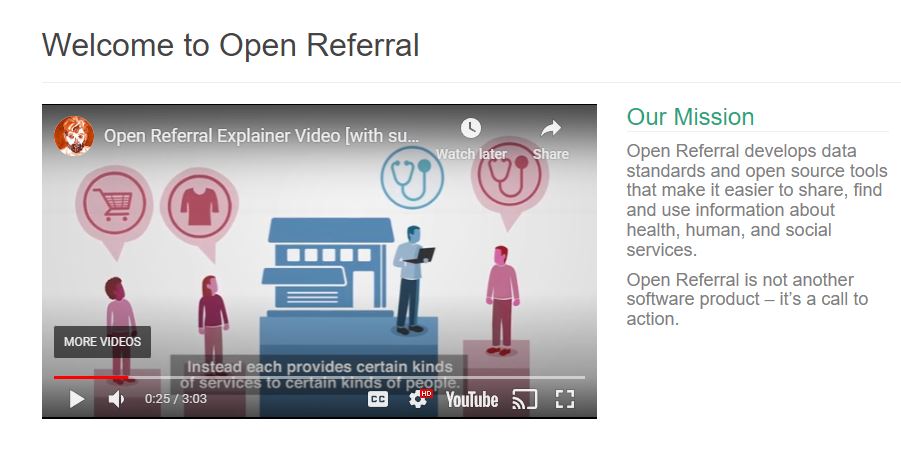
Someone who's been doing some deep thinking about part of this is Greg Bloom, Founder of Open Referral. He was the speaker at the November 15, 2022 ChiHackNight event.  

I encourage you to view the short video on the home page of the Open Referral website to understand the important work they are doing and the problems they are addressing. 


Greg's group has been bringing people together since 2012 to talk about the challenges of building and maintaining information directories and to "create a common set of data standards, that define and structure information, so that it can be readily transferred between systems".  Read through the FAQ questions and answers on the Open Referral website to understand this better. 

View Greg's Nov 15 presentation to ChiHackNight.  click here

That means many distributed directories could be connected in larger directories, making more information available to more people.

The Tutor/Mentor Connection, which I and a few others created in 1993 and launched in 1994, has been collecting information about Chicago area volunteer-based tutor/mentor programs for 30 years, along with building a library that represents the ecosystem of research, resources, funding, businesses and everyone else who needs to be involved in helping kids in poverty move more safely from birth-to-work.

We published our first printed directory of Chicago tutor and mentor programs, and the ecosystem of those who support them, in 1994 and updated it annually through 2003. After that all of our information was put on-line. 

We had others ask us to share the data, but who never offered to help pay the costs of collecting and maintaining it.  I never did this for fear of the larger organization eliminating the need for our work, and then at some point in the future, ceasing operation, so none of the data we had been collecting would remain available. 

Furthermore, if our data was owned by a national organization, the people who managed it would not have local passion, or local purpose, to use the data regularly to help existing programs constantly improve, nor to help new programs form where data analysis showed more were needed. 

That was why we were collecting the information in the first place!

Thus, I proposed there be a decentralized collection of data that was shared in a system similar to what Greg has been working on. Back in the 1990s the technology, or motivation, to do this was not available.

Thus, I fully understand the challenges Greg describes. For the past 10 years I've been a one-person army trying to maintain the library, share it, and get people to talk to myself, and each other.  If you read though this blog you can find hundreds of articles that relate to this.

Bringing people together.

When we were planning the Tutor/Mentor Connection in 1993 and talking about building a directory our PR partner from Public Communications, Inc. in Chicago, said "You've got to host a conference!".  

Using the contact information from organizations we learned about through our survey and our networking, we hosted a first Tutor/Mentor Leadership and Networking Conference in May 1994 and hosted one every six months after that until May 2015, at which time I had to stop due to lack of money.

In this article you can see a map showing participation over 20 years.  Here's a presentation showing how universities hosted these conferences and how I reached out to them for many years.  Between 1996 and 2002 attendance ranged from over 150 to over 300. Our mailing list grew from 400 to 14,000. This represented quite a large ecosystem, yet, it was not attracting business, philanthropy, government or university participants.   Thus, there were always too few of "the right people" to fully build the Tutor/Mentor Connection to what I hoped it would accomplish.

Since forming the Tutor/Mentor Institute, LLC in 2011 the range of people I've been reaching dramatically declined and conference participation dropped to around 100 per event. 

So let me sum up.

1) the world is dealing with complex problems and some people are creating great visualizations showing this complexity;

2) some people recognize the difficulty of collecting and sharing social service information and are trying to innovate new solutions;

3) knowing "who" should be included in a directory, or in an "invitation list" is part of the problem in a big city like Chicago;  getting them to come to "your event" or into "your conversation" is a huge challenge if you're not well-connected, or have a reputation that draws people to you.  Getting into "their conversations" and "being heard" is just as difficult.

4) I find very few people creating visualizations of who should be connected, or who they are bringing together via their events.

5) even if you have a list of "who" unless you do some sort of network analysis of event participation and/or social media conversations, you don't really know how well your network is connecting.

I'm sure readers might list more problems. I'd love to hear from you.

This has already been a long article, but if you've made it this far I encourage you to go one article further.  Review the 4-part strategy described in this concept map.

The "information collection" described in this article is just STEP 1. Getting people to look at the information (step 2) and helping them understand it (step 3) and use it (step 4) also need to be funded and supported as part of any problem-solving process.

Thanks for reading. I hope you'll share this.  I'm on Twitter, LinkedIn, Instagram, Facebook and Mastodon. (see links here).  Let's connect.

If you appreciate these articles please visit my FundT/MI page and send a small contribution. 


Monday, May 16, 2022

Kids not living in high poverty need mentors, too

If you've followed my work for any length of time you see how my focus has been on helping kids living in high poverty areas connect with adult volunteers in organized non-school tutor, mentor and learning programs.  Open the graphic at the left and you can see a 10-point strategy developed in 1993 that I have followed for over 20 years.

For the past few years as I've watched horrendous tragedy of youth using AR-15 rifles to murder groups of people, as in Buffalo this past weekend, I've begun think that there is another category of young people who need a lot of extra mentoring and adult support.


Since launching the first tutor/mentor survey in January 1994 I've tried to build a segmented understanding of existing tutor/mentor programs in Chicago, sorting by age-group served, type of program and location. 

At the right is a graphic showing a vision that I've had for many years, of creating a much more detailed understanding of what types of programs are available within a geographic area.  You can see this graphic in this blog article

Below is a view of the Tutor/Mentor Program Locator which we launched in 2004, based on the printed Directory we had published since 1994.  It enabled people to search by type of program, age group served and location, to find programs in different parts of Chicago.


This has been an archive since 2018. You can read about it here.  If someone creates a segmented understanding of programs in their area, this is a way to share that information and help those programs attract volunteers, donors, students and media attention.

Below is an updated version of the graphic shown above.  


I've added another sub-category focusing on youth growing up surrounded by adults who have adopted anti democratic conspiracy theories, religious extremism, White Supremacy thinking, etc.  


At the left is a graphic that I include in a presentation titled "Defining Terms".  The graphic shows five categories of youth who could benefit from help provided by volunteers in organized, on-going, tutor, mentor and learning programs. The large light blue area in the middle, showing youth living in high poverty areas, has been where I've focused my efforts for more than 40 years.... helping kids in high poverty areas get extra support that aids them in the journey from birth-to-work.

I updated this graphic yesterday.  

I added a circle to show "all youth" need support of mentors and extra adults. This is similar to the graphic at the top of this article.  I included elements from the original graphic, showing youth with special needs and youth living in high poverty areas.

However, I added two more shaded areas. One focuses on children of the super-rich, who grow up living in a far different reality and level of experiences than do most other kids.  Can they empathize with the challenges other kids face, and use their wealth,  power and influence to help society overcome these challenges?

The second shaded area is more troubling. This includes all youth who are growing up surrounded by adults who have adopted anti democratic conspiracy theories, religious extremism, White Supremacy thinking, disinformation from FOX News and other sources, etc.   The terrorist who murdered 10 people at a Buffalo supermarket was clearly influenced by such an environment.

In an organized, non-school tutor, mentor and learning program youth can connect with a wide range of adults and experiences.  Not all programs have this design, and few offer all of the possible learning opportunities that might attract kids and keep them coming back every week for many years.

But that's the goal I've shared for 20+ years.
Now I think we need to be finding ways to reach kids who don't live in poverty (without reducing our on-going efforts to provide more and better programs and support to kids who DO live in poverty areas).  

I don't even know where to start.  

Well, I do, really,  I need to find a place where someone is collecting articles and research about this and also aggregating links to organizations working to combat the formal and informal grooming that is turning so many young people into disenchanted, destructive human beings. 

The graphic below shows categories in the Tutor/Mentor web library at https://tutormentorexchange.net/resource-links.  I can add another category but I'm not sure what to name it yet.  


I'll share this article on my social media posts and look for suggestions and recommended links from my network.  I don't intend to make this the primary focus of the library, but hope to be able to point to others who do make this the primary focus of their work.  

This page shows links to my social media pages, such as LinkedIn, Twitter, Instagram and Facebook.  I look forward to connecting with you there. 

Monday, August 31, 2020

Call goes out for Volunteers

 Below is a column from the 1997 Chicago SunTimes, telling about the Chicagoland Tutor/Mentor Volunteer Recruitment Campaign that my organization (the Tutor/Mentor Connection) launched as an annual event in 1995.  From 1998 to 2002 we grew the campaign to include more than 100 youth programs who were recruiting volunteers at more than 30 sites throughout the Chicago region during the first week of September.


Visit this page and see media stories from 1990s.

It's now almost September 2020 and once again volunteer-based tutor, mentor and learning programs in Chicago and throughout the country are searching for volunteers. This year is different. Most of those calls now seek virtual volunteers who can support youth via ZOOM and other remote platforms, until face-to-face contact can safely return.

What always made my efforts unique is that while I led a single tutor/mentor program reaching youth in one neighborhood of Chicago, the campaign organized through the Tutor/Mentor Connection intended to draw volunteers to every youth tutor, mentor and learning program in the Chicago region.


We supported the volunteer recruitment campaign in the 1990s with a printed directory listing more than 100 different youth serving organizations. We started putting this list on the Internet in 1998 and in 2004 we launched a map-based program locator, that enabled people to find programs in different parts of Chicago by searching for type of program, age group served and location.

In 2008-9 we created a map-based version of this Chicago Program Locator, which you can see at this link. That site has not been updated since 2013 due to lack of funding and talent and is now only available as an archive. Yet it still serves as a model of what communities might create to help services required in multiple places get the resources needed to grow and thrive, such as youth tutor and/or mentor programs.

We never had consistent funding to do this work, although from 1998-2002 we were well supported by several foundations.  Yet the work of helping youth through school, by helping organized volunteer-based tutor/mentor programs be part of their lives, is on-going work. These programs need help to grow in 2020 more than in the past.

Because I've created a program locator template and a Chicago Programs Database anyone can use their own voice to draw attention and support to all youth programs in a geographic area.

Below is a recent Tweet from NBA Basketball star LeBron James:  

He and other athletes are now taking a lead in calling attention and response to social justice issues. They are focusing on get-out-the-vote strategies, and supporting youth development programs in different places. 

Let's invite them to use those voices to help youth tutor, mentor and learning programs grow throughout Chicago and other cities.


I've posted several articles in past years featuring this image of LeBron James, focused on roles athletes and other celebrities can take to help tutor/mentor programs grow in cities where they play or where they grew up.

Please read them. Share them with athletes you know.

Here's what they can do:
a) they can support efforts to build comprehensive youth program databases, segmented by type of program, age group served and location

b) they can support efforts to build interactive program locators, borrowing from my example (and others if they can find them)

c) they can use social media, traditional interviews and public speaking opportunities to urge people to look at these databases, locate programs in specific areas, and donate time, talent and dollars to help each program become the very best at helping kids through school and into adult lives.

Athletes know that it takes many years of hard work to build great sports teams, and it takes many years of individual effort, along with support from coaches, friends, family and others to reach an elite level of performance.


That's the same range of on-going support needed to help single youth tutor/mentor programs become great, then stay great.  Instead of supporting just one program, athletes like LeBron have the abilityto draw support to every one of these programs.  However, without the database, a search engine and on-going effort, that won't happen.

Imagine this. Look at my website and the articles on this Tutor/Mentor blog, which I started in 2005. What if one of the Chicago sports stars, from the Bears, Bulls, White Sox or Cubs were the author of all of these articles? How many more people might have responded and how many more youth might have been helped through school and into adult lives?

Please share this knowledge and help great youth development and birth-to-work mentoring programs be available in every low income area of Chicago and the rest of the world.

I'm on social media at these sites. Let's connect.

If you value my articles and web library, please help fund Tutor/Mentor Institute, LLC. Click here to learn more. 


Wednesday, August 26, 2020

Help build the Chicago Tutor/Mentor Knowledge Base

Below is a graphic that visualizes almost all that the Tutor/Mentor Connection (1993-present) and Tutor/Mentor Institute, LLC (2011-present) have been trying to do for the past 25+ years to support volunteer-based tutor, mentor and learning programs in every high poverty area of Chicago.

In this post I'm going to show a role that volunteers, including students, can take to help me collect and maintain information that others can use to help youth in every poverty area of the Chicago region. 

The blue box in the middle of this graphic is where I've operated for almost 45 years. Initially I was connecting workplace volunteers with 2nd to 6th grade youth living in the Cabrini Green area of Chicago in weekly one-on-one tutor/mentor sessions held at the Montgomery Ward Headquarters in Chicago.

In 1993 I created the Tutor/Mentor Connection (T/MC) to try to help volunteers and donors connect with youth in all high poverty areas of Chicago, through organized non-school tutor, mentor and learning programs like the one I was leading. Since 2011 I've led the T/MC via the Tutor/Mentor Institute, LLC.

If the blue box on that graphic were a live link it would connect you to a vast library of information which I've been collecting formally since 1993.  The graphic at the right visualizes part of what's in the library.  It contains information about Chicago youth programs, including age group served, type of program, time of day, role of volunteers and location where services are provided.

Between 2004 and 2008 we built an interactive on-line program locator, which anyone could search to find specific programs in different zip codes of Chicago.  

Using this information anyone (see list at the right side of top graphic) can find places where they offer time, talent and/or dollars to help formal programs grow and help more kids and volunteers connect. Anyone, including program leaders and volunteers can draw from information in the web library to learn ways to constantly improve what they do to help kids.

While the library is vast (you can use this blog article to see various sections), I seek help in maintaining my list of Chicago area programs.  You can find this list in these places:

a) Chicago programs links in web library - click here. You can also see those programs on the map at this site

b) List of Chicago programs on Facebook - click here

c) Chicago programs list on Twitter - click here 

d) Chicago youth programs using Instagram - click here

My lists are organized by sections of the city (North, Central, South Central, South).  In the graphic at the top of this article you can see how I've created a grid, dividing the city into smaller sections.


My invitation is that groups in each section of Chicago will take on the role of reviewing links in my library to determine if those programs are still active.  If not, they will email me and I can remove those programs from my lists.  At the same time they will survey the neighborhood to determine if there are other programs that I should include in my lists.

NOTE: I'm not looking for every type of youth program in Chicago. I'm trying to find those who have a strategy that involves volunteers as tutors and/or mentors.  In the larger web library I have other sections where I point to other youth programs in Chicago and to others who are maintaining their own directories.

Anyone can do this work. It could be a class from a local school, a church group, an existing youth program, a civic organization, a business-sponsored club, or a college group.  

It's a great virtual learning project. All you need is a computer and internet access. You can work alone, or gather in a ZOOM group with your peers or mentors and discuss how you are locating programs and what you are finding.  You can share ideas for ways to draw attention to the programs in your area, then share those ideas with groups doing similar work in different parts of the city.


 If you want to take this role email me at tutormentor2 at earthlink.net and let's set up a ZOOM call where I can point you to the list and help you understand what I'm asking for.  Once you commit, I'll pin your organization to my map. Ultimately I hope to have groups in every part of the Chicago region.

As you learn about programs by looking at their websites I want you to use social media to tell others about them, what they do, where they are, who they help and how others can help them.  

That's the role of the BLUE box in the middle of the top graphic. I'm connecting people who can help with programs who need help in making a difference in the lives of kids living in high poverty areas. If you learn to take that role, and practice it for a year or more, it will become something you might do often throughout your lifetime.

That would dramatically change how non-profits are supported and how well they are able to do their work.

Not in Chicago? You can build a Tutor/Mentor Connection type strategy and take on the same role, to help youth tutor/mentor and learning programs grow in your own community. 

If you'd like to support me with a contribution, please visit this page