Showing posts with label NewYear. Show all posts

Monday, January 22, 2024

30 Years Later. New Year. Same Goals.

On the lower left side of this blog you can see a list of years that I've written this blog, starting in 2005. This shows articles written each month, of each year. Thus, you could look at January in past years and find reflections that I've posted, like this one that says "What the heck am I trying to do?"

I led a volunteer-based tutor/mentor program from 1975 to mid 1992 (while holding full time retail advertising management roles with the Montgomery Ward corporation), which connected 2nd to 6th grade kids from the Cabrini-Green homes with volunteers from Montgomery Ward's corporate headquarters and many other Chicago companies.

We created Cabrini Connections as a strategy to help kids who aged out of the first program after 6th grade have support through high school.

We launched the Cabrini Connections program in January 1993, meeting with 5 teens and 7 volunteers on Saturday mornings in the day room of St. Joseph's Church on North Orleans Street in Chicago.   Our volunteers had backgrounds in video production so our weekly activities centered around improvisation, as a form of relationship-building.

At the same time we started meeting at Wells High School with a small group of high school students who had been part of the first program. 

In July 1993 Montgomery Ward donated space in its corporate office tower for us to operate, and we moved the program there, meeting on Thursday evenings.  That first year we recruited 30 teens. Each year after that we added more 7th and 8th graders until by 1998 we were serving close to 90 teens with over 100 volunteers.  Due to available space, we never grew larger than that over the next 12 years.  I left the program in 2011 and sadly, it is no longer operating.

Last week I received a message from one of the teens who joined us in 1993.  She said, "y'all help me grow in so many ways so I want to say thank y'all for being a great team helping us out in the neighborhood."  

I've received variations of this comment consistently over the past 10 years as I've connected to a growing number of alumni on Facebook who were in elementary school in the 1970s and 1980s and were in middle school and high school in the 1990s and are now adults raising their own kids.

These are an affirmation of the importance of volunteer-based tutor/mentor programs and why I start each January with a new commitment to help such programs grow in more places. 

When I first started leading the tutoring program at Montgomery Ward in 1975 one of the Vice President's said "Dan, you don't know  much about leading a tutor/mentor program. Why don't you find others in Chicago who already lead programs and invite them to lunch. See what you can learn from them."

That began 17 years of informal leadership in building a network of Chicago tutor/mentor programs and drawing them together to share ideas and work jointly in training volunteers.  It's probably one of the main reasons I stayed involved for as long as I did.

Then, in October 1992, after I left the original program (read The Tutor/Mentor Business, by Sara Coover Caldwell), and was working with a small group of volunteers to determine a next step, a 7-year-old boy named Dantrell Davis was shot and killed on his way to school.  The front page of the Chicago Sun-Times had an editorial demanding action.

This inspired me to create the Tutor/Mentor Connection. 

From my previous years of networking with Chicago programs I realized that no one was keeping a master list of all the different volunteer-based tutor and/or mentor programs in Chicago, thus, no one, other than myself, could invite programs to gather regularly.

From my retail advertising career at Montgomery Ward I had learned how the company used weekly advertising to draw millions of potential customers to our 400 stores, spread across 40 states.

I saw a pattern in which media would occasionally give featured attention, and anger, to a tragic shooting, or a poorly performing school, or a street gang, but that the story only focused on one neighborhood of Chicago, and seldom included a "call to action", motivating readers to support existing youth programs in that neighborhood, and all others in the city,  as volunteers or donors.

And, then, those stories went away after a few days, replaced by other stories.   My advertising career taught me that you need to keep your story repeating over-and-over, to reach more people, and to have a frequency that would capture readers attention, and ultimately motivate action.

None of this was happening in Chicago.  So we spent 1993 planning a strategy that we launched in January 1994 as the Tutor/Mentor Connection.


You can read the 1994 Tutor/Mentor Connection Case Statement at this link.

Each year between 1993 and 2011 I used part of the money we raised to support our own Cabrini Connections program. And I used part to build a library of Chicago tutor/mentor programs and lead efforts intended to help each program (including our own) get more consistent attention and a better flow of volunteers and dollars, while sharing ideas that each could use to constantly improve based on what they learned from their own work, and what they learned from others.

While initially we published our list of programs in a printed Directory, and shared ideas via a quarterly printed newsletter, one of our volunteers built our first website in 1998 and by 2000 we had moved our library and list of programs on-line.  That was a needed strategy as we did not have the money to continue our print newsletter strategy and needed to reach more people than the 10-12,000 we were sending that newsletter to.  

This concept map shows highlights of the Tutor/Mentor Connection's growth.   

In mid 2011 after I left the Cabrini Connections program (long story) I created the Tutor/Mentor Institute, LLC to keep the Tutor/Mentor Connection available to Chicago and to try to help similar intermediaries grow in other cities.

If you read some of my past January articles you'll find more details of what I've been trying to do and the challenges I've faced to do it as well as is needed.    Here are some other articles that show my 30 year history. 

So as we enter 2024, Chicago and other cities still have areas of concentrated poverty and youth in these neighborhoods attend poorly resource schools and a influenced by too few people modeling a wide range of career opportunities and expectations and too many who model negative habits.

Chicago still needs a Tutor/Mentor Connection strategy (even if it's not led by me, or called the Tutor/Mentor Connection). So do other cities.  So I continue doing what I do with whatever resources I can find, just as I started doing in 1993.


Will you help me?

Read some of my past articles, like these about forming a new Tutor/Mentor Connection.

Share my articles with your network.

Help me find a benefactor and/university that will take ownership of my archives and this strategy and teach leaders to do what I've been doing for the past 30 years.

Make a contribution to help me pay the bills. Click here 

Thank you for reading and if you made a contribution in 2023, thank you for continuing to support my efforts.


Monday, January 02, 2023

New Year Reflections for past decade

I wish you all a full 2023 filled with hope, good health and happiness.

I've been writing this blog since 2005 and had been sharing ideas via printed and email newsletters since forming the Tutor/Mentor Connection and a site-based tutor/mentor program called Cabrini Connections, in 1993.

 
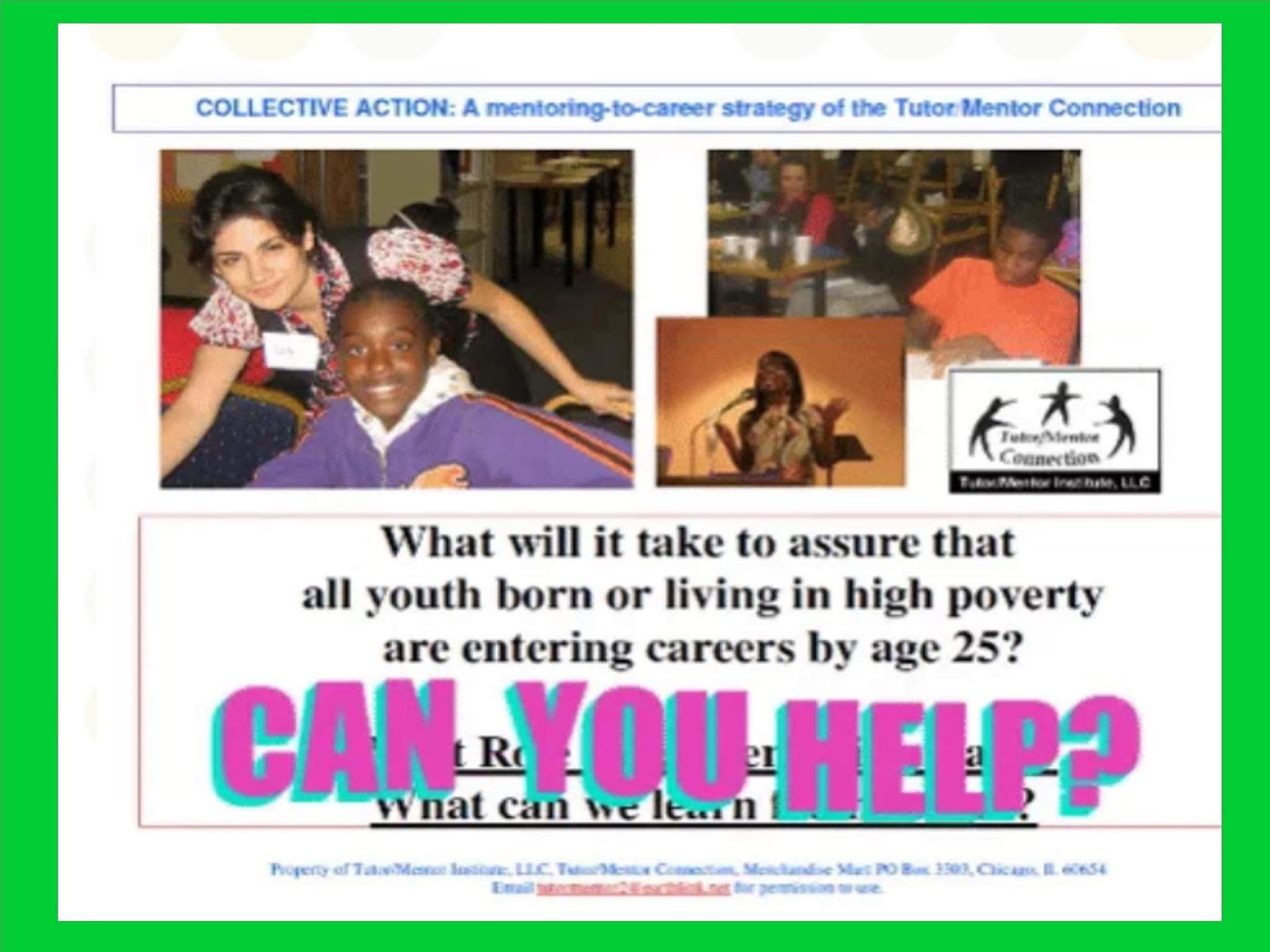
Almost all articles focus on the message in this graphic.  "What will it take to assure that youth born or living in high poverty are entering careers by age 25?  What role does mentoring have?  What can we learn from others?


My first post every January has been a reflection and a challenge for the coming year.  As I thought about what to write today, I reviewed past January posts, and tagged them with "NewYear" so readers can find them more easily. 

I hope you'll spend time reading them.  

You can begin with last year's "Where it began" article. 

You can jump to this 2019 article titled "What the Heck am I Trying to Do?" article.

Or you can visit this January 2011 article titled "New Year. New Decade. New Hope.


Here's another article that I encourage you to read, titled "Bridges that Connect People on Both Sides of the Poverty Line". It was written in September 2005.  In the final paragraph I wrote "I've been working at this for more than 30 years yet I'm still just a whisper in the wilderness." 

Too few people have ever heard about me or the Tutor/Mentor Connection and Tutor/Mentor Institute, LLC.  

That means, if you read and share these, they may find fertile soil and bloom to new life, and new hope.

That's my wish for 2023.  


I am still using Twitter to try to reach as many people as possible with these ideas. I use other platforms, too.  Visit this page and find links to all of them.

And, I continue to depend on a small group of supporters to help me pay the bills and keep sharing these ideas.  Visit this page if you'd like to help. 

Thank you for reading. Happy New Year to you. 


Wednesday, January 05, 2022

Where it began. Tutor/Mentor Connection

 When I and six other volunteers met in November 1992 and launched a new organization that would provide tutor/mentor support to 7th grade kids aging out of the program I led from 1975 to Oct 1992, we had many years of previous experience to draw upon. However, when we also decided to create a strategy that would help volunteer-based tutor/mentor programs grow in all high poverty areas of Chicago, we did not have many examples to follow. 

I became a volunteer with the Tutoring Program at the Montgomery Ward corporate headquarters in Chicago in the fall of 1993. Two years later I was made the leader of that program. For the next 15 years, while my retail advertising jobs at Montgomery Ward grew in responsibility, the tutoring program also grew, from 100 pairs of kids and volunteers meeting weekly in 1975 to more than 300 pairs by June 1990.  

At that point we turned the program in to a non-profit and I took a full-time job leading the program. We grew from 300 pairs in 1990 to more than 440 kids and 550 volunteers by June 1992. 


This growth was the result of building a team of volunteers, drawn from many different Chicago area companies, who helped recruit and train other volunteers and lead the weekly tutor/mentor sessions.  

However, it also was a result of my reaching out to find leaders of other tutor/mentor programs in Chicago, to learn from them and to share my own strategies.  These included programs at 4th Presbyterian Church, Continental Bank, the Blue Gargoyle at the University of Chicago, the CYCLE program at the LaSalle Street Church, a program at Quaker Oats company and a few others.

Recognizing that we all recruited and trained volunteers in August-September we decided to pool our efforts and do joint training events. As we did, we tried to reach out and invite other programs to participate. However, no one had a master list, so we had difficulty finding other programs. The only one in Chicago who seemed to be building a list was myself. 

It was this networking with other leaders, and trying to locate other programs, that planted the seed for the Tutor/Mentor Connection (which in 2011 became Tutor/Mentor Institute, LLC). 

However, it also was this constant flow of stories about violence in Chicago that inspired the T/MC.  In my advertising roles at Montgomery Ward we created weekly print ads that reached 20 million people in 40 states, telling them that we had merchandise and services at a store near them that they were looking for, and that this week, they were on sale.  This constant call to action, pointing to each of our stores, was missing from media coverage of violence.


This concept map shows the 1965-1992 growth of the tutoring program at Wards. 

The program that existed in 1992 was the result of incremental, year-to-year growth, starting in 1965 when a few employees from Montgomery Ward started meeting with elementary school kids living in the Cabrini-Green neighborhood.  By 1978 we were attracting national attention. This letter shows a confirmation for me to speak at the National Right to Read ConferenceThis PDF shares a 1988 study by the Center for Early Adolescence at the University of North Carolina, that cited the Montgomery Ward/Cabrini-Green literacy program as "one of the best in the nation."

Thus, when we decided to launch the Tutor/Mentor Connection we had many years of experience to share to help other programs grow.  

While we launched the first Kids' Connection meetings with youth in January 1994 we spent all of 1993 planning the strategy for what became the Tutor/Mentor Connection.  Originally we called this "Chicago Youth Connection".  You can see from the chart below that we had people from universities, a public relations firm, and MCIC, a Chicago information research organization, involved with the planning. 


We changed the name to Tutor/Mentor Connection in the fall of 1993 after hearing from Chicago Youth Centers (CYC) that they hoped we would not use the same CYC name.  

The result of our planning was a 10-point strategy intended to build an information base, with a comprehensive list of tutor/mentor programs serving Chicago, and a public information strategy that drew more consistent attention, and resources, to every program.  That strategy is described in the graphic below, and in this Case Statement from 1994. 


We launched the strategy in January 1994 with a survey sent to 500 people in the Chicago region asking if they led a volunteer-based tutor/mentor program and, if yes, to provide details.  120 programs responded and told us that they had little contact with peers, would like more contact, and would come to a conference if offered at low, or no, cost.  So in May 1994 we organized the first Tutor/Mentor Leadership and Networking Conference. 70 people attended and feedback was positive. So we organized a second conference in November 1994 and 200 people attended.  We continued that conference every six months until May 2015.

We also published our list of programs in a printed directory.  You can now find this list of programs here


By 1996 we had added an August/September Chicagoland Volunteer Recruitment Campaign, a November Tutor/Mentor Week, and a partnership with the Lend A Hand Program at the Chicago Bar Foundation.  Here's an article in the 1996 CBA Report newsletter about Tutor/Mentor Week. 

We condensed the 10 steps to four, which are visualized in this concept map.

We had no money, only a few volunteers and a vision when we launched the Tutor/Mentor Connection and the Cabrini Connections program. We had to raise the money to pay for our work each year.  We reinvested what we learned from what worked, and what did not work, and what we were learning from others, in constant year-to-year efforts that aimed at helping volunteer-based tutor/mentor programs grow in more places, and helping those programs improve their impact on the lives of kids and volunteers each year.

This concept map timeline shows 1992 to 2022 growth of the T/MC (1993 to present) and Tutor/Mentor Institute, LLC (2011-present) and milestones in this on-going growth.

Keep in mind as you view this that while we were building and leading the Tutor/Mentor Connection to help ALL programs in Chicago, we were also building our own Cabrini Connections program. Here's another concept map that shows this two-part strategy from 1993 to 2011. The first priority of our Board and volunteers was keeping the kids' program working, thus, when the Montgomery Ward company went out of business in 2000 we made a decision to rent expensive space near Cabrini-Green to continue supporting our kids, rather than move to less expensive space elsewhere, where we could continue the Tutor/Mentor Connection.  

While our timelines show consistent growth over time, the reality was that growth was inconsistent. The graphic below shows dips in funding in 2000, 2001, 2008-10 caused by man-made and natural disasters.  Each time funding was reduced we had to prioritize attention on the kids' program, yet continue to operate the Tutor/Mentor Connection.  If this graphic were extended to post 2011 it would show a decade-long dip in funding, almost down to zero.


Every action taken over the past 45 years has aimed at connecting a youth from a high poverty area with an adult who would serve as a tutor, mentor, coach, friend and extended family, in an on-going effort to help each child overcome the challenges of high poverty as they move through school and into adult lives, with jobs that enable them to raise their own kids free from the grips of poverty.


For many kids it has worked. I'm connected on Facebook at many students from the 1970s till 2000s and see them posting stories showing their own kids finishing high school and college.  I see similar stories from a few other tutor/mentor programs in Chicago and around the country.

But not enough.


We started using Geographic Information Systems (GIS) to plot locations of tutor/mentor programs on maps in 1993. By 2004 we had an interactive search page on the Internet that enabled people to search for programs in specific zip codes, based on age group served and type of program. In 2008 we launched an interactive map directory that enabled leaders to look at the entire city, or specific sections.

Unfortunately, since 2011 I've not found the money, or the volunteers to keep these services available and updated and they are only available as archives in 2022.  

I urge you to view map stories on this blog, and the MappingforJustice blog. See how I've tried to use maps as part of planning and resource development to support existing programs, or help new programs form where more are needed.  

I turned 75 last December.  While I will spend this year and future years continuing to invest time, talent and ideas in this effort, every city in the US and the world would benefit from a map-based strategy based on what I've piloted since 1993.  

Thus, while I'm still available to help, why not form a team and make a commitment to build your own Tutor/Mentor Connection type strategy.  

Take a tour of the Tutor/Mentor Institute, LLC website. Use it as a text book for learning about the work done since 1993 that you and others could build on in the next decade. If you launch such a strategy, I can make my Google Drive archives fully available, to help  you learn from my own efforts. 

Remember, the goal is not one, or a few, great programs, but a city filled with great birth-to-work programs in EVERY high poverty zip code.

If you'd like my help, connect with me on Twitter, Facebook, LinkedIn or Instagram (see links here). 

If you'd like to help me pay the bills, visit this page and make a contribution. 


Saturday, January 02, 2021

Mentoring Month Message to Volunteers


As we start a new year, and a new decade, and the National Mentoring Month, we also welcome a new President.

For the past year Democratic Presidential candidates have bombarded us with stories of hope, and change. It would give me more hope for the future, if I could see change in the way elected leaders (and candidates) act as leaders.

I led a volunteer-based tutor/mentor program in Chicago from 1975 to 2011 ( I joined the leadership committee of the Montgomery Ward Cabrini-Green Tutoring Program in Sept. 1994.) 

I formed the Cabrini Connections tutor/mentor program in 1993 to help teens from the original 2nd to 6th grade program at the Montgomery Ward HQ in Chicago get the extra support they need from 7th grade through high school, in order to be prepared for college, vocational education, and the next steps to a job and a career.

When kids and volunteers joining us each year we're making one promise: 

We will do everything we can to assure that each student who joins us will be starting a job/career by age 25. We are only limited by how much our students, volunteers, alumni and supporters are willing to share this responsibility.


Below is a message I shared with our volunteers to start 2008
. This message can be just as relevant in January 2020 to volunteers in any tutor/mentor program, or to newly elected leaders to city, state and national offices. 

 --------------------------- 

I hope that all of our volunteers have had great holidays and that you are looking forward to continuing your role as a tutor/mentor volunteer at Cabrini Connections, Tutor/Mentor Connection.

As you prepare for the second half of the school year, I encourage you to read some of the articles posted at Cabrini Connections - Tutor/Mentor Program in the Cabrini Green area of Chicago (archive.org)

I've been a leader of a tutor/mentor program since 1974, and I've learned that every volunteer and student are different, and constantly changing. Thus, while I can provide a structure for your participation, I can't teach you everything you need to know, or everything I've learned. I can try to help you, and your student, form a learning strategy, where you know where to find information, and find help, so that as you meet weekly, you know where to go for ideas to stimulate and support your involvement. 

Last Christmas, Rebecca Parrish (a Cabrini Connections volunteer) gave me the book "The Starfish and the Spider" as a present. As I read it, I realized that this book was describing Cabrini Connections and the role of every volunteer, staff member, and leader. It also describes the role of alumni, and veteran volunteers. 

We are a decentralized organization in which each volunteer is the CEO of his/her own tutoring/mentoring business. We succeed in life by our own efforts and by what we can learn from others. Our networks are important. They expand opportunities, open doors and provide resources. 

As you go through the tutoring year, each volunteer is learning to individualize his/her weekly activities based on the needs of your student, your own abilities and time, and the level of experience you have gained. Veteran volunteers, alumni, staff and coordinators are able to support you with ideas, information, and structure, but it is your own learning and networking with other volunteers that gives you ideas for what you do. 

Each week I'm trying to coach you with this email, with my blogs, and with the information and networks available to you on the Tutor/Mentor Connection (which we started in 1993 at the same time as we launched the Cabrini Connections program) website at http://www.tutormentorconnection.org 

You all already know how difficult it is to motivate many kids to do home work, do extra learning, and take charge of their lives. Imagine how difficult it is for me and the leaders of Cabrini Connections to recruit busy people like our volunteers, and convince them to spend time beyond their weekly tutoring/mentoring, learning how they can become more effective tutors/mentors, or giving help to others who are seeking help. 

Yet, this is the only way we can succeed in keeping the promise we make to our kids. Read more at http://cabriniblog.blogspot.com/2007/12/good-to-great-in-decentralized.html

I thank you all for your involvement in Cabrini Connections, Tutor/Mentor Connection. On behalf of our volunteer board of directors, I welcome you back for our 16th year of tutoring/mentoring since January 1993.

Dan Bassill
President/CEO
Cabrini Connections 
Tutor/Mentor Connection 

 --------------------------------- 

In what ways will our newly elected leaders support the involvement of volunteers, donors, businesses and universities in programs like Cabrini Connections? Will they use maps to build a distribution of resources into every neighborhood where tutor/mentor programs are needed? Will they use their blogs, web sites, public speaking to connect volunteers with non profits in their district, using links to a Program Locator, so volunteers and donors can search for where to get involved? 

Or will the volunteer and donate button on their web site only point to themselves, in an effort to get elected, or stay elected? 

True leadership lifts up everyone. Real Generals understand the need to distribute troops in all places where the enemy is concentrated, and they understand the need to have an infrastructure that supports those troops with food, clothing, pay, training, weapons, etc. so they are better equipped than the enemy.

Which of our leaders are going to be demonstrating this type of leadership when they take office or ask for our votes again in a few years?

Since I started the Tutor/Mentor Connection in 1993 Chicago has had three different Mayors and the USA has had four different Presidents and will have a 5th in late January 2020.

I've been sharing ideas like these in printed newsletters, websites, blogs, email newsletters and social media for 25 years yet I still find few leaders using maps to show all the places where kids and families need  help, and where they are distributing needed resources.  I find few using concept maps as blueprints to visualize all the supports needed to help a youth in a high poverty area move from first grade to their first job, with a commitment to "do everything we can to assure that each student who joins us will be starting a job/career by age 25."

I thank you for reading this far and sincerely thank those few who have made contributions in 2020 to help fund the Tutor/Mentor Institute, LLC.  

Please go a step further and share my blog articles with your own networks so more people see these ideas and adopt them as their own.  Below is an example of one of my own recent Tweets.
The strategy map that I point to in this tweet can be found on this page, along with all my other concept maps.  Open it. Read it aloud. If it makes sense to you, create your own version. Record it. Share it. Maybe in 2021 we'll finally find leaders who will make this commitment. 

I'm on Twitter @tutormentorteam and you can find me on Facebook, Linkedin and Instagram  (see links on  this page). I look forward to connecting with others who share this commitment. 

Thursday, January 02, 2020

Looking forward to next decade.

I started leading a volunteer-based tutor/mentor program in Chicago more than four decades ago, in the 1970s.  I created the Tutor/Mentor Connection to help youth tutor/mentor programs grow in high poverty areas of Chicago more than 25 years ago.

four part strategy
 In 2010 I wrote two articles reflecting on the previous decade.

1)  I was still leading the Cabrini Connections tutor/mentor program in December 2010 when I wrote this article.

2) Then I wrote this article saying

We all want to lower the high costs of poverty, improve the quality of the workforce, and prepare young people for successful adult lives. Yet, countless articles show that we’re not succeeding, especially in high poverty areas of Chicago and other parts of the country.


Maybe it’s because we’re not focused on the same goals, and we don’t have a common blueprint?


volunteer recruitment
Looking back even further, here's the first message posted into our Yahoo Tutor/Mentor Volunteer Recruitment eGroup in February 2000.  The first goal stated was:

Continue to attract the most individuals to volunteer to be a tutor
or mentor with one of the over 300 programs in the Chicago-area.
Create new sites to reach the most potential volunteers in Chicago
neighborhoods, suburbs and the Loop.


view cmap
Then, I started 2019 with this article, using the title of "What the Heck am I Trying to do?". One of the concept maps was titled "If we want to help kids move from school to careers...." what are all things we need to know and do?

As we enter 2020 and a new decade I'm going to continue to share the same ideas, in as many ways as I'm able.

In the top graphic I posted a four-part strategy that was first developed in 1993 when we launched the Tutor/Mentor Connection.   Below is a concept map that visualizes this as a cycle of recurring actions which I've repeated every year for 25 years and will continue in 2020 and beyond.

four part strategy - click here to open
Open the map, and spend time opening the links on each node. You'll find a cascade of additional maps and full explanations of the 4-part strategy.

read about this - here
The graphic at the left shows a pyramid of actions that can lead to a result we all want of "more kids moving safely through school and into adult lives with jobs and careers".  The pyramid sits on a base of knowledge, which is STEP 1 in the four-part strategy. It's information that I've been collecting and sharing for 45 years, in my leadership of a single tutor/mentor program, and in my efforts to help build a city of well-organized k-12 programs reaching youth in every high poverty neighborhood.

The web library is divided into four main sections, which are shown in the concept map below.  


Open map - click here

Concept maps are layers of information. Thus on each of my maps if you click on the boxes at the bottom of each node, the one on the left takes you to an external web site, and the one on the right opens to one, or more, additional concept maps.

find info about programs - click here
For instance, the green node in the upper left opens to the concept map I'm showing at the right.  For those seeking information about youth tutor/mentor programs in Chicago, or beyond, the links in this map point you to the list of programs I've been maintaining since 1993 as well as to directories maintained by others. If you're a volunteer, donor, parent or youth seeking a place to become involved during National Mentoring Month, this is the resource you would want to know about.

research links - open


If you open the yellow node at the lower left, you'll get the concept map shown to the left. This points to a library of research and resources that I've been building for more than 20 years, showing where tutor/mentor programs are most needed and why they are needed along with actions people can take to build and sustain programs that help youth and adults overcome the challenges of poverty, racism and inequality.

Imagine this in hundreds of
locations of Chicago & beyond
Here are three articles that I've written to help you dig deeper into this library of information.  One contains a list of links to every section of the library as well as to concept maps and visualized strategy essays which I've created over the past three decades.

If you've read this far, thank you. I know there's a lot to look at and understand and that most people don't want to spend the time reading. Yet, for the few who realize that the only way we can solve complex problems is to learn from as many sources as possible, this library is for you.

This is one reason I've continued to seek out high school and university partners who would make the Tutor/Mentor Connection library part of a service-learning curriculum.  Here's one article with that invitation.

I'm 73 now and don't know if I'll be here at the end of this decade, but my hope is that the Tutor/Mentor Connection library will not only still be here, but will be led by many people in many places, with complete updating and rebuilding of much that was created in the past 25 years, but is now rusty and not working as well as needed.  Until then, I'll continue to update the library, maintain my list of Chicago area tutor/mentor programs, and use Twitter, Linkedin, Pinterest and Facebook daily to share ideas and connect with a growing network of people who focus on similar issues.


If you'd like to help connect with me on one of these social media places or introduce yourself with a comment.

Thank you to those who sent 2019 contributions to help fund this work. I hope you'll repeat in 2020. Click here to help.

Thursday, January 03, 2019

What the Heck Am I Trying to Do? Annual Reflection.

Every year I start out with a reflection, aimed at clarifying to myself, and others, “What the hell am I trying to do?” Why should anyone listen, or give me support?

Thus, this annual reflection is as much for my own reinforcement as for readers, but I hope you'll take the journey with me.

I found out more than 20 years ago that my words were not clearly communicating my ideas, in large part because too few others had the same background as I did, and too few others were thinking the same way. My college and Army background in history and intelligence gathering, and my corporate career in retail advertising for a company with 400 stores in 40 states, armed me with a commitment to collect and share best available information to support my decisions, and those of other people and to use daily communications to try to draw people to the ideas I was sharing...which focused on helping hundreds of big and small youth tutor and/or mentor programs grow, not just the single small program I was leading.

Thus, I started creating visualizations to share my ideas. I've been doing that for over 20 years. I'm going to post a few today.

Let's start with this one.

In this graphic, the photo on the left, from the mid 1990s, is a group of 7th and 8th graders. The photo on the right is one of those kids who came back in 2010 to speak at the annual year end dinner. I'm still connected to her and many former students and volunteers on Facebook.

From leading a youth tutor/mentor program that served 2nd to 6th grade kids (1975-1992) then became a 7th to 12th grade program (1993-2011), I began to think of volunteer mentors and tutors as people who give extra help to young people as they move from first grade through high school, and college or vocational school, and into jobs and adult lives.

This has led me to focus on the role of organized programs, that create a safe space, and an opportunity for youth to connect with a wide range of mentors and learning opportunities over a period of years. I created this Total Quality Mentoring graphic in the 1990s to communicate that idea.

Read TQM description.  Read Virtual Corporate Office pdf.

On Facebook and Twitter I'm finding stories from a few programs about alumni who are doing great things. However, too few programs are doing this. Too many may not have program designs that make long-term support possible.

In the next graphic, I then ask “If we want to help kids move from 1st grade to careers, what are all the things we need to be thinking about to make organized tutor/mentor programs available to k-12 kids in more of the places where they are most needed?” Open the map and read it from top left to right, as a circle of thinking. On the bottom row you see a focus on program infrastructure, funding and learning.

View cMap - click here

Kids need a lot of different supports. Organized programs, with a mix of volunteers from different business, education and age backgrounds can be people who help make these extra supports available, if they are encouraged to think beyond the “what do I do with my kid when I meet with them this week” question. The concept map below shows various supports kids in elementary school need. It is is part of a larger “mentoring kids to careers” cMap which shows that kids in middle school, and high school need similar supports, plus a fee more.

View Mentoring Kids to Careers cMap

As a volunteer in 1973, I started each week asking “What will I do with Leo, my mentee, when I meet with him on Tuesday evening?” I'm certain that every volunteer is asking the same questions. My goal has been to provide a library of information and ideas that volunteers could draw from, and to help programs build a talent pool of veteran volunteers and staff, who could provide answers to this weekly question, and many others that arise.

Dan Bassill - year end graduation, 1970s

I became the leader of that volunteer-based program in 1975 and from then until 2010, I started each August with “How do I recruit 100-300 volunteers and kids?” then moved on to “How do I keep them involved from the beginning of the school year till the end?” and “How do I recruit some to volunteer time to help me do this?” The questions kept growing as I formed the Tutor/Mentor Connection in 1993. How do we help this happen at several hundred locations in Chicago, not just the single program I was leading?

Since becoming a non-profit in 1990 the questions expanded to “how do we find the money to pay for this?”

That's what this next graphic is focusing on.
Click on graphic to enlarge, and few in greater detail.

The questions keep growing and ultimately focus on “how do we build and sustain public and private sector support for hundreds of separate programs, and for intermediaries, like myself, who work to support the entire system, the same way people in the corporate office of big companies work to support a vast network of stores in different places, distribution centers, technology and logistics and an army of talented people?

How do we build and sustain the public will to support this?

Then I think of how helping kids grow up is just one of many many complex problems that people throughout Chicago and the world focus on every day. How do we find a few leaders who will give daily attention to the problem I focus on, while also helping leaders grow in other sectors and other places?

Open map - click here

I don't know all the answers to these questions. Heck, I don't know all the questions.

What I've been doing for the past 40 years is building a library of “other people's ideas” that I use to stimulate my own thinking, and that I share to help others become involved in this process. This PDF describes the graphic at the right.

This PDF describes the Tutor/Mentor Learning Network, which is what I've been trying to build through the leadership of the Tutor/Mentor Connection (1993-present) and Tutor/Mentor Institute, LLC (2011-present)

So I think what I do has value.

I collect information others can use to build and sustain programs that connect kids and volunteers in places where they are needed. I also lead a communications effort to increase the number of people looking at that information and reaching out to support programs with time, talent and dollars. And I spend time trying to help other people make sense of all of this.

I don't find anyone else who is writing articles like mine, hosting a web library like mine, or using maps and visualizations the way I do. If you find such people, introduce me. That's what keeps me going every year. 

Four Part Strategy


This graphic visualizes that process, showing a 4-part strategy that I've been following since 1993. Open the link and dig deeper into this cMap.

Below are a couple of more graphics to think about.

We all want every child born today to grow up and have a great life, and be a contributor to the well-being of others and the planet.
Common Goal - read more

If we don't collect the knowledge showing how some people are already doing this, we will constantly be starting from scratch, rather than learning from others. We'll never had the best information available to innovate solutions that we're willing to commit support to for many years.

Influencing Actions


Furthermore, if we don't figure out a way to influence both resource providers and program leaders and volunteers, as well as young people, we'll never have enough of the resources needed to build long-term solutions, nor will we have enough program providers looking at ideas they can use each year to improve work they are doing.

Is that all? 

In this article I've shown just a few of hundreds of graphics I've created to share what I'm thinking and what I'm trying to influence. Thanks for reading along with me.

Visit my page on Pinterest.com/tutormentor to see more.

Do a Google search for “tutor mentor” then look at the images, to see more.

Visit this article and find a list of links to all sections of my library, my cMaps and PDF presentations. Build these into a learning and planning curriculum in your community.

And for your viewing pleasure, I converted one of the power point files that I use when creating these graphics, into a pdf, which I posted on Slideshare.com/tutormentor


There are 36 slides with a progression of ideas. I have several similar PPTs with additional graphics like these. If you browse articles I've posted, you can see how they have been used.

If you think what I'm doing is worth doing, and has value, then, do one or more of the following things

*) read my blog weekly and spend time looking at articles written in past years

*) join me in on-line learning groups such as the #clmooc group on Twitter, or in one of the many conversations I point to in this concept map.

*) share this and other blog articles regularly with people in your network

*) start a conversation with me to explore ways you, your company, your classroom, or your college can take a meaningful role in doing this work, now, and in future years..

*) make a contribution to help me pay the bills – here's my FUND T/MI page

Visit this page to find places to connect with me on social media.

Thank you again for reading.

I wish all of you to have a boat load of health, hope, happiness, peace and good news in the coming year.

Tuesday, January 02, 2018

So Many Problems. Building Networks for Solutions

It's a new year, with new hope and opportunities. Yet, the same problems that we faced last year, and in previous years, are still with us.

I created this graphic several years ago to illustrate the many different problems that people face, and the role of people like myself who try to draw people from different sectors into learning, networking, innovation and actions that try to solve one or more of these problems.

For more than 20 years the problem I've been trying to solve is filling high poverty neighborhoods with non-school, volunteer-based tutor, mentor and learning programs that help kids move through school and into adult lives.

I've created dozens of visualizations to help communicate this idea, which you can find in this blog and my web site.  Or do a Google search for "tutor mentor" and add one more word, like youth, or strategy, or mapping. My web sites are often on the first page of the search (at least for me) and if you look at the images feature, you'll see many of my visualizations. With each you can link to a story where that graphic was used.

I've created a huge knowledge base that I keep adding to, which includes a list of non-school tutor and mentor programs operating in the Chicago region.  I show these on maps with the goal of helping people find programs to offer help or to get kids involved, and to show where more programs are needed.

The big problem is attracting people to this information and helping them use it in their own efforts to solve the same problems I focus on, or on other problems which they care about.

That would be a problem if I were a wealthy person, or a celebrity.  I'm not. I'm just a person with a vision and a message and a library of other people's research and ideas.

I've never had much money to do this. I and six other volunteers started the Cabrini Connections site-based tutor/mentor program in 1993 and spent that entire year researching and planning the Tutor/Mentor Connection, which we launched in January 1994. We had no money, nor deep pocketed friends, so we had to raise the money to pay salaries, rent, insurance and other expenses at the same time as we did the work. We started from zero every year and never knew for sure where the money was coming from. Since 2011 I've led the Tutor/Mentor Connection via the Tutor/Mentor Institute, LLC, and I've had even less money, so have kept this work going by drawing down my own savings. That's a recipe for disaster.

What motivates me is the daily reminders of how much kids living in high poverty areas need an expanded network of support and the understanding that "almost anyone can help".

That means that today, or on any other day, someone who might help me do this work is looking for information and will find my web sites. That someone could be a Bill Gates type, or a Jeff Bezos, or someone I've never heard of. They could take time to learn what I've been trying to do, and reach out to say "I will help you with my time, talent, and my money."

While I need help to continue to do the work I do to connect people to information in my web library and to organizations in Chicago and other cities who work directly with youth, the graphic below illustrates how such help is needed in thousands of places.


I've been writing this blog since 2005, so there are a lot of stories. I invite you to browse through these over the coming year and if what I do is important to you, reach out and connect with me on Twitter, Facebook or LinkedIN, and help me draw attention to the resources in my web library and the youth serving organizations already operating in Chicago and other cities.

Help me draw people into conversations that start with a map, and a "how do we fill all of these areas with needed programs?" question.  Or help me find places where others already are leading that conversation and where I'd be welcome.....even as a paid consultant!

If you want to invest, or take a role and carry this forward into the future, let's connect. Or, visit this page and send me a contribution to help me keep doing this.