Tuesday, April 19, 2022

April Newsletter. What if....

I sent out my monthly newsletter today.  You can read it here.  


I've been sending out a newsletter, in print or email version, since forming the Tutor/Mentor Connection in Chicago in 1993.

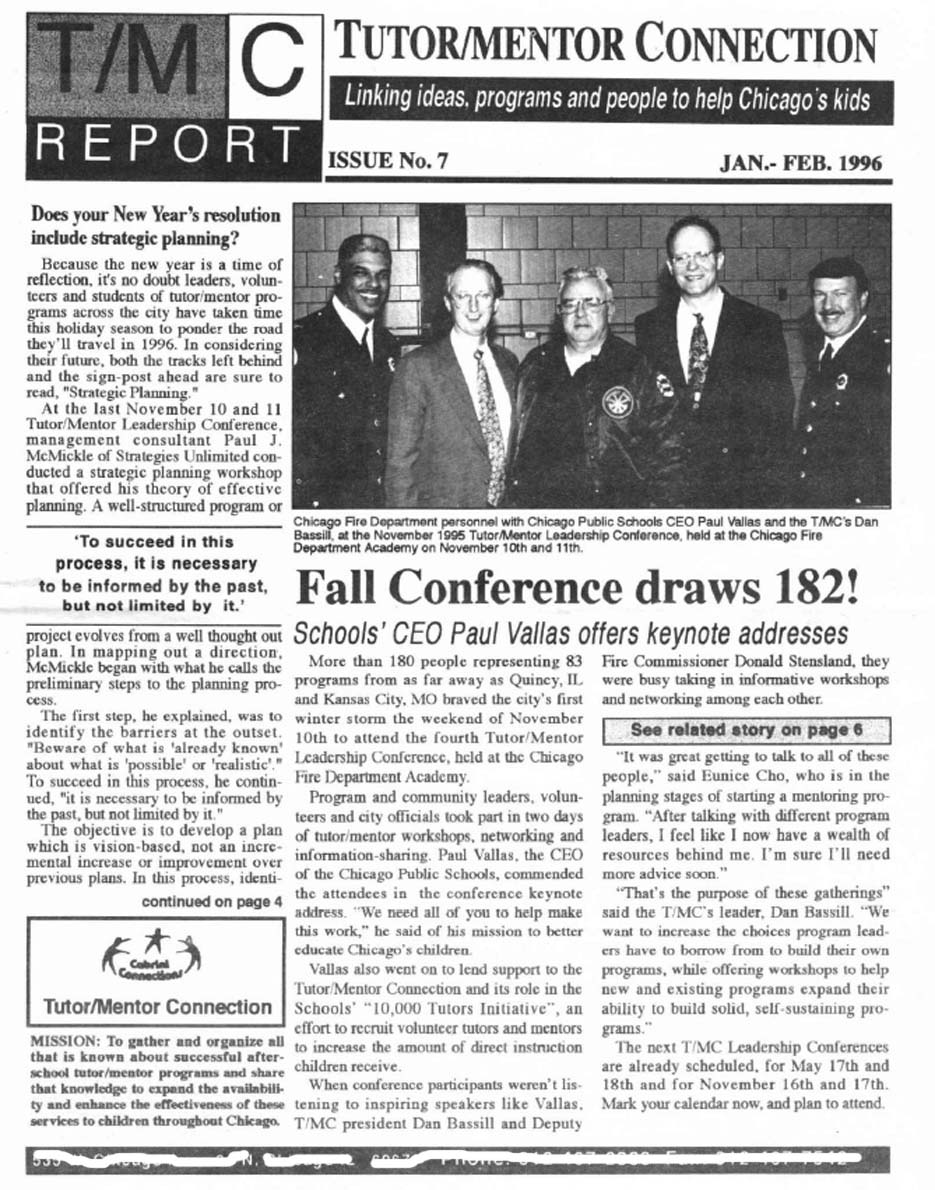
At the right you can see the first page of the Jan/Feb 1996 newsletter, featuring a photo of Chicago Public Schools CEO Paul Vallas and leaders of the Chicago Fire Department.  This was taken at the November 1995 Tutor/Mentor Conference, held at the Fire Department Academy.  Vallas was the keynote speaker. 

Below is a photo of former President Barack Obama, from 1999 when he was a speaker at another Tutor/Mentor Conference held in Chicago.  See it on page 5 of this newsletter

You can find archives of past newsletters on this page.  

Here's another Chicago leader. When Arne Duncan was CEO of Chicago Public Schools he gave small grants to support the Tutor/Mentor Connection and spoke at the volunteer recruitment campaign kickoff in 2001. You can see this image in a 2016 blog article I wrote. 

If you search for Arne Duncan, Barack Obama or Paul Vallas on this blog you'll find many articles where I've pointed to them. 

There's a common theme. I point to information people can use to help build and sustain volunteer-based tutor/mentor programs in high poverty areas of Chicago.  I point to research showing where and why such programs are needed.  I point to articles showing how current fund raising practices don't do enough to support long-term programs.  And I encourage people to use the information. Or if they pointed to maps the way I've done in more than 250 articles.

Below are recent Tweets featuring Obama, Duncan and Vallas.

Now imagine how much more they might have accomplished over the past 25 years if they had been the authors of the newsletters I wrote, and the articles on this and the MappingforJustice blog.  Of if they had consistently read the articles and then encouraged people they influence to also read them and apply the ideas.

Would more people have been investing in programs reaching K-12 youth in high poverty neighborhoods, helping kids through school and into jobs and careers?


Would more people "who can help" be responding to their appeals, and reaching out to offer time, talent and dollars to support school and non-school youth tutor, mentor, learning and jobs programs in every high poverty area of Chicago?  Would this strategy have been duplicated in other cities and countries?


We will never know because they did not take that role, nor has anyone else of influence, celebrity status and power.  

Well, it's never too late. Start now. Maybe in 2040 we'll see less poverty and violence, less structural racism and inequality, because of what our leaders, and others, do consistently, every week, for the next 20 years.  

This blog will remain available, either at this address, or in the Internet archive

The www.tutormentorexchange.net will also remain available via the Internet archive

Thanks for reading. Please share. And let's connect on Twitter, Facebook, Instagram and LinkedIn.  


Wednesday, April 13, 2022

Sharing Ideas With Nigeria

Yesterday I had the honor of talking with Aliyu B. Solomon, who lives in Abuja, Nigeria, which is the capital city of that country.  Here's the link to the recording of our talk.  

Here's the link to the slides that I shared while talking.  In this document you can see the questions I was asked to address along with some responses. 

We first connected via the Tutor/Mentor Connection Ning site in the late 2000s. A few years later we re-connected on Twitter, where we've done most of our interactions since then.  Yesterday was the first time we've actually talked to each other, which reinforces my belief in how people from around the world, or around your city, can connect and build strong relationships via the Internet. 

Nigeria is the most populated country in Africa at over 203 million in 2018 and is projected to grow to about 401.31 million by 2050.   I've circled Abuja, where Aliyu B. Solomon lives.  It's the second largest city in the country, with Lagos, on the coast, being the largest.  See details here.

As with any large country there are substantial areas in each major city with high poverty, and there is much poverty in rural areas. In the interview I talked of the importance of building an information library similar to the Tutor/Mentor library, with a research section that collected information about poverty and inequality, and a programs section, that shows existing efforts to help kids through school and in to jobs. 

If you visit this group on the TutorMentorConnection Ning site you'll see that I've been encouraging people from Africa to take this role for many years. 

Anyone who views this interview is encouraged to form a group and begin studying the Tutor/Mentor Connection strategies, launched in 1993.  Then begin to build a library, pointing to these strategies, my web library and to information you can find related to poverty, inequality, school-to-work and tutor/mentor programs in your own city and country.

As you and others collect this information, or look at different parts of my website, write blog articles showing what you are seeing and what it means to you and your city. Share these and let them be conversation starters among people in your group, and others who will join you.  View the work interns did while working with me between 2004 and 2015 and duplicate their efforts. 

At the right is a concept map showing actions and key events from 1965 to now, which led to the growth of tutor/mentor programs I led in Chicago, and to the Tutor/Mentor Connection (1993-present) and Tutor/Mentor Institute, LLC (2011-present).   See the 1992-present map at this link. 

Hopefully in 50 years many cities will have a timeline full of intentional actions like these. 

Thank you Aliyu B. Solomon, for inviting me to mentor you and your friends.  I look forward to similar conversations in the future with you and others.

I did not charge a fee for this conversation and don't charge others who ask me for help. I do have a page where I ask people to make contributions to help me continue to do this work.  

Monday, April 11, 2022

Religious Holidays - Time for Reflection

For the millions of people in the world who have strong religious beliefs Easter weekend is one of the most powerful celebrations of the year. Millions of people around the world will gather and renew their faith over the next few days. This year the Jewish Passover is also this weekend. 

I've written about this almost every year since 2005 so instead of writing a new story, I encourage you to read some of the articles I've written in the past.

I could have created a brand new article, but I' only be repeating the same themes that I've talked about in the past. I don't think the Christians create a new Bible every year. The scripture and themes that will be in sermons this Sunday will be the same scripture and themes that faith leaders have pointed to for over 2000 years.

If you click into some of the tags on the left side of this blog, such as poverty, public health, violence, etc. you'll see that the level of suffering in the world has not changed in the past year. It has grown with the Russian invasion of the Ukraine. 


The only thing that has changed in my own activities over the past year is that the www.tutormentorconnection.org site is no longer working and all links point to the http://www.tutormentorexchange.net site.  This is now where my web library is hosted.

When I first started writing this blog in 2005 I was leading a direct service tutor/mentor program, which I had done since 1975.  That continued until 2011 when I left that role and formed the Tutor/Mentor Institute, LLC.

I miss the direct involvement in a tutor/mentor program, but not the stress of trying to find funding to keep the bills paid and the program operating from year to year. I have even less cash coming in now than before but I'm only responsible for myself and my family. I'm still depending on others for the money and talent needed to keep the Tutor/Mentor Connection operating.

I continue to draw from my experiences of leading a single tutor/mentor program to share ideas that others can use to help similar, volunteer-based tutor, mentor and learning programs grow in high poverty areas of Chicago and other cities. 

I hope that as you reflect on your faith you will also spend time reading past articles and take on a role that helps these programs do more to help kids move through school and into adult lives.

In the Easter article I wrote in 2008 I talked about the "Give us this day our daily bread" part of the Lord's Prayer.

I still look for this "daily bread" as well as a "bakery" that might provide enough "bread" to help me build out the ideas of the Tutor/Mentor Institute and provide more consistent daily operating support and talent to thousands of small volunteer-based tutor/mentor programs operating in neighborhoods of Chicago and other big cities.

I do a lot with a little.
I've been blessed in many ways because of the work I do. Many young people and volunteers have also been blessed because of the tutor/mentor programs I've led and that are led by others.

I have hope that in the coming months others will step forward with the talent and resources needed to continue to do this work. Visit this page if you'd like to make a contribution. 

Note: the graphic at the top of this article was created by one of the Korean Interns who worked with me in January/February 2012. Read about this project here.

Monday, April 04, 2022

Maps, Time, Social Capital

Below is a graphic that I've been working on this past week. If you work your way through it I hope you'll have a better idea, and commitment, to the work that needs to be done in many places.


At the top of the graphic I show an arrow, that represents support all kids need, for the first 20-25 years of their lives, to help them through school and then, into and through their adult lives. Some kids, like Bill Gates, or Jeff Bezos, or Elon Musk, had much greater support propelling them to career success. Those are extreme examples, but most kids have a larger natural network of support than kids in high poverty areas. 

That arrow comes from this "mentoring kids to careers" graphic, which I created in the late 1990s.  It shows first grade through 12th grade, then college or vocational training, as a series of steps. At each step kids need a variety of different supports and/or are influenced by people who work in occupations that youth might aspire to in their own futures.  If you open this concept map, you'll see a different version of this timeline.

As I said above, all kids need some of these supports and influences.  However, if you read many of the articles in this section of my library, you'll see plenty of evidence showing that kids living in high poverty areas don't have as many naturally occurring supports or career models as do kids in more affluent areas. That means someone, or many people, need to help make these supports available and keep them in place for 12 or more years.

This leads to the next element on the graphic, which are the maps.  


I've been using maps since 1993 to visually show areas of Chicago with high concentrations of poverty and many indicators showing kids and families need more help.  Without a map you could have a long list of places you're helping, but still be missing a larger number of other places that need the same help.

You can find the maps shown above in this article. You can find hundreds of articles on this blog, and the MappingforJustice blog, showing similar maps and encouraging leaders to use them to guide resources into all of these areas for many years. 

The map graphic I've used is a mashup of maps from three sources.  In this concept map you can find many data platforms that could be used to create similar map stories. 

We see media using maps every day to show troop movement in Ukraine. Why can't we see similar maps showing the growth of youth and family support programs in every high poverty area of the  USA?

My focus has been on helping long-term, volunteer-based tutor and/or mentor programs grow in all high poverty areas as a way of expanding the networks of support available to kids, helping them through school and beyond. 

Thus, the arrow, or timeline, indicates multiple years of support. The map illustrates that many places need the same type of support for many years.

The graphic below visualizes the need for every industry to have strategies that distribute volunteers, technology, dollars and more into every neighborhood...and for school and non-school programs to be places where kids connect with a wider range of learning and career opportunities than might be normally available in their own family and neighborhood. 


While I led a tutor/mentor program from 1975 through 2011, which collected inner city kids to a wide range of workplace adults, I did not start to understand this as a form of bridging social capital until the early 2000s.  

Here's a link to one of the earliest articles that have influenced my thinking about social capital. One introductory paragraph says:

“Social networks that can bridge across geography, race and class are key to success in the new economy”, says Professor Manuel Pastor, Jr., University of California, Santa Cruz, who has studied social networks in Los Angeles among Latinos. ‘Hard’ skills are essential, but it’s the connections and mentoring that provide information about what skills are necessary and a vision of how acquiring them can lead to new opportunities for all our residents”.

This was written by Bob Pearlman.  The research he points to can be found at this link.  His current website is at this link

Since then I've aggregated links to many articles about social capital, which you can find here, and have posted 30+ articles on this blog that focus on social capital.

Here's a TED talk about expanding students' social capital - click here

In this article I point to an earlier influence. It was a book that I read in the mid 1990s, titled American Apartheid: Segregation and the Making of the Underclass, by Douglas Massey. This book emphasized how disconnected people living in highly segregated, high poverty, neighborhoods were from the resources that might make lives in those communities better for residents.

I created this presentation more than 20 years ago to show why organized tutor/mentor programs are needed in high poverty areas and actions the Tutor/Mentor Connection had piloted since 1993 to help such programs get the attention and resources each needs to constantly improve.   The graphic I've included here visualizes some of the different types of learning, mentoring and tutoring that might take places in a site-based program.

These strategies have been based on the premise that areas of concentrated, high poverty, have too few people working in the wide range of careers that are modeled daily by parents, family and neighbors in more affluent places.  Thus, such programs need to be built in order to expand the social capital for kids in poverty areas.

However....  that does not mean there are "no people" living in high poverty areas who have jobs and careers.   That's the final element included in the graphic above.  Kids and adults need to learn "who you already know" who might be someone who can mentor them and help open doors to opportunity.


This was emphasized in a social capital research webinar that I attended last Friday. The speaker was Edward DeJesus, who leads a group called "Social Capital Builders".  He is teaching "social capital literacy" to businesses, organizations and young people.  

I encourage you to read this blog article by Edward, titled "The Case for Social Capital Literacy".  

You can also view the webinar, at this link

The need for social capital literacy is not really a new concept. Bob Pearlman's early 2000s article said, "Networking, or acquiring a social network, is a key skill of the 21st Century. It’s how you learn, and how you connect."  

What I'm trying to emphasize is that these skills are not being taught in enough places and that programs like Social Capital Builders are trying to do that.  If you're working with kids you should reach out to Edward and see if his lesson plans might be used in your own efforts. 

Here's another version of the "hub and spoke" graphics shown above. 

I share it in a presentation titled "virtual corporate office" and in these blog articles.  


This shows how different industries could "distribute" learning and mentoring opportunities to kids in all high poverty areas, via school and non-school programs.  Social capital literacy could be a separate box, or could be a part of the mentoring coming from each industry.

The map reinforces the need for these forms of learning and mentoring in EVERY high poverty neighborhood. The timeline emphasizes the need for such learning to be consistently available for many years.  The other graphics emphasize that businesses in every sector could be supporting organized, volunteer-based tutor/mentor programs in multiple locations, not just one or two favored programs. 

Let's look at the timeline arrow once more.  If you click and enlarge it you'll see different types of learning activities that are appropriate for different age levels.

Here's another quote from Bob Pearlman's article:

"But the most significant finding in the study was that a student's social network can have a significant impact on his/her career choice. Students whose parents are both in high-tech careers are more likely to be interested in technology careers themselves. In addition, 83 percent of students rely on personal connections for career-related information and guidance."


I believe that the earlier a young person becomes involved in a well-organized, mentor-rich non-school program, the more benefit that program will have. Stronger bonds will be built with mentors, and with the program itself.  That's important because while a volunteer might leave after a year or longer, the program's ability to provide continuity, and a replacement mentor, helps keep the youth involved.  As a youth moves from middle school to high school the support offered can lead to part time jobs, internships, college access, scholarships and ultimately job and career opportunities. 

The type of mentoring and social capital literacy Edward DeJesus teaches depends on the maturity and motivation of the mentee. This is true with most forms of workplace mentoring that I've looked at. 


Kids in primary school where fundamental learning habits can be reinforced, and career aspirations nurtured, don't yet have that level of maturity.  However, by middle school, and early high school, I think most kids would be ready to take more control over their own futures, if there were people helping them.  

We need to make that happen. 

This  has been a long post. Thanks for reading. I hope we connect on Twitter, Facebook, Instagram and/or LinkedIn.

If you want to support my work, please visit this page and use PayPal to send a contribution. 

Wednesday, March 30, 2022

Planning for start of 2022-23 school year

It's only the end of March but if you lead a volunteer-based tutor/mentor program with a long-term commitment to helping kids in your program move from primary or middle school through high school and beyond, you need to be using the next two months to gather information about what worked, what did not work, and what works in other programs, so that as you finish your year-end celebrations in late May or early June, you have momentum taking your through summer planning and into volunteer and student recruitment starting in August 2022.

The graphic at the right under the "How can we do this better?" question has four elements.  At the left is a "mentoring kids to careers" graphic that conveys the same multi-year message as the graphic I show above.  At the right is a "leaders wanted" graphic, calling for leaders from every industry, sports, entertainment, philanthropy, education sector, etc., to help you get the ideas and resources needed to constantly improve your program.  

In the middle are photos of kids and volunteers who connect in these programs.  Every program will show a different collection of photos, based on who they serve.  The organization's website and blog (if they have one) should be showing these pictures and telling stories of what they do, who they serve, why they do it, what their successes are and what their challenges are.  This presentation show some of the types of information that should be seen on every website. 

In the lower left corner is a map of Chicago, shaded to show high poverty areas where tutor/mentor programs are most needed, with oil-well icons indicating the need for programs in every poverty area with long-term strategies.  While each program focuses primarily on their own needs, the Tutor/Mentor Connection (1993-2011) and Tutor/Mentor Institute, LLC (2011 present) focus on helping mentor-rich programs grow in ALL  high poverty area of Chicago and in other cities.

Good planning should lead to greater support for student and volunteer recruitment campaigns launched in the fall, that bring support to every program, so each can constantly move to becoming "world class" in what they do to help kids.  Read more about the annual planning cycle in this article

I've collected links to websites of Chicago and national youth tutor, mentor and learning programs since the mid 1990s with the goal that programs would share their strategies on their websites and blogs in ways that donors, parents, students and volunteers could "shop" and choose programs that best serve their needs. But also, so that programs could learn from each other and borrow ideas that help them constantly grow from "good to great". 

Not enough do this so one role of volunteers is to get to know programs and help them tell their stories. 

I've often said "You don't need to go to college to learn how to lead a constantly improving tutor/mentor program. You can use my library as a source of ideas and on-going learning. You just need to make time on a regular basis to dig through the different sections and read information you'll find on various websites and blogs."

   
The concept map above shows the "resources" section of the library. It includes information about fund raising, marketing, process improvement, evaluation, and more.  Share my blogs and web library with stakeholders within your organization and create a "learning organization" where everyone is engaged.  I've been writing about this since I started this blog. Here's a 2005 article

Thanks for reading and for everything you do to help well-organized  youth tutor, mentor and learning organizations reach K-12 youth in high poverty area of Chicago and beyond.

I'd love to see others writing similar blogs as mine and sharing these on Twitter, Facebook, Instagram, YouTube, LinkedIn and other platforms. That's the only way we'll build the awareness and public will needed to do more of what needs to be done. 

This page shows my social media links. Please follow and connect with me. 

This page includes a PayPal button you can use to make a small contribution to help me keep doing this work. 


Thursday, March 24, 2022

20 years of failed education reform - SSIR article

Last week I posted an article talking about the "Social Determinants of Education" and how important it is to look at the conditions of the community outside of a school to understand influences on performance of youth in the school. 

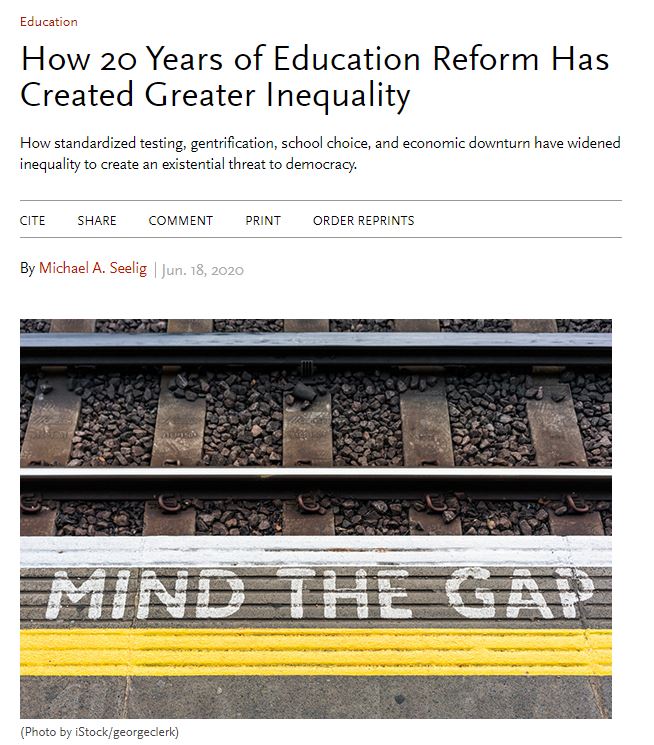
Today I read a 2020 article on the Stanford Social Innovation Review titled "How 20 Years of Education Reform Has Created Greater Inequality," written by Michael A. Seelig, Ed.D, the education policy director and senior advisor to the president of Medgar Evers College of the City University of New York,


This is a long article that shows "four major forces that converged since 2000 to shape how the school reform movement widened inequality: standardized testing, gentrification, school choice, and household economic downturn."

I highlighted text from the fourth factor:  


The highlighted text reads, "What renders so many education reform efforts futile from the outset -- so much so that we avoid talking about it -- is the fact that a student's academic achievement, with few exceptions, is completely tethered to the family's income and the opportunities it can provide."

Below is a paragraph from the conclusions part of the article:


The highlighted text says "We need much better measurement of organizational performance that both recognized the wider geography of schools and communities and accounts for the collateral damage we are leaving in the wake of our efforts." 

A process that collects information related to the "Social Determinants of Education" and a dashboard that measures progress toward goals would be a starting point. Take a look at the webinar that I point to in this article


This gap in opportunity between rich and poor was the theme of Dr. Robert D. Putnam's "Our Kids" book, which I wrote about in several past articles, starting in 2015. 

This gap can be shown on maps, which again is why I encourage you to read the article about "Social Determinants of Education" and look at the dashboard being suggested.  Since 1993 I've used maps to show the geographic gap between rich and poor in Chicago and other cities. I keep looking for other leaders to do the same on a consistent basis. 

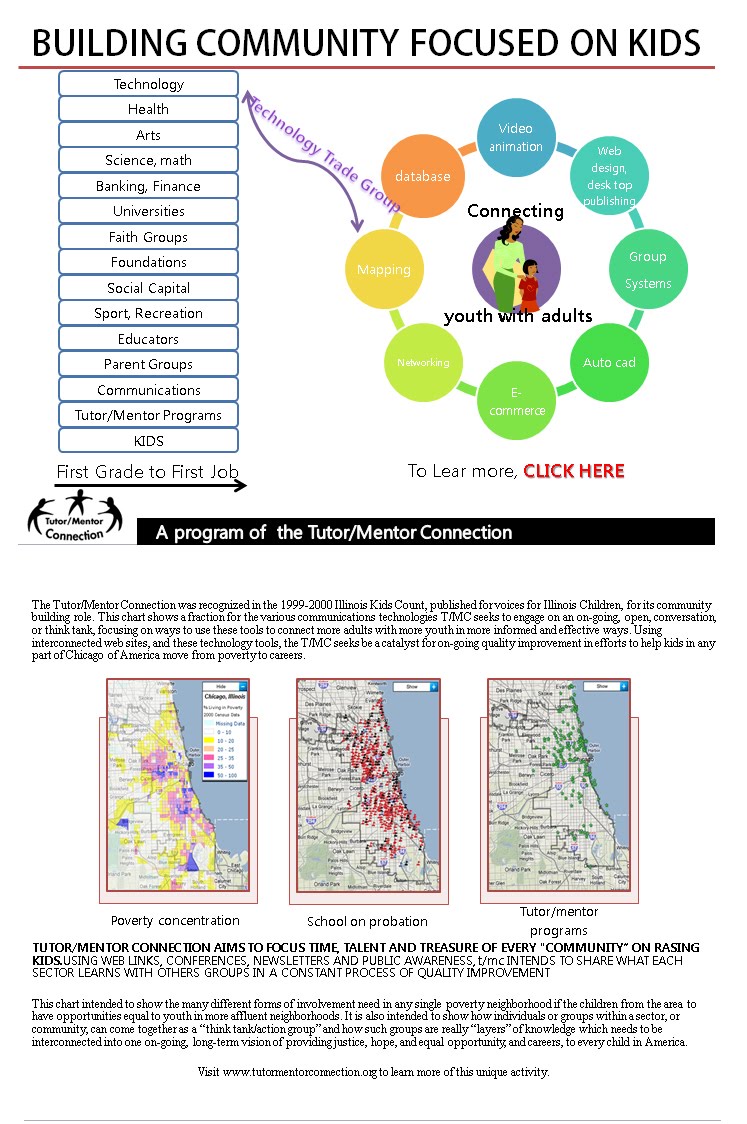
Below I show a graphic that I've used since the mid-1990s to show the potential for non-school, volunteer-based tutor/mentor programs to help build a richer, more diverse community of support for kids in high poverty areas.  


Here's one article where I use this graphic.  This presentation shows it in another format. 

I recall one of my volunteers looking at this once and exclaiming, "You're trying to build a support system for these kids similar to what is already available to kids in wealthy, and more affluent neighborhoods!" 

Yes. That's been my purpose for more than 40 years, although I did not really begin to understand what it was that I was doing until the mid 1990s.  And it's taken many years of reading hundreds of articles like this SSIR article, for me to understand why this is so important.

I added the article to the research section of my library, where it joins more than 100 other articles. 

The problem, which I've focused on since forming the Tutor/Mentor Connection in 1993 is that "too few people really care" enough to make the changes needed.  

In fact, it may be that the self-interest of too many people means they work actively, or unconsciously, against needed reforms. 

Dr. Seelig's article ends, saying "We must recognize the existential threat a system that enhances inequality poses to democracy and need to push through the inevitable fatigue that emerges when we see something before us as too big, or too ambitious."  He ends with "American democracy depends on it."

If you've read this far, and you care about this issue, become the YOU in this graphic and share the article, my library and other articles like this with people you know and encourage them to do the same.

Keep doing it for the next 20 years.

I share my articles and highlight those of others on Twitter, Facebook, LinkedIn and Instagram.  (see links here).  I hope you'll follow me, share my posts, and introduce me to others who may be doing work similar to what I do.

Furthermore, if you are able, I'd appreciate a small contribution to help me continue doing this work Visit this page to learn more. 


Wednesday, March 16, 2022

Build Social Determinants of Education Dashboard

In today's article I want to inspire you to learn more about the Social Determinants of Education and data dashboards that public schools could fund using ESSER dollars.  I confess, I had not heard this term, nor thought much about Elementary and Secondary School Emergency Relief Federal Funding (ESSER) dollars until attending a webinar yesterday.

This was a three-part presentation.

Part 1, featuring @RS21smarter showed ways to "use data "outside the four walls of a school" to improve student outcomes.  The presenters talked about how a growing understanding of social determinants have been used to inform public health and healthcare initiatives, and how "Social Determinants of Education" can be blended with school data to understand the impact on achievement."  Then they showed how data dashboards can support decision-making.

Below are three graphics from the @RS21smarter part of the presentation: 

The first shows things outside of the school that affect education outcomes. 

The second goes into greater detail showing the type of information educators should be looking at and that can be accumulated in the type of data dashboard @RS21smarter demonstrated.  I appreciated how clearly the presenters described this information.  


The third is a screen shot from a demonstration of how the data is mapped with a geographic interface. 


Part 2 was a demonstration by Bill Barberg, Founder and President of InsightFormation, Inc. showing how strategy management dashboards can support and monitor multi-stakeholder strategy success.  

Part 3 focuses on how ESSER (Elementary and Secondary School Emergency Relief Federal Funding) funding (Covid19 government funds) can help with the cost of building dashboards that combine both elements.  

I can't really do justice to the information presented, so I encourage you to take time to watch the video recording of the webinar. click here


3-19-2022 update - here's a blog from RS21 with their section of the webinar featured.

7-27-2022 update - here's another demonstration of using data and maps the target location of social services. 


Here are four articles to help you expand your understanding of Social Determinants of Education:

A NEW APPROACH: SOCIAL DETERMINANTS OF EDUCATION (2020 ARTICLE) - click here 

ADDRESING SOCIAL DETERMINANTS TO ENSURE ON-TIME GRADUATION (2016 ARTICLE

 AN UNDERSTANDING OF SOCIAL DETERMINANTS OF LEARNING (TM) - click here   

2015 ARTICLE ABOUT SOCIAL DETERMINANTS OF EDUCATION - click here
 

Why does this excite me so much?

When we created the Tutor/Mentor Connection in 1993 we intended to build a master database of Chicago non-school, volunteer-based tutor and mentor programs and share that information using maps that showed where they were located and where they were most needed, using indicators like poverty, school performance, violence, etc. 

We also wanted to show assets within the same geographic region of different programs, who could supply volunteers, dollars, ideas and technology to help programs constantly improve their impact on the lives of kids and volunteers.  Initially we published this information in a printed directory, but in 2004 put the directory on-line in a searchable format, then in 2008 in a map-based format.  

Visit this page and this page on my wiki to read about the goals of the program locator and our GIS mapping. 

The dashboard I saw demonstrated yesterday by @RS21smarter represents 15 years of knowledge and technology advancement over what I had started in 1994!  Furthermore the demonstration model is built using Open Source technology, making the code available to every city and technology hub in the world! 

The second part of the presentation also resonated. In 1999 a volunteer from the University of Kansas built an Organizational History and Tracking System (OHATS T/MC) for the Tutor/Mentor Connection, based on work being done by the Work Group on Health Promotion at the university.  In 2007 a team of volunteers from India rebuilt the original OHATS.  This PDF shows how information from the original version was reported in 2002.  This video describes that information. 

When OHATS was rebuilt in 2007 the new site included animated charts showing information for each strategy step.  Thus, we were beginning to build data dashboards in the early 2000s!  Imagine what we might have done since 2011 if we'd continued to receive funding! Sadly I was not able to update this after 2013 and now it's only available as an archive.

It's because I've been collecting and sharing information since 1975 to help people become more effective tutors and mentors and to help programs like the one I led get the resources each needs to constantly improve that I saw so much potential value in the dashboards and ideas about Social Determinants of Education.

The challenge is a) how do I (and others) help more people look at this and use available ESSER dollars and local technology talent to build versions to support kids in their own school districts?  b) how do I help them add some of the ideas behind my own use of maps, to build on-going campaigns to draw volunteers, donors and youth through the dashboards, to the out-of-school resources that are so valuable in student development -- such as tutor/mentor programs? c) how I motivate others to consider using similar dashboards in their own work? 

Here's an example.  I attended another webinar this week, which in this case was an introduction to the Commission on the Social Status of Black Men and Boys, established by Congress in August 2020 and now up and running.  This looks like one potentially good thing done by our former President and his GOP Senate.  This event was hosted by Brookings and launched with this article

While I post on LinkedIn, Facebook and Instagram I seem to have the most interaction on Twitter. Here's an example of how I tried to tie the information in this article together in one Tweet.

Final thought. There are other dashboards.   

I point to many from this concept map.  To help people build the most effective dashboards I feel someone needs to be building a library of these, just like my library of Chicago tutor/mentor programs.  Then, someone needs to look at each and determine what features are most valuable, intuitive and easy-to-use. Then, constantly share this information in ways that help everyone constantly improve.

By the way. That's been needed for my own library since I launched it in 1994.  So far no one  has taken this role. 

Thanks to the people who organized these webinars and made it possible for myself and others to attend.  I hope many will find the information useful and valuable for helping kids who are being left behind by the opportunities of America. 


Thursday, March 10, 2022

The new war - "disinformation"

The last two weeks, as Russia has invaded the Ukraine, the use of information, or "disinformation" as a tool of war, and/or political domination, has really been highlighted for myself, and probably many others.

This is a topic which I have almost no expertise in, yet as social media use has grown, I've witnessed the ways a creative, and focused disinformation campaign has been waged to destabilize America and Western democracies. 


I created the Tutor/Mentor Connection in 1993 to aggregate information that others might use to understand poverty and structural racism, and see how volunteer-based tutor/mentor programs expand the network of adult support, social capital, for kids living in high poverty areas.

A few years ago I created a section in the Tutor/Mentor Library that focuses on progressive issues and campaigns to elect people who would champion those issues.   I've another section that focuses on "race, poverty, inequality, social justice, etc."  

These contain dozens of links that you can use to build your own understanding and response to these issues. 


As I've done this, I've also used some of my blog articles to aggregate links to specific topics.  This article about "redlining" is an example. Look at all the links I've added to the bottom of the article. 

Thus, I'm going to use this article to do the same, focusing on information about information wars, and disinformation.

To start, I'm posting a Tweet using the words "disinformation war". 

Just by visiting this thread on Twitter you can begin to expand your own understanding of disinformation.

In the coming weeks and months I'll add links to specific Twitter threads and articles that you might look at.  

I feel that this is one of the biggest challenges we face, if we want to preserve our democracy and freedoms.  

Monday, March 07, 2022

Global conflict - local focus

 Below is a map showing ongoing conflicts around the world of concern to the United States, from the Council on Foreign Relations website

Click on any dot on the map and you can learn more about the conflict in that area. In Europe the conflict is the attack on the Ukraine that started in late February 2022.  While this one is dominating much of the news, we need to focus on all of these in efforts to reduce or end them.


At the same time we need to continue to work daily to help youth living in high poverty areas of Chicago and other cities have the extra support needed to help them move from birth to work. 

I've used this blog since 2005 to focus attention on the challenges facing youth living in high poverty areas and the potential help that can be offered by volunteers who connect with them in on-going,  tutor, mentor and learning programs.

Yet at the same time, I also have shared graphics that focus on surrounding issues that affect these kids, and others around the world.  The graphic below is from a Nov. 2020 article

As we start a new week, and continue to follow the tragedy unfolding in Ukraine and in other places I encourage you to create your own maps and blueprints, to help you keep track of all the different issues that you need to focus on daily, for this week, and many weeks to come.


If we can do this we can help kids in Chicago and US poverty areas move through school and through the journey of their adult lives.

And, we can build networks of support for kids and families who are being driven from their homes by man-made and natural disasters. 

While the graphic above shows me in 1974 with Leo Hall, and again in 2014 at his 50th birthday, it could also picture kids from any of today's conflicts, with adults who are helping them rebuild their lives and their futures. 

I'm on Twitter, Facebook, Instagram and LinkedIn (see links). I hope you'll follow me and share your own blog articles and graphics. 


Thursday, March 03, 2022

Using maps to draw resources to high poverty areas

With the tragic war in Ukraine we're now seeing maps showing troop movements, occupied territory and besieged cities. If you're old enough to remember the first Gulf War you might remember the evening news reports with Generals using similar maps to show progress of Allied forces in Iraq.

I've been using maps since 1993 for a similar purpose, in the "war on poverty".  I posted three Tweets last week that draw attention to this strategy. Take a look.


I share these on Facebook, LinkedIn and Instagram, too, but have found greater engagement on Twitter than on the others.

Here's an example.  One of my Tweets was noticed by Anthony Brogdon, from Detroit, last week. That resulted in a conversation where Anthony told me of a movie about mentoring he is producing (see link) and that he was interviewing people involved in mentoring to help draw attention to his movie.  I joined him in a ZOOM call and below you can see how he shared our interview in another Tweet. Click on the link to view the video.


This is what I want to have happen as a result of this blog and my activity on social media. I want to enlist others in drawing attention to volunteer-based tutor/mentor programs in Chicago and other cities, and to my own efforts, which I hope many will duplicate.

Here's another Tweet illustrating this goal. We need leaders from every sector using their own visibility and communications networks drawing daily attention to information showing where and why kids need extra help, and to maps and databases that people can use to distribute their help to youth, and youth-serving programs, in every high poverty area of Chicago and other places.

If you see an athlete, business leader, politician, student or other person pointing to a map saying "get informed; get involved" and "let's fill all of these highlighted areas with great programs helping youth through school and into adult lives and jobs" please share this information on social media and be sure to tag me on Twitter @tutormentorteam.

Browse articles on the MappingforJustice blog for more examples of ways maps can be used as well as articles describing my own use of maps since 1993.  This is one of several articles where I describe my past use of maps and the need for someone to step forward and rebuild this capacity. 

If you'd like to take this role, please reach out to me.