In the June 19, 2006 Chicago Sun Times a full page was devoted to this story about gangs building a foothold in Chicago's suburbs. The link to the story is at http://www.chicagosuntimes.com/output/news/cst-nws-gang19.html
To me the most important part was reporting the recommendation to "give kids an alternative to gangs through after school programs, summer job programs, and drug prevention education".
I agree. That's what I try to do at http://www.cabriniconnections.net. This is a comprehensives volunteer-based tutoring/mentoring program that seeks to compete for the participation of kids by providing learning and enrichment and mentoring in the non-school hours.
At http://www.tutormentorconnection.org you can see how we're trying to help programs like Cabrini Connections be available in all poverty neighborhoods. Unfortunately, there are too few dollars to support the growth of programs like ours, and too few programs in most of the neighborhoods that are a breeding ground for gangs.
Thus, if you want to see less gang activity in your suburb, or in the city, I encourage you to visit our web sites and look for ways you can support the growth of tutor/mentor programs with your time, your talent, your leadership and your dollars.
Don't wait for the government, or the school board, or the other guy to take this responsibility. Look in the mirror at the end of each day and tell yourself what YOU did to make more and better non-school learning, mentoring and career education programs available in neighborhoods where gangs have taken over, or will take over, without your involvement.
Send a contribution to support our work, to: Cabrini Connections, Tutor/Mentor Connection, 800 W. Huron, Chicago, Il. 60622. We are a 501(c)3 non profit.
Monday, June 19, 2006


Thursday, June 15, 2006
Volunteer Recruitment for 2006-07 School Year - Get Involved

At the Tutor/Mentor Leadership Conference in May, many of the discussions focused on recruiting volunteers. In the photo at the left I'm talking with a leader from Rockford, Illinois.
Today I met with other members of the Abraham Lincoln Marovitz Lend A Hand Program (http://www.lend-a-hand.net) to review nominations for the annual Lend A Hand Awards which will be presented in a gala event on July 12.
One of the nominations was submitted by Beth Palmer, Executive Director of the Inspired Youth Program. In her nomination of an attorney from the firm of Holland & Knight, Beth wrote "We met Lisa in September 2004 at Borders Books on N. Michigan Avenue at the recruitment fair, "What a Difference a Day Makes". In October 2004 she came to tutor in the Inspired Youth Tutoring Program."
Beth's nomination went on to tell of all of the ways Lisa has been making a difference for the Inspired Youth Program and the kids it serves.
This happened because the Tutor/Mentor Connection has been organizing the annual volunteer recruitment campaign every year since 1995 and because Beth Palmer has been participating for most of those years.
Since 2003 we've not had funds for a part time staff person to organize the annual campaign, so it's been more difficult. Yet, it was 2004 when Beth's volunteer joined her, so this shows that what we're doing is still helping programs get new volunteers.
It's time to get serious about the 2006 campaign, which kicks off on August 1. This campaign is mostly a media campaign. It works when lots of programs find ways to tell the story of individual youth and volunteers who meet in their program. Our goal is to get tutor/mentor stories into all sorts of print, radio, TV and internet media, starting in early August, and continuing each week, like Advertising, through the middle of September.
The goal is to have each story point to the program that originated the story, and to have a line saying "learn more about tutor/mentor opportunities in the Chicago region. Go to the Program Locator at http://www.tutormentorconnection.org"
As long as each story finishes with this line, every story will contribute to the movement of an army of potential volunteers to the Program Locator on the T/MC web site. In this section people can search by type of program, age group, time of day the program operates, or the name of a program, to locate contact information and web site links for specific programs in those areas.
Of course, this does not work for you if you don't have your contact information up to date in the Program Locator.
We've added a new feature that enables you to edit your information, or to add a new program location. You'll need to email the T/MC at tutormentor2@earthlink.net to learn how to register to use this. Once you do, you'll find its easy to keep up to date.
Beth wrote about Lisa, "She was an innovator in Inspired Youth from the beginning." Imagine having a few volunteers like that in your organization.
It can happen if you take an active role in the recruitment campaign, and if you start planning for the campaign now, when there are still a few months to develop stories and find ways to distribute them to potential volunteers.
If you're reading this and you're not in Chicago, contact me and let me help you create a Tutor/Mentor Connection strategy in your own community.
Thursday, June 01, 2006
Celebration of 2005-06 Tutoring/Mentoring

Tonight is the annual celebration of one more year of tutoring/mentoring provided by Cabrini Connections.
This will be the 33rd dinner for me, dating back to 1973 when I first became a volunteer.
Cabrini Connections (http://www.cabriniconnections.net) will have 7 seniors graduating from high school this spring. They join a growing number of alumni -- like James, shown at the left in the photo above. James graduated last year and this photos shows him sharing his experiences with younger students and volunteers during a March Career Day event hosted by the Junior League of Chicago.
The student alumni, who have graduated from Cabrini Connections every year since 1998, are out of high school, but most are not yet at age 25 or at a point where they are anchored in jobs and careers.
We have 6 juniors, 12 10th graders and 19 in freshmen in this year's class, plus 32 in 7th and 8th grade. Thus, while we celebrate the graduation of our seniors, we need to find the $200,000 it will take to offer Cabrini Connections again next year and in each of the following years, if we're to help our younger students have a year end dinner when they are seniors, and if we're to find ways to help our alumni be starting jobs and careers over the next 4 to 8 years.
We cannot do this without your help. Non profits around the country are struggling to find donations and funding. Those who work with inner city kids, are not as visible as those who deal with AIDS, or Cancer, or who respond to tragedies like Katrina, or the Tsunami, or the genocide in Darfur.
Thus, it's up to those who have been part of Cabrini Connections, as a student, or a volunteer, or a past donor, to decide how important it is for this program to be available next year and in future years. There are three ways you can help.
a) make a donation today, using the Pay Pal on one of the links below, or by writing a check and putting it in the mail this weekend.
b) ask your company, your co-worker, or others who have the ability to give, to make a donation as a sponsor for one of these events
c) tell the story of your involvement via a blog or some other form of story-telling and networking. You've been part of the dinner in the past. Many of you have been involved with Cabrini Connections for 3 years or more. You have many stories. Tell them to people you know and invite them to help keep this vision alive.
At http://www.cabriniconnections.net/sponsor05.06.htm you can read about how you can be a sponsor of the 2006-07 program.
At http://www.cabrinitmcgolf.org you can read about how you can be a sponsor of our annual Jimmy Biggs Memorial Cabrini Connections Golf Benefit.
There are many issues in most people's mind that are more important than helping an inner city youth connect with a volunteer tutor/mentor. However, for many Cabrini Connections alumni, this connection has changed the way we understand poverty and the way we think of our own responsibility for making this a better world.
I hope you will help me keep find the money it takes each month and each year to repeat the September through May activities that least to each year end dinner celebration.
Thank you.
Daniel F. Bassill
President & CEO
Tutor/Mentor Connection
Cabrini Connections
http://www.cabriniconnections.net
http://www.cabrinitmcgolf.org
PS: Cabrini Connections is a 501c(3) not-for-profit organization. Our Federal taxpayer identification number is 36-3893431
Monday, May 29, 2006
Where does the courage come from to fight the un-winnable fight?
Some times when I am getting up in the morning, or driving to work, I am overwhelmed by the magnitude of the obstacles I face in trying to create a system that would connect kids living in poverty with the adult support they need to help them through school and into jobs and careers by age 25.
I was in the Army, but never in combat. So I don’t know what a soldier might feel when he is told to do a job that seems impossible and will lead to almost certain death. I wonder which fear is worse: being in a World War 1 trench and getting ready to charge a enemy across an open battlefield, or driving in a convoy from one location to another and not knowing when and where a roadside bomb is waiting to end your existence.
I’m sure that the fear these brave souls face each morning as they anticipate their day is much greater than mine as I face my day. Yet, I’m not sure that the battles we fight are any more winnable.
Nor am I sure that it is any less important to do battle on foriegn soil than it is to fight for the heart and soul of a young person living in the battlefield of inner-city poverty. Maybe one of the inner-city teens saved by a tutor or mentor will become the leader who finds a way to build peace through different means than invasion or terror.
During the past week, I’ve hosted a conference in Chicago where nearly 200 tutor/mentor leaders of volunteer-based tutoring and/or mentoring programs came together to share ideas. Many connections were made. Many ideas were shared. For example, On Friday, a couple of people from a local college and the leader of a local program, told of how they had met through the conference, and might now work together. This is one of many similar connections. I wonder where I’ll find the help to host the next conference in November.
On June 1 Cabrini Connections will host its annual year end dinner. We have 7 seniors graduating this year. We have three teens and one volunteer going to Ireland in August. I have heard from four different alumni this past year, telling me how important Cabrini Connections was to them. We have 56 teens who will be returning in the 2006-07 program, who will need our continued help next year, and for the next 4-5 years. I wonder where the money will come from.
I take the little victories out of my battles and use them to fuel my everyday courage. I try not to think of the huge obstacles, but focus on what needs to be done -- and what I can do -- in the next few moments. At the end of each day, I look back and see the progress I’ve made. I don’t compare it to the size of the mountain of obstacles ahead.
That’s what keeps me going. I do it because it has to be done.
I honor those other people who have similar perserverance in the face of obstacles and who sacrifice their lives for a noble purpose.
I was in the Army, but never in combat. So I don’t know what a soldier might feel when he is told to do a job that seems impossible and will lead to almost certain death. I wonder which fear is worse: being in a World War 1 trench and getting ready to charge a enemy across an open battlefield, or driving in a convoy from one location to another and not knowing when and where a roadside bomb is waiting to end your existence.
I’m sure that the fear these brave souls face each morning as they anticipate their day is much greater than mine as I face my day. Yet, I’m not sure that the battles we fight are any more winnable.
Nor am I sure that it is any less important to do battle on foriegn soil than it is to fight for the heart and soul of a young person living in the battlefield of inner-city poverty. Maybe one of the inner-city teens saved by a tutor or mentor will become the leader who finds a way to build peace through different means than invasion or terror.
During the past week, I’ve hosted a conference in Chicago where nearly 200 tutor/mentor leaders of volunteer-based tutoring and/or mentoring programs came together to share ideas. Many connections were made. Many ideas were shared. For example, On Friday, a couple of people from a local college and the leader of a local program, told of how they had met through the conference, and might now work together. This is one of many similar connections. I wonder where I’ll find the help to host the next conference in November.
On June 1 Cabrini Connections will host its annual year end dinner. We have 7 seniors graduating this year. We have three teens and one volunteer going to Ireland in August. I have heard from four different alumni this past year, telling me how important Cabrini Connections was to them. We have 56 teens who will be returning in the 2006-07 program, who will need our continued help next year, and for the next 4-5 years. I wonder where the money will come from.
I take the little victories out of my battles and use them to fuel my everyday courage. I try not to think of the huge obstacles, but focus on what needs to be done -- and what I can do -- in the next few moments. At the end of each day, I look back and see the progress I’ve made. I don’t compare it to the size of the mountain of obstacles ahead.
That’s what keeps me going. I do it because it has to be done.
I honor those other people who have similar perserverance in the face of obstacles and who sacrifice their lives for a noble purpose.
Monday, May 15, 2006
Education: The Path out of Poverty
The Children's Defense Fund has released its annual "The State of America's Children" report, in which it takes a close look at 37 million people living in America who are poor (including 13 million children). The 2005 edition includes Sept. 2005 poverty data and in depth analysis and recommendations for just treatment for children and poor families. Chapters can be downloaded from http://www.childrensdefense.org/publications/greenbook/
As I write this post, the big question is "Who Cares?" Who cares enough to get personally involved with time, talent, treasure, and to stay involved for many years. With so many other issues bombarding us every day, how do we create a focus on the 13 million kids living in poverty, and on the various programs that are working to help end poverty by helping a youth through school and into a job/career?
That's the goal of the Tutor/Mentor Connection. Last week conversations were hosted at http://www.socialedge.org and http://www.mentoring.org/community. On May 17th IUPUI will host a one day eConference at http://econference.uc.iupui.edu/
On May 25 and 26 a face to face conference will be held in Chicago. If you're interested in helping kids out of poverty through tutoring/mentoring, please try to attend. The agenda can be seen at http://www.tutormentorconference.bigstep.com
As I write this post, the big question is "Who Cares?" Who cares enough to get personally involved with time, talent, treasure, and to stay involved for many years. With so many other issues bombarding us every day, how do we create a focus on the 13 million kids living in poverty, and on the various programs that are working to help end poverty by helping a youth through school and into a job/career?
That's the goal of the Tutor/Mentor Connection. Last week conversations were hosted at http://www.socialedge.org and http://www.mentoring.org/community. On May 17th IUPUI will host a one day eConference at http://econference.uc.iupui.edu/
On May 25 and 26 a face to face conference will be held in Chicago. If you're interested in helping kids out of poverty through tutoring/mentoring, please try to attend. The agenda can be seen at http://www.tutormentorconference.bigstep.com
Friday, May 05, 2006
Connecting those who can help with those who need help
During May and June I'll be co-hosting a variety of on-line forums and a Chicago conference. These will be connecting tutoring and mentoring leaders and supporters with each other, and with local programs who are constantly looking for more volunteers and donors.
Today I'm at http://www.socialedge.org and from May 8-12, I'll be part of a Volunteer Recruitment discussion hosted at http://www.mentoring.org/community.
You can find the full agenda for the Chicago conference and on-line events at http://www.tutormentorconference.bigstep.com
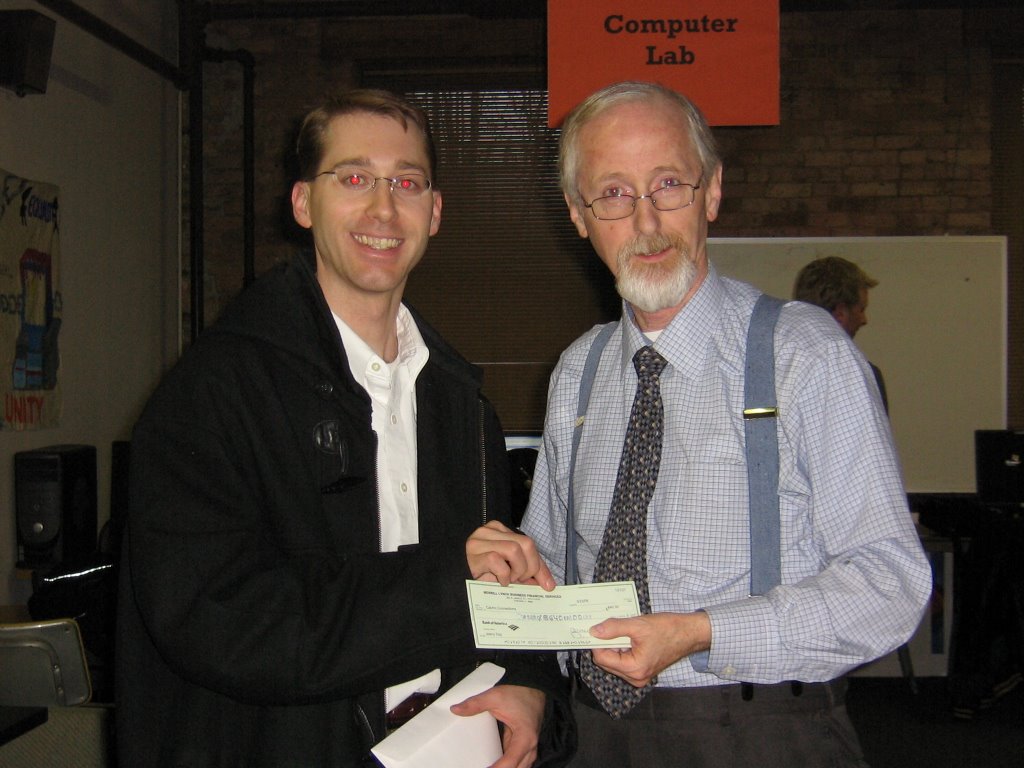
I hope you'll participate, and that you'll invite donors, like Jason who is shown above giving me a donation from his co-workers at Merrill Lynch in Chicago. If we can draw donors into our discussions, my hope is that they will become partners who make sure local programs have all of the resources they need to connect volunteers with kids.
The on-line forums are FREE. I hope I meet you there.
Monday, May 01, 2006
Innovation, Problem Solving, Collaboration
I found three sites worth visiting in the last few days. The first was a non profit blog site titled BlogDigger http://groups.blogdigger.com/groups.jsp?id=2849 The site contains links to current messages in several hundred "Blogs by and/or about Non-Profit organizations". I read through a few of these, and the links highlight some of the most important challenges facing non profits in America and the world. They also provide some great tips that any non profit might use to do better work.
The second site is the Community site of Accenture, one of the largest professional consulting companies in the world. The feature on the http://www.accenture.com/community page is "Executive Issues in Non Profits 2005/06: Identifying Enablers of Nonprofit High Performance". I printed the report and among its findings are a) 77% of non profit executives and board members say "expanding the current donor base is the top issue". 61% say "recruiting high-impact board members" is the top issue. To me, these are the same. In traditional philanthropy, you need well-connected board members who can, AND WILL, help raise money.
A few weeks ago I posted a link to a CompassPoint report, titled Dare to Lead, which provided similar information, showing lack of access to funding to be the biggest contributor to executive burnout and turnover in small and medium non profits. The report is at http://compasspoint.org
The third site I visited was the India Development Coalition of America. This is a small grassroots group of people who want to support charities in India. The site is http://www.idc-america.org
What's the point?
The research provided by Accenture and Compass Point provides information that non profits and for profits could be using to innovate new ways to raise and distribute revenue, ideas, talent and technology to non profits throughout the world.
However, that is not likely to happen until these groups, and many others, connect with each other in on-line portals where ideas are available for innovation, where on-line meeting and discussion capacity is available, and where someone provides a blueprint, and points to maps, showing all of the places where resources are needed, and all of the existing non profits who are scurrying around like goldfish in a feeding bowl, trying to find food for their operations.
If this is of interest to you, visit the eConference page at http://www.tutormentorconference.bigstep.com and find a time and an on-line space where you can begin to join this process. Or, find time to send an email to others in your business, professional, faith and alumni network, to encourage them to join.
The second site is the Community site of Accenture, one of the largest professional consulting companies in the world. The feature on the http://www.accenture.com/community page is "Executive Issues in Non Profits 2005/06: Identifying Enablers of Nonprofit High Performance". I printed the report and among its findings are a) 77% of non profit executives and board members say "expanding the current donor base is the top issue". 61% say "recruiting high-impact board members" is the top issue. To me, these are the same. In traditional philanthropy, you need well-connected board members who can, AND WILL, help raise money.
A few weeks ago I posted a link to a CompassPoint report, titled Dare to Lead, which provided similar information, showing lack of access to funding to be the biggest contributor to executive burnout and turnover in small and medium non profits. The report is at http://compasspoint.org
The third site I visited was the India Development Coalition of America. This is a small grassroots group of people who want to support charities in India. The site is http://www.idc-america.org
What's the point?
The research provided by Accenture and Compass Point provides information that non profits and for profits could be using to innovate new ways to raise and distribute revenue, ideas, talent and technology to non profits throughout the world.
However, that is not likely to happen until these groups, and many others, connect with each other in on-line portals where ideas are available for innovation, where on-line meeting and discussion capacity is available, and where someone provides a blueprint, and points to maps, showing all of the places where resources are needed, and all of the existing non profits who are scurrying around like goldfish in a feeding bowl, trying to find food for their operations.
If this is of interest to you, visit the eConference page at http://www.tutormentorconference.bigstep.com and find a time and an on-line space where you can begin to join this process. Or, find time to send an email to others in your business, professional, faith and alumni network, to encourage them to join.
Tuesday, April 25, 2006
Non Profit Blog Exchange, Round 3
This is the third time in the past year that I've participated in the non profit blog exchange at http://nonprofitblogexchange.blogspot.com/
This time I was assigned The Camp ASCCA Journal at at http://www.mail2web.com/cgi-bin/redir.asp?lid=0&newsite=http://www.campascca.org/journal/.
I'm very impressed with the work being done by Camp ASCCA. Their Mission is to help children and adults with disabilities achieve equality, dignity, and maximum independence through a safe and quality program of camping, recreation, and education in a year-round barrier-free environment.
They have developed a very innovative use of blogs to tell their story. This is an important example for organizations who may want a web strategy, but may not be able to build a traditional web site. This site looks pretty sophisticated, but many of the pages are interactive blog pages that enable members of Camp ASCCA to post up-to-date information about the work they do, and about work other environmental organizations are doing. I encourage you to visit the site.
In addition I was invited to write about the blog at http://www.christine.net . I visited this blog and was pleased to learn that the writer is part of the http://www.omidyar.net/ organization. I'm one of more than 10,000 people who have become a member of O-Net. I don't see the same focus on non-profit issues on this blog as I have in others listed on the non profit blog exchange, but the site provides links to other technology related blogs for anyone interested in learning more about various communications technologies.
I participate in the blog exchange as part of an on-going effort to build a "network of purpose". What is this? Read the ppt essay titled Creating a Learning & Collaboration Network of Purpose which is located in the Tutor/Mentor Institute section of http://www.tutormentorexchange.net.
Or join me next week (May 2-5) at http://www.socialedge.org/ where I'll lead a discussion about building networks of purpose. This is the first of several on-line forums that the Tutor/Mentor Connection has organized for May and June networking of non profit tutor/mentor leaders and their supporters.
The blog exchange is building a network of groups focused on sharing information about non profits. One hundred blogs are now listed at http://nonprofitblogexchange.blogspot.com/ I've visited many and have posted links to some of the best in the LINKS section of the Tutor/Mentor library. As non profit leaders and supporters link to each other and build relationships, some will begin to work together to help non profits get the resources each needs, but which the all compete with each other to get.
The way non profits are now supported is a dysfunctional system. It does not work effectively. The competition of hundreds of non profits for scarce resources is a huge waste of manpower and dollars. Imagine if we could reverse the process and by working together, motivate donors to go to our web sites to see what we do and decide if they want to help us.
Is this possible? Let's talk about it.
Dan Bassill
Tutor/Mentor Connection
This time I was assigned The Camp ASCCA Journal at at http://www.mail2web.com/cgi-bin/redir.asp?lid=0&newsite=http://www.campascca.org/journal/.
I'm very impressed with the work being done by Camp ASCCA. Their Mission is to help children and adults with disabilities achieve equality, dignity, and maximum independence through a safe and quality program of camping, recreation, and education in a year-round barrier-free environment.
They have developed a very innovative use of blogs to tell their story. This is an important example for organizations who may want a web strategy, but may not be able to build a traditional web site. This site looks pretty sophisticated, but many of the pages are interactive blog pages that enable members of Camp ASCCA to post up-to-date information about the work they do, and about work other environmental organizations are doing. I encourage you to visit the site.
In addition I was invited to write about the blog at http://www.christine.net . I visited this blog and was pleased to learn that the writer is part of the http://www.omidyar.net/ organization. I'm one of more than 10,000 people who have become a member of O-Net. I don't see the same focus on non-profit issues on this blog as I have in others listed on the non profit blog exchange, but the site provides links to other technology related blogs for anyone interested in learning more about various communications technologies.
I participate in the blog exchange as part of an on-going effort to build a "network of purpose". What is this? Read the ppt essay titled Creating a Learning & Collaboration Network of Purpose which is located in the Tutor/Mentor Institute section of http://www.tutormentorexchange.net.
Or join me next week (May 2-5) at http://www.socialedge.org/ where I'll lead a discussion about building networks of purpose. This is the first of several on-line forums that the Tutor/Mentor Connection has organized for May and June networking of non profit tutor/mentor leaders and their supporters.
The blog exchange is building a network of groups focused on sharing information about non profits. One hundred blogs are now listed at http://nonprofitblogexchange.blogspot.com/ I've visited many and have posted links to some of the best in the LINKS section of the Tutor/Mentor library. As non profit leaders and supporters link to each other and build relationships, some will begin to work together to help non profits get the resources each needs, but which the all compete with each other to get.
The way non profits are now supported is a dysfunctional system. It does not work effectively. The competition of hundreds of non profits for scarce resources is a huge waste of manpower and dollars. Imagine if we could reverse the process and by working together, motivate donors to go to our web sites to see what we do and decide if they want to help us.
Is this possible? Let's talk about it.
Dan Bassill
Tutor/Mentor Connection
Saturday, April 22, 2006
Message from Volunteer
This is a guest message, written by Dan Truesdell, a volunteer with the Cabrini Connections Tutor/Mentor Program in Chicago. This is a letter Dan submitted to the Chicago Tribune.
------------------------------------
In response to the Chicago Tribune’s recent stories on the shortage of textbooks in Illinois public schools, I am writing to provide witness to this problem here in Chicago. I am a volunteer tutor at Cabrini Connections, a non-profit tutor/mentor program created to help middle and high school students in the Cabrini-Green neighborhood succeed in school and prepare for adult life (http://www.cabriniconnections.net). Our program recruits volunteers from Chicago area businesses to be tutors/mentors. We meet with teens from 6 to 7:45pm each week, in hours when schools are usually closed. I've been involved for 2 years and some of our teens have been involved for 4 and 5 years.
Quite frequently (and sadly), I see many students who come to the program with tattered and outdated textbooks - - if textbooks are available at all. In the case where textbooks are not available to them, students come with loose worksheet material for homework, which lack the valuable reference information available in a textbook. This program maintains a small library to provide students with reference information in order to teach the concepts that are missing from the loose material they receive in school. It also has computer lab, which enables students to search the Internet to find the most current learning information, with the help of volunteers.
In most of the discussion of public school performance, there is little mention of what volunteers and business can do to support non-school tutoring/mentoring. Yet, there are organizations like ours in many parts of Chicago, helping to provide public school students with the tools needed to succeed. I think I've learned as much from the experience as have the students I've worked with. One of the things I've learned is how poorly supported students are in Chicago's public school system.
Textbooks are a key resource in learning, as are places like Cabrini Connections, where youth can connect with a network of volunteer tutors/mentors. While the wheels of politics may grind slowly to fix this problem in the public realm, private citizens can help by providing their time, talent or financial contributions to the many Chicago tutoring and mentoring programs that are addressing this problem now.
Dan Truesdell
Cabrini Connections
http://www.cabriniconnections.net
Chicago
------------------------------------
In response to the Chicago Tribune’s recent stories on the shortage of textbooks in Illinois public schools, I am writing to provide witness to this problem here in Chicago. I am a volunteer tutor at Cabrini Connections, a non-profit tutor/mentor program created to help middle and high school students in the Cabrini-Green neighborhood succeed in school and prepare for adult life (http://www.cabriniconnections.net). Our program recruits volunteers from Chicago area businesses to be tutors/mentors. We meet with teens from 6 to 7:45pm each week, in hours when schools are usually closed. I've been involved for 2 years and some of our teens have been involved for 4 and 5 years.
Quite frequently (and sadly), I see many students who come to the program with tattered and outdated textbooks - - if textbooks are available at all. In the case where textbooks are not available to them, students come with loose worksheet material for homework, which lack the valuable reference information available in a textbook. This program maintains a small library to provide students with reference information in order to teach the concepts that are missing from the loose material they receive in school. It also has computer lab, which enables students to search the Internet to find the most current learning information, with the help of volunteers.
In most of the discussion of public school performance, there is little mention of what volunteers and business can do to support non-school tutoring/mentoring. Yet, there are organizations like ours in many parts of Chicago, helping to provide public school students with the tools needed to succeed. I think I've learned as much from the experience as have the students I've worked with. One of the things I've learned is how poorly supported students are in Chicago's public school system.
Textbooks are a key resource in learning, as are places like Cabrini Connections, where youth can connect with a network of volunteer tutors/mentors. While the wheels of politics may grind slowly to fix this problem in the public realm, private citizens can help by providing their time, talent or financial contributions to the many Chicago tutoring and mentoring programs that are addressing this problem now.
Dan Truesdell
Cabrini Connections
http://www.cabriniconnections.net
Chicago
Wednesday, April 19, 2006
Biotechnology Conference Draws attention to new careers. Will inner city kids be part of this industry?
Last week Chicago hosted a Biotechnology conference where leading scientists from around the world gathered to network and share ideas. At the same time Time magazine and Bill Gates and the Oprah show were focusing public attention on the high school drop out crisis in America.
What's the connection? If America wants to have a lead in the biotechnology industry, more kids need to choose this as a career. If we want to keep more kids in school we need to connect them with mentors who can build aspirations and provide support. We need to create a pipeline to careers and one end of the plumbing needs to be reaching elementary school kids in inner city neighborhoods all over America.
This is a simple concept, but a complicated idea. Thus, I cannot explain it all in this blog. However, we can provide a forum for people to gather and learn, if we can use the internet effectively to support social networking, and networking for a purpose.
Today (April 19) and tomorrow, Tech Soup (http://www.techsoup.org) is hosting an on-line discussion of social networking concepts and applications.
During May and June, the Tutor/Mentor Connection will host a variety of on-line and face to face forums intended to build a network of business, philanthropy, colleges, non profits and educators who work together to build a pipeline to all careers, including biotechnology. You can read about these at http://www.tutormentorconference.bigstep.com.
I encourage you to participate and to encourage others to join in. As we learn to learn and network on-line, and build social networks of purpose, we can innovate ways to create pipelines to careers, and this will be a big step toward reducing the drop out crisis in America.
What's the connection? If America wants to have a lead in the biotechnology industry, more kids need to choose this as a career. If we want to keep more kids in school we need to connect them with mentors who can build aspirations and provide support. We need to create a pipeline to careers and one end of the plumbing needs to be reaching elementary school kids in inner city neighborhoods all over America.
This is a simple concept, but a complicated idea. Thus, I cannot explain it all in this blog. However, we can provide a forum for people to gather and learn, if we can use the internet effectively to support social networking, and networking for a purpose.
Today (April 19) and tomorrow, Tech Soup (http://www.techsoup.org) is hosting an on-line discussion of social networking concepts and applications.
During May and June, the Tutor/Mentor Connection will host a variety of on-line and face to face forums intended to build a network of business, philanthropy, colleges, non profits and educators who work together to build a pipeline to all careers, including biotechnology. You can read about these at http://www.tutormentorconference.bigstep.com.
I encourage you to participate and to encourage others to join in. As we learn to learn and network on-line, and build social networks of purpose, we can innovate ways to create pipelines to careers, and this will be a big step toward reducing the drop out crisis in America.
Thursday, April 13, 2006
Appology. Correct spelling is "Oprah"
In an email Tutor/Mentor News that I sent to my entire network yesterday, I misspelled Oprah's name. Several people emailed to correct me. Thank you.
To Oprah, I apologize.
I hope you don't kill the messenger, but instead, focus on the message.
We need attention on this issue every day for many years and in many ways, not just for a few days of this week.
Dan Bassill
Tutor/Mentor Connection
Cabrini Connections
To Oprah, I apologize.
I hope you don't kill the messenger, but instead, focus on the message.
We need attention on this issue every day for many years and in many ways, not just for a few days of this week.
Dan Bassill
Tutor/Mentor Connection
Cabrini Connections
Tuesday, April 11, 2006
Silent Crisis: Large Numbers of Youth Are Not Completing High School
Demand for Better High Schools Grows Nationally. On Tuesday, April 11 and Wednesday, April 12, the Oprah Winfrey Show will turn the focus of its estimated 49 million U.S. viewers to the dropout crisis in America's high schools. Also this week, TIME magazine's April 17, 2006 cover story, "Dropout Nation," provides an in-depth look at the nationwide dropout crisis and the repercussions that accompany it.
Visit the Connect for Kids web site at http://www.connectforkids.org/node/2776 and read the statistics on this drop out crisis.
Will this public visibility be a random act of media attention? Or can it be sustained as daily bread to feed the understanding of the thousand of people who need to be involved if there is to be a change in the support system for youth who don't make it through school and into careers on the first chance they have.
As we approach Easter weekend, think of the 2000 years of leadership that have resulted in millions of people coming together this weekend. Who will provide the long-term leadership that brings millions of people into a church of commitment to underserved youth in America and other countries?
Visit the Tutor/Mentor Institute section at http://www.tutormentorexchange.net and read power point essays that illustrate the role business, professional, faith and media leaders can take to support a pipeline of organizations that mentor kids through school and into careers.
Look at the Maps on the site to see the large number of neighborhoods in big cities like Chicago where an orchestra of programs are needed, but where too few programs currently exist.
Then, visit http://www.tutormentorconference.org and make an effort to connect with others in the May and June Tutor/Mentor Conferences so you can become part of a solution to this problem, with your time, your talent, your treasure and your leadership.
Dan Bassill
Tutor/Mentor Connection
Read about the www.cabriniconnections.net program and its efforts to help inner city teens to careers.
Visit the Connect for Kids web site at http://www.connectforkids.org/node/2776 and read the statistics on this drop out crisis.
Will this public visibility be a random act of media attention? Or can it be sustained as daily bread to feed the understanding of the thousand of people who need to be involved if there is to be a change in the support system for youth who don't make it through school and into careers on the first chance they have.
As we approach Easter weekend, think of the 2000 years of leadership that have resulted in millions of people coming together this weekend. Who will provide the long-term leadership that brings millions of people into a church of commitment to underserved youth in America and other countries?
Visit the Tutor/Mentor Institute section at http://www.tutormentorexchange.net and read power point essays that illustrate the role business, professional, faith and media leaders can take to support a pipeline of organizations that mentor kids through school and into careers.
Look at the Maps on the site to see the large number of neighborhoods in big cities like Chicago where an orchestra of programs are needed, but where too few programs currently exist.
Then, visit http://www.tutormentorconference.org and make an effort to connect with others in the May and June Tutor/Mentor Conferences so you can become part of a solution to this problem, with your time, your talent, your treasure and your leadership.
Dan Bassill
Tutor/Mentor Connection
Read about the www.cabriniconnections.net program and its efforts to help inner city teens to careers.
Thursday, March 30, 2006
Collaborative Blogging for Strategic Reasons
I encourage you to read Ethan Zukerman's March 23, 2006 blog titled
From representing to pointing: some thoughts on the future of advocacy. It's at http://www.ethanzuckerman.com/blog/?p=452
I also encourage you to read Dr. Robert Halpern's Article, The Big Lie: Reframing Expectations of Afterschool Programs. You can find this at http://www.pasesetter.org/events/reframeafterschool.html
In past blogs I've talked about the need for non-school tutor/mentor programs to be included in national strategies for raising kids. Dr. Halpern states the value of afterschool programs much better than I can, and calls for a "de enlistment" from strategies that tie funding of non-school programs to narrow test score result measures. Of course, until we find the money this is not likely to happen. Until we change the thinking of a lot of donors, we won't change the flow of dollars.
That's where Zukerman's blog comes in. Those who are tutors, mentors, or who lead these programs have many great stories to tell. At http://www.cabriniconnections.net you can read a message posted by one of the seniors in the Cabrini Connections program. In the LINKS library of the Tutor/Mentor Web Library many other tutor/mentor programs tell their stories.
We're all trying convince volunteers and donors to support us.
However, none of us has huge advertising budgets, and each of us singing our own song at different times each day or each year, just makes a loud noise. It's not an orchestra. It's not music. We need to be saying the same things, and aggregating our messages, at key times when what we are talking about can generate a greater response for all of us.
If we learn to adopt some of the strategies Zukerman is describing, and if we find ways to aggregate our blogs, in web libraries like this part of the Tutor/Mentor web library , our blogs do become an orchestra and a collection of stories, and maybe more people will understand what Halpern is writing about and what most of us know from our own experience in leading non-school tutor/mentor programs.
Visit the Tutor/Mentor Leadership Conference page at http://www.tutormentorconference.org and read how you can learn more about these strategies, or how you can take a role in teaching others how to blog, or how to build and sustain a volunteer-based tutor/mentor program.
If you know any donors, or people who want to end poverty through education to careers, you can invite them, too. Until they are in the orchestra looking at the same music, we'll still be struggling to find a place to play.
From representing to pointing: some thoughts on the future of advocacy. It's at http://www.ethanzuckerman.com/blog/?p=452
I also encourage you to read Dr. Robert Halpern's Article, The Big Lie: Reframing Expectations of Afterschool Programs. You can find this at http://www.pasesetter.org/events/reframeafterschool.html
In past blogs I've talked about the need for non-school tutor/mentor programs to be included in national strategies for raising kids. Dr. Halpern states the value of afterschool programs much better than I can, and calls for a "de enlistment" from strategies that tie funding of non-school programs to narrow test score result measures. Of course, until we find the money this is not likely to happen. Until we change the thinking of a lot of donors, we won't change the flow of dollars.
That's where Zukerman's blog comes in. Those who are tutors, mentors, or who lead these programs have many great stories to tell. At http://www.cabriniconnections.net you can read a message posted by one of the seniors in the Cabrini Connections program. In the LINKS library of the Tutor/Mentor Web Library many other tutor/mentor programs tell their stories.
We're all trying convince volunteers and donors to support us.
However, none of us has huge advertising budgets, and each of us singing our own song at different times each day or each year, just makes a loud noise. It's not an orchestra. It's not music. We need to be saying the same things, and aggregating our messages, at key times when what we are talking about can generate a greater response for all of us.
If we learn to adopt some of the strategies Zukerman is describing, and if we find ways to aggregate our blogs, in web libraries like this part of the Tutor/Mentor web library , our blogs do become an orchestra and a collection of stories, and maybe more people will understand what Halpern is writing about and what most of us know from our own experience in leading non-school tutor/mentor programs.
Visit the Tutor/Mentor Leadership Conference page at http://www.tutormentorconference.org and read how you can learn more about these strategies, or how you can take a role in teaching others how to blog, or how to build and sustain a volunteer-based tutor/mentor program.
If you know any donors, or people who want to end poverty through education to careers, you can invite them, too. Until they are in the orchestra looking at the same music, we'll still be struggling to find a place to play.
Wednesday, March 22, 2006
So, What Do We Do About It?
Over the past couple of weeks I’ve written about the shootings in Englewood, and expressed my concern that nothing will happen because there is no plan for engaging people from beyond poverty in this discussion in a process that creates ownership, understanding of the issues, and a dramatic increase the resources needed to build and sustain comprehensive tutor/mentor programs in poverty neighborhoods.
Yesterday, 3/21, I participated in an audio conference titled “Integrating Mentoring and After-School”, which focused on the need for mentoring programs in more places (like Englewood) and the potential for these programs being hosted in traditional after-school programs, such as Boys & Girls Clubs, YMCA’s, schools, etc. I encourage you to read the Policy Commentary at https://web.archive.org/web/20060324000257/http://www.forumfyi.org/files/ostpc11.pdf. In a few days you should be able to read a transcript of the actual audio conference.
Today, 3/22, I attended an event titled Non profit Leadership Challenges and Opportunities, which was hosted by the Donors Forum of Chicago
Representatives from Compass Point, presented findings from a web survey that was distributed in eight cities over the past year. It’s titled “Daring to Lead, 2006” and you can download the full report at www.compasspoint.org.
The Daring to Lead presentation highlighted three surprising findings: a) 30% of executives leave their jobs involuntarily (either fired or forced out); b) Executive directors plan to leave their jobs but will stay active in the nonprofit sector; and c) A key driver of executive burnout is frustration with funders.
While the focus of the Donor’s Forum meeting was on succession planning, which is essential to leadership stability and organizational growth, the research constantly pointed to a lack of ACCESS TO CAPITAL as the primary challenge facing small and mid size non profits. Their was a rousing cheer when the need for funding non-restricted, long-term general operations funding was raised as a pivotal issue.
I agree. You cannot keep good leaders, or pay them well, or offer retirement, if you don’t have enough money to pay the rent on a regular basis. If you deal with this problem every day for 12 years, as I have, it tends to be a bit stressful.
How do these issues connect? If we want more to reduce the violence in neighborhoods like Englewood, we must provide better education and career opportunities. To do this we must increase the range of non-school programs that help kids succeed in school, stay safe in non-school hours, and move successfully to jobs and careers. The only time when work place adults are consistently available to be involved in long-term mentoring is after 5pm, when most after-school programs are not open.
Finally, it takes years to build good tutor/mentor programs and it takes a dozen years just to help a youth go from first grade through high school. It takes another 6-8 years before that youth is anchored on a career path. We can never support this process on a consistent basis in many locations if we cannot attract and keep key leaders for existing programs, let alone attract thousands more for the additional programs needed in Chicago and around the country.
We cannot do this without changing the funding paradigm.
So what do we do next?
There must have been over 500 people at the Donors Forum event. I don’t know how many were in the audio conference on Tuesday. However, most will never be in the same room, or the same discussion, at the same time again, because there was no strategy in evidence that gave participants and opportunity to connect with each other, and the presenters, in a facilitated, and open, on-going dialogs.
That’s why we created the Tutor/Mentor Connection. That’s why I invite anyone interested in tutoring/mentoring as a strategy for civic engagement and for increasing the understanding of poverty, to participate in the May and November Tutor/Mentor Leadership Conferences held in Chicago and on the Internet.
These are a meeting place for people to come together to present, reinforce, advocate and discuss information such as was presented over the last two days, in the context of the urgency that is reinforced by the media coverage of events like the shootings in Englewood.
Over the past two year’s we’ve also begun to develop a web conferencing process, so that people from distant locations can connect with people in Chicago, during the May and November conference periods, and so that people can stay connected on an on-going basis. As others host video and audio conferences, or face to face meetings such as today's event, my hope is that they will build web strategies that link the participants to each other, and to affinity groups such as the Tutor/Mentor Connection.
Our goal is to turn discussions into meetings, and meetings into a process of identifying tipping points, or ways to collaborate in activities, like leadership development, funding, volunteer recruitment, which effect all tutor/mentor programs in the country, not just our program in the Cabrini Green neighborhood of Chicago.
(note: if you're an architect, or work with complex decision support, we'd like to recruit you to map this process, to create a blueprint that people could follow to understand the problems and to be strategically involved in the solutions)
If you read back through the blogs I’ve posted in the past year, you’ll see that there have been many forums where information of importance was presented to a gathering of interested people.
I invite all of those who are creating and presenting research on poverty, workforce development, tutoring/mentoring, violence prevention, youth development, service learning, etc. to use the T/MC conferences and internet space as additional times and places where you can present your information, help more people understand it, and contribute to a long-term process that leads to the development of more and better programs that keep kids safe, successful in school and moving toward jobs and careers.
You can read about the conference at http://tutormentor.blogspot.com
Yesterday, 3/21, I participated in an audio conference titled “Integrating Mentoring and After-School”, which focused on the need for mentoring programs in more places (like Englewood) and the potential for these programs being hosted in traditional after-school programs, such as Boys & Girls Clubs, YMCA’s, schools, etc. I encourage you to read the Policy Commentary at https://web.archive.org/web/20060324000257/http://www.forumfyi.org/files/ostpc11.pdf. In a few days you should be able to read a transcript of the actual audio conference.
Today, 3/22, I attended an event titled Non profit Leadership Challenges and Opportunities, which was hosted by the Donors Forum of Chicago
Representatives from Compass Point, presented findings from a web survey that was distributed in eight cities over the past year. It’s titled “Daring to Lead, 2006” and you can download the full report at www.compasspoint.org.
The Daring to Lead presentation highlighted three surprising findings: a) 30% of executives leave their jobs involuntarily (either fired or forced out); b) Executive directors plan to leave their jobs but will stay active in the nonprofit sector; and c) A key driver of executive burnout is frustration with funders.
While the focus of the Donor’s Forum meeting was on succession planning, which is essential to leadership stability and organizational growth, the research constantly pointed to a lack of ACCESS TO CAPITAL as the primary challenge facing small and mid size non profits. Their was a rousing cheer when the need for funding non-restricted, long-term general operations funding was raised as a pivotal issue.
I agree. You cannot keep good leaders, or pay them well, or offer retirement, if you don’t have enough money to pay the rent on a regular basis. If you deal with this problem every day for 12 years, as I have, it tends to be a bit stressful.
How do these issues connect? If we want more to reduce the violence in neighborhoods like Englewood, we must provide better education and career opportunities. To do this we must increase the range of non-school programs that help kids succeed in school, stay safe in non-school hours, and move successfully to jobs and careers. The only time when work place adults are consistently available to be involved in long-term mentoring is after 5pm, when most after-school programs are not open.
Finally, it takes years to build good tutor/mentor programs and it takes a dozen years just to help a youth go from first grade through high school. It takes another 6-8 years before that youth is anchored on a career path. We can never support this process on a consistent basis in many locations if we cannot attract and keep key leaders for existing programs, let alone attract thousands more for the additional programs needed in Chicago and around the country.
We cannot do this without changing the funding paradigm.
So what do we do next?
There must have been over 500 people at the Donors Forum event. I don’t know how many were in the audio conference on Tuesday. However, most will never be in the same room, or the same discussion, at the same time again, because there was no strategy in evidence that gave participants and opportunity to connect with each other, and the presenters, in a facilitated, and open, on-going dialogs.
That’s why we created the Tutor/Mentor Connection. That’s why I invite anyone interested in tutoring/mentoring as a strategy for civic engagement and for increasing the understanding of poverty, to participate in the May and November Tutor/Mentor Leadership Conferences held in Chicago and on the Internet.
These are a meeting place for people to come together to present, reinforce, advocate and discuss information such as was presented over the last two days, in the context of the urgency that is reinforced by the media coverage of events like the shootings in Englewood.
Over the past two year’s we’ve also begun to develop a web conferencing process, so that people from distant locations can connect with people in Chicago, during the May and November conference periods, and so that people can stay connected on an on-going basis. As others host video and audio conferences, or face to face meetings such as today's event, my hope is that they will build web strategies that link the participants to each other, and to affinity groups such as the Tutor/Mentor Connection.
Our goal is to turn discussions into meetings, and meetings into a process of identifying tipping points, or ways to collaborate in activities, like leadership development, funding, volunteer recruitment, which effect all tutor/mentor programs in the country, not just our program in the Cabrini Green neighborhood of Chicago.
(note: if you're an architect, or work with complex decision support, we'd like to recruit you to map this process, to create a blueprint that people could follow to understand the problems and to be strategically involved in the solutions)
If you read back through the blogs I’ve posted in the past year, you’ll see that there have been many forums where information of importance was presented to a gathering of interested people.
I invite all of those who are creating and presenting research on poverty, workforce development, tutoring/mentoring, violence prevention, youth development, service learning, etc. to use the T/MC conferences and internet space as additional times and places where you can present your information, help more people understand it, and contribute to a long-term process that leads to the development of more and better programs that keep kids safe, successful in school and moving toward jobs and careers.
You can read about the conference at http://tutormentor.blogspot.com
Sunday, March 19, 2006
Englewood: Less Marching + More Planning = Better Results
The reason nothing will change in Englewood is that too many people are marching and calling for truces and an end to the violence, and in front of the cameras, getting face time while the cameras are focused on the tragedy in Englewood. There's nothing wrong with that, except it just creates a flash of anger. Nothing is sustained. There's no plan.
Too few people are in deep thought innovating ways to build and sustain a long-term movement. Too few people are creating new ways to build involvement, ownership and public support from all parts of society, especially those who only read about poverty and tragedies like this in the paper. It will take a comprehensive vision, sustained over many years to change the conditions that make neighborhoods like Englewood feeding grounds for gangs, drugs and random violence.
The tragedy is, too few people follow up after the rage had died down to sustain and expand a movement long enough to do any good.
Change that and we change what’s happening in Englewood and in hundreds of inner city neighborhoods throughout the country where the same thing is happening.
Dan Bassill
Tutor/Mentor Connection
Too few people are in deep thought innovating ways to build and sustain a long-term movement. Too few people are creating new ways to build involvement, ownership and public support from all parts of society, especially those who only read about poverty and tragedies like this in the paper. It will take a comprehensive vision, sustained over many years to change the conditions that make neighborhoods like Englewood feeding grounds for gangs, drugs and random violence.
The tragedy is, too few people follow up after the rage had died down to sustain and expand a movement long enough to do any good.
Change that and we change what’s happening in Englewood and in hundreds of inner city neighborhoods throughout the country where the same thing is happening.
Dan Bassill
Tutor/Mentor Connection
Tuesday, March 14, 2006
The Tragedy of Englewood
On page 1 of the March 13, 2006 Chicago Sun Times the feature headline is WHEN ARE THEY GOING TO STOP KILLING OUR KIDS? The headline in the Chicago Tribune is Another Stray bullet shatters Englewood.
On October 15, 1992 the front page of the Chicago Sun Times feature headline was “THE KILING GROUND: 7-Year-Old’s Death at Cabrini Requires Action.
In the 14 years between these two headlines there have been dozens of smaller stories about violence, and hundreds of unreported stories. In addition there have been feature stories about poverty, gangs, poorly performing schools, ex-offenders being released into poverty neighborhoods, etc. You can find copies of many of these stories in the files of the Tutor/Mentor Connection’s offices at 800 W. Huron in Chicago.
What I cannot find, are web sites that link these stories and show how they are interrelated. What I cannot find are stories that talk about comprehensive efforts to build community support systems in neighborhoods like Englewood that provide youth with a variety of learning and enrichment opportunities and surround them with a network of adults who are committed to helping kids move through school safely and into jobs and careers.
Stopping the killing in Englewood is not just about getting guns off the street. Ending the war in our inner cities is no easier than ending the war on terrorism. This is a complex social problem that will take the involvement of many people over many years. The solutions must enlist business as self-interested partners, along with universities, faith networks, media, hospitals and the entire orchestra of civic and social organizations.
When Dantrell Davis was killed in 1992, most of us did not even know that the Internet existed. Things have changed. People from around the world are connecting with each other via the Internet. Complex ideas are being discussed by many people in many different places.
Here’s a sample. At http://www.socialedge.org/Events/Workshops/63 is a forum titled Balancing act: the alchemy of the social entrepreneur . This discussion talks about dealing with change and solving complex problems. In one posts, Charles Cameron writes about “keys to real social change” and refers to an article by Donella Meadows about Places to Intervene in a System: http://www.donellameadows.org/archives/leverage-points-places-to-intervene-in-a-system/
I read the article. I encourage you to read it to. It shows the importance of knowledge and information, which is the primary currency of the Tutor/Mentor Connection. Other than maintaining a Program Locator database of Chicago area tutor/mentor programs, we don’t create new knowledge. What we do is collect, aggregate and organize it on our various web sites.
This Social Edge discussion, and many like it that I’ve participated in for the past 10 years, challenge me to think in more complex and long-term ways about what must be done to solve the problems of Englewood. I express many of my ideas in Power Point essays posted at the Tutor/Mentor Institute section of http://www.tutormentorexchange.net/library
The reason I support volunteer based tutor/mentor programs like www.cabriniconnections.org is not because they solve all of the problems facing inner city youth, but because they engage more people personally in the lives of these kids and create a bridge linking poor neighborhoods with more affluent communities, with business, with universities and with others who must be more passionately and strategically involved, for many years, if there is to be a paradigm shift in what is happening in high poverty neighborhoods around Chicago and in the rest of the world.
When a person gets Cancer, he becomes a big supporter of Cancer Research. When a father loses a child to a school yard shooting, he becomes a gun control advocate. What do we need to do to create this type of personal involvement and commitment before a tragedy occurs?
Getting people involved in volunteer-based organizations that create a weekly, monthly and long-term connection with poverty is a place to start.
Unfortunately, too few of these organizations exist. Search the Program Locator at http://www.tutormentorprogramlocator.net/Prgloc.aspx for the 60636, 60621 and 60620 zip codes (the Englewood Neighborhood). You’ll find very few comprehensive tutor/mentor programs. Ask the leaders of any tutor/mentor program in Chicago, and you’ll also find that there is too little funding to help tutor/mentor programs grow and sustain volunteer involvement.
Ask the Tutor/Mentor Connection and we’ll tell you how difficult it is to find dollars to support the Program Locator and other services of the T/MC.
I don’t expect the news media to change the way they sensationalize bad news. It sells papers and they are in business to make a profit. What I do hope to do is engage the media and the business communities in innovative thinking of how they can use their resources, their leadership and their visibility to draw daily attention to the issues, like advertisers draw daily attention to their products and services.
We don’t need a front page headline every 14 years. We need this emphasis from someone in business, media, politics, religion, etc. every day.
We need them to point to web sites like http://www.tutormentorexchange.net so that people can find where to get involved, why to get involved, and how to be smarter when they do get involved.
The tragedy of Englewood is that too few people will read this and respond, which means the tragedy will repeat over and over again.
On October 15, 1992 the front page of the Chicago Sun Times feature headline was “THE KILING GROUND: 7-Year-Old’s Death at Cabrini Requires Action.
In the 14 years between these two headlines there have been dozens of smaller stories about violence, and hundreds of unreported stories. In addition there have been feature stories about poverty, gangs, poorly performing schools, ex-offenders being released into poverty neighborhoods, etc. You can find copies of many of these stories in the files of the Tutor/Mentor Connection’s offices at 800 W. Huron in Chicago.
What I cannot find, are web sites that link these stories and show how they are interrelated. What I cannot find are stories that talk about comprehensive efforts to build community support systems in neighborhoods like Englewood that provide youth with a variety of learning and enrichment opportunities and surround them with a network of adults who are committed to helping kids move through school safely and into jobs and careers.
Stopping the killing in Englewood is not just about getting guns off the street. Ending the war in our inner cities is no easier than ending the war on terrorism. This is a complex social problem that will take the involvement of many people over many years. The solutions must enlist business as self-interested partners, along with universities, faith networks, media, hospitals and the entire orchestra of civic and social organizations.
When Dantrell Davis was killed in 1992, most of us did not even know that the Internet existed. Things have changed. People from around the world are connecting with each other via the Internet. Complex ideas are being discussed by many people in many different places.
Here’s a sample. At http://www.socialedge.org/Events/Workshops/63 is a forum titled Balancing act: the alchemy of the social entrepreneur . This discussion talks about dealing with change and solving complex problems. In one posts, Charles Cameron writes about “keys to real social change” and refers to an article by Donella Meadows about Places to Intervene in a System: http://www.donellameadows.org/archives/leverage-points-places-to-intervene-in-a-system/
I read the article. I encourage you to read it to. It shows the importance of knowledge and information, which is the primary currency of the Tutor/Mentor Connection. Other than maintaining a Program Locator database of Chicago area tutor/mentor programs, we don’t create new knowledge. What we do is collect, aggregate and organize it on our various web sites.
This Social Edge discussion, and many like it that I’ve participated in for the past 10 years, challenge me to think in more complex and long-term ways about what must be done to solve the problems of Englewood. I express many of my ideas in Power Point essays posted at the Tutor/Mentor Institute section of http://www.tutormentorexchange.net/library
The reason I support volunteer based tutor/mentor programs like www.cabriniconnections.org is not because they solve all of the problems facing inner city youth, but because they engage more people personally in the lives of these kids and create a bridge linking poor neighborhoods with more affluent communities, with business, with universities and with others who must be more passionately and strategically involved, for many years, if there is to be a paradigm shift in what is happening in high poverty neighborhoods around Chicago and in the rest of the world.
When a person gets Cancer, he becomes a big supporter of Cancer Research. When a father loses a child to a school yard shooting, he becomes a gun control advocate. What do we need to do to create this type of personal involvement and commitment before a tragedy occurs?
Getting people involved in volunteer-based organizations that create a weekly, monthly and long-term connection with poverty is a place to start.
Unfortunately, too few of these organizations exist. Search the Program Locator at http://www.tutormentorprogramlocator.net/Prgloc.aspx for the 60636, 60621 and 60620 zip codes (the Englewood Neighborhood). You’ll find very few comprehensive tutor/mentor programs. Ask the leaders of any tutor/mentor program in Chicago, and you’ll also find that there is too little funding to help tutor/mentor programs grow and sustain volunteer involvement.
Ask the Tutor/Mentor Connection and we’ll tell you how difficult it is to find dollars to support the Program Locator and other services of the T/MC.
I don’t expect the news media to change the way they sensationalize bad news. It sells papers and they are in business to make a profit. What I do hope to do is engage the media and the business communities in innovative thinking of how they can use their resources, their leadership and their visibility to draw daily attention to the issues, like advertisers draw daily attention to their products and services.
We don’t need a front page headline every 14 years. We need this emphasis from someone in business, media, politics, religion, etc. every day.
We need them to point to web sites like http://www.tutormentorexchange.net so that people can find where to get involved, why to get involved, and how to be smarter when they do get involved.
The tragedy of Englewood is that too few people will read this and respond, which means the tragedy will repeat over and over again.
Sunday, March 05, 2006
Stray bullet kills family's 'angel'
Note: this article was written in 2006, but updated in 2021.
Today, March 4, 2006, the front page story of the Chicago Tribune shows a picture of a 14 year old honor student who was killed on Friday morning when a stray bullet fired from an assault-type rifle went through a window of her house and struck her in the head. The paper gave the address as the 6700 block of South Honore Street. I looked up the zip code. It is 60636.

At the left is a map created in 2018, showing the Englewood area of Chicago and the number of youth, age 6 to 17, below poverty. This number was much larger in 2006. See the map in this SlideShare presentation.

If you look at this zip code map you can see where the 60636 zip code is in the South part of Chicago.

At the left is a map created in 2018, showing the Englewood area of Chicago and the number of youth, age 6 to 17, below poverty. This number was much larger in 2006. See the map in this SlideShare presentation.
In this article on the MappingforJustice blog I show a map of Englewood with poorly performing schools included. If you look at this map you can see that there are numerous poorly performing public schools in this area, which is a contributor to kids dropping out, getting in gangs, and contributing to street violence.

The youth who was shot was an "honor student" who was trying to escape this violence. However, if you search the program locator database (not available, as of 2021) for the 60636 zip code, looking for a mixture of tutoring/mentoring, like you see at http://cabriniblog.blogspot.com, you'll find no listings.
(2021 note: View Chicago volunteer-based tutor, mentor programs map and list in this article)
This means that if there are any programs in this area working to keep kids in school and out of gangs and violence, they are operating in isolation, and struggling on their own to find resources to do this work. Or, there are no programs.
In either case, the tragedy of a 14 year old girl should be enough to get lots of people angry enough to want to do something.
I don't see anything in the Tribune that calls on businesses, foundations, churches and others to help start non-school tutor/mentor programs in this area, or that points to others parts of the city with similar problems, where programs do operate, but struggle for donations to support their work.
Maybe we'll see this in editorials in the coming week.
However, if you want to stop this violence, you can become a volunteer, donor, or a leaders. You can use the Program Locator to decide what neighborhood and what programs you want to help. You can support the Tutor/Mentor Leadership Conference, http://www.tutormentorconference.org, (hosted from May 1994 to May 2015) so programs can come together and learn from each other.
You can even support the T/MC and our efforts to help new programs start in areas like Englewood, by providing knowledge people can use to build new programs, and tools like the Program Locator, and Map Gallery, so people can find programs already operating in neighborhoods with too much poverty, and too many poorly performing schools.
You can even support the T/MC and our efforts to help new programs start in areas like Englewood, by providing knowledge people can use to build new programs, and tools like the Program Locator, and Map Gallery, so people can find programs already operating in neighborhoods with too much poverty, and too many poorly performing schools.
Finally, you can become a link between this message and this blog and your friends, family, co-workers, faith community, college, alumni network and others who need to be involved, but have not yet been introduced.
We can try to prevent future tragedies like this by building programs that keep kids coming to school, keep kids safe in non-school hours, and keep kids focused on legal jobs and careers.
Or you can just ignore the problem and wait until the next time this story is on the front page of our major papers.
Daniel F. Bassill
Tutor/Mentor Connection (1993-present);
Tutor/Mentor Institute, LLC (2011-present)
Tutor/Mentor Connection (1993-present);
Tutor/Mentor Institute, LLC (2011-present)
Sunday, February 26, 2006
Mentoring. A Personal Testimony. A Life Journey.
In previous messages, I've talked about what people and organizations need to do to strengthen the infrastructure of comprehensive, volunteer-based tutor/mentor programs in this country.
I draw my passion from 30 years of leading a tutor/mentor program in Chicago. I first got involved as a volunteer in a program hosted by the Montgomery Ward Corporation. That was 1973.
This morning I received an email from the boy that I first tutored back in 1973 when he was in 4th grade and I was in my first year as a volunteer. He's 43 now. I've been to every one of his graduations. Grade School. High School. College. Wedding.
He's in Nashville now. I had not heard from him for a few years, so today's message was a pleasant surprise.
He wrote, " I cannot believe that is has been over 30 years since we've met. When I look back over the years, you were always there for me. My next trip to Chicago is planned for July 2006. I will make it a top priority to find you, and tell you thanks again. You have really been a great inspiration to me. Thank you."
I wrote to him that I felt lucky to be part of his life and that my involvement with thousands of youth and volunteers in the years since has enriched my life in probably more ways than I was able to change his.
We both benefited and that's why I want to find ways to make it possible for more youth and adults to connect in this type of mentoring. That's the reason for the Tutor/Mentor Connection.
If your life has been touched by a mentor, or by a student that you have mentored, please share your story.
Dan Bassill
http://www.tutormentorconference.bigstep.com
I draw my passion from 30 years of leading a tutor/mentor program in Chicago. I first got involved as a volunteer in a program hosted by the Montgomery Ward Corporation. That was 1973.
This morning I received an email from the boy that I first tutored back in 1973 when he was in 4th grade and I was in my first year as a volunteer. He's 43 now. I've been to every one of his graduations. Grade School. High School. College. Wedding.
He's in Nashville now. I had not heard from him for a few years, so today's message was a pleasant surprise.
He wrote, " I cannot believe that is has been over 30 years since we've met. When I look back over the years, you were always there for me. My next trip to Chicago is planned for July 2006. I will make it a top priority to find you, and tell you thanks again. You have really been a great inspiration to me. Thank you."
I wrote to him that I felt lucky to be part of his life and that my involvement with thousands of youth and volunteers in the years since has enriched my life in probably more ways than I was able to change his.
We both benefited and that's why I want to find ways to make it possible for more youth and adults to connect in this type of mentoring. That's the reason for the Tutor/Mentor Connection.
If your life has been touched by a mentor, or by a student that you have mentored, please share your story.
Dan Bassill
http://www.tutormentorconference.bigstep.com
Wednesday, February 08, 2006
"the difficulty of success does not relieve one of the obligation to try"
Yesterday at the funeral of Corretta Scott King dozens of high profile people gave inspirational speeches calling for service to this nation and this world.
(NOTE: while this was posted in 2006 I've updated some of the links to point to current (2014) web sites)
I heard President Clinton while driving home. He said, "the difficulty of success does not relieve one of the obligation to try"
That resonated with me. For the past 30 years I've been trying to connect volunteers and inner city kids in a process that transforms the lives of the adult and the youth. For the youth we're trying to show that there are many career opportunities beyond those modeled in high poverty inner-city neighborhoods. They are available to anyone who works hard enough and takes advantage of the support offered by volunteer based tutor/mentor programs. To the volunteer's I've tried to teach concepts of service and leadership that go beyond "giving back" or "random acts of kindness". A youth in 5th grade needs volunteer support for many years and without the help of volunteers who become leaders and help improve the capacity of a tutor/mentor program, we'll never maintain our appeal long enough to ensure that our kids reach careers. Each year, this seems like an impossible task, yet, "the difficulty of success does not relieve me of the obligation to try."
I formed the Tutor/Mentor Connection in 1993 because I realized that no one had a master database of volunteer based tutor/mentor programs serving Chicago, and no one was leading a day-to-day effort to help each program that was already operating get the help and encouragement it needs to be successful at connecting kids and adults in long-term, career oriented mentoring. By not knowing what programs exist and where they were located, the city did not have a way to identify neighborhoods or age groups where there were no programs, or build a strategy to add new programs to fill these voids.
I've been trying to get leaders of tutor/mentor programs, researchers, funders, business leaders, etc. to come together in on-going learning that leads to the growth of volunteer-based mentoring-to-career programs in every poverty neighborhood of Chicago and other major cities.
I describe this process in a Theory of Change presentation that can be found in the Tutor/Mentor Institute library.
I participate in a variety of email forums, and issue a monthly email newsletter. Our web sites receive 4,000 visits a month. Through these I reach more than 10,000 people a month with invitations to connect with the Tutor/Mentor Connection. We receive a trickle of responses which are the people we've worked with since 1993 to build the Tutor/Mentor Connection. I'm disappointed that we don't have greater response, or that we've not found a major benefactor to support our work, but in the spirit of President Clinton's message, "it does not relieve me of the obligation to try".
I use power point essays to describe a multidimensional process that shows a sequence of services that start at birth and lead kids through school and into jobs and careers 25 years later, and that are available in thousands of neighborhoods, and supported by dozens of different types of organizations, and every industry segment, all with the same goals, but all working in silos to do their work.
Connecting these groups and teaching business and philanthropy to distribute funds based on where tutor/mentor programs are needed and which programs already operate in those areas is an almost impossible task. Yet, "the difficulty of the challenge does not relieve me of the obligation to try"
I am beginning to organize workshops for the May 25 and 26, 2006 Tutor/Mentor Leadership Conference that will be held at the Northwestern University Law School in Chicago. I'm also looking for colleges and universities who will host internet based discussions of conference topics, enabling more people to connect, network and learn from each other than who normally can attend a face to face conference. I'm also looking for a host college for the November 2006 conference. While it's difficult finding people to donate time or space or money needed to bring program leaders together, "the difficulty of the challenge does not relieve me of the obligation to try."
I encourage anyone who listened to Al Sharpton or the Rev. Joseph Lowery, or Bill Clinton's words in honor of the memory of Coretta Scott King to connect with the Tutor/Mentor Connection through the May or November Conferences or social media sites or the the Tutor/Mentor Connection on-line forum. You can offer workshops to share what you are learning and to help other programs find ways to connect adult and kids in ways that transform lives. Or, you can help sponsor the conference.
I you are interested in participating, please visit http://www.tutormentorconference.org for details or email me at tutormentor2@earthlink.net
Daniel F. Bassill
President
Cabrini Connections (1993-2011)
Tutor/Mentor Connection
Tutor/Mentor Institute, LLC (2011-2014)
(NOTE: while this was posted in 2006 I've updated some of the links to point to current (2014) web sites)
I heard President Clinton while driving home. He said, "the difficulty of success does not relieve one of the obligation to try"
That resonated with me. For the past 30 years I've been trying to connect volunteers and inner city kids in a process that transforms the lives of the adult and the youth. For the youth we're trying to show that there are many career opportunities beyond those modeled in high poverty inner-city neighborhoods. They are available to anyone who works hard enough and takes advantage of the support offered by volunteer based tutor/mentor programs. To the volunteer's I've tried to teach concepts of service and leadership that go beyond "giving back" or "random acts of kindness". A youth in 5th grade needs volunteer support for many years and without the help of volunteers who become leaders and help improve the capacity of a tutor/mentor program, we'll never maintain our appeal long enough to ensure that our kids reach careers. Each year, this seems like an impossible task, yet, "the difficulty of success does not relieve me of the obligation to try."
I formed the Tutor/Mentor Connection in 1993 because I realized that no one had a master database of volunteer based tutor/mentor programs serving Chicago, and no one was leading a day-to-day effort to help each program that was already operating get the help and encouragement it needs to be successful at connecting kids and adults in long-term, career oriented mentoring. By not knowing what programs exist and where they were located, the city did not have a way to identify neighborhoods or age groups where there were no programs, or build a strategy to add new programs to fill these voids.
I've been trying to get leaders of tutor/mentor programs, researchers, funders, business leaders, etc. to come together in on-going learning that leads to the growth of volunteer-based mentoring-to-career programs in every poverty neighborhood of Chicago and other major cities.
I describe this process in a Theory of Change presentation that can be found in the Tutor/Mentor Institute library.
I participate in a variety of email forums, and issue a monthly email newsletter. Our web sites receive 4,000 visits a month. Through these I reach more than 10,000 people a month with invitations to connect with the Tutor/Mentor Connection. We receive a trickle of responses which are the people we've worked with since 1993 to build the Tutor/Mentor Connection. I'm disappointed that we don't have greater response, or that we've not found a major benefactor to support our work, but in the spirit of President Clinton's message, "it does not relieve me of the obligation to try".
I use power point essays to describe a multidimensional process that shows a sequence of services that start at birth and lead kids through school and into jobs and careers 25 years later, and that are available in thousands of neighborhoods, and supported by dozens of different types of organizations, and every industry segment, all with the same goals, but all working in silos to do their work.
Connecting these groups and teaching business and philanthropy to distribute funds based on where tutor/mentor programs are needed and which programs already operate in those areas is an almost impossible task. Yet, "the difficulty of the challenge does not relieve me of the obligation to try"
I am beginning to organize workshops for the May 25 and 26, 2006 Tutor/Mentor Leadership Conference that will be held at the Northwestern University Law School in Chicago. I'm also looking for colleges and universities who will host internet based discussions of conference topics, enabling more people to connect, network and learn from each other than who normally can attend a face to face conference. I'm also looking for a host college for the November 2006 conference. While it's difficult finding people to donate time or space or money needed to bring program leaders together, "the difficulty of the challenge does not relieve me of the obligation to try."
I encourage anyone who listened to Al Sharpton or the Rev. Joseph Lowery, or Bill Clinton's words in honor of the memory of Coretta Scott King to connect with the Tutor/Mentor Connection through the May or November Conferences or social media sites or the the Tutor/Mentor Connection on-line forum. You can offer workshops to share what you are learning and to help other programs find ways to connect adult and kids in ways that transform lives. Or, you can help sponsor the conference.
I you are interested in participating, please visit http://www.tutormentorconference.org for details or email me at tutormentor2@earthlink.net
Daniel F. Bassill
President
Cabrini Connections (1993-2011)
Tutor/Mentor Connection
Tutor/Mentor Institute, LLC (2011-2014)
Wednesday, February 01, 2006
2006 State of the Union Response: There's A Better Way
Last night in the Democratic response to President George W. Bush's State of the Union Address, Virginia Governor Tim Kaine said "There's got to be a better way" to manage the affairs of government.
I agree, but my message is to leaders of both parties on the national and local level. My message is also to business leaders who are worrying about how to stay competitive with foreign competition over the next 20-30 years.
For many years I've been trying to draw attention to what I think is a better way to help inner city kids succeed in school and move to careers.
You can find my ideas in the Tutor/Mentor Institute Library.
I've created a variety of short power point essays illustrating the role business should be taking to PULL kids through school and into jobs, using their employees, jobs, technology, leadership and dollars.
I've also created power point essays showing how maps could be used to build a better distribution of resources, and programs, in all poverty neighborhoods of a big city like Chicago. Read the one titled "No General Would Go to War without a Map"
So far I've had many people say "great idea" but few leaders come and say, "let me help you".
In fact, the opposite seems to be happening. The Tutor/Mentor Connection has been building and maintaining a database of non-school tutor/mentor programs since 1994. We use this to send invitations for programs to come together for networking and collaboration, and to draw donors and volunteers to the various tutor/mentor programs in different neighborhoods of the city .
We've had to build this with a patchwork of inconsistent donor help and a variety of volunteers because we cannot find donors who would invest in this. Yet every year some city or state organization spends scarce money to build a database of non school youth serving organizations. I just received a fax from Chicago Public Schools asking for information for the database they are building.
It would be a lot cheaper for CPS and other public agencies to give money to the T/MC to help us update the database we've already created, not just because we have a database, but because we're using the database to draw private sector resources to these programs. We're using the database to help existing programs survive and get better. We're using it to help identify the neighborhoods without programs so that businesses, churches, hospitals and community groups can fill these voids, borrowing from the ideas of programs that already provide services.
I cannot imagine the Mayor, or the CEO of Chicago Public Schools saying to all of their business friends, "look in our database and make a contribution to tutor/mentor programs near where your employees live or near where you sell merchandise or in neighborhoods with poorly performing schools". This would possibly reduce donations to the School Partners Program or to the Chicago Matters Program. Yet, maybe the schools would need less money if more kids were coming to school better prepared to learn and with greater aspirations to have a career beyond those modeled in their neighborhoods by ex-convicts and gangbangers.
In the Tutor/Mentor Institute is a section titled Theory of Change. It shows how important it is for someone to maintain this database, not just create it. It shows what can result if we help programs get the resources they need to do good work of mentoring kids to make healthy choices. It also shows that this is a long term process and that if you don't maintain the database on an ongoing basis, it is worthless and the benefit of having a database will be reduced.
There is a better way. If Democrats and Republicans would begin to use maps to show where they need to provide better services, and if voters would begin to use maps to determine where in their district an elected person has helped a community organization get a donation, or a volunteer, we could be more objective in fighting our wars.
That's how generals use maps.
Daniel F. Bassill
Tutor/Mentor Connection
Cabrini Connections (1993-2011)
Tutor/Mentor Institute, LLC (2011-present)
NOTE: this article was edited in 2015 to update links referred to in the article and to show changes in my organizational affiliation.
I agree, but my message is to leaders of both parties on the national and local level. My message is also to business leaders who are worrying about how to stay competitive with foreign competition over the next 20-30 years.
For many years I've been trying to draw attention to what I think is a better way to help inner city kids succeed in school and move to careers.
You can find my ideas in the Tutor/Mentor Institute Library.
I've created a variety of short power point essays illustrating the role business should be taking to PULL kids through school and into jobs, using their employees, jobs, technology, leadership and dollars.
I've also created power point essays showing how maps could be used to build a better distribution of resources, and programs, in all poverty neighborhoods of a big city like Chicago. Read the one titled "No General Would Go to War without a Map"
So far I've had many people say "great idea" but few leaders come and say, "let me help you".
In fact, the opposite seems to be happening. The Tutor/Mentor Connection has been building and maintaining a database of non-school tutor/mentor programs since 1994. We use this to send invitations for programs to come together for networking and collaboration, and to draw donors and volunteers to the various tutor/mentor programs in different neighborhoods of the city .
We've had to build this with a patchwork of inconsistent donor help and a variety of volunteers because we cannot find donors who would invest in this. Yet every year some city or state organization spends scarce money to build a database of non school youth serving organizations. I just received a fax from Chicago Public Schools asking for information for the database they are building.
It would be a lot cheaper for CPS and other public agencies to give money to the T/MC to help us update the database we've already created, not just because we have a database, but because we're using the database to draw private sector resources to these programs. We're using the database to help existing programs survive and get better. We're using it to help identify the neighborhoods without programs so that businesses, churches, hospitals and community groups can fill these voids, borrowing from the ideas of programs that already provide services.
I cannot imagine the Mayor, or the CEO of Chicago Public Schools saying to all of their business friends, "look in our database and make a contribution to tutor/mentor programs near where your employees live or near where you sell merchandise or in neighborhoods with poorly performing schools". This would possibly reduce donations to the School Partners Program or to the Chicago Matters Program. Yet, maybe the schools would need less money if more kids were coming to school better prepared to learn and with greater aspirations to have a career beyond those modeled in their neighborhoods by ex-convicts and gangbangers.
In the Tutor/Mentor Institute is a section titled Theory of Change. It shows how important it is for someone to maintain this database, not just create it. It shows what can result if we help programs get the resources they need to do good work of mentoring kids to make healthy choices. It also shows that this is a long term process and that if you don't maintain the database on an ongoing basis, it is worthless and the benefit of having a database will be reduced.
There is a better way. If Democrats and Republicans would begin to use maps to show where they need to provide better services, and if voters would begin to use maps to determine where in their district an elected person has helped a community organization get a donation, or a volunteer, we could be more objective in fighting our wars.
That's how generals use maps.
Daniel F. Bassill
Tutor/Mentor Connection
Cabrini Connections (1993-2011)
Tutor/Mentor Institute, LLC (2011-present)
NOTE: this article was edited in 2015 to update links referred to in the article and to show changes in my organizational affiliation.
Subscribe to:
Posts (Atom)


 Posts
Posts


