Showing posts sorted by relevance for query blueprint. Sort by date Show all posts

Tuesday, April 15, 2025

A way forward for philanthropy. A path out of darkness.

My main website is still not working so I'll use my articles to point to the type of links I include in the library.

Here's an article titled, "Funders, here's the blueprint for saving democracy".    It's written by Vu Le, who I've followed for several years.  I urge you to read it.  


I've used the term "blueprint" in many articles, to show a range of actions that donors, leaders, policy-makers, etc. need to be taking to help make sure well-organized, long-term, volunteer-based tutor, mentor and learning programs are available in EVERY high poverty area of Chicago and other places with concentrations of persistent poverty.

I've also used visualizations to communicate ideas, like this one, which I used this in 2021 in an article where I first quoted Vu Le.  


Again, I urge you to read Vu Le's current article.  

You want a plan to save democracy? He says we already have many blueprints, but donors don't use them.  In his current article he says,  "You want a plan to stop fascism? Here it is, broken down into two parts:"

He starts out with "First, stop the bleeding" and list 8 steps that donors should take.  

I love the first step, which I show below:

"Change your founding charters so you can give out more money and fund differently and more effectively, such as funding progressive individuals, movements, mutual aid, LLCs, religious orgs, 501c4s, PACs, and so on. Stop letting policies written during different times and by people who are less likely to suffer under this regime dictate your actions in the present moment."

I've operated as an LLC since 2011 and if donors had been following this thinking since then all of the content that we created through the Tutor/Mentor Connection (1993-present) in the 2000s would still be working, with many upgrades that would draw youth programs together and draw volunteers and donors more consistently to every youth tutor/mentor program operating in defined geographic areas.

His second set of strategies come under the heading of "Fight Fire with Fire".

He wrote, "Gather your team and read Sally Covington’s report that spelled out all the strategies conservatives have been using for decades that liberal-leaning funders have largely avoided, which has contributed greatly to the situation we find ourselves in today. (This report is so vital, I’ve created a link you can easily remember: tinyurl.com/rightwingfunding)

It’s time we use conservatives’ strategies, which focuses on FIVE KEY AREAS, which I summarize here but overlay a progressive lens. These strategies need to be funded through Multi-Year General Operating Dollars (MYGOD), for 20 or 30 years at a time, which is what the right has done, which is why they’ve been so effective."

When Vu Le says "Gather your team" I think of the graphic below. Share Vu Le's article, and mine, and start discussions with friends, family, co-workers, etc. and figure ways to adopt the blueprint he's shared.

While I focus on  helping mentor-rich youth-serving organizations grow, which help kids through school and into adult lives, the graphic below shows many other issues that also need long-term, flexible funding.


A similar concept map could be created to show all of the issues we need to address to not only save Democracy, but to move closer to the ideals expressed in the forming of America, which have made this a land of hope, and opportunity, for immigrants of all backgrounds, since the day the first European set foot on these shores.   

Such a strategy would also address the challenges facing the people who occupied the North American continent before the arrival of Europeans.

I have used cMapTools since 2005 to create concept maps like the one shown above (click here).  Since my website is not opening, I can't point you to the page with my entire collection.  However, I invite you to skim these articles and open the maps I've been sharing.

Furthermore, I encourage you to skim the collection of articles I've written about philanthropy (click here).


Then, read these "tipping point" articles. 

And, read my "blueprint" articles.

In many you'll see that I believe this information needs to be aggregated, and taught from universities and high schools as kids move from first grade through school and through their adult lives.  It needs to be part of on-going learning, just as conservative radio and TV had been embedded for the past 60+ years in an on-going public education and influence program.

Donors need to fund this, too.

Thank you Vu Le for your articles.  If people share these in their networks that's the first step toward making them a reality.

6-3-2025 update - here's another article by Vu Le, titled "Funder-inflicted trauma and how it affects nonprofit leaders and our sector - click here

11-26-2025 update - here's another article by Vu Le, where he compares funding of conservative efforts to that of progressive efforts. - click here

Tuesday, December 28, 2010

Do The Right Thing - What Things?


We all want to lower the high costs of poverty, improve the quality of the workforce, and prepare young people for successful adult lives. Yet, countless articles show that we’re not succeeding, especially in high poverty areas of Chicago and other parts of the country.

Maybe it’s because we’re not focused on the same goals, and we don’t have a common blueprint?

In researching for this article I did a Google search on “Do the Right Thing” and found a number of interesting links that I posted on the T/MC forum (no longer active).

In the past week I showed how many teens Cabrini Connections has helped in the past decade. I wrote about how we've created an information library that we share with people at Cabrini Connections, and who lead other tutor/mentor programs. I wrote about how we've expanded our mapping capacity and drawn people together to share ideas with each other.

This graphic shows the home page of the T/MC web site, with the four general goals that I've described.


If you are given a $100 million dollars by your company, and your community, you need to apply some of the lessons in this Blueprint for Strategic Leadership article.

I think you'd also need to do what I've outlined as the four steps of the T/MC strategy. Collect information related to the problem and potential solutions, bring more people together to look at that information, help them understand that, and help them converge on actions that if repeated over time would lead to better non-school support systems in high poverty neighborhoods, more consistent involvement of those beyond poverty to help those living in poverty, better schools, a more consistent flow of resources, and ultimately, more kids staying in school and leaving with momentum toward jobs and careers.

If this is true, then what system would enable us to know which leaders are actually following this blueprint in their own actions?

In the late 1990s I was contacted by Steve Roussos, a PhD student at the University of Kansas. He began to present workshops at T/MC conferences in Chicago and we began barnstorming ways to improve T/MC effectiveness. Steve introduce the idea of on-line documentation, that was piloted with a project in Kansas City.

The idea of on-line documentation is that unless the various people involved in a project are documenting actions they take to achieve specific goals related to long-term mission, it would be impossible to really know over time what the group had accomplished, and/or who was responsible for any successes that were achieved.

In a recent Stanford Social Innovation Review article this idea of documentation collaborative action was reviewed. Measuring Outcomes Across multiple organizations was also discussed here.

Thus T/MC was able to receive a small grant of $15,000 in 1999 and we paid Steve to build an Organizational History and Tracking System for the Tutor/Mentor Connection. We began documenting actions and recruiting people who were working with T/MC to document their actions.

However, we did not get funding after the first year to keep working out the bugs in the system and to keep Steve involved. My mid 2002 we had documented over 400 actions and Steve wrote this report showing purpose of OHATS and creating an analysis of actions documented up to that point.

As we moved into 2003 we found that the more actions we were documenting the less people were likely to scroll through the list of actions to read what was reported. We also found that the system was getting spammed. Without funds for Steve or other tech people we could not fix this.

Thus in 2004-2006 not much was being documented.

Then in 2007 a volunteer from Baltimore offered to help. He completely rebuilt the OHATS, adding in search features and charts that automatically changed with each new document added. We launched the new OHATS in 2008, and we’ve begun to reach out to invite others to use it.


However, we still don’t have the money to keep updating the technology, nor do we have an analyst like Steve, to make sense of what is being reported. In the examples I pointed to above about on-line documentation systems and collaborative networks, the intermediary groups were spending over $1.5 million each year. T/MC has not had more than $200,000 in any year since 2001 for its entire operation.

However, we’ve now documented more than 1500 actions over the past 10 years to help volunteer-based tutor/mentor programs grow in all high poverty neighborhoods of Chicago.


One of the latest was by Nicola Avery, who lives in the United Kingdom. She’s visiting T/MC sites to borrow ideas she can use in the UK. A few weeks ago she created this video to show others how to use the OHATS.

On the home page of OHATS you can see one of the charts, with a brief description of what that chart is focusing on. On this Metrics page you can see four additional charts.


To help visitors to OHATS understand the purpose of each chart we add a link to a discussion page on our ning site where you can get a more in-depth understanding of that chart.


Now, imagine what might be the result if hundreds of Chicago area leaders and volunteers -- representing business, philanthropy, government, volunteer and civic organizations, etc. -- were to become recorders, and were documenting their own actions toward these goals?

Wouldn’t that mean more of us were following the same blueprint, and learning to see that specific actions lead to desired results, and that by repeating these actions over and over for many years we can get more of the results we all want.

What is keeping this from happening? More tomorrow.

See the entire group of charts in this Decade in Review PDF.

Saturday, February 21, 2026

Tribute to a Larger-than-Life Leader

I've seen many tributes in local and national media this week, recognizing the life of service and leadership of the Rev. Jesse Jackson, who passed away this week.  Here's one from PBS.


I met Rev. Jackson in 1997 when I was part of the Chicago delegation to the President's Summit for America's Future. I'm in the back row of this picture, between General John Borling, who was CEO of the United Way/Crusade of Mercy and the Rev. Jackson.

I was in several meetings with him following the April 1997 Summit, but never built any kind of relationship.

Between 1998 and 2000 I participated in monthly planning meetings held at Operation PUSH headquarters, along with leaders of the Illinois Judicial Council.  The goal was to develop a strategy that the Judges could take to area Black churches to influence the growth of mentoring programs in more places.

Below is part of a plan that I developed for the group, titled "Join the Minister's Mobilization".


You can view the complete plan at this link, along with some related documents. 

Then open this document to see an updated version of this plan that I created in the late 2000s. 


My latest update can be seen in this visual essay.

Unfortunately, the strategy presented at Operation PUSH never went very far.  We reached a point in our meetings when I was asking the Rev Jackson to take the role shown in the graphic below, using his powerful voice to draw volunteers AND donors to individual churches, so they would have the resources to actually start AND operate mentor-rich programs.  


I was told that this was not what the Rev Jackson did, since he was constantly raising money for Operation PUSH programs.  That's when I stopped attending the meetings at Operation PUSH.

So we're in 2026 with still too few programs, and with a lot fewer Black kids living in the Southside neighborhoods of Chicago.

However, I've continued to share that strategy for the past 25 years.

What's a message that faith leaders might be delivering?  I asked Google Gemini to look at this speech, by the CEO of a company, then create a speech, delivered by a Faith leader. It's posted below.

--- begin Gemini version ---

From Prayer to Purpose: A Unified Covenant for Chicago’s Future Presenter:
[Leader Name/Title], [Faith Community/Organization Name]
Audience: Chicago Interfaith Council & Regional Religious Leadership

The "Why": Beyond Charitable Almsgiving
Friends and fellow laborers, we are all familiar with the call to "clothe the naked" and "feed the hungry." We pass the plate, we run our food pantries, and we offer our prayers. But if we are honest, our current approach is fragmented. We are tending to the wounds, but we are not stopping the violence that causes them.

If we were building a new sanctuary, we would not lay a single brick without a sanctified blueprint. Yet, when it comes to the "living stones" of our city—the children growing up in the shadows of systemic neglect—we often operate without a shared vision.

I am here today to ask our congregations to adopt a specific strategic blueprint: The Tutor/Mentor Connection Strategy Map.

The Blueprint: A Map for Mercy and Justice
This is more than a diagram; it is a systemic path to redemption for our neighborhoods. You can view this sacred map here: http://tinyurl.com/tmc-strategy-map.

As faith leaders, we understand the "Cradle-to-Calling" journey. If a child’s path is blocked by the thorns of poverty and a lack of guidance, the divine potential within them is stifled. This map shows us exactly where the path is broken and how we, as a community of faith, can mend it.

The Sacred Site: Our Buildings as Bridges
The research is clear: relationships save lives, but relationships need a place to grow. We cannot rely on informal or school-based connections alone. We need organized, site-based programs that serve as "hubs" of social capital.

Look around at our houses of worship. These are not just buildings; they are underutilized sanctuaries for the youth in our "service deserts." By hosting organized programs, we provide a safe, consistent space where a child knows a mentor will be waiting every week. These sites become the "glue" that attracts both the child and the volunteer, offering access to technology, quiet study, and a community of peers that many cannot find elsewhere.

The Four-Part Ministry of Presence
To make Chicago "mentor-rich," we must apply the same discipline to our outreach that we apply to our liturgy:

* Bearing Witness (Data): We must map where the light is shining and where the darkness remains. We must identify the neighborhoods where organized programs don't exist and ask ourselves: Why not here?

* Prophetic Voice (Public Awareness): We must use our pulpits. I am challenging you to record a video "reading" this strategy map to your congregants. We must signal that mentoring is a core tenet of our faith, not a side project.

* Stewardship of People (Resource Distribution):
We don’t just give tithes; we give ourselves. We must drive our most valuable asset—our people—into the zip codes that have been forsaken.

* Cultivating the Vineyard (Continuous Improvement):
We must share our collective expertise in administration and stability to help small, neighborhood missions move from "surviving" to "thriving."

The "Village" Cluster: Our Sacred Role
Look at the "Village Clusters" on the map. Whether you lead a mosque, a synagogue, a cathedral, or a storefront church, you are a pillar of this village. I am calling for "Moral Signaling." When a faith community adopts this map, they are committing to a 20-year covenant of support—a "long obedience" in the same direction.

 "Enough is enough. We cannot simply pray for a better Chicago while standing still. We must adopt a strategy that matches the scale of the giants we are facing." 

The Closing Challenge: Anoint the Strategy
At the top of this map is a blue box. It is currently empty. It is waiting for the seal of your faith community.

By placing your identity alongside this strategy, you are telling the people of Chicago that your house of worship is a bridge to the future. You are vowing that a child born today in a high-poverty neighborhood will have a spiritual family and a physical "site" of support walking beside them until they reach their full, God-given potential twenty years from now.

My Next Step: I have already integrated this strategy map into our community’s mission portal and opened our doors for these sessions. I would like to show you how to do the same.

Would you like me to send you the "Leader’s Script" we use to explain this map and the use of our buildings to our members during service?

---- end Gemini ----

I was inspired to use Google Gemini by Gene Bellinger, who has demonstrate its value through articles he's posted on his Substack - click here to find his articles.  

Thanks for reading this.  I think one of the best ways to honor the memory of the Rev. Jesse Jackson would be to adopt the strategies I've shared in this post, and share your commitment at least four times a year with a sermon based on what I shared here, or that you create by using Gemini yourself. 

You can become the YOU in the graphic shown above.

Let's connect on LinkedIn, Facebook, BlueSky, Twitter, Mastodon, etc.  Find links here.

If you value what I'm sharing, please visit this page and make a contribution to help me keep doing it.

Friday, March 06, 2026

Role of Faith Leaders - Sample Sermon

I created the graphic below many years ago to show how leaders can support youth-serving organizations via sermons given at four strategic times each year.   

We're in 2026 with still too few volunteer-based tutor, mentor and learning programs reaching youth in high poverty areas of Chicago and other places.

What's a message that faith leaders might be delivering to draw support to individual youth-serving programs in different parts of a city like Chicago?  I asked Google Gemini to look at this speech, by the CEO of a company, then create a sermon, delivered by a Faith leader. It's posted below.

--- begin Gemini version ---

From Prayer to Purpose: A Unified Covenant for Chicago’s Future Presenter:
[Leader Name/Title], [Faith Community/Organization Name]
Audience: Chicago Interfaith Council & Regional Religious Leadership

The "Why": Beyond Charitable Almsgiving
Friends and fellow laborers, we are all familiar with the call to "clothe the naked" and "feed the hungry." We pass the plate, we run our food pantries, and we offer our prayers. But if we are honest, our current approach is fragmented. We are tending to the wounds, but we are not stopping the violence that causes them.

If we were building a new sanctuary, we would not lay a single brick without a sanctified blueprint. Yet, when it comes to the "living stones" of our city—the children growing up in the shadows of systemic neglect—we often operate without a shared vision.

I am here today to ask our congregations to adopt a specific strategic blueprint: The Tutor/Mentor Connection Strategy Map.


 The Blueprint: A Map for Mercy and Justice
This is more than a diagram; it is a systemic path to redemption for our neighborhoods. You can view this concept map here: http://tinyurl.com/tmc-strategy-map.

As faith leaders, we understand the "Cradle-to-Calling" journey. If a child’s path is blocked by the thorns of poverty and a lack of guidance, the divine potential within them is stifled. This map shows us a way we, as a community of faith, can help mend it.

The Sacred Site: Our Buildings as Bridges
The research is clear: relationships save lives, but relationships need a place to grow. We cannot rely on informal or school-based connections alone. We need organized, site-based programs that serve as "hubs" of social capital.

Look around at our houses of worship. These are not just buildings; they are underutilized sanctuaries for the youth in our "service deserts." By hosting organized programs, we provide a safe, consistent space where a child knows a mentor will be waiting every week. These sites become the "glue" that attracts both the child and the volunteer, offering access to technology, quiet study, and a community of peers that many cannot find elsewhere.

The Four-Part Ministry of Presence
To make Chicago "mentor-rich," we must apply the same discipline to our outreach that we apply to our liturgy:

* Bearing Witness (Data): We must map where the light is shining and where the darkness remains. We must identify the neighborhoods where organized programs don't exist and ask ourselves: Why not here?

* Prophetic Voice (Public Awareness): We must use our pulpits. I am challenging you to record a video "reading" this strategy map to your congregants. We must signal that mentoring is a core tenet of our faith, not a side project.

* Stewardship of People (Resource Distribution):
We don’t just give tithes; we give ourselves. We must drive our most valuable asset—our people—into the zip codes that have been forsaken.

* Cultivating the Vineyard (Continuous Improvement):
We must share our collective expertise in administration and stability to help small, neighborhood missions move from "surviving" to "thriving."

The "Village" Cluster: Our Sacred Role
Look at the "Village Clusters" on the map. Whether you lead a mosque, a synagogue, a cathedral, or a storefront church, you are a pillar of this village. I am calling for "Moral Signaling." When a faith community adopts this map, they are committing to a 20-year covenant of support—a "long obedience" in the same direction.

 "Enough is enough. We cannot simply pray for a better Chicago while standing still. We must adopt a strategy that matches the scale of the giants we are facing." 

The Closing Challenge: Anoint the Strategy
At the top of this map is a blue box. It is currently empty. It is waiting for the seal of your faith community.

By placing your identity alongside this strategy, you are telling the people of Chicago that your house of worship is a bridge to the future. You are vowing that a child born today in a high-poverty neighborhood will have a spiritual family and a physical "site" of support walking beside them until they reach their full, God-given potential twenty years from now.

My Next Step: I have already integrated this strategy map into our community’s mission portal and opened our doors for these sessions. I would like to show you how to do the same.

---- end Gemini ----

I wish I could point to faith leaders who actually have taken the "Next Step" shown above.  

I think one of the best ways to honor the memory of the Rev. Jesse Jackson would be to adopt the strategies I've shared in this post, and share your commitment at least four times a year with a sermon based on what you've read here, or that you create by using Gemini yourself. 


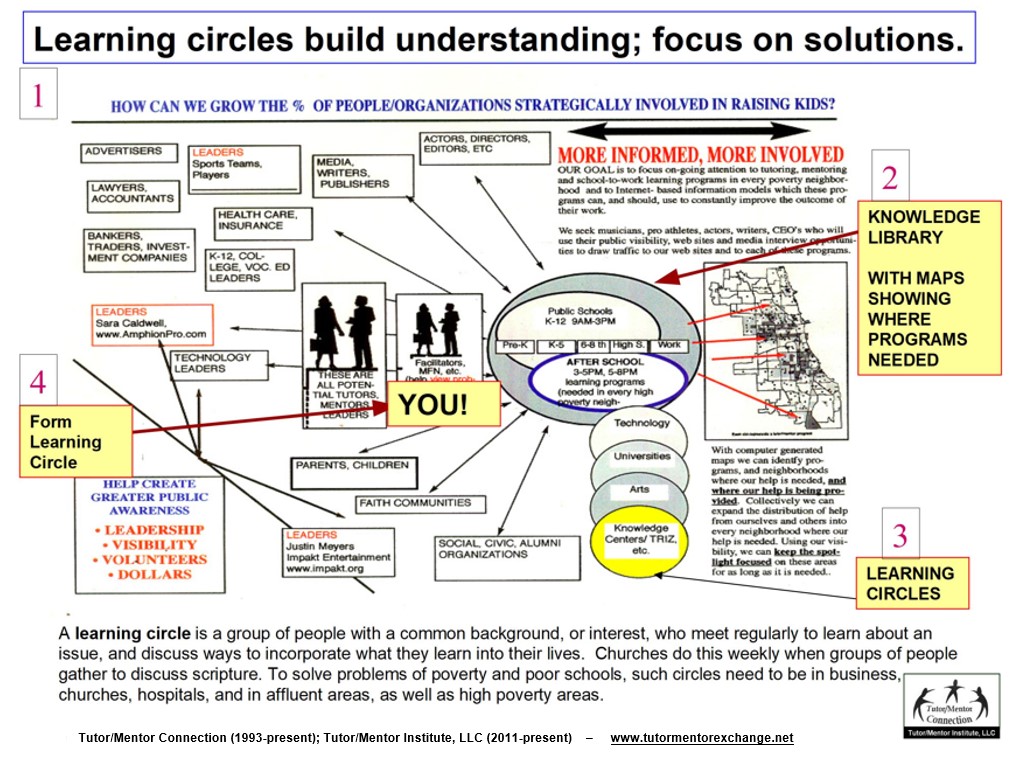
 You can become the YOU in the graphic shown above.  

Form a learning circle and read and discuss ways you can apply the ideas in this visual essay.


Thanks for reading this.  Let's connect on LinkedIn, Facebook, BlueSky, Twitter, Mastodon, etc.  Find links here.

If you value what I'm sharing, please visit this page and make a contribution to help me keep doing it.

Tuesday, August 02, 2016

What if all Black kids were succeeding in school, and careers?

Social media, telephone cameras, instant videos, etc. have combined over the past few years to bring much greater, and horrifying attention to issues of race in America. In many articles, like this one titled,The Sugarcoated Language of White Fragility", from the Huffington Post, “white privilege,” “inclusion” and “unconscious bias” as part of a deeply rooted system of racist oppression", is the focus.

I want to share three images from my library that illustrate what I've been focusing on for the past 20-30 years.

This one focuses on the 12-20 years it takes to help a youth move through school and into a job and career. It emphasizes the work needed on the ground floor, and the sequence of supports that need to be sustained. In education terms, this means "pre school through post high school".


This one asks a question: What are all the things that need to happen for this type of system of support to be available to youth in every high poverty neighborhood of Chicago and other cities?


Now here's the big question.  If this system were in place, and succeeding, and, let's say, in 2030, every Black child born in America in 2005 had finished high school, post HS education (college, vocational, etc.) and was starting a job with prospects of further growth in income and opportunities, what would the conversation about "race in America" look like then?

In many articles I've pointed to systems thinking, concept mapping, MOOCs, etc. to share ideas about building conversations and mapping complex problems and solutions. If you looked at the blueprint books for the building shown above, they would probably be several feet thick, showing many pages of detailed work.

In the concept map below I show a birth to work blueprint, but it needs much more detail at each age level.  As I talk to others, such as in the Connected Learning MOOC, #CLMOOC,  I'm trying to encourage some of them, and their students, to flesh out concept maps like this, with those needed details. And I'm encouraging them to share their map with leaders in their communities, so the strategies are adopted in many cities, not just Chicago.


I've not found a map like this serving as the blueprint a community was using to build and sustain needed supports in every poverty neighborhood, but if you know of one, please share it.

Such a map can only be created, and useful, if part of an on-going strategy, which I describe here.

Until then, my question is just a rhetorical question. We won't know what the conversation about race in America will look like under these circumstances, until we have built a system where all Black kids are moving successfully through school and into jobs.

Such a system would be helping all kids, not just Black kids....or kids living in poverty.  I hope.

However, if in 2030 and beyond all Black young people were in jobs, able to afford to live and raise their own kids where ever they want, with many in upper and top management positions in many sectors, what would the conversation about race look like?

If you're thinking about this, I encourage you to write up your thinking on a blog post, then share the web address in the comment section below.


Wednesday, August 21, 2019

Looking Back - 2006 Skoll Foundation "Profit for a Purpose"

I'm in the process of updating the web library that I host on the Tutor/Mentor Connection web site and I just opened a link to this 2006 conversation hosted on the Skoll Social Edge Forum (now an archive).

The topic was Profit for a Purpose.

I scrolled through the conversation and found that I'd posted some thoughts. They are still relevant today, so I've re-posted them below.

----------------------------

Thinking of Social Enterprise in three dimensions, not two:

Sutia,

You had many inspiring ideas in your message. One that made me chuckle in agreement was "The private sector uses the term “going concern” which implies an active, dynamic, tap-dancing state also known as survival."

I’ve led a donor-funded(non profit) organization in Chicago for 14 years and when donors ask for a report on accomplishments I always say my first accomplishment is that I’m still in business and able to continue the process of growing from good to great in the coming year. I rely on a wide range of volunteers to supplement an inconsistent flow of dollars.

When I read about the various social enterprise leaders and activities, I see innovative people finding ways to support their own vision for saving the world. The funds they raise from their enterprise support one or a few organizations that do the work they are interested in. The more successful they are, the greater their ability becomes to host forums like this, bringing others together to share ideas.

While this is good, what about the others in the world who do similar work, maybe in different places, and who have not found a way to create a revenue producing enterprise to sustain their vision? What would it take to expand the support generated by one entrepreneur for a single charity, to multiple charities doing the same work, or to multiple charities needed to solve the same problem?

Here’s my example. I maintain a database listing 200-300 organizations in the Chicago region that offer various forms of volunteer-based tutoring and/or mentoring. Each is constantly seeking dollars. Mentoring is a long term process, so each needs to find ways to keep kids and volunteers connected for many years.

Most are not running food pantries to pay the bills, and few parents have the funds to pay for services. Thus, most operate in a level of relative poverty, struggling to do good work, and still be in business at the end of each year (survival).

By providing my list of organizations via the Program Locator at at http://tutormentorprogramlocator.net/Prgloc.aspx, I make it possible for any business, college, law association, etc. who wants to make the world better by helping inner city kids connect with mentors, and move to jobs, to create a social enterprise that draws dollars, volunteers and other resources to all tutor/mentor programs throughout Chicago on a consistent basis, or to fund just one or a few programs in a single zip code, if they choose. (The Lend A Hand Program at the Chicago Bar Association is an early adopter of this strategy – https://www.lawyerslendahand.org/ )

If a few people from every industry who have been successful in making profit, point their profit and their employees and customers, to tutor/mentor programs throughout the city, there will be a better distribution of resources to all programs doing this work, and more programs will have the ability to constantly get better at what they do.

Since tutoring/mentoring alone will not solve the problems facing kids in poverty, I suggest a "blueprint" be created that shows all of the services that are needed at any time in order for a youth to reach adulthood. All of these need to be funded, just as all sub contractors on a building blueprint need to be funded. If that does not happen, the program is not successful. By only funding a few of the needed services in a neighborhood, city or country, we only address part of a complex problem, and may not really solve the problem at all. Thus funding, or social enterprise, needs to focus at multiple service providers, not just one or a few.

This is a three dimensional approach, where a) for profits choose a cause to support, and stick with it for decades; b) social entrepreneurs who have succeeded in creating a money flow point their resources at multiple organizations, not just their own non profit; and c) where non profits are able to attract and retain a higher quality of leadership who use the resources more effectively for social benefit, while also learn to collaborate with others, and market there efforts more successfully to compete for resources for the entire community, not just their own agency.

The result would be that more places where tutoring/mentoring is needed would begin to have good programs that not only survive from year to year, but begin to accelerate the rate of youth finishing school with a network of adults helping them to the next level in their lives. While my example focuses on tutoring/mentoring, I feel it could apply to any other social endeavor.

In the past couple of years I’ve sent invitations to the Said Business School, and to others in the US, encouraging teams of graduate students to adopt this approach, creating an international competition of business school teams who compete with each other to see which can raise the most money, visibility and volunteers, for tutor/mentor programs in their community. If such a competition repeated from year to year, its visibility, and impact would grow and young people would learn lessons they could apply the rest of their lives. You can read about this idea on this wiki page.

If some of you reading this would like to take a role of making this idea a reality, I hope you’ll contact me.

-----------------------------
A couple of things are obvious in what I wrote in 2006.

1) I could really have benefited from a spell check for my post.  I've found that too often to be the case when I write and type stream of conscious posts.  I'm sure that has hurt my credibility over the past 25 years.

2) The problem I was describing has not changed in 13 years since I wrote this.

3) I'm still trying to find a lead university and business sponsor to get the Business School Connection idea off the ground.

Below is a presentation describing the need for a "blueprint" and showing work that I was trying to do in past years and still seek to do as we head into 2020.


 Much has changed for me personally and professionally. Since 2011 I have not led the Cabrini Connections direct service program.  And since 2011 I've led the Tutor/Mentor Connection through the Tutor/Mentor Institute, LLC, which is no longer a 501-c-3 but now one of those social enterprises seeking investors.

Because of my age, I'm 72, I no longer seek to re-build the Tutor/Mentor Connection around me. Instead I seek a partner, at a university, or a business, or of a new group of younger leaders, who will use all that I've created and re-build it, making it much stronger and more influential in the next decade.

The Business School Connection idea is just one of many that are on the drawing board waiting for investors to help bring it to life.

I want to help make that happen while I still am able.

I'm on Twitter, Facebook and Linkedin. Connect with me in one of those spaces or introduce yourself with a comment on this blog.


Thursday, July 31, 2014

How to apply systems thinking mapping to helping kids move through school

In a number of past articles I've posted videos by Gene Bellinger, who leads a Systems Thinking network on a variety of web platforms. In a video I watched today Gene showed the history that led him to what he is doing today. I encourage you to view this.


As I looked at the first part of the video I was reminded of my own efforts using concept maps to show my history going back to 1965 when employees at the Montgomery Ward Corporation launched a tutor/mentor program in Chicago. I created this map to show history and my involvement until 1992, then this map to show the creation of the Tutor/Mentor Connection, and my involvement, since late 1992.


I'm inspired to convert many of my maps and graphics to KUMU and Insight maker and create videos to help people understand them, but unlike Gene, I've not built a network of thousands of people who are interacting regularly about ways to make youth tutor/mentor programs available in high poverty neighborhoods, or to help those programs constantly improve their impact over many years as a result of how donors, business partners and volunteers support them. In fact, since 2011 I've operated as Tutor/Mentor Institute, LLC due to changes at the non profit I had founded to do this work in 1992. It has been difficult to find talent, leaders and donors to give me the organizational strength to continue the Tutor/Mentor Connection in Chicago, led alone help similar groups grow in other cities.

Thus, I spend a lot of time talking to myself, and creating in a vaacuum.

I created this graphic a few years ago to illustrate the fact that every youth serving organization is constantly experimenting, trying to find the best ways to motivate youth and volunteers to participate, and trying to find ways to turn this into youth aspirations that lead to motivation and learning. Edison had a good amount of wealth to support his experiments. Over the years I led Cabrini Connections I struggled to find dollars and talent to do this thinking with me. Hundreds of other youth serving organizations face the same challenges.

Parents are constantly experimenting, in raising their own kids. Tutor/Mentor program leaders are also constantly experimenting trying to help the kids they work with grow up. Few of us have blueprints to follow. Few of us have the consistent funding needed.

I created this graphic to illustrate this concept. Raising kids is like building a building. We start with a blueprint (and financing) then dig the foundation. From that stage forward,with the help of teams of workers who have different skills, we build the building, one floor at a time.

Chicago and other cities needs well organized, age appropriate, mentor rich programs in all high poverty neighborhoods. However, no one has a blueprint and no long term financing exists to support the hundreds of programs needed. The thinking behind a well organized program is complex. I've not found any programs using systems thinking mapping to show their history, and steps they go through to help youth move on to college, vocational education and jobs.

The thinking behind mobilizing resources to fill a city with programs is even more complex. Once Edison invented the light bulb, he then invented an industry that enabled light bulbs to be in every home and business. He had a lot of help doing that and a lot of money to invest. I've had even more difficulty finding people to invest money in the Tutor/Mentor Connection, which is aimed at building a citywide network of youth serving organizations that work in a systematic way to help kids move from first grade to first job and on through adult lives out of poverty.

The systems thinking tools Gene has described in his videos are available to me, and anyone else who cares about helping close the gaps between rich and poor. We should find a way to use them.

I'm don't want to invest my own time converting what I've built over the past 20 years into a new way of sharing ideas. I want to do this as a collaborative project with others who focus on the same goals, or who want to carry on the Tutor/Mentor Connection in Chicago, and in other cities, in future years.

I've talked to many people about duplicating the Tutor/Mentor Connection. However, most don't really understand it. I feel that until someone actually is trying to create their own graphics, write their own blog articles, and enlist their own network in support of these ideas, they won't really understand. Until you are leading a tutor/mentor program and struggling to find the resources you need to operate, you won't fully understand how challenging, and how frustrating this is. If the Board of a non profit were writing regular articles, and creating their own graphics to illustrate the work that needs to be done, more would have a deeper commitment to strategies that support the growth of all programs, and would do more to help obtain the resources needed.

In today's video Gene said at one point "this (systems thinking and systems thinking mapping) is only important if it enables you to do something meaningful with it."

I think that foundations, researchers, businesses focusing on workforce skill development, policy makers, media and many in this country are as concerned with the education of our youth and with preparing them to compete in a global workforce as I am.

In fact, there are many who are beginning to do work in this area. Take a look at the Prezi on this page of the Kirwan Institute at Ohio State University. Take a look at the way information is shared on the Boston Indicators site. In this section of the Tutor/Mentor web library I point to many who are innovating in visual thinking.

There must be some who will invest time and talent to apply the ideas Gene is sharing to mapping and sharing the information and ideas I've aggregated over the past 40 years.

Where to start? Look at the projects interns have created to share their own understanding of Tutor/Mentor Connection. Build your own understanding by creating a map on Insight maker, or on Prezi of some other platform. Join the forum where I've coached interns, and let me coach you and your team. Of reach out to me on Twitter or Facebook, or this site, and offer financial support to help me build this network.

Monday, October 07, 2013

A New Chicago Plan - Some Suggestions

In Sunday's Chicago Tribune, readers and organizations were invited to finish the work that civic architect Daniel Burnham started over 100 years ago — "to address the imperiled livability, uneven prosperity and desperate public finances that have driven residents to leave by the hundreds of thousands." Read the article and offer your ideas.

As this 1995 article demonstrates, I've been offering my ideas for close to 20 years. In the graphics below I'll highlight a few key points.

Raising kids is like building a building. You start at the beginning, birth or conception, whichever you prefer, and work toward adulthood, and self reliance. A team of people is involved in any building project, and blueprints define work that needs to be done at each stage of the project, along with who needs to be involved.

This takes 20 to 30 years of consistent support. Building and sustaining support from millions of Chicago area residents, now and in future years, is the primary challenge that must be overcome.

The graphic below is one I've been working on for nearly 20 years. It shows a range of supports that youth need from the time they are born to when they enter jobs and careers. To me, volunteer tutors/mentors in organized non-school tutor/mentor programs are "extra adults" helping youth and families get needed resources. They are needed in areas of high poverty where families and communities struggle to make such resources available.

If you click on this link you can view the graphic. You can also click on a few of the nodes, which take you to a web library where I've aggregated links specific to that topic.

Building a solution to the problems facing Chicago, and other cities, should be considered a form of "open source" development. A web portal that enables anyone to post an idea and link it visually to a map, or a blueprint, is something I've been looking for help with for many years.

This image is a map of Chicago. The "oil well" intends to illustrate that the "birth to work" support system needs to be available in different parts of every community area of Chicago. Since poverty is now growing the suburbs, and what happens in the city affects the suburbs, this new vision for Chicago really needs to be a vision for the Chicago region.

While I've been sharing these ideas for nearly 20 years, most of the leaders in Chicago have been busy ignoring them and doing their own "problem solving". In addition to the Tribune's call for ideas, the Donors Forum has launched a platform for "Building a Better Illinois" and the Mayor's office is supporting a Thrive Chicago initiative, which does not yet have a web site.

There are dozens of different organizations focused on helping youth overcome poverty and succeed in school. Thus, one of the first challenges is connecting the different networks with each other and integrating the ideas into one collective vision, with a set of blueprints that anyone can use to support their own actions, in one or more neighborhoods of the region. This concept map points to many networks focusing on youth that I'm aware of. I'm sure there are more.

Anyone who has put an addition on their house, or built a towering skyscraper knows that you need financing so that everyone gets paid to do the work they are supposed to do. Anyone involved in non-profit work knows that finding financing to do all of the work you need to be doing is almost impossible. I was at a Philanthropy Club meeting last week where a Compass Point report titled "Underdeveloped: Challenges Facing Nonprofit Fund Raising" was discussed. I've created an entire section of articles that focus on challenges facing the non profit sector, and have recently pointed to solutions offered by creative thinkers like Dan Pallotta.

Thus, not only do we need to create a blueprint capturing the ideas of many different organizations already involved in efforts to improve the well-being of the Chicago region, we need to innovate new ways of funding this work over a period of many decades, while the city and state faces all sorts of financial challenges.

I created this slideshare essay to illustrate some of the work that needs to be done.


Here are a few additional essays on Scrib.come that I would recommend

* 4-part strategy on Scribd - http://tinyurl.com/TMI-4-part-strategy

* Planning Cycle - War on Poverty - http://www.scribd.com/doc/93233051/Planning-Cycle-War-on-Poverty

* Collaboration goals - http://tinyurl.com/TMC-Collaboration-Scribd-com

* Year Round strategy - http://tinyurl.com/TMI-Year-round

The success of the new Chicago Plan, or any other, will depend on how many leaders in business, philanthropy, religion, politics, etc. adopt the commitment shown in this strategy map and this Role of Leaders essay.


When the Mayor asks "Where on your web site do you show your commitment to this strategy? before providing a contract or favor, or when the media begin to build web lists pointing to web sites of leaders who include a version of this strategy map on their web sites, we'll begin to have the motivation and accountability needed to not only build a strategy, but to build and distribute the resources to make it work.

I've hosted a Tutor/Mentor Leadership and Networking Conference in Chicago every six months since May 1994, with the goal of bringing leaders together to innovate ways to make more and better tutor/mentor programs available throughout the city and suburbs. I've never had consistent financial support, nor have I had consistent participation from media, business leaders, political or faith leaders. Yet, I'm still sending the invitation to connect.
The next conference is Monday, November 4 at the Metcalfe Federal Building. If the ideas I've shared resonate with you, take part in the conference, or reach out to add your support to my own efforts, or include me in your efforts.

Visit Pinterest to find more graphics like those in this article. Click into the various sub categories of past articles (shown on left) to find more illustrated articles and ideas.

Tuesday, November 15, 2016

Stay Focused. Do What You Can Every Day.

This morning I listened on-line to the State of the Community presentation, delivered by leaders of The Chicago Community Trust, at a large gathering in Chicago.  The Twitter hash tag is #WhatYouDoMatters.

Last night as I ate dinner I listened to Mayor Rahm Emanuel on public radio, and followed the #Rahmtalk on Twitter.   I hope someone creates a Storyfy archive of each of these, and that you'll see how I share ideas from this blog and my archive in each.

A year ago I wrote an article titled, "Keeping Focus Amid a World on Fire"  Little did I know how much the world would change in just one year, and by the votes of nearly 50 million fellow Americans.

I've used this graphic a few times in the past, such as here,  to illustrate how I've been sharing strategy ideas for nearly 20 years, while others with greater visibility, more reputation, and more money, keep coming into this space with new invitations of joining together, connecting ideas and networks, etc.

I just keep repeating the same ideas over and over. 

Below I'm going to post a few graphics, with links to blog articles where they appeared. I hope you or others will take a look.

 After the Election, Work to Do.  I actually wrote this on November 5th, before the election.  Now that we know who will be in the White House for the next few years, it's more important than ever that many people share ownership of this graphic and take a role in helping youth living in high poverty, urban, rural or reservation, have school and non-school support systems that help them move from first grade to a job and career over the next 12 to 20 years.

This commitment has to be continuous over the cycles of many elected leaders.


Birth to Work Blueprints Needed.  I've included these graphics in many articles since I started writing this in 2005.  People who build hotels, homes, skycrapers, etc. follow a blueprint, showing work to be done from foundation to top floor.  Each page of the blueprint shows work that needs to be done by different contractors. They all need to be skilled and they all need to be paid.

We need such blueprints for solving any of the complex problems we face, and we need to find ways to generate revenue so skilled people are doing that work.   

I've created a library of concept maps that could be used by leaders in Chicago and other cities to build a comprehensive set of blueprints that show people where and how to get involved, and show a sequence of supports that need to be available in every high poverty neighborhood or zip code in the country.

I created these graphics in the 1990s and  have shared them consistently via printed newsletters, web  sites and blog articles like this one. The headline was "Cubs Win! Let's talk about building great youth support teams."

The challenge is that people are busy, foundations want new ideas, and funding generally only covers a small percent of anyone's work. 

That leads to service-learning and creating a meaningful role for involving young people.

I included this graphic in a 2015 blog article created and shared with a network of educator who were joined together via a Connected Learning cMOOC, using the hashtag of #clmooc.

I pointed to two visualizations created by interns from South Korea. In these they reviewed work done by previous interns, in an effort to draw new attention to work done in the past. You can see the visualizations here.

Today I've shown you just a few of more than 1000 articles I've posted on this blog since 2005.  You can find other articles, showing uses of GIS maps, on the MappingforJustice blog.


I created this tag cloud a few months ago, to show the different categories of articles on this blog, and to encourage people to dig into these articles and use the ideas to build and sustain systems of support for youth and adults living in high poverty neighborhoods of Chicago and other cities.

While I don't have any financial support from local or national foundations and few people helping me do this work, I think it's important and will continue to share the ideas, regardless of what disasters are demanding that I focus on other issues.

If you're using these ideas, or creating versions of  your own, please post a comment and introduce yourself and your blog or web site. Together we can do more than we can working alone.


Sunday, December 17, 2017

What Do We Need to Do to Achieve this?

As we move into 2018 I want to focus on two ideas that I've championed for more than 20 years, but without much traction or support.

This graphic represents the first:

This concept map shows supports kids need at each stage of schooling as they move from pre-school toward adult lives, jobs and careers.

Mentoring Kids to Careers - support needed for 12-16 years
We all know how architects and engineers use blueprints to show all the work involved in building a building or an airplane. Consider this concept map a blueprint for what help kids need as they grow up. Most kids have these supports naturally within their family and community. However, kids living in high poverty have fewer natural supports, or family and community wealth, thus it's up to others to help make these supports available.

Don't agree with my concept map? Create your own. Share it. We can learn from each other.

Here's the second idea. Below is a map of Chicago, created a few years ago. The shaded areas are high poverty neighborhoods.


I led a single volunteer-based, non-school, tutor/mentor program serving 2nd to 6th grade kids in one Chicago neighborhood from 1975-1992 and created a second program in 1993 to help these kids move from 7th grade through 12th grade and beyond. I led that till mid 2011. As we created the new program in 1993, we also created the Tutor/Mentor Connection (T/MC), to help our program, and similar programs throughout the Chicago area, get the resources each need to constantly improve and stay connected to youth and volunteers over a multi-year stretch.  

Since 2011 the T/MC has been part of Tutor/Mentor Institute, LLC.  Same goals. Just different funding structure. 

The T/MC started using maps, like the one above, to show where our single program was located, and to show where other programs in Chicago were located, using overlays of high poverty, poorly performing schools, and incidents of violence, or health disparities to show where these programs were most needed. Browse articles on the MappingforJustice blog, written since 2008, to see uses of maps. Click here to see a current map and list of Chicago area tutor and mentor programs.

Here's the question I've been asking for 20 years. If we know what supports kids need, and understand how organized programs help create greater access to some of these supports (like a local grocery store provides access to fresh food), then what do businesses, foundations, volunteers, donors, policy makers and others who don't live in high poverty areas need to be doing on a regular basis to  help local community leaders fill every high poverty neighborhood with the entire range of needed supports?

An engineer or an architect knows that if you leave out one or two components, like wiring for the 4th floor, or a few screws in the side of an airplane, the end product is not going to work. Without building a full range of supports for kids in every high poverty neighborhood why should we expect different outcomes than what we're getting?

While my maps primarily show Chicago, similar maps need to be created that show other cities and regions of the US....and the world.

The only way to show that you've an answer to my question is to put a map on your web site showing where you're providing resources to support needed programs in one or two neighborhoods, or an entire city, along with a concept map, or blueprint, to show all of the supports you think will be needed as each youth moves from birth to work over a 20 to 25 year period.

I've been building a web library for over 20 years with links to programs operating in Chicago and other cities, as well as links to research and to process improvement, innovation and collaboration sites. Send me links to show how you're bringing people together to discuss these ideas, or that show solutions you and others are already implementing. I'd be happy to add them to the library so I and others can learn from what you are already doing.

If you value this idea and my web library and maps, become a patron and support my work. Visit this page and use the PayPal button to contribute.