Showing posts sorted by relevance for query enough is enough. Sort by date Show all posts

Saturday, July 24, 2010

'ENOUGH IS ENOUGH' - SunTimes' front page

Once again a horrific act has moved violence to the front page of Chicago's Sun Times newspaper, with the headline "ENOUGH IS ENOUGH".

In the article Chicago Police Supt. Jody Weis is quoted saying “So I say, enough is enough. We are coming for you. We will find you, and we will bring you to justice.”

The article also quotes St. Sabina’s pastor, the Rev. Michael Pfleger, who said "it’s not enough to pray, not enough to lower flags every time an officer is killed."

How many times must we read the same headlines? How do we move beyond the prayers, marches and flag-lowering, to the research, planning, brainstorming and action steps that are needed?

On Thursday, October 08, 2009, Arne Duncan was quoted as saying, "This is the time to look in our collective mirror and ask whether we like what we see or whether we can do better together."

This is not a new problem. However, it's a problem that our leaders can't stay focused on every day, because there are so many other problems.

That's why I think it's important for another level of leaders to emerge, who are totally focused on building a better community understanding, and response, to the problems and solutions.

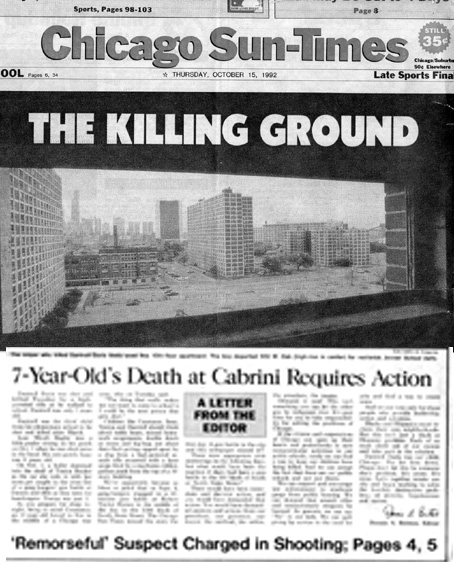
I've been issuing this invitation for the past 17 years, since we formed Cabrini Connections, Tutor/Mentor Connection, in the weeks following the shooting of Dantrell Davis in Chicago back in October 1992. I keep the front page of this Chicago SunTimes story in my office, as a reminder of my responsibility.

I've developed my own actions steps, and posted them on this blog in the past. Here they are again:

If we want to stop this violence, we have to act now, and keep acting to solve this problem for many years. We have to think spatially, that is, look at the entire city and suburban problem, not just one neighborhood. At the same time, we need to act locally, because none of us has the time, or the resources to help each of the kids in the entire Chicago region who live in neighborhoods where poverty is the root cause of the violence.

Here are some ways to remind yourself. Think of ENOUGH, is ENOUGH

E – educate yourself – most of us do not live in high poverty neighborhoods, so we only understand the root causes of senseless shootings from what we read in newspapers. We also only read negative news in the media, so we’re now really well informed on where these events are taking place most frequently. Finally, while there is a perception that there are plenty of youth programs, we really don’t have a good understanding of the distribution of different types of youth programs, to different age groups, in different zip codes. The only way this will change is if each of us pledges to spend one hour a week reading books, articles and web reports, that illustrate the root causes of these shootings, or of poor performance in schools. Through our learning we can draw ideas that we use in our own actions. We can also begin to contribute information that other people use to support their own decision making.

N – engage your network – find ways to draw others who you know into this shared understanding. Recognize people who volunteer time and talent, or who help kids through the programs they operate. If you are a business leader, or a church leader, engage your corporation or your congregation. You can use your web site, advertising, point of purchase materials, etc. to point to web sites that show all of the agencies in the city who do tutoring/mentoring, such as www.tutormentorconnection.org. If you do this weekly, year after year, your friends, coworkers and customers will become involved in solving this problem with you.

O – offer help, don’t wait to be asked. As you build your understanding of where poverty is most concentrated, and what social services are in those areas, choose a neighborhood, and reach out with offers of time, as a volunteer, talent, help build a web site, do the accounting, or offer Public relations services, and dollars, if the web site of an organization shows they do good work, you don’t need to ask for a proposal of h ow they would spend your donation, you need to send them a donation so they can keep doing that good work

U – build a shared understanding. Form groups of peers to share reading and learning assignments, just as you meet every Sunday to read passages of scripture and build the group’s understanding of the Word of God. Use the many different resources of the T/MC Links library as the starting point for your search for wisdom, and understanding.

G – give until it feels good – people who generously donate time and dollars to causes they believe in feel good about their giving. If we’re going surround kids living in poverty dominated neighborhoods with extra learning and adult mentoring networks, donors will need to give more than random contributions of time, dollars and talent. On the Bolder Giving web site donors are inspired to give to their full potential and those giving 50% or more are given recognition. Can we inspire donors who support youth services to give at this level?

H – form habits of learning, and pass these on to your kids. Imagine how much more successful teachers were if youth came to school every day asking questions about where to find information, or how to understand information they had researched on the Internet the previous day? We can model that habit if we build it into our own activity. Keep a chart, such as the OHATS on the Tutor/mentor connection web site, where you can document actions you take each week to same sure that this time ENOUGH, really means ENOUGH.

At the end of every day, look in your personal mirror and check of what actions you took. If you document actions, you can review what you’ve done at the end of each month, and each year, and begin to see a growing mountain of actions you have taken to solve this problem. Some of these will be actions that got other people involved, so that the good work you do is multiplying because of the good work others are also doing.

Through this process you help build this shared understanding, which will lead to better public policy. Without this habit of learning, and without learning to use the Internet to find good ideas from people in all parts of the world, we won’t be able to problem solve as well as we need to, and we won’t be able to teach this habit to our kids.

If we do this, we’ll not only reduce the root causes of youth on youth violence, we’ll also address one of the growing issues facing America in a global economy. We will begin to create a nation of learners, problem solvers, creative thinkers and innovators, who use learning and information as the basis of creating opportunity and keeping America great.

Read Leadership ideas here and here

Here are other articles I've written on this topic in the past few years.

Friday, June 29, 2012

Stopping Violence - Do the Planning

I wrote this article several years ago following a shooting that received front page media attention. I've repeated is a few times, most recently in July 2010. Since violence and murder are getting editorial attention again, I'd like to re-post it.

Once again a horrific act has moved violence to the front page of Chicago's Sun Times newspaper, with the headline "ENOUGH IS ENOUGH".

In the article Chicago Police Supt. Jody Weis is quoted saying “So I say, enough is enough. We are coming for you. We will find you, and we will bring you to justice.”

The article also quotes St. Sabina’s pastor, the Rev. Michael Pfleger, who said "it’s not enough to pray, not enough to lower flags every time an officer is killed."

How many times must we read the same headlines? How do we move beyond the prayers, marches and flag-lowering, to the research, planning, brainstorming and action steps that are needed?

On Thursday, October 08, 2009, Arne Duncan was quoted as saying, "This is the time to look in our collective mirror and ask whether we like what we see or whether we can do better together."

This is not a new problem. However, it's a problem that our leaders can't stay focused on every day, because there are so many other problems.

That's why I think it's important for another level of leaders to emerge, who are totally focused on building a better community understanding, and response, to the problems and solutions.

I've been issuing this invitation for the past 17 years, since we formed Cabrini Connections, Tutor/Mentor Connection, in the weeks following the shooting of Dantrell Davis in Chicago back in October 1992. I keep the front page of this Chicago SunTimes story in my office, as a reminder of my responsibility.

I've developed my own actions steps, and posted them on this blog in the past. Here they are again:

If we want to stop this violence, we have to act now, and keep acting to solve this problem for many years. We have to think spatially, that is, look at the entire city and suburban problem, not just one neighborhood. At the same time, we need to act locally, because none of us has the time, or the resources to help each of the kids in the entire Chicago region who live in neighborhoods where poverty is the root cause of the violence.

This animation was done by one of my interns after reading this article.

Here are some ways to remind yourself. Think of ENOUGH, is ENOUGH

E – educate yourself – most of us do not live in high poverty neighborhoods, so we only understand the root causes of senseless shootings from what we read in newspapers. We also only read negative news in the media, so we’re not really well informed on where these events are taking place most frequently. Finally, while there is a perception that there are plenty of youth programs, we really don’t have a good understanding of the distribution of different types of youth programs, to different age groups, in different zip codes. The only way this will change is if each of us pledges to spend one hour a week reading books, articles and web reports, that illustrate the root causes of these shootings, or of poor performance in schools. Through our learning we can draw ideas that we use in our own actions. We can also begin to contribute information that other people use to support their own decision making.

N – engage your network – find ways to draw others who you know into this shared understanding. Recognize people who volunteer time and talent, or who help kids through the programs they operate. If you are a business leader, or a church leader, engage your corporation or your congregation. You can use your web site, advertising, point of purchase materials, etc. to point to web sites that show all of the agencies in the city who do tutoring/mentoring, such as www.tutormentorexchange.net. If you do this weekly, year after year, your friends, coworkers and customers will become involved in solving this problem with you.

O – offer help, don’t wait to be asked. As you build your understanding of where poverty is most concentrated, and what social services are in those areas, choose a neighborhood, and reach out with offers of time, as a volunteer, talent, help build a web site, do the accounting, or offer Public relations services, and dollars, if the web site of an organization shows they do good work, you don’t need to ask for a proposal of how they would spend your donation, you need to send them a donation so they can keep doing that good work

U – build a shared understanding. Form groups of peers to share reading and learning assignments, just as you meet every Sunday to read passages of scripture and build the group’s understanding of the Word of God. Use the many different resources of the T/MC Links library as the starting point for your search for wisdom, and understanding.

G – give until it feels good – people who generously donate time and dollars to causes they believe in feel good about their giving. If we’re going surround kids living in poverty dominated neighborhoods with extra learning and adult mentoring networks, donors will need to give more than random contributions of time, dollars and talent.  

H – form habits of learning, and pass these on to your kids. Imagine how much more successful teachers were if youth came to school every day asking questions about where to find information, or how to understand information they had researched on the Internet the previous day? We can model that habit if we build it into our own activity. Keep a chart where you can document actions you take each week to same sure that this time ENOUGH, really means ENOUGH.

If you document actions, you can review what you’ve done at the end of each month, and each year, and begin to see a growing mountain of actions you have taken to solve this problem. Some of these will be actions that got other people involved, so that the good work you do is multiplying because of the good work others are also doing.

Through this process you help build this shared understanding, which will lead to better public policy. Without this habit of learning, and without learning to use the Internet to find good ideas from people in all parts of the world, we won’t be able to problem solve as well as we need to, and we won’t be able to teach this habit to our kids.

If we do this, we’ll not only reduce the root causes of youth on youth violence, we’ll also address one of the growing issues facing America in a global economy. We will begin to create a nation of learners, problem solvers, creative thinkers and innovators, who use learning and information as the basis of creating opportunity and keeping America great.

Read Leadership ideas here and here

Here are other articles I've written on this topic in the past few years.

Monday, December 30, 2019

Enough is Enough. Do the Planning. Build the Network.

It's time for New Year's Resolutions. I resolve to continue sharing ideas and encouraging others to use information available through the Tutor/Mentor Institute, LLC website.  I hope others read some of what I share and that you'll spend some time thinking about how your actions might lead to a world with less need to send men and women to fight on foreign soil, or to fight in our own streets and neighborhoods.

I created this Enough is Enough message in 2007. It shows actions people can take to help solve problems we face locally and globally.  The video below is from this 2007 blog article.


I repeated the ENOUGH message again in this 2008 article. Then again in this 2010 article.  Again in this 2012 article.

Again in 2015 article.

Chicago Sun-Times 1992
Again with this 2016 article.

Now as we head into 2020 and a new decade.

Anyone who looks at a media story like this can dig up one of these "Enough is Enough" articles and share it with friends, family, co-workers, faith network, college and more.

Until more people take these steps we'll keep seeing these stories.

Resolve to spend some time weekly in 2020 to take a look and share with others.

teams needed in many places

The primary purpose of the information I'm sharing continues to be to help teams of people grow in thousands of places. Such teams will use their time, talent and dollars to help long-term, mentor-rich non-school programs grow in every high poverty location in Chicago, it's suburbs, and other cities.  These programs will seek to constantly learn from each other, in efforts to help kids move through school and into adult lives.


put yourself in the blue box 
You can use this concept map to frame your commitment. Just put your photo and/or company logo in the blue box at the top. The rest can remain the same, since it shows a commitment, and set of actions, to help youth in poverty move through school and into adult lives. 

I started the Tutor/Mentor Connection in 1993 and launched it in January 1994--- 25 years ago!  I created Tutor/Mentor Institute, LLC in 2011 to provide a structure in which I could continue to keep the T/MC available.  I continue to seek contributions from others to  help fund my efforts.

If you can make a 2019 contribution, please click here and use the PayPal button. 

Thursday, October 16, 2025

After the March, Do the Planning

On Saturday, October 18th, millions of people across the USA, and the world, will be out in the streets marching to protest against the rapid destruction of our freedoms, democracy, and the rise of fascism in the world.  This link shows where you can become part of one of these "NO Kings" protests. 

They are saying "Enough is Enough!"

After the march, do the learning.  If you browse through this blog you'll see my focus is on using an "information-based problem solving" strategy to build and sustain mentor-rich non-school programs that reach K-12 kids in high poverty areas with long-term support.

I've tried to engage others in this effort for over 30 years.  Every time a negative news story appeared in a Chicago paper, I said "Enough is Enough".  In the late 2000s I listed steps anyone could take. The animation below was created a few years later by an intern from South Korea.  Take a look.


This animation was done by one of my interns after reading this article.

If we want to stop this violence against Democracy, we have to act now, and keep acting to solve this problem for many years. We have to think spatially, that is, look at the entire city and suburbs, our state, other states, and other countries, not just one neighborhood.

At the same time, we need to act locally, because none of us has the time, or the resources to help each of the kids in the entire Chicago region who live in neighborhoods where poverty is the root cause of the violence.

Here are some ways to remind yourself. Think of ENOUGH, is ENOUGH

E – educate yourself – most of us do not live in high poverty neighborhoods, so we only understand the root causes of senseless shootings from what we read in newspapers. We also only read negative news in the media, so we’re not really well informed on where these events are taking place most frequently. Finally, while there is a perception that there are plenty of youth programs, we really don’t have a good understanding of the distribution of different types of youth programs, to different age groups, in different zip codes. The only way this will change is if each of us pledges to spend one hour a week reading books, articles and web reports, that illustrate the root causes of these shootings, or of poor performance in schools. Through our learning we can draw ideas that we use in our own actions. We can also begin to contribute information that other people use to support their own decision making.

To help with your learning about race, poverty and inequality in America browse the different sections of the Tutor/Mentor library, shown on this concept map. 


It's really important to understand what drives people to vote for Trump and his enablers.  Many of the articles and websites that I point to from this concept map, provide information that will help you better understand the the problems we face.   A similar library could be created to aggregate research and articles that help us better understand what fuels support for Trump and other fascists leaders. 

Another library that is needed would be one aggregating information about immigration, and showing ways to create a legal path for people from different countries to enter the USA and seek a brighter future.  

If you host either of these libraries share a link in the comments and I'll add it to my own library.

N – engage your network – find ways to draw others who you know into this shared understanding. Recognize people who volunteer time and talent, or who help kids through the programs they operate. If you are a business leader, or a church leader, engage your corporation or your congregation. You can use your web site, advertising, point of purchase materials, etc. to point to web sites that show all of the agencies in the city who do tutoring/mentoring, such as www.tutormentorexchange.net. If you do this weekly, year after year, your friends, coworkers and customers will become involved in solving this problem with you.


This concept map shows another section of my library.  The links point to resources on collaboration, community building, innovation, knowledge management, etc.  These are skills many should learn, in order to build and sustain the coalitions needed to not only remove Trump and his enablers, but to address the root causes and social injustices that fuel voter ager and disengagement.

O – offer help, don’t wait to be asked. As you build your understanding of where poverty is most concentrated, and what social services are in those areas, choose a neighborhood, and reach out with offers of time, as a volunteer, talent, help build a web site, do the accounting, or offer Public relations services, and dollars, if the web site of an organization shows they do good work, you don’t need to ask for a proposal of how they would spend your donation, you need to send them a donation so they can keep doing that good work.

Apply the same practices to help political leaders mobilize voters, then stay accountable to them once they are elected.

U – build a shared understanding. Form groups of peers to share reading and learning assignments, just as you meet every Sunday to read passages of scripture and build the group’s understanding of the Word of God. Use the many different resources of the T/MC Links library as the starting point for your search for wisdom, and understanding.

In the concept map shown above you'll find one node pointing to concept maps that show political engagement resources.  When/IF we defeat Trump and regain control of the House, Senate, White House and Supreme Court, we need a complete revision of how people are elected and how they represent the people who voted for them, not the people who have given them tons of money. Here's one of those concept maps.

G – give until it feels good – people who generously donate time and dollars to causes they believe in feel good about their giving. If we’re going to surround kids living in poverty dominated neighborhoods with extra learning and adult mentoring networks, donors will need to give more than random contributions of time, dollars and talent.  

Political campaigns are expensive. Pick a few candidates and support them.  I do my political giving through a website hosted by Charles Gaba.  

H – form habits of learning, and pass these on to your kids. Imagine how much more successful teachers were if youth came to school every day asking questions about where to find information, or how to understand information they had researched on the Internet the previous day? We can model that habit if we build it into our own activity. Keep a chart where you can document actions you take each week to same sure that this time ENOUGH, really means ENOUGH.

If you document actions, you can review what you’ve done at the end of each month, and each year, and begin to see a growing mountain of actions you have taken to solve this problem. Some of these will be actions that got other people involved, so that the good work you do is multiplying because of the good work others are also doing.

Through this process you help build this shared understanding, which will lead to better public policy. Without this habit of learning, and without learning to use the Internet to find good ideas from people in all parts of the world, we won’t be able to problem solve as well as we need to, and we won’t be able to teach this habit to our kids.


I plan on being at the No Kings protest in Arlington Heights, Il.  I'll bring my folding chair, my oxygen tank, and my sign.  

But, I'll also be on LinkedIn, BlueSky, Twitter, Facebook, Mastodon and Instagram.  I hope you'll connect with me.

Finally, if you're able, visit this page and make a contribution to help fund my work. 

Sunday, May 28, 2017

Enough is Enough. Do the Planning. Build the Network.

Hope everyone is enjoying this Memorial Day. I also hope you'll spend some time thinking about how your actions might lead to a world with less need to send men and women to fight on foriegn soil, or to fight in our own streets and neighborhoods.


I created this Enough is Enough message in 2007. The video above is from this 2007 blog article.

I repeated it again in this 2008 article. Then again in this 2010 article.  Again in this 2012 article.

Again in 2015 article.

Chicago Sun-Times 1992
Again with this 2016 article.

Anyone who looks at a media story like this can dig up one of these "Enough is Enough" articles and share it with friends, family, co-workers, faith network, college and more.

Until more people take these steps we'll keep seeing these stories.

Friday, May 25, 2007

Memorial Day - Keeping Commitments

See Animation of graphic
Earlier this week I wrote ENOUGH is ENOUGH. A week before that I wrote about another shooting in Chicago. I've often pointed to comprehensive, mentor rich neighborhood programs as places that can surround youth with a network of adults and enriched learning opportunities, and can compete with the negative influences in the neighborhoods where the shootings take place.

I've also written that there are too few such programs, and too few leaders with a comprehensive strategy to change the availability of programs.

As you browse the internet over the weekend, I encourage you to reflect on the Tutor/Mentor Connection Strategy which I've begun to outline, using a concept mapping tool.

At the same time, consider the actions outlined below:

If we want to stop this violence, we have to act now, and keep acting to solve this problem for many years. We have to think spatially, that is, look at the entire city and suburban problem, not just one neighborhood. At the same time, we need to act locally, because none of us has the time, or the resources to help each of the kids in the entire Chicago region who live in neighborhoods where poverty is the root cause of the violence.

Here are some ways to remind yourself. Think of ENOUGH, is ENOUGH

E – educate yourself – most of us do not live in high poverty neighborhoods, so we only understand the root causes of senseless shootings from what we read in newspapers. We also only read negative news in the media, so we’re not really well informed on where these events are taking place most frequently. Finally, while there is a perception that there are plenty of youth programs, we really don’t have a good understanding of the distribution of different types of youth programs, to different age groups, in different zip codes. The only way this will change is if each of us pledges to spend one hour a week reading books, articles and web reports, that illustrate the root causes of these shootings, or of poor performance in schools. Through our learning we can draw ideas that we use in our own actions. We can also begin to contribute information that other people use to support their own decision making.

N – engage your network – find ways to draw others who you know into this shared understanding. Recognize people who volunteer time and talent, or who help kids through the programs they operate. If you are a business leader, or a church leader, engage your corporation or your congregation. You can use your web site, advertising, point of purchase materials, etc. to point to web sites that show all of the agencies in the city who do tutoring/mentoring, such as www.tutormentorconnection.org. If you do this weekly, year after year, your friends, coworkers and customers will become involved in solving this problem with you.

O – offer help, don’t wait to be asked. As you build your understanding of where poverty is most concentrated, and what social services are in those areas, choose a neighborhood, and reach out with offers of time, as a volunteer, talent, help build a web site, do the accounting, or offer Public relations services, and dollars, if the web site of an organization shows they do good work, you don’t need to ask for a proposal of h ow they would spend your donation, you need to send them a donation so they can keep doing that good work

U – build a shared understanding. Form groups of peers to share reading and learning assignments, just as you meet every Sunday to read passages of scripture and build the group’s understanding of the Word of God. Use the many different resources of the http://www.tutormentorconnection.org library as the starting point for your search for wisdom, and understanding.

G – give until it feels good – people who generously donate time and dollars to causes they believe in feel good about their giving. If we’re going surround kids living in poverty dominated neighborhoods with extra learning and adult mentoring networks, donors will need to give more than random contributions of time, dollars and talent. On the Bolder Giving web site (http://www.boldergiving.org/) donors are inspired to give to their full potential and those giving 50% or more are given recognition. Can we inspire donors who support youth services to give at this level?

H – form habits of learning, and pass these on to your kids. Imagine how much more successful teachers were if youth came to school every day asking questions about where to find information, or how to understand information they had researched on the Internet the previous day? We can model that habit if we build it into our own activity. Keep a chart, such as the OHATS on the Tutor/mentor connection web site, where you can document actions you take each week to same sure that this time ENOUGH, really means ENOUGH.

If you document actions, you can review what you’ve done at the end of each month, and each year, and begin to see a growing mountain of actions you have taken to solve this problem. Some of these will be actions that got other people involved, so that the good work you do is multiplying because of the good work others are also doing.

Through this process you help build this shared understanding, which will lead to better public policy. Without this habit of learning, and without learning to use the Internet to find good ideas from people in all parts of the world, we won’t be able to problem solve as well as we need to, and we won’t be able to teach this habit to our kids.

If we do this, we’ll not only reduce the root causes of youth on youth violence, we’ll also address one of the growing issues facing America in a global economy. We will begin to create a nation of learners, problem solvers, creative thinkers and innovators, who use learning and information as the basis of creating opportunity and keeping America great.

If you know of a tutor/mentor program operating in your neighborhood, see if it is listed in the Program Locator at http://www.tutormentorconnection.org. If not, ask the program to contact the T/MC. Together we can create a shared library of knowledge, that helps us all understand where we have enough services, and where there are neighborhoods without services.

Wednesday, September 30, 2015

Chicago Mayor says "Enough is Enough".

In response to another wave of violence in Chicago, I heard Mayor Emmanuel use the term "Enough is Enough" to show his frustration. At the left is a 1994 Chicago Tribune article where the same quote is made after a conference on violence in Washington, DC.


At the right is a 2007 Chicago SunTimes story following the killing of a Chicago youth, Blair Holt. View this news360 article, Chicago Police Commander Ronald Holt, whose son, Blair, was murdered while riding a CTA bus, says a root cause of violence is “Hopelessness. People living in poverty who have developed a ‘I don’t care’ attitude. So the slightest of things will set them off and heaven forbid they’re in possession of an illegal firearm.”.

If you search this blog, for the word ENOUGH, you'll find articles I've posted since 2007, like this one, that offers the same strategy intended to mobilize more, and more people from the entire Chicago region, in efforts that build a better understanding and deeper commitment, to the many on-going actions needed to help re-build hope in areas where this is one of the root causes of so much violence.

I've invited Mayors, media, leaders in business, religion, hospital, law firms and the entire VILLAGE to take ownership of this strategy, with limited success.

I repeat that invitation again today, with a reminder, there is no quick fix.

Tuesday, May 27, 2008

More shootings in Chicago this weekend. Same as last year.

Last May I wrote an article following some shootings in Chicago.

If this concerns you, why not come to the Tutor/Mentor Leadership and Networking Conference being held in Chicago this Thursday and Friday (May 29 and 30). Here's the web site.

If you're not in Chicago, join us in on-line forums.

Here's what I wrote a year ago as steps anyone can take to help stop the violence:

If we want to stop this violence, we have to act now, and keep acting to solve this problem for many years. We have to think spatially, that is, look at the entire city and suburban problem, not just one neighborhood. At the same time, we need to act locally, because none of us has the time, or the resources to help each of the kids in the entire Chicago region who live in neighborhoods where poverty is the root cause of the violence.

Here are some ways to remind yourself. Think of ENOUGH, is ENOUGH

E – educate yourself – most of us do not live in high poverty neighborhoods, so we only understand the root causes of senseless shootings from what we read in newspapers. We also only read negative news in the media, so we’re now really well informed on where these events are taking place most frequently. Finally, while there is a perception that there are plenty of youth programs, we really don’t have a good understanding of the distribution of different types of youth programs, to different age groups, in different zip codes. The only way this will change is if each of us pledges to spend one hour a week reading books, articles and web reports, that illustrate the root causes of these shootings, or of poor performance in schools. Through our learning we can draw ideas that we use in our own actions. We can also begin to contribute information that other people use to support their own decision making.

N – engage your network – find ways to draw others who you know into this shared understanding. Recognize people who volunteer time and talent, or who help kids through the programs they operate. If you are a business leader, or a church leader, engage your corporation or your congregation. You can use your web site, advertising, point of purchase materials, etc. to point to web sites that show all of the agencies in the city who do tutoring/mentoring, such as www.tutormentorconnection.org. If you do this weekly, year after year, your friends, coworkers and customers will become involved in solving this problem with you.

O – offer help, don’t wait to be asked. As you build your understanding of where poverty is most concentrated, and what social services are in those areas, choose a neighborhood, and reach out with offers of time, as a volunteer, talent, help build a web site, do the accounting, or offer Public relations services, and dollars, if the web site of an organization shows they do good work, you don’t need to ask for a proposal of h ow they would spend your donation, you need to send them a donation so they can keep doing that good work

U – build a shared understanding. Form groups of peers to share reading and learning assignments, just as you meet every Sunday to read passages of scripture and build the group’s understanding of the Word of God. Use the many different resources of the http://www.tutormentorconnection.org library as the starting point for your search for wisdom, and understanding.

G – give until it feels good – people who generously donate time and dollars to causes they believe in feel good about their giving. If we’re going surround kids living in poverty dominated neighborhoods with extra learning and adult mentoring networks, donors will need to give more than random contributions of time, dollars and talent. On the Bolder Giving web site (http://www.boldergiving.org/) donors are inspired to give to their full potential and those giving 50% or more are given recognition. Can we inspire donors who support youth services to give at this level?

H – form habits of learning, and pass these on to your kids. Imagine how much more successful teachers were if youth came to school every day asking questions about where to find information, or how to understand information they had researched on the Internet the previous day? We can model that habit if we build it into our own activity. Keep a chart, such as the OHATS on the Tutor/mentor connection web site, where you can document actions you take each week to same sure that this time ENOUGH, really means ENOUGH.

If you document actions, you can review what you’ve done at the end of each month, and each year, and begin to see a growing mountain of actions you have taken to solve this problem. Some of these will be actions that got other people involved, so that the good work you do is multiplying because of the good work others are also doing.

Through this process you help build this shared understanding, which will lead to better public policy. Without this habit of learning, and without learning to use the Internet to find good ideas from people in all parts of the world, we won’t be able to problem solve as well as we need to, and we won’t be able to teach this habit to our kids.

If we do this, we’ll not only reduce the root causes of youth on youth violence, we’ll also address one of the growing issues facing America in a global economy. We will begin to create a nation of learners, problem solvers, creative thinkers and innovators, who use learning and information as the basis of creating opportunity and keeping America great.

If you know of a tutor/mentor program operating in your neighborhood, see if it is listed in the Program Links or Program Locator at http://www.tutormentorconnection.org. If not, ask the program to contact the T/MC. Together we can create a shared library of knowledge, that helps us all understand where we have enough services, and where there are neighborhoods without services.

Sunday, May 16, 2021

Enough is Enough. Adopt this Strategy to Help Youth

Below is a concept map that I've shared since 2005 showing a commitment I feel needs to be made by many leaders, if we're ever going to build the comprehensive system of supports kids living in high poverty areas need to move more safely and successfully through school  and into adult lives.

open concept map - http://tinyurl.com/tmc-strategy-map

I've listened to leaders for the past 30 years who talk about helping kids, but have not found any using maps or visualizations the way architects and engineers use blueprints to create a shared vision of work that needs to be done.  Or recruiting teams of people to support youth development, tutor and/or mentor programs reaching k-12 youth in EVERY high poverty area of cities where they live and/or do business.

Or using their media and visibility to draw volunteers and donors directly to programs already operating in their cities, the way this graphic visualizes. 


It's so easy to create a video, that I challenge leaders, from middle school through senior citizen, to create a video reading this strategy map to signal their commitment. 

I created three close ups, to provide a script for what people might say in such a video.

Look at the left hand side:  Follow the lines connecting the nodes on the map, which start at the top with "my goal is".


Then, look at the right hand side, showing that the strategy recruits workplace volunteers, to support comprehensive k-12 programs, that reach youth in high poverty neighborhoods with a range of needed supports.


Look back at the top of the graphic.  The vision is achieved by following a four-part strategy, shown by another concept map. The vision is also achieved by recruiting other leaders to also adopt the strategy.


The words are there.  This strategy applies in any city where there are inequalities and wealth gaps, with areas of people living in concentrated, segregated poverty.  That means youth or adults from any city could look at these maps, then create videos, animations or other types of communication, with their Mayor, local celebrities and sports stars, CEOs, faith leaders, and community activists sharing the message and the commitment visualized in this concept map.

If enough people make this commitment, and renew it from year-to-year for the next decade or two, we might begin to have more mentor rich learning programs in high poverty areas with the on-going support each needs to hire and retain talented staff, who can attract kids and volunteers, and keep them involved as the kids move from elementary school, through middle school and high school, then on toward jobs and adult lives.

Anyone can create such videos. It would be a great time for this video to appear on social media, with leaders showing their commitment to the strategy by saying "be a volunteer" and pointing to directories of youth serving programs in their communities, which were created as part of step 1 of the four part strategy.

It's not enough to wish more leaders would adopt this strategy, we need to know who is so we can recognize them in front of their peers, as a strategy to influence more people to also adopt the strategy.  Take a look at the concept map shown below:


I'm sure you've heard the "It takes a village to raise a child" statement.  What this map visualizes are the many different stakeholders in any community, organized in clusters.  If you've looked at my concept  maps, you'll see that at the bottom are nodes linking to other web pages, or other concept maps.  For instance, at some point in the future you might click on the circle with "legal community" and open a new map, where "legal community" is the  hub and the spokes lead to the many different types of businesses and professions make up the legal community.

Ideally, if you went to their websites you'd find a version of this strategy map, featuring the company leaders, signaling their commitment.   

Below is another presentation that shows ROLE OF LEADERS who adopt the commitment shown on this strategy map.  


If you've read this far, and opened the different links under each node on the strategy map,  you'll find this 4-part strategy. These are the actions that must happen in every city for leaders to be able to keep their commitment.

Read article outlining these steps - click here

Thus, if people were adopting the strategy map, and putting a version of it on their own web sites, we should be able to put links from this village map to their pages, thus aggregating links to leaders who are making a long-term, comprehensive commitment, to help kids grow up.

If you're tired of reading about violence and inequality, then say ENOUGH, and make an effort to adopt these ideas. 


I can't do t his by myself. I need the help of many to spread the word, gather the info, update the maps, etc.  

However, if you do adopt this strategy and put it on your web site, please send me a link so I can put a link to your site in my village map, share it with the world.

If you want to act as a producer and/or sponsor and help me re-do my own versions of these videos and strategy presentations, I want to hear from you. I need your help.

You can connect with me on Twitter, Facebook, LinkedIn, Mastodon, BlueSky or Instagram. Find links on this page.

If you're able, please visit this page and make a contribution to help fund the Tutor/Mentor Institute, LLC, so I can continue to manage this information and share it with the world. 


Tuesday, February 28, 2023

Borrow from Lessons of Tutor/Mentor Connection

Does Chicago have a Master Plan for saving its kids?  Does your city? 

That was the headline of a Chicago Tribune column about the Tutor/Mentor Connection back in 1995. 

It's what I've been sharing in these blog articles since 2005.  See this "Master Plan" article and PDF in my December 2020 article. 

I offer this blog and my website as a library that anyone can use to build a strategy that helps k-12 youth move through school and into adult lives, with the help of volunteer tutors and mentors who they meet in organized youth serving programs. 

In April 1997 I was one of 10 people representing Chicago at the President's Summit for America's Future, held in Philadelphia.  The Tutor/Mentor Connection was one of 50 Teaching Examples invited to have displays and present information at the Summit.

Below is a video that we shared at the Summit. It was created with much help from Public Communications Inc, who helped form the T/MC strategy in 1993 and was our pro bono PR partner through the 1990s.  


In the video we share strategies developed in 1993 and launched in January 1994.  I've described these in many articles on this blog, but here are four collections that I urge you to spend time viewing.


From 2006 to 2015 I encouraged interns who spent from a week, to a year with my organization, to dig into the blog articles and visual essays that I had created, then build a new presentation that shared their understanding.

Browse articles on this blog to see work they did.   This is a form of learning that can be duplicated in schools across the world, where young people do the first investigation, then share what they learn with their family, friends, teacher networks, etc. If done consistently it's a strategy that engages a growing community, which is essential for any long-term, city-wide strategy to be effective.  Read more about engaging students and universities - click here.

I urge you to invite youth and volunteers in your community to do the same.  Just use maps of your city instead of Chicago.

As you do your research read the T/MC Case Statement from 1997.  

T/MC is introduced with this description

"T/MC is a network that is inventorying every community in Chicago to identify afterschool tutoring/mentoring programs. It is continuously promoting the need for tutoring and mentoring and volunteer involvement so that more programs become available in each coming year. It is providing a means of sharing successful strategies among new and existing programs and will identify and focus public attention — on a continuing basis — on the areas where tutoring services are most needed." 

Then view this Tutor/Mentor Learning Network Proposal from 1999.

In the introduction it states".....


"At this time, the biggest obstacle to involving children and caring adults in tutor/mentor programs is the need for more of the programs themselves, as well as the need for a more consistent flow of resources (dollars, volunteers, training, technology, etc.) to existing programs. While most people look to the government to provide funding for schools, non profits and all other social problems, the reality is that there is not enough public money, nor taxpayer will power, to fund all schools to the level they need, let alone fund a comprehensive network of nonschool tutor/mentor programs to the level of funding they require to be effective — and available in all of the places where they are needed.

This obstacle is compounded by an even greater challenge. The issues of big city poverty are complex.

“In an era of globalization, when knowledge and scholarship are becoming increasingly universal and universally accessible, problems, too, with all their complexity, no longer recognize borders of geography, language, time, culture, or a myriad of other factors and so they demand an integrated approach. They demand the best ideas from all of us and the wisdom to work together to see that ideas turn into actions and solutions.” … Carnegie Corporation of New York: Meeting Challenges of the 21st Century.

Most leaders, donors, corporate sponsors and potential volunteers are only superficially involved in discussions of poverty, workforce development, school reform, racism and related issues which comprehensive “total quality” tutor/mentor programs can address. Too many tutor/mentor programs are isolated. Too little infrastructure exists. There is not enough time to get all of the right people in the same room often enough to come to a deep enough understanding of the problems and the solutions that already exist.

This makes it difficult, if not impossible, to build common understanding, and a convergence on solutions which need to be sustained for the 25 years it takes for just one child to move from birth in poverty to a first step on a career.

There are about 15 million children in America who need such help. While the Internet has great potential to offer virtual meetings, and collaborative action, too few dollars are available to innovate ways to bring disconnected stakeholders to on-line meeting places (see Policy Link 2001 report titled, "Bridging the Organizational Divide").

The Tutor/Mentor Connection (T/MC) was created as a response to these needs. The T/MC is an innovative, visionary effort to build tutor/mentor programs. The T/MC is not an effort to develop a single tutor/mentor program, or even a few tutor/mentor programs, that will serve a limited number of children who are referred for services. Instead, the goal of the T/MC is to support the development of an entire universe of tutor/mentor programs that will serve low-income children BEFORE problems occur."

------ end of introduction ----- 

In the final segment of the 1997 video shared above, I summarize the work being done by the Tutor/Mentor Connection and invite others to duplicate the strategy in their community and help me build it in Chicago.

I repeat that invitation today, but with 25 years of further experience beyond what we had in 1997.  

Please read the articles I point to and others on this blog.

Share them with your own network. I'm on Twitter, LinkedIn, Facebook, Mastodon, and Instagram and I invite you to bring your network and connect with me.

If you value the ideas and resources I'm sharing, please consider a small contribution to help Fund T/MI. Visit this page to learn more. 


Wednesday, June 13, 2012

CPS Anti Violence Program Not Enough

The front page of today's Chicago Tribune featured a photo and story under the headline: Anti-violence program fails to save young Markham man. The story talked about the highly visible and very expensive Chicago Public Schools anti-violence mentoring program designed to target a small group of youth with high potential for being involved in gang violence.

For one youth, that was not enough to keep him from being gunned down in Chicago this week. The final line in the story is "He died with bullets in his head, chest and arm, and a mentor who keeps wondering what else he could have done."

In another section of today's Tribune, columnist Mary Schmich writes about Life in 2 Chicagos showing how most of Chicago area residents are safe from the violence that is a daily part of the lives of others in Chicago.

I've written about violence in Chicago in many past blog articles. I've included maps in my stories to try to focus attention on the need for a wide range of youth supports in these neighborhoods. I've created an interactive map/program locator that anyone can use to see the connection between poverty and poorly performing schools and to learn about volunteer-based tutoring and/or mentoring programs operating in different parts of the city.

This is not a new problem. However, we have never found a way to

a) bring enough people from all sectors into a learning and service process where we build empathy through our direct involvement and we build growing understanding through the on-going reading we do from libraries of research like the one I've been hosting for the last 15 years.

b)we've never found a way to keep this story in the media and in business publications on a daily basis the way fast food stores, banks and other retailers keep their products and services in front of potential customers. Without consistent advertising we can never get enough people and resources involved in all the places where concentrated, segregated poverty is the root-cause of the violence.


c) we've not found a way to make this issue important enough to business so that they would have teams of people working regularly to find ways to reach kids with volunteers, ideas, technology and jobs training programs that expand the social capital connecting youth in islands of poverty with the rest of Chicago and the opportunities these young people have in the future.

I said this is not a new problem.

This 1994 report titled Children, Families and Communities: A New Approach to Social Services, called for the creation of a system of primary supports that would reach kids before problems occur. It also called for a system of intermediaries to support the knowledge sharing and network building required.

I wrote about the CPS anti violence program in this 2009 article.

I wonder how many people who have been mentors with Big Brothers or any other tutor/mentor program in Chicago over the last 18 years have been encouraged to read this or to think of ways they could do more to help the kids they mentor than just raise money for their own non profit, or than just spend time with a kids for a few hours a week and a couple of years?

However, there's a second problem.

In his book Uncharitable, Dan Pallota talks about philanthropy as an unworkable system.

He's not the only one.

Michael Porter, a Professor at Harvard University understands that the philanthropy model does not have enough money to fund all social problem solving. Instead, he feels that "Companies must take the lead in bringing business and society back together." He describes the "principle of shared value, which involves creating economic value in a way that also creates value for society by addressing its needs and challenges."

How many volunteers who come from the business community are reading articles like this or visiting forums like this and starting conversations in their companies aimed at creating new business models that "re-imagine and re-engineer" the support systems that reach kids in high poverty with programs, services and mentoring that helps young people learn to become CEOs of their own futures even before they enter middle school?

When the Chicago Tribune puts a story on the front page and devotes another full page to the story it is investing nearly a half million dollars in printed space and message distribution. It is potentially reaching more than a half million volunteers, innovators, investors, etc.

Few non profits have millions of dollars for advertising and few public service campaigns have this type of daily impact. We need to innovate new ways to bring people together and create the advertising, team building and communications systems that support this.

If we want to solve the problems we face we need to invest in long-term learning, innovation, complex thinking and problem solving. We need to create platforms that bring thousands of people together on a regular basis and that distribute the time, talent and resources of these people to many places where help is needed.

I'm hosting a conference tomorrow at First Unitarian Church in Hyde Park and welcome your attendance. I doubt that many who attend are thinking of Shared Value or have read the 1994 report, but through this my on-going efforts I keep trying to bring more people to this information.

Few of us can meet face to face. Many of us can meet on-line. Let's connect.

Read more of my articles in the Tutor/Mentor Institute, LLC web site and in this library of articles.


Wednesday, May 31, 2023

Poverty In America. Why So Much?

In early May I watched a presentation hosted by the Urban Institute, featuring Matt Desmond, author of a new book titled "Poverty in America".  Open this link to view the video of the presentation. 


In a follow up email the Urban Institute summarized some of the key points of the webinar.  They wrote:

While no one policy is a silver bullet, Desmond suggests keeping these ideas in mind:
Then, on May 21, an opinion article in Politico, by Sheryll Cashin, a law professor at Georgetown University and author of several books on racial justice and American democracy, provided an in-depth analysis in an article titled: America’s Poverty Is Built by Design: How did the U.S. become a land of economic extremes with the rich getting richer while the working poor grind it out? Deliberately." 

I added links to Matt Desmond's website to the Tutor/Mentor Library. You can find them here, and here.

I and six other volunteers created Cabrini Connections (a site-based tutor/mentor program) and the Tutor/Mentor Connection in November 1992 following the shooting death of a 7-year old boy, in the Cabrini-Green area of Chicago.  I've used this front-page story from the October 1992 Chicago Sun-Times as a reminder and motivation every year since then.

In the summary above Desmond is quoted as saying "individual actions can build political will for larger changes". 

This is not a new problem. However, it's a problem that our leaders can't stay focused on every day, because there are so many other problems.

That's why I think it's important for another level of leaders to emerge, who are totally focused on building a better community understanding, and response, to the problems and solutions.

I've been issuing this invitation for the past 25 years, since we formed Cabrini Connections, Tutor/Mentor Connection, in the weeks following the shooting of Dantrell Davis in Chicago back in October 1992. I keep the front page of this Chicago SunTimes story in my office, as a reminder of my responsibility.

I've developed my own actions steps, and posted them on this blog in the past. Here they are again:

If we want to stop this violence, we have to act now, and keep acting to solve this problem for many years. We have to think spatially, that is, look at the entire city and suburban problem, not just one neighborhood. At the same time, we need to act locally, because none of us has the time, or the resources to help each of the kids in the entire Chicago region who live in neighborhoods where poverty is the root cause of the violence.

This animation was done by one of my interns after reading this article.

Here are some ways to remind yourself. Think of ENOUGH, is ENOUGH

E – educate yourself – most of us do not live in high poverty neighborhoods, so we only understand the root causes of senseless shootings from what we read in newspapers. We also only read negative news in the media, so we’re not really well informed on where these events are taking place most frequently. Finally, while there is a perception that there are plenty of youth programs, we really don’t have a good understanding of the distribution of different types of youth programs, to different age groups, in different zip codes. The only way this will change is if each of us pledges to spend one hour a week reading books, articles and web reports, that illustrate the root causes of these shootings, or of poor performance in schools. Through our learning we can draw ideas that we use in our own actions. We can also begin to contribute information that other people use to support their own decision making.

To help with your learning about race, poverty and inequality in America browse the different sections of the Tutor/Mentor library, shown on this concept map. 


N – engage your network – find ways to draw others who you know into this shared understanding. Recognize people who volunteer time and talent, or who help kids through the programs they operate. If you are a business leader, or a church leader, engage your corporation or your congregation. You can use your web site, advertising, point of purchase materials, etc. to point to web sites that show all of the agencies in the city who do tutoring/mentoring, such as www.tutormentorexchange.net. If you do this weekly, year after year, your friends, coworkers and customers will become involved in solving this problem with you.

O – offer help, don’t wait to be asked. As you build your understanding of where poverty is most concentrated, and what social services are in those areas, choose a neighborhood, and reach out with offers of time, as a volunteer, talent, help build a web site, do the accounting, or offer Public relations services, and dollars, if the web site of an organization shows they do good work, you don’t need to ask for a proposal of how they would spend your donation, you need to send them a donation so they can keep doing that good work

U – build a shared understanding. Form groups of peers to share reading and learning assignments, just as you meet every Sunday to read passages of scripture and build the group’s understanding of the Word of God. Use the many different resources of the T/MC Links library as the starting point for your search for wisdom, and understanding.

G – give until it feels good – people who generously donate time and dollars to causes they believe in feel good about their giving. If we’re going to surround kids living in poverty dominated neighborhoods with extra learning and adult mentoring networks, donors will need to give more than random contributions of time, dollars and talent.  

H – form habits of learning, and pass these on to your kids. Imagine how much more successful teachers were if youth came to school every day asking questions about where to find information, or how to understand information they had researched on the Internet the previous day? We can model that habit if we build it into our own activity. Keep a chart where you can document actions you take each week to same sure that this time ENOUGH, really means ENOUGH.

If you document actions, you can review what you’ve done at the end of each month, and each year, and begin to see a growing mountain of actions you have taken to solve this problem. Some of these will be actions that got other people involved, so that the good work you do is multiplying because of the good work others are also doing.

Through this process you help build this shared understanding, which will lead to better public policy. Without this habit of learning, and without learning to use the Internet to find good ideas from people in all parts of the world, we won’t be able to problem solve as well as we need to, and we won’t be able to teach this habit to our kids.


Share this post and the links I point to. Start discussions in your own circles of influence. Be the  YOU in the graphic shown above.

If we do this, we’ll not only reduce the root causes of youth on youth violence, we’ll also address one of the growing issues facing America in a global economy. We will begin to create a nation of learners, problem solvers, creative thinkers and innovators, who use learning and information as the basis of creating opportunity and keeping America great.

Read Leadership ideas here and here

6-30-2025 update - Visit the Othering & Belonging Institute and listen to a discussion of a new book titled "Structural Racism".  

Thanks for reading and sharing this article.

Find me on Twitter, Instagram, Mastodon, LinkedIn and Facebook (see links here).

If you want to help support my efforts please visit this page and send a small contribution to help Fund the Tutor/Mentor Institute, LLC.