Showing posts sorted by relevance for query impact of violence. Sort by date Show all posts

Wednesday, August 06, 2008

Mapping impact of violence on kids. Moving to solutions.

This week the Chicago SunTimes is hosting a series of feature articles to show the impact of violence on inner city kids.

In April a story titled Hidden Wounds of Violence focused on the same issue. I wrote about it here . I included a quote from the article in which a parent said "she has enrolled him in tutoring, mentoring and other programs to give him an outlet for his energy in a safe, indoor environment."

Mike Trakan, who works for the Tutor/Mentor Connection posted an article on his blog showing locations of poorly performing public schools, along with "succeeding schools" which may just be steps away from being on the poorly performing list. He overlayed this list on a poverty map, and then a demographics map, showing high concentrations of African American and Hispanic populations in the city. Mike's questioning some assumptions and asking for feedback, so I encourage you to read the article.

However, Mike's map and the articles in the SunTimes only talk about the problem. They don't talk about the availability of tutor/mentor programs, or lack thereof, or of ways businesses, congregations, media, and others could provide the manpower, dollars, technology and other resources to make comprehensive, volunteer-based tutor/mentor programs available.

Here's some maps that illustrate the problem. This map shows the location of around 140 places where a combination of volunteer based tutoring/mentoring is offered.

These programs vary greatly on size, quality and what age group they serve, but they are a starting point for any volunteer, donor, parent or community leader who wants to help kids have access to this type of support. You can see from the map that many neighborhoods have no programs. Thus, in addition to supporting existing programs, we need to be thinking of ways to start and sustain new programs, borrowing from the experience of those already in existence.

This map shows tutor/mentor programs serving high school youth.


If you compare the two maps, you see an even more critical problem. Not only are there too few tutor/mentor programs in total, but there are even fewer offering positive opportunities and mentor connections to high school youth.

We cannot compete with gangs if we don't offer programs and services in the same areas where the gangs are recruiting.

Thus, as you read the articles in the SunTimes, get together groups within your church, company, alumni network, or civic/social group and talk about ways your group can mobilize volunteers to give time, talent and dollars to support the growth of tutor/mentor programs throughout the city, or in a single neighborhood.

Use the web sites of existing programs to shop and compare and to make your choices. Use the Program Locator Zip Code map to learn what organizations operate in what zip code and to find contact information and web addresses.

Don't wait for someone else to organize such a group. At the end of the day, look in the mirror and give yourself a bit of praise for what YOU do to make this happen.

Saturday, August 08, 2009

Crime down in Chicago. What about shootings? What's the rest of the story?

Today's Chicago SunTimes re[prts that the Murder Rate is Falling . That's good news, but does it tell the whole story?

Carol Marin wrote a column last week saying, Homicides may be down in Chicago, but shootings are up. There's not a lot of good data on how many shootings there are. No good records on who was shot. Even fewer good records on who was "shot at" but missed.


What's the impact of this? The SunTimes ran a series last year titled, "Schooled in Fear" showing the impact of violence on the learning abilities of inner city kids. We created this maps, and others, showing the schools and neighborhoods featured in the Sun Times Story.

I attended a meeting in the Woodlawn area yesterday, where faith leaders, University of Chicago leaders and the principles of the nine elementary schools in the Woodlawn area met to discuss setting up a tutoring program at each school in the neighborhood. This was part of a larger vision called the Woodlawn Children's Zone, which is modeled after the highly visible Harlem Children's Zone.

Below is a map of the Woodlawn areas, created using the Tutor/Mentor Program Locator.


In my meeting yesterday I heard Bishop Arthur Brazier of the Apostolic Church of God, talk of a strategy that reaches all youth in the Woodlawn area, not just a few in a few pilot programs.

This is exciting news. If the University and the faith community use their resources to support the growth of school-based and non school tutoring and mentoring throughout the Woodlawn area, creating a pipeline of programs that reach youth from K-16, and provide mentoring and enrichment and character development, as well as tutoring and learning support, they are well on their way to combating the impact of violence, drugs and other negatives working against children growing up in Chicago.

I hope the media help them by pointing to tutor/mentor programs on a weekly basis.

Sunday, July 07, 2013

Mapping Chicago Violence. Engaging Community.

Today's Chicago Tribune devoted the front page and two full inside pages on a story showing the impact of shootings in Chicago. Included was an interactive map at http://chicagotribune.com/shootings that you can click on to understand the number of people shot in Chicago in the first six months of 2013 - 1,043.

I created a map story in April 2013, showing the areas of Chicago targeted for new corporate philanthropy, along with a map from the Tutor/Mentor Program Locator, showing areas of poverty and poorly performing schools. The goal was to engage people in strategies that provided on-going funds for youth mentoring, tutoring, learning and jobs programs in all of the neighborhoods shown on the map to be areas of need.

I updated that map today with the map from the Chicago Tribune site.

The Program Locator map and the Chicago Tribune map show many neighborhoods where youth and families need extra help. The challenge is to engage people from business, faith groups, civic groups, public health, universities, etc. in an on-going process that leads to a better understanding of the root-causes of the problem along with a better understanding of potential solutions, based on what we can learn from efforts all over the world. Furthermore, this understanding has to lead to a growth in solution providers in all of the neighborhoods shown on the maps to have a need for extra help.

This problem is not new. Finding a way to build on-going engagement of hundreds of thousands of people in the Chicago region would be new. One potential is the use of MOOCs, as described in this Harvard Business Review article, as well as in other articles I've written about MOOCs and Learning on this blog.

Just as a reminder that this is not a new problem, I encourage you to read some of these articles from the Violence section of this blog

We've heard this all before, July 2012

Teen killed in Maywood, Sept. 2011

Quelling Wave of Youth Violence, Oct. 2011

Enough is Enough, July 2010

This is a time to look in our collective mirror, Oct. 2009

Chicago Kids Victim of Neighborhood Violence, July 2009

“7-Year-Old’s Death at Cabrini Requires Action.” Sept 2008 article shows front cover of October 1992 Chicago SunTimes.

I encourage you to read this article about building networks and mapping their growth.

When you read my articles about MOOCs and Learning you'll see that I point to a library of articles that people can use to expand their knowledge. I keep adding new links to the library all the time, such as this Chicago Crime Lab page. In a MOOC we are encouraging people to dig through these links at their own pace and share what they are learning in a variety of on-line communities where they learn from others, while also building relationships with people who might work together to implement some of these ideas in more places where the maps indicate need.

Until we can find investors who will help finance the network building that leads to more people reading articles like this and engaging their friends, co-workers, family and others in understanding the information and applying their own time, talent and dollars to supporting solutions in different places ON AN ON_GOING BASIS, we'll still be reading media stories about violence and shooting in Chicago and other cities 20 years from now.

Wednesday, October 30, 2013

Covering Violence in Chicago. Covering the Solutions

Yesterday I titled my post "Does this scare you?" and wrote about the financial challenges of non profits. Last night I attended an anti-violence media forum at Columbia College, titled "Covering Violence. Covering the Solutions." It was co-hosted by Community Media Workshop. The moderator was Natalie Moore, a WBEZ reporter. Panel members included Brenda Butler of Columbia College, John Owens, Chicago Tribune, Gaynor Hall Paterson, WGN/CLTV, Chris Rudd, Mikva Challenge Juvenile Justice Council, and Juliana Stratton, Cook County Justice Advisory Council. About 50 people were in the audience. This was recorded and when I find the link I'll add it to this article.

The meeting started with a video showing emotional responses to violence. The panel members affirmed that Chicago has earned a world-wide reputation for violence. They also expressed concern that no one has found a better way to report this. When it came time to offer solutions, one panel member commented, "writers give headaches, not solutions" and "it's not a reporters job to find the solutions".

One of the final words of advice to community organizations was "Rely on yourselves to tell your own story."

This was really scary. Yet it's a fact.

One person in the audience suggested "every non profit should find time to learn how to get their story to the media." A week ago when I met with the leader of a non profit and suggested they create a blog, the response was "where do I find the time".

The panel asked for solutions. The Chicago Tribune, in a series started a couple of weeks ago, is asking for proposals for a "New Plan for Chicago". I've been providing solutions for many years. Finding more ways to get this information to the public, and to community leaders, is what I want to talk about today. I hope reporters will find time and ways to encourage others to take a look at these.

I've used this graphic often in the past to illustrate the role a single tutor/mentor program takes in connecting volunteers with youth in well organized programs. Such programs need to be located throughout the city, in all of the high poverty neighborhoods.

This graphic also shows the role of intermediaries, like the Tutor/Mentor Connection (T/MC) and Tutor/Mentor Institute, LLC.

Well organized non-school tutoring and/or mentoring programs like Cabrini Connections, Big Brothers Big Sisters, Cluster Tutoring, Chicago Tutoring, Family Matters, Highsight, and many others shown in the directory of Chicago programs that I've hosted since 1994 connect youth who need extra adult involvement with adults who help provide such support.

In the discussion of how media cover violence Chris Rudd of Mikva Challenge offered that media stories give a message to youth that "You don't matter." In my years of leading a volunteer-based tutor/mentor program one of the most important lessons is that one person in the life of a youth can say "You do matter."

If Chicago wants more non-school tutoring, mentoring, arts, youth media, technology and job-training programs available to youth in high poverty neighborhoods, the media need to be telling more stories about the challenges programs face in finding money to fund their operations. In the video leading off last night's event, Phil Jackson, CEO of The Black Star Project was a featured speaker. Yesterday Phil emailed me to say he could not bring a team to the Nov. 4 conference because his organizations is facing financial challenges, meaning they are short of cash!"

I'm no longer leading Cabrini Connections because we ran out of cash too often between 2007 and 2011. Other programs and non profits serving people in high poverty no longer exist for the same reasons.

I created this graphic many years ago to illustrate how any of us who are concerned with violence, education, racial discrimination, social justice, etc. can use our own personal or professional media to encourage the people we know to get informed, then get involved with one or more of the different tutor/mentor programs in the Chicago region.

In 1993 when we developed the strategy for the Tutor/Mentor Connection (read 1994 case statement)our goal was to increase the number of media stories about tutoring/mentoring programs in Chicago. This 1994 article announced that strategy and is one of many media stories shown on this page.
I come from a retail advertising background so in 1993 when we were developing the strategy for the Tutor/Mentor Connection, I understood that without a regular frequency of stories reaching more and more people, we never would be able to generate the awareness, understanding and motivation of the much larger network of supporters needed to provide talent, time and dollars in all of the different neighborhoods where tutor/mentor programs were operating, and where more are needed. Thus, events like the Tutor/Mentor Conference were created as a strategy to generate public awareness and media stories, as well as bring programs together to share ideas.

.
As we went through the 1990s and 2000s I realized that with virtually no money for advertising and/or PR support, my impact would be limited. I also have come to develop an appreciation of the specific needs within every on-going tutor/mentor program. One of my interns created this graphic a few years ago to illustrate the infrastructure needed in each program in order to support on-going tutoring, mentoring and learning

Due to lack of funds most programs simply don't have enough people and talent to focus on all of these functions they way larger corporations or larger non profit organizations do.

Thus, I've looked for other ways to support the growth of these programs.


This graphic represents all of the things that should be part of a well-organized tutor/mentor program. Many of these could be provided by volunteers who offer their talent to support the infrastructure of a program, in addition, or instead of, being a one-on-one tutor/mentor. Thus, accountants could offer pro-bono book keeping and financial services. Journalism students, advertising and public relations professions, including reporters, could take on the story-telling responsibility for one or more organizations. Technologists could take on web site management and tech support responsibilities, adopting all of the programs in a zip code or community area, or just a single program.

Awards could be given each year to recognize who does this well. Blog articles and news stories could tell such stories. This pdf illustrates the potential of influencing constant process improvement by recognizing the good work being done by people supporting non profit organization growth.

I'm not suggesting pro bono projects where a team builds a solution to a problem the non profit proposes, then leaves it up to the non profit to implement the solution. Those things are needed, but I'm suggesting that volunteers, and/or volunteer teams, take on this as an on-going role. Develop the solutions AND implement it!

When Edison and other inventors were creating a working light bulb they experimented thousands of times. Everyone working to reduce inner city violence and keep more kids in school and heading to jobs, rather than out of school and heading to jail, is experimenting. No one has figured out a solution that works all the time.

And one of the biggest problems is that no one has figured out a dependable way to provide "energy" to all of these places on a consistent basis. What I mean by energy is "time, talent and operating/innovation dollars".

While I've been sharing ideas like this for over 18 years, I've found that while the ideas may sound good, and I get many heads nodding approval, most people who work for a living usually can't give away their talent for free, especially on an on-going basis.

And since I've never had a Warren Buffet or Bill Gates, or even one of the leaders of Goldman Sachs, Bain & Co, or other investment bankers in my corner, I've never had the dollars to "ignite the passion" of others who might become intermediaries to provide one, or more, of these solutions.

I'm now in the process of restructuring the Tutor/Mentor Connection, to build a new non profit, with a board of leaders who do have this type of wealth and influence. At the same time, I'm looking for partners and investors to develop the Tutor/Mentor Institute, LLC, so that we could become an incubator of new ideas and solutions that provide the fuel and energy it takes for non profit organizations operating in high poverty, high violence, and high drop out areas, to innovate more effective ways to help kids move through school and into jobs and careers.

I've written a long article and most people won't take time to read it, or pass it on to others who need to be reading it. Last night's meeting ended with a "Rely on yourself to tell your own story" message.

On the We are Not Alone web site are links to videos created by young people, and organizations helping young people become journalists and communicators.

In this link you can find a variety of visualizations created by interns working with me since 2005.

In this PDF I show how maps can be created showing where tutor/mentor programs are needed, what programs exist, and what assets exist in the same zip code who should be supporting the growth of youth mentoring programs in those areas.

If we want to call more attention to solutions, and build a resource flow to make constantly improving youth tutoring, mentoring programs available in more places, teach youth in high schools, colleges and youth programs, in the city, and in the suburbs, to do the following

a) adopt a zip code or community area and create map analysis reports that you post on your own blog;

b) if you are in a high poverty neighborhood, become a reporter of the activities going on every day in the youth organizations you are part of, or write about programs in other neighborhoods, and ask why the leaders in your neighborhood are not making such programs available to you;

c) if you live in an out-of-poverty neighborhood, adopt a city or suburban zip code with high poverty, and do the same analysis. Take on the same role of telling the story.

Not only can youth, with the help of volunteer mentors and tutors, learn to tell this story on a regular basis, they can find ways to amplify the voices of others who are telling the story. The video below was done by a Tutor/Mentor Connection intern in spring 2013 to show case the work other interns had done in previous years.


At some point in the future when we look at a map of Chicago, showing existing youth serving organizations, we should be able to click into the web site of each program and find stories written or created by youth and volunteers telling why the program is needed, where they are, what they do and how others can help them.

We also should see visualizations showing the reduction in violence, drop out rates, poverty zones, and the increase of indicators showing Chicago and its suburbs being the best city in the world for everyone to raise their kids.

Journalist can give attention to these stories when they are covering bad news, or doing solution journalism. By recognizing the good work done to support the growth of youth tutoring/mentoring programs in every neighborhood, we encourage new strategies that support a community of programs working together to solve a problem, rather than individual programs competing with each other to stay alive.

It won't be so scary if this begins to happen.


Wednesday, June 16, 2010

Research shows connection of violence, academic performance

Thanks to Phil Jackson and The Black Star Project for sharing this story via their email newsletter. This study, By Deborah L. Shelton, Chicago Tribune reporter, "says academic performance suffers whether they witness the nearby violence or not" Read the full article.

One of the speakers at the May 27 and 28 conference was Deanna Wilkerson, a professor at Ohio State University, and an expert on urban violence and its impact on youth. You can find her presentation, along with those of other speakers on the conference web site. You can connect directly with her in the Tutor/Mentor Connection on-line forum.

Volunteers, in well-organized tutoring/mentoring programs, can provide a range of mentoring, coaching, tutoring and social/emotional support to help youth overcome the impact of violence in their lives, if the programs are available, and if the programs have the consistent funding to be as strong as they need to be, and to stay that way for many years.

So, if you want to do something to help kids living in inner city war zones, pick one of the programs listed on this list of Chicago Program web sites, or Cabrini Connections, and send a donation today.

If you want to know what a "well organized program looks like" browse the web sites we point to, and compare them to each other. Some do a great job of showing what they do. Others make it difficult for you to know they have a mentoring program. Look at when they were formed. The longer they've been hosting a tutor/mentor program (not how long the agency has been in business), the more likely that the program is well organized (or it would not have lasted so long!).

Some use graphics to show their strategy, such as this page on the BUILD web site and this page on the Breakthrough Urban Ministries site.

Cabrini Connections shows its Success Strategy on its home page, and shows many of the other ideas we apply, on the Tutor/Mentor Institute site.

Don't penalize programs that don't look as good as other programs. Use the ideas from all of the web sites we point to, to help each program become a world-class organization. They all need to be great, because they are all serving different kids in different parts of the city. You can see this distribution using the interactive tutor/mentor program locator.

This information was provided by the Tutor/Mentor Connection, a part of the Cabrini Connections non-profit organization. There are hundreds of questions that could be asked about the tutor/mentor programs in Chicago, based on the database we maintain, but we barely have enough money to keep the database current and share the information on web sites.

If you want to help tutor/mentor programs grow in all poverty neighborhoods, and where violence is influencing student aspirations and learning, then provide dollars to the Tutor/Mentor Connection, as well as to individual programs.

Wednesday, June 13, 2012

CPS Anti Violence Program Not Enough

The front page of today's Chicago Tribune featured a photo and story under the headline: Anti-violence program fails to save young Markham man. The story talked about the highly visible and very expensive Chicago Public Schools anti-violence mentoring program designed to target a small group of youth with high potential for being involved in gang violence.

For one youth, that was not enough to keep him from being gunned down in Chicago this week. The final line in the story is "He died with bullets in his head, chest and arm, and a mentor who keeps wondering what else he could have done."

In another section of today's Tribune, columnist Mary Schmich writes about Life in 2 Chicagos showing how most of Chicago area residents are safe from the violence that is a daily part of the lives of others in Chicago.

I've written about violence in Chicago in many past blog articles. I've included maps in my stories to try to focus attention on the need for a wide range of youth supports in these neighborhoods. I've created an interactive map/program locator that anyone can use to see the connection between poverty and poorly performing schools and to learn about volunteer-based tutoring and/or mentoring programs operating in different parts of the city.

This is not a new problem. However, we have never found a way to

a) bring enough people from all sectors into a learning and service process where we build empathy through our direct involvement and we build growing understanding through the on-going reading we do from libraries of research like the one I've been hosting for the last 15 years.

b)we've never found a way to keep this story in the media and in business publications on a daily basis the way fast food stores, banks and other retailers keep their products and services in front of potential customers. Without consistent advertising we can never get enough people and resources involved in all the places where concentrated, segregated poverty is the root-cause of the violence.


c) we've not found a way to make this issue important enough to business so that they would have teams of people working regularly to find ways to reach kids with volunteers, ideas, technology and jobs training programs that expand the social capital connecting youth in islands of poverty with the rest of Chicago and the opportunities these young people have in the future.

I said this is not a new problem.

This 1994 report titled Children, Families and Communities: A New Approach to Social Services, called for the creation of a system of primary supports that would reach kids before problems occur. It also called for a system of intermediaries to support the knowledge sharing and network building required.

I wrote about the CPS anti violence program in this 2009 article.

I wonder how many people who have been mentors with Big Brothers or any other tutor/mentor program in Chicago over the last 18 years have been encouraged to read this or to think of ways they could do more to help the kids they mentor than just raise money for their own non profit, or than just spend time with a kids for a few hours a week and a couple of years?

However, there's a second problem.

In his book Uncharitable, Dan Pallota talks about philanthropy as an unworkable system.

He's not the only one.

Michael Porter, a Professor at Harvard University understands that the philanthropy model does not have enough money to fund all social problem solving. Instead, he feels that "Companies must take the lead in bringing business and society back together." He describes the "principle of shared value, which involves creating economic value in a way that also creates value for society by addressing its needs and challenges."

How many volunteers who come from the business community are reading articles like this or visiting forums like this and starting conversations in their companies aimed at creating new business models that "re-imagine and re-engineer" the support systems that reach kids in high poverty with programs, services and mentoring that helps young people learn to become CEOs of their own futures even before they enter middle school?

When the Chicago Tribune puts a story on the front page and devotes another full page to the story it is investing nearly a half million dollars in printed space and message distribution. It is potentially reaching more than a half million volunteers, innovators, investors, etc.

Few non profits have millions of dollars for advertising and few public service campaigns have this type of daily impact. We need to innovate new ways to bring people together and create the advertising, team building and communications systems that support this.

If we want to solve the problems we face we need to invest in long-term learning, innovation, complex thinking and problem solving. We need to create platforms that bring thousands of people together on a regular basis and that distribute the time, talent and resources of these people to many places where help is needed.

I'm hosting a conference tomorrow at First Unitarian Church in Hyde Park and welcome your attendance. I doubt that many who attend are thinking of Shared Value or have read the 1994 report, but through this my on-going efforts I keep trying to bring more people to this information.

Few of us can meet face to face. Many of us can meet on-line. Let's connect.

Read more of my articles in the Tutor/Mentor Institute, LLC web site and in this library of articles.


Tuesday, July 08, 2014

82 shot and 14 killed. The war zone that is Chicago.

This is a guest article, submitted by Dan Cotter, who is Chairman of the Board of the Lawyers Lend A Hand to Youth organization, and 2014-15 President of the Chicago Bar Association. This is his opinion, and not an official statement from either of the organizations where he serves.

We must find a way to stem this violence and to create safe places and alternatives. One way to address the violence is through strong mentoring programs in our disadvantaged communities. Working as a board member of Lawyers Lend-A-Hand over the last decade, I have witnessed the impact that mentoring has on our youth.

A recent example of how powerful mentoring can be occurred at the Lawyers Lend-A-Hand to Youth Spring Awards Dinner on April 30. At the dinner, George, a young man mentored through the Urban Life Skills Program of New Life Centers, spoke of how before joining the program he cared little for anyone else. He literally described himself as a "psychopath." After working with his mentor, he has become a whole new person that "wants to give back."

George is just one example. At an awards presentation by Jeffrey Leving to Passages, we met a number of young men who anxiously await the arrival daily of its executive director. They spoke of how important the mentoring program was to them and described it as a sanctuary from the streets and violence around them.

A dozen years ago, with two young children at home, I wanted to pay it forward for the huge impact mentoring had on my life. From my first mentor, my dad, to my 8th grade teacher, Cheryl Porter, to my high school coach, John Urban, to my college coaches, Tiny Devore and Kelly Kane, to my first boss in law, Mark Wilcox, and first corporate mentor, Paul Hourihan, to my wife, Ann, I have been blessed. So many provided advice, tutoring, and friendship to me. I was beginning to competitively powerlift. I joined the two and came up with Lifting to Lend-A-Hand. In 2002, I raised $2,600. I took 2003 off due to injury but then discovered I was a line item for revenue in the LLAH budget.

The next 9 years, the amount increased each year until we raised $45,000 in 2012. Taking a year off to "allow the organization to find other fundraising avenues," I decided to give it one final push this year as I became CBA President.

Thinking of George and the wonderful work grantees of LLAH perform to provide our future with strong mentoring opportunities, I decided the goal this year would be one year's grants - $100,000. Nothing ventured, nothing gained. And think of the number of George's we can help with that amount.

It literally takes not just a village but a city, a state and beyond. You can partner with me. No amount is too small - if 5,000 people gave $20 each, we would hit it; 2,000 people at $50 each, 10,000 @ $10, 1,000 @ $100, etc. With just under two weeks to go, we are about to surpass $50,000 with less than 200 donors. Think of the alternatives if we hit $100,000. A city with less violence and more future. Please I to lawyerslendahand.org, hit donate and give what you can. $1, $5, $10. Etc. Dig deep and be part of the collective you that raises $100,000 for mentoring. Thank the mentors who have you their time, talent and treasures. Pay it forward. Yours in mentoring, grateful and thankful for the power of mentoring, The Lifting Lawyer. @lifting2014xi. Liftingtolendahand@hotmail.com.

Thank you Dan. We need more leaders duplicating your efforts.


In the editorial page of the July 14, 2014 Chicago Tribune, the final call to action says "If Chicago is to conquer this plague of violence in Chicago, the solutions have to come from all of us." The image at the left is from the October 15, 1992 Chicago Sun Times, where virtually the same call to responsibility was issued.

I've been trying to build business and political support for volunteer-based tutor/mentor programs for nearly 25 year. This image is from 1990 when Mayor Richard Daley and the CEOs of the Montgomery Ward Corporation and Quaker Oats Corporation visited the tutor/mentor program I led in Chicago. If you view past newsletters, media stories, and blog articles, you'll see a consistent call for leadership that would help mentor-rich programs grow in high poverty areas of Chicago and its suburbs.

This "it takes a village" map is one I've shared for many years, indicating that leaders from every sector need to support the growth of mentor rich programs that help youth through school and into jobs.

Had these ideas been embraced in the early 1990s, perhaps there would be fewer youth out on the streets shooting at each other.

Unless these strategies are embraced in 2014, I fear what the stories will be in 2034.

We need more people like Dan Cotter, doing heavy lifting to raise funds to support tutor/mentor programs, and using his own social media to help me spread this message.

Saturday, October 08, 2016

Climate Crisis - Environmental Racism

I've been watching the Weather Channel videos showing the progress of Hurricane Matthew through the Caribbean up through Florida, Georgia and South Carolina. While there will be millions of dollars of property loss in the US, few lives will be lost. In Haiti the death toll already is over 800.

As I watched these Friday morning, I thought of past tragedies, going back to 9/11, and of how these natural and man-made disasters have had a negative impact on the Tutor/Mentor Connection's ability to build a system of support for inner-city kids.

I've written articles in the past, where I've shown how such events make it difficult to consistently build a strong organization, or a strong movement consisting of many organizations that focus on a common problem.  This graphic shows that progress is not steady growth. There are many dips in the road. Such negative impact is probably felt by thousands of organizations in the US and around the world ever time a tsunami, earthquake, flood, or hurricane strikes.  

I recalled a couple of videos I had seen that did a great job of showing the growth of the climate change movement, and the issues it focuses on, so I am repeating two of those here.  This first video was included in an article I wrote in 2014. You can view the video in this article.


It was in this video that speakers called the climate crisis "Environmental Racism" and said "climate disruptions are a social justice issue", saying that "who gets hurt the most are poor people who can't get out of the way."

The organizers of the 2013 climate march recognized that "in order to address the climate crisis we have to first address inequalities".

Thus, throughout this video you'll see efforts to reach out to minorities, the poor, and those who are  most disadvantaged.

This second video was created in 2009 and shows how movements in the 1960's lead to a wave of legislation in the 1970s. I included it in this article.


This video describes the process of mobilizing people as a "swarm" and suggests that with the Internet it's possible to create an on line hub that could support the growth of the climate change movement.

As you look at the strategy that's proposed, visit this presentation, which shows the strategy I've been following since creating the Tutor/Mentor Connection in 1993, and the Tutor/Mentor Institute, LLC in 2011.

I did some web searching on Friday to see if I could find some graphics that showed the growth of the climate change network, or showed the different organizations who they have been connecting with.

350 0rg seems to be one of the lead intermediaries in the climate change movement.  Below is a screen shot of a map that shows different organizations working on climate change throughout the world.

I have been using GIS maps since 1993 to show where tutor/mentor programs are needed, and to show participation in conferences I've hosted in Chicago and to show participation in on-line events, like the Connected Learning #clmooc.  Maps force you to look at all the places where a problem needs to be solved, or that need to be represented in movement-building. Without a map you could fill a stadium with people who are active in solving a problem, but still be missing most of the places where the problem needs a constant flow of ideas, talent, dollars, technology, etc. to be solved.


Over the past 20 years I've also become interested in process and strategy. How does a tutor/mentor program help a youth move through school and into a job? How do we make well organized, long-term programs available in more places? How do climate change organizers map their own process toward goal? How is this being done in other sectors?

How do we visualize this?

I started creating concept maps to show strategy and to show organization's I'm connecting with, via events I attend, people I meet on line, or links in the Tutor/Mentor web library.  In many of these maps I include links, pointing visitors directly to additional maps, and/or the web sites of other organizations.

The map below is a collection of maps that focus on building networks, and creating maps to show who I'm reaching out to, and who is in my web library. 


In this map, which is a collection of several maps,  I'm trying to show that while supporting youth via non-school tutoring, mentoring and learning programs is my primary goal, it is not the primary goal of organizers who focus on different issues, such as climate change, public health, the environment, inequality, jobs, etc..  Poverty, climate change and other environmental issues are only a few of the issues included in the United Nations Sustainability goals.


I use the pie chart to visualize leaders from many sectors focusing on each issue area, including the mission of my organization. I should be able to find blog articles, such as these that use systems thinking and concept maps to engage a network of stakeholders and show strategies for achieving long-term goals of climate change, public health, violence prevention, inequality, etc.   The hub and spoke design of the wheel shows that these issues are related to each other.  The climate march organizers in the first video recognized this, saying " "in order to address the climate crisis we have to first address inequalities".

My blog articles, strategy presentations, web library, concept maps, and GIS maps are examples that not only could be used by leaders who focus on  poverty and youth development throughout the world, but by leaders who understand that to solve their problem they also need to focus on inequalities in the world, and that they, too, could be using maps like I do to show their progress, their networks and how they are connecting people, organizations and resources.

As I write articles like this I seek three responses:

a) Are there people already writing articles and creating maps like this?  If you know them, post a link in the comment section of this blog

b) Are you a writer, illustrator, mapper, etc. who can communicate these ideas more effectively than I do? 

c) are you one of those who are contributing hundreds of million dollars to every election cycle and might want to devote a few million to fully developing the Tutor/Mentor Institute as a free standing organization, or on a college campus?

If you're any of the above,  I look forward to hearing from you.  

additional reading

Note: 2/2/2017 update - here's an ESRI storymap showing impact of climate change on migration throughout the world. The is valuable resource both for understanding climate crisis, and for understanding uses of storymaps. 

4-2-2017 update - This article on the Resiliance.org web site shows that liberal approaches to climate change are just as much of a problem as is conservative denial. 

4-2-2017 update - are we facing a global extension of the human race - this writer has a series of blog articles that show this possible future.

4-15-2017 update - An Unprecedented Four Famines Threaten the Planet. - read article

4-17-2017 update - take to the streets during April 2017 and other actions you can take  - read article

6-19-2017 update - Atlantis Rising: Why Floating Cities are the Next Frontier - see video

6-26-17 update - Deadly Heat Waves Likely to Get Worse - read article talking about affect of extreme heat.

7-9-17 update - analysis of economic impact of climate change in the US - read article

7-10-17 update - This article, titled The Uninhabitable Earth, describes coming climate disasters facing the world.

7-17-17 update - The Climate-Smart Cities program at the Trust for Public Land is helping cities overcome challenges to successful climate action. Read article.

8-30-17 update - The Texas Floods following Hurricane Havey have generated several new articles worth reading.  1) Public Service Media Warned of Texas Catastrophe. Still time to learn (article). This points to a 2016 series titled "Hell and High Water" ;  2) How catastrophe affects most vulnerable people most. article; and 3) library of ESRI story maps showing flooding in Texas and around world. A second page showing ESRI story maps - click here

11-11-17 update - Here's a group that draws attention to climate change with music. It's called The Climate Music Project. click here

11-13-17 update - #Decarbonize #Decolonize  describes itself as "worlds largest synthesis of youth research, recommended policy and action on climate change". Is mobilizing youth from across the planet.

2-27-18 update - Welcome to the Age of Climate Migration - Rolling Stone article. As some areas become unlivable the wealthy will move to more climate friendly cities, causing prices to rise, driving out the poor. Those without the money to move will suffer greatly.

5-16-2018 update - The Shape of Water - Chicago Magazine article forecasting a future for Chicago and the Great Lakes water basin. click here

6-21-2018 update - How Tackling Climate Change Could Tackle Inequality - read article

7-9-2018 update - Nicola Avery, from UK, posted blog article today with a collection of climate change links. Add to your reading list. click here

9-3-2018 update - Planetary Health Alliance - article with many links to additional resources - click here

10-12-18 update - Interactive map shows projected changes in rainfall and snow by 2050 in communities across the world.

10-17-18 update - Popular Science magazine article titled "The most important science policy issue in every state" - click here

11-16-18 update - List of natural disasters in the USA since 2000 - on Wikipedia. What's important to understand is that people in past disasters are probably still trying to rebuild their lives, even after many years. 

3-6-19 update - Project Drawdown claims to be "the most comprehensive plan ever proposed to reverse global warming".  The site includes a list of 100 most substantive, existing solutions to address climate change -   click here

3-6-19 update - WASH Funders by Candid - web resource focuses on water issues around world. Includes a funders map, too. click here

8-1-19 update - "Migration and the climate crisis: the UN’s search for solutions" - article 

10-25-19 update - Global Chaos Map Project - this project is building a map to help understand where in the world environmental and political stress is leading to violence.  Click here to read article.   Click here to the Chaos Map Project site. Click here to view the interactive map.

12-18-19 update - America After Climate Change Mapped - click here

2-3-2021 update - Now's the Time interactive map shows oil, natural gas, coal, wind and other energy production and distribution resources from around the world.  For those advocating for movement away from carbon based energies this site should be a useful tool.  This is website with overview. 

2-3-2021 update - Climate Justice Alliance - Here's description from website: "Climate Justice Alliance is amplifying the leadership of the original Our Power Communities while expanding to 70 communities in seven regions that are home to key grassroots groups. These groups organize to end the era of extreme energy and implement a Just Transition that promotes local control of resources (including energy, land, water, and food systems)." 

2-3-2021 update - Extinction Rebellion Chicago (XRC) - a growing group of activists formed in 2019 to demand, through creative and non-violent direct action, t hat the government act now to stop climate catastrophe.

2-4-2021 update - Mapping Environmental Justice in the Biden-Harris Administration - click here ;  Mentioned in the article is the CalEnviroScreen. This link points to a Disadvantaged Communities Map (California). 

2-24-2021 update - Is your house going to flood because of climate change? These maps will tell you. - read article 

3-6-2021 update - Mapping Project Explores Links Between Historic Redlining And Future Climate Vulnerability - click here

Tuesday, August 30, 2016

Building Mentor-Rich Programs in High Violence Neighborhoods. Let's Talk.

Since the mid 1990s I've created map-stories like the one at the left, showing neighborhoods featured in media stories following incidents of violence. I've shown locations of non-school tutor/mentor programs, if any, that operate in the map-area, and I've listed some of the businesses, faith groups, universities, hospitals, etc. that also are located within the map area.

All of these groups should be meeting regularly to innovate ways to fill the area with a wide range of k-12 tutoring, mentoring and learning programs.  Obviously that's not happening.

The goal has been to dramatically increase the flow of dollars, talent, volunteers, technology, ideas, etc. directly to all of the different youth serving organizations throughout the Chicago region, so each could constantly improve its impact on youth and volunteers.  My efforts have been too little to have the impact needed, but I've continued this effort using what talent and resources I've been able to mobilize.

That's the point of this and many of my articles. We need to keep trying until the problem is resolved.

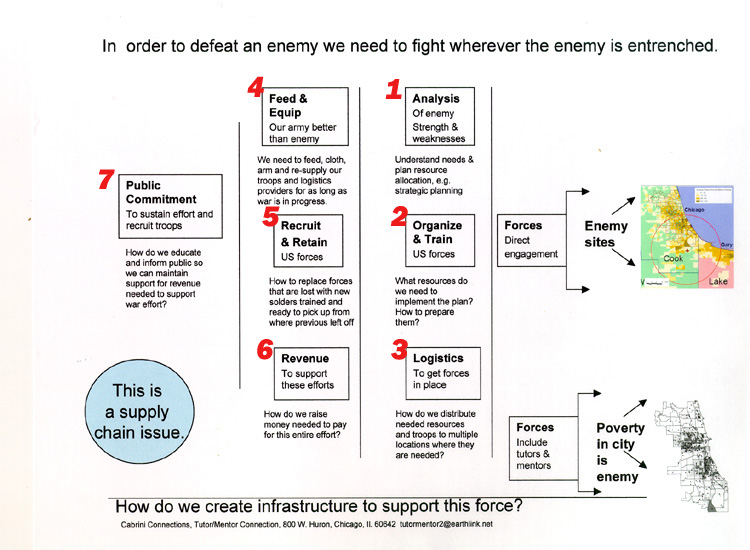
Below I show another graphic, this time describing a planning process, that I feel needs to be taking place in many different organizations and businesses throughout the Chicago region, and in other cities..

Looking at the maps at the right, you can see the goal of filling high poverty neighborhoods with needed programs that help kids move safely through school and into jobs and adult lives. If this system were in place there would be fewer young people turning to gangs, and the violence that goes along with this.

Step 7, at the far left, focuses on "building public" will,
which is the involvement of public and private sector members in the planning process, and action steps, that would grow the number of high quality youth supports needed in every poverty neighborhood.

Part of this process involves bringing together a team of people with a mix of talents who will lead this process.  Keeping that team together, and growing, is one outcome of successfully building public support.

Major challenge: Attracting volunteers into neighborhoods with high violence.

When I led tutoring programs at the Montgomery Ward complex on Chicago's near North area, across the street from the Cabrini Green Housing Complex, many potential volunteers would ask me "Is it safe to come to the program site?"  I would respond, "Wards has nearly 3000 employees here every day.  Yes. It is safe."

Between 1975 and 1992 that program grew from 100 volunteers participating weekly to over 500, who came from companies throughout the Chicago region.

However, that location was near the Chicago LOOP and surrounded by neighborhoods where thousands of potential volunteers lived and worked. It was easy to get to on a weekly basis.


This map is one we created in 2008 showing high poverty areas in Chicagoland, known non-school tutor and/or mentor programs, access routes into the city to the downtown LOOP work area, and universities with locations in different parts of the region.

Attracting volunteers into neighborhoods on Chicago's far West side and middle and far South side, where media stories report innocent people being killed as they walked the streets, requires a much more difficult set of conversations and solutions.

We need to be having that conversation.  

It needs to be taking place in many organizations, located as far West as Elmhurst, as far North as Lake Forest, and as far South as LaGrange.


This graphic illustrates how groups of people with something in common (technology, marketing, consulting, medial careers, etc.) or who are part of the same organization (alumni group, business, hospital, etc.) need to be looking at information showing where and why tutor/mentor programs are needed, and web sites of existing programs, then innovating ways to support the growth of mentor-rich programs in high violence, high poverty, neighborhoods throughout the Chicago region.

These groups need to be using maps to focus their attention, and resources, on the different poverty areas of the city and suburbs. Browse 2008-2016 articles at the MappingforJustice blog to find map resources and ideas.

I don't know the answer to this challenge. I do know that unless more people are asking the question and looking for solutions, we'll never have enough mentor-rich programs reaching k-12 youth in all of the neighborhoods getting media attention for the wrong reasons.

Related links to this article:

*  Planning Process - click here
*  Four Part strategy - click here
*  Virtual Corporate office - click here.
*  Shoppers Guide - what should you see on youth orgs web site? click here
*  Total Quality Mentoring - ideas mentor-rich program design - click here
*  Map of Tutor/Mentor Web Library -  resources available to support the planning process. click here

I'd be happy to head your or your group through this information and help you launch your planning process. 


Wednesday, January 23, 2019

Impact. Nudging the Network. Takes Time.


I created this graphic in 2011 to illustrate how my daily actions intend to influence actions of others.  The challenge is, that unless others tell me what they  have done with what I share, I can't tell you what impact I've had. And while I've multiple pages of "thank you" notes, these don't share very easily.

So  here's an example of a recent set of interactions.


On January 20, I posted a blog article that included a set of maps, under the heading of "How I'll Honor MLKing Jr Holiday".

The maps at the left show Opportunity Zone areas on the right, and demographics of Chicago on the left. Other maps showed indicators of need for investment in these areas, based on violence, poverty and health disparities.

Click to view Tweet
Then, when I opened my Twitter feed the next day, Jan 21, I saw this post from Terry Elliott, a college professor in Kentucky, whom I've gotten to know over the past five years through the Connected Learning on-line community. 

I have written often about the #clmooc community because of the way they connect and share ideas, and because I feel it's a model of connected learning that the non-school ecosystem could borrow.   Here's a reflection on my past connections with #clmooc that I posted at the end of December 2018.

In Terry's Tweet he said "If you are looking for a way to honor MLK day, read this post from a man who has dedicated his adult life to working with and for Chicago youth" read this article and add your comments using the Hypothes.is annotation tool.

Open this link to read and add comments
Using on-line annotation is just the same as using a yellow highlighter to mark up a book you are reading.  I do that all the time. And I write comments in the margins.  Unfortunately, no one else sees what I've deemed important via my highlights and comments.

Using the on-line annotation tool, multiple people can read and comment on the same article. The margins become a second, even a third, conversation.

In this graphic I show how Terry embedded a video, then Kevin Hodgson, a teacher from Western Massachusetts, who is also a #clmooc mainstay, added a graphic from my collection, saying "This sounds like your mission statement, Daniel".

If you follow Kevin and Terry and others from the #clmooc network on Twitter, and read their blogs, you'll see a constant exchange of ideas, moving from one platform to another.  Their interaction in this annotation is just one of many that I've followed and joined. I've built a list of blogs I follow using Inoreader, which I learned about from Terry. You can see the CLMOOC list and others in on this page.

Read Sheri's article
That's not the end of the story.

At the right is a screen shot of a blog article written by Sheri Edwards, another #clmooc educator, who is a retired teacher living in Washington State.

Sheri posted a screen shot of the Tweet from Terry, then she wrote:

As I read the post, I considered the poverty issues in my very rural area, near a large Native American Indian reservation. I began searches for information, and this search path occurred like this....

The rest of her article describes her search, some dead ends, and shares links to information she found.  She then joined in on the annotation of my article and shared what she was doing and what she was learning, in the margins.

Sheri did exactly what I hope many, many other people do. She started building an information base, focusing on a geographic area she was interested in. 

And she used Twitter to share what she was doing.  Thus, I have a piece of evidence to show impact of the work I've been doing.


Then, Wendy Taleo, an educator from Australia posted this Tweet, telling of her involvement with the Smith Family mentoring program in Australia.

I did not know any of these people in 2013 when I joined the first Connected Learning MOOC.  It has taken a consistent effort on my part to build these relationships, and to apply some of the ideas I was learning in the work I've been doing.

And #clmooc is just one of many on-line communities that I follow in an effort to seek ideas and share information. This concept map shows just some of them:

View the map, and open links under each node
And....

Sheri, Kevin, Terry and a few others from #clmooc and my Twitter network made financial contributions to support Tutor/Mentor Institute, LLC last year, which to me is another piece of evidence that shows I'm having some impact.

Why is this important?


Often in recent months and past years people have questioned the impact of the Tutor/Mentor Connection (T/MC), formed in 1993, and Tutor/Mentor Institute, LLC, formed in 2011.  It's a difficult question to answer.

First, that's because Chicago is a huge city, with many different power bases. We started the T/MC in 1993 with no money, but an  understanding of the need for well-organized non-school tutor/mentor programs to be located in every high poverty area of Chicago, and a need to draw more consistent flows of attention and resources to every program in order for this to happen.

Second, I've never had much money to do this, especially since we were also operating our own growing tutor/mentor program serving teens grade 7 to 12, living in Cabrini Green and other high poverty areas of Chicago. Since 2011 when I formed the Tutor/Mentor Institute, LLC to keep the T/MC alive after the strategy was discontinued by the Board of the non profit I had been leading, I've had almost no money and have covered expenses from my own savings.

Finally, others have continued to enter the space where the T/MC was operating. Instead of saying "We see what you're trying to do; can we help you?" many have ignored that the T/MC even existed and have created their own organization and strategy to help kids succeed in school, but never with all the components that the T/MC put into it's own on-going strategy.

Thus, I've used what we had available (talent, dollars, ideas, etc) in any given year to try to collect, organize and share information, then motivate more people to  use that information to support various tutor/mentor programs in Chicago, including our own.  This strategy page shows four actions that I've repeated over and over, for 25 years.

I created a Google doc a few weeks ago to show a few more of these interactions.  I hope you'll take a look.  If you're interested in learning more, here's a PDF summarizing work done from 2000 to 2010 when I was leading the Cabrini Connections youth program as well as the Tutor/Mentor Connection.

Then, I invite you to add your own contribution to support my effort, or reach out to explore how you could make a major commitment and help rebuild and re-energize all of the work that I've been doing for 25 years.

If more people use these ideas, and more people provide resources to do the work, we can help youth in more places have mentor-rich support systems that help them move through school and into adult lives. That's a huge, huge challenge, but worth the effort.