Showing posts sorted by relevance for query pallotta. Sort by date Show all posts

Sunday, March 24, 2013

Bono, the Pope, Pallotta, Poverty & Data

I apologize for another long post. However, I’m trying to tie several streams of thought together. I hope you’ll follow and add your own thinking.

Last Sunday I read an article in the Chicago Tribune titled “Pope wants more focus on poor.” I’ve been working on a story about this all week.

Then today I saw this TED talk, where Bono talks about data and facts and ending extreme poverty.


If you’ve not been totally absorbed on your NCAA Basketball Brackets, you’ve probably read about the new Pope and his commitment to “walking the talk” when it comes to setting an example for other Catholics and people of faith.

While most people probably have read or listened to something about the new Pope, I suspect most have not been having a soul searching discussion about philanthropy and how the system of charitable giving does too little to support social sector organizations serving the poor and addressing complex environmental, social and health problems that plague the world.

I posted an article a couple of weeks ago about Dan Pallotta’s TED talk, titled The way we think about charity is dead wrong. That TED talk has stimulated a number of discussions on social media space. I’m part of three on Linked in, such as this one.

In one Linkedin post the writer compared the challenges of changing how charities are supported to the challenges facing the new Pope, saying:

This good debate here over definitions defining our entire industry does not hold a candle to the thousands-years-old debate in the church. Just these two NYT articles today about the power-grabbing intrigue in the Vatican ( http://www.nytimes.com/2013/03/19/world/europe/pope-francis-faces-an-entrenched-curia.html?hp ) and the perceived goals of the new pope ( http://www.nytimes.com/2013/03/20/world/europe/installation-of-pope-francis.html?hp ) mirror our debate here.

Bono’s TED talk describes the 3000 year old fight against poverty. He’s fighting the same fight as the POPE, but on a different battlefield. It’s the same fight Pallotta is fighting. It’s the same one I’ve been fighting for nearly 20 years.

When BONO talks about using data he does not mention the most important asset he offers to the war on poverty, which is his own celebrity visibility. He’s been blessed with the ability to draw the attention of millions of people, wealthy and poor. When Pallotta talks about lack of advertising available to social sector organizations, he is describing how so few organizations have the celebrity power of Bono, or the POPE, to attract and educate donors and keep them focused on their work for dozens of years.


When BONO talks about using data he uses charts and graphs. I want to see him using , geographic maps, showing at the zip code level where extreme poverty, or extreme gaps between rich an poor, are most concentrated. I’ve used maps in many articles to propose a marketing strategy that engages people from every Catholic Church in the Chicago region in on-going efforts that help existing volunteer based tutor/mentor programs get the talent, technology, operating dollars and ideas each needs to constantly improve what they do to connect youth and volunteers and transform the lives of both.

In addition, when BONO talks of using data, I hope that the collection of data, and responses to BONO’s outreach, will lead to web sites that visually map all of the issues that contribute to extreme poverty, or extreme disenfranchisement. The pie chart shown on this Glasgow site is one example of how this might be done.


The Internet has created the ability to mine data from all over the world, and for teams of design and visualization engineers to create concept maps, like the one above, that shows the range of age-appropriate supports kids need as they move from birth, through elementary school, high school, post high school and into jobs.

Similar maps could show how fighting disease in a poverty area also needs to be combined with concurrent efforts to fight corruption, improve education and technology access, and create jobs. If you’re building a skyscraper, every page of the blueprint show skills needed to complete the work described on that page. Everyone needs to be paid and have the highest level of skills. If we think of ending poverty as we do of building a new hotel, what are all the skills needed at different stages of the project?

Maps like this can be interactive, animated, three-dimensional, and connected to data libraries that a) include research that provides a better understanding of the problem, and potential solutions; and b) links to web sites of organizations in different places that are working to provide a solution, but work with limited resources in many cases.

This is where both Bono, the POPE and Pallotta’s TED talks intersect. Bono and the POPE provides celebrity power that is far greater than what Dan Pallotta or most of the rest of us in the social services sector, can generate. While Pallotta’s TED talk has received over 1 million hits, stimulating discussions in many places, how will this be sustained, expanded, then turned into actions that improve the flow of resources to thousands of places?

Who is talking about this?

Bono talks about ending poverty by 2028, and talks about the inertia that might prevent this, or the momentum that might make it a reality. The articles about Pope Francis show that efforts have been made to reform the Catholic Church for centuries, with little success.

If Bono and the Pope and other leaders were to build map-based data bases, and concept maps, that work like blueprints to show work that needs to be done in many places on an on-going basis, they could draw more consistent attention to the problems with philanthropy that Pallotta describes.

As I’ve written these articles I feel that I have three mountains of obstacles to overcome.

1) Donors, businesses, public leaders and individuals are already doing a lot to try to help youth and families living in poverty. Thus, asking them to do more, which is what the POPE is asking, meets a lot of resistance.

Pallotta’s message is that unless we find ways to draw more resources into social sector organizations, so they can innovate, hire and retain the best talent, experiment and even make mistakes that they learn from so they can get better at what they do, we’ll continue to not achieve our long-term goals of helping kids born in poverty live adult lives out of poverty because of the help they have received from birth to work.

2) If you’re already a secure, well funded non profit, who is challenging you to do more than what you are doing? If no one is advertising, or trying to educate the public so they can look at an organization's web site and make a judgment as to whether or not the organization deserves financial support, how can we move beyond superficial measures, such as money spent on "overhead"? If no one is aggregating information and web links pointing to organizations doing similar work, how can you benchmark yourself against what others are doing, to see where you can improve? What’s your motivation if your donor base is constantly giving you money because of your history and reputation, or the names of the people on your Board of Directors?

3) If we don’t map where the need is for social services, and where existing services are located, with information that maps categories of organizations serving similar population, we won’t know if the money we are spending is reaching all of the people who need that help. We could fill every NCAA Tournament Basketball stadium with fans, or fill a football stadium for a visit by the Pope, and still not have people from every poverty neighborhood represented.


This graphic shows the role of intermediaries who connect people who can help (volunteers, donors, idea generators, etc.) to organizations in places where help is needed. If the Pope, Bono, Pallotta and thousands of others use their daily visibility to draw people to information that shows where and why they are needed, and motivates them to give time, dollars, talent, etc. they can continue the momentum Bono describes and provide the advertising support and resource flow that Pallotta describes, to all of the places where the poor live in need of extra help.

I’ve posted articles like this on my blog and web site for 15 years with the goal that someone in the Vatican, Bono’s team, the Mayor’s office, etc. would read them and bring them to the attention of these leaders, so they can add the ideas into their own leadership efforts.

As I build a library of content on sites I host, I point to sites with additional ideas. Over the past few years I've written more about network building, learning and point to virtual events such as the Education, Technology and Media MOOC, ETMOOC which demonstrate how thousands of people could be connecting, sharing ideas and innovating ways to reach people in high poverty with resources that aid youth and families in overcoming the challenges they face.

I won’t be alive in 2028 to see if Bono's dream comes true, but these ideas can be if you read, reflect and share them with others.


Wednesday, August 07, 2013

Pallotta TED talk. Discussion. Solutions.

In 2011 when I first read Dan Pallotta's book, Uncharitable, I created a concept map to outline the chapters. After his TED talk in spring 2013 I updated it with links to places on the Internet where this is being discussed. After attending a Chicago Philanthropy Club meeting today where this was discussed, and after participating in a Philanthropy MOOC where this is being discussed, I updated it again.

This time I added a recommendation that this discussion be broken into sub-sections, based on the topics Pallotta listed in his TED talk. These are shown in the graphics below and in the concept map. When lots of people are talking about these issues we have too many different conversations going at once. By breaking this down into sub topics, perhaps we can gain some greater understanding of the problem and potentially move toward some solutions.


However, I want to go a step further. I think that when discussing overhead and the issues Pallotta is talking about we should break into sub groups so we are framing the discussion around specific types and sizes of non profit and social benefit organizations. Within each of the pie chart categories we should talk about organizations with budgets under $500,000, budgets under $1 million, budgets under $5 million, and organizations larger than $5 million. Others might suggest different budget sized, but the point is, small organizations don't pay salaries of $100,000 or larger or have departments doing fund raising, marketing, human resources, etc. In many cases one or two people do all of these jobs.


In addition, I think it's important to talk about where the charity is located. It costs more to operate in a big city than it does to operate in a smaller community or rural area. Different types of social services have different organizational strategies for achieving their mission. Some need to rent or own space. Others can get donated space. All of these factors make the topic of compensation, talent, advertising and marketing, etc. have different meaning when applied to different types of organizations and locations.

Finally, when there are 30 or more people in a room it's almost impossible to give everyone a chance to talk, or to express complex ideas that outline a person's understanding of this problem, or their ideas for a solution. I've been writing about MOOCs where 500 to 1500 people are given the opportunity to express their ideas in organized discussions that take place on the Internet and stretch over a period of weeks. One taking place right now is hosted by the Learning By Giving Foundation, headed by members of Warren Buffett's family.
I think that these types of on-line communities can draw together a much larger group of people than we can get together in any conference, and can give everyone a chance to talk. I think they can build in facilitation, network analysis, participation mapping, and do much more to help people who share a passion for the same cause to connect and innovate ways to solve the challenges Dan Pallotta raises. Maybe the solutions won't be what Dan is proposing. Maybe they will be ideas we never would have heard about if we did not make it possible for people who have no public status, not wealth or celebrity power, no elected position, etc. to express ideas that they have researched or developed through their own experiences.

If you're already hosting this type of discussion please post a link in the comments section so I can join you and the others who read this blog can also join you.

Wednesday, November 09, 2011

If we keep doing the same thing the same way...

"Insanity: doing the same thing over and over again and expecting different results." Attributed to Albert Einstein.

I've been writing this blog since 2005 and I've been trying to help volunteer-based tutor/mentor programs grow in the Chicago region since 1993 when I created the Tutor/Mentor Connection.

Over the years I've developed a strong belief that traditional "beg for gift" philanthropy is an ineffective way to generate the continuous flow of resources and the high levels of talent needed to operate a single tutor/mentor program, let alone enough to reach 20-30% of the kids living in high poverty neighborhoods of Chicago.

When we launched the Tutor/Mentor Connection our goals were

a) create information about existing programs, where they were needed, what they do, how they differ, who funds them, etc.

b) dramatically increase the number of people looking at that information

c) activities that help people understand the information

d) efforts that lead people to become volunteers, donors, leaders, etc. in each of the different tutor/mentor programs operating in Chicago

While I've had many people give positive feedback I've not found philanthropic investors to provide the capital needed to build organizational strength that would make what I was doing as effective as it needs to be. Part of that was because of an inability to keep donors involved for multiple years. Part of that was due to not having volunteers with enough civic reach involved in this effort. Part of it was not having the resources for advertising and public awareness.

I started following the blog articles written by Dan Pallotta a few years ago. I have a link to them on this web site. I saw references to a book he wrote titled "Uncharitable" but I never had time to read it until I picked it up at the library a couple of weeks ago.

I'm not completely through but in reading it I can see many reasons why I've not been able to find the financial and leadership support I've needed for the past 18 years.

If you have read my blog articles you see I point to the ideas of other people via web links and blog exchanges. The first commitment of the T/MC was to "collect ideas created by other people and to try to get greater circulation of those ideas so more people understood them".

I don't need to originate an idea. If it's good, I just need to find ways more people will look at the idea and try to understand it.

I think Dan Pallotta has some good ideas. Some are so controversial that they can keep you from thinking through some of the other ideas. That's why I've created a map of the chapters of the book. While you're having difficulty getting past some of the first ideas you need to be thinking of some of the other ideas.

So as I'm still moving through the last chapters of Uncharitable I'm saying "How can I help more people begin to read and reflect on this book" so that over a period of years we might build a sub-culture of people who think differently and act differently.

We don't need to change everyone. We need to change a small percent of everyone.


I've not dug into this deeply so if you know of people who are doing what I'm describing, please post a comment and share a link. In his book Pallotta sort of bashes religion for some of their practices regarding charity.

Yet, I think that if someone were to take the various sound bytes out of Dan's book and create a 52 week lesson plan, it could be connected to the 52-week lesson plan of any faith group and included in weekly discussion groups just like people read a passage of scripture then sit and discuss it with small groups of other people.

I created a concept map outlining chapters in Uncharitable and put links to some of Dan Palotta's blog articles, as well as to some written by others. I'd like to find a group who would take ownership of this and put it in a format like Debategraph.org where others could add new links whenever they want.

Obviously I have a self interest in this. I'm trying to find capital that I can invest in the ideas I've generated over 20 years which I think would help an entire industry of volunteer-based, mentor-rich organizations become available in high poverty neighborhoods. I need to find investors who share the vision and are willing to invest in long-term solutions that start with the building of information libraries and interactive technology portals. I've outlined many of the ideas I'm trying to develop in this wiki.

Thus, my goal in bring attention to "Untouchable" is to build a sub-set of leaders and volunteers and investors who will apply these ideas to support my own efforts and those of leaders in hundreds of youth serving organizations throughout the world.

I look forward to connecting with others who have been thinking of ways to change the insanity of what we've been doing now to support our efforts.

NOTE: in the comments I've added updates to this post, reflecting additional thinking on this topic.

Sunday, November 15, 2009

Free the Non Profits - read more

Dan Pallotta is a leading expert on innovation in the nonprofit sector and a pioneering social entrepreneur. I encourage you to take a look at some of his ideas.

http://blogs.harvardbusiness.org/pallotta/2009/11/pallotta-six-todos-for-the-whi.html

Friday, November 04, 2022

Examples of Tutor/Mentor Library

In today's article I'm going to show two examples of the type of information that's in the Tutor/Mentor Institute, LLC web library.

Below are two concept maps, creating using free cMapTools:

The first is an outline of the Our Kids book written in 2013 by Dr. Robert Putnam.  click here to view.

Putnam focuses on social capital and how "benefits accrue to kids born in affluent areas" and "negatives accrue to kids born in low income areas".  I outlined the book and point to articles on this blog and my library that expand on this idea and show volunteer-based tutor/mentor programs to be an ideal strategy for expanding bridging social capital and narrowing the impact of "where you were born" for kids born in low income areas. 

The second is an outline of a book titled Uncharitable, written by Dan Pallotta. click here to view

Pallotta offers challenging ideas for how social sector organizations should operate and be funded, focusing on "if you want charities to do important work you need to change how they are funded."  Links from different nodes in the concept map point to sections of the tutor/mentor library with information related to philanthropy and fund raising. 

Thus, a big part of the library focuses on building and sustaining constantly improving tutor/mentor programs that have a quantum impact on the lives of kids in poverty, as well as volunteers who become part of their lives via organized programs.  

Next I'm showing three map-based information platforms.

First is the Georgia Statewide AfterSchool Network website and data map.  


Take time to browse this site and see all the information that's available to help leaders support the growth of high quality afterschool programs throughout Georgia.  A second map on the site is a program locator

Next is the 50 State Afterschool Network map, funded by the C.S. Mott Foundation. 

Run your mouse over each state and the afterschool network for that state is shown, with a link to a page with extensive information, and a link, to that network.

So, I clicked into Washington State, then followed the links to the Elevate Washington website that has a map-directory showing afterschool programs in that state. 


I added links to both sites to this section of the tutor/mentor library, where I point to afterschool networks and resources.  I've another section with "program locators and directories" where I could have put these links. 

Anyone in the country could be viewing these links with the goal of finding ideas and "best practices" that they could apply to help youth tutor/mentor and afterschool programs grow in their own state.

That's the goal of the library.  


As one person gets to know what's in the library they can share links with other people, who do the same.  In this way it becomes a "learning resource" available to anyone in the world who is committed to helping reduce poverty, violence, inequality and many other problems by providing more support to kids in high poverty areas as they grow from birth to work.

I keep looking for people who will share ownership of the library, provide funds, and even rebuild it, to make the information easier to find and to fix broken links and continually add new information.

So far no one has stepped forward to take this role, so I'll just "keep on, keeping on."  However, I'll be 76 in December and that means for the library to remain available, someone(s) need to begin to take ownership.  

I'm still using Twitter. Here's a set of posts that show some good reasons why I plan to stay.  I'm also on LinkedIn, Facebook and Instagram and have re-started my Mastodon account.  I hope you'll reach out and connect with me.

I'm also seeking contributions to help fund the Tutor/Mentor Institute, LLC. Click here if you want to help. 

Thanks for reading. 

Wednesday, November 26, 2025

Take a new look at founding of the USA

Over the past week I watched all six episodes of the Ken Burns's Documentary titled "The American Revolution".  Find it here

I hope you'll also find time to watch this.  Understanding our history offers a chance to influence our future.  Below are a few articles that I've read that dig deeper into the documentary, and share links to additional reading.

"Ken Burns' The American Revolution: 10 Big Takeaways from the Directors (Exclusive) - on Military.com - click here 

From the Reader's Digest: "I Watched All 12 Hours of Ken Burns's Revolutionary War Documentary So You Don't Have to - Here Are the 12 Most Interesting Things I Learned" - click here

From the Smithsonian magazine - "Ken Burns Says His New Documentary Forced Him to Revisit Everything He Thought He Knew About the American Revolution" - click here

NPR/WBEZ Chicago interview with Ken Burns "voices the founders overlooked" - click here


The documentary also emphasized the roles of Black Americans (both slave and free) and of Indigenous nations in the American Revolution. Here's one article that describes the role of Native Americans.

Another article: "Unsung Patriots: The Contributions of People of Color in the American Revolutionary War" - click here

Throughout the Ken Burns's documentary there was a revelation of the self-interests driving many leaders of the revolution, including Washington.  This article on AlterNet, is titled "Did the Founding Fathers lead the American Revolution for t he Pursuit of Liberty - Or Personal Greed."

The articles above did not include much about the role John Adams played, in "influencing" the rebellion and subsequent Declaration of Independence.  This article outlines his involvement.  I include this because when I watched the first episode and saw the role John Adams played, I thought of FOX News, and talk radio shows such as Rush Limbaugh, and how they have influenced the actions of today's Republican Party.  

The final 15 minutes of the concluding episode showed how much the founders feared that the government would be taken over by a despot (Trump?).  

This quote is from a US History Collection on LumenLearning.com.  "In our opposition to monarchy, we forgot that the temple of tyranny has two doors. We bolted one of them by proper restraints; but we left the other open, by neglecting to guard against the effects of (the people's) ignorance and licentiousness."   This quote is from a US History Collection on LumenLearning.com. click here

I'm finding that there are a lot of websites with information about the American Revolution and early US history.  Here's a page on the Library of Congress website titled "The American Revolution in Context"

Several years ago I created a concept map that could be used as a study guide to a book titled "Uncharitable", by Dan Pallotta.  You can see it below:

I wonder if anyone has created a similar study guide for the ideas included in the Ken Burns documentary, with links to the articles I listed above.  If you have such a resource, please share the link in the comment box.

I've been posting articles on this blog since 2005. In the 12 years prior to that I shared them in visual essays on the www.tutormentorexchange.net and in printed newsletters.

As we celebrate Thanksgiving I want to thank everyone who has volunteered time, talent and dollars to help me over the past 50 years.  And, I want to urge you to form learning groups and dig into my archives, then create your own media to share what I've been sharing.  

Become part of the effort needed to create an "informed population" that the founders realized was needed for their democracy to work.

Let's connect on LinkedIn, Twitter, BlueSky, Facebook, Instagram, Mastodon and other platforms. (see links here).

Next Tuesday,  December 2, is "Giving Tuesday" when nonprofits throughout the world will be seeking donations.  I'll be sending small gifts to five Chicago tutor/mentor programs, plus to Wikipedia, the Internet Archive and Illinois Wesleyan.  I encourage you to browse my lists of Chicago tutor, mentor and learning programs and pick a few to support. 

I also hope you'll look for the HelpT/MI and Support Dan's December 19th Birthday pages on the www.tutormentorexchange.net and make December contributions that help me continue this work in 2026.


Monday, October 07, 2013

A New Chicago Plan - Some Suggestions

In Sunday's Chicago Tribune, readers and organizations were invited to finish the work that civic architect Daniel Burnham started over 100 years ago — "to address the imperiled livability, uneven prosperity and desperate public finances that have driven residents to leave by the hundreds of thousands." Read the article and offer your ideas.

As this 1995 article demonstrates, I've been offering my ideas for close to 20 years. In the graphics below I'll highlight a few key points.

Raising kids is like building a building. You start at the beginning, birth or conception, whichever you prefer, and work toward adulthood, and self reliance. A team of people is involved in any building project, and blueprints define work that needs to be done at each stage of the project, along with who needs to be involved.

This takes 20 to 30 years of consistent support. Building and sustaining support from millions of Chicago area residents, now and in future years, is the primary challenge that must be overcome.

The graphic below is one I've been working on for nearly 20 years. It shows a range of supports that youth need from the time they are born to when they enter jobs and careers. To me, volunteer tutors/mentors in organized non-school tutor/mentor programs are "extra adults" helping youth and families get needed resources. They are needed in areas of high poverty where families and communities struggle to make such resources available.

If you click on this link you can view the graphic. You can also click on a few of the nodes, which take you to a web library where I've aggregated links specific to that topic.

Building a solution to the problems facing Chicago, and other cities, should be considered a form of "open source" development. A web portal that enables anyone to post an idea and link it visually to a map, or a blueprint, is something I've been looking for help with for many years.

This image is a map of Chicago. The "oil well" intends to illustrate that the "birth to work" support system needs to be available in different parts of every community area of Chicago. Since poverty is now growing the suburbs, and what happens in the city affects the suburbs, this new vision for Chicago really needs to be a vision for the Chicago region.

While I've been sharing these ideas for nearly 20 years, most of the leaders in Chicago have been busy ignoring them and doing their own "problem solving". In addition to the Tribune's call for ideas, the Donors Forum has launched a platform for "Building a Better Illinois" and the Mayor's office is supporting a Thrive Chicago initiative, which does not yet have a web site.

There are dozens of different organizations focused on helping youth overcome poverty and succeed in school. Thus, one of the first challenges is connecting the different networks with each other and integrating the ideas into one collective vision, with a set of blueprints that anyone can use to support their own actions, in one or more neighborhoods of the region. This concept map points to many networks focusing on youth that I'm aware of. I'm sure there are more.

Anyone who has put an addition on their house, or built a towering skyscraper knows that you need financing so that everyone gets paid to do the work they are supposed to do. Anyone involved in non-profit work knows that finding financing to do all of the work you need to be doing is almost impossible. I was at a Philanthropy Club meeting last week where a Compass Point report titled "Underdeveloped: Challenges Facing Nonprofit Fund Raising" was discussed. I've created an entire section of articles that focus on challenges facing the non profit sector, and have recently pointed to solutions offered by creative thinkers like Dan Pallotta.

Thus, not only do we need to create a blueprint capturing the ideas of many different organizations already involved in efforts to improve the well-being of the Chicago region, we need to innovate new ways of funding this work over a period of many decades, while the city and state faces all sorts of financial challenges.

I created this slideshare essay to illustrate some of the work that needs to be done.


Here are a few additional essays on Scrib.come that I would recommend

* 4-part strategy on Scribd - http://tinyurl.com/TMI-4-part-strategy

* Planning Cycle - War on Poverty - http://www.scribd.com/doc/93233051/Planning-Cycle-War-on-Poverty

* Collaboration goals - http://tinyurl.com/TMC-Collaboration-Scribd-com

* Year Round strategy - http://tinyurl.com/TMI-Year-round

The success of the new Chicago Plan, or any other, will depend on how many leaders in business, philanthropy, religion, politics, etc. adopt the commitment shown in this strategy map and this Role of Leaders essay.


When the Mayor asks "Where on your web site do you show your commitment to this strategy? before providing a contract or favor, or when the media begin to build web lists pointing to web sites of leaders who include a version of this strategy map on their web sites, we'll begin to have the motivation and accountability needed to not only build a strategy, but to build and distribute the resources to make it work.

I've hosted a Tutor/Mentor Leadership and Networking Conference in Chicago every six months since May 1994, with the goal of bringing leaders together to innovate ways to make more and better tutor/mentor programs available throughout the city and suburbs. I've never had consistent financial support, nor have I had consistent participation from media, business leaders, political or faith leaders. Yet, I'm still sending the invitation to connect.
The next conference is Monday, November 4 at the Metcalfe Federal Building. If the ideas I've shared resonate with you, take part in the conference, or reach out to add your support to my own efforts, or include me in your efforts.

Visit Pinterest to find more graphics like those in this article. Click into the various sub categories of past articles (shown on left) to find more illustrated articles and ideas.

Tuesday, October 29, 2013

Does this Scare You?

I keep adding links to a section of my web library showing challenges facing non profits. Since so much responsibility is heaped upon them, this should scare anyone. I attended the Breaking IT! Down Conference last Friday at UIC, and the mid day panel focused on challenges facing non profits, as well as ideas proposed by Dan Pallotta in his TED talk. I wrote about that here.

During the noon panel John Rodgers of Arial Capital talked about how leaders of hedge funds and private equity funds were making over $500 billion dollars at the height of the financial crisis and that much of this income came from managing the funds of philanthropic foundations.

Carlos Tortolero, Executive Director of the National Museum of Mexican Art, summed up the feeling of many non profit leaders when he said "We have to talk about survival. We can't talk about growth."

So what will it take for some of those hedge fund managers to devote 20-30% of their annual income to supporting youth tutoring, mentoring, jobs and college access programs, as well as the infrastructure that helps each program operate more effectively, and at a lower cost per program?

That's a scary thought. I'll write more about my ideas tomorrow.

Thursday, May 05, 2016

Our Kids: The American Dream in Crisis - follow up to Putnam talk in Chicago

Dr. Robert Putnam was in Chicago again last week to talk about his book, Our Kids: The American Dream in Crisis, and to  point people to a new publication titled, The Opportunity Gap, which contains the ideas of many deep thinkers who were gathered over the past year by Dr.  Putnam and The Saguaro Seminar, which he leads at Harvard  University.

I heard Dr. Putnam speak in Chicago a couple times in early 2015 and wrote a series of blog articles, starting with this one

I have been using maps since 1993 to focus attention on all the places in Chicago where poverty creates unequal opportunities for the American Dream so the case made in Dr. Putnam's book is nothing new to me.  


I spent time in the past week reading through The Opportunity Gap, to see what ideas were being suggested for closing the gap.  It's over 70 pages of text with lots of ideas.  My first thought was "Who's going to read this?"

A few years ago I read a book titled "Uncharitable" by Dan Pallotta, which challenges the way non profits are funded and offers suggestions of different paths. I spent some time creating a concept map, to outline chapters in the book, hoping people would use this as a study guide. I also wrote a series of blog articles, applying these ideas to the youth tutor/mentor sector, which I feel is a strategy that should be considered not just for the impact well-organized tutor/mentor programs can have on kids, but on how they might involve more adults. After his TED talk, I updated the concept map to point to places where people were talking about his ideas. 

I sent an introduction to The Saguaro Seminar, and posted a message on Dr. Putnam's Facebook page, encouraging them to do the same to help people dig through the book and the ideas in The Opportunity Gap white paper.

Then, I went ahead and created a concept map, that I'm showing below.


This map is a starting point, that people at Harvard, or any other university, high school and/or civic organization, could use to build their own study guide as part of an on-going effort to get more people involved in actions that make opportunities available to k-12 youth and families now living in the high poverty places that Putnam and others describe in their writing and research.

On the left side of the map I focus on the book, and the white paper. I don't know of a place that I could point to with links to specific chapters, but someone else could provide this. 

On the right site of the map I point to sections of my own web library, with links to hundreds of other web sites with information that learners should look at, including information about challenges facing non profits who we're asking to do much of the work.  I also show examples of data maps, and of ways maps and network analysis could be used to show who is joining in this effort.


One of the organizations I point to is the Community Commons web site, which is a resource many could use, and a model of telling map stories and focusing attention on others,  that I feel many could duplicate.  They create maps such as the one at the left, showing faith groups in the Chicago region.  And they create map stories, such as this, showing how leaders in the St. Louis area are responding to the 2014 Ferguson riots. 

I dug a bit deeper into this story, and took a look at the web site of For The Sake of All, which is a  multi-disciplinary project focused on the health and well-being of African Americans in St. Louis.  I really like the ways that they are breaking down segments of their report and featuring them on the web site.  I think others could duplicate this to help learners dig deeper into their own publications.

On pages 56 and 56 of The Opportunity Gap, I found this message:

Page 51

We agreed that any policy agenda designed to reduce segregation and its consequences should begin with several principles.

First, it must be place conscious. Community experts have long debated whether to invest in places or the people within them. We argue for a place-conscious approach that recognizes how inequality is organized along spatial lines, and includes investments both in places and the people within them.6

Second, the policy agenda must consider both structure and choice.7 To close the opportunity gap for children, we must reduce structural barriers that shape neighborhood inequality and block their success while encouraging individuals to make choices that will facilitate their own mobility.

Third, a community agenda must include multi-level and cross-sectoral interventions. Confronting the decline of communities requires policy from multiple sectors operating at multiple levels, from the nonprofit and private sectors to local, state, and national government.8

Fourth, dosage matters. Over the past several decades many exciting community-rebuilding policies have been diluted in the political process or abandoned before they could realistically transform communities.9 Any place-conscious policy should be assessed for its long term sustainability so it can forge durable change in families’ lives and their communities.

Page 56

We shouldn’t kid ourselves about quick neighborhood turnarounds. It takes time to create stable communities, establish partnerships, and change accountability. Organizations often resist the call to broaden their efforts to reach the community as a whole, claiming that a broader agenda will dilute their focus or make their task too hard.


The truth is that the stakes are too high for business as usual. We must begin by identifying actors within and outside of a community, core anchor institutions, and funders and policymakers willing to plan for long-term change, agree on these broader metrics and the importance of working together to achieve them, and have the public or private sector support this collaboration and the data systems that enable communities to track their progress.  


Can this have greater long-term impact than similar initiatives in the past?

I've pointed to past news stories, like the one below from 1993, to reinforce what is being said in The Opportunity Gap report.  


I've also attempted to fill an intermediary role, collecting, organizing and sharing information, that others can use in their own efforts, and long-term commitments, to help close this gap, in Chicago, or in any other part of the USA, or the world.

I hope that role is appreciated, and that the ideas and resources are used and applied.  I started doing this in 1975 when I began to draw volunteers together to support youth  in the Cabrini-Green area of Chicago, then expanded my role in 1976 and 1977 when I began to invite leaders from other programs in Chicago to gather and share ideas and resources.  I formalized this information collection and public awareness campaign in 1993 when the Tutor/Mentor Connection was created. I continue this effort under the structure of the Tutor/Mentor Institute, LLC, created in 2011.

This timeline shows some of the actions taken since 1992.  

I'd be happy to share my ideas and experiences with any of those who are also focusing on this problem. I'd love to have help to communicate these ideas more effective, more consistently, and to more people. I keep looking for a benefactor who would put his/her name on the Tutor/Mentor Institute, either as a stand-alone think tank, or as a policy/action center on a university campus.

Let's connect if you want to use the ideas or want to help.


Sunday, June 18, 2017

If we keep doing things the way we always have, we'll keep getting the same poor results

I launched the Tutor/Mentor Connection in 1993 with a goal of helping every non-school, volunteer based tutor/mentor program in the Chicago region get a more continuous flow of the dollars and talent each needs to become great at connecting urban youth with adult volunteers in on-going programs that transform the future for both.  This 1994 Chicago Tribune article announced our launch.

I've struggled for over 20 years to find the talent, dollars and support to do every think I was trying to do, which means I also was never able to build the flow of resources to Chicago area programs that has been needed.  In 2011 I read a book by Dan Pallotta, titled Uncharitable, which outlined some of the struggles I and others in the non profit sector have consistently faced. I wrote about it in this article and several others.

Today I saw this video and want to share it with any who read my blog, with the goal that you'll share it with others.  If we want to get different results we need to invest in the talent and organizational structure that enables great work to be done.


As you look at this video and rethink how you support people doing social benefit work, under a 501-c-3 tax status, or an LLC tax status, take a look at the video below.


If we think connecting a youth with an adult mentor has value, how do we build and sustain high quality non-school programs in all of the neighborhoods where kids need this support from first grade until their are in their adult years and starting jobs and careers?

If this is something that interests you I hope you'll browse other articles on this blog and reach out to start a conversation around ways you can help.

Friday, January 16, 2015

Who Shares the Passion for Building the Infrastructure needed to help social organizations have greater impact?

I attended the Chicago Hive five year celebration last night and heard CEO Sam Dyson say something like, "If you're serious about helping kids you need to be serious about mobilizing the resources needed."

Earlier in the day Dan Pallotta sent me an email asking me to look at a Boston Globe article showing his efforts to revolutionize how philanthropic organizations are funded. I've written about Dan's work before and adopted this to my own vision. See article.

The day before I attended a Generation ALL Chicago event, where leaders talked about mobilizing stakeholders from all parts of Chicago to focus on building great public high schools in every neighborhood of Chicago.

Then this morning I responded to a consultant who coaches businesses on volunteer engagement, with an email showing my own "dream". I finished by saying since this is the day everyone's honoring Dr. Martin Luther King, Jr., it's appropriate that I share my own vision and dream: Here's what I wrote:

---------------------------------------- The recent outrage about unequal coverage of the tragedy in Nigeria vs the tragedy in Paris show how difficult it it to attract people (and donor) attention and keep it focused for any length of time on places where help must be consistently provided.

I've maintained a newspaper clip file going back into the 1970s with articles on education, poverty, race and violence in Chicago. I'm digitizing those articles over the coming year and as I do I'm finding article calling for action from the 1990s to solve problems we still have not solved 20 years later.

In my blog articles and on-line networking I'm looking for people who express a passion for solving this problem, and who are willing to work with me to find others, and to innovate actions, that can create a reach and daily frequency of messages that draw support to non profits and social entrepreneurs the same way business draws customers to their stories, on-line market place and products and services.

I reach out to you because you express some of the same ideas, and in the "food chain" you're closer to the business leaders who need to use their own communications tools to carry this message to the public.

I think I'm older than you, but I think we both have grey hair. I want to leave something in place when I die that I think builds a better future for my grand kids and other people's grand kids. It take money to do this, but even more it takes a shared effort of people who have talents and networks that I don't have.

----------------------
In another email conversation I shared my vision of having "Tutor/Mentor Connection student-led teams form on college and high school campuses throughout Chicago and in other cities. Here's what I wrote:

I encourage you to browse the articles by interns, at this page.

Each of these interns has spent time learning what the Tutor/Mentor Connection strategy is, then communicating it via blog articles, visualizations and videos. If formal "tutor/mentor connection" teams formed on campuses and schools, their first role would be to learn what I'm trying to do, so they can see their role of duplicating everything I do, but focused on a smaller geographic region (around a college or high school) or focused on a specific network of people, such as students, faculty, alumni of a college.

In short, they learn to connect people they know to information those people can use to support places in their neighborhood which are trying to help kids move through school and into careers, via tutoring, mentoring, social/emotional support, jobs training, and a wide range of other activities.

As student teams form, and learn to do this work, they become organizers of networking events on their campus, and at citywide and national events, that connect groups from one campus with groups from other campuses. The Tutor/Mentor Conferences, are just two events out of a 365 day calendar when people could be gathering to share ideas and inspire actions.


----------------------------

I also shared an idea with one of the other organizations building networks of people to focus on violence in Chicago. I wrote:

Your organization is already using its blog to share ideas and spotlight people it works with, and you're using your events to bring people together. I encourage you to read this article, and dozens like it that I've posted since 2005. 

These talk about what it takes to build and sustain great programs in all high poverty neighborhoods. They call on readers to be volunteers, donors, leaders, etc. and to reach out and get more people involved...in programs all over the city, which are represented in databases like the one I maintain at  https://www.tutormentorexchange.net/chicago-area-program-links

I think your organization and others, such as Chicago Hive, and Generation All, etc., could write similar stories, even better than I do, and with the ability to reach people who I don't reach.

This is not something you or I need to have an agreement to do, but it is something I'd be happy to talk with you and brainstorm ways others might take on the same role so more voices are out there every day calling on resource providers, volunteers and other needed talent to become strategically involved in supporting programs all over the region.


As I learn about intermediary organizations in Chicago I've been adding them to this concept map. Click here to see the live version, where you can click on nodes to find web sites for each group.

One role that Tutor/Mentor Teams on campuses would have is to create a map showing organizations and assets in their neighborhood who should know each other and be working together to support youth as they move SAFELY from birth to work. Such maps could be shared on web sites just the way I do, to help each group connect with each other, and to draw donor support to all of the intermediaries on an on-going basis. Generation ALL's leader talked of a 10+ year vision. For that to be achieved, consistent funding needs to be secured.

However, just funding the backbone is not enough. Each of the organizations these intermediaries support also require consistent flows of talent, dollars, ideas, etc. If someone hosts a map of participating organizations, I want to see consistent messages calling on visitors to their web site to go through the map, find an organization, and become a supporter. I point to this list of Chicago non-school tutoring/mentoring organizations all the time and from most of my web sites.

So much for today's soap box. I guess on ML King, Jr's anniversary it's fair for me to share my own "dream".

Monday, March 11, 2013

Change Way We Think About Charity

If we want to reach more youth living in poverty with mentor-rich programs that support those kids as they move through school and into jobs we need to change the way the programs attract resources, talent, ideas, etc. I first heard about Dan Pallotta a year ago and wrote about his ideas in this article. I mapped the ideas in this concept map.

This TED talk does a great job of conveying his ideas. I hope you'll watch it and then look for ways to support tutor/mentor programs with daily communications that draw volunteers and donors to all of the tutor/mentor programs in Chicago and other cities ---based on what information they show on their web sites and what knowledge you build about the role these programs can have in the lives of kids.


Take a look at the article I wrote last Friday. If we can attract a greater share of business funding we can do more to make constantly improving tutor/mentor programs available in high poverty neighborhoods.

What do I mean by "constantly improving"?

I don't think any organization starts out "great" even if they start out with millions of dollars. They grow to be great by learning from their own efforts, even their mistakes, and by learning from work done by peers and competitors. They become great by attracting and retaining talented people so that the knowledge and experience in the organization grows. They become a smarter organization that is constantly looking for ways to improve.

Jim Collins wrote a book titled "Good to Great and the Social Sectors" in which he described this idea of constant improvement. I wrote about it in this article.

We all want young people to move through school into jobs and careers, but few are doing the work that assures that constantly improving youth organizations are available in all the places where they are needed, with the constant flow of capital and operating resources needed to fuel the constant innovation needed to achieve this goal.

Without changing the way we are able to attract capital and daily operating income few non profits can grow to be good, then great.


Tuesday, January 21, 2014

Lessons from Polk Bros – Power of Advertising!

On January 8 I attended the Polk Bros Foundation’s 25th Anniversary. I wrote about that in this article.

While leaving the event I was given a copy of a book titled “I Bought It at Polk Bros: The Story of an American Retailing Phenomenon”. It’s available on Amazon. Free copies might be available from the Polk Bros Foundation.

This is the story of the growth of a Chicago retail giant, starting with a very, very small appliance store, in the 1930s. It’s the story of an immigrant family, and the vision of one man, Sol Polk, the company’s founder and president until he died in the 1980s.

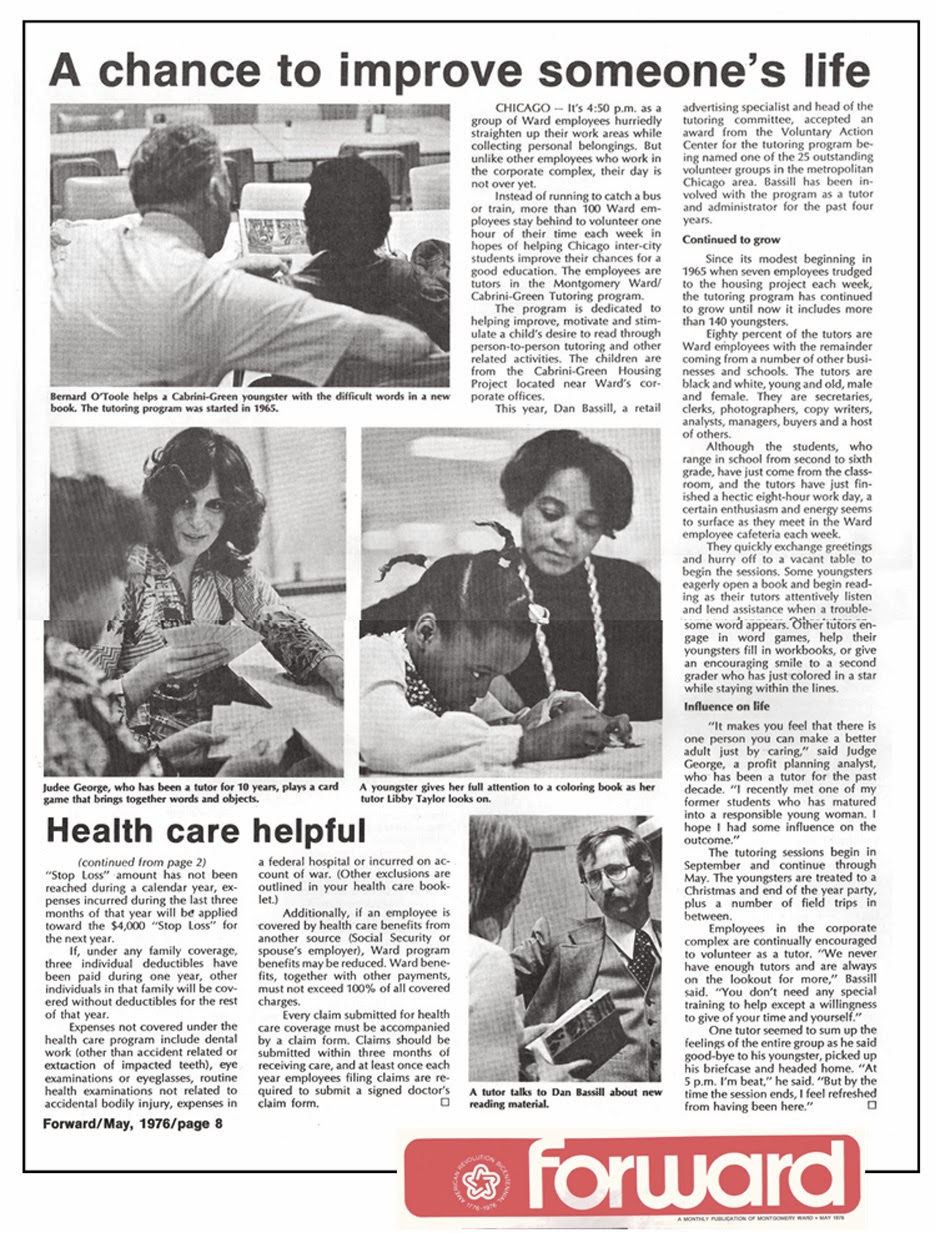
This story resonated with me because from 1973 to 1990 I held retail advertising management positions with the Montgomery Ward Corporation, a competitor of Polk Bros in the Chicago market. Being part of the advertising department, I and the writers, artists and production people who worked with me, were constantly frustrated by how the merchandise people would change ads often, and frequently at the last minute.

In reading about Sol Polk’s commitment to advertising, and how he watched competitor ads and made last minute changes to TV and Radio scripts and print ads so Polk Bros could have a lower price, I recognized what was happening in my own company, and how savagely each business competed for customers every day.
(This is the front cover of one supplement I created for the Automotive Department at Wards)

So what does this have to do with volunteer-based tutoring/mentoring? I led the tutoring program at the Montgomery Ward headquarters in Chicago from 1975 to 1990, as a volunteer while holding advertising roles with growing responsibility. By the early 1980s I was in charge of creative development of all national print advertising.


Thus, leading a volunteer program with 200-300 pairs of kids/volunteer meeting weekly, and virtually no paid staff, was a real challenge.

I learned very early that there was no way to provide enough training to volunteers to solve every problem they would face as a tutor/mentor. All kids were different. All volunteers were different. They all were constantly changing.

Thus, I began to borrow from my advertising experiences to share ideas and motivate actions within my volunteer world. Every week I created a one or two page “newsletter” which included tips for tutors, announcements of weekly activities, and an encouragement to dig deeper into our resource library to understand why the tutor/mentor program was needed, and ways volunteers could support the overall program’s growth.

Initially my “mass communications” was a mimeograph machine to make copies, and my own two feet to pass out these copies each week to our volunteers. The format for making copies changed as we moved to desk top publishing and copy machines in the 1980s and 1990s, but what really changed was the Internet becoming a place where we could host ideas that any of our teens, volunteers and donors could find them. By 2002 I was sending a weekly email newsletter to our volunteers, and a monthly email newsletter to all of our supporters.

While this works within a single program, if you have the time to create a newsletter, and to research ideas that you would put into it, not every program has people who can do the design, writing, formatting, publishing and distribution of electronic communications.

What’s more significant, motivating people to read the communications weekly and dig deeper into the research, and to form small groups to discuss the ideas with peers and other volunteers, is a challenge that still has not been solved.
Busy volunteers, staff members, directors, donors, etc. have many other priorities in their lives beyond their involvement in the tutor/mentor program. Even people paid to do the job spend so much time with day-to-day challenges of supporting youth and volunteers and keeping funds coming in, that there is very little “flexible time” to spend reading and “learning”.

I’ve written about MOOCs in the past year and this week I’m participating in a Deeper Learning MOOC, that engages more than 1000 people from around the country around the topic of “Deeper Learning”, which according to the William & Flora Hewlett Foundation, is…..“students engaged in deeper learning—are using their knowledge and skills in a way that prepares them for real life.

They are mastering core academic content, like reading, writing, math, and science, while learning how to think critically, collaborate, communicate effectively, direct their own learning, and believe in themselves (known as an “academic mindset
”.”

Over the past week I’ve read several hundred introductions, mostly from educators. What concerns me, is that too few of these are people working in big city school districts, such as Chicago, Detroit, New York, Houston, LA, etc. If leaders and thinkers from these cities are not engaged in “deeper learning” how can we expect to bring higher quality learning experiences to inner city youth.

I’ve also seen very few participants in my MOOCs from people who lead non school tutoring and/or mentoring programs. If representatives from programs, and from those who support these programs, are not engaged in “deeper learning” how can they find ways to constantly improve the impact of their programs, or the flow of operating resources and talent that are essential to program improvement?

Sol Polk understood the power of advertising. He also recognized that he could get other people to pay for a large part of the costs of his advertising. The people who manufactured the merchandise sold in Polk Bros stores provided dollars for advertising costs. There’s an entire chapter on this in the book.

In his TED talk, Dan Pallotta talks about the power of advertising, and shows how donors are not willing to pay the costs for non profits to advertise. Read more here.

When I started Tutor/Mentor Connection in 1993, one of the key goals was to increase the frequency of news stories talking about tutoring/mentoring programs in Chicago. That’s still a goal.

Tutor/Mentor Connection and Tutor/Mentor Institute, LLC will never have millions of dollars for advertising. Thus, companies, churches, college groups, athletes, etc. need to become our “advertising partners” using their own media, visibility, in-store displays, etc. to build awareness and draw “customers” --- youth, volunteers, donors, etc. --- directly to the different tutor/mentor locations operating in Chicago or other cities.

Polk Bros did not just spend millions of dollars on advertising and promotions without a clear purpose. They ran “sales” and “events” throughout the year, which were intended to motivate customers to come to their stores. VOLUME was the goal of Sol Polk.

VOLUME is also the goal of Tutor/Mentor Institute, LLC. We must dramatically increase the number of people who are thinking about tutor/mentor programs every day, and who are visiting web sites to learn more about where, why and how they can help programs in different neighborhoods of Chicago.

National Mentoring Month is in January every year. Events throughout the month have encourage people to post articles on blogs, comments on Twitter and Facebook. New stories have shown how mentors can change a youth’s life. This needs to be happening 12 months a year, not just in January.

Every story needs to end with a “call to involvement”. A “hook” as Sol Polk would have described it, that motivates a customer to come to a store, or to support a tutor/mentor program in one of Chicago’s neighborhoods.

If you’re an advertising professional, a retail executive, a PR manager, etc. this is a strategy you certainly should understand, and that you can support in your own efforts to help Chicago become a place where EVERY child has the opportunities and support to find work, establish a career, and raise a family out of the grip of poverty.

If you are a foundation established using wealth created by entrepreneurs who started their companies in the early part of the 19th century, why not go beyond giving grants. Why not spend some of your own capital to create “advertising” that draws other donors, volunteers and leaders to support the same programs you are funding?

Few foundation grants provide more than 5% of the total operating costs for any non profit. Many don’t even cover costs of general operations…which is the cost of keeping the doors open and constantly improving. Thus, it would seem to make sense that using foundation dollars (in addition to advertising and sales promotion from others) would help attract more (up to 100%) of the dollars every non-school tutor/mentor program needs to operate effectively every year.

Where are people talking about this? Is anyone hosting a “Deeper Learning” MOOC that engages donors, business leaders, advertisers and shows them more ways to help draw on-going customer support to all of the different non profits needed to enrich a city like Chicago? During the National Mentoring Summit, being held in Washington, DC on January 30 and 31, many of the sessions will be available on line (for $20 fee). Maybe some of us can connect via that forum.

Who wants to help fund the Tutor/Mentor Leadership and Networking Conferences so they can attract leaders and support this type of conversation, face to face, and via online communities? The next conference is May 19 and sponsors and workshop presenters are encouraged to step forward and introduce themselves.