Showing posts sorted by relevance for query starfish. Sort by date Show all posts

Sunday, May 08, 2011

bin Laden, Geronimo .....and T/MC


Clarence Page wrote a column in Sunday’s Tribune, talking about the strength of decentralized organizations, using the book titled “The Starfish and the Spider” by Ori Brafman and Rod A. Beckstrom, as a reference.

"What do they have in common?" asked Page. “Loosely defined organizational structure, widely shared power and a leadership that acts as a motivational catalyst, not a top-down command structure”.

I was given this book as a gift a few years ago by Rebecca Parrish, a volunteer who led our video program for a year.

I’ve referred to it often, here, and here, because it describes the organizational strategy of the Tutor/Mentor Connection.

I wrote this Network for Purpose article on May 8, 2007.

In a big city like Chicago there are too many “silos” and power brokers to expect many to follow the lead of a single tops-down leader, even if that leader is the Mayor, or a local billionaire. Expecting all of these people to follow the T/MC in a tops down structure would be more than crazy.

However, building shared ownership of a vision, such as helping poor kids to careers, is possible. In the Starfish and the Spider the authors write of blended strategies, like eBey, have created internet platforms that millions of users can use.

The T/MC has created a knowledge-based platform that anyone in Chicago can use. At its core is a database of organizations that provide various forms of volunteer-based tutoring and/or mentoring in non-school settings.

Over years I've heard many leaders talk about "pipelines" to careers. In my opinion, “the plumbing is clogged” by the bureaucracy of big city public school systems and the lack of non-school learning and mentoring programs in high poverty neighborhoods. We can either try to fix the clog, or we can open a new channel to reach kids.

If we provide links showing how some people are already reaching kids in new ways, and how others are providing the dollars and the leadership, any leader who shares the same vision and mission can use this information to innovate ways they can reach kids, and choose places on the map of Chicago where they want to anchor one end of their pipeline.

The type of knowledge base the Tutor/Mentor Connection has been building since 1993 is intended to aggregate links and information showing “what others are already doing some place in the world” that could be duplicated in many other places if the talent and money were available. We use maps to inspire thinking and actions that make high-quality learning programs available in all of the poverty areas of the Chicago region, not just a few locations in a few neighborhoods.

Because we host this others don’t need to do the as much work to find these ideas. They are all in one place, and a network of links to other sites. With this information leaders can build teams of learners and innovators who use this information to constantly improve their own efforts. If we can capture what is being done each year, through research, or awards, it can be shared so that every year innovators in many places can improve their own efforts by building from the work being done elsewhere.

The T/MC platform is not well funded. In fact it is broke and at risk of going extinct. Yet it is available and it is a model that is already visited by people from all parts of the world. It is the heart of what we hope is a growing network of leaders who share a deep commitment to closing the gaps between rich and poor in the world.

Our challenge is innovating ways to increase the number of people who look at this information every day. This is the challenge every leader has had since the beginning of time. Innovating new ways to solve this problem involved applying ideas pf decentralized ownership as describe in books like The Starfish and the Spider.

If we can enlist more people to share this information daily, we might get the attention of the billionaires meeting in Arizona last weekend. Support from just one of you would suffice.

Or we can get the attention of big-city leaders like Mayor Emmanuel who has linked his tenure in office to educating all of Chicago's youth. "Sunday, 5/8/2011 Chicago Tribune Editorial!"

The Mayor needs to think like the leader of a decentralized organization. He help from individuals and organizations throughout the Chicago region. If enough leaders adopt some of the ideas we share, and help build a system of volunteer-based tutoring/mentoring and learning programs that reach kids in non-school channels, maybe we can help him keep his campaign promise.

If you agree with these ideas please attend the Tutor/Mentor Leadership and Networking Conference on May 19 and 20, or encourage people you know to attend. If you can provide dollars to help pay for the conference and the T/MC, that would help also.

Like the Mayor, we also need help from many owners throughout the Chicago region and the world.

Wednesday, February 06, 2019

Chicago Tutor and/or Mentor Programs on Social Media

In this article I'm sharing some of what I've been seeing on Twitter and Facebook from Chicago based youth Tutor and/or Mentor programs. You can look at this the same way I do, by following this list of programs on Twitter.

This from Starfish Learning @StarfishChicago


this from Chicago Lights @chicagolights


this from Daniel Murphy Scholarship Fund @MurphyScholars


this from By The Hand @ByTheHandClub


I'm seeing more than this in every 24 hour cycle, but only selected a few from the top of my feed for this post.  I encourage others to do exactly what I've done. View the list, then write a story pointing to posts from some of the different tutor/mentor programs in Chicago, or in a different city, if yoiu don't live here.

Facebook also has posts by Chicago tutor/mentor programs, but it is really difficult to find them. What I mean by that is on Twitter,  you can open my list, and scroll the feed, and see what's been posted in the past day or week. If programs are sharing what they do, you'll see it. 

The Facebook news feed does not have a list/sort feature like Twitter has. On your news feed you get everything from all of the friends and pages you like. Thus, seeing what youth tutor/mentor programs in Chicago are doing is really difficult.


This graphic is in the NOTES section of my Facebook page, and includes a list of Chicago youth tutor/mentor programs. You can scroll the list, and click on a page, to see what that program is sharing. But you don't get a list showing what all of these programs are sharing. LinkedIN works the same way.

(Note: in 2020 Facebook removed NOTES. You can now find my list of programs on Facebook at http://tutormentorexchange.net/tm-programs-on-facebook}

Thus, unless you are looking at Facebook or LinkedIN for hours every day,  you won't see much of what's posted by Chicago tutor/mentor programs.  In a few minutes on Twitter,  you can see what's been posted over the past 24 hours.

Now, the other part of this story is that TOO FEW PROGRAMS ARE POSTING ON ANY SOCIAL MEDIA, AND TOO FEW HAVE BLOGS ON THEIR WEB SITES

Volunteers, donors and media can't find you and tell your story if you're not helping them.

Note: If someone is using Facebook or LinkedIN and has found a way to view lists of Chicago tutor/mentor programs, please post a comment with instructions for doing this.


Thursday, June 27, 2024

Drawing from my archives

 I've spent time over the past months and years (since 2019) digitizing all of the paper files that I had accumulated in leading tutor/mentor programs since 1975 and the Tutor/Mentor Connection since 1993.  

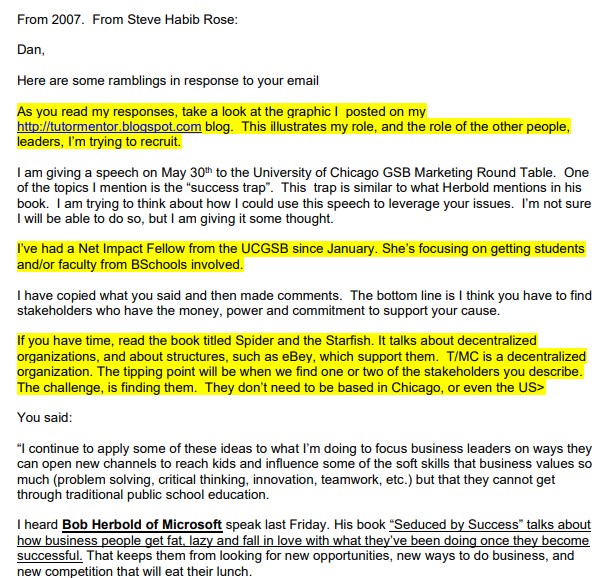
Yesterday I found a document with comments I'd made in response to a blog exchange held in 2007 with Steve Habib Rose. I show that below and you can view the PDF at this link.


The yellow highlights were my comments to what Steve had written.

I did a search on this blog to see if I'd written about this and, sure enough, found this article from March 4, 2007.  It's titled "Connecting Networks". 

In the first paragraph I wrote "I encourage you to read what Habib Rose is writing about networking and how this relates to connecting volunteers and leaders of tutor/mentor programs to each other."

When I clicked on the link, I found that it was broken. So I went to the Internet Archive, and found the article at this link. 


Then I looked at the TAGs on his blog and found several posts under "Tutor/Mentor Connection".   One is shown below.

These posts remind me of who I was connecting with in past years and how I was trying to build a network of people who would work to help kids in high poverty areas connect with volunteer tutors and mentors and extra learning opportunities in organized, on-going non-school programs. 

Some people I'm able to look up on LinkedIn and re-connect with. Others, like Steve Habib Rose, are no longer with us.  In fact, Steve died suddenly shortly after this blog exchange.  It's a reminder of how difficult it is to create a movement and sustain it for decades.

About the same time as I was connecting with Steve Habib Rose one of my interns gave me a book, titled "The Starfish and the Spider".   I pointed to that on this page of the Tutor/Mentor Institute, LLC website.


This book illustrates my role as a catalyst in building a decentralized network of leaders who support volunteer-based tutor/mentor programs.  My archives, this blog and my website are resources any one can use to draw people together, learn more about issues, see work others are doing, and innovate ways to help youth in their own community.

The final part of  "The Starfish and the Spider" talks about platforms, like eBey, which support millions of users.  If you go through my archives you'll see my efforts to create such platforms.  Most are now archives, except for my website library.  

Most are resources that you can find through your computer and the Internet, if you just make the time to look.

I've about eight boxes of paper files left to digitize, then a lot of organizing work to do. I hope to finish by this time next year.  I'll share some as I go, like I'm doing today. 

As you look at this, ask "Who will keep this resource available after Dan's no longer with us?"   I keep asking the same question.

7-14-2026 update - I've digitized most of my files and they are available via my Google Drive.  In this article I point to a couple of sections.  The graphic below is a small portion of all the maps shared in just one file!


Connect with me on social media channels (see links here).   

And, if you're able, visit this page and send a contribution, to help me sustain my work.


Thursday, August 14, 2008

Once you have a light bulb, you need an industry to distribute it.

I've been participating in a Social Edge forum this week and one of the introductory articles was from the Harvard Review, titled Design Thinking. 

In this article the author wrote about how "Thomas Edison created the electric lightbulb and then wrapped an entire industry around it." He wrote, "Edison’s genius lay in his ability to conceive of a fully developed marketplace, not simply a discrete device. He was able to envision how people would want to use what he made, and he engineered toward that insight." 

I have used this example in the past (read here) to illustrate how the Tutor/Mentor Connection was created to provide a full range of supports needed by our Cabrini Connections program, so that we could have a greater impact on our 7th grade students reaching jobs and careers by age 25. 

In order to build support for a single small program in Chicago, we've had to envision an industry that would support similar programs in every poverty neighborhood of the world. In order for this vision to be successful, my role is a catalyst. Others need to become the owners and leaders. 

This concept of decentralized organization supported by a platform of knowledge and collaboration is illustrated in a book titled The Spider and the Starfish. I urge you to read it. I encourage you to view the concept maps and other articles we've created to illustrate this vision, and to invite our peers, and potential supporters, to incorporate these ideas into their own thinking. 

By the way... I hope you notice the new format for this blog. Instead of archiving articles by month, I've archived them by topic. Thus, if you want to review articles related to violence, or No Child Left Behind (NCLB), click on the tag, and you can scroll through past articles on this topic. 

If you're forming a learning group, these articles can provide a valuable resource for helping your group become a leader in building this Edison-like infrastructure. I hope you'll use it, and contribute to it with your own articles.

Saturday, February 17, 2007

Helping Inner-city Teens Reach Careers


During the past week I've been contacted by two of the students who started with Cabrini Connections between 1994 and 1996, when they were in 7th and 8th grade.


One graduated from Syracuse University last spring, and is now starting an acting career in New York City. He told me that he had a small part in a new Barbershop film, which filmed recently in Toronto. He got his start in acting as part of our youth video group.


The other graduated from St. Mary's University, near Notre Dame. She's also involved in the film industry, but from a production side. She now lives in London, but works in Chicago when she's not involved in projects. We met at a volunteer recruitment event hosted by Women On Call, a new organization that is helping professional women find ways to volunteer.


In the photo above we show a group of our teens and a group of graduate students from Edgewood College in Madison, Wisconsin. This group met in the summer of 2006 at our Chicago location. This was the 7th year that students from Edgewood have hosted a summer workshop with our teens. The goal is to help our teens build skills and aspirations that help them succeed in school and move to college, while also helping the students at Edgewood connect with inner city youth and expand the choices they might make for where they become teachers.


If you look at these photos and read stories on the Cabrini Blog, or web site, it begs the question: Just what is a tutor/mentor program? Is it tutoring? Is it mentoring? How do we define it? How do we create metrics that others might use to value it, or invest in it?


In the Tutor/Mentor Institute I provide an essay titled Defining Terms: Tutoring. Mentoring. Same Words. Different Meanings. In another essay I show the use of maps. My goal is to define what a tutor/mentor program is in terms of what the need for a tutor/mentor program is, based on demographics such as poverty or concentrations of poorly performing schools.


As you look at these maps, it's rapidly clear, that one single tutor/mentor program in one neighborhood, serving a growing number of teens and alumni -- a total of 490 since 1993, as of Sept. 2007--is not enough in a city where there are more than 400,000 kids in the school system, more than 200,000 living in high concentrations of poverty, and more than 135,000 attending poorly performing schools.


What's needed is leadership that would make such programs available in more places. That's what the Tutor/Mentor Connections seeks to build. But then, how do you defined the metrics, or valuations, of this role of catalyst, information center, net-worker?

I just read a book describing the work of the Ashoka organization, titled How to Change the World. Before that I read The Starfish and the Spider. You can find links to both books in the T/MC Links library. These describe work that unfolds over a lifetime, and is only successful because of the passion and persistence of a few individuals with a vision that others don't see.

Our vision is helping youth born in neighborhoods of highly concentrated big city poverty get the help they need to be starting jobs and careers by their mid twenties. We hope you'll help us define the metrics, or the values, in way that investors and business leaders will be willing to risk their own involvement. 

If this moves you, we hope you'll give your support.

Friday, January 13, 2023

I Have a Dream, too.

As we head into the 2023 MLKing Day weekend, I'd like to encourage all who will do service, to also do learning.  That means spending some time looking at ideas I've been sharing on this blog since 2005.

I led a volunteer-based tutor/mentor program in Chicago from 1974 to 2011. I formed Cabrini Connections in 1993 to help teens from the original 2nd to 6th grade program at the Montgomery Ward HQ in Chicago get the extra support they need from 7th grade through high school, in order to be prepared for college, vocational education, and the next steps to a job and a career.

When kids and volunteers joined us we made one promise: We will do everything we can to assure that each student who joins us will be starting a job/career by age 25. We are only limited by how much our students, volunteers, alumni and supporters are willing to share this responsibility.

I visualize that commitment with graphics like I'm showing in this article.  


Below is a message I shared with volunteers in the tutor/mentor program I was leading to start 2008.

This message can be just as relevant to volunteers in any tutor/mentor program, or to people looking to be elected to city, state and national office. 
 --------------------------- 

I hope that all of our volunteers have had great holidays and that you are looking forward to continuing your role as a tutor/mentor volunteer at Cabrini Connections, Tutor/Mentor Connection.

I've been a leader of a tutor/mentor program since 1974, and I've learned that every volunteer and student are different, and constantly changing. Thus, while I can provide a structure for your participation, I can't teach you everything you need to know, or everything I've learned. I can try to help you, and your student, form a learning strategy, where you know where to find information, and find help, so that as you meet weekly, you know where to go for ideas to stimulate and support your involvement. 

Last Christmas, Rebecca Parrish (a Cabrini Connections volunteer) gave me the book "The Starfish and the Spider" as a present. As I read it, I realized that this book was describing Cabrini Connections and the role of every volunteer, staff member, and leader. It also describes the role of alumni, and veteran volunteers. 

We are a decentralized organization in which each volunteer is the CEO of his/her own tutoring/mentoring business. We succeed in life by our own efforts and by what we can learn from others. Our networks are important. They expand opportunities, open doors and provide resources. 

As you go through the tutoring year, each volunteer is learning to individualize his/her weekly activities based on the needs of your student, your own abilities and time, and the level of experience you have gained. Veteran volunteers, alumni, staff and coordinators are able to support you with ideas, information, and structure, but it is your own learning and networking with other volunteers that gives you ideas for what you do. 

Each week I'm trying to coach you with this email, with my blogs, and with the information and networks available to you on the Tutor/Mentor Connection web site at http://www.tutormentorconnection.org 

You all already know how difficult it is to motivate many kids to do homework, do extra learning, and take charge of their lives. Imagine how difficult it is for me and the leaders of Cabrini Connections to recruit busy people like our volunteers, and convince them to spend time beyond their weekly tutoring/mentoring, learning how they can become more effective tutors/mentors, or giving help to others who are seeking help. 

Yet, this is the only way we can succeed in keeping the promise we make to our kids. Read more at http://cabriniblog.blogspot.com/2007/12/good-to-great-in-decentralized.html

I thank you all for your involvement in Cabrini Connections, Tutor/Mentor Connection. On behalf of our volunteer board of directors, I welcome you back for our 16th year of tutoring/mentoring since January 1993.

Dan Bassill
President/CEO
Cabrini Connections 
Tutor/Mentor Connection 

 ---- end 2008 article --------------------------------- 

In what ways will our elected leaders support the involvement of volunteers, donors, businesses and universities in programs like Cabrini Connections? Will they use maps to build a distribution of resources into every neighborhood where tutor/mentor programs are needed? Will they use their blogs, web sites, public speaking to connect volunteers with non profits in their district, using links to a Program Locator, so volunteers and donors can search for where to get involved? 

Or will the volunteer and donate button on their web site only point to themselves, in an effort to get elected, or stay elected? 

True leadership lifts up everyone. Real Generals understand the need to distribute troops in all places where the enemy is concentrated, and they understand the need to have an infrastructure that supports those troops with food, clothing, pay, training, weapons, etc. so they are better equipped than the enemy.


I created this graphic in 2011 and shared it in this 2012 article.  As you think of helping kids in high poverty areas include data maps and each of these steps in your planning. Next year, and each year after that, celebrate National Mentoring Month and MLKing Day by providing a review of actions you took to help more kids during the previous year and actions you plan to take in the coming year to build on past year progress. 


This graphic illustrates an information based problem solving strategy where groups of people focus on a section of geography where kids need extra help, then look at available information showing how some people have helped similar kids in different places. Then they brainstorm and create and execute their own plan. At the end of the year they review what they've accomplished, look at work others are doing, then launch a plan for the coming year, building on what was done the previous year. See the concept map here and blog article here. 

This type of planning needs to be happening in many places in order to fill all high poverty areas with comprehensive, on-going, birth-to-work mentoring strategies.


Which of our leaders are going to be demonstrating this type of leadership in 2023? Who already is sharing these type of ideas in other places? 

Let's connect.  Find me on Twitter, Facebook, Instagram, Mastodon, LinkedIn, etc. Find links on this page. 

Thanks for reading. Enjoy the weekend. Please make my vision, your vision, too. 

If you want to help Fund T/MI and the work I'm doing, please visit this page and use PayPal to send a contribution. 

Monday, April 01, 2013

Create a SWARM of engagement

This video was introduced to me via one of my Facebook groups today. I encourage you to take 15 minutes to view it.


As I review this I think of a book I read a few years ago, talking about the strength of decentralized organizations, called The Starfish and the Spider (see link) , and my own efforts to connect people, ideas and actions, as described in this presentation.


There are many ideas about creating an information hub that connects people from around the world with information related to a problem, such as poverty, the environment, global warming, etc. along with hubs that provide practical ideas for solving the problem, based on what people in some places are already doing.

As this graphic suggests, these ideas are all connected in a larger wheel of global well-being.


The challenge that we face now is finding ways to connect those who are already involved to each other, and creating linkages that connect groups to each other, so people and ideas and resources can flow through the network to support the many different efforts, and to act as a glue or gravity that pulls them closer together.

If we don't do this more and more hubs and platforms will launch, and instead of a gravity pulling us together there will be a vacuum in which we drift further and further apart, with random clusters forming and reforming as resources and public attention become available.


Monday, January 02, 2012

Platform for Collective Actions

Phil Simon wrote a book titled The Age of the Platform showing how Google, Facebook, Amazon and Apple have created business models that support the actions of millions of users. A few years ago I read the book titled The Spider and the Starfish, in which the author told how Wikipedia and eBey were platforms supporting millions of owner-users. 

This graphic illustrates how the web sites of the Tutor/Mentor Institute, LLC are intended to be a social problem solving platform that can be used by people throughout the world who focus on the challenges poor kids face in moving from birth to jobs and careers over the first 20 to 30 years of their lives. 

A social problem solving platform would include:
a) data related to specific issue/problem, 
b) ways to draw millions to the platform; 
c) ways to engage the people with the data in order to create shared understanding and, 
d) ways to point the efforts of the group to places within geographic boundaries where the ideas and action can support constant improvement, or betterment, resolution of the problem. 

This map shows the platform I've been trying to build for more than a decade. It shows many areas where others can share ownership and responsibility for building this platform and for encouraging others to use it. 

I think it can apply in any city/urban area and thus partners/talent to build it can come from any part of the world. Now I need to find investors or partners to help build this platform to meet its potential and the do more to connect people who can help and people, youth and programs in places where help is needed. Know anyone at Google?

Tuesday, January 15, 2008

What's our promise to our kids? What will our elected leaders do to keep this promise?

The Presidential campaign is coming to Illinois, which means we'll be bombarded with stories of hope, and change. It would give me more hope for the future, if I could see change in the way elected leaders (and candidates) act as leaders.

I have led a volunteer-based tutor/mentor program since 1974. I formed Cabrini Connections in 1993 to help teens from the original 2nd to 6th grade program at the Montgomery Ward HQ in Chicago get the extra support they need from 7th grade through high school, in order to be prepared for college, vocational education, and the next steps to a job and a career.

When kids and volunteers join us we're making one promise: We will do everything we can to assure that each student who joins us will be starting a job/career by age 25. We are only limited by how much our students, volunteers, alumni and supporters are willing to share this responsibility.

Below is a message I shared with our volunteers to start 2008. This message can be just as relevant to volunteers in any tutor/mentor program, or to people looking to be elected to city, state and national office. 
 --------------------------- 

I hope that all of our volunteers have had great holidays and that you are looking forward to continuing your role as a tutor/mentor volunteer at Cabrini Connections, Tutor/Mentor Connection.

As you prepare for the second half of the school year, I encourage you to read some of the articles posted at Cabrini Connections - Tutor/Mentor Program in the Cabrini Green area of Chicago (archive.org)

I've been a leader of a tutor/mentor program since 1974, and I've learned that every volunteer and student are different, and constantly changing. Thus, while I can provide a structure for your participation, I can't teach you everything you need to know, or everything I've learned. I can try to help you, and your student, form a learning strategy, where you know where to find information, and find help, so that as you meet weekly, you know where to go for ideas to stimulate and support your involvement. 

Last Christmas, Rebecca Parrish (a Cabrini Connections volunteer) gave me the book "The Starfish and the Spider" as a present. As I read it, I realized that this book was describing Cabrini Connections and the role of every volunteer, staff member, and leader. It also describes the role of alumni, and veteran volunteers. 

We are a decentralized organization in which each volunteer is the CEO of his/her own tutoring/mentoring business. We succeed in life by our own efforts and by what we can learn from others. Our networks are important. They expand opportunities, open doors and provide resources. 

As you go through the tutoring year, each volunteer is learning to individualize his/her weekly activities based on the needs of your student, your own abilities and time, and the level of experience you have gained. Veteran volunteers, alumni, staff and coordinators are able to support you with ideas, information, and structure, but it is your own learning and networking with other volunteers that gives you ideas for what you do. 

Each week I'm trying to coach you with this email, with my blogs, and with the information and networks available to you on the Tutor/Mentor Connection web site at http://www.tutormentorconnection.org 

You all already know how difficult it is to motivate many kids to do home work, do extra learning, and take charge of their lives. Imagine how difficult it is for me and the leaders of Cabrini Connections to recruit busy people like our volunteers, and convince them to spend time beyond their weekly tutoring/mentoring, learning how they can become more effective tutors/mentors, or giving help to others who are seeking help. 

Yet, this is the only way we can succeed in keeping the promise we make to our kids. Read more at http://cabriniblog.blogspot.com/2007/12/good-to-great-in-decentralized.html

I thank you all for your involvement in Cabrini Connections, Tutor/Mentor Connection. On behalf of our volunteer board of directors, I welcome you back for our 16th year of tutoring/mentoring since January 1993.

Dan Bassill
President/CEO
Cabrini Connections 
Tutor/Mentor Connection 

 --------------------------------- 

In what ways will our elected leaders support the involvement of volunteers, donors, businesses and universities in programs like Cabrini Connections? Will they use maps to build a distribution of resources into every neighborhood where tutor/mentor programs are needed? Will they use their blogs, web sites, public speaking to connect volunteers with non profits in their district, using links to a Program Locator, so volunteers and donors can search for where to get involved? 

Or will the volunteer and donate button on their web site only point to themselves, in an effort to get elected, or stay elected? 

True leadership lifts up everyone. Real Generals understand the need to distribute troops in all places where the enemy is concentrated, and they understand the need to have an infrastructure that supports those troops with food, clothing, pay, training, weapons, etc. so they are better equipped than the enemy.

Which of our leaders are going to be demonstrating this type of leadership when they come to Illinois and ask for our vote?

Wednesday, March 28, 2012

Making Sense of Info. Using it to solve problems.

One of the first things most people say after talking to me, or visiting my web sites is "there's a lot of information!" Some are really saying "too much" information. That's not the way I see it.

Instead I see a constantly expanding wealth of information that young people and adults can learn from over a lifetime in efforts to reduce poverty in the US and the world. The map below shows the different sections of my library. The actual link is here. So how do I see this?
My library points to people from around the world who are brighter than me, better writers, and better able to visualize ideas. By hosting links to these ideas in the Tutor/Mentor Institute, LLC library, I make these ideas available to anyone who visits my site and browses the links.

I created this explanation of the four-part Tutor/Mentor Institute, LLC strategy yesterday in preparation for an on-line discussion scheduled for April 15.

The first part focuses on aggregating information. The second part focuses on advertising and network building, intending to increase the number who view this information. The third part focuses on facilitating and helping people understand and use this information.

A few months ago I pointed to some blog articles written by Vance Stevens, where he introduced the idea of MOOCs (Massive Online Organized Curriculum). Today I read an article by Steven Downes, which shows the potential and challenges of MOOCs.

I'm trying to take this a step, maybe many steps, further.

First, by aggregating information about non-school tutor/mentor programs in Chicago I'm inviting others to help make sense of this information. By using maps to show all poverty areas in the region, and concept maps to visualize ideas and strategies, I'm trying to focus people on strategies that build the entire system of supports, not just a few good programs in a few places. How many programs are there? What is the availability of programs in different poverty neighborhoods, based on type of program, age group served, size, etc? How do programs differ from each other? What do they have in common? What are their challenges?

How can a collective effort including business, faith groups, political leaders, etc. help overcome the challenges and make more and better programs available in more places?

Second, I'm trying to find people who will help bring people in Chicago and the world together in a MOOC focused on building a shared understanding of the information represented by the 2000+ links in my library. Instead of focusing on reading, writing, math that we want kids to learn I'm focusing on problem solving skills and knowledge that young people and adults can use throughout their lives to close the gaps between rich and poor in Chicago and other cities.

Finally, I'm trying to find people who are already doing this who want to add me to their team, and people with the talent needed to do this 'sense-making' and organize a MOOC along with other forms of mentoring and learning. In the book titled The StarFish and the Spider, decentralized organizations were described, along with platforms that enabled millions of people to connect with each other.

Many people need to be owners and contributors to this process, not just me. Many places can be hosting these ideas, not just my web site. As long as we are connected in one, or many, systems of navigation, learners can find their way through the library and find places to support their own learning and problem solving.

As a result of better understanding of poverty and how other people are working in different parts of the world to close the gaps, along with a better understanding of the revenue systems that need to support on-going efforts in many places, more people will begin to use the maps and information library available through platforms like the Tutor/Mentor Program Locator, to search out places where they can offer time, talent, dollars, and their own growing knowledge. That's the fourth step in the Tutor/Mentor Institute, LLC strategy.

Over the past 20 years I've done much work to build the platform, aggregate information, and build a network of people and ideas. Over the next 10 years I hope to find investors, benefactors, partners who will turn this into a MOOC and a constantly expanding network of people and organizations working in many ways to help share these ideas.

Saturday, January 02, 2021

Mentoring Month Message to Volunteers


As we start a new year, and a new decade, and the National Mentoring Month, we also welcome a new President.

For the past year Democratic Presidential candidates have bombarded us with stories of hope, and change. It would give me more hope for the future, if I could see change in the way elected leaders (and candidates) act as leaders.

I led a volunteer-based tutor/mentor program in Chicago from 1975 to 2011 ( I joined the leadership committee of the Montgomery Ward Cabrini-Green Tutoring Program in Sept. 1994.) 

I formed the Cabrini Connections tutor/mentor program in 1993 to help teens from the original 2nd to 6th grade program at the Montgomery Ward HQ in Chicago get the extra support they need from 7th grade through high school, in order to be prepared for college, vocational education, and the next steps to a job and a career.

When kids and volunteers joining us each year we're making one promise: 

We will do everything we can to assure that each student who joins us will be starting a job/career by age 25. We are only limited by how much our students, volunteers, alumni and supporters are willing to share this responsibility.


Below is a message I shared with our volunteers to start 2008
. This message can be just as relevant in January 2020 to volunteers in any tutor/mentor program, or to newly elected leaders to city, state and national offices. 

 --------------------------- 

I hope that all of our volunteers have had great holidays and that you are looking forward to continuing your role as a tutor/mentor volunteer at Cabrini Connections, Tutor/Mentor Connection.

As you prepare for the second half of the school year, I encourage you to read some of the articles posted at Cabrini Connections - Tutor/Mentor Program in the Cabrini Green area of Chicago (archive.org)

I've been a leader of a tutor/mentor program since 1974, and I've learned that every volunteer and student are different, and constantly changing. Thus, while I can provide a structure for your participation, I can't teach you everything you need to know, or everything I've learned. I can try to help you, and your student, form a learning strategy, where you know where to find information, and find help, so that as you meet weekly, you know where to go for ideas to stimulate and support your involvement. 

Last Christmas, Rebecca Parrish (a Cabrini Connections volunteer) gave me the book "The Starfish and the Spider" as a present. As I read it, I realized that this book was describing Cabrini Connections and the role of every volunteer, staff member, and leader. It also describes the role of alumni, and veteran volunteers. 

We are a decentralized organization in which each volunteer is the CEO of his/her own tutoring/mentoring business. We succeed in life by our own efforts and by what we can learn from others. Our networks are important. They expand opportunities, open doors and provide resources. 

As you go through the tutoring year, each volunteer is learning to individualize his/her weekly activities based on the needs of your student, your own abilities and time, and the level of experience you have gained. Veteran volunteers, alumni, staff and coordinators are able to support you with ideas, information, and structure, but it is your own learning and networking with other volunteers that gives you ideas for what you do. 

Each week I'm trying to coach you with this email, with my blogs, and with the information and networks available to you on the Tutor/Mentor Connection (which we started in 1993 at the same time as we launched the Cabrini Connections program) website at http://www.tutormentorconnection.org 

You all already know how difficult it is to motivate many kids to do home work, do extra learning, and take charge of their lives. Imagine how difficult it is for me and the leaders of Cabrini Connections to recruit busy people like our volunteers, and convince them to spend time beyond their weekly tutoring/mentoring, learning how they can become more effective tutors/mentors, or giving help to others who are seeking help. 

Yet, this is the only way we can succeed in keeping the promise we make to our kids. Read more at http://cabriniblog.blogspot.com/2007/12/good-to-great-in-decentralized.html

I thank you all for your involvement in Cabrini Connections, Tutor/Mentor Connection. On behalf of our volunteer board of directors, I welcome you back for our 16th year of tutoring/mentoring since January 1993.

Dan Bassill
President/CEO
Cabrini Connections 
Tutor/Mentor Connection 

 --------------------------------- 

In what ways will our newly elected leaders support the involvement of volunteers, donors, businesses and universities in programs like Cabrini Connections? Will they use maps to build a distribution of resources into every neighborhood where tutor/mentor programs are needed? Will they use their blogs, web sites, public speaking to connect volunteers with non profits in their district, using links to a Program Locator, so volunteers and donors can search for where to get involved? 

Or will the volunteer and donate button on their web site only point to themselves, in an effort to get elected, or stay elected? 

True leadership lifts up everyone. Real Generals understand the need to distribute troops in all places where the enemy is concentrated, and they understand the need to have an infrastructure that supports those troops with food, clothing, pay, training, weapons, etc. so they are better equipped than the enemy.

Which of our leaders are going to be demonstrating this type of leadership when they take office or ask for our votes again in a few years?

Since I started the Tutor/Mentor Connection in 1993 Chicago has had three different Mayors and the USA has had four different Presidents and will have a 5th in late January 2020.

I've been sharing ideas like these in printed newsletters, websites, blogs, email newsletters and social media for 25 years yet I still find few leaders using maps to show all the places where kids and families need  help, and where they are distributing needed resources.  I find few using concept maps as blueprints to visualize all the supports needed to help a youth in a high poverty area move from first grade to their first job, with a commitment to "do everything we can to assure that each student who joins us will be starting a job/career by age 25."

I thank you for reading this far and sincerely thank those few who have made contributions in 2020 to help fund the Tutor/Mentor Institute, LLC.  

Please go a step further and share my blog articles with your own networks so more people see these ideas and adopt them as their own.  Below is an example of one of my own recent Tweets.
The strategy map that I point to in this tweet can be found on this page, along with all my other concept maps.  Open it. Read it aloud. If it makes sense to you, create your own version. Record it. Share it. Maybe in 2021 we'll finally find leaders who will make this commitment. 

I'm on Twitter @tutormentorteam and you can find me on Facebook, Linkedin and Instagram  (see links on  this page). I look forward to connecting with others who share this commitment. 

Saturday, May 26, 2018

Networked Creativity Focused on Local-Global Issues

In this article I'm going to write about the Thinglink360 video created by Kevin Hodgson, a middle school teacher from Western Massachusetts, and more than 20 other people starting in February 2018.

Then I'm going to write about this cMap which I created this week, inspired by the project Kevin is describing.  I hope you'll follow along and see the connection.

See Interns w T/MC cMap at this link. 


I first met Kevin in 2013 as part of the Connected Learning #CLMOOC, and have grown to appreciate and value the ideas he shares on his blog. Thus, I visit often. So in early April I opened this article, which was the first of a three-part reflection under the title of "Creating a Virtual Gallery of Digital Art".

It all started about three months ago (mid February?) when Kevin got an idea. "What if the (open and university) folks dabbling in Networked Narratives (#NetNarr) together created a collaborative piece of trans-media artwork together?"

Kevin brainstormed the idea with a few other on-line friends and soon created this site as an invitation for others to join in the fun. He titled this the NetNarrAlchemyLab.

In his blog Kevin wrote, "Early on, we had a vision of an immersive virtual lab that visitors could wander around in, like a museum."  He went on "We wanted to create a "doorway" in and a "doorway" out.

Over six to eight weeks 20 people from different parts of the world (Australia, Scotland, USA, France, etc) created more than 50 projects. The project began with a group from the #NetNarr ecosystem, but soon spread to folks in the #DS106 and #clmooc groups.   

I encourage you to visit Kevin's blog and read his description of what worked, what did not, and see how he keeps drawing attention to the work he and others have been doing. 

See graphic in this article
As I said, I've been engaging with the #clmooc world for five years and have shared some of these interactions using graphics and concept maps posted in more than 30 articles. 

I've watched Kevin and many others from several on-line communities connect with each other and amplify the work they are each doing via their own blog articles, Tweets and Facebook posts. The motivations for these interactions are many. For instance, if you visit this #clmooc home page you can see how such interactions have been stimulated in that group.  

As you do you'll see a few examples of where I've tried to draw members into the work I've been doing since 1993, helping non-school tutor/mentor programs reach k-12 youth in high poverty neighborhoods.

I liked Kevin's description of his goal,"to create  an immersive virtual lab that visitors could wander around in, like a museum."  That's the way I think of the web library I've created, and it communicates my own goal that people come in, wander around, do some reading, then share what they see with others.

As I looked at the Thinglink360 I wanted to create something similar to show work interns have done while working with Tutor/Mentor Connection and Tutor/Mentor Institute, LLC between 2006 and 2015, with the goal that some of these educators would duplicate these intern efforts and for the same purposes.  Since I don't have a paid account with Thinglink (or the talent) I could not do what Kevin did, so I used my free cMapTools account and created the concept map shown above. 

Each graphic on the cMap comes from a project done by one of the many interns who work on the Tutor/Mentor Connection/Institute, LLC project. Below each graphic you can find one or more links that open blog articles and/or videos that show the project, or show how the project was created and how I coached the interns along the way.

As I spent time last week reviewing work interns had done to collect images and links for the cMap I was reminded again of the immense talent of the students who worked with me.  More than half came from South Korea and Hong Kong, while most of the others were from Chicago area universities.


Much of the work being done in these on-line communities focuses on "cultivating connections" and "strengthening networks".  My goal is to draw people from the non-school #tutor #mentor, youth and workforce development and anti-poverty ecosystems together in similar on-line communities...and to connect them with the people and networks I'm already following.

As participation grows I hope to recruit a few people from different places who will spend time building their own understanding of what I've been trying to do. I hope some then begin to duplicate my own 25 year history, by creating libraries of content, and recruiting students from as early as middle school to spend time reading, reflecting, hacking and re-making work that I and my interns have done, to mobilize the time, talent and dollars of more people to help kids born or living in high poverty areas get the extra adult support they need to not only move successfully through school, but to have help moving into adult lives with jobs and careers that enable them to raise their own kids in any place they choose.

In many of the links on the cMap, like this one, I show how interns created their own projects after reading PDF essays, or blog articles, that I've written.   That represents more than 1000 articles, a mountain of content and ideas, that educators and social innovators from all over the world could draw from.

Throughout this and other articles I've included #hashtags with links to Twitter.  If you open these and scroll through past Tweets, you'll open yourself to a wide network of people and ideas.  For instance, here's a Tweet Kevin posted to draw attention to one of the projects in the Alchemy Lab.


In another cMap I've been aggregating links to Twitter conversations I've been following.  My vision is that at some point in the future I could find Tweets within each of these groups, pointing to my articles and work interns have done with me in Chicago, with new visualizations, videos, articles, etc. that apply those concepts in Chicago neighborhoods, or in neighborhoods throughout the world.


Furthermore, while my articles focus on helping kids living in poverty connect with extra adults and learning via organized non-school programs, this graphic visualizes a wide range of complex problems that need to be concurrently addressed in Chicago and throughout the world.

The "how do we do this" needs many people's ideas and what better way to communicate those than through the type of work Kevin is describing and that I've been trying to do.

Finally, if you are re-making and hacking the ideas I share, let me know. In the lower right corner of the intern map, you'll find this map, shown below, which I'm using as another 'museum' that showcases others who are already helping share Tutor/Mentor Connection/Institute, LLC ideas.


I'm at @tutormentorteam on Twitter and you can find me on Facebook and LinkedIN too, I hope to connect and that you'll share with me some work inspired by what I'm writing about.

Monday, December 09, 2024

Deeper learning and lost digital archives


I've been sharing ideas for ways people can start and sustain volunteer-based tutor, mentor and learning programs that help kids in high poverty areas move through school and into adult lives since forming the Tutor/Mentor Connection in Chicago in 1993 (and the Tutor/Mentor Institute, LLC in 2011).

As I searched past articles for inspiration for this article, I initially was going to share an article showing work interns had done in past years to help share the ideas I launched in PDF essays and blog articles.

That brought me to an article I wrote on this blog in 2018, which I'm going to repost, with comments.

Start 2018 ---

My first line was "In this article I'm going to write about the Thinglink360 video created by Kevin Hodgson, a middle school teacher from Western Massachusetts, and more than 20 other people starting in February 2018."

However, Thinglink360 no longer is open for public viewing so the video by Kevin, and the projects I created, no longer work.  Furthermore, my link to Kevin's profile on Twitter does not work either, because Kevin deleted his Twitter account due to the actions of its owner.  He's not the only one.

Then I wrote about this cMap which I created in 2018, inspired by the project Kevin is describing.  I hope you'll follow along and see the connection.

See Interns w T/MC cMap at this link. 


I first met Kevin in 2013 as part of the Connected Learning #CLMOOC, and have grown to appreciate and value the ideas he shares on his blog. Thus, I visit often. So in early April 2018 I opened this article, which was the first of a three-part reflection under the title of "Creating a Virtual Gallery of Digital Art".

It all started about three months ago (mid February?) when Kevin got an idea. "What if the (open and university) folks dabbling in Networked Narratives (#NetNarr) together created a collaborative piece of trans-media artwork together?"

Kevin brainstormed the idea with a few other on-line friends and soon created this site as an invitation for others to join in the fun. He titled this the NetNarrAlchemyLab.

In his blog Kevin wrote, "Early on, we had a vision of an immersive virtual lab that visitors could wander around in, like a museum."  He went on "We wanted to create a "doorway" in and a "doorway" out.

Over six to eight weeks 20 people from different parts of the world (Australia, Scotland, USA, France, etc) created more than 50 projects. The project began with a group from the #NetNarr ecosystem, but soon spread to folks in the #DS106 and #clmooc groups.   

I encourage you to visit Kevin's blog and read his description of what worked, what did not, and see how he keeps drawing attention to the work he and others have been doing. 

Another change I learned about today is that Kevin has reformatted his blog. No longer does it show past articles or links to other blogs on his side bar.  

See graphic in this article
As I said, I've been engaging with the #clmooc world for five years and have shared some of these interactions using graphics and concept maps posted in more than 30 articles. 

As of December 2024 that number is up to 75.

I've watched Kevin and many others from several on-line communities connect with each other and amplify the work they are each doing via their own blog articles, Tweets and Facebook posts. The motivations for these interactions are many. For instance, if you visit this #clmooc home page you can see how such interactions have been stimulated in that group.  

Since late 2023 many of the people who I met on Twitter are now using Mastodon and BlueSky to connect and share ideas.  

Find Dan Bassill on Bluesky - https://bsky.app/profile/tutormentor.bsky.social
Find Dan Bassill on Mastodon - https://mastodon.social/@tutormentor1, https://mastodon.garden/@tutormentor1 and @tutormentor1@mastodon.cloud

As you do you'll see a few examples of where I've tried to draw members into the work I've been doing since 1993, helping non-school tutor/mentor programs reach k-12 youth in high poverty neighborhoods.

So far, I've not found many of the Chicago tutor/mentor programs on this list on Mastodon and BlueSky. Few use Twitter any more.  Some are on Instagram. Some on Facebook. Some on LinkedIn.

That means people looking for information about programs and ways to help them are going to have a more difficult time.

I liked Kevin's description of his goal, "to create  an immersive virtual lab that visitors could wander around in, like a museum."  That's the way I think of the web library I've created, and it communicates my own goal that people come in, wander around, do some reading, then share what they see with others.

As I looked at the Thinglink360 I wanted to create something similar to show work interns have done while working with Tutor/Mentor Connection and Tutor/Mentor Institute, LLC between 2006 and 2015, with the goal that some of these educators would duplicate these intern efforts and for the same purposes.  Since I don't have a paid account with Thinglink (or the talent) I could not do what Kevin did, so I used my free cMapTools account and created the concept map shown above. 

Each graphic on the cMap comes from a project done by one of the many interns who work on the Tutor/Mentor Connection/Institute, LLC project. Below each graphic you can find one or more links that open blog articles and/or videos that show the project, or show how the project was created and how I coached the interns along the way.

As I spent time last week reviewing work interns had done to collect images and links for the cMap I was reminded again of the immense talent of the students who worked with me.  More than half came from South Korea and Hong Kong, while most of the others were from Chicago area universities.


Much of the work being done in these on-line communities focuses on "cultivating connections" and "strengthening networks".  My goal is to draw people from the non-school #tutor #mentor, youth and workforce development and anti-poverty ecosystems together in similar on-line communities...and to connect them with the people and networks I'm already following.

As participation grows I hope to recruit a few people from different places who will spend time building their own understanding of what I've been trying to do. I hope some then begin to duplicate my own 25 year history, by creating libraries of content, and recruiting students from as early as middle school to spend time reading, reflecting, hacking and re-making work that I and my interns have done, to mobilize the time, talent and dollars of more people to help kids born or living in high poverty areas get the extra adult support they need to not only move successfully through school, but to have help moving into adult lives with jobs and careers that enable them to raise their own kids in any place they choose.

In many of the links on the cMap, like this one, I show how interns created their own projects after reading PDF essays, or blog articles, that I've written.   That represents more than 1000 articles, a mountain of content and ideas, that educators and social innovators from all over the world could draw from.

Throughout this and other articles I've included #hashtags with links to Twitter.  If you open these and scroll through past Tweets, you'll open yourself to a wide network of people and ideas.  For instance, here's a Tweet Kevin posted to draw attention to one of the projects in the Alchemy Lab.

Note:  Due to people like Kevin leaving Twitter hundreds of my past articles will have a "not found" message. Fortunately, the text still appears.


In another cMap I've been aggregating links to Twitter conversations I've been following.  My vision is that at some point in the future I could find Tweets within each of these groups, pointing to my articles and work interns have done with me in Chicago, with new visualizations, videos, articles, etc. that apply those concepts in Chicago neighborhoods, or in neighborhoods throughout the world.

I'm not sure how much value this cMap will have in the future, unless their is a dramatic reversal in ownership and operations at Twitter. 


Furthermore, while my articles focus on helping kids living in poverty connect with extra adults and learning via organized non-school programs, this graphic visualizes a wide range of complex problems that need to be concurrently addressed in Chicago and throughout the world.

The "how do we do this" needs many people's ideas and what better way to communicate those than through the type of work Kevin is describing and that I've been trying to do.

Finally, if you are re-making and hacking the ideas I share, let me know. In the lower right corner of the intern map, you'll find this map, shown below, which I'm using as another 'museum' that showcases others who are already helping share Tutor/Mentor Connection/Institute, LLC ideas.

I don't find enough people writing about my work. Yet, I keep encouraging alumni and others to take ownership and carry this effort into the future. 

Share the link in the comments section or on social media. You can connect with me on many platforms. Open this page to find links to each. 

--- end 2018 article w 2024 comments ----

Thanks for reading my posts, and for sharing them with others.

If you find value in what I'm sharing please consider a gift to support my 78th birthday - see this page

Or a contribution to my annual "Fund the T/MI" campaign - see this page.

This helps me keep my library and ideas on line for another year.