Saturday, November 25, 2006

Thanks and Giving


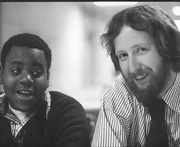
At 8am on Thanksgiving morning I met for coffee with a middle age man named Leo Hall. Leo lives in Nashville, TN, makes videos and is a substitute teacher. He has two great boys and a wonderful wife.

What made this event special?

I first met Leo almost 33 years ago when he was in 4th grade, attending an elementary school in the Cabrini-Green area of Chicago. I was a first year employee working in the Advertising Department of the Montgomery Ward corporate headquarters of Chicago. In the fall of 1973 I became a volunteer tutor with the Montgomery Ward Cabrini Green Tutoring Program in Chicago. I was assigned to work with Leo. We met every Tuesday night during that 1973-74 school year, and for the next several years.

In the years since then, I've attended every graduation of Leo's, including 8th grade, high school and college.

Leo sent me an email Tuesday, telling me he was coming to Chicago, and that he wanted to meet with me. He made special arrangements to be able to join me on Thursday morning, just as I did.

We have stayed in contact for 33 years, although we've not seen each other for about six years. Since he was coming to Chicago he wanted to make sure he saw me.

He wanted to say "thanks" for me being his mentor for all of these years.

While I accepted his "thanks" I also offered my own. I said "thanks" for him letting me be part of his life, and for all of the ways this involvement has become my life in the years since then.

When I write about tutoring/mentoring and the infrastructure needed to support such programs, I'm thinking about what it took for Leo and I to first meet in 1973, and to stay connected for all of these years. If some volunteers had not made the weekly commitment for the Wards program to operate, we never would have met. If donors had not provide enough dollars to operate every year, we would not have been able to stay connected. He could not have found me, or me him, if Cabrini Connections were not a home, that connects us, and many others, to each other.

As you do your holiday charitable giving, I encourage you to made a donation to a volunteer-based tutor/mentor program like Cabrini Connections so you can help us continue to make these connections between youth like Leo and adults like me.

If you view the Chicago Programs Links at the Tutor/Mentor Connection web site, you'll find web site links for Cabrini Connections and for many other Chicago organizations that offer various forms of tutoring and/or mentoring. You can use these to choose places where you might want to make a donation or become a volunteer in the coming year.

We all give thanks for the richness that mentoring has added to our lives. We hope that through your giving we'll be able to continue this work for many more years.

Thursday, November 16, 2006

$2 Million Award supports Chicago volunteer-based tutor/mentor programs!


Over the past two years I've posted many messages showing how the Tutor/Mentor Connection has been working to help volunteer-based tutor/mentor programs grow in Chicago and in other major cities. That has been a three part effort

a) building knowledge of who does this work, what works, who supports it, etc.

b) drawing programs together to learn from each other and collaborate on capacity building

c) working with business and professional groups to create strategies that distribute funds annually to tutor/mentor programs in every part of the city, instead of just to one or two favorite, or highly visible programs.

The best example of our success in getting businesses involved has been the work we've done since 1994 to help the Abraham Lincoln Marovitz Lend A Hand Program (http://www.lend-a-hand.net/ ) grow at the Chicago Bar Association. Since 1995 the LAH has been able to award $30,000 to $50,000 each year in small grants to 20-30 different programs. The photo above shows the Thomas A Demetrio Lend A Hand Award recognizing an outstanding example of a Chicago tutor/mentor program, being awarded during a Tutor/Mentor Conference.
While these were welcome, the size of the grant means the programs still had to find about 98% of the money needed to operate from other sources.

Yesterday the LAH received $2 million from the Chicago Sun Times as part of a legal settlement. These funds will increase the grant pool to as much as $300,000 per year over the next 3 to 5 years, and dramatically increase the size of grants awarded to tutor/mentor programs in the Chicago area.

This is the result of our efforts to connect those who can help with volunteer-based tutor/mentor programs who are helping inner city kids reach careers. It's also a result of many tutor/mentor programs participating in the May and November conference, and the August/September Volunteer Recruitment Campaigns, organized by the Tutor/Mentor Connection.

The goal of the T/MC is to have the Lend A Hand duplicated in every industry, so that tutor/mentor programs receive funds, and volunteers, from many sources, not just the legal community. The way we hope to achieve this is that more tutor/mentor leaders in Chicago will become active partners in this strategy, and that program leaders in other communities begin to work with the T/MC as collaborators so that the business and professional groups in their own community will adopt this strategy.

The best way to get more involved is to participate in the Nov. 30 Tutor/Mentor Conference being held at DePaul University, 1 E Jackson. Read about the conference at https://web.archive.org/web/20060810050733/http://www.tutormentorconference.bigstep.com/

This strategy can be duplicated in Rockford, Milwaukee, Detroit, Indianapolis, St. Louis, or any other major city. I encourage you to connect with the T/MC so we can help you take a T/MC type leadership in your neighborhood, or your city. To get involved, post a message in the Discussion Forum, or email me at tutormentor2@earthlink.net

Saturday, November 11, 2006

Veterans Day salute to service and sacrifice

It’s Veteran’s Day today. I’m writing thank you letters that I’ve fallen behind on and I was inspired to write this post.

I’m a Veteran in two ways. I served in the Army from 1968-71 and I’ve served in the war on poverty as leader of a tutor/mentor program from 1974 till today. I’m proud of both.

Service requires sacrifice. It’s easy to understand the level of sacrifice given on the battlefield. Yet when I was coming back from Korea in 1971, I felt that my service to my country was not as important because I was not on the battlefield. Over the years, I’ve changed my mind through my leadership of a tutor/mentor program. For the soldiers on the front line to do their job, soldiers behind the scenes need to do their jobs, too.

In our war on poverty the volunteers who connect directly with teens as tutors/mentors, and the people who staff tutor/mentor programs are in combat every day. They can tell you the horror stories and the sacrifices they make to help kids who need many types of support to succeed in school in neighborhoods where many expectations and role models support different aspirations.

What I've learned is that while we need tutors/mentors, we also need many other volunteers who provide their time as leaders, organizers, web site developers, fund raisers, and as a donors. If non profit tutor/mentor programs can not consistently get this type of infrastructure support, most will not be consistently able to support those who are directly connected with kids.

Thus, as a veteran, I thank everyone who is making donations of time and money to support volunteer based tutor/mentor programs that serve kids living in poverty. I hope you'll look at the level of sacrifice being made by those who give their lives and time to military service, and consider expanding your own level of commitment to helping us end poverty by helping kids move through school and into jobs and careers.

Monday, November 06, 2006

Principal for a Day should focus on neighborhoods, not just schools


Once again Chicago and other cities hosted a Principal for a Day event that brought CEOs and celebrities into Chicago schools. The goal was to energize leaders to become supporters of education efforts in Chicago. This year there was a concerted effort to raise money for CPS from this effort.

While this is needed, I'd like to see an effort that encouraged businesses to adopt neighborhoods, not just schools. Such a strategy would reinforce the 24/365 learning that is required to help a youth succeed in school. It would point business leaders to non-school tutoring/mentoring and youth development programs, not just the programs offered by CPS during its 9 month schedule and range of summer programs.

It would give more opportunities for business volunteers to become engaged and to stay involved for more time than a one-day visit to a school. Such a strategy would not only build stronger relationships with youth who need extra adults to mentor and build career aspirations, but would also help people beyond poverty become more informed of the complex issues that all need to be addressed at the same time, and for many years, if we're to change education outcomes in some inner city neighborhoods.

You can see our vision of this strategy in the Tutor/Mentor Institute section of the http://www.tutormentorconnection.org web site. If you know one of the leaders who spent a day in one of Chicago's schools this month, I encourage you to encourage that person to consider support for non school programs in the same neighborhood.

Sunday, November 05, 2006

Holiday Tutor Mentor Bloggers Wanted

On Nov. 30 the Tutor/Mentor Connection will host a one-day conference in Chicago to draw leaders and supporters of volunteer-based tutor/mentor programs together, and to create visibility that helps draw needed donations to tutor/mentor programs in Chicago and other cities. You can read about the conference at http://www.tutormentorconference.org

I'm writing to recruit bloggers who are talking about charity, and volunteerism, and programs that connect adults with inner-city kids in roles of tutors, mentors, advocates, coaches and friends. If we can increase the number of people around the world blogging this topic, and pointing to sites such as the Program Links area of http://www.tutormentorconnection.org, we can increase holiday donations and give donors choices of where they send those donations.

If you're blogging this topic, just post a comment in this section with your blog's web address. If you are aggregating charity blogs, I encourage you to create a sub section that points at non profits that connect adults and youth who do not live in poverty with youth and communities that are dominated by poverty.

I'll look forward to reading your posts.

Sunday, October 29, 2006

Thanks + Giving: Plan Ahead

On November 30 the Tutor/Mentor Connection will be hosting a one-day conference in Chicago. It's aim is to share information that helps more and better volunteer-based tutor/mentor programs be available for inner-city youth.

While I lead one of these programs and know from personal experience how these programs transform youth and adults, I also know how hard it is to find dollars to operate consistently from year to year. Thus, at this conference my goal is to draw programs leaders together to share ideas, build visibility, and to find ways to work together to draw needed dollars to all tutor/mentor programs, not just Cabrini Connections.

One strategy for this is to share some of the research that shows the need for learning supports, and for non-school programs. Here are three reports I encourage you to read and share with others:

The Essential Supports for School Improvement, published by the Consortium on Chicago School Research at the University of Chicago.

Policy Brief: Promoting a Systematic Focus on Learning Supports to Address Barriers to Learning and Teaching, found at the UCLA Center for Mental Health in Schools . Open the What's New section and follow the links to the Student Support Initiative.

The Big Lie: Reframing Expectations of Afterschool Programs, by Dr. Robert Halpern of the Erickson Institute.

If life were a game of 'tag' then my purpose in writing this blog is to 'tag' others who will then carry this message into their own network of friends, family and co-workers. If these people 'tag' others, we can reach millions of potential volunteers and donors, who will be willing to share some of the blessings they celebrate during Thanksgiving and the year end holidays with one or more tutor/mentor programs operating in Chicago or other cities.

I hope that Cabrini Connections and the Tutor/Mentor Connection are among the organizations that you support with your donations.

Saturday, October 21, 2006

Nobel Prize, Giraffes and Tutor/Mentor. What's the Link?

I received the following email yesterday from the Giraffe Foundation:

A Second Giraffe Wins Nobel Peace Prize
There was much jubilation here at the news last week that Muhammad Yunus
(www.grameenfoundation.org ) had won the Nobel Peace Prize for 2006. Yunus was commended as a Giraffe way back in 1987. He follows Giraffe Wangari Maathai (www.greenbeltmovement.org) , who was commended as a Giraffe in 1990 and won the Nobel Peace Prize in 2004. We happily suggest that the Nobel Committee check our files now for potential future winners.

What's the connection? Daniel F. Bassill, president of Cabrini Connections and the Tutor/Mentor Connection, was commended as a Giraffe in 1997. I've been proud to wear the Giraffe pin on my coat for almost a decade.

I keep telling people that we can earn awards like this, if they will join me in the efforts of the T/MC. Over the past couple of days, I've been talking to Phil Cubeta at GIFT HUB and Sean Stannard-Stockton at tacticalphilanthropy.com about ways generous acts of kindness can add up as strategic, long-term support of non profits working to help kids grow from first grade to first job, or working to help solve other long-term challenges.

My goal is to use maps, databases, the Internet, and social networking/collaboration tools to draw donors and volunteers to maps where they see where the need for charity dollars, or volunteers is, and choose among many agencies to decide who to help, and how much to help. By using information as a middle man in this process, we can improve the distribution of support to all places where help is needed, and sustain it for the many years it takes for organizations to grow from good to great.

If we can make this work, I think it deserves a Nobel Prize.

While I've not received a Nobel Prize or MacArthur Foundation Genius Award, here's a list of recognition I have received.

Wednesday, October 18, 2006

Creating Network of Purpose - Nov. 30 gathering

On a variety of web sites and blogs I find people with great ideas about networking. I have a link to the Non profit Blog Exchange, at the left. Network Weaving is another site where you can learn. In the Tutor/Mentor Connection Links, I list a variety of blogs and forums where people can connect.

I am now organizing a one-day conference for Chicago and am looking for one or two blog/networking experts to participate on a panel that focuses on collaboration. In addition, I'm looking for others to blog this topic in December. Please read about the Conference Strategy and email tutormentor2@earthlink.net if you'd like to help.

Monday, October 16, 2006

K-12 On-line Conference - Join in!!

For those who are involved or concerned about education outcomes in the US or in other countries, a unique on-line event is beginning On Oct. 16 and continuing through the end of October. You can find details and read the Keynote blog at http://k12onlineconference.org/

Friday, October 13, 2006

RED Alert - Celebs' Anti-AIDS Effort. Can it be duplicated?

Today the front page story in my Chicago SunTimes was the story of Bono, Oprah and others launching a campaign to "sell red-colored cell phones in the United States to raise money -- potentially billions -- for Bono's Product Red campaign to help treat African women and children with HIV/Aids."

I heard Bono speak at the National Conference on Volunteerism and Service in 2005 and I'm really impressed with this guy and what he's accomplished.

Here's my problem. The graphic I show on this page illustrates the many different issues that most communities face, to some degree or another. I'm trying to use this wheel as a navigation tool. Imagine that you could click into any slice of this pie, and go to a web page that focused totally on a single broad issue, such as poverty, or health. AIDS would be listed in both categories, as an issue, but might be addressed by different organizations, competing for the same dollars.

Imagine though, if once you're in an issue area, you find another wheel, that breaks down poverty or any of these other categories into sub categories, then provides a map that shows you where in a city, or the world, this was a problem that needed solving, which means it needs money from people like Bono.

Unless someone is maintaining a database to show what organizations are working in each of these issue areas, and in each of these countries, cities and neighborhoods, it's likely that the money being raised by Bono and Bill Gates and others will not distribute to all of the organizations needing help. It's also likely that most of the high poverty places where help is needed, there are few organizations providing help, so there's no place for funds to be distributed, even if that was the intention.

The reality is that all of these slices are inter-related. We just tend to deal with them as silos, with separate organizations and donors providing support to different groups who address the same issue in a different way.

I focus on volunteer based, non-school tutor/mentor programs serving youth in high poverty neighborhoods. The reason I focus on non-school is that in big cities, it's hard to get away from work and drive to a neighborhood school where you can spend your lunch hour each week as a mentor. Yet, you might pass through these neighborhoods as you go from work to home every evening. Why not spend one evening at a neighborhood tutor/mentor program. I've led such a program for more than 30 years and more than three thousands volunteers have made this commitment. Over 10% stayed involved for five or more years, and many became leaders and donors. Kids that I first met in elementary school are now college graduates. These programs enable long-term connections and relationships to be formed between volunteers and youth. When that happens, the volunteers are more personally connected, and likley to do more to help solve the poverty and economic isolation that causes tutor/mentor programs to be needed in the first place.

Thus there's a value for non-school programs like Cabrini Connections. Yet, we struggle to find the money to pay the bills, or to make enough programs available in enough places. A couple of weeks ago a feature story in the Chicago Tribune on Sunday and Monday was about how Chicago Public Schools had raised $25 million in 2005 from corporations and foundations, vis only $2 million five years ago. While it's great that CPS can raise so much money, that's money that only funds school based activities. It's money that might have funded non-school programs that connect kids with mentors and learning activities that the schools can't provide. We need the Mayor, the CEO of Schools, and a few business leaders and celebrities mobilizing donors to distribute funds to schools, and to non-school programs.... if we really want kids to go through school better prepared for jobs and careers.

My goal in showing a chart like this is to encourage leaders to think more holistically about all of the different factors that contribute to AIDs, or to Poverty, or to poorly performing kids coming out of public schools. My hope is to find more people like Bono who will bring business into innovation processes so that we can have yellow TVs, and green shoes, and blue bikes, and pokadot sports tickets, each with some of the profit going to find a stream of charity, or a slice of the pie.

If you're reading this any you've got a great marketing idea, I can show you a whole city of volunteer based tutor/mentor programs who each need donations every day.

Note, I you can see an example of this wheel being used to draw attention to each issue area if you visit the Boston Innovation Hub (http://www.tbf.org/indicatorsproject/hubofinnovation/innovation.asp ). That's what inspired me to create this graphic.

Thursday, October 05, 2006

Learning about poverty, and how mentoring can help youth reach careers

The LINKS library at http://www.tutormentorconnection.org is now fully operational again, after a month of rebuilding that was done after hackers caused us to move to a new hosting site. I hope you'll take a look.

The aim of this library is to help leaders, volunteers, donors, youth and parents find information that they want, when they want it.

For students, this can help them with homework, help them explore career goals, or connect with peers around the world.

For program leaders and donors, the links can be used to benchmark what one program is doing against what others do to solve the same problem. If the donor and the non profit are looking at the same information, and the donor is committed to helping kids in the zip code where they program is located. this shared understanding of what ideas would help improve a program should result in the donor providing the funds for the program to do the work of adding this new idea.

The LINKS also provide in-depth information that helps everyone understand the challenges of poverty, and see the opportunities to help youth reach their full potential.

There is a lot of information on this web site. However, poverty is a very complex issue, and affects millions of people in the US and around the world. Solutions cannot be achieved by a few minutes of learning. It takes many years of learning, just like getting a college degree and a PdD takes four to 8 years of work.

Thus, we hope you not only return to this site often, but that you add new links, rate the links, and discuss the information you find in this discussion forum.

In this way we share the work of helping people find and use information that can lead youth out of poverty and to careers.

Saturday, September 30, 2006

Making a Difference and Bridging the Poverty Divide

During the past two weeks an amazing thing has happened in Chicago. Volunteers from various businesses and professions have begun meeting with 7th to 12th grade teens from the Cabrini-Green neighborhood for a 14th year of tutoring/mentoring and networking at the Cabrini Connections Tutor/Mentor Program.

More than 470 teens and 600 volunteers have been involved with this program since 1993. Here's a few highlights from my recent newsletter:

Daniel Sherrod (who started with CC in 1994) honored with Associated Colleges of Illinois award - ACI Honors Cabrini Connections alumni

Cabrini Connections Music Video can be viewed - on YouTube

Michael Tam blogs from Hong Kong - http://michaelcnt.blogspot.com

Josh Rothstein (2005-06 volunteer) emailed to tell us he's moved back to California and will be interviewing in the coming weeks at the Jet Propulsion Laboratory (a NASA contracted facility) in Pasadena.

Ted Bills (former volunteer) emailed from St. Louis and said "Our United Way campaign kicked off today and I sent the email to 70+ people that I have met at GE."

Larry Daigle (former volunteer) emailed to tell us he enjoys staying connected via our email newsletter and he's now living in Costa Rica). 

These illustrate how Cabrini Connections is turning the meeting between teens and volunteers at our Chicago site into a life long connection made possible by the Internet. With such a connection we can remove the isolation of poverty for every teen who joins us and learns to connect with each other and volunteers via the Internet. 

In order for us to keep our teens and volunteers connected with each other and with Cabrini Connections, we must constantly raise money. You can make a difference this weekend, by writing a check or going on line and making a Pay Pal donation. 

Some of you have already received the Back to School Mailing in a Yellow Envelop. Here's a link to a PDF that you can forward to friends. Back to School Campaign (no longer active -2020 note)

Some of you might be interested in a social/networking opportunity. Join us on Oct. 13 for Martini Madness. Here's a pdf with details: Martini Maddness (no longer active -2020 note) 

In 2011 I left Cabrini Connections and created Tutor/Mentor Institute, LLC to continue leading the Tutor/Mentor Connection. Visit my profile on Facebook and you can see that I'm still connected to students and volunteers from programs I led from 1975-2011).

In other sections of this blog you've been able to read posts about how difficult it is for non profits to find on-going dollars to sustain their work. We've been fortunate to find dollars for the past 14 years, but never enough to avoid borrowing money when cash is short, and never enough to do all of the work we know needs to be done to assure that our teens are in jobs by age 25. 

As you read this, I hope you'll make an effort to help us now, and in the future. I also hope you'll make an effort to help programs like Cabrini Connections that operate in other neighborhoods, and other cities, get the dollars and volunteers they also need. 

While we change the future for the teens who join Cabrini Connections, we still only impact a small number out of the more than 200,000 youth living in poverty in Chicago and the millions living in poverty in other big cities. A strategy (the Tutor/Mentor Connection) that supports all tutor/mentor programs consistently is one that will also support Cabrini Connections more consistently.

If you'd like to discuss ways you can help, email me at tutormentor2@earthlink.net

Sunday, September 24, 2006

Mentoring in the News. The Rest of the Story

On Thursday and Friday of this week the Chicago Sun Times ran stories of mentoring efforts supported by the CEO of ComEd and the CEO of Soft Sheen. These programs are part of a mentoring initiative started by the United Way of Metropolitan Chicago in response to studies showing incarceration rates of young black men at historically high rates.

I wrote the SunTimes, and said "thank you" and I called the United Way and said "let's meet". The REST OF THE STORY is that this has been a problem for more than a few years and that there are many organizations in Chicago who already offer volunteer-based tutoring/mentoring and who would love to have help from ComEd, Soft Sheen and every other business in the city.

My hope is that the media will link stories they write about one initiative, to existing work already being done in the city, in these, or other neighborhoods, so that the visibility the story draws to mentoring, will draw volunteers, donors, and business partners to tutor/mentor programs throughout the city and suburbs.

In the same edition of the SunTimes that talked about how a mentor program keeps young blacks focused was another story with the headline "20-year old slain on Southwest Side". Nothing in the reporting of this story suggested that mentoring or other forms of youth development or career development, could be a way to keep this type of problem from happening, yet the neighborhood where the youth was shot is the same area where mentoring is being offered.

If you want to help make mentoring more available in high risk Chicago areas, visit the Program Locator at http://www.tutormentorconnection.org and search by zip code to locate programs in specific areas. You'll find that some areas don't have many programs, thus, we'll need companies like ComEd and Soft Sheen to help start new programs, while we also need their help to keep existing programs in operation.

I hope that the new African American Initiatives at the United Way and at the Chicago Community Trust draw needed reinforcements to existing programs throughout the city. This is the only way we can assure that youth get the adult support needed to stay in school and move to careers.

Tuesday, September 19, 2006

What business execs don't know, but should know about non profits

Dennis Whittle, founder of Global Giving has a thought-provoking essay on his Pulling for the Underdog blog. He links to an article written by the from the Stanford Social Innovation Review.

As you read this, I encourage you to think of the thousands of places where comprehensive, volunteer-based tutor/mentor programs need to reach kids living in high poverty and near poorly performing schools. Each of these programs needs an innovative, dedicated leader who can attract kids, volunteers, donors and keep programs growing from "good to great" over a period of years.

If we can enlist business leaders to innovate ways to distribute needed resources to all tutor/mentor programs on a more consistent basis, we can do much to build a pipeline connecting inner city kids to careers. One strategy leaders might employ is to provide links on their web sites to organizations that mentor kids to careers, then encourage employees and customers to volunteer and donate money through payroll deduction programs to support these programs.

The goal is that an executive point to all of the organizations in a city, or multiple cities, that offer tutoring/mentoring and not just to the one that he/she may serve as a board member. In the Tutor/Mentor Program Locator I illustrate one sort of database that executives could refer volunteers to in order to distribute support to multiple locations.

Friday, September 15, 2006

Blogging for a Purpose

Today in the Chicago SunTimes, Steve Huntley wrote a commentary titled "Lots of Questions to answer before schools get more money." In the article he asked why parents who have sacrificed to have kids in communities with better schools, and higher taxes, would be willing to pay for the costs of educating other people's kids.

To me, this goes beyond providing that proposed school reform, and non profit strategies work, it provokes a question of "how do we get more people personally involved so they'd care enough to help other people's kids?"

I feel volunteer-based tutor/mentor programs are one of the best strategies the nation might invest in to get adults who don't live in poverty personally connected with kids who do. Through these connections these adults will have a better understanding of the challenges poverty presents, and a more personal reason to use their time, talent and dollars to create change.

Unfortunately, there are too few programs building long term connections, and too few dollars to help existing and new programs grow from start, to good, to great.

That brings me to the topic of blogs, and blog exchanges. I encourage you to visit

Monday, September 11, 2006

Remembering 9/11 - How much sacrifice is enough?

Today people in the USA and friends from around the world are pausing for a few moments to remember the lives lost in the 9/11 tragedy and in the war on terrorism that has taken place sense then.

Last week we were pausing to remember the Katrina tragedy.

Those of us at Cabrini Connections and the Tutor/Mentor Connection add our prayers of hope and remembrance to the families of those directly affected by these events. However, we would like to go a step further.

We'd like to ask everyone to dig a bit deeper and to find a little more time to try to understand the poverty in the world that is a breeding ground for these events. While nature caused the Hurricane, it was poverty that gave us the images of desperate people in New Orleans.

While it is a small group of fanatics fanning the fire of terrorism, it is poverty that provides recruits for these fanatics.

Thus, it's poverty we need to understand and deal with.

In this context, the next question is "how much time, talent and treasure" should one be expected to commit to this war on poverty? In the speeches that will be given today we'll honor those who gave the ultimate sacrifice. The number of dead will be totaled. In the background will be the number of families and children changed forever because a parent was lost in 9/11 or killed or severely wounded in the years since then.

When we think of this as 100% sacrifice, how do our own daily commitments of time, talent and treasure stack up? I'm not in a position to say what the appropriate level of giving should be. However, I can look in my own mirror every night and feel good about my own efforts.

I'd like to find a way that more people were looking in the mirror every night and doing more than just staring at a pretty face!!

Tonight we'll hold our first orientation for the volunteers who will become tutors/mentors in the 2006-07 Cabrini Connections program. As I talk to them I'll be starting them on a journey that is intended to stretch their involvement beyond two hours a week with one of our teens, to a commitment that draws the heart, body and spirit of a growing number into the efforts it takes to end poverty by helping kids move through school and into jobs/careers.

We promise our kids "we'll do everything we can" to assure that you're starting a job/career by age 25. "Everything" is a lot. It's unconditional effort. It recognizes the potential of unleashing the talent of our volunteers, their friends and families, the people they work with, and the people they pray with or go to football games with, in efforts to end poverty and provide hope.

Our efforts to unleash and focus more of the talents and time of our students, alumni and volunteers are the best memorial to 9/11 that I feel we can offer.

Sunday, September 10, 2006

Fan donates $220k to send band to football game. How much to help kids get to college?

On Saturday night I watched a bit of the Ohio State vs Texas football game. I heard the announcers say that an Ohio State benefactor had provided $220,000 to bring the entire OSU band to Texas for the game.

I love football, but I wonder how much that money could have done to help a few more inner city kids get the adult support they need to be able to attend either one of these universities.

Maybe this benefactor also gives millions of dollars to charities helping kids.... I hope so.

As leader of http://www.cabriniconnections.net I know how hard it is to find $5,000 a month to pay our rent and keep our kids connected to tutor/mentors. Donations over $200,000 would cover the operating costs of my program for an entire year.

Friday, September 08, 2006

No Child Law near perfect? No way.

Last week Education Secretary Margaret Spellings was quoted as saying the 2002 No Child Left Behind Law was "99.9" percent close to working properly and needed little change when it comes up for renewal next year.

That's not the opinion of many, including the Center for Mental Health in Schools at UCLA: http://tutormentor.blogspot.com/2006/07/learning-supports-needed-to-make-nclb.html

In today's Chicago SunTimes there were four articles that I feel related to NCLB, but none seemed intended on relating to each other, or demonstrated a long term vision of how to change the status quo.

On a page 23 article titled "No Child law near perfect? Blagojevich begs to differ", Governor Blagojevich was quoted as "joining a growing chorus of critics".

On page 34, there was an article titled "A Last Ditch effort to save gang members". This talked about how ministers in Durham, North Carolina, are raising money to send gang members out of state, so they can escape gangs. Does this mean if they send them to Chicago's West or South side neighborhoods they won't be recruited into gangs? No. Poverty is a breeding ground for gangs. While education is the path out of poverty, government has not yet outlined a plan that provides learning supports in the non-school hours, and in all high poverty neighborhoods.

On page 40, Tom Sharp of Lincoln Park wrote "Principals don't deserve easy A's"
Tom's article concluded with, "The basic fact that CPS leadership has yet to accept is that the students themselves, there home environments, and the value placed on education by their parents/guardians are the key variables to education success. The teacher plays a secondary role and the principle, more often than not, is a minor player at best.

On page 39, Andrew Greeley's column was titled "Greed trumps common good every time".
Greeley wrote about "how difficult it is for this large, pluralistic and cumbersome country to accomplish goals that most of its people agree on, more or less." According to Greeley, "one of the major obstacles is greed." He targets big business, saying, "The common good just doesn't matter when big business is running the country -- into the ground."

In my opinion, these are articles are all related. NCLB (and government policy) does not provide funding for the wide range of learning supports (including tutoring/mentoring) that would help more kids come to school with greater aspirations and motivations to learn.

It does not provide the type of non-school activities that would compete with gangs for student involvement. It does not motivate businesses to use their own resources (people, dollars, technology, jobs, leadership) to help youth come to school prepared to learn, and move through school more prepared for 21st century jobs. Just pointing at teachers and principles, or at the bureaucracy of NCLB, is not providing a vision for how we all work together to solve the problem.

Tutor/Mentor programs are learning supports where people from beyond poverty can connect with youth living in poverty, and become extra resources to help youth move through school and into jobs. However, without consistent funding there are too few programs, and too few good programs.

Until leadership understands that these programs not only benefit youth, but also transform the adult volunteer into a leader, they won't invest time and leadership into strategies that draw more adults into these programs, or support the operations that retain volunteers for multiple years.

In the end, we cannot legislate morality or dictate leadership. We can only recognize and support it when we see it. Thus, when we talk of greed, my suggestion would be to find ways to recognize with our votes, and with our shopping habits, those leaders who do more to make this a better world. If we reward good leadership others will soon learn to duplicate this, or even innovate better leadership.

Imagine a day when elected leaders and big and small businesses would be competing with each other to see who could do the most good.

A first step would be for editors to link stories in the news to web site forums that draw people together to understand how these stories relate to each other. Another would be to find ways to get more people personally involved.

Being a volunteer in a tutor/mentor program is a good way to start that involvement.

Wednesday, September 06, 2006

CEOs and Volunteerism

In most of my posts my focus is on building strategic partnerships with business and professional groups. I often point to web sites such as www.healthworkforce.org/guide/pipeline_sec1_1.htm where industry leaders are talking about workforce issues specific to their industry. These show "WHY" CEO's should take a strategic role in tutoring/mentoring, and provide examples that CEOs in one community can borrow for use in their own communities.

This week I'm leading a discussion of CEOs and Volunteerism on the http://www.socialedge.org web site. I hope you'll join in and provide links to other web sites that illustrate why business should become more involved, or that illustrate innovative forms of leadership that draw volunteers, and donors, to volunteer-based charities.

Sunday, September 03, 2006

Ending Poverty. Improving Schools.

School starts in Chicago on Tuesday for over 400,000 kids. Almost half live in high poverty neighborhoods. Many will be attending over-crowded schools. Many will come with few aspirations or experiences that prepare or motivate them to learn. This is the same in every big city of America.

As school starts, many in the media will be writing editorials and commentary, lamenting the lack of leadership, or involvement, in solving poverty, or improving schools. One initiative, the Million Dad March, will seek to involve men in getting kids to school this week, and in helping those kids learn.

What's missing? While media stories that focus on Katrina, or individual kids are well written and catch some reader attention, they don't create the on-going personal connection that leads people beyond poverty, or who don't have kids in poor schools, to become personally involved.

Without a personally connection this remains "someone else's problem".

I feel that volunteering in a tutor/mentor program, where a volunteer makes a weekly contact with a youth, is one way of creating a bridge that links people beyond poverty with children and families in poverty. I write about this often in this blog.

As school starts, tutor/mentor programs all over the country, including Chicago, are looking for volunteers...and donors.

In Chicago you can visit the Program Locator at http://www.tutormentorexchange.net to find contact information for different programs in different neighborhoods. In other cities, you need to search volunteer databases, such as http://www.volunteermatch.org.

All of these programs are different. They are not equally good at what they do. However, they are a connecting place where those who want to help can begin to build a personal understanding of the problem, and a personal connection with a young person who will enrich the life of the volunteer, as the volunteer seeks to do the same for the youth.

If you are a writer for a radio, TV, or newspaper, or if you know someone who is, I urge you to end your stories about poverty, poor schools, gangs, drugs, workforce development, civic engagement, etc, with links to web portals where people who don't live in the neighborhoods you write about can find ways to become personally connected.

If you do this with every story, you will be helping us build this bridge, and we'll begin to have more people read your stories with a personal understanding of what the problem is, and ways to solve it.

This is not a race. This is a journey. It takes 12 years just to go from 1st grade to being a high school graduate. It takes another 4 to 8 years to go on through the next level of education and be starting a job/career.

Many kids won't make it because too few people are involved personally in helping them along the way.

As school starts this week, let's make a commitment to change this.