Showing posts with label design. Show all posts

Saturday, July 13, 2024

Build information base to support anti-violence efforts

 I saw an announcement that Chicago business leaders were pledging $100 million to support anti-violence efforts in Chicago.  Gee. When have I heard that before.  


Let's see. Here's a 2013 article talking about a $50 million business commitment.  How'd that go? 

Of course, I've been pointing to this October 1992 Chicago SunTimes article for over 30 years. 

What's not happening? 

First, there's no comprehensive strategy, and nothing has lasted for 10-20 consecutive years.

What should be in a comprehensive strategy?

First.  Maps.  Maps can show where poverty is most concentrated in a geographic region like Chicago. They can show other indicators, such as poorly performing schools, violence, health disparities, etc.

This concept map points to many data platforms leaders can use to build their own map stories and map-based strategies.  I've posted more than 280 articles on this blog demonstrating ways maps can be used.  I've posted many more on the MappingforJustice blog. 

Second. Understand the different needs of kids living in areas of high poverty vs living in other areas. Then inventory existing youth serving programs to understand what programs are serving which kids.

View the graphic shown above in this article.  It's one of several articles in this group, that focus on designing youth programs based on the needs of the youth being served.  View this article to learn of the Tutor/Mentor Connection's 1992-2010 efforts to collect, map and share this information.

Then, look at articles like these, asking "How Many Youth Programs are Needed?"

Concept maps can also serve as blueprints, showing what's needed at each age level. Use this map as a starting point, then create your own version.

Understand what other programs and leaders are already doing, in Chicago, and around the world.
Open the Tutor/Mentor Library and look through the different categories and sub-categories.  There are more than 2000 links to other people's ideas that you can borrow for your own planning.  Don't reinvent the wheel if you can avoid it.  Don't start something new if there's already a project in place that you can support.  


Third. Use this information in an on-going planning process.

This concept map shows the planning cycle. 


This concept map shows planning needed, that fills areas of the map with a full range of programs helping kids through school and into adult lives, and keeps those programs fully funded for 10-20 years.


Before you do any of this, view this "Role of Leaders" visual essay, which I created in the late 1990s.  Look at "Step 2" on Page 10, where it says "Appoint a "get it done" leader.  and "Step 3" on page 11, where it says, "Do your homework."   Then, look at "Step 7" that focuses on CEO commitment to  year-to-year growth and process improvement.  


I share 30 years of thinking on this blog and on the www.tutormentorexchange.net website that leaders can use to build a comprehensive, long-term plan that actually reduces violence because it reduces the root causes, reaches kids and families in every high poverty area, and reaches the larger community to build and sustain the commitment, and financing, needed.

I've been spreading this message for over 30 years.  But, too few have ever heard what I've been sharing because I had too few resources to tell the story with reach and frequency.

That's still the case. But now, anyone who reads any of my articles can share them with their network, create their own versions, and build the awareness and commitment needed for building and sustaining strategic, long-term plans.

I'm on Twitter (X), Facebook, LinkedIn, Instagram, Mastodon, Bluesky and other places. You can find links on this page.  Please connect with me. Share your own vision and strategies.

I'm also dependent on a small group of  donors to help keep this information available.  Visit this page and send a contribution if you'd like to help me. 

Thursday, January 04, 2024

National Mentoring Month - Infrastructure Focus

Below is a photo from 2001 when the US Post Office issued a mentoring stamp to help celebrate and draw attention to mentoring in America.  My organization (Tutor/Mentor Connection, 1993-present) introduced it during the Tutor/Mentor Leadership and Networking Conference in Chicago, which I began hosting in May 1994 and continued hosting every six months until May 2015.


The conference was part of an on-going effort to help volunteer-based tutor, mentor and learning programs reach K-12 kids in high poverty areas of Chicago and other places and help those kids through school and into jobs and careers, with the help of adults they met through these programs.

I began my volunteer involvement in 1973 when I joined the tutoring program at the Montgomery Ward Corporate Headquarters in Chicago. I was matched with a 4th grade boy named Leo and we met every Tuesday after my work day ended.  We're still connected over 50 years later!

During mentoring month much of the focus will be on the "act" of mentoring, which could be workplace mentoring and could be mentoring of youth with disabilities.  

I want that to expand to focus on the infrastructure of mentoring.  I demonstrate this below.

I created the graphic below several years ago to visualize the many different reasons mentoring and/or tutoring are needed and the different types of organized programs needed to meet each category.


Below is an another graphic, showing this information in a different way.


I've posted several articles in the past few years (here, here and here) talking about building a "segmented understanding" of what types of mentoring and tutoring are needed based on "who" is being mentored.  During National Mentoring Month I urge you to read some of these.  

While the above graphics visualize the different needs of youth in America, they don't show where these kids live and/or where organized tutor/mentor programs are most needed.  I've been trying to use GIS maps since 1994 to do this.  Below is a concept map that shows my history of using maps.


Between 1993 and 2010 the Tutor/Mentor Connection was able to collect and maintain information about organized volunteer-based tutor/mentor programs in Chicago, which could be sorted by type of program (pure mentoring, tutor/mentor, pure tutoring), age group served (elementary, middle school, high school), time of day (school day, after school, evening/weekend), and location.


While we shared this information in a printed directory from 1994 to 2003 that rarely reached more than 1000 organizations (non profits, foundations, media, political, universities, etc.)  In 2004 a program locator was created that made this information available to the world. In 2008 a map-based program locator (shown above) was created that had the same search features as the 2004 program locator, but reversed the process, starting with a map of the Chicago region, then enabling a process of searching for programs and program supporters in specific zip codes, community areas or neighborhoods.

Visit this page to learn about our efforts to build the program locator and to find ideas for building your own version. 

Unfortunately, I've not been able to raise money or find partners since 2011 to systematically collect and segment information about Chicago programs or maintain the program locator directories. They are now only available as archives.  

That brings me back to National Mentoring Month.  

While most efforts will focus on the act of mentoring I hope leaders will step forward to build Tutor/Mentor Connection-type learning programs at one, or more universities in  Chicago and other urban areas, where students will duplicate the work my organization did from 1994 to 2010 and what I've tried to continue since then, through the Tutor/Mentor Institute, LLC.

I urge leaders to build a segmented understanding that not only shows what types of programs are needed and where they are most needed, but shows what programs already operate in these areas and are constantly searching for volunteers and donors.  Here's another page that shows uses of geographic information systems and data. 


Use this blog, the MappingforJustice blog and the http://www.tutormentorexchange.net website as a text book to build your understanding of what a Tutor/Mentor Connection strategy might be and how you might build it as part of a degree program on a college campus. 

Share what you are learning through your own blog articles and on social media so others can learn from you, just as I've been sharing so you can learn from me.  


Thanks for reading.  I hope you'll share this article with your network and connect with me on social media platforms (find links here). 

Finally, I want to give a special thank you to those who sent contributions in 2023 and in previous years to help me continue to do this work.  Please continue in 2024 and help me find a benefactor who will bring this strategy into a university. 

Visit this page to make a 2024 contribution. 

Friday, September 01, 2023

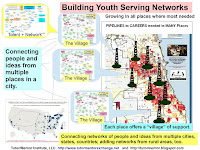
Building youth networks.

Below is a graphic I created in 1990s to show the range of adults from different backgrounds who were connecting with teens in the Chicago tutor/mentor program that I led from 1993 to 2011.

Note the pre-school through career timeline in the middle of the circle. This shows the multi-year support needed by kids living in high poverty areas, where too few of the people surrounding them work in the wide range of careers that more affluent kids are exposed to.  Note also the circle showing public school above the timeline and the 3pm-5pm and 5pm-8pm circles below the timeline. This shows that the 3-5pm non-school hours are the typical after-school program, needed in all areas where Mom and Dad have full-time jobs and kids need safe places during this time frame.

The 5pm-8pm timeframe is more unique to big cities where workplace volunteers are more able to become tutors and mentors in on-going programs. That was the timeframe when the programs I led operated. 

I did not realize until I read Dr. Robert Putnam's Bowling Alone book in the late 1990s that what we were doing was creating bridging social capital for our kids.  Around 2013 Putnam published another book, titled "Our Kids: The American Dream in Crisis" which I've written about often. 

In my graphic at the top of this article I show a hub and spoke design, where the hub represents a tutor/mentor program, or an individual youth. The spokes represent all the people who could be part of that youth's network, made possible by the family and community she is part of, or by the organized tutor/mentor program she is part of.

But how do we show this?  

At the left is another graphic that I've used for many years. In the mid 2000s I begin to learn about social network analysis, which is a tool for mapping connections between people and showing them in a visualization.  

Here are two articles written in the late 2000s where I introduce social network analysis, and one of it's pioneers, Valdis Krebs.  Click here and here. 

Yesterday I did a web search using the terms "tutor mentor push pull maps".  Below is a screen shot of the images from the top results on that search. Many of the images shown are from this blog and the Tutor/Mentor Institute, LLC website. 


I often do searches like this to make sure my web content can be found if people are searching for terms that include "tutor mentor".  In this search I saw that there were some others who were mapping networks.

One was a mentoring network map from Lehigh University. 


The second was an Earth Sciences mentor network map.


Both of these graphics use a "hub and spoke" design, similar to mine.  Both are trying to teach people to "know their networks".   I encourage you to visit their websites and read more about their network mapping.  Learn from them and apply the ideas to your own program design. 

Here's another great resource.

In 2021 I connected with the Christensen Institute on Twitter and posted the graphic below in this blog article, titled "Digging Deeper into Social Capital Thinking".  


The Christensen Institute has a collection of articles on its website that focus on increasing social capital.  I also have a collection of links to social capital websites and research in the Tutor/Mentor library.  The more you know and understand these terms and how expanding social capital can be a strategy for creating opportunity while reducing violence, and improving workforce readiness, the more you might apply these ideas in your own work.  

So how are youth programs showing social capital in their program design and outcomes? Are they?

From posts I see and websites I review, I know many Chicago tutor/mentor programs are connecting inner-city kids with adults from diverse workplace backgrounds.  At the left is a post on Twitter from Chicago Youth Programs, Inc. Their website does a great job showing their long-term support for kids and families.  However, I don't see the term "social capital", although they certainly do help kids build their networks.

Furthermore, I don't know of many foundations funding youth programs based on their social capital-building designs.  I pointed to recent MENTOR research in this article, that shows how few foundations fund long-term operations. That's a problem. 

There's a lot to digest in this article. The two mentor network mapping sites that I point to above focus on adult-to-adult mentoring.  The Christensen Institute seems to focus on what schools can do to expand student networks.  

Thus, I don't see many using work of people like Valdis Krebs to figure ways to show how student networks expand over a period of years as a result of intentional program design, funded by committed philanthropic partners.


I'm still connected to Leo Hall, who I first met in 1973 when I was assigned to be his tutor/mentor.  He's one of many former students, volunteers and staff members whom I'm connected to on Facebook. 

I've dabbled with network analysis over the past 20 years.  In 2010 we set up this intern group on our Ning site, where our goal was to create a tool to map network growth.  That fizzled when I could not retain interns for more than a few months. 


In 2012 I created a network analysis map showing my Facebook followers. You can see the analysis in this PDF essay.   

I'd love to find student researchers who'd continue the network analysis work I point to above.  It's not something I can do on my own.

Are you doing this type of analysis?  How can we apply the network mapping graphics used in workplace mentoring to better understand the impact and program design of youth tutor/mentor programs?  How can we convince funders to provide operating dollars based on this information showing up on a youth program website?

Where are you connecting and talking about building social capital for youth in high poverty areas?  I host a list on Twitter that includes the people I've mentioned here.  I hope you'll connect.

Here's my list of Chicago youth tutor/mentor programs. Take a look. See which, if any, are building social capital through program design and which, if any, are writing about this in their blog, or strategy pages.  If you know these programs, connect them to articles like this on my blog.

Thanks for reading.  As usual, I encourage you to connect and follow me on social media and to visit this page and make a contribution to support my work.

5-5-2025  update - here's May 2025 newsletter from Julia Freedland Fisher and the Christensen Institute. Note the feature article about social capital.  click here

Thursday, July 13, 2023

Communicating long-term strategies

We created the Tutor/Mentor Connection in 1993 and launched a survey in January 1994 to determine who was offering various forms of organized volunteer-based tutor and/or mentor programs in the city of Chicago.  We published that in a printed Directory in May 1994 as we hosted our first Tutor/Mentor Leadership and Networking Conference.

Our goal was to help programs attract greater public attention and a greater flow of resources to support their efforts.  Our goal also was to enable programs to learn from each other, so every program was constantly improving their impact on kids and volunteers.

I'm still doing that in 2023.

Below are two Tweets that I posted over the past few days.

The first points to the Chicago Scholars website.


 The second points to the Chicago Youth Programs, Inc. website.
In each I'm highlighting how the organization is sharing a multi-year youth support strategy.  They each do it differently, and they each start their support at different ages in a child's life. But, their websites provide plenty of reasons for a parent to want to get their child enrolled, for a volunteer to join, and for a donor to provide the operating dollars each program needs annually to continue these services.

While we did the planning to start the Tutor/Mentor Connection in 1993 we launched our own Cabrini Connections tutor/mentor program in January 1993. We communicated our Success Steps strategy via printed material in the 1990s then via websites until I left the organization in 2011. This PDF shows that strategy.


I have not published a printed Directory since 2003. Instead we built an on-line search page in 2004 and a map-based directory in 2008 (both now only available as archives) and supported these with this list of Chicago area tutor/mentor programs.   

Chicago Scholars and Chicago Youth Programs are both on these lists, along with more than 200 other youth serving programs operating in the Chicago region and many more operating around the USA and abroad.


I keep sharing this information with the goal that schools and youth serving organizations will use it as a resource to build and sustain k-12 tutor/mentor and learning programs in more high poverty areas.

Furthermore, it's my goal that teams from these same school and non-school programs spend time looking at websites of these organizations to find others who are doing a good job of communicating their strategies and who have developed long-term support programs. 

As they discover these examples they can then share them with social media posts and blog articles, just as I am doing.  

That will result in drawing greater attention to every program, encouraging constant improvement, and influencing what donors do to provide the operating dollars necessary for programs to become great, then stay great, over a period of many years. 

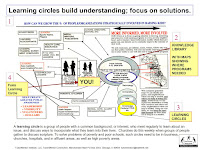
Young people (and adults) who take this role are learning to be the YOU in this graphic.  They will learn that it takes a constant effort to mobilize attention and draw people together to help youth tutor/mentor programs grow in all the places where they are most needed. 

These lessons apply to any problem solving, not just to building youth-serving programs.

I can be found on Twitter, Facebook, LinkedIn, Mastodon, Instagram (not yet Threads).  See links on this page.  Let's connect.

Thanks for reading. I hope you'll share this article.

That's me in this picture, with Leo, who I was matched with in 1973.  Leo called me a few days ago to ask what I knew about ChatGPT!  That's an example of long-term connections made possible by a multi-year, volunteer-based tutor/mentor program.  

Chicago and other place need more programs like Chicago Scholars, Chicago Youth Programs, etc. and the ones I led for 35 years.  


Friday, June 23, 2023

Focus on program design. Drawing attention.

Since 2005 I've posted more than 1200 articles on this blog. That means there's a lot to read. That's a problem.   So I use my Tweets to try to draw attention to specific sets of articles.  I posted these today.


These can be viewed in this collection of articles.  I realize that most people won't take the time to read many of these articles, which is why I've continued to encourage high schools and  universities to create a Tutor/Mentor Connection type study group on their campus, building this into on-going learning and leadership courses.  I shared that invitation in this Tweet.


Thanks for taking time to read this article.  If you go a step further and share it on social media and with your own personal network, you're taking an active role in helping kids in high poverty areas of Chicago and other places get the on-going extra support most need to move safely through school and into adult lives.


This is a photo from 1993 with myself surrounded by kids and volunteers in the new tutor/mentor program that I and six other volunteers created in November 1992. 

As you read my articles imagine such connections being established in thousands of safe places.  

I'm on Twitter, Facebook, LinkedIn, Mastodon, Instagram and a few other platforms (see links here).  Please connect with me.

If you can help fund the Tutor/Mentor Institute, LLC with a small contribution, visit this page and use the PayPal.  Thank you. 


Monday, May 16, 2022

Kids not living in high poverty need mentors, too

If you've followed my work for any length of time you see how my focus has been on helping kids living in high poverty areas connect with adult volunteers in organized non-school tutor, mentor and learning programs.  Open the graphic at the left and you can see a 10-point strategy developed in 1993 that I have followed for over 20 years.

For the past few years as I've watched horrendous tragedy of youth using AR-15 rifles to murder groups of people, as in Buffalo this past weekend, I've begun think that there is another category of young people who need a lot of extra mentoring and adult support.


Since launching the first tutor/mentor survey in January 1994 I've tried to build a segmented understanding of existing tutor/mentor programs in Chicago, sorting by age-group served, type of program and location. 

At the right is a graphic showing a vision that I've had for many years, of creating a much more detailed understanding of what types of programs are available within a geographic area.  You can see this graphic in this blog article. 

Below is a view of the Tutor/Mentor Program Locator which we launched in 2004, based on the printed Directory we had published since 1994.  It enabled people to search by type of program, age group served and location, to find programs in different parts of Chicago.


This has been an archive since 2018. You can read about it here.  If someone creates a segmented understanding of programs in their area, this is a way to share that information and help those programs attract volunteers, donors, students and media attention.

Below is an updated version of the graphic shown above.  


I've added another sub-category focusing on youth growing up surrounded by adults who have adopted anti democratic conspiracy theories, religious extremism, White Supremacy thinking, etc.  


At the left is a graphic that I include in a presentation titled "Defining Terms".  The graphic shows five categories of youth who could benefit from help provided by volunteers in organized, on-going, tutor, mentor and learning programs. The large light blue area in the middle, showing youth living in high poverty areas, has been where I've focused my efforts for more than 40 years.... helping kids in high poverty areas get extra support that aids them in the journey from birth-to-work.

I updated this graphic yesterday.  

I added a circle to show "all youth" need support of mentors and extra adults. This is similar to the graphic at the top of this article.  I included elements from the original graphic, showing youth with special needs and youth living in high poverty areas.

However, I added two more shaded areas. One focuses on children of the super-rich, who grow up living in a far different reality and level of experiences than do most other kids.  Can they empathize with the challenges other kids face, and use their wealth,  power and influence to help society overcome these challenges?

The second shaded area is more troubling. This includes all youth who are growing up surrounded by adults who have adopted anti democratic conspiracy theories, religious extremism, White Supremacy thinking, disinformation from FOX News and other sources, etc.   The terrorist who murdered 10 people at a Buffalo supermarket was clearly influenced by such an environment.

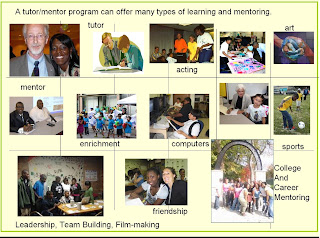
In an organized, non-school tutor, mentor and learning program youth can connect with a wide range of adults and experiences.  Not all programs have this design, and few offer all of the possible learning opportunities that might attract kids and keep them coming back every week for many years.

But that's the goal I've shared for 20+ years.
Now I think we need to be finding ways to reach kids who don't live in poverty (without reducing our on-going efforts to provide more and better programs and support to kids who DO live in poverty areas).  

I don't even know where to start.  

Well, I do, really,  I need to find a place where someone is collecting articles and research about this and also aggregating links to organizations working to combat the formal and informal grooming that is turning so many young people into disenchanted, destructive human beings. 

The graphic below shows categories in the Tutor/Mentor web library at https://tutormentorexchange.net/resource-links.  I can add another category but I'm not sure what to name it yet.  


I'll share this article on my social media posts and look for suggestions and recommended links from my network.  I don't intend to make this the primary focus of the library, but hope to be able to point to others who do make this the primary focus of their work.  

This page shows links to my social media pages, such as LinkedIn, Twitter, Instagram and Facebook.  I look forward to connecting with you there. 

Friday, February 11, 2022

Connecting seniors with K-12 youth - program design

Today I read an article from the Churchill Fellows blog about "harnessing the assets of the older people in our communities, including those living in long-term care and those living with dementia, and supporting them to build deep relationships with children and young people who are experiencing poverty and disadvantage."

This article outlines strategies for doing this,  including "overcoming silos to make the most out of resources".

This is something I've thought about for a long time. Senior citizens have been volunteers in tutor/mentor programs I led in Chicago between 1975 and 2011, but there's never been a strategy that would connect seniors systematically in youth tutor/mentor programs throughout Chicago.

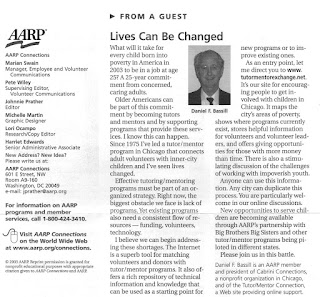
Below is a guest article I wrote for the AARP magazine in 2002.


I've followed the Churchill Fellows program for more than 20 years and hosted three different fellows between 1998 and 2006.  One was Clair Kime, who wrote this article summarizing her visit with myself and other tutor/mentor leaders in Chicago, Boston and New York in 2005.

AARP does encourage senior citizens to volunteer with youth, through programs like Experience Corps. However, I don't see a map-based strategy that connects seniors with youth the way the Churchill Fellows article envisions.  

When I say "map based" I mean leaders in different sectors should be innovating ways to make mentor-rich non-school tutor and/or mentor programs available in every high poverty area, for  many years.  

Such programs need a mix of volunteers working directly with youth, and working with program leaders to operate the program, raise needed funds, and build constant improvement.  Seniors have many work-backgrounds and a range of talents and could not only support individual programs, but lead city-wide efforts.

As you're doing your planning, take a look at the Churchill Fellowship article and think of ways you can involve seniors in many of the ways they describe. 

I'm on Twitter, LinkedIn, Facebook and Instagram. Let's connect and talk about these ideas. Find links here.


Monday, January 24, 2022

Elements of Effective AfterSchool Program

 I saw the Tweet below today, posted by the Afterschool Alliance.  It includes a graphic showing elements of comprehensive afterschool programs.  View the Pdf here.

In many of my own articles I've used a version of the graphic below to communicate ideal program design.


I actually think the AfterSchool Alliance graphic is more comprehensive. The only thing it's missing is a block showing "extra adult support/mentors" but maybe that's implied in the various types of activities included on their graphic.  

What they do include, more than I do, are other elements such as "wrap around family supports" and "healthy food and exercise".  


Helping youth programs get the volunteers and dollars needed to build and sustain such programs is what I've focused on since forming the Tutor/Mentor Connection in 1993 and Tutor/Mentor Institute, LLC in 2011.  

Here's one article that uses the graphic at the left. Here's a few others that focus on program design and infrastructure.  

I'd love to find more people creating their own graphics to show program design and infrastructure needed, as well as maps that show all the places where such programs are most needed. 

I encourage you to share these articles and graphics with people you know and start discussions about ways you can help comprehensive programs grow in all high poverty areas of Chicago and other places. 

Be the YOU in this graphic. 

As you look at the recommendations from the afterschool alliance here are two more resources.

8 Conditions for Student Success - developed by the Quaglia Institute for Student Aspirations (QISA)-  click here

8 dimensions of development from Afterschool Allstars Project - watch video. See chart at 9 minute mark. 

Thursday, December 09, 2021

What you don't see when you visit a Tutor/Mentor Program


Every year about this time between 1990 and 2010 I was writing grant requests, hosting site visits, and writing final reports to gain the operating dollars needed to support the annual activities of the site based tutor/mentor program I led in Chicago called, Cabrini Connections, and the Tutor/Mentor Connection, which I now lead through Tutor/Mentor Institute, LLC. 

It’s amazing how many people assume that getting teens and volunteers to Cabrini Connections each week was a simple process, and wanted to focus on how many kids are now college graduates because of the $5,000 to $25,000 they have provided in the past year. 


In October 2008 I thought I’d write and article to reflect on this. That article is posted below, with some updates.  


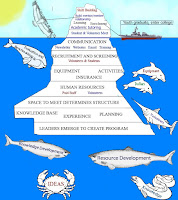
I called it “Below the Ice” because when you see an Iceberg, all you see is what’s above water. Most of it is below water and out of site. When you see a student and volunteer meeting at Cabrini Connections on a Tuesday or Wednesday evening, you'd you see what was happening for these two hours. You wouldn't see the infrastructure and program support it takes for the student and volunteer, or Cabrini Connections, to simply be here to make this connection.

So, what are we not seeing, or taking for granted?  This is a long article. In the first section I write about the thinking that goes on to make a program like this available to kids and volunteers.  

In the second section is a list of elements that must be in place to support this process. 

a) Someone had to make a commitment to start this organization, and keep it going. Cabrini Connections was not created by some government initiative, with a bundle of up-front dollars. It was started in October 1992 by seven volunteers who saw a need. They created Cabrini Connections to provide a 7th grade through high school support system for kids who were aging out of the 2nd to 6th grade Montgomery Ward/Cabrini Green Tutoring Program. They had no money. They had no space to operate. During the spring of 1993 there was no paid staff, and volunteers and kids met each week in the day-room of St. Joseph’s Church on Orleans Street in Chicago, and once a week at Wells high school.

b) Space is needed. We operated from the dayroom of a church for the first six months of 1993. Then the Montgomery Ward Corporation donated an entire floor of their corporate tower (almost 20,000 sq. ft. of space), along with desks, cabinets, parking and security. We operated from there from August 1993 until June 1999. Then we moved to rented space as Wards went out of business. We actually spit into two buildings, 8 blocks apart. The Cabrini Connections program operated at Holy Family Church on Larrabee, while the T/MC, and Fund Raising, operated from a room at 1111 N. Wells. In 2001 we moved into our current 4,000 sq ft location at 800 W. Huron, just a few blocks from Cabrini Green. 

While we had donated space we could devote all funds raised to our programs. And we had a $40,000 annual grant from Wards. This really helped us get off the ground because in 1993 we only raised $50,000 and in 1994 we only raised $114,000. Without the help from Wards the program would never have built any kind of following. However, since 1999 space, utilities, and insurance expenses were over $70,000 per year. This was a fixed expense that was necessary for us to continue to offer the program to kids in Cabrini Green. Without funds for the space, insurance, equipment and utilities there is no program.

c) If you want good results, you involved talented people. Volunteers can do tremendous things. I led the tutor/mentor program at Montgomery Ward for 15 years while holding a full time retail advertising job. We had more than 300 kids and 300 volunteers participating by 1990. We had nearly 50 volunteers involved in various leadership roles. Many of these volunteers came from companies beyond Wards. However, to support this type of volunteer involvement I spent my lunch, evening and weekend hours, plus at least one week of vacation each year, doing the work of leading this organization. I had tremendous freedom to take phone calls and work on this during the day, as long as my own work was being done to an outstanding level.

And while we did a great job of keeping kids and volunteers connected, I think we could have done much more if I or another leader had been able to devote 40 to 50 hours a week on this. At Cabrini Connections the glue that keeps the kids and volunteers coming is the lead coordinator, who is a paid staff person. In 2008 we had 70 kids and more than 90 volunteers participating weekly and a more than 400 alumni. We had two full time staff people, one full time e-learning coordinator, and myself. To keep the lead coordinators in place we needed to reward them with decent compensation and benefits, and try to surround them with extra help (staff and volunteers) so they don’t burn out and leave after a couple of years.

d) Volunteers are critical to success of this organization; but they need support, too. We have volunteers in a variety of leadership and organizing roles, not just on the board of directors. Many of them have been involved for five or more years. They represent the organizational knowledge, in addition to my own. However, these lead volunteers need to be recruited, supported and mentored by our lead staff.

e) Volunteers are customers. The need to be recruited. They are not standing in line waiting to be your tutors and mentors. The best way to recruit new volunteers is to provide a great experience for your current volunteers. We started with seven volunteers in October 1992 and added new volunteers each school year from 1993 till I wrote this in 2008. We grew Cabrini Connections, and before that the Montgomery Ward/Cabrini Green Tutoring Program, by converting volunteers into ambassadors who go out and recruit other volunteers. Many of these people are also recruiting the dollars we need. However, this is not something that happens by accident. It takes lots of time, and a consistent effort to provide a well-organized experience, and to mentor volunteers as they attempt to build relationships with kids. It takes a constant external communications (see below) to attract new volunteers to replace those who leave the program during every year.

f) Kids are volunteers, too. This is not a court mandated program, or a program for failing kids who are sent here by schools. We focus on kids who can succeed in school and life if they just get the support the need to overcome the obstacles poverty put in their lives. These kids did not start Cabrini Connections. Our founders saw a need and invited kids to participate. Each year our customer service intends to provide an experience that motivates kids to come back each week, and each year. Each year our outreach aims to recruit new students who don’t know about our program, but might participate if given the chance.

g) Our volunteers are the CEOs of this effort, not the staff. Each volunteer is different and each youth is different. The strength of a one-on-one program is the ability of a volunteer to tailor his/her mentoring and tutoring to the needs of the student and the talents and time available from the volunteer. The longer someone stays involved, the more experienced and effective they become. And while 25% of our volunteers will stay 3 or more years, many only stay one year, and some do not complete their first year. This means the volunteer work force is in constant need of mentoring and coaching from other volunteers and from experienced staff.

h) Finding space, finding staff, setting up a structure and a recruitment campaign to get kids and volunteers to participate is just the beginning. Each week during the school year there is constant follow up and coaching of each student/mentor pair. There is constant planning to develop activities to support the weekly tutor/mentor sessions. There are mountains of details required to track attendance, keep information current in databases and on email lists, and to stay in touch with parents, teachers, social workers, as well as volunteers. There are new volunteers to be interviewed. There are 70 kids, and 70 different sets of personal and family issues to deal with each week.

i) Communications is hard work and takes time. Creating the training materials, writing the weekly email newsletter, maintaining the web site and on-line documentation systems, and creating brochures to recruit new students and volunteers requires time and talent. The less talent you have at writing, the longer it takes to write a letter, or a brochure. We are required to multi-task because we only have 3 people. Yet, if we do not provide these communications, we cannot mentor and guild the process of our kids and volunteers.

j) Does it work? We say kids and volunteers vote with their feet. Thus, if they come most of the time (80% is our goal), and most return from one year to the next (kids goal: 80% return; volunteer goal: 65% return) then we feel they are telling us that they like what we are doing. However, donors want to know more. What impact does this have on grades, test scores, social and emotional behavior. We can say from observation and feedback that it benefits some kids more than others and that some volunteers have had life changing experiences because of their involvement. That’s enough to keep me working on this every day.

However, we can’t quantify this via traditional research and evaluation. Why? We barely have the manpower to do what we’re doing. That’s why.  Furthermore, the impacts of this type of mentoring are long term. The benefits accumulate over time. An evaluation would need to cover many years and extend into the years after kids have finished high school to paint a true picture of our impact. Such research is not being done in very many places because most programs have the same problem we have of not being able to stay connected to kids or volunteers once they no longer attend the program.

(visit my page on Facebook and look at my friends list. Many are alumni. If you look at the posts on their own timelines you'll see stories of their success, and the success of their own children who are now finishing high school and entering college.)

k) The money does not come out of thin air. It took six months to find donated space at Montgomery Ward, along with a $40,000 grant, that enabled the program to hire part time staff, and purchase needed office equipment. Every year since then, the organization has started the new fiscal year (Jan. 1) needing to raise all of the money for the program’s operations (rent, utilities, insurance, staff, etc.) as they also provided coaching to kids and volunteers. During the 10/7/08 Presidential campaign debate one question asked was “what level of sacrifice will you ask from Americans”. I don’t think either candidate answered that question. If you read my blog I think that for there to be programs like Cabrini Connections in hundreds of places, lots of people are going to need to go beyond 2% annual donations, and a few hours of volunteering. Our men and women in the armed forces give 100% for our freedoms. Each person needs their own personal barometer, but hopefully our leaders can light a fire so some people will go beyond the call of duty for citizen service.

l) And we cannot attract donors without good communications and consistent outreach and evidence of impact. Many larger non profits have full time development directors and staffs with many people. They can farm out creative work to ad agencies and creative services because they have the money to do that. One potential donor, who was worth about $500 million, once asked me why I needed to spend $70,000 a year on fund raising. He said his charity did not need to do that. He could just call someone and get the money they need. He gave me $1,000 one year and nothing after that. My budget for Cabrini Connections was about $200,000 in 2008. How did he think we were finding the other $199,000? If we’re spending all of our time coaching kids and volunteers, where do we find time to market and do fund raising?

m) The answer would be to have people with high net worth adopt Cabrini Connections. Then they could call themselves up each year and say how much good work we are doing, and ask for a donation to cover the budget. A CEO of a real estate company once said “that’s a tax deduction” when talking about the $4 million it would take to purchase a building for our operations.

n) Another answer would be to build a network of 1000 people with modest means who would each provide $250 per year to support the program. That has more potential. $250 is really just $5 a week, or, maybe the cost of one latte at Starbucks each week.  Is the potential future of an at-risk child worth a cup of java to you?


What Basic Conditions need to be met, to attract students and volunteers to a site based tutor/mentor program?

Listed in order of priority are the organizational needs that had to be met each week for CABRINI CONNECTIONS to maintain the high quality level for which it has earned a reputation of excellence.

1) Create positive environment for tutors and students to spend time together. 

    • Clean, orderly area (70 desks, 100 chairs)
    • Pencils, paper, calculators, scissors, attendance lists, and other needed supplies stocked in cabinets
    • Learning resources, such as library, worksheet binders, and geography materials in place and orderly.
    • Coffee and snacks in stock and prepared for distribution. 

2) Provide a structure and support that offers an opportunity for a satisfactory experience. Focus primarily on tutors because if volunteers were to stop coming, the program would not survive.

    • Annual evaluation, review and plan which incrementally builds on previous year accomplishments
    • Regular communications program (newsletters, email, blogs, web sites, bulletin boards, etc.)
    • Informational and historical record (Annual Report, brochures, etc.)
    • Information on community resources, field trip activities, etc.
    • Motivation activities such as parties, field trips, and writing contests

 3) Provide a broad base of resources from which individual children and tutors can build activities.

    • Library, with reference materials and motivational activity worksheets 
    • Internet Library with home work help, suggested activities, tips for tutors/mentors, networking opportunities.
    • Student history file with report cards
    • Teacher referral forms from local schools
    • School supplies, learning resources, library
    • Computers, with dedicated work area
    • Speaker/Role Model Program
    • Field Trips to business and college sites
    • Parties and informal social gatherings for kids and volunteers 

 4) Ensure frequency and consistency of participation. Focus on student attendance because if students come inconsistently tutors will eventually stop coming. Focus on tutor attendance to improve relationships and quality of tutoring/mentoring children receive.

    • Preparation of weekly attendance record, with volunteers to do check in
    • Maintenance of tutor and student address data-base with up-to-date info
    • Tutor contact network with weekly follow-up
    • Weekly calls and letters to children with 2+ absences
    • Perfect attendance recognition and reward for 10 weeks without absence
    • Recognition for volunteers with 90% or better attendance
    • Marketing and maintenance of Point Bank system

5) Provide training and other motivational resources to enable tutors to have more satisfying and effective experience.

    • Written Handbook, plus regular handouts
    • Organized training sessions (Orientation, Fall Workshop, Jan. Workshop)
    • First Year tutor orientations every 6 weeks
    • Encourage participation in program committees and after-tutor activities
    • Files full of math and language-skills worksheets, to be used as individual lessons
    • SVHAT20 on-line support system for students and volunteers

 6) Provide direct service benefits to children.

    • Safe environment in which to interact with caring adult.
    • Role models to spend time with
    • Extra learning activities such as arts, technology, writing clubs
    • Computer and Internet access for homework  help, networking, communications with volunteer
    • Learning materials (books, pencils, reference books, dictionaries, etc.)
    • Books to check out and take home to read.
    • Snacks at sessions
    • Experience and enrichment activities (field trips, etc.)
    • Parties, with gifts and treats 

 7) Involve parents in tutoring activities and children’s education.

    • Parent Orientation at start of year
    • Involvement of parents in weekly sessions
    • Informational literature provided through program
    • Auxiliary parent-education programs on subjects such as nutrition, or reading to children at home

8) Involve teachers and social workers in tutoring activities and children’s education.

    • Teacher and Social Worker  Orientation or Introduction at start of year
    • Involvement of teachers and social workers in developing mentoring and tutoring strategies
    • Informational literature provided through program
    • Report Card permission from parent so school can release information directly to program
    • Coach volunteer to contact teacher or social worker directly

 9) Involve business in tutoring and mentoring activities and children’s education.

    • Through the Success Steps engage business in providing training programs to prepare students for work
    • Create a pool of part-time and summer jobs for qualified students, at companies which commit to also “mentor” students while on the job
    • Create scholarship pools from Success Steps companies which help student obtain advanced education.
    • Invite businesses to Career Day activities
    • Teach volunteers to be ambassadors for tutor/mentor within their company or industry

The leaders of Cabrini Connections needed to be thinking about all of the things listed above, every day, every year. Finding people who understand this, and can recruit volunteers and donors to help do some of the work, and who can relate to kids and families, and who will stay with this five or ten years, is the biggest challenge we faced. 

We can overcome part of this challenge if we can find donors who understand what's under the surface and who will help us have the operating dollars to try to make this type of program available to teens in this part of Chicago.

If you've read this far, thank you.  I led this process every year from 1975 until mid 2011 (as a volunteer from 1975 till 1990).  

The original program I led is now Tutoring Chicago.  Cabrini Connections became Chicago Tutoring Connection around 2013. Sadly, they stopped operating around 2023.  They and each other youth tutor/mentor program in the Chicago area need your contributions this year, and every year. 

If you lead a non-school youth program, what are the elements that make your volunteer-based tutor/mentor program a success. Do you share this on your web site so others can learn from you?

What I described above only showed work we did weekly to operate our youth-serving tutor/mentor program.  At the same time we were working to make our program successful, we were trying to help more than 100 similar programs located in different parts of Chicago get the ideas and resources each of them also needed. And we were trying to build and share a library of information that our volunteers and leaders could use, as well as leaders from other programs.

We were doing that with no more than 2 full time staff. 

I only am responsible for the Tutor/Mentor Connection now, via Tutor/Mentor Institute, LLC. This blog is one of the resources I use to share information others can use.    While I no longer lead a direct service program I share my 35 years of experience in posts like this to help other programs grow throughout Chicago and in other cities and states.

Feel free to borrow and share the ideas.  

If you'd like to connect I'm on Twitter, Facebook, Instagram and LinkedIn.  

If you'd like to help, see my FundTMI page, or my 75th Birthday page.