Wednesday, October 09, 2019

Enlisting College Fraternities - Doing Well. Doing Good.

Acacia on Ning - click here

I attended Homecoming at Illinois Wesleyan University on October 5, 2019 and spent the day with Acacia Fraternity brothers ranging from Pin Number 3, one of the founders of the IWU chapter in 1957, to new pledges who have just joined in 2019.

During the alumni/active chapter meeting held at 10:am rush (recruiting new members) was discussed, as well as the negative image of fraternities in public media.

I took the opportunity to call the group's attention to a discussion started on the Tutor/Mentor Connection Ning.com forum in 2009, and my efforts since the early 2000s to motivate the IWU chapter and the national fraternities, to adopt the Tutor/Mentor Connection strategy, for the following reasons.

1 - student learning - between 2006 and 2015 interns from various colleges, including many from South Korea, spent time looking at ideas on my web sites, then creating their own interpretations. View these here. In many cases interns used this opportunity to teach themselves new communications tools. If you visit this section of the T/MC Ning forum you can see who they were and see their reflections.

If Acacia undergrads started doing this work as freshmen and continued through graduation they would learn a wide range of tools to share their understanding of complex ideas with many other people. They would learn leadership roles and the cyclical process of action research.

2) Public visibility and public image - if service-learning teams grew within each chapter, and if chapters were connected and learning from each other,  duplicating the Tutor/Mentor Connection 4-part strategy, to build greater understanding of issues, and greater involvement in solving that problem, focusing on the local community where that chapter is located, or where undergrads and alumni live, tremendous positive visibility can be generated. 

Build collection of media stories
Visit this link and view the list of media stories that I've been able to generate over many years. Then imagine a place on each chapter's web site where a similar list grows as a result of their consistent work in this focus area.  View this list of awards, with the same goal in mind.

3) Connections between alumni and undergrads, and between chapters across the country. Imagine being able to go to the web site of any chapter and finding a page with the graphic at the top of this article. In each node would be links to a sub-page, showing a group of people studying a particular issue.

Then imagine finding network analysis maps using tools like NodeXL, showing Twitter, Facebook and/or Linked in discussions of this strategy, or of any of the sub-issues on the concept map above. The nodes on the NodeXL should show numerous undergrads and alumni from different chapters talking about that issue during a specific time frame.

Over time participation in these discussions would grow as the social media strategies described at this link are learned and applied.

Many can fill leadership role.
4- Impact on Rush and Fund Raising - This graphic shows that an on-going campaign can raise visibility and draw volunteers and dollars to all youth serving organizations in the city where a fraternity is located.  This also draws attention to the Fraternity.

A strategy that focuses on issues important to a community, and that focuses on helping kids from high poverty areas come through school and into college, which generates growing public and social media awareness, has to build awareness among incoming students (and parents) and potential donors, as well as university administrators. That awareness leads to new pledges and new dollars to fund scholarships, operations at the local and national fraternity level.

It also influences what other fraternities do.

5 - Impact on careers. A network analysis map shows connections between people. In each map the growing number of undergrad and alumni nodes represents constantly expanding social capital, that can open doors to jobs and business opportunities and strengthen the ties of brotherhood, within each chapter and across the national fraternity.

6 - One Acacia in a divided America - If there are groups of undergrads and alumni in each node focusing on important issues, the on-going work builds stronger ties and reduces the social and political divides that are tearing America apart.

All of these are leadership roles that are available to Acacia. Just by sharing your interpretation of this article from the National Chapter, at Conclave, and from local chapters, you are inviting members to take time to understand it, and to take the lead in launching it.

I've created two Slideshare presentations to help communicate these ideas.

Creating a Tutor/Mentor Connection on a university campus:


If this strategy were in place, there might be a dozen versions of these presentations, embedded in blogs on each chapter's web site, and even on the company web site of alumni participants!

That's the goal. The Tutor/Mentor Connection/Institute, LLC pages are intended to simulate and influence thinking and actions of others.   Feel free to create your own versions. Use as thought starters. Share them with me on Twitter, Facebook and/or Linkedin.

If this article has value, please consider a contribution to help fund the Tutor/Mentor Institute, LLC. Click here to learn more.


Wednesday, October 02, 2019

What's Next for Volunteers and Youth in Tutor Mentor Programs?

School has started and for the past few weeks non-school volunteer-based tutoring and/or mentoring programs have been going through the annual process of recruiting, interviewing, doing background checks, providing training and orientations, all leading up to matching a youth and a volunteer in what they hope will be at least a year-long journey.


Connecting a youth with an adult volunteer is just the beginning.
Each week volunteers will be looking for ideas and "what to do" when they meet with their mentee. As they get to know the kids they will also begin to have questions related to the social and emotional well-being and academic needs, of their mentees, as well as the level of support the community and local schools provide.

I've been building a Tutor/Mentor web library since the 1990s (based on a real library I started in the 1970s) which is intended to support volunteers and youth as the look for ideas and what to do.  Below is a concept map pointing to different homework help and learning resources in the library.

Homework Help/Learning Ideas - click here
Open the links at the bottom of each node then scan through the resources that I host on the site. One way to encourage youth and volunteers to do this is to create a "scavenger hunt" or "web quest" and encourage them to write about what they find on an organization blog. As they share what they learn, others are learning with them. The knowledge spreads.  Encourage this. Rewards help!

Once you are familiar with what's in the library it's easy to go back to find specific resources when they are needed.

Answering questions volunteers have will be more of a challenge, since each student is different.  Having an experienced staff who have knowledge of local issues and schools is critically important.  However, encouraging volunteers to network and learn from each other is equally important.

To support this learning I point to one sub-section of the Tutor/Mentor Library, with sections that include many articles about race, poverty and inequality.  This is another set of links that will require on-going reading. There's a lot there. 

While the school year has just started, now's a good time to remind you to think of the year-round planning process that will help you build and sustain a strong program.

The presentation below focuses on year-round planning. It is one of four that are included in this section of the Tutor/Mentor Institute, LLC website. 

If you follow this planning cycle you'll be collecting ideas now that help you with volunteer recruitment and training when you start the next school year.  You'll be building organizational knowledge that helps you, your staff and your veteran volunteers and students create a culture of learning that focuses on what you need to know to attract students and volunteers, help them build strong relationships and help them do all they can to assure student growth, success in school, and movement toward graduation and adult lives.


I started reaching our to leaders of other tutor/mentor programs in Chicago in 1974 when I first became part of the leadership group of the program at Montgomery Ward.  I've continued this learning ever since.  When we formed the Tutor/Mentor Connection in 1993 one reason for building a list of existing programs was to provide a resource that enabled everyone to learn from everyone else. 

I hosted conferences in Chicago every six months from May 1994 to May 2015 to encourage programs to connect and learn from each other.  Since going on line in 1998 I've tried to encourage tutor/mentor program leaders and volunteers to use on-line spaces to share ideas and help each other.

I now now maintain a list of program on three sites:

on Facebook - click here
on Twitter - click here
on Instagram - click here
on LinkedIn - click here
on the Tutor/Mentor Institute, LLC site - click here

These enable anyone to look at information other programs are posting or sharing on their web sites. Anyone can reach out with questions. It just takes time.

When I left the Cabrini Connections program in 2011 one of the Board Members said "We'll never know have as much as you've already forgotten."   

I've devoted the past 30 years to finding ways to aggregate knowledge, including experiences of people who have led tutor/mentor programs, in an effort to build a university curriculum that would train people to come into jobs or volunteer roles ALREADY KNOWING MUCH OF WHAT I'VE LEARNED. 

It's unrealistic to expect busy volunteers or transient paid staff to spend 10, 20 or 30 years in one or more programs, learning as much as I have along the way. A few will do that. Not enough.

We need to create a formal learning process, starting when kids are in K-12 school and continuing through college and career. 

read article - click here
That's what this graphic is describing. Read this article and join me in reaching out to one of the many billionaires who are making multi million dollar gifts to universities, so that one of them designates her gift to building a Tutor/Mentor Institute, based on these ideas.

I started this article providing homework help resources for volunteers and students.  Then I moved on to program planning and development.

Hopefully some volunteers, students, parents, staff and alumni from different programs will dig deeper and think with me about ways to build and sustain high quality programs in more places.

I look forward to connecting with you on one of these social media sites.

If you value these articles, please click here and send a contribution. 

Saturday, September 28, 2019

Concept Map Library - new page


I've been creating concept maps to visualize ideas since 2005. These are embedded in dozens of blog articles which you can find if you scroll through this set of articles.

I have built so many that I created a page on my web site where I showed all that have been created.  I've pointed to that link often.


Today, I built a new page, with a new link.  It is
http://www.tutormentorexchange.net/conceptmaps

If you click on the earlier version you'll still see the maps, however, I'm not updating these and the images are not always showing properly.

If you're interested in the concept maps, bookmark the link above, so whenever you want to visit the library you go to the most current page.

By the way. I'm not really happy with how this looks, but I've stretched my page building and HTML knowledge as far as it goes.  If someone wants to build a new page that I can put on the JOOMLA platform, please get in contact with me.

Thursday, September 26, 2019

Connecting with the world and the powerful - via Twitter

I've included versions of this graphic often in my blog articles to show my role in connecting people who can help, to information they can use to support decisions they make about who they will help and what type of help they will provide.

I've never had much (any) money for advertising so have used blogs, my web sites, email newsletters and social media to try to connect with others.  Below are a few Tweets from the past few weeks that illustrate how I am doing this.

I posted this on Sept. 17 as I listened to a webinar hosted by the Forum for Youth Investment  The archive of that event is here


Then on Sept 19 I participated in this #MPCLuncheon, hosted by The Metropolitan Planning Council, with Tweets like this,

Here's another Tweet that I posted, using #MPCLuncheon hashtag.

At the same time I was watching the September 19 City Club of Chicago lunch speaker and posted the Tweet shown below.  The City Club of Chicago hosts weekly lunches and livestreams them so people like myself can engage, just as I'm demonstrating.


Because I mentioned #NodeXL, a network analysis tool, in my #MPCLuncheon Tweet, they created a network analysis map showing who was connecting on September 19.

On Sept. 21 I shared this with Raymond Lopez, Chicago's 15th Ward Alderman

Then I posted this as I followed some Tweets from the Rockefeller Foundation who hosted a major gathering in New York City this week, to discuss ways to achieve the UN Global Goals by 2030.  There are 17 Goals, so their event was organized into #17Rooms.

On Tuesday, Sept. 23, I responded to an email invitation from the Rockefeller Foundation to share #myglobalvision

Also on Tuesday I posted this Tweet, from The Green Living Room in the Woodlawn area of Chicago, just South of Hyde Park.


Today I shared this Tweet, pointing to an article written by the President of IFF (International Finance Fund?).

I've included hashtags and links in describing each of these Tweets, so you can go back and review each of these conversation threads. You can reTweet, LIKE, or even post your own comment, sharing information about your work the way I do.

You can also visit @tutormentorteam and scroll through Tweets I've posted over the past few weeks.  What I've shared in this article are just a small sample of the wide range of people I've reached out to via multiple Tweets. I've been doing this for the past 10 years!

I received some ReTweets, some LIKES, and a few followers from these. Over the past few years I've developed some pretty strong relationships, and cultivated a few new contributors who help fund my work. 

That's the goal.  I want people to use the ideas I share, even if I never hear from them.  

However a larger goal is that someone who reads my post and digs into my blog articles and web sites will step forward to put her name on the Tutor/Mentor Institute, LLC, with a major investment that brings it into a university, or some other structure, where it can be re-built, and reach a much larger network of people than what I've been able to reach.

These articles talk about "A New T/MC". Take some time to look through them.

It's a process. It takes time. It's an investment of time on my part. 

If you want to make a difference, start reading these.  Or start following me on Twitter, Linkedin and Facebook.


Thursday, September 19, 2019

Know the Network. Nudge the Network.

I started leading a volunteer-based tutor/mentor program in 1975 while starting an advertising career with the Montgomery Ward Corporation in Chicago.  What I learned over the next 15 years was that leaders constantly need to be reaching out to people with different talents and networks to help them do the work needed to sustain and grow the organization.


As I was learning this by running a volunteer base program I was also learning this from how we used weekly national advertising to attract customers to our 400 retail stories located in 40 different states. The graphic above visualizes the idea that it takes teams of people with different talents to help youth tutor, mentor and learning programs thrive. In a big city like Chicago, it takes many of these programs to reach just a fraction of the 200,000 or so kids who could benefit.

Talent needed - click here
At the right is a concept map that visualizes the talent needed to help an organization thrive.  Each of these nodes should link to social media or Linkedin profiles of people who are providing that talent in support of the organization's mission.

In the blue box at the top of this cMap is a link pointing to a similar map, which shows networks, rather than skills.   You need a mix of talent representing different networks.

Finding and recruiting people to fill these roles is an on-going challenge, that is especially difficult for smaller organizations who don't have major civic and/or business support.

I participated in two Twitter chats today which were in support of events held in Chicago which each attracted at least 200 civic and business leaders.  One was hosted by the Metropolitan Planning Council, with the Raj Chetty (see my July article) as keynote speaker. I show one Tweet from that event,  using #MPCLuncheon as the hashtag.


The second, held during the same time frame, was live streamed by the City Club of Chicago.  Here's a Tweet that announced the event.
For several years I've been encouraging event organizers to be more active in encouraging participants to connect on Twitter using a common hashtag.  At the same time I've also encouraged them to use network analysis tools like NodeXL to create a graphic showing who did participate and how they are connected to each other.

Today I posted a Tweet at the start of the event encouraging Metropolitan Planning Council organizers to do this.

Then later this afternoon I received a message from NodeXL with a map that they created showing participants in the #MPCLuncheon event. I show it below.


You can see this actual map, and view an interactive version, at this link.   

I think there are 25 nodes (Twitter users) on this map. That's far short of the 150-200 who were at the actual lunch event, or the potential audience who could have been following on line.  To make a comparison, visit the NodeXL gallery and view their collection of maps. Many with several hundred nodes. 

Update:  Here's an updated NodeXL map, from 9-20-2019 showing 43 users.  click here

I've posted several articles in the past showing how network analysis can help community organizers build a better understanding of who is participating in their events, and thus, also a better understanding of who is missing.

Connect those who can help
with those who need help.
Using this information I feel organizers can nudge the network to do learning, network building, donating, volunteering, voting, etc. and other things needed to build and sustain an effective organization.

They can also reach out to add new people based on what talents and networks are missing from their ecosystem.  Furthermore, they can use these maps to demonstrate a growing (or shrinking) participation over months and years.

I'll share this article on social media with the goal that some of the people who see it will a) embrace the idea and build it into future activities; or b) show me blog posts that illustrate how they are already doing this type of work.

Maybe some will even add me as a consultant to their planning teams to help them think through network building and engagement strategies like this.

Thanks to Valdis Krebs for the "Know the network. Nudge the Network." phrase.

If you've found value in this article please consider a contribution to help fund the Tutor/Mentor Institute, LLC. Click here to learn more. 


Saturday, September 14, 2019

Five Dot Challenge from #CLMOOC

On Twitter - click here
If you've followed my blog for a few years you have seen me point to the Connected Learning #clmooc network that I'm connected to on Twitter, Facebook and via blog articles.

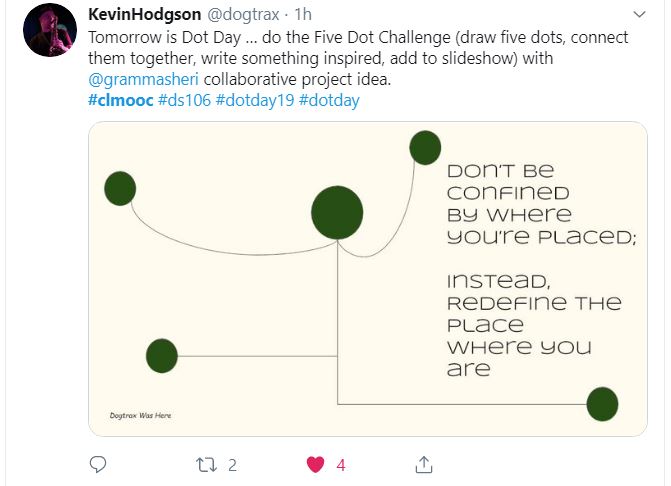
For the past week or so I've seen this invitation to participate in a five-dot challenge, which is illustrated by Kevin Hodgson in the Tweet at the left.

What you've also seen if you've read past articles is that I usually connect these activities to work I'm doing.  So, my five-dot challenge graphic is shown below.

My five dots are shown on the 4-part strategy map.  
The Tutor/Mentor Connection piloted this strategy in 1993 and I've followed it since then. You can see it on the strategy page of my main web site.  I wrote several blog articles describing the 4-part strategy. Here's one.  http://tutormentor.blogspot.com/2017/07/four-part-strategy-to-help-k-12-youth.html 

See intern visualizations
As I write my blog and share with educators and leaders of other youth tutor, mentor and learning programs in Chicago and other cities, one goal is that youth in these programs look at these articles, then create their own interpretations, using a variety of different media and communications formats.  Visit this page and see how interns from South Korean and US universities have interpreted the four part strategies of the Tutor/Mentor Connection (which I now lead via Tutor/Mentor Institute, LLC).

I've never had enough support to do all that I've been trying to do, and have believed that youth in high school and colleges throughout the country could provide manpower and talent to lead Tutor/Mentor Connection-type strategies in their own communities.  Below is another version of the four part strategy, which in this case, shows work youth could be doing.

Look deeply and see ways youth and others can help - click here

While I've tried to inspire people to share what they find on my web sites, blogs and social media post, those who have been doing that are pretty scarce.  Visit this cMap page and you can view blog articles that show how some people have been doing this.

View here

Thus, I've been really impressed by how Democratic Presidential Candidate Andrew Yang has inspired dozens (probably more) of people to create videos telling their #MyYangStory.  The one shown at the left is just one that you will find if you search #yanggang on Twitter. 

I've not made a commitment to vote for Andrew Yang. What I'm saying is that I'm really impressed at how he has inspired so many other people to help share his message.

Imagine if that many people were sharing the ideas of the Tutor/Mentor Connection/Institute, LLC.

Would that result in more people helping well-organized non-school tutor, mentor and learning programs reach k-12 youth in high poverty neighborhoods of the USA and the world?

Would it share ideas and generate resources so that in five or ten years we'd find stories on thousands of web sites showing kids and volunteers who have had their lives transformed as a result of being part of these programs?

That's the goal.

Thus, my five dot story is intended to inspire such actions.  If you create a post, share it on Twitter with me at @tutormentorteam.  

Monday, September 09, 2019

Looking back 21 years - Webheads and Tutor/Mentor Connection


My wife complains that "I never throw anything away."  She's right. I'm a collector. We sold our house this spring and had to down-size. It was terribly painful for me.

This habit is especially true when it comes to the information I've learned from leading a volunteer based tutor/mentor program in Chicago for 35 years and from trying to help fill city neighborhoods with well-organized programs for the past 25 years.

This graphic is one of the first that I created in the early 1990s to show the type of information I was gathering and sharing - initially via print newsletters.  The challenge that I've always had (of many) is finding ways to help other people find and use the information I've been collecting.

It's not a challenge that is unique to myself.

Yesterday I joined in an on-line reunion, celebrating 21 years of a group called Webheads in Action.

Three original Writing for Webheads members, Vance Stevens, Michael Coghlan and Felix Zaniboni, convened in Zoom for a 21 year reunion. It started at 7:AM Chicago time, but late in the evening for the others. I joined in late.

Vance has been the prime mover in this group since it's beginning, so he created a blog article and posted it today, to recap the conversation.  I show the heading below, but am not going to try to recap all of the detailed information that Vance put in the blog, which recapped what was shared in the on-line session. 

Read Vance Stevens' Learning2Gether blog from 9-8-19
I really, really, really hope some of you will open the link and read Vance's article.  Look at how he is pointing to Webheads events from as early as 1998.  He's been generous in using the space to show how I've connected to Webheads since the early 2000s and shows one of the interviews he and I did together.  You can view the video on YouTube.

Innovation, creativity - cMap
What Vance is doing is showing people his collection of Webheads history, and in doing so, he's sharing ideas that I and others contributed during our interactions over the past 21 years.

At the right is a cMap showing one of four sections of the Tutor/Mentor Connection/Institute web library, which I started putting on-line in 1998. I'd been collecting some of this information as hard-copy publications since the 1970s.

Here's a screenshot of that section of the library.

Collaboration, innovation, knowledge management, mapping - click here
There are 443 links divided into six sub-sections.  Yesterday I finished opening every one of those links, checking to see if they still work, updating broken links and refreshing myself on why I added them to the library in the first place.

As I did this I shared some of the links on Twitter. Here's an example:


If you search @tutormentorteam on Twitter and scroll through my past Tweets you'll find many examples.  If you read Vance's blog, you'll see that he's doing the same thing in the way that he pointed at my Tweet about yesterday's event.

If you look at the graphic at the right, Vance, and myself, are the people in the middle, hosting information libraries and spending time on a regular basis helping other people find and use that information. I've been trying to teach others to take this role for many years.

Below is a cMap that illustrates some success.  I created this a few years ago to point to places where other people were writing about work I'm doing, to help facilitate understanding among a larger network of people.  Vance Stevens is one of the nodes on this map and I added a link to his blog.  Many people who I've met via the #clmooc group are also included, as are interns who worked with me from 2006 to 2015.

Connecting with others - open links on each node 

Many of my blog articles are pointing to the past in an effort to share information people can use to shape a brighter future for kids and families.  If you browse the list of articles in the cMap above (click here) you'll find many that talk about learning, network building, collaboration, etc. Most put the responsibility on the learner to do the walking and to create new content that does the sharing.

Want another example of what I'm talking about and asking you to do?  Take a look at this Tweet.


For the past month or so I've watched a growing number of people take turns sharing the ideas of Andrew Yang on Twitter, using #YangGang as one of their hashtags.  He and his campaign team have created content which they share via books and on his web site, and a growing number of others are creating new content to share these ideas.

Imagine being able to get kids and volunteers from multiple youth programs connected to each other in long-term communities like Webheads.  Then imagine them sharing their stories and talking about what it takes to build and sustain a long-term tutor/mentor program, using the same enthusiasm and frequency that #YangGang members are doing.

Would that result in more well-organized, long-term programs reaching k-16 youth in high poverty areas all over the country - or the world?

That's the goal. If you've read this, write about it. Share it. Create a video.

And, if you're able, send me a contribution, click here, to help me fund this work.  

Saturday, August 31, 2019

Building Systems of Support for Urban Youth - What's It Look Like?

Last Sunday the Chicago Tribune called attention to our inability to solve the violence and poverty that plagues some parts of Chicago more than others by telling the story of  Yummy Sandifer, from 1994.  I wrote about this on Monday.

I shared my post on social media but received no responses. Yesterday I saw a post on Twitter, following up on this story. You can see it below:

Peter Nickeas, the writer, talks about systems that touch violence.  As I read this and tried to frame a response, I was frustrated because I have more thoughts than could be communicated in one Tweet.

Since the mid 1990s I've been using visual tools to try to show "systems" of support that need to be available in every high poverty neighborhood, using graphics like the one at the right. I've embedded these in print newsletters, web sites and my blog articles, as well as in my own posts on social media.

I create many of these using PowerPoint, which I then convert to JPGs.  A few months ago I embedded one of my PPTs on Slideshare, to enable people to view a collection of graphics in one place. I show it below:


While there are more than 30 graphics in this PPT, that's really just a small sample of the graphics I've created.  Here are places you can find more:

1)  Pinterest.com/tutormentor  - I've created several collections on Pinterest. With each graphic I've included a link to where the graphic was used

2)  Google search - view images - if you search 'tutor/mentor connection' on Google then look at the images, you'll find dozens of my graphics. Each has a link to where it was used.  Do the same search on Bing.com

See map here
3) Concept maps can be used to visualize systems of support, showing all that is needed, to help young people move safely through school and into adult lives.  I show a collection of my cMaps at this link.

The Mentoring-Kids-to-Careers cMap is at this link.

Every time a story appears in the news that causes you to ask "Why is that happening?" or "What can I do to change that" I encourage you to view some of my graphics and draw others together to discuss what they mean to you.


That's what I was trying to communicate in this graphic (which was created by an intern from South Korea, using the graphic shown below).  We talk about the "village" that needs to be involved in raising kids.  I show that the "village" consists of many groups.  Each needs to be looking at these graphics, and maps of their city, and asking "What can we do?" and "Where can we help?"

The graphic below shows this in two earlier visualizations.  The top one shows the network of support that helps kids grow from birth to adult lives. Where you are born determines the range of support and opportunities your network makes available to you. Kids born in high poverty don't have as diverse a network modeling hope and opportunity. I believe organized tutor/mentor programs can provide such support. They need to be available in every high poverty zip code.  Here's my list of programs that I'm aware of

The second graphic shows how any person can invite people she knows into a discussion using the graphics and articles I've been sharing.  Many need to be doing this. 

I mentioned that an intern from South Korea created the first graphic, using the second as inspiration. Youth from schools across the world could be looking at my graphics and then creating their own interpretations and sharing them via social media, YouTube, Instagram, etc. with the same goals as I have.  If you're doing that, let me know!

Chicago SunTimes 4-7-1997
While last Sunday's Chicago Tribune focused on one killing, there have really been hundreds in the years since then.  At the left is a story from 1997 with a map we created at that time.  We did not have the Internet then to communicate these. Now we do.

I'd be happy to talk with any group and explain the meaning of my graphics or show how they could be creating and sharing their own.

I'm on Twitter, Facebook and Linkedin.   If you want to help me do this, visit this page and send me a contribution.

Monday, August 26, 2019

Yummy's Story. New for You? Not for me.

Did you see this editorial in yesterday's Chicago Tribune?   I created the graphic at the left so I could talk about it in this article. I shared it on Twitter with this Tweet (open to view).

It's the story of an 11-year-old Chicago boy murdered 25 years ago in August 1994.  While the story might be new to you, it is not new to me. 

I've been collecting news clips of stories like this for nearly 30 years in an effort to mobilize more consistent attention and resources to help prevent kids from becoming victims of poverty and inequality. 

So I looked in my files to see what I had. Below are just a few of a series of 1994 stories.

This was the front page of the Chicago SunTimes on September 2, 1994 as media started to try to build an understanding of why this happened.


This is the front page of the Chicago Tribune on August 25, 1994.  The image from this story was used in yesterday's editorial.


67 kids were slain in Chicago in 1994 according to a Chicago Tribune story from January 1, 1995.  I put that story into the graphic below to highlight where Yummy Sandifer was on the list and where in Chicago his killing took place....in the Roseland area on the far South Side of Chicago.

 
I had created the Tutor/Mentor Connection in 1993 and our goal was to help draw volunteers, donors and ideas to non-school tutor/mentor programs in Chicago, using a four-part strategy that you can see on this page. Step 1 was an information collection strategy, which included building a list of non-school tutor/mentor programs in Chicago. In 1994 we started trying to use maps to show this information and map-stories to try to draw attention to different areas following media stories. 

Below is a map created in August 1994 to highlight the Roseland area where this shooting took place.  Over the next 25 years our maps became more sophisticated yet the purpose remained the same.


If you look at the January 1, 1995 Chicago Tribune story shown above, you'll see at the right that they point to places where people could volunteer.  Unfortunately they did not point to the Tutor/Mentor Connection and the Directory that we had first published in May 1994 or the conference that we held that May.  (They did do a story in May 1994 about the conference, but did not tie these together). 

If you view this list you can see a long list of articles where local media did try to tell what the Tutor/Mentor Connection was trying to do. Unfortunately these were far fewer after 2001. We tried to overcome that with a growing use of the Internet.

While yesterday's Chicago Tribune editorial focused on the Yummy Sandifer story the Chicago SunTimes did a story showing changes of demographics in Chicago, caused by a growing number of college graduates moving into the city.  Below are the maps featured in this story, along with maps from a WBEZ story that I used in a "Don't Drive By Poverty. Get Involved." story.


I've been using maps in stories for 25 years, in my print newsletters, on my web sites, email newsletters and blog articles.  If you read the stories about kids in poor schools, kids in gangs, kids in poverty and kids killing each other, and look at maps showing where these are taking place, you begin to understand that there is a need for solutions in many parts of the city.

Here's another map-story that has driven my efforts. This is from 1994, showing more than 240,000 kids in poverty. If you look at the shaded areas they are pretty much the same areas as we're looking at in 2019. Yet, there are changes, too. 


What a map is intended to provoke are questions of "How do we reach all of these kids with great programs?" How do we help these programs stay connected to kids from the years they start school till they are adults with jobs able to raise their own kids free of poverty?  How do we change the funding systems that make long-term programs so difficult to operate?"

Below is just one of many graphics I've included in blog articles and newsletters. How can we do this better?  How do we bring leaders from every sector into this conversation and keep them involved for many years.  How do we build birth to work programs reaching kids in every poverty area? How do we collect and report data that shows what programs are operating, where they are and what they do, so we can know that we really are reaching kids in all places where they are needed.

This "how to do it better" conversation needs to be taking place in many sectors.

As you look at graphics like this, where I show maps and the "mentoring kids to careers" graphic, also look at concept maps like the one below.

Kids in every neighborhood need ALL of these supports - view map

For any number of reasons I've not had the magic formula for drawing leaders to this information and motivating them to use it.  Nor have I been able to attract consistent funding, or a significant benefactor who would champion the Tutor/Mentor Connection.

What I started 25  years ago has left many footprints that others could follow, but as we enter 2020 I don't have any resources to go beyond maintaining an information base and posting articles like this to build on stories I see in the media and try to stimulate more strategic thinking by more people.

In the graphic above where I show the SunTimes maps I also put a small graphic of a bridge. If you look at the maps you see colors representing rich and poor sections of Chicago.  Volunteer-based tutor, mentor and learning programs can be islands of hope and opportunity that serve as bridges that connect people from both backgrounds in mutually beneficial ways.

Such programs need to be identified, supported and multiplied so they are in every high poverty neighborhood.

If you want to help me keep writing these articles visit this page and make a contribution. 

Or, better yet, reach out and start a conversation. Hire me to be a consultant to share these ideas with you and your planning team.

Or help create a Tutor/Mentor Connection at one of Chicago's colleges, so student researchers can dig into my files and pull out more stories that might motivate people to do what has not been done in the past 30 years: 

Build a system of school and community support that really does reach kids and families in every poverty neighborhood.

I'm on Twitter, Facebook and Linkedin. Connect with me there or leave a comment.