Showing posts sorted by date for query violence. Sort by relevance Show all posts

Tuesday, July 07, 2026

What's Needed in an on-line Tutor/Mentor Program Locator?

This week I posted a new article on Substack.com that shows how I've been using GIG maps since 1993. I hope you'll read it. click here


I pointed to articles on the MappingforJustice blog, such as this one, that show examples of how I've used maps, and how others are doing similar work. 

And, I encouraged universities, and others, to borrow from my history  and build their own platform to support youth-serving programs in their community, and to help them reach more K-12 kids in every high poverty area.  

So what is involved.  Take a look at this concept map.

From left to right I show

a) boundary layers - city, zip code, community area, state and federal legislative districts, etc.

b) indicators layers - poverty, violence, poorly performing schools, etc.

c) programs - while I focus on tutor/mentor programs, this could also show arts/science, or other types of services which need to be located close to consumers, meaning many are needed throughout the city.  The programs layer can be sorted by age group served, type of program, time of day

sample map
d) this shows the goal of the program locator, and the Tutor/Mentor Connection/ Institute, LLC.  We want to help leaders use this to build support for existing programs and help new ones form where needed.  At the right is an example of a map view that can be created using the program locator, then adding additional annotation using Power Point

e) assets layers - in this section you can find sub sections for banks,  hospitals, universities, faith groups, drug stores, and insurance companies, with offices/branches in different locations throughout the city. 

sample map
Using this information a map of a small section of the city can be created that shows indicators of need, existing programs and assets who share the geography, and thus should be expected to support programs that help kids in that area.

Ideally an updated version of the Program Locator would find ways to pull data on assets from resource files on the Internet, making this a continually updated feature.

Two features were never built into the program locator.

a) I wanted to be able to connect data from indicators into a form that program leaders (or donors) could use to determine the need for tutor/mentor programs in specific neighborhoods.  Imagine clicking on a community area and getting a form showing number of kids; level of poverty, locations of existing programs, age group, type of program, etc. A program would just fill in their program information on the form and get a printed document to send to a donor.  View this PDF to see how a map might show the number of kids in a community area. 

b) I wanted to create another layer that could be used to raise money for programs shown on the map, and to track donations to do an analysis showing the different levels of funding going to different neighborhoods.  I describe what I have in mind on this page of my planning wiki.

In another concept map I've been sharing links to platforms that collect and map data, shown all the places in the country where people need extra help.


Most of these show where help is needed, but don't host a directory of organizations who are trying to solve those problems.  And, if a service needs to be close in order for people to participate, many such organizations would be needed in big cities like Chicago.

And they all compete with each other for scarce funding.

If you live in one of the cities where there are pockets of concentrated poverty and your newspaper headlines are showing "bad news" happening,  why not reach out to technologists in your community or at your local university.  Show them how I've been using maps and the Program Locator that was built in 2008. 

Encourage them to build a similar resource for your community.

If you'd like my help, just reach out on LinkedIn.

That's just one place where you can find me. Visit this page to see my social media links.

And, if you want to help me pay the bills, visit this page. 

Wednesday, May 20, 2026

Influencing Career Aspirations - Role of Business & Mentoring

I originally wrote this article in 2013.  Since the ideas still apply, I'm sharing it again, with a few edits and additions.

--- begin 2013 article ----

In this UK report titled "Nothing in Common: The Career Aspirations of Young Britons Mapped against Projected Labor Market Demands (2010-2020)" the authors show that career aspirations for many youth do not align with available jobs and call for greater business involvement with education efforts to change this.

This lack of alignment is probably as common in the US as in the UK. So what are businesses and mentoring programs doing about it? Since I've led a volunteer-based tutor/mentor program for over 35 years I've come to believe that having mentors from different business and professional backgrounds involved with young people can expand the types of career choices youth might aspire to. The image below shows young people in the Cabrini Connections program engaged in performance activities. One of those young people, Tramaine Montel Ford, is now a professional actor in New York, who says his "acting bug" started with the video program at Cabrini Connections.


At Cabrini Connections every teen was in a one-on-one match with volunteers from different business backgrounds. However, since this was a site-based program, other volunteers were also able to participate, organizing small learning groups (we called clubs) focused on technology, art, video, writing, dance, etc. These never had funding for consistent staff support so the level of activity from year to year was inconsistent, but they all provided a range of extra learning opportunities for the teens who participated.

In the mid 1990s I tried to create a new term for this type of mentoring program. I called it "Total Quality Mentoring (TQM)" borrowing from the business concept of Total Quality Management. I was describing a type of mentoring that had many different influences, and was constantly looking for ways to improve its impact by engaging the talents of volunteers and youth in all phases of program operations. This graphic was created to demonstrate this program model.

The center of the "wheel" is a youth, with the spokes representing the different types of influences that a program might expose the youth to via the volunteers who participate and the activities the program offers. This graphic also is the model for a "program" which recruits volunteers from different work backgrounds and recruits youth in elementary or middle school and works to keep them involved all through high school. As the Internet became available, this vision extends to building a life-long network connecting youth and volunteers with each other in a virtual support system.

Each spoke of the wheel has an arrow going both ways. Every time a volunteer interacts with a youth in a weekly tutor/mentor session he/she is learning something about that child and the community he/she lives in. Every week that volunteer informally shares what is learned with his friends, family and co-workers. The longer the volunteer stays involved, the greater his empathy/understanding grows and the more he is willing to do to support the youth, and often the program. This animation illustrates this service-learning loop. If volunteers are well-supported by consistent staff involvement, they will stay involved longer and many will begin to bring other volunteers, other learning opportunities, and even financial support, to the organization.

Read this 2013 Education Week article about the "eight conditions for student success" and see how "belonging" and "heroes" influence student aspirations.  I was first introduced to this in 1999 at a conference in Portland, Oregon.  It changed my termination from "motivating" students to "building student aspirations".   

Every spoke in the chart also points to a specific industry cluster that has different workforce readiness needs. In this graphic I emphasize the 12 years it takes to go from first grade through high school and the ways business could support this journey with volunteer involvement, technology, ideas and on-going funding. If companies were to look at this strategically, they could be supporting volunteers with ideas they could take to their tutor/mentor sessions. Thus, volunteers from engineering and manufacturing could be using clay and animation to teach thinking skills to elementary school kids, that might motivate aspirations for these types of careers. They also might organize field trips and job shadowing during middle school years. In addition they might offer part time jobs and internships during high school years, and even provide scholarship money and summer jobs during college years.

Here's a visual essay showing the Total Quality Mentoring idea - click here

In the above graphics you'll see inserts with maps showing high poverty areas of Chicago.  While this article shares ideas for helping individual tutor/mentor programs constantly improve, the overall goal of my articles is to help motivate donors, policy-makers and business leaders to provide the on-going resources needed to make mentor-rich non-school learning programs available to K-12 youth in every high poverty area of the Chicago region.  


If political leaders recognized the importance of this strategy they could be recruiting and recognizing companies from every industry who were adopting this strategy. The result would be that volunteers and financial support would be coming to each program in the city from many different sectors, creating a broader base of funding needed to ensure that each program had talented staff that would stay with these programs longer, and that youth were surrounded with volunteers modeling many different career aspirations, not just one or two.

If you are a volunteer, alumni, student, parent, donor, etc. you can share this idea with people in your network who are involved in different industries, or who are in media, entertainment and/or politics and who might provide encouragement for companies to adopt the Total Quality Mentoring model.

If you're being asked to contribute $50 million for a new anti-violence strategy wouldn't it make sense if this was also a workforce development strategy?

--- end 2013 article ---

I wrote this 13 years ago yet, the need is as great, or greater, today than it was then.  And with COVID, distance learning, and artificial intelligence, there are new issues to understand.

Since last December I've been posting graphics like this, showing who participated in one, more more, of the Tutor/Mentor Leadership and Networking Conferences that I hosted in Chicago every six months from May 1994 to May 2015. Browse these articles to see some of these. 

As I post articles like this one, my goal is that readers will share it with their networks and that this leads to people using the Open Source Mapping Tool created by the Fall 2025 IVMOOC team at Indiana University, to show who's connecting around these ideas.  

If  you're using these ideas or creating your own versions please connect with me on LinkedIn, BlueSky, Instagram, Mastodon, Facebook and/or Twitter to share your work. 

Finally, I depend on contributions from a small group of supporters to keep doing this work. If you'd like to help, visit this page. 

Saturday, March 21, 2026

Competing for Attention. Too Few Resources.

This week I read a five-part story about the demise of Local School Councils (LSC) in Chicago, written by Marcus Flenaugh who was defeated in this week's LSC election when only 30 people out of a school service area of about 27,000 residents took the time to vote.  In the 5th article  he concluded by urging people to mobilize and offered many specific suggestions.

That prompted me to look at a couple of visual essays that show a strategy that involves young people in community-organizing efforts.  

The first outlines a strategy that follows highly visible media stories with student generated stories. click here


The second shows an application of this strategy, focusing on the North Lawndale area of Chicago. click here


Below is the first part of an article I wrote in 2024, which points to similar articles from 2019 and 2012.

---- start 2024 -----


In October 1992, this was the front page of the Chicago SunTimes. 

The headline said "7-Year-Old's Death at Cabrini Requires Action".  

I had led a volunteer-based tutor/mentor program serving Cabrini-Green 2nd to 6th grade kids since 1975, so this hit hard.  I was in the process of creating a new program to help kids who aged out of the first program after 6th grade have similar support to help them from 7th grade through high school.  We called that program Cabrini Connections and launched it in January 1993. I led it until mid 2011.

However, this shooting was the catalyst for our creating a second program as we launched our site-based program.  That was the Tutor/Mentor Connection (T/MC). It's goal was to help on-going, volunteer-based tutor, mentor and learning programs reach K-12 youth in every high poverty area of the Chicago region.


As I write today's article (remember, this was prior to the Nov. 2024 election), most attention is focused on the coming election and a variety of natural and man-made disasters taking place in the USA and the world.  

So how do we get a share of that attention focused on this issue?

click here to read the full article

---------end 2024 article ------

These articles focus on building on-going attention for specific areas of Chicago, or any other city, and in drawing needed resources to organizations and schools in the focus area. Since adults have their hands full, why not enlist youth from local schools and colleges?  

Above is one view created using the Chicago Tutor/Mentor Program Locator, which was created in 2008.  While the Program Locator no longer is active, it remains a model of "what is needed".  View this PDF essay to see some of the features that were included.

Since 2011 I've been using the MappingForJustice blog, created by Mike Traken in 2008, to show ways to use maps to draw more consistent attention to volunteer-based tutor/mentor programs in high poverty areas of Chicago.  The strategy can be used to draw attention to local schools and their surrounding community, too.

In this article I included a concept map showing layers of information that need to be included on maps now being built by others.

I also included the concept map in this article.

Since I began trying to harness map-making technology in 1993 the means of creating data maps have simplified dramatically.  However, while I find many maps that show boundaries and indicators (poverty, violence, health disparities, etc.) I don't find many showing existing service providers and I find even fewer adding assets (people who can help) to the map layers.  Or using their maps in on-going stories intended to draw more attention and resources into the map area.

Thus, my "Rest of the Story" essays can still provide some ideas that others can apply.  I hope that happens.

I close many of my articles with this photo of me standing in front of a map of Chicago, and a Chicago Tribune article with a headline of "City Kids at Risk". 

I'd love to find blog articles and newspaper stories with similar photos, showing political leaders, business leaders, sports and entertainment figures, and others in my place.

This could be a photo of a 5th grade boy or girl from a South Chicago  neighborhood!

Thanks for reading.  Connect with me on LinkedIn, BlueSky, Facebook, Mastodon, Twitter and other platforms. see links here

And, if you're able, visit this page and make a small contribution to help me pay the bills.

Friday, March 06, 2026

Role of Faith Leaders - Sample Sermon

I created the graphic below many years ago to show how leaders can support youth-serving organizations via sermons given at four strategic times each year.   

We're in 2026 with still too few volunteer-based tutor, mentor and learning programs reaching youth in high poverty areas of Chicago and other places.

What's a message that faith leaders might be delivering to draw support to individual youth-serving programs in different parts of a city like Chicago?  I asked Google Gemini to look at this speech, by the CEO of a company, then create a sermon, delivered by a Faith leader. It's posted below.

--- begin Gemini version ---

From Prayer to Purpose: A Unified Covenant for Chicago’s Future Presenter:
[Leader Name/Title], [Faith Community/Organization Name]
Audience: Chicago Interfaith Council & Regional Religious Leadership

The "Why": Beyond Charitable Almsgiving
Friends and fellow laborers, we are all familiar with the call to "clothe the naked" and "feed the hungry." We pass the plate, we run our food pantries, and we offer our prayers. But if we are honest, our current approach is fragmented. We are tending to the wounds, but we are not stopping the violence that causes them.

If we were building a new sanctuary, we would not lay a single brick without a sanctified blueprint. Yet, when it comes to the "living stones" of our city—the children growing up in the shadows of systemic neglect—we often operate without a shared vision.

I am here today to ask our congregations to adopt a specific strategic blueprint: The Tutor/Mentor Connection Strategy Map.


 The Blueprint: A Map for Mercy and Justice
This is more than a diagram; it is a systemic path to redemption for our neighborhoods. You can view this concept map here: http://tinyurl.com/tmc-strategy-map.

As faith leaders, we understand the "Cradle-to-Calling" journey. If a child’s path is blocked by the thorns of poverty and a lack of guidance, the divine potential within them is stifled. This map shows us a way we, as a community of faith, can help mend it.

The Sacred Site: Our Buildings as Bridges
The research is clear: relationships save lives, but relationships need a place to grow. We cannot rely on informal or school-based connections alone. We need organized, site-based programs that serve as "hubs" of social capital.

Look around at our houses of worship. These are not just buildings; they are underutilized sanctuaries for the youth in our "service deserts." By hosting organized programs, we provide a safe, consistent space where a child knows a mentor will be waiting every week. These sites become the "glue" that attracts both the child and the volunteer, offering access to technology, quiet study, and a community of peers that many cannot find elsewhere.

The Four-Part Ministry of Presence
To make Chicago "mentor-rich," we must apply the same discipline to our outreach that we apply to our liturgy:

* Bearing Witness (Data): We must map where the light is shining and where the darkness remains. We must identify the neighborhoods where organized programs don't exist and ask ourselves: Why not here?

* Prophetic Voice (Public Awareness): We must use our pulpits. I am challenging you to record a video "reading" this strategy map to your congregants. We must signal that mentoring is a core tenet of our faith, not a side project.

* Stewardship of People (Resource Distribution):
We don’t just give tithes; we give ourselves. We must drive our most valuable asset—our people—into the zip codes that have been forsaken.

* Cultivating the Vineyard (Continuous Improvement):
We must share our collective expertise in administration and stability to help small, neighborhood missions move from "surviving" to "thriving."

The "Village" Cluster: Our Sacred Role
Look at the "Village Clusters" on the map. Whether you lead a mosque, a synagogue, a cathedral, or a storefront church, you are a pillar of this village. I am calling for "Moral Signaling." When a faith community adopts this map, they are committing to a 20-year covenant of support—a "long obedience" in the same direction.

 "Enough is enough. We cannot simply pray for a better Chicago while standing still. We must adopt a strategy that matches the scale of the giants we are facing." 

The Closing Challenge: Anoint the Strategy
At the top of this map is a blue box. It is currently empty. It is waiting for the seal of your faith community.

By placing your identity alongside this strategy, you are telling the people of Chicago that your house of worship is a bridge to the future. You are vowing that a child born today in a high-poverty neighborhood will have a spiritual family and a physical "site" of support walking beside them until they reach their full, God-given potential twenty years from now.

My Next Step: I have already integrated this strategy map into our community’s mission portal and opened our doors for these sessions. I would like to show you how to do the same.

---- end Gemini ----

I wish I could point to faith leaders who actually have taken the "Next Step" shown above.  

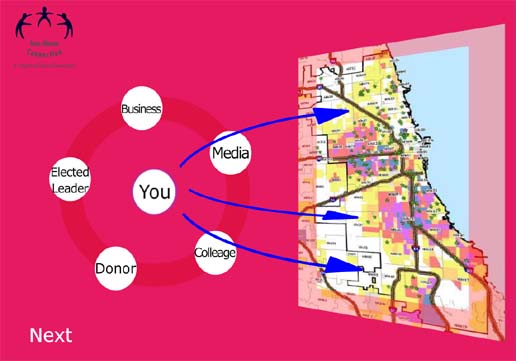
I think one of the best ways to honor the memory of the Rev. Jesse Jackson would be to adopt the strategies I've shared in this post, and share your commitment at least four times a year with a sermon based on what you've read here, or that you create by using Gemini yourself. 


 You can become the YOU in the graphic shown above.  

Form a learning circle and read and discuss ways you can apply the ideas in this visual essay.


Thanks for reading this.  Let's connect on LinkedIn, Facebook, BlueSky, Twitter, Mastodon, etc.  Find links here.

If you value what I'm sharing, please visit this page and make a contribution to help me keep doing it.

Saturday, February 21, 2026

Tribute to a Larger-than-Life Leader

I've seen many tributes in local and national media this week, recognizing the life of service and leadership of the Rev. Jesse Jackson, who passed away this week.  Here's one from PBS.


I met Rev. Jackson in 1997 when I was part of the Chicago delegation to the President's Summit for America's Future. I'm in the back row of this picture, between General John Borling, who was CEO of the United Way/Crusade of Mercy and the Rev. Jackson.

I was in several meetings with him following the April 1997 Summit, but never built any kind of relationship.

Between 1998 and 2000 I participated in monthly planning meetings held at Operation PUSH headquarters, along with leaders of the Illinois Judicial Council.  The goal was to develop a strategy that the Judges could take to area Black churches to influence the growth of mentoring programs in more places.

Below is part of a plan that I developed for the group, titled "Join the Minister's Mobilization".


You can view the complete plan at this link, along with some related documents. 

Then open this document to see an updated version of this plan that I created in the late 2000s. 


My latest update can be seen in this visual essay.

Unfortunately, the strategy presented at Operation PUSH never went very far.  We reached a point in our meetings when I was asking the Rev Jackson to take the role shown in the graphic below, using his powerful voice to draw volunteers AND donors to individual churches, so they would have the resources to actually start AND operate mentor-rich programs.  


I was told that this was not what the Rev Jackson did, since he was constantly raising money for Operation PUSH programs.  That's when I stopped attending the meetings at Operation PUSH.

So we're in 2026 with still too few programs, and with a lot fewer Black kids living in the Southside neighborhoods of Chicago.

However, I've continued to share that strategy for the past 25 years.

What's a message that faith leaders might be delivering?  I asked Google Gemini to look at this speech, by the CEO of a company, then create a speech, delivered by a Faith leader. It's posted below.

--- begin Gemini version ---

From Prayer to Purpose: A Unified Covenant for Chicago’s Future Presenter:
[Leader Name/Title], [Faith Community/Organization Name]
Audience: Chicago Interfaith Council & Regional Religious Leadership

The "Why": Beyond Charitable Almsgiving
Friends and fellow laborers, we are all familiar with the call to "clothe the naked" and "feed the hungry." We pass the plate, we run our food pantries, and we offer our prayers. But if we are honest, our current approach is fragmented. We are tending to the wounds, but we are not stopping the violence that causes them.

If we were building a new sanctuary, we would not lay a single brick without a sanctified blueprint. Yet, when it comes to the "living stones" of our city—the children growing up in the shadows of systemic neglect—we often operate without a shared vision.

I am here today to ask our congregations to adopt a specific strategic blueprint: The Tutor/Mentor Connection Strategy Map.

The Blueprint: A Map for Mercy and Justice
This is more than a diagram; it is a systemic path to redemption for our neighborhoods. You can view this sacred map here: http://tinyurl.com/tmc-strategy-map.

As faith leaders, we understand the "Cradle-to-Calling" journey. If a child’s path is blocked by the thorns of poverty and a lack of guidance, the divine potential within them is stifled. This map shows us exactly where the path is broken and how we, as a community of faith, can mend it.

The Sacred Site: Our Buildings as Bridges
The research is clear: relationships save lives, but relationships need a place to grow. We cannot rely on informal or school-based connections alone. We need organized, site-based programs that serve as "hubs" of social capital.

Look around at our houses of worship. These are not just buildings; they are underutilized sanctuaries for the youth in our "service deserts." By hosting organized programs, we provide a safe, consistent space where a child knows a mentor will be waiting every week. These sites become the "glue" that attracts both the child and the volunteer, offering access to technology, quiet study, and a community of peers that many cannot find elsewhere.

The Four-Part Ministry of Presence
To make Chicago "mentor-rich," we must apply the same discipline to our outreach that we apply to our liturgy:

* Bearing Witness (Data): We must map where the light is shining and where the darkness remains. We must identify the neighborhoods where organized programs don't exist and ask ourselves: Why not here?

* Prophetic Voice (Public Awareness): We must use our pulpits. I am challenging you to record a video "reading" this strategy map to your congregants. We must signal that mentoring is a core tenet of our faith, not a side project.

* Stewardship of People (Resource Distribution):
We don’t just give tithes; we give ourselves. We must drive our most valuable asset—our people—into the zip codes that have been forsaken.

* Cultivating the Vineyard (Continuous Improvement):
We must share our collective expertise in administration and stability to help small, neighborhood missions move from "surviving" to "thriving."

The "Village" Cluster: Our Sacred Role
Look at the "Village Clusters" on the map. Whether you lead a mosque, a synagogue, a cathedral, or a storefront church, you are a pillar of this village. I am calling for "Moral Signaling." When a faith community adopts this map, they are committing to a 20-year covenant of support—a "long obedience" in the same direction.

 "Enough is enough. We cannot simply pray for a better Chicago while standing still. We must adopt a strategy that matches the scale of the giants we are facing." 

The Closing Challenge: Anoint the Strategy
At the top of this map is a blue box. It is currently empty. It is waiting for the seal of your faith community.

By placing your identity alongside this strategy, you are telling the people of Chicago that your house of worship is a bridge to the future. You are vowing that a child born today in a high-poverty neighborhood will have a spiritual family and a physical "site" of support walking beside them until they reach their full, God-given potential twenty years from now.

My Next Step: I have already integrated this strategy map into our community’s mission portal and opened our doors for these sessions. I would like to show you how to do the same.

Would you like me to send you the "Leader’s Script" we use to explain this map and the use of our buildings to our members during service?

---- end Gemini ----

I was inspired to use Google Gemini by Gene Bellinger, who has demonstrate its value through articles he's posted on his Substack - click here to find his articles.  

Thanks for reading this.  I think one of the best ways to honor the memory of the Rev. Jesse Jackson would be to adopt the strategies I've shared in this post, and share your commitment at least four times a year with a sermon based on what I shared here, or that you create by using Gemini yourself. 

You can become the YOU in the graphic shown above.

Let's connect on LinkedIn, Facebook, BlueSky, Twitter, Mastodon, etc.  Find links here.

If you value what I'm sharing, please visit this page and make a contribution to help me keep doing it.

Thursday, October 16, 2025

After the March, Do the Planning

On Saturday, October 18th, millions of people across the USA, and the world, will be out in the streets marching to protest against the rapid destruction of our freedoms, democracy, and the rise of fascism in the world.  This link shows where you can become part of one of these "NO Kings" protests. 

They are saying "Enough is Enough!"

After the march, do the learning.  If you browse through this blog you'll see my focus is on using an "information-based problem solving" strategy to build and sustain mentor-rich non-school programs that reach K-12 kids in high poverty areas with long-term support.

I've tried to engage others in this effort for over 30 years.  Every time a negative news story appeared in a Chicago paper, I said "Enough is Enough".  In the late 2000s I listed steps anyone could take. The animation below was created a few years later by an intern from South Korea.  Take a look.


This animation was done by one of my interns after reading this article.

If we want to stop this violence against Democracy, we have to act now, and keep acting to solve this problem for many years. We have to think spatially, that is, look at the entire city and suburbs, our state, other states, and other countries, not just one neighborhood.

At the same time, we need to act locally, because none of us has the time, or the resources to help each of the kids in the entire Chicago region who live in neighborhoods where poverty is the root cause of the violence.

Here are some ways to remind yourself. Think of ENOUGH, is ENOUGH

E – educate yourself – most of us do not live in high poverty neighborhoods, so we only understand the root causes of senseless shootings from what we read in newspapers. We also only read negative news in the media, so we’re not really well informed on where these events are taking place most frequently. Finally, while there is a perception that there are plenty of youth programs, we really don’t have a good understanding of the distribution of different types of youth programs, to different age groups, in different zip codes. The only way this will change is if each of us pledges to spend one hour a week reading books, articles and web reports, that illustrate the root causes of these shootings, or of poor performance in schools. Through our learning we can draw ideas that we use in our own actions. We can also begin to contribute information that other people use to support their own decision making.

To help with your learning about race, poverty and inequality in America browse the different sections of the Tutor/Mentor library, shown on this concept map. 


It's really important to understand what drives people to vote for Trump and his enablers.  Many of the articles and websites that I point to from this concept map, provide information that will help you better understand the the problems we face.   A similar library could be created to aggregate research and articles that help us better understand what fuels support for Trump and other fascists leaders. 

Another library that is needed would be one aggregating information about immigration, and showing ways to create a legal path for people from different countries to enter the USA and seek a brighter future.  

If you host either of these libraries share a link in the comments and I'll add it to my own library.

N – engage your network – find ways to draw others who you know into this shared understanding. Recognize people who volunteer time and talent, or who help kids through the programs they operate. If you are a business leader, or a church leader, engage your corporation or your congregation. You can use your web site, advertising, point of purchase materials, etc. to point to web sites that show all of the agencies in the city who do tutoring/mentoring, such as www.tutormentorexchange.net. If you do this weekly, year after year, your friends, coworkers and customers will become involved in solving this problem with you.


This concept map shows another section of my library.  The links point to resources on collaboration, community building, innovation, knowledge management, etc.  These are skills many should learn, in order to build and sustain the coalitions needed to not only remove Trump and his enablers, but to address the root causes and social injustices that fuel voter ager and disengagement.

O – offer help, don’t wait to be asked. As you build your understanding of where poverty is most concentrated, and what social services are in those areas, choose a neighborhood, and reach out with offers of time, as a volunteer, talent, help build a web site, do the accounting, or offer Public relations services, and dollars, if the web site of an organization shows they do good work, you don’t need to ask for a proposal of how they would spend your donation, you need to send them a donation so they can keep doing that good work.

Apply the same practices to help political leaders mobilize voters, then stay accountable to them once they are elected.

U – build a shared understanding. Form groups of peers to share reading and learning assignments, just as you meet every Sunday to read passages of scripture and build the group’s understanding of the Word of God. Use the many different resources of the T/MC Links library as the starting point for your search for wisdom, and understanding.

In the concept map shown above you'll find one node pointing to concept maps that show political engagement resources.  When/IF we defeat Trump and regain control of the House, Senate, White House and Supreme Court, we need a complete revision of how people are elected and how they represent the people who voted for them, not the people who have given them tons of money. Here's one of those concept maps.

G – give until it feels good – people who generously donate time and dollars to causes they believe in feel good about their giving. If we’re going to surround kids living in poverty dominated neighborhoods with extra learning and adult mentoring networks, donors will need to give more than random contributions of time, dollars and talent.  

Political campaigns are expensive. Pick a few candidates and support them.  I do my political giving through a website hosted by Charles Gaba.  

H – form habits of learning, and pass these on to your kids. Imagine how much more successful teachers were if youth came to school every day asking questions about where to find information, or how to understand information they had researched on the Internet the previous day? We can model that habit if we build it into our own activity. Keep a chart where you can document actions you take each week to same sure that this time ENOUGH, really means ENOUGH.

If you document actions, you can review what you’ve done at the end of each month, and each year, and begin to see a growing mountain of actions you have taken to solve this problem. Some of these will be actions that got other people involved, so that the good work you do is multiplying because of the good work others are also doing.

Through this process you help build this shared understanding, which will lead to better public policy. Without this habit of learning, and without learning to use the Internet to find good ideas from people in all parts of the world, we won’t be able to problem solve as well as we need to, and we won’t be able to teach this habit to our kids.


I plan on being at the No Kings protest in Arlington Heights, Il.  I'll bring my folding chair, my oxygen tank, and my sign.  

But, I'll also be on LinkedIn, BlueSky, Twitter, Facebook, Mastodon and Instagram.  I hope you'll connect with me.

Finally, if you're able, visit this page and make a contribution to help fund my work. 

Tuesday, September 23, 2025

What issues unite us?

The political and cultural issues of the United States are creating growing political divides, and growing "hate" and "distrust" of others. Political violence is creeping in.  I'm seeing more and more signs that we're losing our traditional democracy and gaining a narrow focused dictatorship.

I've used this blog since 2005 and my print and email newsletters since 1993 to focus attention on libraries where people can spend time learning about these issues and finding ways to connect with others who are trying to find a better way.

I use concept maps, like the one below to try to guide people to different sections of my library, which has links to more than 2000 external websites, with their own extensive libraries.


And, I've created visual essays, like this one, to show actions anyone can take to draw attention to the issues and causes that they care about.  Borrow what works for you. Teach it to others.


My own focus for the past 50 years has been to help youth who live in areas of concentrated, persistent poverty, get the extra, on-going support they need to move through school and into adult lives, with jobs and careers that enable them to raise their own kids free of poverty.

I use visualizations like the one below to illustrate this goal.


The photo at the upper left is from the mid 1990s and the photo at the lower right is when one of those young women came back in 2010 to speak at our year-end graduation.  We're all now connected on Facebook and I'm seeing stories of their own kids finishing high school and college.

The graphic shown below emphasizes the need for long-term programs in high poverty areas of Chicago. If donors recognized this value, and the long-term support needed, my hope is that they would fund on-going general operations of programs who build such support for kids into their core strategies.  A map should show such programs reaching k-12 kids in every high poverty area, not just a few places.


In the lower left corner of this graphic is a  map of the Chicago area, with areas of persistent poverty highlighted.  Since 2005 I've posted more than 280 articles using maps to focus attention on specific areas of Chicago.  I highlight a few in this collection.

In this article I included this map of the United States, showing cities with high concentrations of poverty.  


The dark areas are metros. The orange area within each metro indicates an area of concentrated poverty.  Each of these cities should have a research intermediary that borrows strategies piloted since 1993 by the Tutor/Mentor Connection, who collects and reports information that everyone else in that city can use to supply the resources needed to reach a higher percent of kids in high poverty areas with well-organized, mentor-rich, non-school tutor, mentor and learning programs.

In another article I show a dashboard created by the Economic Innovation Group (EIG) that shows areas of the United States where economic prosperity is more prevalent, and where distressed communities are located.  Below is one view of that dashboard.

Here is a second view, this time centering on the Chicago region, where I've worked for the past 30 years to help volunteer-based tutor, mentor and learning programs grow.

This map shows that there are many places in the Chicago region and Northwest Indiana that have distressed communities. So do other cities surrounding Lake Michigan, such as Milwaukee and Kenosha, Wisconsin, Waukegan, Illinois, Benton Harbor and cities further East.

If you zoom out, you'll find places all over the country with areas of persistent poverty and/or where economic opportunity is low.

This means people from every one of these cities and states should be talking to each other.  Where is that happening?

So, what's your cause?  Saving democracy? The planet? People in distressed situations?  If someone is building a library like mine, it can be a resource used by anyone, anywhere, to find information about complex issues and ideas for trying to solve those problems.  The blue box in the graphic below illustrates the role of such libraries. 

As I wrote above, the Tutor/Mentor library has more than 2000 links to external websites. Many of those have extensive libraries on their own site.  Each resource I point to represents one, or dozens, of people who work with that organization.  Imagine finding web platforms where people from all of these organizations were connecting regularly to share ideas, build networks and relationship, and create blueprints that show what's needed, and in what sequence, to solve the problem they focus on.

This concept map is an example of a blueprint that could be used in every metro shown on the map above.  In every high poverty zip code all of the supports shown on this map, for each age group, need to be available.  Building the blueprint and getting support for it are two huge challenges.

I wonder if anyone has created a concept map like this showing steps that would reduce the growing conflicts dividing this country.  I'd love to see it.

Thanks for reading.  I'm sure there are hundreds, if not thousands, of organizations building libraries and trying to draw viewers to their sites and events.  When I learn about these, I add them to my own library.

For instance, I added the SocialRoots website today. Check it out. 

I encourage them to dig into my blog articles and library and then include these in their own libraries. 

Then, reach out and connect with me on one or more of the social media platforms that I share on this page. 

If you value what I'm sharing and can help, please visit this page and make a contribution to help fund my work. 

Friday, August 01, 2025

Knowledge Based Problem Solving in Era of Government Chaos

Since I started leading a tutor/mentor program in 1975 I've searched for ideas that I could learn from to constantly improve my own efforts. I began to build a library of program reports, newsletters and research, that I shared with volunteers, to help them expand their own efforts. In 1993 when I formed the Tutor/Mentor Connection, I dramatically expanded this library, and in 1998 when I launched my first website, I expanded it even more. I still add new links every week.

I've learned that while our focus is on connecting kids and volunteers, there are a massive web of other issues that affect each student's future, and our own.  Below are two graphics that illustrate this.

Birth to Work Challenges concept map - click here to open

 
This shows that while a tutor/mentor program must overcome an on-going series of challenges to keep a student participating as they move from first grade through 12th grade (which could be in more than one program) the student, family and school face many more challenges caused by poverty and systemic racism in the United States.   If you open the concept map and look at the far right, you'll see that one of these challenges is "poor elected leaders".  

Below is a different graphic, created to show many of the challenges we face. I included it in this "Can't drain the swamp" article. 


Note at the far left I've highlighted "Democracy under Attack".  This was the third version of the climate change graphic created since 2019.  It was created in 2021 following the January 6th attack on Congress. 

Now that Trump and Project 2025 are now back in the White House, and many states are in the control of ultra conservative forces, the magnitude of this problem is much, much greater. Even our courts have been compromised. 

I created the graphic below many years ago to visualize the need for daily, on-going outreach to attract visitors to my library, my list of tutor/mentor programs, and to the programs themselves. 


I think a similar graphic could be created to show the on-going effort needed to draw attention and resources to each of the issues I show on the top two graphics.  

My challenge now, in mid 2025, is how do I keep this attention focused, knowing that without continuous help kids fall behind in school, and in life, so that volunteer-based tutor, mentor and learning programs find the support they need to stay available to kids.

Yet, how do I also call attention to the terrible things being done to vulnerable people in this country. How do I help keep the United States from becoming a new Nazi Germany?  

When I created the Tutor/Mentor Connection in 1993 the mission was to "gather and organize all that was known about successful non-school tutor/mentor programs and to apply that knowledge to expand the availability and effectiveness of these services to children throughout the Chicago region". Read it here.

I've often tried to explain the purpose of the information I collect, by using the analogy of a "hospital operating room"
where the operation is performed in an amphitheater where hundreds of others are watching. I found this graphic in a Wall Street Journal ad, and it communicates the idea visually.

I hope you'll follow this progression of thinking, because it applies to helping cities like Chicago solve complex problems.  It also may help solve the problems facing democracy and our planet, too.

1) At the start of the "operation" two people are bent over a patient (a problem like violence?). As long as the expertise they both have is enough to do the operation, they continue. (This photo is from an improvisation workshop in spring 1993, during the first year operations of the Cabrini Connections program I founded and led until 2011.)

2) However, as usually is the case, something occurs where the two doctors on the floor, don't know the answer. They say to the audience, "Do any of you know how to solve this problem?" Someone says "I do" and they join the two on the floor. As this continues to happen, new ideas are brought to the operation and the group on the floor grows.

3) At some point, no one in the amphitheater knows the answer. However, someone says, "I know someone who does know the answer. I'll find them and invite them to join the group." Once that happens, the operation continues.

4) Eventually, a problem will arise that no one knows the answer, or knows anyone else who has ever dealt with that particular problem. Someone high in the gallery says, "I'm starting a PhD course at the local university. I'll look into this and when I find an answer I'll bring it to the group." Several people, in universities, or in business, could be doing research on that problem.

I've been looking for people with experiences and information that could help people in Chicago build systems of support that help youth in high poverty areas move through school and into jobs since I launched the Tutor/Mentor Connection in 1993. I'd been doing this informally since I started leading a tutor/mentor program at the Montgomery Ward Headquarters in Chicago back in 1975. 

My library and social media network now represents thousand of organizations and tens of thousands of people.  

Those people, IF connected physically and virtually, represent the wide range of people who need to be in the "operating room" looking for solutions to the problems we face.  

Below is a map of the information in my "knowledge" library.


This information has been growing for 30 years. It's been available to leaders in Chicago and other cities for that long. It went on the Internet in 1998. Yet, too few seem to value the role information has to support innovation and problem solving. That means when I go to events where people are gathering to "solve the problem" of education, violence, workforce development, health disparities, etc, few are even aware that my library exists.

The process does not effectively capture the knowledge of everyone in the room, or of others who may be in other cities and countries. Yet anyone could be building a web library, with links to ideas and resources they find valuable, and with links to other web libraries. This concept is outlined in the PDF showing the goal of a "Tutor/Mentor Learning Network" which I've been trying to build since 1993.

The critical idea in this PDF is that since few of us have advertising dollars, we need to take daily actions that draw attention to everyone in the network of information and ideas, not just to our own organization, no matter how powerful we are. As speakers have emphasized over, and over, "No one can solve this problem by themselves."

I've devoted one entire section of the library to collaboration, knowledge management, visualization, innovation, etc. You can enter it via this map. This section could be curriculum for school, or non-school, youth programs, where volunteers from business and universities help youth learn these skills, and learn to apply them in their own efforts.  It can also be a training resource for organizers working on other issues.

I've devoted another concept map to social justice, race, poverty and inequality issues.  

That concept map points to maps like this, and, another section that focuses on political issues, and reforms, asking what is causing people to accept what Trump and Project 2025 are doing?,  and what strategies might reverse this? 

One set of blog articles that I point to focuses on "online learning, cMOOCs, etc." The ideas in these sections can help enhance the information-sharing process any group is using to solve local-global problems, regardless of if they connect with me or not.

Below is another visualization that I've created to illustrate the role knowledge, or work done by others, can take in supporting the constant improvement of work everyone is doing to help youth born in poverty move through school and into jobs and careers.

Using Ideas to Stimulate Competition and Process Improvement - Concept Paper by Daniel F. Bassill


I think my role is to aggregate information that others can learn from, and to use my social media and email newsletter to draw attention to the library while trying to motivate others to share it.

And to motivate volunteers and donors to visit program websites and be proactive in offering support, without waiting for an "ask" or a "grant proposal".

In some posts I'll be calling attention to Chicago tutor/mentor programs and in others I'll be boosting posts by others who focus on broader issues, including stopping the movement toward fascism, and, not just rebuilding democratic structures, but making them do more to improve the quality of life for every person in the USA and the world.  

I'll do this every day. 

You can help.  And, I hope I'm helping you.

Connect with me on social media (find links on this page) and share my posts with your own network. 

Find time to browse my library and get familiar with what it includes. Use the ideas to expand your own efforts, to help kids and tutor/mentor programs, and to help fix our broken government. 

Thanks for reading.  If you're able, visit this page and make a contribution to help me pay the bills.