Tuesday, February 28, 2023

Borrow from Lessons of Tutor/Mentor Connection

Does Chicago have a Master Plan for saving its kids?  Does your city? 

That was the headline of a Chicago Tribune column about the Tutor/Mentor Connection back in 1995. 

It's what I've been sharing in these blog articles since 2005.  See this "Master Plan" article and PDF in my December 2020 article. 

I offer this blog and my website as a library that anyone can use to build a strategy that helps k-12 youth move through school and into adult lives, with the help of volunteer tutors and mentors who they meet in organized youth serving programs. 

In April 1997 I was one of 10 people representing Chicago at the President's Summit for America's Future, held in Philadelphia.  The Tutor/Mentor Connection was one of 50 Teaching Examples invited to have displays and present information at the Summit.

Below is a video that we shared at the Summit. It was created with much help from Public Communications Inc, who helped form the T/MC strategy in 1993 and was our pro bono PR partner through the 1990s.  


In the video we share strategies developed in 1993 and launched in January 1994.  I've described these in many articles on this blog, but here are four collections that I urge you to spend time viewing.


From 2006 to 2015 I encouraged interns who spent from a week, to a year with my organization, to dig into the blog articles and visual essays that I had created, then build a new presentation that shared their understanding.

Browse articles on this blog to see work they did.   This is a form of learning that can be duplicated in schools across the world, where young people do the first investigation, then share what they learn with their family, friends, teacher networks, etc. If done consistently it's a strategy that engages a growing community, which is essential for any long-term, city-wide strategy to be effective.  Read more about engaging students and universities - click here.

I urge you to invite youth and volunteers in your community to do the same.  Just use maps of your city instead of Chicago.

As you do your research read the T/MC Case Statement from 1997.  

T/MC is introduced with this description

"T/MC is a network that is inventorying every community in Chicago to identify afterschool tutoring/mentoring programs. It is continuously promoting the need for tutoring and mentoring and volunteer involvement so that more programs become available in each coming year. It is providing a means of sharing successful strategies among new and existing programs and will identify and focus public attention — on a continuing basis — on the areas where tutoring services are most needed." 

Then view this Tutor/Mentor Learning Network Proposal from 1999.

In the introduction it states".....


"At this time, the biggest obstacle to involving children and caring adults in tutor/mentor programs is the need for more of the programs themselves, as well as the need for a more consistent flow of resources (dollars, volunteers, training, technology, etc.) to existing programs. While most people look to the government to provide funding for schools, non profits and all other social problems, the reality is that there is not enough public money, nor taxpayer will power, to fund all schools to the level they need, let alone fund a comprehensive network of nonschool tutor/mentor programs to the level of funding they require to be effective — and available in all of the places where they are needed.

This obstacle is compounded by an even greater challenge. The issues of big city poverty are complex.

“In an era of globalization, when knowledge and scholarship are becoming increasingly universal and universally accessible, problems, too, with all their complexity, no longer recognize borders of geography, language, time, culture, or a myriad of other factors and so they demand an integrated approach. They demand the best ideas from all of us and the wisdom to work together to see that ideas turn into actions and solutions.” … Carnegie Corporation of New York: Meeting Challenges of the 21st Century.

Most leaders, donors, corporate sponsors and potential volunteers are only superficially involved in discussions of poverty, workforce development, school reform, racism and related issues which comprehensive “total quality” tutor/mentor programs can address. Too many tutor/mentor programs are isolated. Too little infrastructure exists. There is not enough time to get all of the right people in the same room often enough to come to a deep enough understanding of the problems and the solutions that already exist.

This makes it difficult, if not impossible, to build common understanding, and a convergence on solutions which need to be sustained for the 25 years it takes for just one child to move from birth in poverty to a first step on a career.

There are about 15 million children in America who need such help. While the Internet has great potential to offer virtual meetings, and collaborative action, too few dollars are available to innovate ways to bring disconnected stakeholders to on-line meeting places (see Policy Link 2001 report titled, "Bridging the Organizational Divide").

The Tutor/Mentor Connection (T/MC) was created as a response to these needs. The T/MC is an innovative, visionary effort to build tutor/mentor programs. The T/MC is not an effort to develop a single tutor/mentor program, or even a few tutor/mentor programs, that will serve a limited number of children who are referred for services. Instead, the goal of the T/MC is to support the development of an entire universe of tutor/mentor programs that will serve low-income children BEFORE problems occur."

------ end of introduction ----- 

In the final segment of the 1997 video shared above, I summarize the work being done by the Tutor/Mentor Connection and invite others to duplicate the strategy in their community and help me build it in Chicago.

I repeat that invitation today, but with 25 years of further experience beyond what we had in 1997.  

Please read the articles I point to and others on this blog.

Share them with your own network. I'm on Twitter, LinkedIn, Facebook, Mastodon, and Instagram and I invite you to bring your network and connect with me.

If you value the ideas and resources I'm sharing, please consider a small contribution to help Fund T/MI. Visit this page to learn more. 


Monday, February 20, 2023

What Youth Programs Exist in Your Area?

My small non-profit published it's first Directory of youth tutor and/or mentor programs serving Chicago in May 1994.  The goal was to help volunteers and donors find and support existing programs and to provide a source of information leaders could use to determine where more programs were needed, based on what already existed, and the population of kids in poverty in different zip codes.

We continued to publish the printed directory until 2003, but started putting the information on the Internet in 1998.  Since 2004 all the information I've shared has been on our websites.

Read more about the Directory and Program Locator - click here

The survey we used to collect information about programs segmented responses by a) type of program - pure tutoring, pure mentoring, combination of on-going tutor/mentor supports; b) age group served - elementary school, middles school, high school; c) time of day services offered - school day, after school, after 5pm & weekends; and d) address.

With this information people could search specific areas for programs serving specific age groups.  Unfortunately the websites we built in the 2000s to share this information are now only viewable as archives.  I'm only able to share my list of programs through the map shown above (see this site) and this list on the Tutor/Mentor Institute, LLC website. 

Furthermore, I'm not the only one collecting information about youth programs serving Chicago and Illinois.  Here are a few others.

Peace Hub Chicago map - click here

Use the tables at the left to narrow your search. Click on the red icons to get contact information and website address.  Under services you can search for "tutoring" or "mentoring".  

ACT NOW! Afterschool for Children and Teens - maps entire state - click here


You can refine your search for grade levels served and type of programming offered.  Click on the icon for program information.

MyChiMyFuture - Programs Map 


This is the Mayor's initiative, aimed at helping youth find out-of-school time programs they can participate in.  There are many ways to narrow your search, however, for some reason I don't see a category for mentoring.  Many of the resources shown are libraries and park district facilities.  I'm not sure how many community based organizations are on this map.

If Chicago gets a new Mayor in 2023 will that Mayor continue to support this initiative? I hope so. 

These are just three directories that I'm aware of. I'm building a list at this location, so you can visit and see directories for Chicago and for other cities and states, too. 

What I don't see yet....

I don't see blog articles or social media posts using these on-line directories to focus attention on areas with high poverty, poorly performing schools or acts of violence.

I don't see blog articles or social media posts using these platforms to do an analysis of type of programs, age group served and number of youth in specific areas who need these services.


Furthermore, I don't see an on-going, multi-year attempt to draw volunteers and donors through these platforms to individual programs where they offer support for operations and constant improvement.


I  urge you to browse articles in the maps, media and violence categories on this blog to see examples of how I've used the program locator directories the Tutor/Mentor Connection created to draw attention and resources to programs in specific parts of Chicago.


Read these "Rest-of-the-Story" articles to see how young people could be creating regular stories using maps and intended to help tutor/mentor programs grow in more places, helping more kids through school and into adult lives. 

Raising kids continues to be a two decade effort and in some places parents and schools need extra support that can be offered by well-organized non-school tutor, mentor and learning programs.  

Helping existing programs sustain their efforts and helping new programs grow where more are needed is something many people need to be doing, in Chicago and in other cities and states. It's not something one person can make happen.


Thanks for reading.   Please connect with me on Twitter, Facebook, Instagram, Mastodon, LinkedIn and other platforms.  

Share these ideas. Create your own versions, with maps of your community if you're not in Chicago.  

Finally, if you can help fund my work, please visit this page and send a contribution. 


12/28/2023 update - On the Mapping for Justice blog I posted this article, showing a STEM Opportunity Mapping project focused on nine Chicago South-side neighborhoods.


Sunday, February 12, 2023

Super Bowl, Tutoring and Mentoring

Today's the big football game. It will be watched by millions of people from around the world.  I hope a few of those from every city will find, and read, this and other articles I've posted on this blog since 2005.

My friend Brian Banks, who posts on LinkedIn, sent me an article about a virtual tutoring company called Paper.  I read the article, visited the website and added it to this collection in my library.  

I led a volunteer-based tutor/mentor program in Chicago from 1975 to 2011 (joined as a volunteer in 1973).  I created the Tutor/Mentor Connection in 1993 to try to make this type of program available to more kids in high poverty areas.  

Two things stood out in the article about Paper.  

1) the $40 cost per student is paid by the school, not the family, but there are still many schools that cannot afford this cost.  (I did not find cost information on the website, such as how long the $40 fee applies. Is it for a full school year? A shorter time frame?)

2) according to the article "the biggest hurdle is 'awareness'.  If students don't know the service exists, the district buys it, and it sits on a shelf. It's not good for Paper and it's not good for the school, or the students. So building that awareness is the number one most critical thing."

Below is a graphic I've shared often on this post.  


The map in the lower left corner shows high poverty areas of Chicago. As kids grow up different events in their lives influence their learning, and their motivations to learn. This could be lack of reinforcement at home, traumatic events such as shootings, or deaths from health issues. It could be a growing awareness of poverty and racism as the youth moves from middle school to high school. It could be the change in adult support as they move from elementary school, to middle school, then high school. It could be the influence of street gangs, in their own family, and/or in their neighborhood.

These affect each youth differently, at different times.  

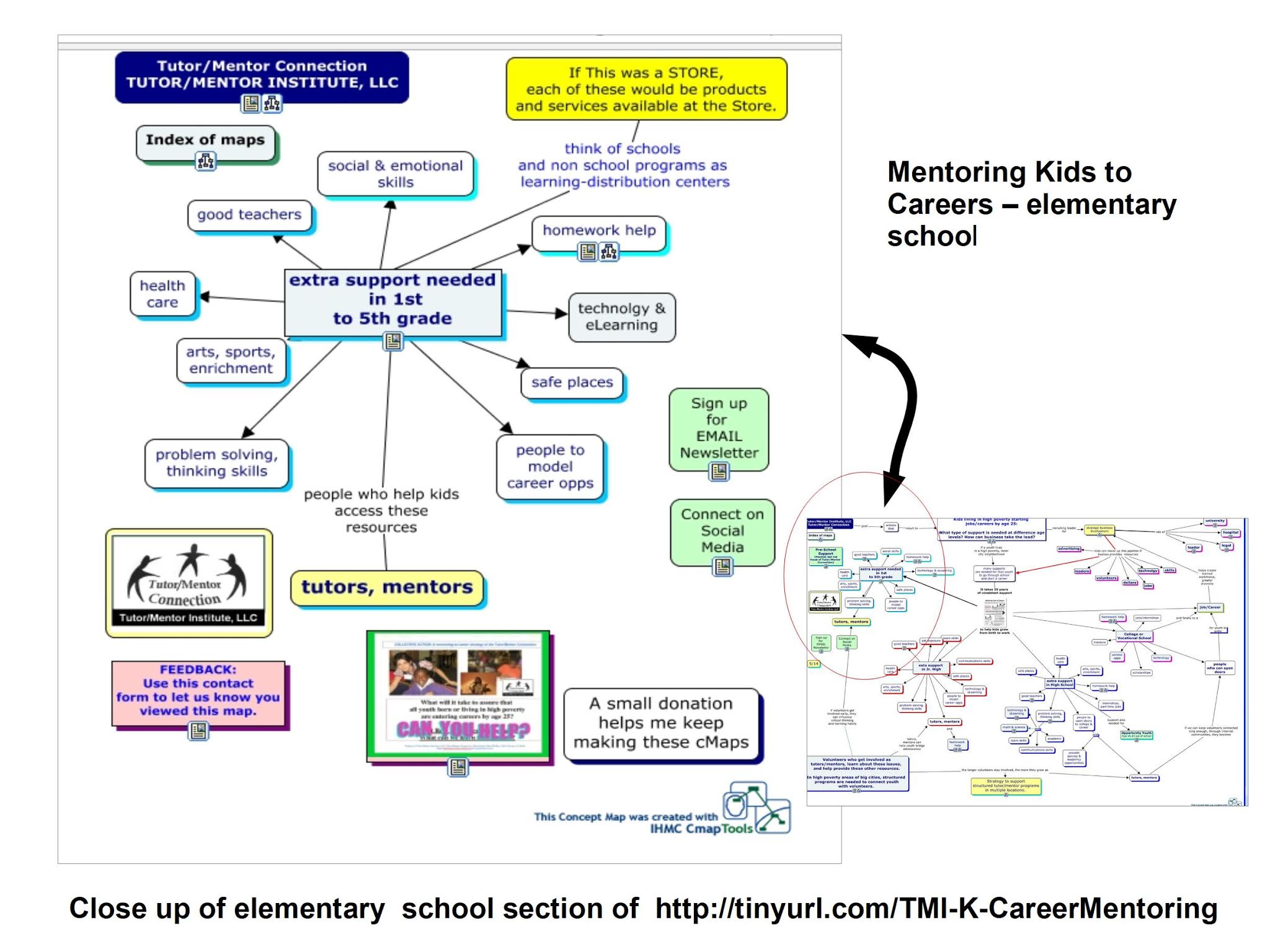
Open the concept map shown below and look closely at the supports kids need at each grade level as they move through school and into jobs and careers. 

I've not found a similar map for Chicago or any other city.  Nor have I found an analysis showing on a school-by-school basis, which of these supports are available.  However, at each level homework help and good teachers are needed. Thus a virtual learning option like Paper could be really valuable...if it was available, and if they knew about it.

This is where organized, non-school, volunteer-based tutor/mentor programs can make a difference.


In the programs I led kids came to our site once a week throughout the school year, where they met with a primary one-on-one tutor/mentor, and connected with a variety of other volunteers and learning experiences.  View some of the yearbooks to see the range of activities and volunteers.  

Many students continued for multiple years, often with the same volunteers.  Staff and program leaders provided additional continuity.  

I would have loved to have had access to a learning tool like Paper.  Our volunteers could have coached kids to use it, when they needed extra help, solving part of the awareness problem.

In addition, since our volunteers came from many different companies in the Chicago region, and often from families with significant wealth, they could have helped raise funds for schools to afford services like Paper.

Take another look at the concept map shown above and consider the role volunteers can take to help draw needed resources to schools and families. 

A few days ago I posted an article that included a 2013 map showing participation in an Education, Technology and learning MOOC.  


On Friday evening I participated in a ZOOM reunion with a few of those people, who've stayed connected for the past 10 years. This was posted on Twitter following the gathering.
When I look at a participation map like the ETMOOC map I'm thinking of all the people, from so many different places, who are gathering to talk about ways to help kids.

Imagine a similar map showing Super Bowl viewers.  What would it take for hundreds, or thousands, of people in every city to be looking at information and sharing ideas for building mentor-rich, birth-to-work support systems for kids in every high poverty area, including virtual tutoring resources like Paper offers? 

Below is an animation that illustrates a role athletes could take on a regular basis to mobilize fans and owners to support constantly improving youth programs in high poverty areas.


This animation, and other videos in my library, could be re-produced in many ways, with hundreds of different athletes, celebrities, etc. giving the message.

I hope you'll think of these ideas as you watch the Super Bowl and reflect on it in coming days and weeks.  


Thanks for reading. Enjoy the game.  My family has roots in Philadelphia, so I'm rooting for the Eagles!

Connect with me on Twitter, LinkedIn, Instagram, Mastodon and/or Facebook.

Help me pay the bills!  Check out the Fund T/MI page. 

Tuesday, February 07, 2023

Fix how youth programs are funded

Last night I interacted with some educators who I met in 2013 via an Education and Technology MOOC (#ETMOOC).  I mentioned a participation map that I had seen late 2012, which drew my attention to the event.  After looking around for a while, and exchanging some Tweets with the organizers, I found the map. You can see it below and at this link.


I've been encouraging leaders to use maps since 1994 because they point to all of the places within a geographic region, like Chicago, where people need extra help. Participation maps can show "who is in the conversation, and lead to a discussion of "who's missing".  I wrote about this in 2016 and 2017 articles. 

That's not really the focus of this article.

While I was scrolling my blog via my phone, looking for the ETMOOC map, I found a 2013 article I wrote about foundations who fund youth serving programs in Chicago and around the country.  I'm reposting that article below:

----- start ----

I’ve been part of an Education Technology MOOC (#ETMOOC) this week where more than 1000 people from around the world are connecting on-line and sharing ideas about uses of technology in education, learning, media and network building.

I’ve been trying for the past 20 years to build this type of learning community, connecting all of those who are concerned with the gap between rich and poor in America, the education system, workforce diversity, social justice, violence, public health, and a number of other reasons to be involved. Some people talk about the "village" it takes to raise kids. I write about it and try to bring members of the village together.

I started leading a volunteer-based tutor/mentor program in 1975 (see history) while I held a full time job with the Montgomery Ward company. While our program grew to include over 300 pairs of youth and volunteers by 1990, funding was not an issue because all of the leaders were volunteers.

However, in 1990 when I converted this program to a 501-c-3 non profit and needed to raise money to pay salaries for myself and others to stay involved, the funding of non profits began to become a real issue. Over the years I’ve aggregated a wide range of personal frustration on the challenges small non profits face in finding consistent operating funds, and I’ve built a library of articles that show how others think on this topic.

I illustrate my thinking visually so let me show some maps that I think many of you will find interesting, and useful.


This is a map showing nearly 400 foundation (corporate and private) in the Chicago region and Eastern part of the United States who I put on my mailing list between 1993 and 2005.

Every year I send copies of my printed newsletters to these people, showing why tutor/mentor programs were needed and what I was doing as a direct service provider, and as leader of the intermediary Tutor/Mentor Connection.

The green icons on the map are foundations that funded my organization at least one time. Few funded me more than 2-3 years in a row. Some, like Montgomery Ward, funded me for seven consecutive years, then went out of business, and thus were not able to continue their support. None of the grants was larger than $50,000 and most were in the $1,000 to $10,000 per year range. Some were for general operating expenses, which I could use flexibly to build the organization, while many focused specifically on activities of the Cabrini Connections direct service program or the Tutor/Mentor Connection. In total I raised more than $6 million between 1993 and 2011, with a peak of $500,000 in 2000. This money split with 40% funding the Cabrini Connections direct service program, 40% the Tutor/Mentor Connection, and 20% funding operating and fundraising expenses. With no multi-year commitments, each year since about 1998 I started from zero in raising $300 to $400,000 from a wide range of donors.

This map shows a close up of the Chicago region so you can get a better sense of how many foundations I was reaching out to.


My organization never had more than 3 or 4 people on staff, and never had a full time professional development officer. I was CEO, chief innovator, chief marketing officer, newsletter writer, grant writer, janitor. Yet every year I was challenged to write letters of introduction, letters of inquiry, grant requests, grant reports, each with different requirements and different questions.

Yet we all were focused on helping expand the network of programs supporting inner-city kids during the non-school hours. By 1998 I was using web sites to show the work I was doing and what I was trying to do.

This map shows the Chicago LOOP area.

When I begin using maps I started following media stories about kids being killed in Chicago, with maps showing where this was happening, and with links showing what tutor/mentor programs were operating in those areas,
and what knowledge was available to community leaders, business and foundations so they would work to build programs that would provide more mentoring, tutoring, learning opportunities. Visit this Map Gallery to see a collection of maps created in the past.


This week I attended a Dr. Martin Luther King, Jr. celebration at the University of Chicago,
where panel members were asked to talk about their experiences with mentoring.


They each talked about mentors who “helped them stay in school” and who provided life lesions, such as “never, ever forget where you come from”.

Here are some other quotes from the event:


“Who ever is talking to them and showing an interest is a mentor.”

“We need to mentor each other’s kids since our own don’t listen to us enough”

“Foundation of mentoring is caring.”

“Mentoring is a two-way street. Mentors learn from youth.”

“Students who are successful have great networking skills.”

“Since the middle class has left the inner city, how are we going to connect mentors with youth living in inner city neighborhoods” “How do we reach those kids.”

“The politicians don’t care. These kids and parents don’t vote.”

“Why are there only 30 people attending this event when this is National Mentoring Month?” Why don’t more people care?”

I handed out business cards to each of the participants and said “Let’s find ways to change this.” I share these ideas on my blog, and in MOOCs so that people in more places will come together to find ways to support the growth of mentor-rich programs in more places where they are needed.


I host a Chicago Tutor/Mentor Program Locator with maps that show where tutor/mentor programs are needed. Why can’t leaders in these foundations use my maps, or similar directories, to adopt neighborhoods, then adopt tutor/mentor programs in those neighborhoods and make long-term commitments to help each program become the best in the world by borrowing ideas from each other and using a constant flow of operating/innovation dollars and volunteer talent to implement these ideas.

Here’s an interactive version of the map of foundations. You can enlarge the map and zoom in and see the name and location of each. Some no longer exist since this list was last updated in 2005. (2023 editor note: this map may not show up in your Chrome browser. It does show up when I view it from my phone. It also can be seen if you use Microsoft Edge browser.)
  

With more than 200 youth serving organizations in Chicago offering various forms of tutoring, mentoring and non-school support, we can have 200 development officers and/or Executive Directors reaching through this list to find foundations who will give them funds each year, which is a tremendous redundancy.

Or we can build strategies that educate and motivate donors and business partners to reach out and build proactive support systems for tutor/mentor programs in neighborhoods that need such programs.

We can discuss ideas like this in face-to-face events, like the May and November Tutor/Mentor Leadership and Networking Conferences. We can also connect in on-line events like the Education Technology MOOC.

We can do both. We can do better.

---- end 2013 article ----- 

Sadly, I still don't find people using maps to show participation in events, or to expand participation to more of those who need to be involved.  I've not seen many foundations using maps to show who is receiving their grants, or anyone aggregating this information to show all of those funding specific types of service categories, like youth development and/or tutor/mentor programs, within specific geographic areas.  

I've had almost no response to the business cards I shared in that January 2013 mentoring event. I still don't find youth development, tutor and/or mentor program leaders, staff, funders, researchers, and business leaders interacting in on-going MOOC-like events.

While I've actively reached out to build lists of stakeholders on Twitter, Facebook and Instagram, I find few doing the same (or adding me to their lists). 

Maybe this is happening in different parts of the country, or the world, but I don't see it.  

If you share this article in your networks, maybe some people will send me links to websites showing this work being done.  I'll add those to my library and share them with others.

Thanks for reading. You can find me on these social media pages. 

Since writing the 2013 article I've added collections of articles in the About T/MI, History, and A New T/MC sections. Read these to understand what I've been trying to do, and to learn how you might duplicate this work in different places.

And, you can help me keep sharing these ideas by visiting my "Fund T/MI" page and sending a small contribution. 

Friday, February 03, 2023

Candidates for Mayor - take a look!

On February 28th Chicago residents (or a very small percent of them) will elect a new Mayor, or re-elect the current one.  Here's one website with a list of candidates. 

The only candidate I have had much interaction with is Paul Vallas, who was very supportive of the Tutor/Mentor Connection in the mid 1990s when he was CEO of Chicago Public Schools.  He spoke at two of our conferences and one, or two, of our Aug/Sept Citywide Tutor/Mentor Volunteer-Recruitment Campaigns.

So you'd think I would be endorsing him.  I'm not.  He's had 20 years to follow what I write on this blog and incorporate the ideas into his own leadership and I've not seen evidence of that 

Of course, I've not seen indicators that past Mayors or candidates have borrowed my ideas either, although if you browse through this set of articles you'll see that I've been sharing them for many years since starting this blog in 2005. Prior to that I shared them in print newsletters. 

I've participated in the current Mayor's MyChiMyFuture meetings and shared ideas. I like the map they have created. They could be doing more.  No one has asked to learn more from me. 

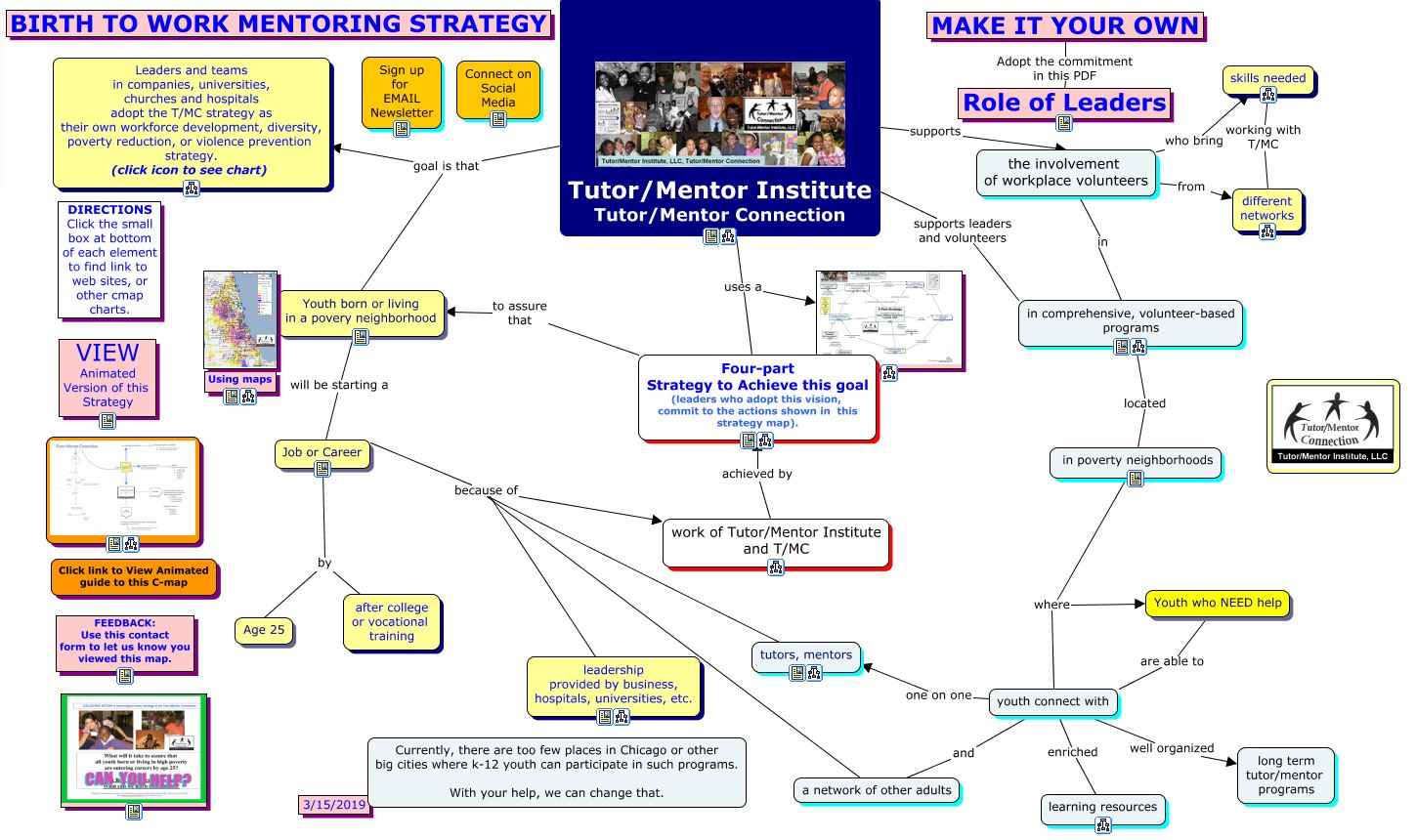
How would you know if they were borrowing these ideas? You'd see a version of this concept map on their own website.  


Here's one article they could read to understand what this map is showing.  If they adopted this strategy they'd be doing three things regularly.

1) recruiting other leaders to also adopt the strategy map and its commitments

2) support the four-part strategy (see middle node on the map).  This article describes the 4-part strategy.

3) they'd be reading current and past articles and encouraging others to do the same, just like a preacher in a religious group or a teacher in a classroom.  In doing so they'd find many graphics that visualize the commitment they would be making. 

They would emphasize a long-term birth-to-work strategy that has roots in every high poverty neighborhood.


They would be calling for a "learning distribution system" that reach kids in school and non-school hours, and on the Internet.


They would be using their public visibility to draw volunteers and DONORs directly to websites of youth serving programs to offer on-going support.  They would be filling the blue box in the middle of this graphic, drawing "people who can help" to information they can use to locate places in neighborhoods where help is needed. 


Every day they would be challenging the residents of the city and suburbs, asking "How can we do this better?"


It's not enough that they might put these ideas on their campaign website.  They should have a personal and/or organizational blog that shows they have been sharing this commitment and performing these actions for many years.

I'd vote for someone who demonstrated this leadership and these ideas.
(While my focus has been on the city of Chicago and I lived in Rogers Park for 17 years, and led a tutor/mentor program serving kids in Cabrini-Green for 35 years, I currently live in Arlington Heights, so cannot vote in the Chicago election.)

But this message is aimed at potential Mayors of any big city in America.  View this map in this article.

The map shown above is from a Brookings Metro report.  Highlighted are metro areas with concentrations of  poverty.  Each of these cities could use the map/information-based strategy I've piloted since 1993.

It's available for FREE.

Of course, I'd be happy to help anyone understand what I'm proposing and guide you through the ideas I've been sharing on this blog and on the www.tutormentorexchange.net website. 

One of my first recommendations would be to set up a student-learning program in high schools and colleges, where students spend time reading articles then sharing them using various media tools.  View this blog to see how interns did this between 2006 and 2015. 

Thanks for reading. If you're helping someone run for office, share this with them.  Maybe they will adopt the ideas, even if they don't win in 2023.  

I'm on Twitter (still) and other social media platforms (click here for list). Let's connect. 

If you want to help me keep sharing these ideas and hosting my library please visit my Fund T/MI page and send a contribution. 

Sunday, January 29, 2023

We can help kids through school, but can we keep them safe from racism?

The nation is once again shocked by a Black man being murdered by police. This time it was in Nashville, Tennessee.   Below is one of many Tweets that have prompted this post. If you have spent any time on this blog over the past 17 years you've seen this graphic, or a version of it.


This shows the goal of organized, volunteer-based tutor, mentor and learning programs, that operate in non-school hours out of neighborhood facilities, which help kids from high poverty areas move through school and into adult lives.  

If enough of these programs were available, in more places and consistently funded, constantly improving, etc., more kids would move through school without detours in the criminal justice system or in need of mental health support.

Here's a concept map that visualizes this same goal.  Note the text box in the lower left corner where I describe a role for volunteers who get involved as tutors and mentors.  


I've never believed that a single mentor can do everything needed to help a youth in high poverty area overcome all of the challenges they face growing up, which I've described in the concept map below. 

Yet I do believe a single volunteers can have a life changing impact.  It's just not predictable in what cases that will happen.  I know that the boy I first met in 1973 when he was in 4th grade says I had a huge impact on his life, but I know he had other people also helping him, including a strong mother.

I've seen countless stories over the past 30 years showing similar life changing mentoring and tutoring relationships.  

Here's what I'm struggling with.  Being Black in America puts you at risk, regardless of how successful you are in business, education, sports, etc.  

You can be running in a park, or driving down a street, and someone will single you out, just because of the color of your skin.  

One of the reasons I support volunteer-based tutor/mentor programs is that they can attract people who don't live in poverty, connect them in one-on-one, on-going relationships with kids who do live in poverty, then slowly educate them of the challenges kids and families face.  

This volunteer growth cycle visualizes that process. See it in this blog article. 


Every time you read about an act of violence or racism against people of color, I urge you to do homework to understand why that is happening and ways you can get involved to help prevent it from happening in the future.

Below are two graphics to consider:

Resource library - links to articles on race, poverty and inequality.  Click here to open

Connect people to this information.


I've used versions of this graphic for over 20 years.  In the middle, the blue box represents libraries of information such as the one I host, and the many that I point to from my library.  You can find many more through your own web searches. You can even build your own.

At the right is a map of Chicago, showing high poverty areas, where kids need extra help and where tutor/mentor programs are most needed.  At the left is a list showing all the people who could be using the information in our libraries to find ways to help kids and families in high poverty areas.

However, as I look at another act of police violence against a grown man, I realize that the is more learning to be done.  Be the YOU in this graphic.


Many of the articles in my library represent starting points in a life-long learning journey.  In this graphic the big circle represents libraries of information. The smaller circles represent groups of people meeting regularly to read small segments of that library and discuss what it means and how they can respond.  In concept its very similar to classroom learning in schools across the world, or to religious circles, where people read scripture and reflect on its meaning.

If you're a volunteer in an organized tutor and/or mentor program working with kids in elementary, middle or high school, start thinking of what future they will have beyond college, getting a job and starting a family.

What can you and people you know do to assure that none of them will be a victim of racial injustice at some point in the future?

I don't know the answer.

I do know that learning can lead to understanding and can show models of how others are trying to solve these problems. And that should stimulate your own thinking of how you, and people you know, can help make a difference.

While this article, and much of my work, focuses on Black youth, racism and hate extend to Asians, Indigenous, Latino and religious groups.  In every case, understanding why and innovating solutions starts with building (or accessing) a library of information.  I encourage others to create their own concept maps and blog articles to draw people to such libraries.  Send me a link to your library and I'll add it to mine.  


Thank you for reading.  Let's do more than "thoughts and prayers" for victims of racism and police violence.  

Thursday, January 26, 2023

Changing Demographics for Chicago Children - Update from 2007

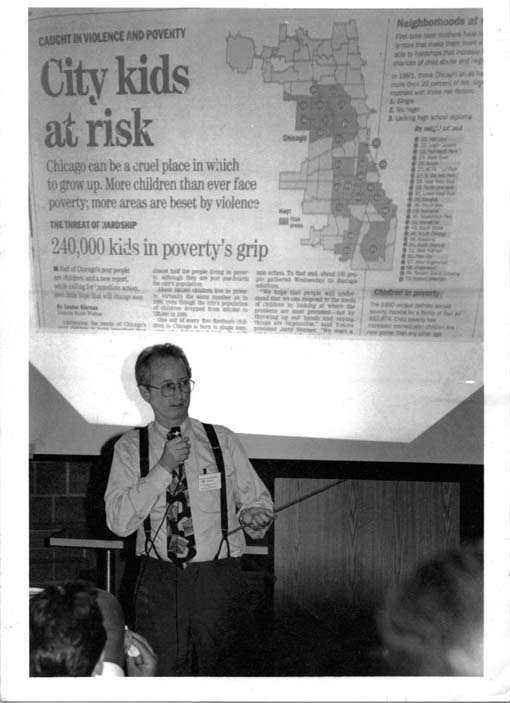
I've been using maps since 1993 to focus attention on areas of high poverty in Chicago where kids and families need extra help.  At the left is a photo of me with a Chicago Tribune article on the screen behind me. The headline was "City kids at risk" and the sub head told of 240,000 kids living in poverty.

I've pointed to this and similar maps often in an effort to motivate leaders to develop long-term strategies that build and sustain mentor-rich non-school youth programs in all of these areas, instead of having a few great programs in a few areas.  

Below is an article I wrote in January 2007 

----- start 2007 article ---


During a Public Policy Forum hosted in Chicago on 1/24/07, maps were used to show the changing population trends and their implications for future services. The research was created by the Chapin Hall Center for Children.

The T/MC has used maps for many years to show poverty demographics and locations of poorly performing schools as an indicator of need for tutor/mentor programs. The T/MC Program Locator includes a Map Gallery, and a searchable database that visitors can use to shop for programs in different parts of the Chicago region.

However, we've also built a GIS links library, with links to different organizations in the Chicago region and nationally who are using maps to create a better understanding of poverty as the root cause of many other social issues.

During the meeting today I invited the 300-plus participants to use the GIS links on our web site as a resource in their own planning and networking. In addition, I invited them to add additional links, showing other sites that use maps to provide a spatial understanding of important social issues.

I also invited people to provide information about forums where people are using maps to share information, network and collaborate, so that all children in the Chicago region have equal opportunities for an education and a life out of poverty.

Finally, if you know of people who blog the issues that were discussed in today's forum, add your link to the T/MC links library or introduce this resource in the comments section below.

If we build a network of Chicago area and national organizations using maps to make better decisions, then the next step is to create blog-exchanges at strategic times throughout the year, so we can draw a growing number of people together to look at this information, reflect on it, and use it to do more to help kids living in poverty neighborhoods.

 ---- end 2007 article ----

If you spend some time viewing articles posted since 2007 I've often invited leaders to adopt the strategies I've been sharing.

It has not happened.

For a variety of reasons but most likely, too few have ever spent time looking at what I've written, and the ideas have always been too far from common practice for people to understand and adopt them.

Many things have changed since 2007, but two stand out.

First, the number of kids living in poverty has declined.  This article points to research by UIC and the MacArthur Foundation showing demographic shifts since 2000.  The biggest decline is among Black Chicagoans. The UIC report shows that this group declined from 1,063,737 in 2000 to 787,661 in 2020.  At the same time Latino population grew from 753,644 in 2000 to 819,518 2020. 

According to the UIC report (page 40) 28.2 percent of the Black population is in poverty. 18% of the Latino population is in poverty.

That means around 222,000 Black Chicagoans live in poverty in 2020 and 147,500 Latino families live in poverty.  That's about 370,000 people. 

Another report from Self Inc., a financial technology company, says that "20.6% of Chicago minorities live in poverty".  This report says that there are 126,988 children below the poverty level in Chicago.

That's a big change since 1994, but still a huge number.

Second, media stories about crime and violence remind us that poverty continues to have a negative impact on many children and families living in high poverty areas.

I included this Chicago SunTimes story in an article I posted in November 2020. 

It's one of dozens of similar articles I've posted in this section since 2007.  

So, there are still a lot of kids who need help in Chicago. That's true for other big cities, too. 

Yesterday I was contacted by a PhD student from Germany, who had visited my MappingforJustice blog and wanted me to fill out a survey about my uses of technology for civic benefit.  Last year I wrote about an on-going conversation I was having with Aliyu B. Solomon, from Nigeria. 

I wish people in Chicago had been showing similar interest over the past 28 years. Actually, a researcher from the University of Chicago did do a brief case study of the Tutor/Mentor Connection in the late 1990s. You can read it here. 

In this report one observation said "T/MC may be particularly difficult to understand because it does not easily fit within known categories of organizations"

That remains true in 2023.  

In the 2007 article I pointed to the library of GIS resources that I had been building.  I've added to that often since then.  I also created this concept map, to help people find data resources they could use in creating stories similar in purpose to those on this blog.


I still don't find many using maps the way I have been so I've also not been able to gather people at strategic times a year to talk about what they are doing. Maybe someone in the future will do that.

The future.

Along the left side of this blog are tags that enable you to narrow your search for articles to read.  I encourage you to open About T/MI, History, and A NEW T/MC to expand your understanding of what I've been trying to do and to learn ways you might build your own version focused on your city, and/or step forward and help rebuild the T/MC to focus on Chicago in future years.

Thanks for reading this. Please share it. 

I'm on various social media platforms. I hope you'll connect with me.  Find links on this page. 


Furthermore, I invite you to help Fund T/MI in 2023 to help me continue to share ideas and host the ideas and library.

Visit this page and use PayPal to send a contribution. 

Go forth and do good!