Showing posts with label mayor. Show all posts

Thursday, May 18, 2023

Chicago school closings. 2011 and now

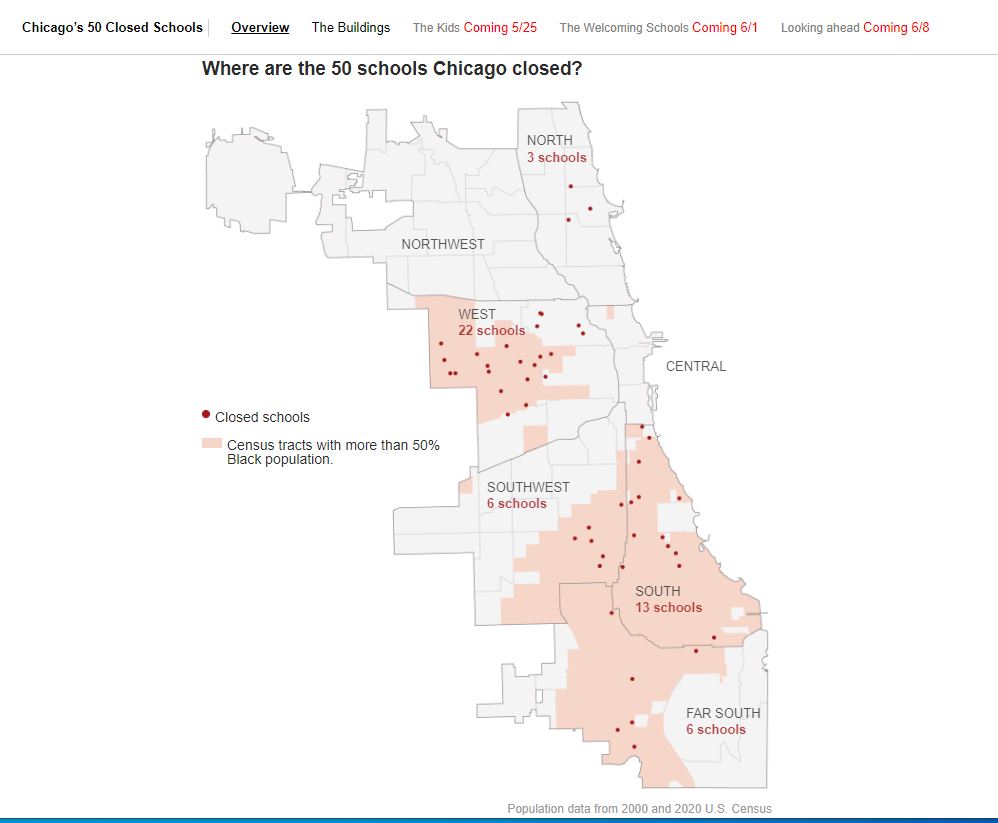
Today I read a WBEZ article titled "Chicago Closed 50 public schools 10 years ago. Did the city keep its promises?"  

Today's article is the first in a 3-part series and includes maps that show a majority of these schools were in areas with high concentrations of Black Chicago residents.

So far,  the answer to the question, is "No. Chicago did not keep it's promises."  I encourage you to read this article and the ones that will follow.

I was curious to see what I wrote about the school closings, back in 2011 when they were happening.  Below I've re-posted an article that I wrote in November 2011.

--- start 2011 article ---- 

Today's Chicago Tribune includes a feature article titled: CPS fails to close performance gap: Black students still losing academic ground despite reforms, study finds

It leads off saying:

Twenty years of reform efforts and programs targeting low-income families in Chicago Public Schools has only widened the performance gap between white and African-American students, a troubling trend at odds with what has occurred nationally.

Across the city, and spanning three eras of CPS leadership, black elementary school students have lost ground to their white, Latino and Asian classmates in testing proficiency in math and reading, according to a recent analysis by the University of Chicago Consortium on School Research.


It includes a statement saying:

"If school closings destabilized certain neighborhoods, other efforts were ineffective — millions of dollars pumped into countless after-school initiatives and tutoring and mentoring programs geared toward African-American students, only to see math and reading scores languish and many students fall further behind."

I challenge this statement of "countless after-school initiatives and tutoring and mentoring programs".

I've been hosting a database of non-school volunteer-based tutoring and/or mentoring program serving Chicago and have been using maps to show where these programs are needed, where existing programs are located, and where more dollars are needed to help programs constantly innovate ways to have a greater impact.

I tried to find census maps on the internet today to support this article. Here's one set of maps showing demographic concentrations in the Chicago region. This is from a U.S. Census Grids web site.


Here's a maps showing African American population concentrations in Chicago, created by the Tutor/Mentor Connection in the mid 2000s. On this map we've overlaid locations of poorly performing schools from the 2007 ISBE watch list. From both sets of maps you can see high concentrations of African Americans living in high poverty areas. You can also see a huge number of failing schools.

On this next map you can see locations of different non-school tutor/mentor programs in the Chicago area. You just don't see a large number of programs in many parts of this map. I encourage you to use the Interactive Program Locator (archive since 2018) and create your own map. Sort by type of program and age group served.

When trying to understand this information you need to think in layers. What is the distribution of tutor/mentor programs serving elementary school kids? Middle school? High school? In each neighborhood programs serving all three groups need to be equally available?

If "millions of dollars had been spent on countless non-school tutor/mentor programs" targeted at African American youth, the map should show many more programs in these neighborhoods than we show.

There may be more. This mapping project has never received funding from the city, the schools or major philanthropy. Thus, there may be programs we don't know about and some of our information is out-of-date. Furthermore, there needs to be many more questions asked, to know more about what these programs have in common, how they differ, what they need to find and retain quality staff and financial support, ways they can constantly improve.

The Tribune story offers a generalization that makes one think that millions of dollars were spent on a comprehensive tutoring/mentoring strategy. Millions may have been spent, but there is no evidence that any strategy has been used to assure that Chicago has a broad distribution of well-organized and constantly improving non-school tutor/mentor programs in high poverty neighborhoods.

This could change if the Mayor, a foundation or an investor were to become a partner and provide financial support to the Tutor/Mentor Institute, LLC so we can update the maps and launch an aggressive advertising campaign to help existing programs get the funding and talent they need to operate in more places and to constantly improve their impact over the next 10-20 years.

---- end 2011 article ----

If you've read any of the articles I posted before, or after, 2011, I've constantly encouraged leaders to invest in a city-wide network of non-school tutor, mentor and learning programs that reach K-12 youth in every high-poverty neighborhood.

No leader has yet embraced this strategy.  Maybe Chicago's new Mayor will make it part of his strategy, and his legacy.

He won't know about it unless you share this article with him or members of his team.  

You can find me on Twitter, Facebook, Instagram, LinkedIn and Mastodon (see links here). I hope you'll connect and invite your network to also connect.

If you'd like to help me keep writing articles like this and hosting the Tutor/Mentor Library, please visit this page and make a small contribution.

If you'd like to bring my archives into your university so students can study what I've been sharing and apply it to their own lifetime commitments, I'd really love to talk with you!  


Tuesday, May 09, 2023

Building and Sustaining Mentor-Rich Support Systems for K-12 Youth

Chicago will have a new mayor in a few days and he has huge challenges facing him.  I think many of those center around how he builds and sustains a mentor-rich support system that reach k-12 kids in every high poverty area of the city and helps more of those kids move safely through school and into adult lives.

I've been sharing strategies for over 25 years, based on my own leadership of a non-school tutor/mentor programs and what I've learned from other programs in Chicago and other places, as well as what I learned in 17 years of retail advertising for the Montgomery Ward Corporation, 4 years as a Loaned Executive with the United Way and 3 years in Army Intelligence. 

Those ideas are on the Tutor/Mentor Institute, LLC website and in articles posted on this blog since 2005.  

Below I'm reposting an article from 2016 that I hope you'll read and share with Mayor Johnson, and with leaders in other cities.

----- start 2016 article ----

I've been using graphics like this for more than 20 years to communicate the vision of long-term volunteer-based tutor/mentor programs that connect with youth as early as elementary and middle school, then do everything they can to help those kids move through school and toward jobs and careers.  If you do a Google search for "tutor mentor" my sites are frequently in the first five. If you then look at the "images" feature, you'll see dozens of maps and visualizations. You can click on each to find the article where the image was used.

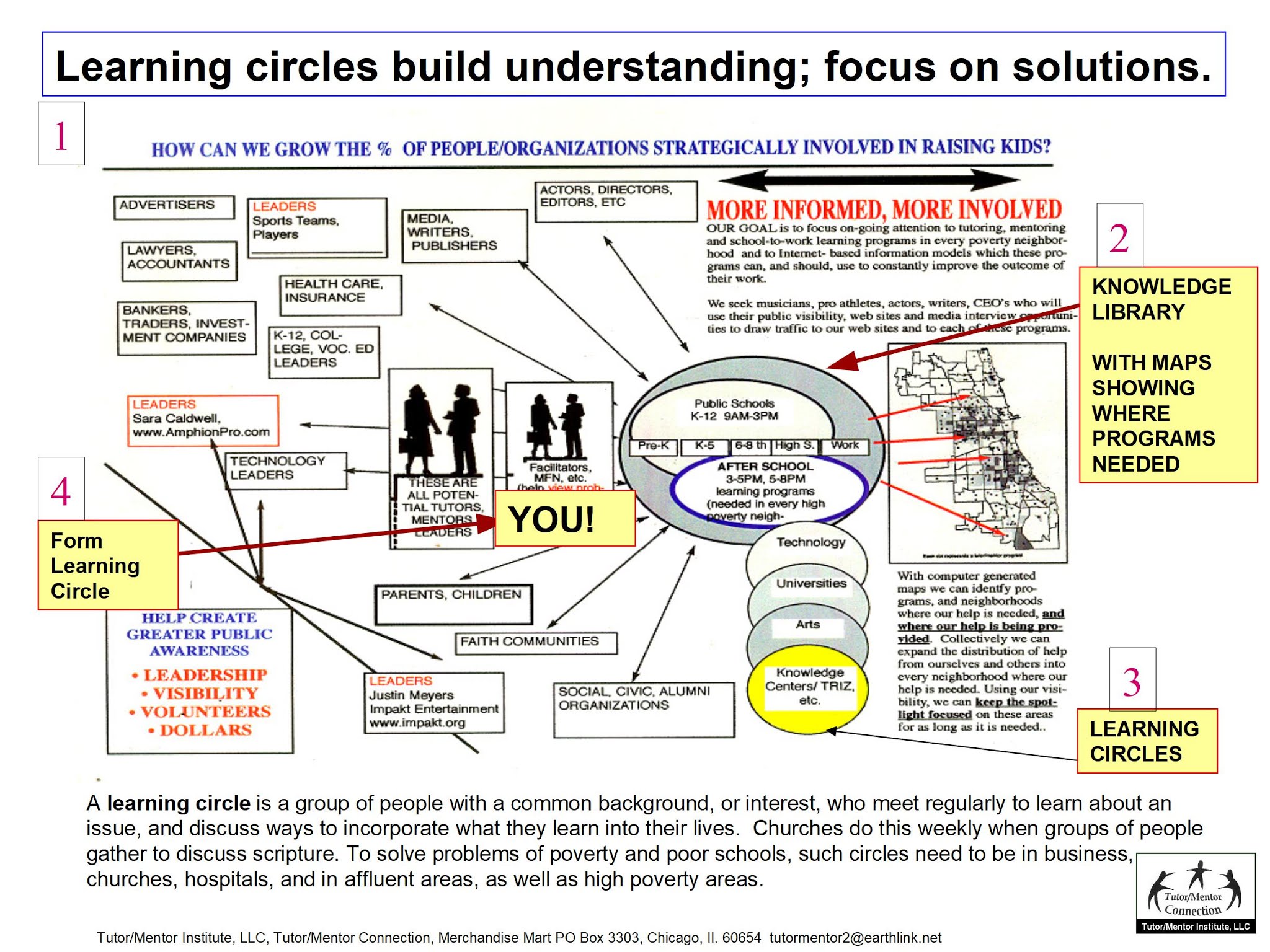
In many of my graphics I combine maps with network-building visualizations. This is one. The circle in the middle represents the knowledge that's available to us through the internet, and through the contacts we make with others. The two images to the left of the circle represent intermediaries, like myself, who collect and share the information, and use blog articles and social media to "nudge" the network. The second image represents people who read these stories, then re-post them to people in their own networks, who then form "learning circles" who read, reflect, discuss, then act.

Sort of what happens in faith groups every Saturday or Sunday, except these groups use maps to focus their attention and resources on neighborhoods where tutor/mentor and learning programs are most needed.


This is the front page of many of the PDF articles I share on Scribd.com.  Our learning should be intended to help strong, and constantly improving tutoring, mentoring and learning programs be available in all high poverty neighborhoods. That means we need to influence what resource providers do as well as what program leaders and policy makers do.   In this video I describe volunteer involvement in a tutor/mentor program as a form of adult "service learning". 


Since starting the Tutor/Mentor Connection in 1993, and the Tutor/Mentor Institute, LLC in 2011,  I've recognized the need to dig deeper into the library of Chicago area youth serving programs that I've been hosting, to learn about their history and infrastructure, so we know more about what it takes to connect youth and volunteers in long-term relationships that transform the lives of both.  This graphic recognizes that much of the work that needs to be done is not visible to someone just spending an hour or two a week as a tutor/mentor, or to someone reading a one page summary included in a grant proposal.

I've never had the staff or finances to dig deeply into this information, thus have reached out to universities and others to share this work, I created the presentation below to show that community information collection is a shared responsibility.


I created another pdf that I titled "Shoppers Guide" to suggest elements that researchers would look for as they studied different youth serving organizations, or that volunteers, parents and/or donors might look for on web sites of youth serving organizations.


There's a lot of information in my blog articles and on my web sites, representing information and ideas collected over the past 40 years.  It's not something that anyone can master in one or two sessions. Yet college degrees are earned over four to eight years of study. And people have been gathering in big and small groups weekly for over two thousand years to understand the scripture collected in the Torah and the Bible.  

When you read a newspaper story, or Tweet that talks about the bad things happening in our world, where do you go to find ideas for making those negatives change into something better? Or do you even try?

Anyone, anywhere, can take this role.

If you have read this far, your next step is to share this, so others read and reflect, then pass the ideas on to others in their own networks. Through this network-building we'll find people with special talents and resources who will help make a greater difference in the world with the ideas we're sharing. 

 --- end 2016 article ---

I started tutoring in 1973 and was matched with a 4th grade boy named Leo Hall.  We've stayed connected for 50 years.  Over the past few years I've broadcast that Leo was in need of a kidney transplant.  I'm thrilled to say he received that last month and now is in full recovery.

I share these posts on Twitter, LinkedIn, Facebook, Instagram and Mastodon (see links here). I hope you'll connect with me and share these ideas with your own networks.

I also hope a few readers will go to this page and make a small contribution to help me continue to do this work.  Thank you.  

Monday, April 10, 2023

Sharing on Twitter

Chicago has a new Mayor and over the past week I've shared some strategies from this blog via Tweets. You can see some of them below.

I hope a few people will read this and then share it so others will also take a look.  Then, I hope some people will say, "I can do that, too!"  and "I can do that better."   Or, "I can create my own version of these articles and apply them to my city instead of Chicago".

That is my goal. Until there are more people in Chicago and other places writing a similar blog, hosting a website like www.tutormentorexchange.net, and sharing on social media, we just won't have enough attention or enough people applying these ideas to create a better future.

Enjoy your week. There's much work to do. 


Wednesday, April 05, 2023

Chicago has a new Mayor; Same Problems

Last night Chicago voters elected Brandon Johnson to be the city's next Mayor.  I've been giving advice via this blog since 2005. I offer my congratulations and support.

I hope Johnson's team will spend time looking at these articles. 

Below are a few graphics that I want to emphasize.

Invest in programs that reach youth living in EVERY high poverty area of Chicago with pre-school programs and continue with age appropriate programs until they are adults and in jobs where they can raise kids free of poverty. 


Build a learning distribution system, engaging the business community, colleges, entertainment, technology and every other sector.  Ask school and non-school programs to put graphics on their website that indicate the many types of learning made available to students and that engage mentors and tutors from a wide range of networks.   Do the data collection and analysis that assures that such programs are available to each grade level in EVERY high poverty neighborhood.


Address the other issues, too. Just building tutor/mentor programs and improving schools won't remove all of the barriers that reduce opportunities for kids living in high poverty neighborhoods or come from minority communities.  


Be a cheerleader and team builder. Be the YOU in this graphic. Use your public appearances, interviews, websites, policy and other tools to connect people from EVERY sector of Chicago and its suburbs to information they can use to learn more about the problems that need to be solved and places where they can use their time, talent, dollars and votes to solve those programs.  


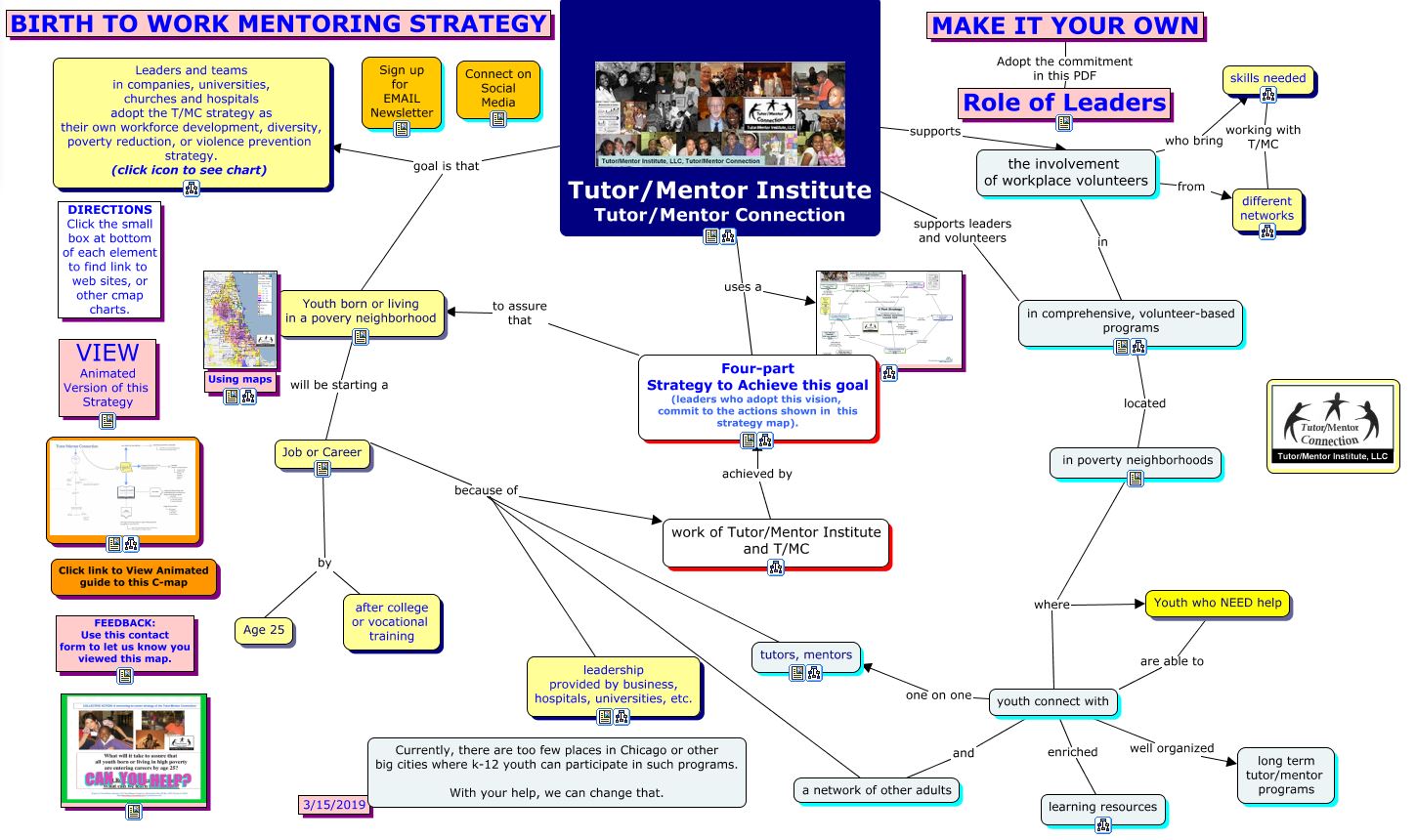
Create a version of the concept map shown below, with your name in the blue box in the middle. Enlist leaders from all sectors to do the same. 


Point volunteers and donors to directories of youth serving programs where a consistent flow of operating dollars are needed to sustain constantly improving, long-term support for kids.  I point to many lists from this concept map.


These graphics just touch the surface of what your team needs to know and support.  Scroll through the articles on this blog to see where I've used these graphics and others that share similar ideas.  In four years I hope to see a collection of similar articles on blogs and websites of many people in the Chicago region.

If you set the example I hope you are re-elected in four years. More importantly, I hope the next Mayor, and the ones after that, continue this set of actions.  

One thing I hope to see are stories showing you standing in front of a map of Chicago, recognizing the leaders who are investing in programs that help kids from birth to work, and showing what neighborhoods they are investing on-going efforts. 

I'd be happy to coach and mentor your teams, or teams from any organization so more people can navigate this information base. 

I'm still using Twitter and can be found on LinkedIn, Instagram, Mastadon and other platforms, too.  Find links here.

I've been doing this work for the past 30 years and now seek leaders from universities and other institutions to take ownership of my archives and my strategies, creating a new, stronger Tutor/Mentor Connection type strategy. Read more in these articles

Now that the election is over I hope a few of your donors will invest a few dollars to help me continue to operate the Tutor/Mentor Institute, LLC and keep the Tutor/Mentor Connection available to Chicago. Visit this page to send a contribution. 

Sunday, April 02, 2023

Crime and Violence in Chicago - Not New

As I read through today's Chicago Sun-Times I saw this article about the violent death of a student athlete from Crane Medical Prep High School on Chicago's Near West Side.

I thought I'd written about Crane HS in the past so did a search and found an article from 2008 with the headline of "Stop the Violence around Crane. Is Police State Mentality the Answer?"

Chicago is electing a new Mayor this Tuesday and that question seems to be dominating voter, and media, attention.

I encourage you to read what I wrote 15 years ago.

start - 2008 article ---

Today and yesterday the Chicago Sun-Times featured two-page stories in response to the shooting of one student near Crane High School, and the severe beatings of two others. You can read 3/17 here and 3/18 here.

These stories focus on the immediate response of setting up police escorts to get kids from one public housing area to the school, because the kids fear retaliation from kids who come from the neighborhood of the youth who was killed. That's a good show of force by our new Police chief. But it's not enough.

Last week an article in the Sun-Times focused on the new book chosen by the Mayor and the Public Library that everyone in Chicago is hoped will read. Why couldn't the choice have been the articles in the Tutor/Mentor Connection web library? Maybe if more people read these we can begin to get more people involved in solving the problems that plague our inner city neighborhoods.

I'm sure the stories about Crane High School are selling newspapers. But, why aren't the editorial and education writers doing stories about how kids who fear for their lives aren't going to be focusing on learning and how this affects the future of Chicago's economy because we're leaving too many kids behind who we need to fill positions in the 21st century workforce?

Why aren't we asking John, Hillary, and Barack what they are doing to engage people in this type of complex problem solving?

Over the weekend I browsed a publication in my library, titled "Wanted: Solutions for America. What We Know Works. An overview of research about what works (and what doesn't) in social service programs." This was published by the Pew Partnership for Civic Change in 2003 (2023 note: The specific link is no longer available. Look at the "solutions" reports in this 2008 web archive).

In the conclusion the article reads "Equipped with reliable information about what works, how do communities move forward to tackle tough problems? If so much is known about promising approaches, why haven't we come farther faster in connecting all citizens to hope and opportunity?"

As the authors of this report conclude, "Change doesn't just happen. It demands gifted and persistent leadership." There are no short term answers to this. Putting an army of police around this school won't solve this problem. It's a band aid. And it won't address the same problem in the area around many other big city public schools.


In many of my blog articles I use maps to illustrate the wide geographic areas where poverty is concentrated in Chicago, and where there are poor schools, gangs and youth on youth violence. I use graphics and concept maps to illustrate what the Pew Partnership was referring to when they said "We have focused too narrowly on specific interventions without confronting the complex interrelationship of issues in a community."

In this concept map of the Tutor/Mentor Connection library I illustrate the four components of the T/MC library, in an effort to draw together people from different silos, and in an effort to expand the thinking and problem solving ability of people who focus too narrowly on just one part of this problem.

Why mentoring? Because mentoring is an adult form of service learning. It can engage adults who don't live in poverty directly in the lives of youth who do. If we can support the growth of hundreds of volunteer based programs around the city we can grow the number of adults who begin to understand this problem, and begin to use their time, talent, networks and wealth to contribute to solutions.

I host a May and November conference with a goal of drawing people who read or write these articles and host these web sites, into face to face networking, and to create public awareness that draws more people to the Internet where they can read these articles and connect with others.

If you're in health care, law, higher education, engineering, workforce development, or if you're a leader, or volunteer, or donor who support tutoring/mentoring programs, I encourage you to use the conference as a meeting place (not offered since 2015) and the T/MC library as a resource for complex problem solving.

If you're the new head of the Chicago Police Department, I encourage you to look at the T/MC as your own strategy. There's no way you can keep an army of police around every high school in Chicago, throughout every school year.

The SunTimes articles show that the problems of gangs have plagued Chicago schools for 20 years and more. It's almost taken for granted. Why?

---- end 2008 article ----

I have not hosted a conference since 2015 due to lack of funds and competition for attention. Yet I still maintain a web library and use this blog and social media to try to draw users to that library. 

I use social media as a meeting place where people can connect and share ideas. 

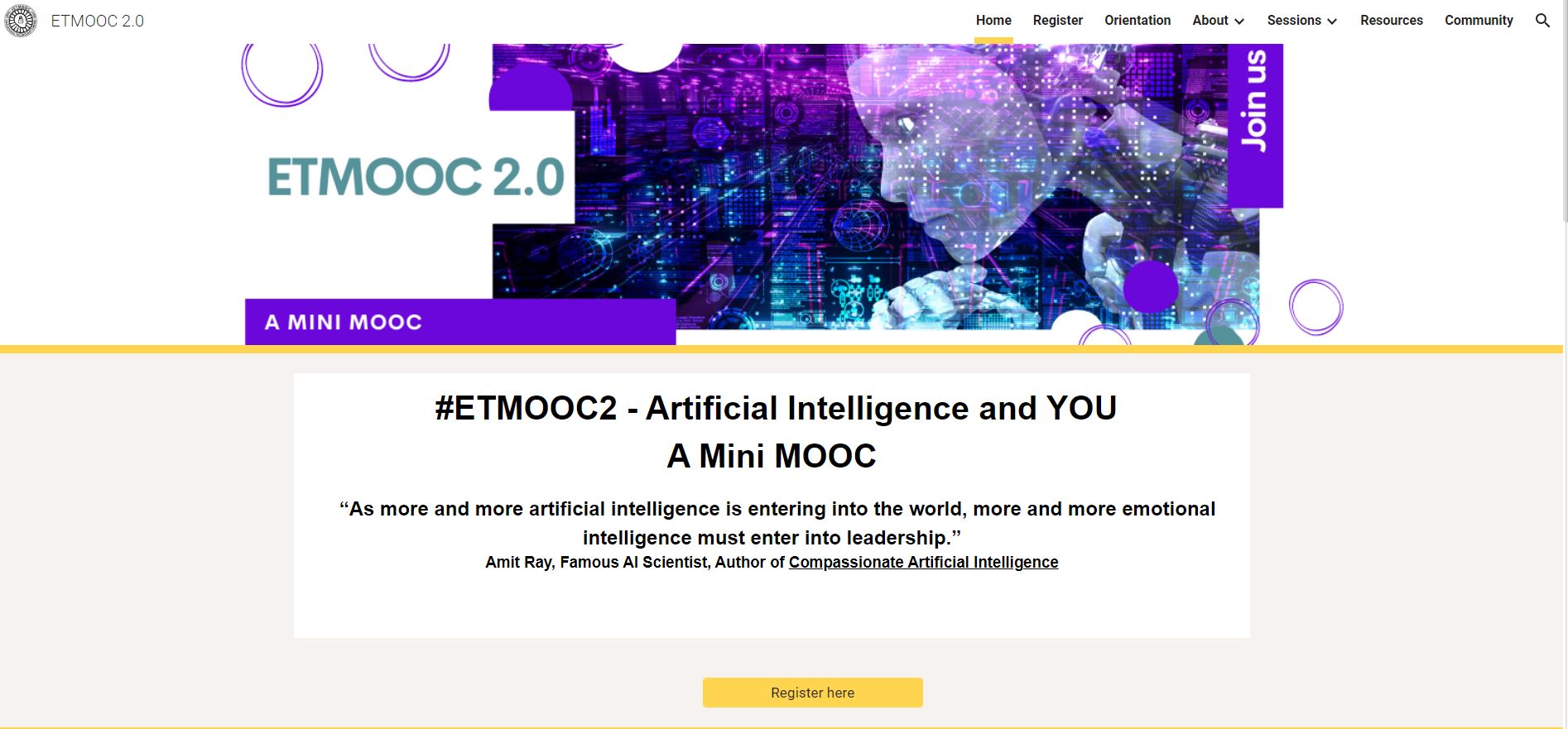
In many of the articles on this blog, dating back to 2013, I've written about cMOOCs, a form of on-line learning and network building. On April 12th a new gathering will look at Artificial Intelligence.  You can learn about this here and follow along on Twitter using the #ETMOOC2 hashtag. 


I point this out because whoever wins Tuesday's election is going to need to find innovative ways to connect people from this huge city with ideas and strategies, and resources, that lead to better solutions than I've seen in Chicago for the past 30 years. cMOOCs and social media connections are one strategy that can be applied. 

All are welcome to use the library and strategies I've shared.  I'd be happy to help coach any teams through the learning process.


Find me on Twitter, LinkedIn, Instagram, Facebook and Mastodon and maybe on Discord, too. See links here.


If you can help fund Tutor/Mentor Institute, LLC, please visit this page and send some support. 


Friday, February 03, 2023

Candidates for Mayor - take a look!

On February 28th Chicago residents (or a very small percent of them) will elect a new Mayor, or re-elect the current one.  Here's one website with a list of candidates

The only candidate I have had much interaction with is Paul Vallas, who was very supportive of the Tutor/Mentor Connection in the mid 1990s when he was CEO of Chicago Public Schools.  He spoke at two of our conferences and one, or two, of our Aug/Sept Citywide Tutor/Mentor Volunteer-Recruitment Campaigns.

So you'd think I would be endorsing him.  I'm not.  He's had 20 years to follow what I write on this blog and incorporate the ideas into his own leadership and I've not seen evidence of that 

Of course, I've not seen indicators that past Mayors or candidates have borrowed my ideas either, although if you browse through this set of articles you'll see that I've been sharing them for many years since starting this blog in 2005. Prior to that I shared them in print newsletters. 

I've participated in the current Mayor's MyChiMyFuture meetings and shared ideas. I like the map they have created. They could be doing more.  No one has asked to learn more from me. 

How would you know if they were borrowing these ideas? You'd see a version of this concept map on their own website.  


Here's one article they could read to understand what this map is showing.  If they adopted this strategy they'd be doing three things regularly.

1) recruiting other leaders to also adopt the strategy map and its commitments

2) support the four-part strategy (see middle node on the map).  This article describes the 4-part strategy.

3) they'd be reading current and past articles and encouraging others to do the same, just like a preacher in a religious group or a teacher in a classroom.  In doing so they'd find many graphics that visualize the commitment they would be making. 

They would emphasize a long-term birth-to-work strategy that has roots in every high poverty neighborhood.


They would be calling for a "learning distribution system" that reach kids in school and non-school hours, and on the Internet.


They would be using their public visibility to draw volunteers and DONORs directly to websites of youth serving programs to offer on-going support.  They would be filling the blue box in the middle of this graphic, drawing "people who can help" to information they can use to locate places in neighborhoods where help is needed. 


Every day they would be challenging the residents of the city and suburbs, asking "How can we do this better?"


It's not enough that they might put these ideas on their campaign website.  They should have a personal and/or organizational blog that shows they have been sharing this commitment and performing these actions for many years.

I'd vote for someone who demonstrated this leadership and these ideas.
(While my focus has been on the city of Chicago and I lived in Rogers Park for 17 years, and led a tutor/mentor program serving kids in Cabrini-Green for 35 years, I currently live in Arlington Heights, so cannot vote in the Chicago election.)

But this message is aimed at potential Mayors of any big city in America.  View this map in this article.

The map shown above is from a Brookings Metro report.  Highlighted are metro areas with concentrations of  poverty.  Each of these cities could use the map/information-based strategy I've piloted since 1993.

It's available for FREE.

Of course, I'd be happy to help anyone understand what I'm proposing and guide you through the ideas I've been sharing on this blog and on the www.tutormentorexchange.net website. 

One of my first recommendations would be to set up a student-learning program in high schools and colleges, where students spend time reading articles then sharing them using various media tools.  View this blog to see how interns did this between 2006 and 2015. 

Thanks for reading. If you're helping someone run for office, share this with them.  Maybe they will adopt the ideas, even if they don't win in 2023.  

I'm on Twitter (still) and other social media platforms (click here for list). Let's connect. 

If you want to help me keep sharing these ideas and hosting my library please visit my Fund T/MI page and send a contribution. 

Wednesday, January 29, 2020

MyChi. MyFuture. Feedback.

As the Tweet below shows, yesterday I attended the citywide meeting of Mayor Lightfoot's EveryKidConnected initiative, which was launched last October. Since then the hashtag has changed to #EveryYouth Connected, and may change again.

As the meeting ended I encouraged the others at my table to use their blogs to share their own ideas for next steps for this initiative.  Mine are below.

In this next Tweet I'm sharing the mission statement developed at the January meeting.


As I said in the Tweet, that vision is what I feel describes a total quality non-school tutor/mentor program.  The graphic below is shown in this presentation. It visualizes the growth of organized, non-school, k-12 youth programs, available in every high poverty neighborhood, with a wide range of age-appropriate mentoring, enrichment and learning opportunities.

Building a learning distribution system - read more

How we get there is what needs to be worked out.  Below are some of the ideas for generating public awareness and involvement that were shared at my table.

The MyChi.MyFuture media campaign is planned to launch at the end of March. The costs of a comprehensive tops-down campaign could be huge, thus efforts that generate free communications from people and organizations throughout the city should be a priority, now and in the future.

1) - So far there is little communications from the leaders of the initiative on Twitter, using either #everykidconnected, #everyyouthconnected, or #MyChiMyFuture.  I received an email follow up yesterday, with the PDF of the slides from the presentation.  If that had been in a Tweet I could have already shared it with my own network.  Using Facebook, Linkedin and Instagram in the same way should be strategic. (see more social media ideas below).

2) - Encourage organizations throughout the city to blog their understanding of this initiative, as well as their part of the process, as well as services available to youth in their own programs and/or communities. Bloggers could be faith groups, elected officials, businesses, non-profit youth orgs, schools, etc.  Once blog articles are written they should be shared in social media, using a hashtag launched by the leaders of the initiative.  

#clmooc 

I have written numerous articles on this blog showing my engagement with the Connected Learning #clmooc community on social media. I urge leaders of this initiative to spend time studying these, to see ways they can use these same low, or no-cost, strategies to connect people, organizations, resource providers and youth throughout Chicago with each other.

3) - Enlist students and parents as communicators. 

The Parent Mentor Program was mentioned as one example where parents are already working to help build relationships between parents, teachers and students. Such groups could be learning about non-school opportunities and existing programs and communicating those via their own efforts. Below I show Tutor/Mentor Connection/Institute, LLC efforts to aggregate and share information. Someone should be aggregating information about parent groups who could be sharing MyChi.MyFuture information and supporting youth involvement in different parts of the city.

Enlist students as story tellers.  During National Mentoring Month youth have been posting #ThankYourMentor stories.  This could be #MyOutOfSchoolLearning experience or #MyChiMyFutureLearning experience. It could also be #HowISpentMySummer  or #MySummerLearningExperience. As youth become engaged they could suggest new  hashtags, and themes for future communications and interaction efforts.

Participation maps such as this from the 2017 CLMOOC could be used to show places in the city where youth are creating messages for this campaign, and to show locations of non-school learning opportunities.

Use maps to assure youth in every part of Chicago have opportunities

Enlist students via classroom learning activities - Here's one of many blog articles where a middle school educator from Massachusetts shares work his students are doing.  If during spring 2020 educators were encouraged to develop a back-to-school activity where students used blogs, videos, social media, games and other forms of communications to share #MySummerLearningExperince or #OutofSchoolTimePrograms in my neighborhood, which were then aggregated and shared on blogs like Kevin's, this could launch thousands of stories from September 2020 to May 2021 (and beyond) to help the MyChiMyFuture initiative grow and reach all Chicago youth over the next few years.

Tutor/Mentor lists on Facebook

4)  While MyChi.MyFuture is attempting to create a master list of out-of-school-time opportunities I feel it should point to existing lists, such as the ones I point to from this concept map. I'm sure there are others that I'm unaware of. Collectively these will always have more information that what any single intermediary is able to collect and keep updated.

5)   To  help draw attention to existing providers and help them connect and learn from each other, MyChi.MyFuture should a) create a profile on Twitter, FB, Linkedin, etc. then use the list feature on Twitter, and Notes feature on Facebook, to create one of more lists of Chicago programs.  (It could create one master list, or could create lists for sections of the city, North, Central, South Central, Far South) as I do in the Tutor/Mentor Programs Directory.

Here's my TMPrograms list on Twitter. Here's my Facebook list of Chicago programs and intermediaries.  If MyChi.MyFuture were to create its own lists, people visiting their account could scroll the list to learn about existing programs via the information they posts. Donors and volunteers could learn to use this to find programs in different parts of the city to support. Parents and youth could learn this to find opportunities.

6)  - Recruit volunteers from advertising, PR, technology and other communications companies to mentor youth and teach them ways to tell stories via multiple media. At some point in the future maps should be showing icons throughout the city where people from each industry are connecting with youth.  Programs should show that multiple industries have volunteers working at their sites, not just in direct service, but in helping programs communicate their stories, their lessons and their challenges.  Many companies should be doing this as part of on-going, formal, workforce development strategies.


7) - Focus on connecting intermediaries like the Austin planning group, to others throughout the city, so they can learn from each other.  Below is a concept map showing the planning process that should be on-going in every community area.

Planning is an on-going cycle, focusing on a specific geographic area. read more
One of the roles of the leadership of MyChi.MyFuture is to identify the various stakeholders and share that information in ways that encourage conversation, interaction, learning and shared efforts among the various organizations.  Below is an example of how I've been doing that.

Intermediaries focused on youth in Chicago - cmap
Youth in various schools and non-school programs, local colleges, or any other group could be creating similar maps showing local organizations, intermediaries, etc.  Note that I point to the web sites of each organization on the map (if I have a link).  This information is published in my blogs, website and social media to encourage programs to connect and learn from each other.

8)  How will you measure this?  How will you quantify the number of youth in each neighborhood who most need these programs? How will you show how many participated during the summer, or during the school year? How will you share that, at the neighborhood level, to support on-going planning and program growth?  Below is a Slideshare pdf that shows the number of youth, age 6-17, and the number of high poverty youth, in each community area.  

Every Youth Connected implies that 100% of the youth in each area will participate in one or more learning experiences in the summer and in the school year.  That is a significant challenge, both from the planning perspective, and from the funding perspective, since right now there are so few program slots available in many areas of the city.

I've been sharing ideas like this on this blog since 2005 and on websites since 1998. I hope some of the people involved in this new initiative will take the time to look and want to have me help them understand and apply these ideas.

You can find links to my social media sites at this page.


Friday, October 11, 2019

Chicago Mayor launched #EveryKidConnected Youth Initiative

I was one of more than 200 invited to attend a meeting at the Chicago Cultural Center yesterday, where Mayor Lori Lightfoot launched her #EveryKidConnected initiative. (By the end of the 2 hour event this became #EveryYouthConnected).

Click the link above and you can find Tweets posted by myself and a few others during and following the event.

Here's a paragraph that sounds much like what the Mayor said in her welcoming remarks:

 Chicago can only succeed as a city if every part of Chicago succeeds.

Chicago won’t move forward unless we all work to move forward together. Success will be measured by asking whether all of our communities are thriving.

These plans are highly interdependent. For how can we even begin to think about the way our government should be structured and run without deep consideration of the supports that communities need and the best way to deliver those services? How can we grow without strong communities? How can we ponder what is best for our communities without thinking hard about the challenges our children face?

Was this Mayor Lightfoot? No it's from Mayor Emanuel's Plan of Chicago, launched in 2011. I posted it here

Here's another blog article that I posted in 2011.


Then, here's an earlier article, posted in 2009 when President Obama launched a mentoring initiative from the White House.  At the left side of this blog you can find a category for Obama and find other articles where I've tried to reach into his thinking and actions.


Then in 2013 when Thrive Chicago was launched by Mayor Emanuel, I posted this article.
There's a common thread in each of these articles. 

Since 1993 I've been building a library of ideas that would support the growth of well-organized non-school tutor, mentor and learning programs in every high poverty neighborhood. It's been available to anyone doing research related to this issue.  Yet, if any of the people organizing these initiatives were looking at this information, none have reached out to ask for my help...during the initial planning, not at an event where I'm part of 200 other people.

Here's a much earlier example. In 1993 and 1994 Mayor Richard Daley's office researched ways to build a network of youth serving organizations. This 1995 report announced their plan.

1995 Chicago For Youth

The link to the PDF report is here.  Even though I had led a volunteer-based tutor/mentor program in Chicago since 1975 and had just launched the Tutor/Mentor Connection in 1994, I was not invited to contribute ideas to this planning process.

1998 article
It's not as though I was invisible in Chicago. Here's a 1998 article from Crain's Chicago Business. It's one of many you can view on this page.

While I share my ideas on blogs and via pdf white papers on the Tutor/Mentor Institute, LLC website, the library I've been building since the mid 1990s points to the ideas of thousands of other people and organizations, in Chicago and around the world.

Below is a Tweet I posted during yesterday's event, pointing to a report published by The American Institute of Architects Chicago (AIA Chicago).

Personal Learning Network

I have been trying to motivate volunteers, donors, leaders and youth to form personal learning networks (described in this article) for more than 40 years. The libraries I've been building have been intended to help volunteers do more to help youth, and donors and volunteers do more to help youth programs grow in more places.

The information has been on line since 1998.  Can't anyone find it?

Here's one more Tweet from yesterday, showing what I hope results from my own efforts on Twitter, Facebook and Linkedin.

I'm available. I can meet via Skype of meet at your office. If you spend time in advance looking through my web sites and blog articles you'll know much more about what I'm trying to do before we meet. That way you won't be overwhelmed by what I share when we do meet.

I only wish I'd been able to have this influence 25 years ago.

Here's one more challenge. Visiting my web sites and borrowing my ideas is free. It just costs you time. However, since 2011 I've not been funded to do this, or to keep the Tutor/Mentor Institute, LLC resources on line. I've used my own savings and I depend on a small group of contributors. Will you help?  click here