Showing posts sorted by relevance for query influence. Sort by date Show all posts

Friday, November 14, 2014

The Value of Intentional Influence - SSIR series

I've been reading, and commenting, on a series of articles on the Stanford Social Innovation Review site, titled The Value of Intentional Influence.

I hope you'll spend some time reading these, then browse back through blog articles I've written on this site, and the Mapping for Justice site, and look at some of the printed newsletters I was sending to 12,000 people in the 1990s.

Here's a graphic that illustrates my goal of influencing what resource providers do, along with what tutor/mentor program leaders do, so every high poverty neighborhood of Chicago and other cities is filled with great, or constantly improving, non-school programs helping kids move through school and into jobs some day in the future. In this article you can see how I posted this in a blog, then one of my interns from IIT and South Korea, converted it to a video on YouTube.

This is one of many graphics I've created to emphasize the role everyone, or anyone, can take to influence the actions of others.

I've been trying to influence what people do since I became a mentor, then leader of a volunteer-based tutor/mentor program in 1973-1975. Actually, I started earlier in college when I was in a fraternity and tried to influence new freshmen every year to join the fraternity. When I came to Chicago in 1973 it was to become a retail advertising copywriter with the Montgomery Ward corporation. For the next 17 years my daily focus was creating advertising that would influence people to shop in one of the 400 retail stores we had in 40 states.

At Wards our annual retail advertising budget in the 1980s was close to $250 million. In the past 20 years my advertising budget has been close to zero. I started the Tutor/Mentor Connection in 1993 with no money and seven volunteers, and with a primary goal of creating a new youth serving programs to help 7th graders in Cabrini-Green move through high school. I've never had more than $150,000 in a given year for everything the Tutor/Mentor Connection was trying to do, even though my focus was the third largest city in the USA.

Thus, my ability to influence what leaders in industry, philanthropy, media, politics, sports, religion, education, etc. do has been limited, even though writers like John McCarron of the Chicago Tribune recognized the vision I had as early as 1995. See article. In the past three years, as the Tutor/Mentor Institute, LLC has been my organizational structure, the dollars I have available to influence people has been even less, yet my time has grown since I'm no longer also responsible for leading a non-school tutor/mentor program with 80 pairs of teens/volunteers meeting weekly.

If you want to help youth born in high poverty neighborhoods move from birth to work you need to make a daily effort to influence what others do to provide the talent, operating dollars, technology and ideas to schools and non school organizations working with youth and families in high poverty neighborhoods.

If you want to help me do this work you can go to this page and make an investment in my work. Or you can contact me and explore ways you can become a partner, or even an owner, sharing this influence building effort in your own community.

Monday, October 26, 2015

Role of Influence: Expanding Support for Youth Serving Organizations

I've posted more than 1000 articles on this blog since 2005. All focus on ways to help high quality, volunteer-based tutoring, mentoring and learning organizations become available to k-12 youth living in high poverty neighborhoods of Chicago and other cities. All seek to influence what other people do, recognizing that my ideas and efforts alone have very little impact.

I use visualizations to communicate ideas, and realize many are not clearly understood by people who have not spent as much time as I have thinking of ways to make systems of support available the same way teams in corporate offices spend time thinking of ways to make retail stores, food outlets and product distribution systems available to customers in many places.

Yesterday I uploaded a presentation that is intended to help clarify the meaning of one of my graphics. See below.

How to Influence Change: Use of Visualizations by Daniel F. Bassill


I created this based on information in this blog article and this series of articles.

If you read this, Tweet this to your own network, or lead a discussion group within your church, business, social group and/or fraternity, I have had an influence on your actions. If the people you share this with, share it in their own networks, I've had a greater influence, and you've had your own influence. If this is viewed and shared by people who are in positions of greater power, or influence, then the ideas are leveraged, and have even greater influence.

This is a process. It'a a relay-race, where one person passes on the idea to others, who then pass it on to an even larger group of people.

That's how movements grow and change begins to happen.

Take the first step. Read this.

Take the second step. Forward it to your own network.

Take additional steps. Browse through articles I've posted since 2005 and other articles I've posted at https://www.scribd.com/daniel-f-bassill-7291

Create your own versions of this idea, just as interns working with me in Chicago have been doing since 2006.

Sunday, November 25, 2018

Doing the impossible. Influencing Donors and Providers

I've been creating visualizations to share ideas since the 1990s, thinking a picture is worth a thousand words, and you can see many in my blog articles.  The one featured in this article is one of the most important.

I try to draw ideas and resources
to every youth program in Chicago
When I started the Tutor/Mentor Connection (T/MC) in 1993 my goal was to duplicate advertising strategies that big business use to motivate people to shop at their stores.  I needed to find a way to do this without the money available to most companies to do this work.

On one level, I've been sharing information that people directly involved in youth tutor/mentor programs can use to help build on-going programs that help kids move through school and into jobs and careers.

At the same time, I've been sharing information intended to influence donors to become more proactive in supporting youth tutor/mentor programs already operating, and in helping new programs start where more are needed.

Below is a graphic that you can click into to see these influence steps.


Both paths shown on this graphic are important.  I think influencing people who don't live in poverty to provide a consistent flow of time, talent and dollars to programs serving youth and families in poverty is going to be just as difficult as it is to influence the people leading existing programs, or starting new programs, to look past what they have already been doing, to new ideas of what they should be doing,  if the goal is that the kids in these programs today are in jobs and starting careers when they are age 25 or older.

I first used this graphic in this 2014 article.  Browse this list and read more articles where I use this graphic. Can you apply this in your own efforts?

However, there's also a third level of influence involved. Since forming Cabrini Connections and the Tutor/Mentor Connection in 1993 I've tried to influence volunteers and donors to provide the talent and dollars both parts of our youth support strategies needed each year.  And, since forming the Tutor/Mentor Institute, LLC in 2011, I've continued to try find this support each year.

It Takes A Village - see map

It's never been easy. It's been much more difficult since 2011. 

The concept map at the right is titled "It Takes A Village" meaning, people from every different sector of life in the Chicago region, or any other part of the country, should be involved in helping all kids move through school and into jobs and careers.   With this in mind, many could be joining me in trying to "influence" actions of others. 

If you're doing this, or trying to do this, I'm trying to find and connect with you on Twitter, LinkedIN or Facebook.

This also means that many people could also be helping me do this work. 

If you've read this far I hope I've influenced you to visit this page and send a contribution to help me continue this work.

Saturday, January 02, 2016

Using Better Data to Support Innovative Problem Solving

I read this article, from the Stanford Social Innovation Review (SSIR) today, titled,"Bridging Communities and Government Through Data".   It shows how better data can point people and resources to places where complex problems require investment and on-going effort to create solutions.   This would be part of Step 1, from this 4-part strategy (see presentation)  that I've been sharing , and applying through my own efforts, since 1993.


The SSIR articles calls for government funding of the data gathering part of this process. I think that's part of the solution, but before we get consistent, on-going funding for everything that I include in this strategy map, we need to influence many people in the private sector to do much more than they do now.

The visualization below is one that illustrates a need to influence what resource providers do in order to also influence how government and social benefit organizations do.  Without building a flow of resources, to support innovation, learning, and stronger organizations in more places, the efforts to document and measure outcomes will be too few, and to limited. 


I don't know if you've set a New Year's Resolution yet, of if you ever do. However, unless more people share the ideas I write about, or that SSIR posts on their web site, too few people will be involved in doing the "influence" work needed to get more people involved, more resources involved, and better on-going distribution of talent, dollars, ideas and other needed resources into all of the high poverty areas which are the root of many of the problems we see written about in the daily media.

I've written more than 1000 blog articles since 2005 and I have hosted ideas like this on web sites since 1998. I included these ideas in printed newsletters before the Internet became my tool for sharing ideas.


Leaders in every sector, in every city, need to be writing blogs with the same information I'm sharing, and for the same purpose.

Among the data we need to be collecting would be data that recognizes, on an industry-by-industry, or faith group-by-faith group basis, who is actually taking this role.

In this presentation I show the potential of using the information we collect to inspire and influence constant, year-to-year improvement in what we're all doing to solve complex problems.

While I think this role can be adopted in many types of organization, I continue to seek partners, funders, investors who will help me continue my own efforts.  Click here and make a 2016 contribution to support my work. I'm not a 501-c-3, so I cannot offer a tax deduction.

I can offer to continue to share these ideas, at no cost, to you and other users if you'll help me. 

Monday, October 24, 2011

Tipping Points, Influence and more

I created this graphic over the weekend as another attempt to communicate visually what I have been trying to do for the past 18 years, in fact all the way back to 1975 when I first started leading a volunteer-based tutor/mentor program.

I firmly believe that connecting a youth with a non-family adult in a structured, on-going tutor/mentor program is a good thing
. It has an influence on both the youth and the adult but in so many different ways that it is difficult to quantify. I'm not trying to recruit those who don't believe. I'm trying to connect with the thousands of people who have already been part of tutor/mentor programs at some point in their lives and already know how they have been enriched in big or small ways as a result.

In order for these programs to reach youth in high poverty areas of big cities like Chicago and to involve volunteers who work full-time jobs
in many different industries the programs need to operate in non-school hours and in places where youth and volunteers feel safe participating. In such places the program/organization itself becomes part of the mentoring process. It sets a tradition that connects past, current and future participants of that program.

In a city like Chicago with close to 200,000 youth living in high poverty neighborhoods there needs to be hundreds of small tutor/mentor programs
serving k-12 youth. For such programs to grow in more places teams of leaders need to step forward who act as a 'virtual corporate office'. They do things that people in the corporate offices at WalMart, Sears, McDonalds and other big companies do everyday to support multiple stores in many locations.

If we know who the existing programs are then we can lower their costs of operating and we can enhance the quality of their work
if we can influence the flow of operating dollars directly to each program and if we can influence the flow of manpower and talent to each program. If programs have access to capital for innovation and if they have talented people learning ways to get better by learning from what other programs are already doing, then we can also enhance the quality of every program by collecting and sharing ideas that can be used by any program at any time.

Every big city in the world has areas with high poverty where the gaps between rich and poor are growing wider every year. That means there could be teams and leaders in every city trying to collect information about existing organizations and trying to influence the flow of dollars, talent and ideas to all of the programs in their cities.

I have hosted a Tutor/Mentor Leadership and Networking Conference every six months since 1994 to help stimulate the sharing of ideas among leaders of programs and to build greater visibility for tutoring/mentoring that would drive more donors and volunteers to each of the programs in the city. The next conference is Friday, November 4 and because of my own lack of dollars and the few leaders in Chicago who embrace this strategy, I'm still trying to build attendance for next week's event.

The map below (find at Debategraph site) shows the goals of the conference.


If you can't join me in Chicago why not join me in this forum?

If you are someone who already believes in this logic and sees that you could take a role in influencing the flow of resources to tutor/mentor programs in Chicago or your own community, let's find a way to connect.

Saturday, March 10, 2012

Power of Connected Networks

In one of the sessions of the Getting It Done II Conference I attended Monday and Tuesday of last week, a facilitator defined "organizing" as an intentional effort to obtain relational power, which translates to political influence, philanthropic influence and community influence.

I was impressed by how well Community Development Organizations have been able to mobilize and obtain this type of power, and I was also humbled by how far I and other youth development organizations might need to go to achieve a similar level of power and influence.

Over the past few days I've been visiting web sites of people who were speakers and workshop leaders at the conference. I added some to this section of the Tutor/Mentor Library and I created the map below to show the range of organizations this conference brought together. You can see this actual map here. Last October after I attended a DropOut Prevention Conference I created a similar map, which you can view in this link. By creating these maps and putting links into my library I'm sharing what I learn every day with anyone who visits my web sites or reads my blogs. Based on what I've read of knowledge management over the past decade, this is a value because it saves other people time in finding this information and helps them to see how one idea or network fits together with other ideas and networks as part of a larger collective effort to help kids from poverty areas get the support each needs to move through school and into jobs.

Then, today, I was introduced by my Facebook network to an article titled "Knowledge and Praxis of Networks As a Political Process" written by Yannick Rumpala from the University of Nice, in Nice, France.

In 17 pages Dr. Rumpala provided numerous reasons for mapping and understanding networks, as part of an effort to achieve critical mass and POLITICAL influence. In one statement he wrote "A reticular vision can be a way to rethink the idea of citizenship."

As I read this I saw many things that I've been doing intuitively but with extremely limited talent and resources. I saw the potential of connecting with a much larger network of thinkers and innovators who were mapping ideas, networks and processes and making this information available to support community and political involvement throughout the world.

I hope some of my readers will take some time to read this paper and look at the maps I've created. I'll look forward to hearing from you and working with those who see the potential of what I've been doing and what Dr. Rumpala is describing.

Monday, October 26, 2020

Tipping Points, Influence and more

I created this graphic in 2011 as another attempt to communicate visually what I had been trying to do since 1993, in fact all the way back to 1975 when I first started leading a volunteer-based tutor/mentor program in Chicago.  The beliefs I posted then are still valid in 2020.


I firmly believe that connecting a youth with a non-family adult in a structured, on-going tutor/mentor program is a good thing
. It has an influence on both the youth and the adult but in so many different ways that it is difficult to quantify. I'm not trying to recruit those who don't believe. I'm trying to connect with the thousands of people who have already been part of tutor/mentor programs at some point in their lives and already know how they have been enriched in big or small ways as a result.

In order for these programs to reach youth in high poverty areas of big cities like Chicago and to involve volunteers who work full-time jobs
in many different industries the programs need to operate in non-school hours and in places where youth and volunteers feel safe participating. In such places the program/organization itself becomes part of the mentoring process. It sets a tradition that connects past, current and future participants of that program.

In a city like Chicago with close to 200,000 youth living in high poverty neighborhoods there needs to be hundreds of small tutor/mentor programs
serving k-12 youth. For such programs to grow in more places teams of leaders need to step forward who act as a 'virtual corporate office'. They do things that people in the corporate offices at WalMart, Sears, McDonalds and other big companies do everyday to support multiple stores in many locations.

If we know who the existing programs are then we can lower their costs of operating and we can enhance the quality of their work
if we can influence the flow of operating dollars directly to each program and if we can influence the flow of manpower and talent to each program. If programs have access to capital for innovation and if they have talented people learning ways to get better by learning from what other programs are already doing, then we can also enhance the quality of every program by collecting and sharing ideas that can be used by any program at any time. 

I created the graphic below in 2013 to visualize this thinking. Here's a 2015 article where I explain it more.


Every big city in the world has areas with high poverty where the gaps between rich and poor are growing wider every year. That means there could be teams and leaders in every city trying to collect information about existing organizations and trying to influence the flow of dollars, talent and ideas to all of the programs in their cities.

I hosted a Tutor/Mentor Leadership and Networking Conference every six months between May 1994 and May 2015 to help stimulate the sharing of ideas among leaders of programs and to build greater visibility for tutoring/mentoring that would drive more donors and volunteers to each of the programs in the city. I've not  hosted the conference for the past few years due to lack of funding and partnership from others.  Yet, I still support the learning goals of the conferences. 

The map below (find at Debategraph site) shows the goals of the conference.


I share these eLearning goals on this page, too. 

For the past six months the nation and the world has been dramatically reshaped by the Covid19 pandemic.  Site-based tutor, mentor and learning programs have not been able to maintain face-to-face connections with youth and volunteers. While many have moved to virtual connections, there are huge obstacles to be overcome.  I think it's more important than ever to connect programs, volunteers, youth and supporters in the type of eLearning that I was trying to stimulate via the conferences.

Ten years ago I was just beginning to use Twitter, Facebook and Linkedin.  Now they are my primary means of connecting and sharing ideas with others.  If you're reading this, I encourage you to share it.  If you know of others hosting similar discussions please share the information with me.

If you are someone who already believes in the logic model I've been sharing and sees that you could take a role in influencing the flow of resources to tutor/mentor programs in Chicago or your own community, let's find a way to connect.

I created the Tutor/Mentor Institute, LLC in 2011 to be able to continue leading the Tutor/Mentor Connection in Chicago and to share the ideas with other cities. 

I depend on contributions to help fund this work. If you're able, please go to this page and use the PayPal to offer your support.

Thursday, September 03, 2015

Building Public Will - Essential

I scratched out the outline for this story a couple of days ago as I was riding the train and thinking about the challenges we face in solving complex problems like poverty. I hope you'll follow along with my thinking.

This graphic is part of a strategy graphic that shows the planning steps needed to solve complex problems or roll out a new business strategy. See the full graphic and explanation here.

Every year, millions of dollars are spent by social benefit organizations trying to attract resource to support their work. The money is spent directly on fund raising, marketing and public education. It's spent indirectly on training programs and consultants.

Regardless of where an organization operates or what cause it focuses on, we're all competing for a slice of the same donor pie. That pie seems to be shrinking, either because of economic circumstances, or because of the rise in organizations competing for a share of the pie. Natural disasters that occur randomly around the world exert a huge pull on discretionary donor dollars every time they happen.


Thus, it's unlikely that great programs, doing similar work, but in different places, will be available in a large percent of the places where such programs are needed. Since 1993 I've piloted uses of maps to show where non-school tutor/mentor programs are most needed, then using the maps to influence donor support of programs in every place where the map shows programs are needed. In recent years there is a growing application of mapping and data visualization (see blog). However, I still don't see many who are trying to create maps of all service providers doing similar work in areas where that work is needed. Such maps would show a poor distribution of needed programs. Over time it would show change as new programs launch and some go out of business.

It's also unlikely that many organizations will attract on-going dollars to enable them to provide long-term support. In youth development, this is a serious issue. Kids take 12 years to move from first grade to first job. If they are living in high poverty areas, the support system needs to reach them early and stay with them through school and even into work. Such support systems are needed in many, many places.


What's the solution?

Building public will is step 7 on this map. Each step is important in solving complex problems. However, until more people from different places, with different talents, and different levels of influence get involved in brainstorming ways to build public support and keep it growing, I don't see many long-term solutions emerging.

I created this graphic (see article) to illustrate that while we want to help social benefit organizations and clients use the resources available to achieve their missions and/or overcome challenges they face, we also need to influence what people who don't live in poverty do to help them. This can include direct support such as funding, or public policy. It can also include indirect support, such as removing barriers and obstacles.

Some (but certainly not all) of the actions we need to be focusing on include:

a) constant education of the public so they have deeper understanding of the problems and places where strong, constantly improving, social benefit organizations are needed

b) innovation of on-going advertising-type campaigns to influence what resource providers do

c) build growing understanding of how current systems of philanthropic and government support are not working.

Just a small growth of the resource pie every year could make a huge impact on the availability of needed social benefit organizations (including tutoring/mentoring organizations) in more of the places where they are most needed.

Building public will requires champions and leaders from every sector, in every city of the world. I'm certain that this discussion is taking place. I'm just not sure where this is an on-line forum, a cMOOC, or part of a web library that points to a wide range of places where this is being discussed.

Use the comment section to provide links to open, on-line forums, Google groups, or cMOOCs that you're aware of, where "building public will" is the focus of the group. Or introduce yourself to me on Twitter, Facebook or Linkedin.

Saturday, September 22, 2012

Religious Organizations - A Force for Social Change

As you head into your weekend reflections I encourage you to read this article on the Stanford Social Innovation Review, titled A Faithful Force for Good

I often comment on the SSIR articles, but sometimes chose to post my reflections in my own blog.

I think faith communities have huge untapped potential to influence social change. They already have one of the most effective communications systems in existence and they have millions of people coming together each week to network and share ideas. Thus, I think it's only a matter of time before we see cable TV shows that look like the current Gospel hour shows, but when we tune in we find that these are planning sessions where the leaders are using maps to show all of the places within 5 or 10 miles of different congregations where members can become change agents by giving generously of their time, talent and dollars.

I've created some presentations that are intended to inspire faith leaders to take this role, such as this one

In addition I've written a few dozen blog articles to show what strategies faith leaders might adopt to help kids living in inner city poverty gain an expanded network of adult supporters who help them move from first grade to their first job.


In these I use maps to show not only poverty, but locations of different faith groups in the Chicago region. Faith leaders could survey their congregations and determine the current level of involvement each location has in supporting youth through tutor/mentor programs. They could create their own maps showing their current level of influence in the region then set goals to expand their influence from year to year. They could even use these to build collaborations with other faith groups and influence what private sector and elected people do.

Most religious organizations have a calendar of holidays, Holy Days, messages that are delivered each year at the same time. I created this graphic in the past to show how faith leaders might use the same 52-week calendar to encourage congregations to become involved with the information I share about where and why tutor/mentor programs are needed, and as volunteers, leaders and donors, supporting the growth of one or many tutor/mentor programs in Chicago and other cities.
As a growing number of faith leaders integrate this thinking into their own actions we'll be able to build greater attention for the issues facing youth, families and congregations in high poverty, and more connections between those who were blessed to be born in more affluent circumstances with those who were born in areas where greater challenges exist.

If you know of religious groups using maps, sermons, TV shows, web sites, etc. to connect congregations with poverty in their regions share links and stories about them on your own web sites and evangelize these examples throughout the faith community so that good ideas are adopted in more places.

Who better to take this role than faith communities who are more accountable than most of us to a higher power.

9-14-2018 update. Since writing this article I've found other resources that can be used to map faith groups. One is the Association of Religion Data Archives, ARDA. A second resource is the Community Commons web site, which I point to in this blog article.


Monday, December 31, 2007

Act Locally. Influence Globally. Add this to your 2008 Resolution


This photo describes the strategy of Cabrini Connections and the Tutor/Mentor Connection (T/MC). While we operate one tutor/mentor program in the Near North part of Chicago (LOCAL), we created the T/MC (GLOBAL)to help tutor/mentor programs grow in all high poverty neighborhoods of Chicago and its suburbs. Through the Internet, we're sharing this strategy and enlisting partners in big cities throughout the country.

We'd like to encourage businesses, colleges, civic and health care groups to adopt this local/global strategy. It's very expensive to operate a tutor/mentor program, and it takes many years for a program to become great, as well as a minimum of 6 years for a youth to go from 7th grade to high school graduate. Thus, while a company can put great energy into one or two sites, they really only reach a few kids out of the more than 200,000 living in poverty in Chicago, or the approximately 13 million living in poverty around the country.

However, if a company uses its advertising, public relations, internal communications, etc. to encourage employees and customers to get involved in tutor/mentor programs all over the city, or in many cities, it can influence what happens in many tutor/mentor programs, and the lives of thousands of kids.

What's great about this concept is that this form of leadership is not really very expensive. It's a mindset. Business uses all sorts of advertising to influence the actions of millions of people. If they apply this same thinking they can influence hundreds of tutor/mentor locations. In addition, they probably will also learn more ways to make the local programs they operate much more effective. That's what we've learned. By operating the Tutor/Mentor Connection we actually have done more to help our own Cabrini Connections program grow.

Follow the links at the left side of this page, or skim through the articles I've written over the past 2 years, and learn how your church, business, law firm, university, and/or high school service learning project can adopt this thinking in your own efforts.

Have a safe, happy new year. I'll add some more to this blog tomorrow.

Monday, August 17, 2020

Building Public Will to Invest in Racial Justice

Today I listened to an Instagram conversation hosted by the Schott Foundation, featuring their president, Dr. John Jackson ( @DrJohnHJackson ) and Keron Blair (@Keronblair). Below is a Tweet from that conversation. If you listen to this you'll see a focus on the political will needed to generate a sustained distribution of resources into all Black and Brown neighborhoods that lead to social justice over a period of many years.

In several past articles I wrote about "building public will".  Below I share what I wrote in 2015.

----- begin 2015 article -----

I scratched out the outline for this story a couple of days ago as I was riding the train and thinking about the challenges we face in solving complex problems like poverty. I hope you'll follow along with my thinking. 


This graphic is part of a strategy graphic that shows the planning steps needed to solve complex problems or roll out a new business strategy. See the full graphic and explanation here

Every year, millions of dollars are spent by social benefit organizations trying to attract resource to support their work. The money is spent directly on fund raising, marketing and public education. It's spent indirectly on training programs and consultants.

Regardless of where an organization operates or what cause it focuses on, we're all competing for a slice of the same donor pie. That pie seems to be shrinking, either because of economic circumstances, or because of the rise in organizations competing for a share of the pie. Natural disasters that occur randomly around the world exert a huge pull on discretionary donor dollars every time they happen.  Covid19 has added a new level of challenges.


Thus, it's unlikely that great programs, doing similar work, but in different places, will be available in a large percent of the places where such programs are needed. Since 1993 I've piloted uses of maps to show where non-school tutor/mentor programs are most needed, then using the maps to influence donor support of programs in every place where the map shows programs are needed.

In recent years there is a growing application of mapping and data visualization (see blog). However, I still don't see many who are trying to create maps of all service providers doing similar work in areas where that work is needed. Such maps would show a poor distribution of needed programs. Over time it would show change as new programs launch and some go out of business.

It's also unlikely that many organizations will attract on-going dollars to enable them to provide long-term support. In youth development, this is a serious issue. Kids take 12 years to move from first grade to first job. If they are living in high poverty areas, the support system needs to reach them early and stay with them through school and even into work. Such support systems are needed in many, many places.


What's the solution?

Building public will is step 7 on this map. Each step is important in solving complex problems. However, until more people from different places, with different talents, and different levels of influence get involved in brainstorming ways to build public support and keep it growing, I don't see many long-term solutions emerging.

I created this graphic (see article) to illustrate that while we want to help social benefit organizations and clients use the resources available to achieve their missions and/or overcome challenges they face, we also need to influence what people who don't live in poverty do to help them. This can include direct support such as funding, or public policy. It can also include indirect support, such as removing barriers and obstacles. 

Some (but certainly not all) of the actions we need to be focusing on include:

a) constant education of the public so they have deeper understanding of the problems and places where strong, constantly improving, social benefit organizations are needed

b) innovation of on-going advertising-type campaigns to influence what resource providers do

c) build growing understanding of how current systems of philanthropic and government support are not working. 

Just a small growth of the resource pie every year could make a huge impact on the availability of needed social benefit organizations (including tutoring/mentoring organizations) in more of the places where they are most needed. 

Building public will requires champions and leaders from every sector, in every city of the world. I'm certain that this discussion is taking place. I'm just not sure where this is an on-line forum, a cMOOC, or part of a web library that points to a wide range of places where this is being discussed. 

Use the comment section to provide links to open, on-line forums, Google groups, or cMOOCs that you're aware of, where "building public will" is the focus of the group. Or introduce yourself to me on TwitterFacebook or Linkedin.

---- end 2015 article ------

Now we're in the middle of a global pandemic, and facing a highly contentious November election. We've a climate crisis that threatens major disruption over the next century.  

As I listened to Dr Jackson and Keron Blair this morning I thought of this concept map. It shows the need for long term investments to help kids move from birth to work and shows many different issues that need to be addressed in every high poverty area of the country.  This requires a massive investment. Finding ways to build the public and political will needed will require finding ways to connect people from each of these sectors and innovate ways to cut through the noise of every other issue to draw daily attention to this challenge.


I share these graphics here and on Twitter (knowing that only 22% of people actually use Twitter!) with the invitation that others who are more appropriate, or more visible, spokespeople will borrow them for their own leadership.  

If you'd like my help understanding the meaning of these or any or my articles just reach out to me.


Tuesday, October 28, 2014

Brainstorming. Sharing ideas. Influencing Others.

Last week I spent three hours talking with Mark Carter, who leads a small consulting firm in Chicago. We've been meeting about once every two months with a goal of me helping Mark understanding my goals and strategies, so that Mark becomes a leader who shares them with others. After a previous meeting Mark posted this blog article.

In last week's meeting we were focusing on how the Tutor/Mentor Connection could be a project that engages business mentors and high school/college students in ways that help non school volunteer-based tutor/mentor programs grow, and help youth move more successfully from college to jobs. As we talked I began to scratch out my ideas on a piece of paper. You can see this below.


The ideas this is conveying is that an intermediary could recruit volunteers from marketing, advertising, communications companies who would coach teams of youth who would do pro bono consulting to help non profits gain strategies they could apply to help programs grow. Instead of helping a single tutor/mentor program grow, I suggested these teams could help all tutor/mentor programs in a defined geography. Furthermore, the student/volunteer teams would apply the strategies they develop, on an on-going basis, rather than give them over to the non profit hoping they could find the resources to implement the idea. The four circles in the lower right of the graphic were indicating quarterly events that youth intermediary could organize. New students joining the project in future years would be building upon the work started by previous students, thus the impact on the non profits would grow, as would the impact on the youth doing the capacity building.

I do a lot of idea generating on scratch paper like this. In many cases I then convert the idea to a power point visualization. Here's the same idea, with a new graphic.


I admit that most of my visualizations are a bit simplistic. That's why I've been pleased to have interns from IIT and other universities create their own versions of my graphics. Visit this page to see a collection of visualizations done by interns, and showing the original source of their work.

All of the work I've done since 1993 is intended to influence the actions of others. In fact, if you lead a tutor/mentor program, which I did from 1974 to 2011, you spend every day trying to influence what volunteers, donors, board members, staff, youth and community partners do. I was pleased to find this article on the Stanford Social Innovation Review this past week, which describes "Influence as an underutilized tool for organizations that want to achieve bold social goals."

In the graphic above I described a goal of the Tutor/Mentor Institute, LLC of helping T/MC-type intermediary groups grow on college campuses and in high schools throughout the Chicago region and in other cities. Such groups would duplicate my own efforts, and over time, innovate even better ways to communicate ideas and influence actions that help youth born in high poverty have the support system they need to move through school and into work.

If you'd like to take on this role
, let's connect on Twitter, or in the Tutor/Mentor Connection forum where I coach interns to do this work.

See more of these ideas on past blog articles, as well as in the Mapping for Justice blog.

Tuesday, November 05, 2019

Influencing Change - Take a look

Influence change
I created this graphic several years ago to visualize the idea that "reaching goals we want, such as kids born in poverty areas being in jobs/careers by age 25", requires that we influence what people beyond poverty do, not just what people, schools and social services organizations in high poverty areas do.

Here is a series of blog articles that include this graphic. I encourage you to read each of them to build your own understanding of this strategy, then create your own visualizations to share it with others.

What are some of the strategies that might influence leaders in business, faith groups, universities, media, philanthropy, government, etc. to be more proactive and consistent in reaching out to support organizations working with youth and families in high poverty areas?   One is to visualize the long-term goal we seek, which I do with the two graphics shown below.

Helping kids through school and into adult lives is a long-term process.
What might some "tipping points" be. Or, what would be some strategies that would have a major impact, or influence, on building and sustaining these systems of support?

grow new leaders
In this article I share a visualization that describes a process that reaches youth while in middle school and supports them with on-going learning and mentoring so that some become leaders of volunteer-based  k-12 tutor, mentor and learning programs and so that others become proactive, on-going supporters.

Great programs in many places
Imagine viewing a map of Chicago or another city some day in the future with icons in many places showing youth organizations with leaders and supporters who have come through this long-term learning process.  That's the goal.

Here are a couple of other "tipping point" articles.

View graphic-click here


Here's one more graphic to look at.  This graphic shows work interns did between 2004 and 2015 to understand and communicate strategies of Tutor/Mentor Connection (1993-present) and Tutor/Mentor Institute, LLC (2011-present).  Imagine going to a high school or college web site and finding a page with a graphic like this and a list of intern work like this one.

Until more people are spending time reading, reflecting, understanding, then sharing, the ideas I post on this blog and the Tutor/Mentor Institute, LLC web site, most of these ideas will remain unfulfilled wishes. 

You can change that. That would make you a "tipping point".  Want to talk with me about this or other articles and graphics on this blog? I'm on Twitter @tutormentorteam.  I'm also on Linkedin and Facebook. Let's connect.

You can also help me fund the Tutor/Mentor Institute, LLC - click here to learn more.


Monday, July 11, 2016

Who Am I? #CLMOOC Introduction

This week the 2016 version of the Connected Learning MOOC is starting.  Participants are encouraged to create a visual introduction, and share it with others on various social media platforms.

I first connected with this group in 2013 and repeated in the past two years.  I am constantly amazed by the energy and creativity that many participants show through the many different graphics, blogs, videos and "makes" they create and share (see the "make bank" on the CLMOOC web site). Frankly, I'm in awe.

As I've participated in the #clmooc, I've begun to share interactions in articles on this blog. Click this link and scroll through the articles.

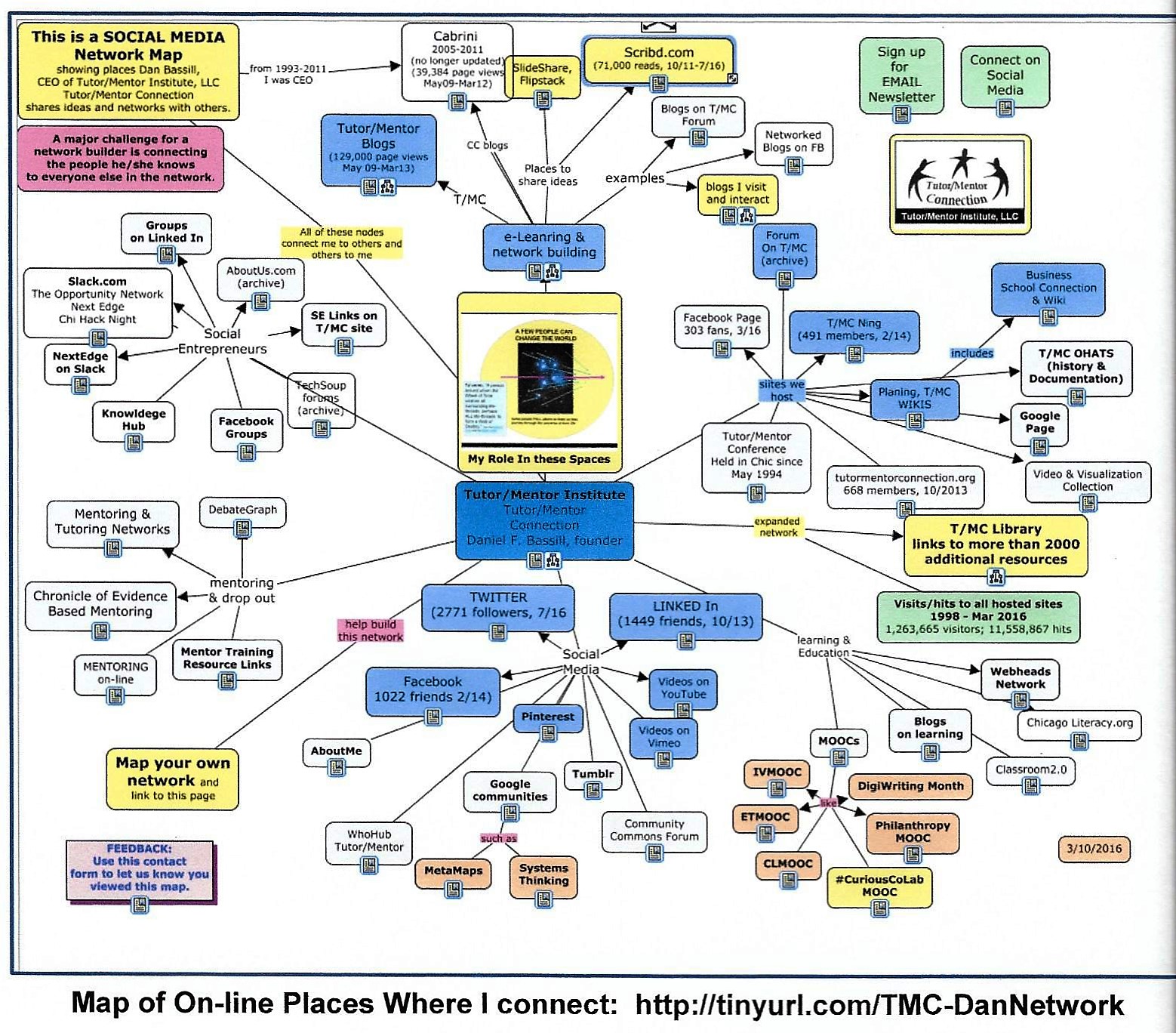
So how will I introduce myself.  How's this?


This concept map shows many of the places on the Internet where I share ideas and learn from others. While I started using the Internet in 1998, my networking, learning and idea sharing extends back to 1973 when I first became a volunteer tutor, working with a 4th grade inner city boy, named Leo.

Not knowing much about Leo, or tutoring and mentoring, I began to search out ideas from others. When I was named the leader of the volunteer program in 1975, I expanded my search for ideas by reaching out to others in Chicago who did this work, and by beginning to collect publications and newspaper stories that showed why tutoring/mentoring was needed, where it was most needed, and what programs already were operating, in Chicago or in other places.  In forming the Tutor/Mentor Connection in 1993, I dramatically expanded this outreach. By going on the Internet in 1998, I expanded my search to peers and models throughout the world.

As a one-on-one mentor, my universe was narrow. It included the boy I met each week, and a few other volunteers and students who I was meeting through my involvement in the program.  However, as I became the leader of the program, my universe expanded to include 100 pairs of elementary school youth and volunteers (400 pairs by 1992), plus company officials and staff, local school and Chicago Housing Authority leaders, and others who were resources for keeping the program operating. Once we converted the original Montgomery Ward based program to a non-profit in 1990, the range of influence expanded to increase donors and business partners.

In the role of leader (beginning in 1975) I began to realize that I could not do all that needed to be done by myself, and that I needed to recruit others to help me.  I needed to create a continuous, year-round, communications program that "influenced" others to become more involved. I needed to learn to "recruit and delegate" and ask people to "do more" than what they might have expected when they first became part of the tutoring program..

I also began to think visually, mapping the different skills, and networks, that I needed to influence, in order to have all of the talents needed to operate an effective program.

In forming the Tutor/Mentor Connection in 1993, with a goal of helping mentor-rich non-school programs grow in all high poverty neighborhoods of Chicago,  the range of people who needed to be involved has expanded dramatically, expanding to political leaders, business CEOs, media, celebrities, etc..  Not having much money to advertise and draw people together has meant I've needed to innovate other ways to communicate regularly, connect with people and build the network.  

I first used the constellation graphic in this September 2011 article. What it's saying is that "as we journey through life, we create a gravitational pull that draws others to our ideas and to follow our example, and our lead."

For some this happens naturally. For others, their influence on others may be limited to the small circle of family, friends and co-workers. For me, and, I'm sure for many others, it's an intentional process. Each day is a new opportunity to connect with someone who will change the world for myself, and for those I seek to help.

I embedded the constellation graphic in this concept map, showing places I was connecting with others, learning and sharing ideas. In the lower right portion of the map I point to several cMOOCs that I've been part of in recent years, including the #CLMOOC.  

I emphasize these because I feel the cMOOC format can be duplicated in the social sector in on-going efforts to connect more people from the "village" of adults and organizations who need to be consistently, and strategically, involved in on-going efforts intended to reduce poverty, inequality, racism and many of the other complex problems that we face in the US and the world.

I also feel that the educators who are the primary participants in the cMOOCs I've been part of can be engaging their students, as early as middle school, in roles that follow my own example and enable them to have a greater influence on others as they journey through their own lives.

Finally, I feel that some of the people who are organizing the MOOCs I've been following might provide the talent and manpower, and organizing ability, needed to help me bring this learning and networking forming into the work I'm doing.

So that's my introduction.  

I hope others in the #CLMOOC will hack this, and create their own interpretations, as they have done in past years.