Showing posts with label influence. Show all posts

Thursday, February 04, 2021

Building a Super Bowl of Support for Youth Serving Programs

If we want great youth serving organizations reaching k-12 youth in all high poverty neighborhoods of Chicago and other places we need to provide traditional training to help staff, volunteers, board members learn how to build effective programs.

However, unless we also educate resource providers, volunteers, media and political leaders to take an active, on-going role that delivers operating resources, talent, ideas and technology to programs in every neighborhood, on an on-going basis, few programs will have the resources needed to put good ideas into practice.

Read on. If you agree, share with people in your own network.  

I posted this graphic on my blog in April 2013. It expresses a lot of ideas. So I thought I’d try to break it down into components.  After you review this I encourage volunteers, youth and others to create their own versions, using animation, video, different social media platforms, etc.  

Share your versions with me and on social media. 
Here is same graphic, but with numbers on different parts. In the paragraphs below I’ll show the meaning.

To get to the goal we want we need to influence both resource providers and program organizers.


First, the goal of this graphic, and the Tutor/Mentor Institute, LLC is to help high quality, long-term, site-based tutor/mentor programs grow in high poverty neighborhoods. This section of the Tutor/Mentor web library includes dozens of research articles that show the impact of poverty, indicating the potential benefits of mentor-rich programs.

Second, if we want mentor-rich programs in more high poverty neighborhoods, then we must find ways to increase the flow of needed resources to all programs, and keep this consistent for many years. To do that we need to influence what the donor and resource provider do, not just what programs do.

I’ve followed last week's National Mentoring Summit and posted comments on Twitter. More than 1,000 people attended virtual the Summit. I shared a few of my Twitter posts in this article

The workshops called attention to mentoring as a strategy but even with 1000 participants there are too few paying attention.  Two workshops called attention to building relationships as an outcome of organized volunteer-based programs, pointing to social capital ideas and theory.  However, they said, "too few programs actually use social capital terms in describing their strategy and input."  In addition, they reported that "too few schools and educators have strategies intended to help youth build needed relationships."

These are “attention gaps” we need to close and we cannot do that without more consistent, and strategic, support from business, public leaders, media and other potential resource providers.

Let’s look at this chart closer:

A tutor/mentor program supports a connection between an adult volunteer with a youth living in an area where indicators show extra adult support and learning activities are needed. NOTE: many mentoring strategies are not primarily focused on youth living in high poverty. However, there is much research showing that for youth living in high poverty the non-school hours offer risk if not filled with positive learning activities and that there are too few resources in most neighborhoods. The Tutor/Mentor Institute's primary focus is helping mentor rich programs reach youth living in high poverty areas of big cities like Chicago.

There are a wide variety of formal mentoring programs, and many youth are involved in informal mentoring. This 2014 report: The Mentoring Effect, shows that too few youth are engaged in formal mentoring.  This remains true in 2020, and with the remote learning restrictions posted by Covid19, there are even greater gaps in mentoring availability. 

This is one graphic from my web site illustrating a need to support youth for many years. On Pinterest.com you can find more graphics like this, which point to a long-term result, which is when kids have made the journey from first grade through high school, post high school learning, and into jobs with family level wages or better. Our aim is to help youth programs build strategies that support this long-term goal.

View this "Mentoring Kids to Careers" concept map for a different version of this #birthtowork idea.

This graphic is intended to illustrate the infrastructure needed in every tutor/mentor program. Most people, including youth and volunteers, don’t see the work it takes to recruit and retain youth and volunteers, and find the operating dollars and other resources needed to build an ongoing program. See this graphic at this link.

This "tipping point" article talks about building future leaders and donors for mentor-rich programs.

This article uses teams on a football field to visualize the idea that great teams need a wide range of on-going support. So do great youth programs.  


I’ve piloted uses of maps since 1994 to illustrate the need for organized tutor/mentor programs in every high poverty neighborhood of Chicago. Without the maps donors and media focus on a few high profile programs, or a few high profile neighborhoods. You don't get a distribution of resources to all of the neighborhoods, or all of the programs, which need consistent support.

The oil well graphic indicates the need for programs to help youth from birth to work. See more maps at http://mappingforjustice.blogspot.com

Most efforts to support non profits, including tutor/mentor programs, share ideas that help programs improve themselves, and their operations. This concept map shows a section of the Tutor/Mentor Web library that represents a college of resources that tutor/mentor leaders could draw from to be better at what they do.

However, most smaller programs are so overwhelmed and under financed that they can't draw from this information for on-going learning as much as they need to. This section of the library should be read by business leaders, donors and policy makers. It shows challenges facing non profits.

As the Iceberg graphic demonstrated, every program has common needs for a wide range of talent. Few have the money to hire all the talent they need or purchase the best technology and other tools needed to run a high quality business.

This is where we need to grow. Business leaders have tremendous expertise in building chains of stores operating in multiple locations. I wrote about Polk Bros, showing how advertising and sales promotion were used to draw customers to stores. On Pinterest I show many graphics that illustrate the role of business and professionals could take to draw needed resources to volunteer-based tutoring and/or mentoring programs all over the city. I created this “Virtual Corporate office PDF” to illustrate the way volunteer talent in many companies and industries could be mobilized and focused on supporting the growth of tutor/mentor programs throughout big cities like Chicago.

If programs are consistently supported, and are constantly learning from each other, and engaging all of their supporters in efforts to constantly improve the organization’s impact, they should be able to show on their web sites many indicators of their value and impact. This pdf illustrates some of the things a “shopper” should want to see when looking at a tutor/mentor program’s web site.

Teams of volunteers from business, universities, high schools, etc. could help programs collect and share this information on web sites, and could provide some of the advertising support needed every day to encourage more people to look at these web sites and provide support to help one, or many, programs grow.

As a result of this support there should be many programs with a long-term history and the ability to posts murals like this, showing youth and volunteers who have been part of programs in the past, and who are still connected to those programs today, while helping programs provide services to the next generation of youth.

Now, when you look at this graphic, do you understand what it is showing? Can you share this with people in your own network? Take a look at this blog to see how interns have been creating visualizations and new interpretations of graphics like this. Start a project at your school, or in your church or in your tutor/mentor program, where youth and volunteers create their own interpretations, focusing on your own community and/or school neighborhood if you're not in Chicago.

While Super Bowl advertising is drawing attention to products and services offered by various companies, we need a similar level of outreach to draw attention to ideas like this and to lists of youth tutor/mentor programs in Chicago and other cities, encouraging volunteers to give time, talent and dollars to build great youth tutoring, mentoring and learning programs in more places.

Since we don't have the advertising dollars to lead such a campaign we depend on the voices of individuals.  Can you be one of those voices?  

Connect with me on Twitter, Linkedin, Facebook and Instagram to share your stories.   

If you value what I'm writing about, a small contribution will help fund the Tutor/Mentor Institute, LLC.

Tuesday, November 05, 2019

Influencing Change - Take a look

Influence change
I created this graphic several years ago to visualize the idea that "reaching goals we want, such as kids born in poverty areas being in jobs/careers by age 25", requires that we influence what people beyond poverty do, not just what people, schools and social services organizations in high poverty areas do.

Here is a series of blog articles that include this graphic. I encourage you to read each of them to build your own understanding of this strategy, then create your own visualizations to share it with others.

What are some of the strategies that might influence leaders in business, faith groups, universities, media, philanthropy, government, etc. to be more proactive and consistent in reaching out to support organizations working with youth and families in high poverty areas?   One is to visualize the long-term goal we seek, which I do with the two graphics shown below.

Helping kids through school and into adult lives is a long-term process.
What might some "tipping points" be. Or, what would be some strategies that would have a major impact, or influence, on building and sustaining these systems of support?

grow new leaders
In this article I share a visualization that describes a process that reaches youth while in middle school and supports them with on-going learning and mentoring so that some become leaders of volunteer-based  k-12 tutor, mentor and learning programs and so that others become proactive, on-going supporters.

Great programs in many places
Imagine viewing a map of Chicago or another city some day in the future with icons in many places showing youth organizations with leaders and supporters who have come through this long-term learning process.  That's the goal.

Here are a couple of other "tipping point" articles.

View graphic-click here


Here's one more graphic to look at.  This graphic shows work interns did between 2004 and 2015 to understand and communicate strategies of Tutor/Mentor Connection (1993-present) and Tutor/Mentor Institute, LLC (2011-present).  Imagine going to a high school or college web site and finding a page with a graphic like this and a list of intern work like this one.

Until more people are spending time reading, reflecting, understanding, then sharing, the ideas I post on this blog and the Tutor/Mentor Institute, LLC web site, most of these ideas will remain unfulfilled wishes. 

You can change that. That would make you a "tipping point".  Want to talk with me about this or other articles and graphics on this blog? I'm on Twitter @tutormentorteam.  I'm also on Linkedin and Facebook. Let's connect.

You can also help me fund the Tutor/Mentor Institute, LLC - click here to learn more.


Sunday, November 25, 2018

Doing the impossible. Influencing Donors and Providers

I've been creating visualizations to share ideas since the 1990s, thinking a picture is worth a thousand words, and you can see many in my blog articles.  The one featured in this article is one of the most important.

I try to draw ideas and resources
to every youth program in Chicago
When I started the Tutor/Mentor Connection (T/MC) in 1993 my goal was to duplicate advertising strategies that big business use to motivate people to shop at their stores.  I needed to find a way to do this without the money available to most companies to do this work.

On one level, I've been sharing information that people directly involved in youth tutor/mentor programs can use to help build on-going programs that help kids move through school and into jobs and careers.

At the same time, I've been sharing information intended to influence donors to become more proactive in supporting youth tutor/mentor programs already operating, and in helping new programs start where more are needed.

Below is a graphic that you can click into to see these influence steps.


Both paths shown on this graphic are important.  I think influencing people who don't live in poverty to provide a consistent flow of time, talent and dollars to programs serving youth and families in poverty is going to be just as difficult as it is to influence the people leading existing programs, or starting new programs, to look past what they have already been doing, to new ideas of what they should be doing,  if the goal is that the kids in these programs today are in jobs and starting careers when they are age 25 or older.

I first used this graphic in this 2014 article.  Browse this list and read more articles where I use this graphic. Can you apply this in your own efforts?

However, there's also a third level of influence involved. Since forming Cabrini Connections and the Tutor/Mentor Connection in 1993 I've tried to influence volunteers and donors to provide the talent and dollars both parts of our youth support strategies needed each year.  And, since forming the Tutor/Mentor Institute, LLC in 2011, I've continued to try find this support each year.

It Takes A Village - see map

It's never been easy. It's been much more difficult since 2011. 

The concept map at the right is titled "It Takes A Village" meaning, people from every different sector of life in the Chicago region, or any other part of the country, should be involved in helping all kids move through school and into jobs and careers.   With this in mind, many could be joining me in trying to "influence" actions of others. 

If you're doing this, or trying to do this, I'm trying to find and connect with you on Twitter, LinkedIN or Facebook.

This also means that many people could also be helping me do this work. 

If you've read this far I hope I've influenced you to visit this page and send a contribution to help me continue this work.

Saturday, August 26, 2017

Influencing Actions That Lead to More Help for Youth in Poverty

When I started the Tutor/Mentor Connection (T/MC) in 1993 my goal was to duplicate advertising strategies that big business use to motivate people to shop at their stores.  I needed to find a way to do this without the money available to most companies to do this work.

I've been creating visualizations to share ideas, thinking a picture is worth a thousand words, and you can see many in my blog articles.  My friends in the Connected Learning #clmooc community introduced me to Thinglink, so I'm beginning to use that to point out elements in some of my graphics. Here's one that focuses on "intentional influence".


Both paths shown on this graphic are important.  I think influencing people who don't live in poverty to provide a consistent flow of time, talent and dollars to programs serving youth and families in poverty is going to be just as difficult as it is to influence the people leading existing programs, or starting new programs, to look past what they have already been doing, to new ideas of what they should be doing,  if the goal is that the kids in these programs today are in jobs and starting careers when they are age 25 or older.

Who else is thinking this way?

Friday, July 21, 2017

Combating Chicago Violence - Influencing Actions

Yesterday I viewed an archive of an anti-violence discussion hosted by the City Club of Chicago.  I posted some of my ideas to the Twitter feed, such as this Tweet, and this Tweet.

I'm more convinced than ever that if we want to address the root causes of violence and poverty in Chicago we need comprehensive, long-term solutions that influence what people beyond poverty neighborhoods do, using their time, talent, dollars, jobs and votes.

I created this graphic several years ago to illustrate this idea.  You can see it described in this article, this pdf presentation, and this video.

Making change happen is a process.   In my articles I use maps, showing high poverty areas throughout Chicago, with the goal that groups of people from many sectors will join in a learning and planning process that begins to fill each area with a range of needed services that help young people move through school and into jobs and careers free from poverty.  The map below visualizes this process.

 Planning Cycle:   http://tinyurl.com/TMI-PlanningCycle-cmap
Making change happen is a long-term process, thus recruiting leaders who will fuel that process with dollars, talent, visibility and network building skills is essential to support the planning process and build and sustain the public will needed in such efforts.

I've written a couple of articles in the past inviting wealthy philanthropists to support this process, such as this one.

Then, in my Facebook feed yesterday, I saw this article about John Arnold, who created The John Arnold Foundation (TJAF) in the mid 2000s.  If I read the article correctly, TJAF does its own research and seeks out projects it wants to support.  

I've occasionally had donors find me as a result of their own internet search.  One of those resulted in a $50k anonymous donation in late 2007 that enabled me to build the interactive Chicago Tutor/Mentor Program Locator in 2008-09.  

Unfortunately that did not result in repeat donations which ultimately led to the need to create the Tutor/Mentor Institute, LLC in 2011 to try to keep the program locator and other resources of the Tutor/Mentor Connection available to Chicago and other cities.  I've not been able to update the program locator since 2013.

But, this is not about me.
View TQM pdf

It's about filling high poverty neighborhoods with programs that bring a wide range of needed support to youth and families, which if supported continuously for many years, will help reduce violence, income disparities and poverty by helping more young people move to jobs and careers.

I'm not just writing theory. I've continued to maintain a list of Chicago non-school tutor and mentor programs, which I started building in 1993*, which is available at this link.  The donor who gave my organization $50k in 2007 also gave a similar amount to two other Chicago tutor/mentor programs, using my data about programs to find and investigate programs that were later funded.

School is starting again soon. Multi millionaires are running for Governor of Illinois. Many others are active in all sorts of philanthropy. Do your research. Get to know the programs on my list. Let the web site of an organization be its proposal. Reach out with offers of help to programs in many neighborhoods, not just to a few high profile programs.  If you're not in Chicago and no one is maintaining a list of programs, then you can help someone start a T/MC type organization in your own community. 

As you're doing your research, read this article, which I posted earlier this week. Take a visible role and motivate other leaders to duplicate your own efforts. 

*I actually started building a list of Chicago tutor/mentor programs in 1975 when I started leading a local program and was searching for ideas that I could borrow to support my own efforts. By building a list, and a library, I began to share ideas that anyone could use to help make mentor-rich programs available in more places.  I've been doing this for over 40 years.


Tuesday, February 14, 2017

"So You're Trying to Duplicate What Kids Have in Affluent Areas!"

I led a non-school tutor/mentor program in Chicago from 1975-2011, serving inner-city youth from the Cabrini-Green area.
This is the graphic one of my volunteers was looking at in the 1990s when he turned to me and said, "So You're Trying to Duplicate What Kids Have in Affluent Areas!"

Yes. That's what I feel a mentor-rich, non-school, tutor, mentor and learning program can try to do.

I've written about this many times in the past, but was prompted to write again today after reading an article titled, "I look like a self-made millionaire, but I owe my success to privilege."

Same challenges. Different resources.
Since 2015 I've posted articles about a book written by Dr. Robert Putnam, titled "Our Kids: The American Dream in Crisis", where he shows that affluent youth have growing advantages that are not available to low income youth of any race. I created this concept map to illustrate this.  If you're an African American living in poverty, you have even more challenges to overcome.

In the graphic at the top of the page I show a small map of Chicago in the lower left corner. This is to emphasize the need for well-organized, long-term, tutor/mentor programs to in all high poverty areas, serving a growing number of youth from first grade through high school and beyond.

That's the type of support affluent families and communities offer their kids. Since families in  high poverty areas struggle just to put food on the table and pay rent, and deal with outside influences such as violence, crime, racial discrimination, etc., it's up to people who don't live in poverty to help make needed programs available, and keep them available for many years.

So where are leaders talking about this?  What are the challenges? What are the Tipping Points?  I've spent over 30 years thinking about this. Below is one of many presentations that share my ideas.


If we want well-organized, on-going, non-school tutor/mentor and learning programs to reach youth in high poverty areas of big cities, rural areas and reservations, we need to be building libraries of information, which I have been doing, and then using that information to train leaders who will staff these programs and who will support decision making among businesses, foundations and government policy makers.

Influence both sides.
I created this graphic a couple of years ago. If we want kids in poverty to move through school more safely and into jobs and lives free of poverty, we need to influence what non profit leaders and staff do, and we need to influence what business, foundations, government, etc. do.  Read the article.

I've spent 40 years thinking of ways to recruit adult volunteers to be tutors, mentors and change agents in the lives of  urban youth. I've been writing articles and sharing them via printed newsletters and Internet for 23 years.

I don't expect anyone to instantly grasp what I'm describing. It's only by spending time reading, reflecting, and creating your own visualizations, over and over for many years, that others will build a shared understanding.

That means the learning needs to begin while future leaders are still in middle school!

I keep searching for partners, benefactors, universities, etc. who understand the long-term work that needs to be done in order for well-organized, long-term programs be be reaching more youth in high poverty with support systems that give these youth some of the same "privileges" as affluent White kids grow up with.

If you want to help please reach out to me.

Monday, July 11, 2016

Who Am I? #CLMOOC Introduction

This week the 2016 version of the Connected Learning MOOC is starting.  Participants are encouraged to create a visual introduction, and share it with others on various social media platforms.

I first connected with this group in 2013 and repeated in the past two years.  I am constantly amazed by the energy and creativity that many participants show through the many different graphics, blogs, videos and "makes" they create and share (see the "make bank" on the CLMOOC web site). Frankly, I'm in awe.

As I've participated in the #clmooc, I've begun to share interactions in articles on this blog. Click this link and scroll through the articles.

So how will I introduce myself.  How's this?


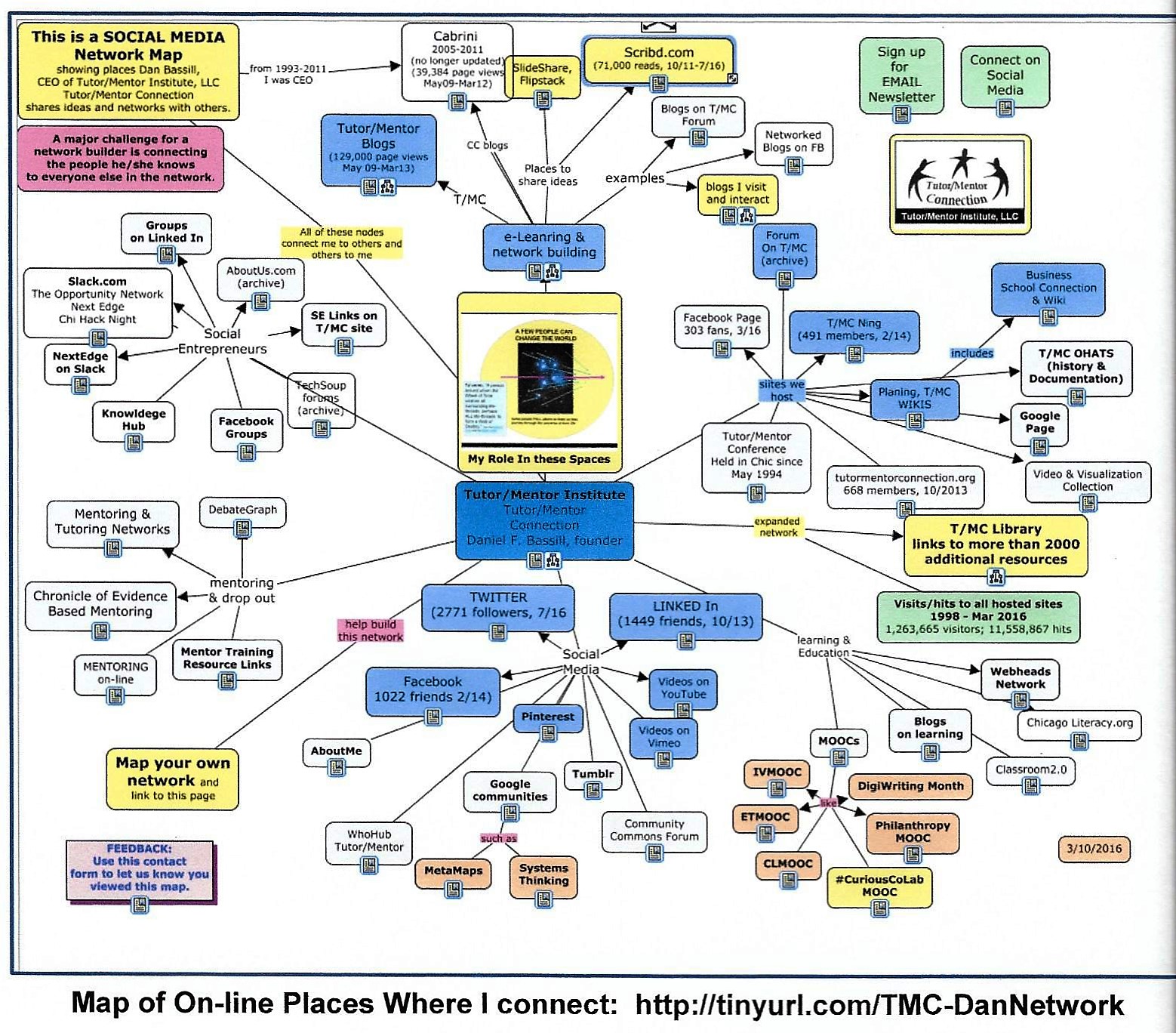
This concept map shows many of the places on the Internet where I share ideas and learn from others. While I started using the Internet in 1998, my networking, learning and idea sharing extends back to 1973 when I first became a volunteer tutor, working with a 4th grade inner city boy, named Leo.

Not knowing much about Leo, or tutoring and mentoring, I began to search out ideas from others. When I was named the leader of the volunteer program in 1975, I expanded my search for ideas by reaching out to others in Chicago who did this work, and by beginning to collect publications and newspaper stories that showed why tutoring/mentoring was needed, where it was most needed, and what programs already were operating, in Chicago or in other places.  In forming the Tutor/Mentor Connection in 1993, I dramatically expanded this outreach. By going on the Internet in 1998, I expanded my search to peers and models throughout the world.

As a one-on-one mentor, my universe was narrow. It included the boy I met each week, and a few other volunteers and students who I was meeting through my involvement in the program.  However, as I became the leader of the program, my universe expanded to include 100 pairs of elementary school youth and volunteers (400 pairs by 1992), plus company officials and staff, local school and Chicago Housing Authority leaders, and others who were resources for keeping the program operating. Once we converted the original Montgomery Ward based program to a non-profit in 1990, the range of influence expanded to increase donors and business partners.

In the role of leader (beginning in 1975) I began to realize that I could not do all that needed to be done by myself, and that I needed to recruit others to help me.  I needed to create a continuous, year-round, communications program that "influenced" others to become more involved. I needed to learn to "recruit and delegate" and ask people to "do more" than what they might have expected when they first became part of the tutoring program..

I also began to think visually, mapping the different skills, and networks, that I needed to influence, in order to have all of the talents needed to operate an effective program.

In forming the Tutor/Mentor Connection in 1993, with a goal of helping mentor-rich non-school programs grow in all high poverty neighborhoods of Chicago,  the range of people who needed to be involved has expanded dramatically, expanding to political leaders, business CEOs, media, celebrities, etc..  Not having much money to advertise and draw people together has meant I've needed to innovate other ways to communicate regularly, connect with people and build the network.  

I first used the constellation graphic in this September 2011 article. What it's saying is that "as we journey through life, we create a gravitational pull that draws others to our ideas and to follow our example, and our lead."

For some this happens naturally. For others, their influence on others may be limited to the small circle of family, friends and co-workers. For me, and, I'm sure for many others, it's an intentional process. Each day is a new opportunity to connect with someone who will change the world for myself, and for those I seek to help.

I embedded the constellation graphic in this concept map, showing places I was connecting with others, learning and sharing ideas. In the lower right portion of the map I point to several cMOOCs that I've been part of in recent years, including the #CLMOOC.  

I emphasize these because I feel the cMOOC format can be duplicated in the social sector in on-going efforts to connect more people from the "village" of adults and organizations who need to be consistently, and strategically, involved in on-going efforts intended to reduce poverty, inequality, racism and many of the other complex problems that we face in the US and the world.

I also feel that the educators who are the primary participants in the cMOOCs I've been part of can be engaging their students, as early as middle school, in roles that follow my own example and enable them to have a greater influence on others as they journey through their own lives.

Finally, I feel that some of the people who are organizing the MOOCs I've been following might provide the talent and manpower, and organizing ability, needed to help me bring this learning and networking forming into the work I'm doing.

So that's my introduction.  

I hope others in the #CLMOOC will hack this, and create their own interpretations, as they have done in past years.


Tuesday, June 14, 2016

Some focus on act of Mentoring. I focus on infrastructure that makes it possible.

The ideas and visualizations shown on this blog and my web site result from my having led site-based, non-school, volunteer-based tutoring, mentoring and learning programs in Chicago since 1975. As a program leader you know the work it takes to enable youth and volunteers to meet weekly, and to continue participation for multiple years..and to find money to pay the bills. Few others in your organization know these challenges, which makes your life frustrating and your role difficult.

A few  years ago one of the NU Public Interest Program Fellows who was working with me at the time, created a graphic, that looks like an iceberg. You can see it here. Today I updated that graphic (crudely). You can see it at the left.

In my new version, I included photos of teens and volunteers who were part of the Cabrini Connections program that I led between 1993 and 2011. Many joined us while in 7th or 8th grade and stayed involved through high school. I'm still connected to some via Facebook and LinkedIn.

I also added a tagcloud I created last week, that shows the many different areas of knowledge program leaders should be thinking about as they look for ways to build and sustain long-term, mentor-rich programs. These tags can be seen on the left side of this page. However, there are many other places on the Internet where I've been sharing these ideas.

 
In  the graphic at the right I've created "oil well" graphics, and put them on a map of Chicago, where the red color represents areas of high poverty.  The "oil well" and the "iceberg" are two related ideas. Strong programs don't start out great. They become great over a period of years, as a result of constant reinvestment of ideas, dollars, time and lessons learned. They are needed in every poverty neighborhood.

Below is a third graphic, where I compare raising a child to building a house or a tall building. You start with a plan, with financing, and with blueprints. Then you do the work shown on page one before you go to page 2. You work your way from the bottom to the top.  Kids grow from birth to work. They need many different types of learning support as they grow up, and they need help from many different people as they move from school and into work.

Actually, as a parent, with children aged 19 and 26, you don't usually have a plan. You learn as you go. You hope you can find the money. That could be the topic of an entirely different blog.

I'd like to see more people involved in mentoring, from the national level down to the city level, integrating maps and visualizations like these and the strategy map below, showing the infrastructure needed in many different programs, while showing that great programs are needed in many different places. And, showing that the long-term goal is that kids who come through our programs are entering the workforce in their mid-twenties, thus able to earn a living that allows them to raise their own kids free from the challenges of concentrated, segregated, urban or rural poverty.


This map also shows the commitment needed by leaders from business, faith groups, colleges, hospitals, celebrities, media, politicians, etc., who must become more proactive and on-going in their commitments, if great programs are going to be available in more of the places where they are needed.

This graphic is from this article, and illustrates the need to use ideas to influence resource providers as well as non-profit leaders.  

I've just shown you a few of hundreds of visualizations I've created over the past 20 years, all with a goal of enlisting more people in efforts that make programs available which help kids born or living in high poverty neighborhoods today, be in jobs/careers in 25-30 years.

For that to happen, many more people need to be talking about the same ideas that I am communicating through my blog articles.  If that is happening, you should be able to do a Google search for the organization or business and then see many similar visualizations when you look at the images feature on Google. Try it.

If you're using graphics to communicate similar ideas, please post a link to your web site in the comments section below and let's connect. If you'd like to know more about how you might get involved with this work, just introduce yourself to me in an email to tutormentor2@earthlink.net or a post on Twitter or Facebook.

6-10-2025 update - here's an article from Social Roots that shows the value of intermediaries who do the type of work I've been trying to do for the past 32 years. It's titled: Self-Organization Needs Activators: The 9% Who Turn Networks into Movements  click here


Monday, October 26, 2015

Role of Influence: Expanding Support for Youth Serving Organizations

I've posted more than 1000 articles on this blog since 2005. All focus on ways to help high quality, volunteer-based tutoring, mentoring and learning organizations become available to k-12 youth living in high poverty neighborhoods of Chicago and other cities. All seek to influence what other people do, recognizing that my ideas and efforts alone have very little impact.

I use visualizations to communicate ideas, and realize many are not clearly understood by people who have not spent as much time as I have thinking of ways to make systems of support available the same way teams in corporate offices spend time thinking of ways to make retail stores, food outlets and product distribution systems available to customers in many places.

Yesterday I uploaded a presentation that is intended to help clarify the meaning of one of my graphics. See below.

How to Influence Change: Use of Visualizations by Daniel F. Bassill


I created this based on information in this blog article and this series of articles.

If you read this, Tweet this to your own network, or lead a discussion group within your church, business, social group and/or fraternity, I have had an influence on your actions. If the people you share this with, share it in their own networks, I've had a greater influence, and you've had your own influence. If this is viewed and shared by people who are in positions of greater power, or influence, then the ideas are leveraged, and have even greater influence.

This is a process. It'a a relay-race, where one person passes on the idea to others, who then pass it on to an even larger group of people.

That's how movements grow and change begins to happen.

Take the first step. Read this.

Take the second step. Forward it to your own network.

Take additional steps. Browse through articles I've posted since 2005 and other articles I've posted at https://www.scribd.com/daniel-f-bassill-7291

Create your own versions of this idea, just as interns working with me in Chicago have been doing since 2006.

Thursday, September 03, 2015

Building Public Will - Essential

I scratched out the outline for this story a couple of days ago as I was riding the train and thinking about the challenges we face in solving complex problems like poverty. I hope you'll follow along with my thinking.

This graphic is part of a strategy graphic that shows the planning steps needed to solve complex problems or roll out a new business strategy. See the full graphic and explanation here.

Every year, millions of dollars are spent by social benefit organizations trying to attract resource to support their work. The money is spent directly on fund raising, marketing and public education. It's spent indirectly on training programs and consultants.

Regardless of where an organization operates or what cause it focuses on, we're all competing for a slice of the same donor pie. That pie seems to be shrinking, either because of economic circumstances, or because of the rise in organizations competing for a share of the pie. Natural disasters that occur randomly around the world exert a huge pull on discretionary donor dollars every time they happen.


Thus, it's unlikely that great programs, doing similar work, but in different places, will be available in a large percent of the places where such programs are needed. Since 1993 I've piloted uses of maps to show where non-school tutor/mentor programs are most needed, then using the maps to influence donor support of programs in every place where the map shows programs are needed. In recent years there is a growing application of mapping and data visualization (see blog). However, I still don't see many who are trying to create maps of all service providers doing similar work in areas where that work is needed. Such maps would show a poor distribution of needed programs. Over time it would show change as new programs launch and some go out of business.

It's also unlikely that many organizations will attract on-going dollars to enable them to provide long-term support. In youth development, this is a serious issue. Kids take 12 years to move from first grade to first job. If they are living in high poverty areas, the support system needs to reach them early and stay with them through school and even into work. Such support systems are needed in many, many places.


What's the solution?

Building public will is step 7 on this map. Each step is important in solving complex problems. However, until more people from different places, with different talents, and different levels of influence get involved in brainstorming ways to build public support and keep it growing, I don't see many long-term solutions emerging.

I created this graphic (see article) to illustrate that while we want to help social benefit organizations and clients use the resources available to achieve their missions and/or overcome challenges they face, we also need to influence what people who don't live in poverty do to help them. This can include direct support such as funding, or public policy. It can also include indirect support, such as removing barriers and obstacles.

Some (but certainly not all) of the actions we need to be focusing on include:

a) constant education of the public so they have deeper understanding of the problems and places where strong, constantly improving, social benefit organizations are needed

b) innovation of on-going advertising-type campaigns to influence what resource providers do

c) build growing understanding of how current systems of philanthropic and government support are not working.

Just a small growth of the resource pie every year could make a huge impact on the availability of needed social benefit organizations (including tutoring/mentoring organizations) in more of the places where they are most needed.

Building public will requires champions and leaders from every sector, in every city of the world. I'm certain that this discussion is taking place. I'm just not sure where this is an on-line forum, a cMOOC, or part of a web library that points to a wide range of places where this is being discussed.

Use the comment section to provide links to open, on-line forums, Google groups, or cMOOCs that you're aware of, where "building public will" is the focus of the group. Or introduce yourself to me on Twitter, Facebook or Linkedin.