Showing posts with label public will. Show all posts

Wednesday, May 07, 2025

What are your volunteers learning?

I saw this post on Twitter this morning, from the Prison Policy Institute, which I point to from my newsletters and my library.

You can follow their posts on Twitter, or on BlueSky, at this link. If you don't live in a high poverty area you probably have never given a lot of thought to how the prison-industrial complex harms people in vulnerable situations and contributes to the on-going problems of persistent poverty.   Follow posts by Prison Policy Institute and others to expand your own understanding. Share these links with your network to increase the number of people who understand the problem and are willing to provide time, talent, dollars and votes toward solutions. 

I started collecting newspaper clips and research articles in the 1970s to expand my own understanding of why a volunteer-based tutor/mentor program was needed and how to lead a constantly improving program.  

I was digitizing some files yesterday when I found this 1994 opinion article by Mark Freedman, who wrote the book Kindness of Strangers.  It's titled "To Help the Young, We Need More Than Mentors". 

Click on this link to view the article in my Google Drive file.

I've built my understanding of the challenges facing kids and families living in areas of concentrated, persistent poverty over the past 50 years.   And, I've been sharing the resources I was learning from with volunteers in the tutor/mentor programs I led, so they could also expand their understanding.  

Because, mentoring alone is usually not enough.  And, volunteers who become informed and empowered can do much to remove many of the barriers, while also helping the tutor/mentor programs they serve sustain and constantly improve their efforts. Which means doing more to help the youth they mentor.

I created this concept map as a guide to articles in the Tutor/Mentor library. Anyone can access this map and dig into the library. Many of the links I point to are extensive resources themselves. 

You can find a link to the Prison Policy Initiative on this page along with many other related resources.

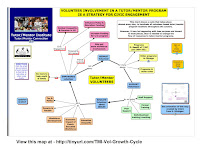
And, I created this concept map to show how volunteers grow over multiple years of involvement in well-organized tutor, mentor and learning programs. It shows my own efforts, and hopefully inspires the design and activities of other programs, in Chicago, and around the country. 

In this "Steps to Start a Tutor/Mentor Program" visual essay I quote Marc Freedman's comments about the potential and the difficulties of mentoring and his suggestion that without infrastructure and support for mentors and mentoring programs, the movement will never reach its potential.

Much of my work since forming the Tutor/Mentor Connection in 1993 and the Tutor/Mentor Institute, LLC in 2011 has focused on helping programs get the on-going resources needed to provide that infrastructure.

I've used my website, print and e-mail newsletters and blogs to share this information and to try to motivate volunteers to spend time learning and building a greater depth of understanding of why tutor/mentor programs are needed, where they are needed, what types of programs are needed, based on who the mentee is, and what other issues need to be addressed.

The goal has been to build a greater public commitment to the actions that need to be taken, and sustained for many years, to solve the problems that Prison Policy Institute and others highlight in their own media.

View this set of articles to see how I've written about "building public will".   

I point to several hundred youth serving organizations in lists on the Tutor/Mentor Institute, LLC website.  I try to open every link, at least once a year, to make sure they work and to see what the program is doing to educate volunteers and donors.  Some point to research showing why their programs are needed. Very few point to my library, or show "educating volunteers" as part of their core strategies.  

That might change if donors looked for such information on a program's website.  

I actually created a visual essay a few years ago which I titled "Shopping Guide".  


This shows some, but probably not all, of the information you should find on an on-going youth tutor, mentor and learning program website.  Programs won't put this information on line unless donors, volunteers and parents are looking for it and unless they have staff and/or volunteers who can put the information on-line.  If you know of programs doing a good job sharing similar information, please share links with me.

Let's connect. You can find me on LinkedIn, BlueSky, Facebook, Instagram, Treads, and Twitter (still).  Find links on this page. 

Thanks for reading. If you value the information I'm sharing, and the resources on the Tutor/Mentor website, please visit this page and make a contribution. 

Saturday, April 05, 2025

State of Chicago Youth - 2025 - Poverty Persists

This week A Better Chicago released a new report titled "State of Chicago Youth, 2025".  I show the cover page and a summary page below.


The report shows that "Too many youth -- especially in communities on the South and West sides of the city -- experience high rates of poverty, violence, unemployment, and homelessness. These long-standing inequities are reflected in every aspect of achievement and well-being including kindergarten readiness, grade-level proficiency in reading and math, high school graduation, college enrollment, and, ultimately, career success."

The report provides a lot of data and statistics, but it's not too long. Spend an hour reading it. Find the PDF on this page.

The report shows that "Of the 2.7 million people who live in Chicago, roughly 793,000 - 29% of the total population -- are under the age of 25, which is how "youth" is defined for purpose of this report.  Of this, 19.8% are under 18, and 5.6% are under the age of five."

Furthermore, "One in four Chicago youth (age 0-18) live in poverty and for Chicago's  youngest residents (age 0-5), that figure is as high as 90% in some neighborhoods."

The report uses a lot of percentages, but by my math that means about 187,900 kids, age -18 live in poverty areas of Chicago.

Compare that to the front page of this 1994 Chicago Tribune.


This shows the same areas of the West and South sides of Chicago as places with "240,000 kids in poverty's grip".  I don't think the lower number in 2025 reflects improvement as much as it reflects migration from the city to the suburbs and other places.  

In the summary page above the left panel shows that "Chicago is among the major cities that continues to experience uneven investment and development across neighborhoods, resulting in inadequate access to essential services, and disparities in economic, education and health outcomes. The data in this report reveals how these historic patterns continue to have a disproportionate negative impact on communities of color.  Understanding these persistent challenges is crucial for developing solutions that create equitable opportunities for all Chicagoans."

Understanding these persistent challenges has been the goal of the Tutor/Mentor Connection since it was created in 1993, and the Tutor/Mentor Institute, LLC, since it was created in 2011.


And, motivating people to use that understanding to innovate strategies that build needed youth tutor, mentor and learning programs that help kids in high poverty areas move from birth to work.

Articles on this blog, and in the Tutor/Mentor library, are intended to help in this process. 

For instance, here's a graphic that I included in an April 2015 article that I titled, "After the March, do the planning".  (see more on that at the bottom of this article). 

The article includes this August 1993 Chicago SunTimes story, which leads off with a statement saying,  "Chicago neighborhoods that were poor 20 years ago are even more entrenched in poverty today because the city lacks a comprehensive battle plan".


This article concludes "While Chicago has “had all these sincere people making good efforts, one group working on poverty, one on education reform, one on community policing, these problems are too interwoven and too immense. The city needs all anti-poverty efforts “at the same table”.

"So many years. So few changes."  That was the title of this 2024 article.  It included the concept map shown below.


I'd love to find maps like this on the website of A Better Chicago and the dozens of other leadership organizations and foundations who focus on poverty and inequality, or workforce development and education, with explanations like I provide in my articles.

In fact, if you read to the bottom of many of my articles I'm encouraging people to create their own versions, using my history to stimulate their own thinking and actions.  There are more than 2000 articles on this blog to draw from and much more on the http://www.tutormentorexchange.net website.

I posted a note on LinkedIn telling A Better Chicago that I was sharing their report and that I hoped many others would do the same.  

Why? Because building and sustaining public will has always been the missing piece in this strategy. That's what I've focused on.  And, it needs the involvement of many leaders sharing this message, in many ways, for many years. My 30 years of articles should be mirrored by thousands of similar articles.

This article describes the public awareness/education strategy that we launched in 1993 as part of the Tutor/Mentor Connection's strategy.  It includes the graphics shown below.


In the research section of the Tutor/Mentor Library, and in other sections, are countless reports similar to the one released this week by A Better Chicago.  While many were released to wide audiences with much media coverage, few have had an on-going public education campaign intended to influence actions of people who need to be strategically involved in providing the time, talent and resources needed to create greater hope and opportunity for people in every high poverty area of Chicago and other places with persistent poverty.

So how do we change this.  Not easy.  But, I've another graphic for you to consider. 


This article describes a role that universities, even middle schools and high schools, need to take. 

At the top of this graphic is the question. What can universities do differently, that might be a tipping point in terms of making well organized programs available in more places, for more years, reaching more youth, and helping them through school?


I answer by saying "build a pipeline of leaders, who work in these programs, and who work to provide the talent and resources needed by each program on an on-going basis".

I've been reading stories of billionaires giving vast sums of money to support charitable causes.  Why can't one provide the money for a few universities to invest in this "tipping point" strategy?  

At the left is a photo of me giving a speech, with the Chicago Tribune map in the background.  This is from the mid 1990s!

Obviously, too few people have heard this message, or we'd find websites in every major city wish maps and graphics and blog articles similar to what I've been sharing, with the same long-term purpose.

This week's report on the "State of Chicago  Youth 2025" from A Better Chicago is a new reminder of the work that needs to be done.  I hope you'll read the report, then dive into my articles and website.  

Maybe in 10 or 20 years a similar result will show more positive news.


While I write this, I realize there is an even bigger issue to address. People all over the country are taking part in protest marches today to try to stop "Trump and Musk's illegal billionaire power grab".  If that does not happen any progress toward the goals I've outlined above will be severely limited. 

Here's a site where you can learn more about getting involved.  Here's a section in the Tutor/Mentor library with political action resource links. Use the library to support your planning!

Thanks for reading. I look forward to seeing your posts and photos if you're protesting today, and your blog articles if you're sharing what I'm writing and the research by A Better Chicago.

Monday, January 13, 2025

Small voice in big universe of problems


I'm starting a new week, like I've started new weeks for the past 20-30 years. Recommitting myself to using my small voice to try to have a positive impact on the lives of people living in areas of concentrated poverty. 

As I though about how to write this I searched for "slice of the pie" to find a graphic that I created in the 1990s showing many issues that require attention, and how the "youth in poverty, and volunteer-based tutor/mentor programs" category is just one small slice of that pie. I found an article I wrote in 2015 and updated in 2020. I've reposted it below, with updates for 2025. 

The fires in Los Angeles and the hurricanes that hit the US South East states in November are just the two latest massive disasters that will require many years of consistent effort for people in the affected areas to recover.  This is not a new problem. 

In September 2005 I wrote an article titled "Disaster challenges us all".  In it I wrote,

"For the next few weeks there will be a tremendous outpouring of charitable donations to support relief efforts, just as there was in the weeks following the Tsunami. However, following this there will be a need for donations to continue for a decade or more. 

However, in six months or a year there will be another disaster that will mobilize public attention. Then the people who need Tsunami aid, and the people who need Katrina aid, will be off the front page and struggling to find the dollars needed to continue rebuilding their communities."  Read the article. 

This graphic is part of a strategy graphic that shows the planning steps needed to solve complex problems or roll out a new business strategy. See the full graphic and explanation here.

Every year, millions of dollars are spent by social benefit organizations trying to attract resource to support their work. The money is spent directly on fund raising, marketing and public education. It's spent indirectly on training programs and consultants.

Regardless of where an organization operates or what cause it focuses on, we're all competing for a slice of the same donor pie. That pie seems to be shrinking, either because of economic circumstances, or because of the rise in organizations competing for a share of the pie. Natural disasters that occur randomly around the world exert a huge pull on discretionary donor dollars every time they happen.

In the last few cycles elections have also drawn a huge share of donor dollars.

In my 2005 article, I wrote, 

"I spent 17 years doing corporate advertising for a large retail store. We sent out 3 waves of advertising each week to 20 million people in 40 states telling potential customers that we had stoves, clothes, tires and other merchandise they wanted in one of 400 stores that we operated. We also spent millions of dollars in making sure we had the right merchandise in those stores, well trained people, and that the stores were in the right locations. 

Each store had a responsibility to do its own advertising and training but because of the support from the national advertising and training, each store was able to attract customers on a regular basis, at a fraction of what it would cost if each had to create their own advertising campaign."

I've not found any city with a consistent, on-going effort to support all tutor/mentor programs in that city the same way big companies supported hundreds of retail stores spread all over the country.

Thus, it's unlikely that great programs, doing similar work, but in different places, will be available in a large percent of the places where such programs are needed. 

Since 1993 I've piloted uses of maps to show where non-school tutor/mentor programs are most needed, then using the maps to influence donor support of programs in every place where the map shows programs are needed. In recent years there is a growing application of mapping and data visualization (see examples on this concept map). However, I still don't see many who are trying to create maps of all service providers doing similar work in areas where that work is needed. Such maps would show a poor distribution of needed programs. Over time it would show change as new programs launch and some go out of business.

It's also unlikely that many organizations will attract on-going dollars to enable them to provide long-term support. In youth development, this is a serious issue. Kids take 12 to 20 years to move from first grade to first job. If they are living in high poverty areas, the support system needs to reach them early and stay with them through school and even into work. Such support systems are needed in many, many places.

Architects, engineers, web developers, etc. all use some form of blueprint to show all of the work that needs to be done, in the correct sequence, and with the right talent, to build a tower, a rocket, or any other product.

In disaster recovery, or helping kids through school and into careers, I feel that this is missing.  Take a look at this concept map.


It shows some of the supports kids need at each grade level as they move through school. It includes a map showing high poverty areas of Chicago, where these supports are most needed (because they are not naturally available).  It also shows a role volunteers and extra adults can take. 

I've seen list posted on social media showing supplies people need in LA because of the fires, but not a concept map that shows what's needed from today (fighting fires/finding places to live) until some day in the future when these areas have been rebuilt and when all the people affected have rebuilt their lives.

Without the blueprint a lot of money will be spent, but without an accumulated long term impact. Without a map, only a few places will get the help it needs.

What's the solution?

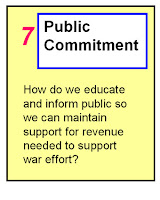
Building public will is step 7 on this map. Each step is important in solving complex problems. However, until more people from different places, with different talents, and different levels of influence get involved in brainstorming ways to build public support and keep it growing, I don't see many long-term solutions emerging.

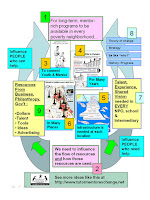
I created this graphic (see article) to illustrate that while we want to help social benefit organizations and clients use the resources available to achieve their missions and/or overcome challenges they face, we also need to influence what people who don't live in poverty do to help them. This can include direct support such as funding, or public policy. It can also include indirect support, such as removing barriers and obstacles.

Some (but certainly not all) of the actions we need to be focusing on include:

a) constant education of the public so they have deeper understanding of the problems and places where strong, constantly improving, social benefit organizations are needed

b) innovation of on-going advertising-type campaigns to influence what resource providers do

c) build growing understanding of how current systems of philanthropic and government support are not working.

Just a small growth of the resource pie every year could make a huge impact on the availability of needed social benefit organizations (including tutoring/mentoring organizations) in more of the places where they are most needed.

Building public will requires champions and leaders from every sector, in every city of the world. I'm certain that this discussion is taking place. I'm just not sure where this is an on-line forum, a cMOOC, or part of a web library that points to a wide range of places where this is being discussed.

I've started using BlueSky more than Twitter. However, while I find groups of educators and a good discussion of nonprofit issues I still don't find volunteer-based youth serving organizations, their donors, the media, or their researchers.    

I've been sharing this message, along with a library or resources, and list of existing programs operating in Chicago, since 1994.  Yet, I find almost no leaders using a collection of graphics similar to those I've put into this article, to share their own commitment to this same goal.

Ideas bursting in air!
I launch my ideas on blog articles every week, then spread them, like fireworks via social media. As you and others pass them on in your own feeds, we reach more people, and maybe convince some to take on leadership roles in this effort.  Such leaders can be from any city in the USA, or from other parts of the world!

Thanks for reading. I'm a small voice, just a whisper in the wilderness. But if you share, we can roar like a lion.

Please share.  I'd like to hear from you.

Use the comment section to provide links to open, on-line forums, social media groups, or cMOOCs that you're aware of, where "building public will" is the focus of the group. Or introduce yourself to me on Facebook or LinkedIn.

Finally, it's a new year and once again I need to raise a few thousand dollars to cover the costs of maintaining the Tutor/Mentor library, writing this blog and trying to be a spark that ignites a massive increase in using these ideas.  Visit this page to make a contribution. 

Thursday, February 03, 2022

Wealth inequality in Chicago and Cook County

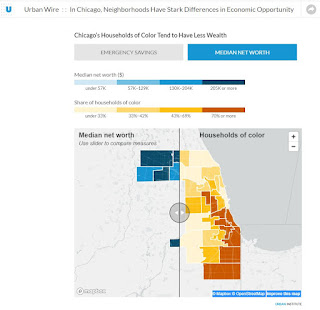
I receive the Urban Institute eMail newsletter and today there was an article about a new interactive map that visualizes Chicago's wealth inequality across the region.  You can view the article at this link.

Slide the bar to the right and you see differences in median net worth and emergency savings. Slide it to the left and you see households of color.  It's clear that wealthy areas have fewer people of color. 

The article that accompanies the map offers some suggestions of how policymakers can help Chicagoans accumulate liquid wealth,  however  it ends saying "With Chicago's significant inequity and Illinois's poor finances, closing wealth gaps will require policies at the national, state and local levels, commitment from nonprofits, and changes from the private sector."

2/12/2022 update - here's a WBEZ article about the Wealth Gap, that goes into greater detail for the Chicago region. 


Here are a few articles that I've written that focus specifically on building public will to invest consistently over many years in strategies that help more kids in poverty areas move through school and into jobs and careers out of poverty. 

Actually, everything I have done via the Tutor/Mentor Connection (1993-present) and Tutor/Mentor Institute, LLC (2011-present) for the past 30 years has had this purpose. 

I have focused on helping workplace volunteers, from many different backgrounds, become involved in the lives of inner-city youth via organized, tutor and/or mentor programs.  As volunteers grow their involvement, the kids go from being "someone else's kids, to being their own kids" and as they learn about the root causes of poverty and the challenges kids face, many will return to their networks and bring reinforcements.

They will help build public will. 

 This article shows the volunteer growth cycle that can come from within an organized tutor/mentor program. 


This graphic shows how we need to influence policy makers, business, donors, and everyone who does not live in poverty, in order to build and sustain programs in high poverty areas that help people move from poverty to opportunity.  See it described in this article.  

I added the Urban Institute article to the "poverty and crime mapping" section of the Tutor/Mentor Library where there are many similar articles to draw from. Another section to look at is a set of "poverty, race, inequality" links. 

If you are troubled by the inequality we face then start reading these articles, and invite others to join you. Start a discussion group. Start thinking of ways to get more people involved. 

Here's something else for a few of you to look at. Getting enough people involved to actually create the changes that the Urban Institute recommends is an effort in community building, movement building and political activism.  Take a look at the article I point to in this Tweet, that talks about measuring the growth of a movement, as a tool for building further growth and achieving goals. 
I added links to these articles in the 'community building and collaboration' section of the Tutor/Mentor library, where they join more than 100 other articles. 

Write about this. Help build the movement.

If you're looking at these articles and writing about some of the ideas I share, as Daniel Delmanto, from Brazil, did in this article, please share your links and connect with me on one of these social media platforms. 

Monday, August 17, 2020

Building Public Will to Invest in Racial Justice

Today I listened to an Instagram conversation hosted by the Schott Foundation, featuring their president, Dr. John Jackson ( @DrJohnHJackson ) and Keron Blair (@Keronblair). Below is a Tweet from that conversation. If you listen to this you'll see a focus on the political will needed to generate a sustained distribution of resources into all Black and Brown neighborhoods that lead to social justice over a period of many years.

In several past articles I wrote about "building public will".  Below I share what I wrote in 2015.

----- begin 2015 article -----

I scratched out the outline for this story a couple of days ago as I was riding the train and thinking about the challenges we face in solving complex problems like poverty. I hope you'll follow along with my thinking. 


This graphic is part of a strategy graphic that shows the planning steps needed to solve complex problems or roll out a new business strategy. See the full graphic and explanation here. 

Every year, millions of dollars are spent by social benefit organizations trying to attract resource to support their work. The money is spent directly on fund raising, marketing and public education. It's spent indirectly on training programs and consultants.

Regardless of where an organization operates or what cause it focuses on, we're all competing for a slice of the same donor pie. That pie seems to be shrinking, either because of economic circumstances, or because of the rise in organizations competing for a share of the pie. Natural disasters that occur randomly around the world exert a huge pull on discretionary donor dollars every time they happen.  Covid19 has added a new level of challenges.


Thus, it's unlikely that great programs, doing similar work, but in different places, will be available in a large percent of the places where such programs are needed. Since 1993 I've piloted uses of maps to show where non-school tutor/mentor programs are most needed, then using the maps to influence donor support of programs in every place where the map shows programs are needed.

In recent years there is a growing application of mapping and data visualization (see blog). However, I still don't see many who are trying to create maps of all service providers doing similar work in areas where that work is needed. Such maps would show a poor distribution of needed programs. Over time it would show change as new programs launch and some go out of business.

It's also unlikely that many organizations will attract on-going dollars to enable them to provide long-term support. In youth development, this is a serious issue. Kids take 12 years to move from first grade to first job. If they are living in high poverty areas, the support system needs to reach them early and stay with them through school and even into work. Such support systems are needed in many, many places.


What's the solution?

Building public will is step 7 on this map. Each step is important in solving complex problems. However, until more people from different places, with different talents, and different levels of influence get involved in brainstorming ways to build public support and keep it growing, I don't see many long-term solutions emerging.

I created this graphic (see article) to illustrate that while we want to help social benefit organizations and clients use the resources available to achieve their missions and/or overcome challenges they face, we also need to influence what people who don't live in poverty do to help them. This can include direct support such as funding, or public policy. It can also include indirect support, such as removing barriers and obstacles. 

Some (but certainly not all) of the actions we need to be focusing on include:

a) constant education of the public so they have deeper understanding of the problems and places where strong, constantly improving, social benefit organizations are needed

b) innovation of on-going advertising-type campaigns to influence what resource providers do

c) build growing understanding of how current systems of philanthropic and government support are not working. 

Just a small growth of the resource pie every year could make a huge impact on the availability of needed social benefit organizations (including tutoring/mentoring organizations) in more of the places where they are most needed. 

Building public will requires champions and leaders from every sector, in every city of the world. I'm certain that this discussion is taking place. I'm just not sure where this is an on-line forum, a cMOOC, or part of a web library that points to a wide range of places where this is being discussed. 

Use the comment section to provide links to open, on-line forums, Google groups, or cMOOCs that you're aware of, where "building public will" is the focus of the group. Or introduce yourself to me on Twitter, Facebook or Linkedin.

---- end 2015 article ------

Now we're in the middle of a global pandemic, and facing a highly contentious November election. We've a climate crisis that threatens major disruption over the next century.  

As I listened to Dr Jackson and Keron Blair this morning I thought of this concept map. It shows the need for long term investments to help kids move from birth to work and shows many different issues that need to be addressed in every high poverty area of the country.  This requires a massive investment. Finding ways to build the public and political will needed will require finding ways to connect people from each of these sectors and innovate ways to cut through the noise of every other issue to draw daily attention to this challenge.


I share these graphics here and on Twitter (knowing that only 22% of people actually use Twitter!) with the invitation that others who are more appropriate, or more visible, spokespeople will borrow them for their own leadership.  

If you'd like my help understanding the meaning of these or any or my articles just reach out to me.


Thursday, June 06, 2019

We Have the Words. What We Lack is the Will

Read 1990s newsletters
At the left is page 2 of the Summer 1995 Tutor/Mentor Connection newsletter.  We published this three to four times a year from 1993 to 2002 then ran out of money for print media.  In each issue I used Page 2 to put in an editorial, under the T/MC EXTRA heading.

Here's what I wrote in 1995

"We have the words. What we lack is the will," said Joe Kellman, founder of the Corporate/Community School, as the concluding quote from an article that appeared in the May 1995 issue of Catalyst, a school reform publication. "This is a problem in our community. We frequently point to others for leadership. We seldom point to ourselves."

“illiteracy has a tremendous impact on the cost of poverty”

Kellman was talking about the difficulty of generating long-term support for school reform efforts.  This is also a problem for our tutoring programs. Mentoring only works if volunteers and programs can support kids for years, not weeks or months. So how do we obtain that commitment?

Two ways. First, our programs must be well organized and provide meaningful opportunities for volunteers to join and contribute. That will build a growing base of business volunteers who will draw their companies into the battle.

Second, we must find a way to show the cost of poverty-in a way that CEO's cannot ignore. Better put, in a way that shows up on the profit or loss statement.

Finding this type of data is a challenge. The healthcare industry serves as a model because healthcare discovered a way to successfully market prevention, causing a fundamental change in the way business invests in healthcare. One hospital has gone a step further. New York's Harlem Hospital has shown that prevention saves money--the result of a long term youth program operated by the hospital.

Now we have a new tool. A 1995 summary report titled "The Cost of Poverty in Overtown and in Dade County in 1990." According to the report, 59% of the cost to sustain households in Overtown comes from the public sector. "The public cost of poverty in Overtown is $30 million per year," it concludes.

That's a cost that shows up on the bottom line of every business in America. That's a lot of will-power.

I concluded with this call to action:

This report is available from DEVPLAN, (407) 395-7445. (2019 note: this is no longer available although I have a hard copy in the Tutor/Mentor Libray) Get it and give it to your CEO. Then give us a call. We can help you invest in prevention programs such as tutoring and mentoring. It pays to be involved.

Why is this relevant in 2019?

A couple of days ago I saw this Youth In Cities brief on LinkedIn, then shared it via the Twitter post I'm showing below:

The introduction to the report states "A city’s rate of upward economic mobility from one generation to the next is strongly linked to its investment in its youth-serving nonprofits." The data shows that Chicago ranks 16th in annual per capital investment far behind other cities such as New York.

Maybe that's one reason Chicago has higher rates of violence than New York?  Just speculating.

Anyone can be the YOU 
If you read my 1995 editorial you'll see I was calling for long-term investment in youth tutor/mentor programs.  I've been using visualizations like the one at the left, to show the need for leaders from throughout the Chicago region to take on-going roles that influence people in their networks to become involved and provide on-going support to youth #tutor #mentor programs throughout the region.

I've provide a list of programs to choose from and a map-directory that can be used to understand where programs are located.   Unfortunately too few have been using this information, and too few have been helping me keep it updated.

Yet, as the Youth In Cities report shows, the need is the same today as it was in 1995

I have been collecting and sharing information since 1993 with the goal that others would use this in on-going discussions that focus on finding ways to help well-organized, long-term youth tutor, mentor and learning programs reach k-12 kids in all high poverty areas of the Chicago region.

I started doing this before the Internet became a tool. My library has been growing on-line since 1998. It's FREE.

I'm available to help guide you through the library and to take part in your conversations.  You can find me on Twitter, Facebook and LinkedIN

Let's connect.

PS: If you value the ideas I'm sharing please make a contribution to help me fund this work. Click here.

Wednesday, February 08, 2017

Helping Kids Through School Requires On-going Effort

The Chicago papers continue the daily reporting of violence in the city and now the new President is adding his own ideas on the problem and solutions.

Mentoring and non-school youth serving programs have been offered as solutions, but too few are talking about the many years of support it takes to help a youth move from elementary school through high school and into a job and career out of poverty....and how long it takes to build a great, well-organized youth program.

I've created dozens of graphics to illustrate ideas I share in this blog and on the Tutor/Mentor Institute,LLC web site. I'll show a few here.  In the above graphic I show 7th and 8th grade teens who were part of the tutor/mentor program I formed in Chicago in 1993. At the right is a photo of one of those kids, who, after college, came back to talk at a year-end dinner.  She and I and many of the other kids and volunteers are still connected on Facebook...nearly 20 years after we first met. That's what I mean by long-term tutor/mentor programs.

Below is another graphic, that focuses on the planning process needed to make programs like the one I was leading available in hundreds of locations.
I compare this process to the planning generals do to win wars.  They use maps to show where the enemy is, then plan strategies that put our troops, with better weapons and training, and better support systems, in places where the enemy is concentrated.   In this analogy, volunteer tutors/mentors and paid staff of non-school tutor/mentor programs are our 'troops". They need to be in every high poverty area of Chicago and its suburbs, and need to be well trained and supported.

At the far left on the above graphic is STEP 7, which is the work needed to build and sustain public will, and consistent funding, to fight the war in every location where poverty, lack of jobs, lack of hope and opportunity, lead to violence against others and violence against self.

I encourage you to view a concept map with this graphic, and a presentation that explains the seven steps.  Then look at this video, which was created by an intern from South Korea.  Think of ways you, or your students, might communicate these ideas to your network.

The next visual is one created while Barack Obama was President.

Building great tutor/mentor programs, and the public will needed to finance them and provide an on-going flow of volunteers, is a huge, and on-going challenge.  I launched the Tutor/Mentor Connection in 1993 with the goal of building greater visibility and a better flow of volunteers and operating dollars to tutor/mentor programs in all poverty areas of Chicago.  Not having many dollars to advertise, the T/MC created quarterly events which drew programs together to learn from each other and created media attention at key times a year. By repeating these events year-after-year the goal was to build a larger level of support.


In 2010 two interns from South Korea, via IIT in Chicago, created Flash animations that showed the quarterly event calendar. In 2011 I created a video to record the animation.  Recently I put this video in a Vialogue, where I could offer comment and update contact information.  It's a place you can also view the video and start a discussion.  These are another example of how students and volunteers can learn new skills, while communicating ideas that mobilize community support for tutor/mentor programs or other needed services.


We're at a very difficult time in US and world history. People are marching in the streets to protest a dramatically new form of political reality and there are many important issues that require attention, and public will.

That's why I hope a few people will spend time reading this article, follow the links, and think of ways you and others can help build public will and support for needed, mentor-rich, non-school tutoring, mentoring and learning programs in high poverty areas of Chicago, other cities and rural America.

At the same time, I hope that this planning process will be used in other sectors to mobilize talent and resources needed to find solutions to complex problems, and to find ways to make America a great place to live and raise families for people throughout this country and for those who see this country as a place of hope, opportunity, freedom of expression and freedom of religion.