Showing posts with label archive. Show all posts

Thursday, June 27, 2024

Drawing from my archives

 I've spent time over the past months and years (since 2019) digitizing all of the paper files that I had accumulated in leading tutor/mentor programs since 1975 and the Tutor/Mentor Connection since 1993.  

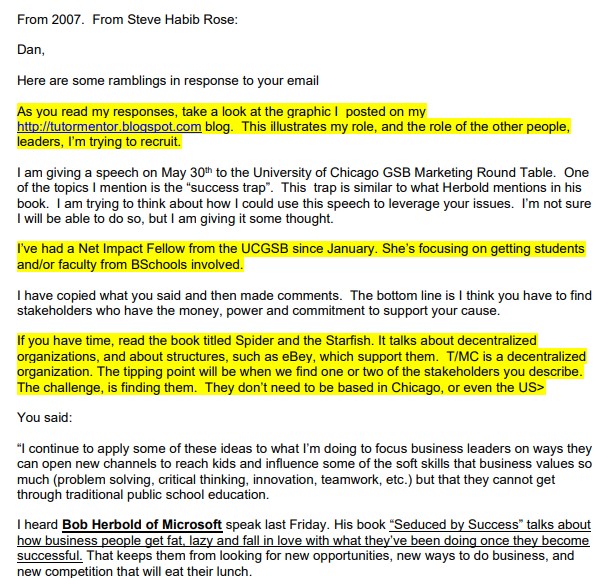
Yesterday I found a document with comments I'd made in response to a blog exchange held in 2007 with Steve Habib Rose. I show that below and you can view the PDF at this link.


The yellow highlights were my comments to what Steve had written.

I did a search on this blog to see if I'd written about this and, sure enough, found this article from March 4, 2007.  It's titled "Connecting Networks". 

In the first paragraph I wrote "I encourage you to read what Habib Rose is writing about networking and how this relates to connecting volunteers and leaders of tutor/mentor programs to each other."

When I clicked on the link, I found that it was broken. So I went to the Internet Archive, and found the article at this link


Then I looked at the TAGs on his blog and found several posts under "Tutor/Mentor Connection".   One is shown below.

These posts remind me of who I was connecting with in past years and how I was trying to build a network of people who would work to help kids in high poverty areas connect with volunteer tutors and mentors and extra learning opportunities in organized, on-going non-school programs. 

Some people I'm able to look up on LinkedIn and re-connect with. Others, like Steve Habib Rose, are no longer with us.  In fact, Steve died suddenly shortly after this blog exchange.  It's a reminder of how difficult it is to create a movement and sustain it for decades.

About the same time as I was connecting with Steve Habib Rose one of my interns gave me a book, titled "The Starfish and the Spider".   I pointed to that on this page of the Tutor/Mentor Institute, LLC website.


This book illustrates my role as a catalyst in building a decentralized network of leaders who support volunteer-based tutor/mentor programs.  My archives, this blog and my website are resources any one can use to draw people together, learn more about issues, see work others are doing, and innovate ways to help youth in their own community.

The final part of  "The Starfish and the Spider" talks about platforms, like eBey, which support millions of users.  If you go through my archives you'll see my efforts to create such platforms.  Most are now archives, except for my website library.  

Most are resources that you can find through your computer and the Internet, if you just make the time to look.

I've about eight boxes of paper files left to digitize, then a lot of organizing work to do. I hope to finish by this time next year.  I'll share some as I go, like I'm doing today. 

As you look at this, ask "Who will keep this resource available after Dan's no longer with us?"   I keep asking the same question.

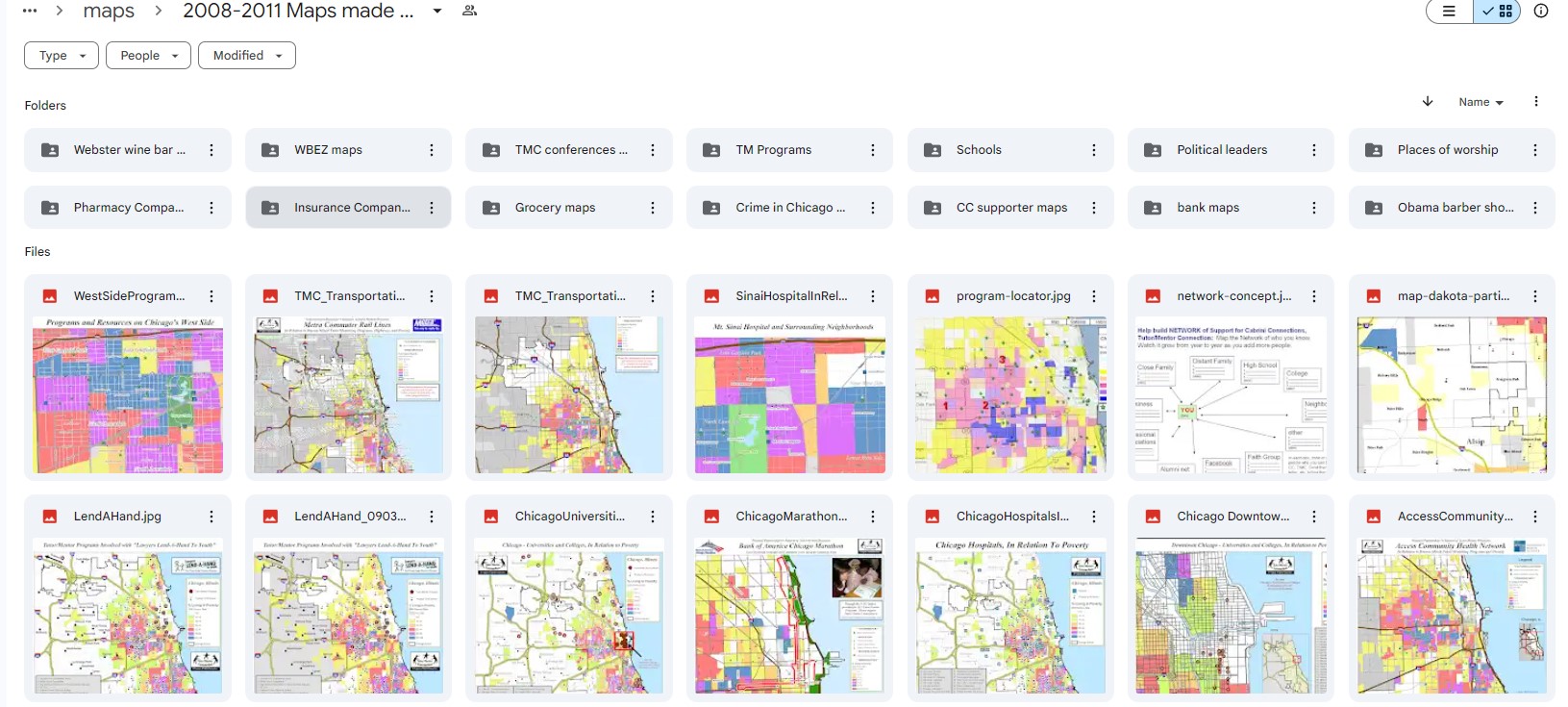
7-14-2026 update - I've digitized most of my files and they are available via my Google Drive.  In this article I point to a couple of sections.  The graphic below is a small portion of all the maps shared in just one file!


Connect with me on social media channels (see links here).   

And, if you're able, visit this page and send a contribution, to help me sustain my work.


Sunday, June 02, 2024

Thanks from 2006 and 2024

In past articles I've tried to draw attention to volunteer-based Chicago youth tutor, mentor and learning programs who I see sharing their stories on social media.  That leaves out some programs that have been around for many years, but don't use social media regularly.  

Inspired Youth is one.  Below is the home page of their website

I was reminded of this today when I received a question on Mastodon from Jayne Cravens, who has been a consultant to volunteer-based organizations since 1996.   She was responding to this 2006 post that I shared earlier today. In it I had mentioned Beth Palmer, who has led Inspired Youth since the 1990s.

Jayne asked me where the stories were featured, which prompted me to search the archives I have placed on my Google drive.   I shared this folder, which has reports from 1995 to 2003 Volunteer Recruitment Campaigns organized by the Tutor/Mentor Connection. 

Then I dug a little deeper and found this letter that Beth had sent to me.


This is part of a set of letters and email sent to me between 2001 and 2006 that can be viewed in this PDF.    By coincidence, Beth and I exchanged an email just a few days ago, as she was celebrating her 40 years of leading the Inspired Youth Tutoring Program (and Epworth Tutoring Program before that).

My archives have a wealth of information showing how I've tried to help tutor mentor programs grow in Chicago, while leading my own single programs from 1975 to 2011.  I'd love to make them available to researchers who want to help new leaders grow in Chicago and other cities who focus on information-based program innovation and growth and on helping fill all high poverty areas of cities like Chicago with programs like Inspired Youth and others who I point to from this page on my website. 


Thanks for reading (and hopefully) sharing my blog articles.

As I've digitized my files and past newsletters I've been reminded of how few people have ever seen any of this information. That won't change unless other people begin to dig into the archives and share the work.

You can connect with me on many social media platforms (see links here). 

And, if you're interested, you can also help me pay the bills to keep doing this work. Visit this page for information. 

Monday, April 29, 2024

Retaining Volunteers in Tutor/Mentor Programs

We're nearing the end of this school year and are at the end of the annual April Volunteer Recognition Month.  Volunteer-based tutor/mentor programs all over the country have been making an effort to recognize the people who have given time and talent over the past year, while are also (I hope) looking for ways to motivate many of those volunteers to return for another year when the 2024-25 school year begins in late August.

I've been digitizing newsletters and yearbooks from the two tutor/mentor programs I led between 1975 and 2011 and thought I'd do some volunteer recognition today.

Below is a page from the 1991-92 yearbook of the tutor/mentor program I led in Chicago from 1975 to the fall of 1992.  


This program was started in 1965. I joined as a volunteer in 1973 and became a member of the leadership committee in 1974. In the summer of 1975 I was chosen to be the leader when the incumbent announced during a summer planning meeting that he was "going to Europe and would not return for a couple of years".   When I took the lead the program was already recruiting 100 pairs of kids and volunteers at the start of the year.  In my last year, 1991-92, that had grown to 440 2nd to 6th grade youth and 550 volunteers.  You can see the yearbook PDF at this link

I left that program in October 1992 and with six other volunteers formed a new program, intended to help kids who aged out of the first program after 6th grade have similar support to help them through high school.  At the same time we formed the Tutor/Mentor Connection, to help similar programs grow in all high poverty areas of Chicago.

Below is a page from the 1999 Annual Report for that program.


Starting with only seven volunteers the program grew quickly, reaching nearly 100 volunteers by the end of the 1998-99 school year.  If you look at the list of veteran volunteers on this page and on the one from 1991-92 you'll see many of the same people. That's because many volunteers from the first program came to the new program with their students, as those kids joined Cabrini Connections.  You can see this Annual Report in this PDF

Note that by 1999 I was using the Total Quality Mentoring graphic to describe how we were recruiting volunteers from many different backgrounds.  That was true in the first program, too. 


In this PDF I describe the concept of Total Quality Mentoring.

By sharing my annual reports and newsletters I hope that I'm providing some inspiration for how others might build activities in their programs that help them recruit and retain students and volunteers for multiple years.  It's these long-term relationships that have the greatest benefit and it's the experience of veteran volunteers that helps newer volunteers become part of the program and stay involved longer.

You can view 1975 to 1992 yearbooks for the Montgomery Ward/Cabrini-Green Tutoring Program at this link.

You can view 1994 to 2009 annual reports for Cabrini Connections, Tutor/Mentor Connection at this link.  

As you look at these annual reports you'll see several thousand volunteers who participated for one or many years. I am tremendously thankful for the time each person contributed to helping create a brighter future for the kids we were working with.  

Now I want to share a President's Message from a January 2005 e-Mail newsletter.  You can open the PDF and read the full newsletter at this link


The heading of my message was "Competing for Attention" and it was written after a year of "unbelievable acts of violence caused by nature and caused by humans."

I wrote, "In the aftermath of these have come equally magnanimous acts of kindness and generosity.  While this leads me to be thankful at the same time as I fear what the next tragedy will be, I feel that we need to look at charity in new ways if we're to maximize the benefits of the generosity that is in this world."

I went on to write

----- begin Jan 2005 ------  

"This is why I participate in a variety of Internet forums that connect people from around the world with each other. 

I feel that out of the Tsunami tragedy will come some innovations that those of us working with kids might benefit from. Right now donations are coming from all over the world to a variety of charities serving the Tsunami because of the high public visibility the tragedy has generated. I feel that if we can create a portal that tells why it's important to help kids, with doors leading to each continent, each nation, each city, and each neighborhood where kids need help, this portal can serve as a funnel for dollars, volunteers and similar resources to go to individual programs in each neighborhood. While there are some on-line charity portals, like http://www.networkforgood.org, these promote all forms of charity, and thus don't have the passion and appeal that could be generated by having portals that focus on specific channels of service, like tutoring/mentoring. 

Rather than reinvent the wheel, my dream is that we could find people who share our passion for helping kids and will share their talent to build such a portal, or to make existing products available to other streams of service. I'm sure such people and organizations exist. We just have not connected yet. In the Discussion section of www.tutormentorexchange.net there is a database and a GIS discussion group where I'm gathering volunteers who might help with such a project.

Once we have the portal every organization that offers any form of tutoring, mentoring, career development, etc. can share in building visibility and traffic, knowing that this helps each of us increase the revenue pie that we end up splitting. In six months much of the attention to the Tsunami will be turned to some other tragedy and the people in these countries will be just like us, struggling to draw attention and consistent revenue to the work of rebuilding lives. The type of portal I'm trying to build could be a benefit to these countries just as much as it will be a benefit to you, me and thousands of others like us. 

This email goes to more than 3,000 people. A print newsletter goes to almost 14,000 people (when we can find the money to print it-the last print newsletter was sent in 2003). Some of you have been connected to me and the Tutor/Mentor Connection for more than a dozen years. Some are getting this email for the first time. While my intention is to share information that I hope you can use, this is also an invitation to everyone who reads this far on this email to contact me to explore ways we might work together. As Margaret Mead once said, "it only takes a few people to change the world". It only takes a few of you to join us in 2005 to make this a better year for thousands of organizations serving kids living in poverty. 

While it is almost impossible to have two or three thousand one-on-one conversations each week, it is very possible to meet in on-line forums where thousands of people can share ideas and unite in joint action. In the Discussion Section of http://www.tutormentorexchange.net a few such forums are listed. I hope you'll join some and that we can meet on-line.

---- end Jan 2005 ----

I've never been able to find a group willing to work together (of provide funding) to build the type of portal that I described in that 2005 newsletter.  I was able to build an interactive tutor/mentor program locator in 2008 and keep it available until 2018, but not able to update it after 2010.


On this planning page you can see the vision for the Chicago Tutor/Mentor Program Locator and find a link to a "next step" of adding a fund raising capacity to the platform, that would enable donors to directly donate to programs listed in the database. 

I've continued to use social media daily to share ideas and connect with others.  I'm still looking for program leaders who "share in building visibility and traffic, knowing that this helps each of us increase the revenue pie that we end up splitting."

In the Tutor/Mentor library I've three lists that point to organizations doing part of what I envisioned in 2005. Find those herehere and here.  If you know of others doing what I described, please share the link in the comments. 

As you read my newsletters I hope you'll share them in your own networks.

Thank you for reading today's post.

At this page you can find links to where I'm active.  Please connect with me and encourage your friends to do the same.

Finally, there's a cost for me to keep these archives available and to keep updating the Tutor/Mentor library.  If you can help fund the Tutor/Mentor Institute, LLC, visit this page and use the PayPal feature to contribute. 


Tuesday, April 16, 2024

What if political campaigns raised money for youth programs?

I've been sharing archives from the work I've done since 1993 to help volunteer-based tutor, mentor and learning programs grow in high poverty areas. Today I'm going to point to email newsletters I wrote in the early 2000s.

Below is the President's Message from the August 24, 2004 newsletter (open PDF here).

This text says:

Editorial: Which candidate is helping you get volunteers and dollars for your tutor/mentor program? Most of the tutor/mentor programs that I know of don't have large advertising and PR budgets. Many, like Cabrini Connections and the Tutor/Mentor Connection, struggle to find money for rent and payroll. Thus, during the election season it is even more difficult to get our call for volunteers heard.

That's a reason we created the T/MC. Its strategy is to create a larger public awareness of tutoring/mentoring by connecting tutor/mentor stakeholders via the Internet and face-to-face meetings. As hundreds of individual programs, networks, and business and professional partners take the lead in calling for volunteers, links to web site portals, like http://www.chicagovolunteer.net or http://www.tutormentorexchange.net create a larger flow of potential volunteers and provide multiple choices of where they might volunteer. If you use these services and participate in the campaign, you should be more effective at recruiting volunteers for your individual program.

As leaders in other cities and states build their own T/MC type strategy we hope to link web sites and link campaigns so that we ultimately have a voice during August and September that is as loud as those of commercial advertising and political candidates. If our strategy works we can create this level of public awareness at a fraction of the money being spent on the fall elections by our major political parties.

Maybe we'll even reach a point where the VOLUNTEER NOW button of a political candidate's web site has a link to the local volunteer center, not just to the candidate's campaign committee!!

In another part of the newsletter, this is what I wrote:


It says:

TRAINING VOLUNTEERS, ONCE YOU HAVE THEM
The Tutor/Mentor Connection web sites have hundreds of links to resources that programs can use to improve quality and support volunteers. In 30 years of leading a tutor/mentor program I've learned that every student and volunteer is different, and they are constantly changing. No training program or manual can provide everything each person needs. Thus, I've focused on building a library of materials that volunteers can use to develop their own skills. The focus of our training and communications is to lead our volunteers, staff and leaders to this information so they begin to use it on a regular basis.  

These messages are as relevant in 2024 as the were 20 years ago.


With the 2024 election season in full swing, millions (billions?) of dollars are being raised to fund political campaigns, just to get people elected or re-elected.  

In 2004 I called for part of that money to be used to support needed youth programs and other important causes.  That's still the case.

In 2004 I also pointed to the resources I was aggregating to help volunteers in tutor/mentor programs become more effective tutors, mentors and advocates, helping their own students and programs, and helping others in different parts of the cities where they live or work.   That's still the case.  Except, the library is much larger today than it was 20 years ago.

Last week I posed this article, sharing my 30 years of reaching out to universities.  And yesterday on the Mapping for Justice blog I posted an article showing my 30 years of using maps to draw attention and resources to every high poverty area of Chicago.

As I look at my archives I'm embarrassed by the number of spelling and grammar errors.  I could have benefitted from having a proof reader!

I can't change that, but you can.

As I share this archive, I also point out that too few people ever saw what I was publishing, because I never had the money to buy advertising, and never was a high profile celebrity who could attract readers just by asking.

Thus, everything I'm sharing would be "new" to most people.

In my final slides on the "Reaching out to Universities" presentation I included a map showing cities in the US with high concentrations of poverty.   Skim through past articles on this blog and you'll see many more stories showing that Chicago is not the only place where a Tutor/Mentor Connection type strategy is needed.

Thus, my archives represent a resource that anyone might use to create and lead a new campaign (with better editors and writers, and more high profile leaders), using my past work as a starting point for their own articles and visual presentations.

The starting point is your own curiosity and learning.  Dig through my archives. Find stories that resonate with you. Re-write them. Post them on your own blog. Share them with your own network. 

Repeat. Repeat. Repeat. 

Maybe in 10 or 20 years you'll be able to share a similar archive.  Maybe you'll be able to point to thousands of kids who you've helped.  Maybe you'll have made a bigger impact on reducing poverty concentrations.

That's the goal.


Do you ever feel like my articles are similar to the messages I gave each year to youth and volunteers in the tutor/mentor programs I led from 1975 to 2011?   

Thanks for reading, and sharing.  

Connect with me on social media.  You can find link on this page.

If you're able, please make a contribution to help fund the Tutor/Mentor Institute, LLC and help me continue this work.  Visit this page

Thursday, April 11, 2024

30-year history of reaching out to universities

Last December I posted this article asking "What if students in every city did this?" 

Youth in every part of the world could be writing articles similar to what I've written on this blog since 2005 and in newsletters back to 1993. 

I promised that "In a few weeks" I was going to write an article showing my efforts since 1993 to build strategic alliances with local and global universities, which would lead to students doing the research and writing that I dream of.

Today's the day to share that history.


Open this PDF presentation and stroll through 50 pages of history showing how I connected with universities throughout Chicago, the Midwest, and other countries, starting in the late 1980s when I led the Tutor/Mentor program at Montgomery Ward's corporate headquarters in Chicago.  

You'll see pages like the ones below, that show evidence of those connections and include links to documents on my Google drive.


These are just a few examples that show important work done by interns over the past 30 years, which I've highlighted on other pages in this PDF.

Please spend a little time looking at the slides. On your first visit, just walk quickly through each slide, so you can see the range of universities I've connected to.  Then, pick a university you're interested in, and open the links on those pages.  These show some of the interactions that I had which led to student involvement.

The slides show 30+ years of engagement. Valuable work was done. Yet, they all have one common weakness, which is a lack of ownership at the university, and no integration into a long-term university-led effort to support the growth of well-organized, non-school tutor, mentor and learning programs in all high poverty areas around the university, or the cities where they are located, or places where some of their student live.

Several years ago I created another presentation showing my 30 year outreach to universities. View it here

The projects with Illinois Wesleyan from 1993-2004, Columbia College of Chicago in the mid 1990s and with IUPUI from 2002 to 2011 came closest to becoming a formal university based initiative.  But these never took root because I did not have the wealth, or fund raising ability, to fund faculty and student involvement, and no one at the university was willing to take on the fund-raising role.

Below is page 57 of the presentation.  Universities establishing Tutor/Mentor Connection programs and implementing the ideas I've piloted would represent "tipping points", or actions that change every thing else that happens.


At the bottom of the page I asked, "What if a wealthy patron, like MacKenzie Scott, who is giving millions of dollars to nonprofits, or Dr. Ruth Gottesman, who gave a $1 billion dollar donation to the Albert Einstein College of Medicine, were to fund a Tutor/Mentor Connection strategy on one or more campuses for 10 to 20 consecutive years.

Don't give the money to me. Set up a competition and award it to universities who spend time reading this presentation and digging through my blog archives, then present a plan for engaging students and faculty in long-term learning that continues well past the years they graduate.


What might universities do differently to prepare leaders to lead needed youth, tutor, mentor and learning programs in high poverty areas that help youth to, and through, college and into careers. Or to train other alumni to support them as on-going  volunteers, advocates and donors?

Yesterday was a day of raising money for Illinois Wesleyan. I made a small donation. they raised a lot of money.  What if such a campaign were raising money each year for non-profits led by their alumni?


That was the idea that a University of Chicago Business School student worked on in 2006. 

Creating leaders who are constantly learning from peers and leaders who are consistently providing needed operating and innovation dollars, could be a degree program at any university. The on-going flow of student interns could come to nonprofits with greater preparation to contribute to the work being done, building on work done by previous interns.

Please share this widely.  As this slide shows, neighborhoods of concentrated poverty are spread throughout the USA.


Without a consistent, on-going, comprehensive effort, not much will change over the next 30 years for people living in areas of persistent poverty.  I've proposed a strategy that might make a difference.


I suspect that my presentation could be turned into a book, or could have an audio narration.  I hope some people will be interested in doing that.

Thank you to all of the faculty and students who have helped me since 1993. The work you did was really impressive and of great value.  

I especially want to thank Dr. Minor Myers, Jr., President of Illinois Wesleyan University from 1990 to 2003, for his constant encouragement.  

You can connect with me on Twitter, Facebook, Instagram, LinkedIn, Mastodon, and other places (see links  here).   

And, if you want to help me pay the bills and continue to maintain and share this resource, visit this page and make a contribution.
Friday, April 05, 2024

More maps now in my archive

A couple of weeks ago I posted this article, showing map stories the Tutor/Mentor Connection created since 1994 to draw volunteers and donors to youth programs in high poverty areas of Chicago.  The graphic at the left is part of that collection. 

I've continued to aggregate maps from different files in the archive so I encourage you to take another look and see what's there.

While I received donated ESRI software in 1995 to use in making maps, I depended on interns from Northern Illinois University to set up my map-making capacity in our tutoring program office in Chicago.  Then, mostly depended on volunteers to make maps for me in following years since I could not find the money to hire someone with GIS expertise.

Then in 2007 an anonymous donor gave us $50,000 to build our map-making capacity.  Mike Traken joined us on a part time basis in January 2008 and made our maps until 2011 when, due to diminished funding, I was no longer able to keep him on staff.  

Yesterday I created a folder in my archive, showing maps Mike created, such as this one featuring the Illinois District 9 Legislative District.

The maps tell stories. This shows the level of poverty in the district and shows universities and hospitals with facilities in the district. Green stars on the maps show existing youth tutor and/or mentor programs in the area.  Hospitals, universities and businesses are assets who should be strategic in using their resources to help tutor/mentor programs grow, and help kids in those programs, and local schools, move through school and into jobs and careers.

Ideally there should be many more green stars in this district than what my map shows.  

Note, this map was made in 2008 or 2009. What would a map of that district look like now? 

This link will take you to the folder with maps that Mike created.  When you open it you'll see this screen.

Above the maps shown are 14 folders, each with maps related to that topic. Thus, the map of District 9 is in the "Political Leaders" folder, where you will find 9 other folders in addition to the one for District 9.  

Hopefully, these inspire you to make your own maps and map-stories to support the growth of needed services in Chicago or in other places.

I wrote an article in 2014 using these map-stories, with the headline of "Without Effective Leadership, Same Problems Will Continue".  

That's been my message since the 1990s.  

I wrote, "I can not find evidence that any leader, from any industry in the Chicago region, has devoted consistent advertising resources to draw attention to tutoring/mentoring, and to draw volunteers and operating dollars to programs throughout the city, or to programs near places where they do business, or where employees or customers live.

I can not find evidence that the current, or former mayor of Chicago, or any alderman, state elected official or county president, has led a weekly, yearly campaign, intended to draw needed volunteers, dollars and technology resources to the tutor/mentor programs operating in various Chicago neighborhoods. Even the occasional public declarations of support for Chicago's kids don't work like a Polk Bros ad to draw attention to tutor/mentor programs all over the city, and to motivate people to volunteer time, or give operating dollars, to support existing programs, or to help new programs start in neighborhoods with great need, but too few programs."

I think the Tutor/Mentor Connection offers a template that others can learn and build from. That's why I've been archiving all of my records.  Now I just need to find some wealthy visionary who will fund a program at a university, where these records are part of a study curriculum that prepares leaders to adopt the strategy in every city with high concentrations of persistent poverty.


Interested?  

Connect with me on Twitter (x), LinkedIn, Instagram, Facebook, Mastodon, Threads, Bluesky and my blogs. (see links here).

And, if you're able, support my work with a small contribution. Visit this page and use the PayPal button.

Tuesday, April 02, 2024

What You Can Do to End Poverty - 2005 Letter

I've been digitizing more of my archives for the past few months, and again today. I've been sharing some files, like these yearbooks, on social media. The result was 67,200 views of this blog in March 2024.

I did another batch today, which requires looking at old files and seeing if I should put them in my Google drive folder.  I found a letter I wrote in October, 2005, as a "Letter to the Editor" which I hoped the Chicago Tribune would publish.  I was going to post it here, but decided to look first, to see if I had posted it in 2005.

Yes. I did, on November 3, 2005.  So I'm going to share what I wrote then: 

---- start Nov. 2005 article ----

On Tuesday, Nov. 1, I attended a meeting at the Federal Reserve Bank in Chicago, where more than 200 people were given information that showed the "State of Latino Chicago". This highlighted the huge contribution Latinos are making to the Chicago area economy, and the need for more programs to help Latino youth move through school and into careers. On Nov. 2nd I attended a meeting at the Union League Club of Chicago where the No Child Left Behind law was discussed. At the same time a lunch was being held where others were focusing on ways to build better schools.

What these meetings had in common is that they were not connected to each other with an internet strategy that would have enabled participants from all three meetings to connect with each other, and with the speakers. They also did not have a strategy for engagement, that would increase the number of people personally involved in long-term efforts that help kids in poverty move to careers.

In September, people from the Connect for Kids group in Washington, DC helped me develop a letter to the editor that illustrated the role of tutoring/mentoring as a civic engagement strategy. I met Connect for Kids through internet networking and this is an example of what's possible when such networking is a strategic goal of people who host face-to-face meetings.

I sent my letter to the Chicago Tribune in mid October and it has not been published. So here it is for you to read:
--------------

What you can do to end Poverty, by Daniel F. Bassill

Alicia and Marquita were in elementary school when I first met them 15 years ago. They were normal kids, except they lived in the Cabrini-Green neighborhood of Chicago, where the role models and life experiences were anything but what normal kids in most parts of America grow up with. The Cabrini Green neighborhood has a high concentration of poverty, many people living on welfare, and strong street gang involvement. This is the neighborhood that shocked the nation in 1992 when 7-year old Dantrell Davis was shot and killed while walking to school. It’s a neighborhood where more than 40% of the kids drop out of high school before graduation, and where many who do graduate never move on to college and careers.

Today, Marquita has graduated from college and Alicia will do the same next year.

What happened to take these girls off the path toward poverty, and place them on a different path toward college and careers? The answer is simple, but powerful. They were able to participate in a comprehensive volunteer-based tutor/mentor program that connected them with adults who mentored them, helped with school work, talked about options and choices, and just plain cared. In elementary school they were able to participate in a program hosted by the Montgomery Ward Corporation in Chicago. After 6th grade they were able to transition to the Cabrini Connections tutor/mentor program, which has supported them for the past 12 years. This year they have become part of the adult tutor/mentor corps, and are now volunteering to help other Cabrini Green children move through school and into college then careers.

In the aftermath of Katrina, people in Chicago and across the nation are asking what we can do about poverty. I’m not a teacher by training and I don’t have special skills. I started mentoring a fourth grade boy living in Cabrini-Green in 1973 and became leader of a volunteer-based program in 1975. Thus I have 30 years of experience in recruiting volunteers and connecting them with inner-city kids. While I did not have much experience when I started, my understanding of the issues and my commitment to volunteer-based tutoring/mentoring has continued to grow with each passing year. I’ve learned the difference between being poor and being poor without hope.

I’ve also learned how tutoring/mentoring can be one of the best strategies for civic-engagement, workforce development and education reform. Long-term programs connect youth and adults from both sides of the economic and social divide in a long-term process of service and learning. This leads to a better understanding of poverty, and a stronger commitment to do what is needed to provide paths to hope and opportunity for kids who need extra support to succeed in school, move to college and find help in starting jobs and careers.

I would like every adult who is not living in poverty to become personally involved in helping build and sustain long-term tutor/mentor programs in every neighborhood where concentrated poverty is the largest obstacle to succeeding in school and moving to jobs and careers. That is how we are going to improve our schools, reduce youth violence, lower the costs of the juvenile justice system and meet the workforce needs of the 21st century.

The way to get everyone involved is for people from every walk of life – business, churches, hospitals and universities – to step up as leaders and make children living in low-wage families a priority. Businesses can use their intranets to provide information about where tutor/mentor programs are needed, and ways to contact existing programs. They can use their advertising to encourage employees and customers to volunteer in programs throughout the Chicago region. Universities can encourage their students to talk with local children about what college is like, and can develop research and teaching programs that connect students and alumni with training resources and tutor/mentor programs throughout the country. Every organization can use its website to publicize volunteer opportunities and to increase the number of people who are learning ways to become involved in tutor/mentor programs. The ways to take action are as endless as the numbers of children in need.

Such a leadership strategy needs to guide volunteers and donors to all neighborhoods where there are high concentrations of poverty, not just to the few brand name programs in highly visible neighborhoods. If we increase the number of people who are willing to commit time, talent and dollars to efforts that help end poverty, we will reduce dependency on government and build programs that last more than a few years.

No business would be successful if it advertised sometimes, and sometimes not. Children take a long time to grow up, and they will only be successful if adults like us get personally involved, stay involved, develop an understanding of poverty, and grow into leaders who bring in new volunteers to do the same. We’re building a system of support for this type of involvement. We call it the Tutor/Mentor Connection. You can find us and similar support networks that operate in other cities by using Internet search tools like www.Google.com .

By the time you read this, the media will probably be turning its attention away from poverty and to the next "hot" issue. But that doesn’t mean we have to turn our attention away from the children who need us.

---- end 2005 article ----

I'm pleased to report that in 2024 Alicia and Marquita are both doing well. I'm connected to them on Facebook, along with many other alumni from the tutor/mentor programs I led since 1975.  I'm seeing many now report on their own kids, or grandkids, finishing high school and college.  And, I'm seeing many starting new families.  

I found another letter in my files today. I wrote it to university contacts in 2008.  It included this paragraph, asking "What are all the things we need to do to assure that all youth in the city where your  university is located, or where your students and alumni live, are starting jobs/careers by age 25/"


You can read that full letter here.   

Imagine if students and faculty at various universities were looking at the documents in my archive, just as I am, and then were sharing them with others at their universities and where they alumni live and work.

Could we build a more consistent and innovative strategy to connect with kids and families in areas of persistent poverty with long-term support that helps them build jobs and careers so they can raise their own kids free of poverty?

I hope you'll share this and that another 65,000 people will view my article in April and every month after that.  Maybe that will increase the number who follow me on social media.

Maybe it will also increase the number who go to this page and make a contribution to help me continue collecting and sharing this information. 

Friday, March 22, 2024

Using maps to draw attention and resources to high poverty areas

This week I watched two panel discussions hosted by Friends of the Children - Chicago.  One is shown below. You can find the second at this link.


Friends of the Children has a long-term model of supporting kids from first grade through high school.  In these videos the speakers make a case for why volunteer-based tutor/mentor programs are needed in areas with many indicators of need, such as high poverty, violence, poorly performing schools, etc. 

I've used graphics like the one below to emphasize the need for long-term programs in high poverty areas of Chicago, so I'd like to see more programs who build such support for kids into their core strategies.  


What I did not see in the videos was anyone holding up a map of Chicago, saying "We need programs like this in every high poverty neighborhood, not just a few."

I've been using maps since 1994 to show where tutor/mentor programs are most needed, and where existing programs were already operating. I've also used them as part of a "Rest of the Story" public awareness strategy.  Below is an example.


This map-story was created in 1996 following a feature story in the Chicago SunTimes with a headline of "Slain children mourned: 'When will this end?"  My strategy was to leverage the public attention of the news report to show the areas where the shooting took place, and to show any tutor/mentor programs in the area (if there were any).  In creating these maps, we also showed "assets", businesses, faith groups, hospitals, universities, etc, who shared the area, and who should be strategic in helping tutor/mentor programs grow near where they do business.  

Unfortunately, we did not have the Internet available in the 1990s so few people actually saw these map stories.  I've been sharing them on this blog and the MappingforJustice blog since 2008. 

Over the past two weeks I've posted several articles showing some of my archives.  Now you can look at two more sections.

This folder includes more than 90 map stories created since the 1990s. 


This folder is even larger.  It contains more than 600 maps and images, mostly created since 2008, which I've used in blog articles, strategy presentations and newsletters.  


Not all of the images in this folder were created by myself, or the volunteers and paid part-time staff, who created maps for me.  Some are screenshots from other websites that we used in stories on one of our blogs.  Some are images of work done in 2008-10 to build the Chicago Tutor/Mentor Program Locator Directory (which has been an archive since 2018). 


By sharing these archives I hope to serve as a resource for students and learners throughout the USA and the world, to demonstrate strategies for helping draw attention to places where the people and the planet need extra help, and extra, on-going, long-term, resources.

Between 2006 and 2015 interns from various universities in Chicago and South Korea spent time looking at articles on my blog and website, then created their own visualizations sharing what they were learning with people they know.  You can see their work on this page

My goal is to inspire a donor to make a major gift to a university that would fund a Tutor/Mentor Connection study program, where students do similar research and build a similar library of media stories and maps.

Imagine finding an archive like mine on a university website 10 to 15 years from now.

The graphic below visualizes my goal. Universities could be creating future social problem solving leaders who are constantly learning from each other and constantly feeding their own experiences into central depositories of wisdom.  


This blog article describes this as a "Tipping Point", because it not only grows a new cadre of leaders who use AI and other tools to aggregate information and draw from these libraries to support their own work, but also educates alumni who go into business and professions, rather than social service, to be proactive, on-going, and generous in supporting those who do go into social service work.

Since the 1990s, I've been building a library of information to support what people do to help kids in high poverty areas connect with adult tutors, mentors, learning opportunities and jobs.  The concept map below shows that library.


The challenge with such a growing amount of information is motivating people to spend time looking at it, and using it to support what they do to help themselves and their family, and to help others create a better future for all of us.


Thanks for reading. And thanks for sharing.

I'm on Twitter (X), Facebook, LinkedIn, Instagram and a few other platforms (see links here). I hope you'll connect with me.


If you'd like to help me pay the bills, please visit this page and make a contribution.  

I'm not a 501-c-3 nonprofit, so cannot offer you a tax deduction, but can promise to use your contribution to keep this library of ideas freely available to you and the world.