Showing posts with label research. Show all posts

Wednesday, July 22, 2026

Turning Research into Active Problem-Solving


Every month I see a new report showing the impact of concentrated poverty on school performance, health, economic well-being and other issues.  Last year A Better Chicago released a new report titled "State of Chicago Youth, 2025". I wrote about it in this article.  They issues an update in 2026 - click here

Below is a message I've shared often, in different articles, for the past 30+ years.

I’ve been collecting similar information since I became a volunteer tutor in 1973, showing where people need extra help, why, and what type of help could be offered to youth via organized, on-going, volunteer-based tutor/mentor programs.

From 1993 to 2003 I shared this information via printed newsletters. Then on a website since 1998.   I’ve been pointing to that research in articles on this blog since 2005.

I’m sharing a few below. I hope you’ll open the links and take a look, then share the ideas through your own blogs, videos, etc.

Here’s an article where I use maps to show where people need extra help.


It’s one of dozens where I show the four-part, information-based problem-solving strategy that I’ve piloted since forming the Tutor/Mentor Connection in 1993, and Tutor/Mentor Institute, LLC in 2011. It’s one where I point to a section of my library with hundreds of links to articles and research about poverty, racism, inequality and social justice. And, it’s one where I encourage others to share this information in their network, so more people find it and use it.


When I formed the Tutor/Mentor Connection the goal was to help every existing tutor/mentor program in the Chicago region get the operating resources, volunteers and ideas each program needs to grow. Here’s one of many articles that focus on the challenges of finding on-going funding for mentor-based programs.

My leadership of a single volunteer-based tutor/mentor program from 1975 to 1992 and a second program starting in 1993, along with my career in retail advertising with the Montgomery Ward corporation, provided the foundation ideas for the Tutor/Mentor Connection.

These experiences led me to understand that organized volunteer-based programs were a way to connect kids in high poverty areas to people, experiences and opportunities that were not readily available in their own family/neighborhoods, due to extreme poverty. Over time, I began to understand this as a form of ‘bridging social capital’ and visualized it in graphics like the one shown below.


Here’s one of many articles where I write about mentoring as a form of social capital.

In my work at Montgomery Ward’s corporate headquarters, from 1973 to 1990, I learned how my department, and other functional teams, supported more than 400 retail stores spread in 40 states. We helped each store be good at attracting customers, selling merchandise and earning a profit. (at least we tried)

Thus, when we formed the Tutor/Mentor Connection plan in 1993 our initial strategy was to learn what programs existed in Chicago, then to build a public awareness strategy that would attract more attention, volunteers and donors to each program, and to every high poverty neighborhood.


This article shows how we began publishing a Directory of programs in 1994 and how this information was used to support programs.

In this article I describe an on-going information-based planning process, that uses information like I’ve been collecting.

This could be led from institutions who have deep roots in geographic areas, like hospitals, universities, businesses, etc.

To do this research, someone needs to host a library like mine, with lists and directories of youth serving programs, then use that information in an on-going planning, program development and public education and resource generation strategy.

This is a missing step in most of the research I’ve seen for over 25 years. Researchers get the money to do the research and produce a report, with a big event that shares it with the public, but then don't have the money to continue to share that research and draw people together to use it over the following years.  What I do is aggregate links to that research and try to motivate people to use it to support youth tutor/mentor and learning programs in every high poverty area of cities like Chicago.

I encourage you to look at articles, like this, where I point to work being done by Daniel Max Crowley, who I met on LinkedIn.  He calls on universities to go beyond collecting research to helping communities use it. 

Over the past 30 years I've piloted actions that I share on my website and that anyone can borrow and apply in their own geographic area.

While I do find a few who host lists of youth serving programs, and even plot the list on interactive maps, I don’t find any with multi-year public awareness efforts aimed at drawing volunteers and donors to every youth-serving program within their city.  If you know of any who do this, please share the link and I'll add them to my library.

Furthermore, I don’t find any doing the deeper research asking “what youth programs exist in your area”.

Doing such research and maintaining a list of programs is a big job, especially in cities as large as Chicago. That’s why, for many years, I’ve tried to motivate universities to build a Tutor/Mentor Connection-based strategy on their campus. This is one of several articles where I share this invitation. 


Here’s an article where I show 30 years of effort to build strategic alliances with universities. You can see a wide range of interactions with many universities, but no long-term initiative led by, and funded by, any university.

Why wasn’t I successful?
Money. Reputation. Clout.

I never had much of any of these so when I met with someone at a university, I’d receive polite nods, with a “I’m already over extended. Find a younger professor.”

 The answer: ultra wealthy donors


Here's one of several articles where I show the potential of strategic investment by one or more wealthy donors.  Here's another

How might we find such donors? 


They are all around us. Do you watch NFL football games? How often do you hear players praised for their philanthropic work? I posted this on Twitter in 2024 sharing the idea from this post.

What if a university aggregated this information and then used it to recruit a group of athletes who support the same cause, to support a Tutor/Mentor Connection strategy at the university that was building the database of athlete involvement?

What if? What if? What if?

What if you share this article in your networks? Maybe someone will read it and adopt the idea and actually take the next steps.

That’s why I write these articles.

If you're connected to a university, or looking to put your name on a building at your alma mater, I hope you'll make this your mission.


Thanks for reading.
  There's a lot here, so bookmark the page and return often.  Then, look me up on LinkedIn, BlueSky, Instagram, Facebook, Twitter, etc. and let's connect.  If you're writing similar articles, which I hope you will, please share them.

Finally, if you're able, please visit this page and make a contribution to help fund my work. 

Monday, June 22, 2026

Focus on conditions that affect student performance - new UCLA Center report

Today I read a new article from the UCLA Center for Mental Health in Schools, titled "Disregarding Inequities Fuels Victim Blaming".  It focuses on how "far too little attention is focused on the role that societal and school inequalities play in shaping both student difficulties and school performance outcomes."  I encourage you to open this PDF and read the article. 

6-26-2026 update - the UCLA Center shared another report about the "Cycle of disinvestment in public schools".  Click here to read it.

This is not new information to me. I've been collecting articles like this for over 30 years and sharing them in my library and via posts like this.  

Below is a concept map showing sections of the library that have related information.  I added the new UCLA article to the "Education" research section.

This is something I started doing nearly 50 years ago.  It started as I was interacting with others, talking about ways to build and sustain volunteer-based tutor/mentor programs.  Most conversations would include an introduction of new ideas from the people I was talking to.  In most situations, the ideas might generate interest, but when the two people leave the conversation, the ideas does not necessarily go with them.  

I started writing down ideas on scratch paper, even paper napkins, then putting them in a "ideas folder" in my office.  From time-to-time I went through that folder, reminding myself of these ideas, which often led me to include them in program upgrades.

When I formed the Tutor/Mentor Connection in 1993 I dramatically expanded the range of ideas I was collecting, and made them available to other tutor/mentor program leaders in Chicago.  When I started using the Internet in the late 1990s I moved the library to a website and I've been adding to it for the past 26-plus years!

Thus, if you look in the set of education research articles (at this link) you'll find many articles that point to this problem. It's not new.  

And, if you open the other sections shown on the concept map, you'll find even more information that supports the ideas in the Summer 2026 UCLA Center's article.

I created this graphic in the 1990s to show how anyone can take a role that draws people to this information and begins building understanding and a commitment to long-term, widely distributed solutions.  The big circle represents the library and smaller circles represent groups of people gathering regularly to read, discuss, reflect and innovate.

The map of Chicago at the far right highlights high poverty areas were these conditions exist. A full range of youth and family support systems is needed in EACH of these areas.


In 2011an intern from South Korea, via IIT in Chicago, looked at my graphic, then created her own version.  I show it below.

This is actually shown in two graphics. Visit this 2011 article and see both.   Note that the title of the article is "Volunteer your talent with Tutor/Mentor Institute".   It's an invitation I've shared over-and-over.  

That's because until people in every community are drawing their networks to this information, the problems won't go away.  Too few people are involved.  

Yet, as I wrote last week, students could be doing what interns did for me in past years.  They can look at the information I'm sharing, then create and share their own interpretations.  

They don't need to do this via the Tutor/Mentor Institute, LLC.  In fact, it really needs to be part of an on-going learning and leadership program embedded into every middle school, high school and college in the country.  There could be hundreds of blogs that aggregate and share student work. 

Thanks for reading. I hope you'll connect with me on LinkedIn and other social media. Share your own ideas and visualizations.  Don't look back in 30 years at the Summer 2026 UCLA article and say, "Why has nothing changed?"

I still depend on a few donors to help me pay the expenses associated with my work. Visit this page if you'd like to help.

Tuesday, April 07, 2026

Making Out-of-School-Time Programs More Available

 Last week I shared the 2026 State of Chicago Youth report from A Better Chicago in this post.

One of the insights of the report focused on Out-of-School and Community-Based Programs and Spaces.  


Visit this page and open the PDF report to view this page. 

The text above says that "Citywide, during the 2024-2025 school year, 31% of CPS youth K-12 participated in out-of-school programs.  Students in grades 3-8 were the most likely to engage in out-of-school programs (37%) compared to k-2 (29%) and high schoolers (27%).   The North Central (39%) and Far South (34%) regions of the city had the highest percentage of youth engaged in out-of-school programming, while the Near South region had the lowest percentage (23%)."

What the report did not include was an interactive dashboard showing out-of-school programs in Chicago, with an ability to sort by age-group served and type of program.  I would loved to see a page on their website listing the programs that are included in the 31% where CPS youth were engaged.  

For instance, they could point to the MyCHI. MY Future program, which does have a searchable map. I show the result of using the menu at the far right and asking for 'reading and writing' programs for youth between age 16 and 18 in this graphic.


You can enlarge the map and zoom into a specific neighborhood. You can drag the map view so it shows a different part of Chicago. 

When you click on a circle representing a program, you can see a description and find a website.  That's good.  What I found is that many of these are programs hosted at Chicago Public Libraries. While the site has many categories, it does not differentiate between nonprofit youth serving programs and government funded services, like the libraries.  

One strength of MyChi MyFuture is the on-going effort to bring stakeholders together for citywide meeting and to share information via email newsletters, their website and social media.  Furthermore, they have empowered the formation of 14 neighborhood networks of stakeholders to support youth in their communities.  


Visit this page on the MyChi MyFuture website and look at the community plans developed in 2023 and 2024 by each of these networks.  I just finished skimming through them. Some have great data. Some have maps. Most list stakeholders involved.  Most have comprehensive plans that stretch into 2025.

However, I found no links to websites for each of these networks, where they were actively implementing the plans, learning from what works, and each other, and developing actions for 2026 and beyond.  If you have a list of these, please share it and I'll put the link in this article.

What I wanted to find when I looked at the websites of A Better Chicago and MyChiMyFuture was a site that worked like the Tutor/Mentor Program Locator, which was built for the Tutor/Mentor Connection in 2004.  Below is the screen users would use to search for tutor/mentor programs in different zip codes of Chicago.  Below that is the first page of a visual essay that shows features in this version of the Program Locator.


Open this PDF to see a description of how to use this Program Locator.   In 2008 this was re-built as a map-based directory.  This PDF shows its features. 

These were intended to help youth, teachers, parents, volunteers, donors, media and others find existing programs in different parts of the city, with features that narrowed the search by type of program (pure tutoring, pure mentoring, combination tutor/mentor) and age group served (elementary, middle school, high school). 

This page shows my long-term goal of "Using Maps to Build Capacity".  Due to funding challenges since late 2000s I've never been able to reach this goal, but still share it with hopes that it will inspire work of others.  

The report from A Better Chicago shows that "Chicago has a problem" and "They are part of the solution". And, it uses maps to show which parts of the city need more programs. However, it does not point to any listing or directory of existing programs, to help attract attention and resources to all of them.

The My CHI My Future site seems designed to help kids find opportunities.  I don't see any form of analysis that says "Do we have enough programs? or "Where are more needed?" Or for donors and volunteers to reach out and support existing programs.  I found this type of analysis on many of the community plans hosted by MyChiMyFuture, but in looking at the lists of stakeholders it seems that many of the organizations on my lists are not included in any of these efforts.  

Since I was looking at PDFs of plans developed in 2023-24, it's possible that a greater number of tutor/mentor programs are participating in these networks.

Below is the front cover of the 1995 Tutor/Mentor Connection Chicago Programs Directory.  It was created before we learned about the Internet. It used maps to show where programs were needed, and listed programs with the same sort features as the Program Locator that we put on line in 2004.


Here's a link to an archived version of the 1997 Director. We used this format each year from 1994 to 2003.  If you look at the listings in this Directory you can see the basic outline of the library that you can now found on the www.tutormentorexchange.net website. 

Below is a graphic showing year-round communications intended to draw people together to learn, share and generate resources for youth-support efforts in specific areas.


On this page I share strategies that the Tutor/Mentor Connection piloted, beginning in 1993 and that I still continue in 2026.  

In this article I show organizations who participated in each of the Tutor/Mentor Leadership and Networking Conferences that I organized between May 1994 and May 2015. 


Last week I included this map in my first article about the 2026 State of Chicago Youth report.


Ideally each year when I look at the community networks hosted by MyChiMyFuture I would find updated maps and graphics showing participation in their meetings and the sites of youth-serving programs in their community areas.  

And when I see new research from organizations like A Better Chicago, I'd find a page pointing to work being done by others to address the same issues.

Young people could be collecting and updating this information!  Maybe it's something the new Obama Center could champion.

Here's just one more map. 


This concept map shows intermediary organizations who support youth-serving programs in the Chicago region. It includes a link to the website of each organization, so that anyone finding my website and map can also learn about others working to make life better for Chicago youth and families.  Creating and constantly updating a concept map like this could be a project done by youth in each community area.

Read more
* 2019 article - What Tutor and/or Mentor Programs Operate in Chicago Region?

* 2019 article - "Now is the time for action. We can't let perfect be the enemy of good".  See the link to the LISC Chicago "Quality of Life Plans".

* 2020 article - "MyChi. MyFuture. Feedback"

* read these articles about "program design" and building a segmented understanding of what youth-serving programs exist, and where more are needed.

As today's article, and these articles from 2019 and 2020 illustrate, I've been sharing ideas that city leaders could be using for a long time.  

The challenge is motivating people to find time to read these articles and look at what others are doing.  I saw an announcement that "The Obama Foundation and After School Matters will provide paid out-of-school time opportunities to Chicago teens in surrounding communities on the South Side."  

This is exactly the type of program that could encourage teens to dig into articles I've been sharing and the organizations I point to in the Tutor/Mentor library.  As they do that they could be leading efforts that draw more people to the information and into actions that make more and better youth learning and development activities available during out-of-school hours.

That's something A Better Chicago's report is calling for.

Thanks for reading.  Please connect with me on LinkedIn, Facebook, Instagram, BlueSky, Twitter and Mastodon and share my posts with your networks.  

And, if you're able, visit this page and make a small contribution to help me pay the bills.

Friday, August 29, 2025

Create a New Tutor/Mentor Program Locator

With the help of others I created the Tutor/Mentor Connection in 1993, with the goal of helping volunteer-based tutor, mentor and learning programs grow in every high poverty area of the Chicago region.  I've led it since 2011 through the Tutor/Mentor Institute, LLC.

We launched a survey in January 1994 to learn what programs were already operating in Chicago and I've tried to keep a current list of those programs available for the past 27 years.

While we published a printed directory from 1994 to 2002 we launched this on-line directory in 2004. It shows how we attempted to categorize programs by a) type of program; b) age group served; c) time of day service was provided; and d) location (zip code or community area).


The image above shows the search page of the Program Locator, which you can find at this link. The results of each search were shown on a Google map. Thus, searchers could see any tutor/mentor programs in a specific zip code of Chicago and find a website address they could use to go directly to each organization and learn more of what they do.

A map-based Program Locator was created in 2008, drawing from the same data.  You can view the archive at this link.  

Program Locator - 2008

This worked from a global perspective, showing the entire Chicago region and all of the tutor/mentor programs in our database, then enabled visitors to narrow their search by type of program, age group served, and location. It also included layers of information showing demographics, public school performance and assets (business, universities, hospitals, universities, faith groups) who shared the same geography and could be doing more to help programs grow.

While the Program Locator has not been updated since 2011, and some features do not work properly, it still is a template and model of the type of platform that is needed in every city. It was designed to provide decision support for community, business and philanthropic leaders while also helping parents, volunteers, educators, etc. find programs located in different parts of the Chicago region. 

View this concept map to learn more about the Program Locator. 

Their is a much wider range of youth-serving programs than just volunteer-based tutor/mentor programs.  Below is a graphic that you can find in this article. It calls for a segmented understanding of youth-serving programs. 

Over the past 15 years I've expanded the range of youth programs that I share in the Tutor/Mentor library, and if I had ever had the resources, I might have included a broader range of programs on my maps and in the searchable program locators. 

Over the past decade I've often wondered if anyone was using IRS 990 data to build a much more comprehensive understanding of existing tutor/mentor programs along with other types of your services. 

Today a LinkedIn post pointed me to this article, titled:  MapAgora, civic opportunity datasets for the study of American local politics and public policy.  


It's a detailed description of the process of building datasets that provide a comprehensive view of civic life across America.  The data they have collected  "illuminates where civic opportunities are available and which types of organizations provide them". 

The article says, "This entire pipeline is reproducible and relies on the two open-source R packages we developed: MapAgora (v0.08 https://github.com/snfagora/MapAgora) for parsing and integrating administrative data, and autotextclassifier (v0.05 https://github.com/snfagora/autotextclassifier/tree/main) for machine-learning-based text classification."

I did not see an maps showing this data, or anything like the Program Locator platforms we built in 2004 and 2008.  Yet, the data collection process is a blueprint for doing this and the datasets they built are available for anyone who might want to take this next step.

1-19-2026 update - Here are two links to efforts aimed at mapping the nonprofit ecosystem:

- Nonprofit Ecosystem Mapping - click here

- Project 990 - Building a comprehensive data analytics platform that integrates information from millions of tax filings, grants, and other sources related to philanthropic giving. click here

4-29-2026 - Chicago Social Impact Atlas, is a "free, searchable map of Chicago's nonprofits, funders and support organizations - built from IRS 990 filings and public data."  Most of the nonprofits shown have budgets of $250,000 or larger. click here


Do you know anyone doing this type of data collection/analysis?  Or drawing from this information to build platforms like the Program Locator? Or, anyone who wants to?  Please share the links.

Connect with me on LinkedIn, Instagram, Twitter, Facebook, BlueSky and/or Mastodon (see links here).

Thanks for reading.  I depend on contributions to help fund the Tutor/Mentor Institute, LLC.  Visit this page if you'd like to help. 

Monday, May 12, 2025

Poverty and Racism in America - Understand the Issues

It's a new week, but with continuing problems based on past history and compounded by current leadership.  I don't know all the issues, nor most of the solutions.  However, while I've been trying to build my own understanding since I became a volunteer in a Chicago tutor/mentor program in 1993, I've also been sharing articles and resource links that I've found in a library that enables other people to find and use the same information.

Below is what I wrote in May 2023.  I've added a few additional links in the text.

--- begin ---

In early May I watched a presentation hosted by the Urban Institute, featuring Matt Desmond, author of a new book titled "Poverty in America".  Open this link to view the video of the presentation


In a follow up email the Urban Institute summarized some of the key points of the webinar.  They wrote:

While no one policy is a silver bullet, Desmond suggests keeping these ideas in mind:
Then, on May 21, an opinion article in Politico, by Sheryll Cashin, a law professor at Georgetown University and author of several books on racial justice and American democracy, provided an in-depth analysis in an article titled: America’s Poverty Is Built by Design: How did the U.S. become a land of economic extremes with the rich getting richer while the working poor grind it out? Deliberately.

I added links to Matt Desmond's website to the Tutor/Mentor Library. You can find them here, and here.

I also encourage you to skim through some of these articles

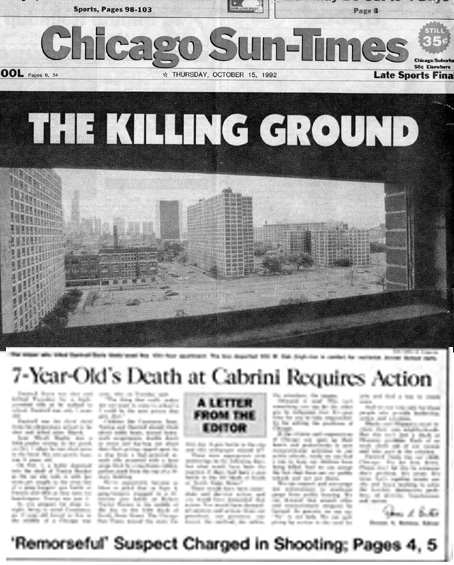
I and six other volunteers created Cabrini Connections (a site-based tutor/mentor program) and the Tutor/Mentor Connection in November 1992 following the shooting death of a 7-year old boy, in the Cabrini-Green area of Chicago.  I've used this front-page story from the October 1992 Chicago Sun-Times as a reminder and motivation every year since then.

In the summary above Desmond is quoted as saying "individual actions can build political will for larger changes"

This is not a new problem. However, it's a problem that our leaders can't stay focused on every day, because there are so many other problems.

That's why I think it's important for another level of leaders to emerge, who are totally focused on building a better community understanding, and response, to the problems and solutions.

I've been issuing this invitation for the past 25 years, since we formed Cabrini Connections, Tutor/Mentor Connection, in the weeks following the shooting of Dantrell Davis in Chicago back in October 1992. I keep the front page of this Chicago SunTimes story in my office, as a reminder of my responsibility.

I've developed my own actions steps, and posted them on this blog in the past. Here they are again:

If we want to stop this violence, we have to act now, and keep acting to solve this problem for many years. We have to think spatially, that is, look at the entire city and suburban problem, not just one neighborhood. At the same time, we need to act locally, because none of us has the time, or the resources to help each of the kids in the entire Chicago region who live in neighborhoods where poverty is the root cause of the violence.

This animation was done by one of my interns after reading this article.

Here are some ways to remind yourself. Think of ENOUGH, is ENOUGH

E – educate yourself – most of us do not live in high poverty neighborhoods, so we only understand the root causes of senseless shootings from what we read in newspapers. We also only read negative news in the media, so we’re not really well informed on where these events are taking place most frequently. Finally, while there is a perception that there are plenty of youth programs, we really don’t have a good understanding of the distribution of different types of youth programs, to different age groups, in different zip codes. The only way this will change is if each of us pledges to spend one hour a week reading books, articles and web reports, that illustrate the root causes of these shootings, or of poor performance in schools. Through our learning we can draw ideas that we use in our own actions. We can also begin to contribute information that other people use to support their own decision making.

To help with your learning about race, poverty and inequality in America browse the different sections of the Tutor/Mentor library, shown on this concept map


N – engage your network – find ways to draw others who you know into this shared understanding. Recognize people who volunteer time and talent, or who help kids through the programs they operate. If you are a business leader, or a church leader, engage your corporation or your congregation. You can use your web site, advertising, point of purchase materials, etc. to point to web sites that show all of the agencies in the city who do tutoring/mentoring, such as www.tutormentorexchange.net. If you do this weekly, year after year, your friends, coworkers and customers will become involved in solving this problem with you.

O – offer help, don’t wait to be asked. As you build your understanding of where poverty is most concentrated, and what social services are in those areas, choose a neighborhood, and reach out with offers of time, as a volunteer, talent, help build a web site, do the accounting, or offer Public relations services, and dollars, if the web site of an organization shows they do good work, you don’t need to ask for a proposal of how they would spend your donation, you need to send them a donation so they can keep doing that good work

U – build a shared understanding. Form groups of peers to share reading and learning assignments, just as you meet every Sunday to read passages of scripture and build the group’s understanding of the Word of God. Use the many different resources of the T/MC Links library as the starting point for your search for wisdom, and understanding.

G – give until it feels good – people who generously donate time and dollars to causes they believe in feel good about their giving. If we’re going to surround kids living in poverty dominated neighborhoods with extra learning and adult mentoring networks, donors will need to give more than random contributions of time, dollars and talent.  

H – form habits of learning, and pass these on to your kids. Imagine how much more successful teachers were if youth came to school every day asking questions about where to find information, or how to understand information they had researched on the Internet the previous day? We can model that habit if we build it into our own activity. Keep a chart where you can document actions you take each week to same sure that this time ENOUGH, really means ENOUGH.

If you document actions, you can review what you’ve done at the end of each month, and each year, and begin to see a growing mountain of actions you have taken to solve this problem. Some of these will be actions that got other people involved, so that the good work you do is multiplying because of the good work others are also doing.

Through this process you help build this shared understanding, which will lead to better public policy. Without this habit of learning, and without learning to use the Internet to find good ideas from people in all parts of the world, we won’t be able to problem solve as well as we need to, and we won’t be able to teach this habit to our kids.


Share this post and the links I point to. Start discussions in your own circles of influence. Be the  YOU in the graphic shown above.

If we do this, we’ll not only reduce the root causes of youth on youth violence, we’ll also address one of the growing issues facing America in a global economy. We will begin to create a nation of learners, problem solvers, creative thinkers and innovators, who use learning and information as the basis of creating opportunity and keeping America great.

Read Leadership ideas here and here

--- end May 2023 --- 

In the above article I talked about "creating new leaders".  In one of the research articles I include this graphic, visualizing a strategy led by universities, funded by mega donors, that creates, and provides on-going support, for such leaders. 


You can find this graphic in this article. You can find more articles showing a sophisticated, long-term strategy, that universities could apply.  They just need donors to provide the motivation. 

Thanks for reading and sharing this article.

Find me on BlueSky, Twitter, Instagram, Mastodon, LinkedIn and Facebook (see links here).

If you want to help support my efforts please visit this page and send a small contribution to help Fund the Tutor/Mentor Institute, LLC. 

Wednesday, May 07, 2025

What are your volunteers learning?

I saw this post on Twitter this morning, from the Prison Policy Institute, which I point to from my newsletters and my library.

You can follow their posts on Twitter, or on BlueSky, at this link. If you don't live in a high poverty area you probably have never given a lot of thought to how the prison-industrial complex harms people in vulnerable situations and contributes to the on-going problems of persistent poverty.   Follow posts by Prison Policy Institute and others to expand your own understanding. Share these links with your network to increase the number of people who understand the problem and are willing to provide time, talent, dollars and votes toward solutions. 

I started collecting newspaper clips and research articles in the 1970s to expand my own understanding of why a volunteer-based tutor/mentor program was needed and how to lead a constantly improving program.  

I was digitizing some files yesterday when I found this 1994 opinion article by Mark Freedman, who wrote the book Kindness of Strangers.  It's titled "To Help the Young, We Need More Than Mentors". 

Click on this link to view the article in my Google Drive file.

I've built my understanding of the challenges facing kids and families living in areas of concentrated, persistent poverty over the past 50 years.   And, I've been sharing the resources I was learning from with volunteers in the tutor/mentor programs I led, so they could also expand their understanding.  

Because, mentoring alone is usually not enough.  And, volunteers who become informed and empowered can do much to remove many of the barriers, while also helping the tutor/mentor programs they serve sustain and constantly improve their efforts. Which means doing more to help the youth they mentor.

I created this concept map as a guide to articles in the Tutor/Mentor library. Anyone can access this map and dig into the library. Many of the links I point to are extensive resources themselves. 

You can find a link to the Prison Policy Initiative on this page along with many other related resources.

And, I created this concept map to show how volunteers grow over multiple years of involvement in well-organized tutor, mentor and learning programs. It shows my own efforts, and hopefully inspires the design and activities of other programs, in Chicago, and around the country. 

In this "Steps to Start a Tutor/Mentor Program" visual essay I quote Marc Freedman's comments about the potential and the difficulties of mentoring and his suggestion that without infrastructure and support for mentors and mentoring programs, the movement will never reach its potential.

Much of my work since forming the Tutor/Mentor Connection in 1993 and the Tutor/Mentor Institute, LLC in 2011 has focused on helping programs get the on-going resources needed to provide that infrastructure.

I've used my website, print and e-mail newsletters and blogs to share this information and to try to motivate volunteers to spend time learning and building a greater depth of understanding of why tutor/mentor programs are needed, where they are needed, what types of programs are needed, based on who the mentee is, and what other issues need to be addressed.

The goal has been to build a greater public commitment to the actions that need to be taken, and sustained for many years, to solve the problems that Prison Policy Institute and others highlight in their own media.

View this set of articles to see how I've written about "building public will".   

I point to several hundred youth serving organizations in lists on the Tutor/Mentor Institute, LLC website.  I try to open every link, at least once a year, to make sure they work and to see what the program is doing to educate volunteers and donors.  Some point to research showing why their programs are needed. Very few point to my library, or show "educating volunteers" as part of their core strategies.  

That might change if donors looked for such information on a program's website.  

I actually created a visual essay a few years ago which I titled "Shopping Guide".  


This shows some, but probably not all, of the information you should find on an on-going youth tutor, mentor and learning program website.  Programs won't put this information on line unless donors, volunteers and parents are looking for it and unless they have staff and/or volunteers who can put the information on-line.  If you know of programs doing a good job sharing similar information, please share links with me.

Let's connect. You can find me on LinkedIn, BlueSky, Facebook, Instagram, Treads, and Twitter (still).  Find links on this page

Thanks for reading. If you value the information I'm sharing, and the resources on the Tutor/Mentor website, please visit this page and make a contribution. 

Friday, April 18, 2025

Innovating new funding solutions

I wish peace, good health and happiness to all who celebrate any religious holiday this weekend.  However, I'm not sure any GOD is going to help us unless we do more to help ourselves.  Thus....

A few days ago I shared an article titled, "Funders, here's the blueprint for saving democracy", written by Vu Le.   I wrote about it in this article

I've used the term "blueprint" in many articles, to show a range of actions that donors, leaders, policy-makers, etc. need to be taking to help make sure well-organized, long-term, volunteer-based tutor, mentor and learning programs are available in EVERY high poverty area of Chicago and other places with concentrations of persistent poverty.
I've been using this "Mentoring Kids to Careers" graphic, along with various versions, since late 1990s, to emphasize the same goals.

In the lower left corner is a map of Chicago, with high poverty areas shaded grey. These are the areas where mentor-rich programs are most needed BECAUSE of how they can expand social capital and aspirations and open doors to opportunity.  

What makes my work unique is that I don't just point to the research.  I maintain a list of Chicago volunteer-based tutor, mentor and learning programs and look for ways to draw volunteers AND donors DIRECTLY to each program, throughout the year.   My long-term goal has been that a program website serves as the "grant proposal" and donors use that, plus the information I share about long-term mentoring, and the need for such programs in high poverty areas, to make funding decisions.

In this article you can find my list of programs and see how I plot them on a map. This helps people find existing programs and hopefully is used by planners to determine where more are needed.

Below I've created another version, highlighting one stage on my career ladder.

Kids grow one year at a time. Support  needed for many years.

It's great to be able to provide a youth tutoring and/or mentoring activity that lasts for one, or two years, but it takes 12 years to move from first grade through high school and four to six more years beyond that to be starting a job and career. Expanding the "who you know" network is critically important for kids living in areas of segregated, concentrated poverty where "who they know" is not as extensive as it is for kids living in more affluent areas.

The challenge Chicago and other places face is building and sustaining k-12 support programs in every high poverty neighborhood.  I've written about this often since starting my blog.  

View in this article

I've been writing articles and sharing graphics like this for nearly 20 years, but as just one voice, I don't have enough impact to influence the massive changes that are needed in how such programs are organized, designed and supported.

Below is another graphic that I use to emphasize the need for continuous flows of flexible operating dollars to youth programs in every high poverty neighborhood.

View in this article

The benefit of long-term support of mentor-rich programs as a form of social capital was reinforced in this 2023 article which points to a report from MENTOR, titled "Opportunities to Invest in Long-Term Social Capital for Our Youth: A Philanthropic Agenda".    

View this group of articles and find more research that donors can use to support funding decisions.

Here's an article about philanthropy that I wrote about in 2018 after it was published by Open Impact. It's titled, "The New Normal: Capacity Building During a Time of Disruption"

I read the article and saw many ideas which I've been trying to implement via the Tutor/Mentor Connection/Institute, LLC since 1993. So I decided to put it on Hypothes.is and re-read it, highlighting relevant parts, and writing comments in the margin that show my own efforts.

In the paper's introduction the writers say "we hope this paper will spark and important conversation". I agree. 

In my comments I suggest that philanthropy would dramatically change if donors were shoppers and if non-profits and social change organizations would put enough information on their web sites for donors, volunteers and clients to make better choices of who they support, and in what ways.  I also emphasize the use of maps to support a better distribution of resources to all high poverty areas of the Chicago region and other places where help is most needed.

Read about Annotation
Thus, I invite you to read "The New Normal: Capacity Building During a Time of Disruption" with three purposes:

1) build a deeper understanding of what I've been trying to do, and to find reasons to support my efforts and help carry them into the future;

2) build a deeper understanding of the challenges facing all social benefit organizations, in the US and the world, and a commitment to draw others into this conversation; and

3) see how on-line annotation works and build a commitment to launch other articles and invite more readers and learners to join in.

I look forward to meeting you in the margins.

So far no one has joined me in reading the New Normal article.   Maybe that's because so few people actually see my articles.

I post on Facebook, Twitter, BlueSky, Mastodon and LinkedIN and occasionally on Instagram. I also have graphics on Pinterest.com.  If you do a Google search for "tutor mentor" my web sites will be on the first page (after paid advertising). Thus, if people are looking, they can find me.

If you're connected to any youth-serving programs in any way (student, alum, volunteer, board member, staff, donor) you can help them attract support by sharing what the organization is doing and making an effort to raise the organization's profile.

You can even write articles like mine.

Thanks for reading!  Enjoy your weekend.


Wednesday, April 09, 2025

Using Research in Planning, Problem-Solving


Last week A Better Chicago released a new report titled "State of Chicago Youth, 2025". I wrote about it in this article

I’ve been collecting similar information for over 30 years, showing where people need extra help, why, and what type of help could be offered to youth via organized, on-going, volunteer-based tutor/mentor programs.

And, I’ve been pointing to that research in articles on this blog. I’m sharing a few below. I hope you’ll open the links and take a look, then share the ideas through your own blogs, videos, etc.

Here’s an article where I use maps to show where people need extra help.


It’s one of dozens where I show the four-part, information-based problem-solving strategy that I’ve piloted since forming the Tutor/Mentor Connection in 1993, and Tutor/Mentor Institute, LLC in 2011. It’s one where I point to a section of my library with hundreds of links to articles and research about poverty, racism, inequality and social justice. And, it’s one where I encourage others to share this information in their network, so more people find it and use it.


When I formed the Tutor/Mentor Connection the goal was to help every existing tutor/mentor program in the Chicago region get the operating resources, volunteers and ideas each program needs to grow. Here’s one of many articles that focus on the challenges of finding on-going funding for mentor-based programs.

My leadership of a single volunteer-based tutor/mentor program from 1975 to 1992 and a second program starting in 1993, along with my career in retail advertising with the Montgomery Ward corporation, provided the foundation ideas for the Tutor/Mentor Connection.

These experiences led me to understand that organized volunteer-based programs were a way to connect kids in high poverty areas to people, experiences and opportunities that were not readily available in their own family/neighborhoods, due to extreme poverty. Over time, I began to understand this as a form of ‘bridging social capital’ and visualized it in graphics like the one shown below.


Here’s one of many articles where I write about mentoring as a form of social capital.

In my work at Montgomery Ward’s corporate headquarters, from 1973 to 1990, I learned how my department, and other functional teams, supported more than 400 retail stores spread in 40 states. We helped each store be good at attracting customers, selling merchandise and earning a profit. (at least we tried)

Thus, when we formed the Tutor/Mentor Connection plan in 1993 our initial strategy was to learn what programs existed in Chicago, then to build a public awareness strategy that would attract more attention, volunteers and donors to each program, and to every high poverty neighborhood.


This article shows how we began publishing a Directory of programs in 1994 and how this information was used to support programs.

In this article I describe an on-going information-based planning process, that uses information like I’ve been collecting.

This could be led from institutions who have deep roots in geographic areas, like hospitals, universities, businesses, etc.

To do this research, someone needs to host a library like mine, with lists and directories of youth serving programs, then use that information in an on-going planning, program development and public education and resource generation strategy.

This is a missing step in most of the research I’ve seen for over 25 years. Researchers get the money to do the research and produce a report, with a big event that shares it with the public, but then don't have the money to continue to share that research and draw people together to use it over the following years.  What I do is aggregate links to that research and try to motivate people to use it to support youth tutor/mentor and learning programs in every high poverty area of cities like Chicago.

Over the past 30 years I've piloted actions that I share on my website and that anyone can borrow and apply in their own geographic area.

While I do find a few who host lists of youth serving programs, and even plot the list on interactive maps, I don’t find any with multi-year public awareness efforts aimed at drawing volunteers and donors to every youth-serving program within their city.  If you know of any who do this, please share the link and I'll add them to my library.

Furthermore, I don’t find any doing the deeper research asking “what youth programs exist in your area”.

Doing such research and maintaining a list of programs is a big job, especially in cities as large as Chicago. That’s why, for many years, I’ve tried to motivate universities to build a Tutor/Mentor Connection-based strategy on their campus. This is one of several articles where I share this invitation. 


Here’s an article where I show 30 years of effort to build strategic alliances with universities. You can see a wide range of interactions with many universities, but no long-term initiative led by, and funded by, any university.

Why wasn’t I successful?
Money. Reputation. Clout.

I never had much of any of these so when I met with someone at a university, I’d receive polite nods, with a “I’m already over extended. Find a younger professor.”

 The answer: ultra wealthy donors


Here's one of several articles where I show the potential of strategic investment by one or more wealthy donors.  Here's another

How might we find such donors? 


They are all around us. Do you watch NFL football games? How often do you hear players praised for their philanthropic work? I posted this on Twitter in 2024 sharing the idea from this post.

What if a university aggregated this information and then used it to recruit a group of athletes who support the same cause, to support a Tutor/Mentor Connection strategy at the university that was building the database of athlete involvement?

What if? What if? What if?

What if you share this article in your networks? Maybe someone will read it and adopt the idea and actually take the next steps.

That’s why I write these articles.

If you're connected to a university, or looking to put your name on a building at your alma mater, I hope you'll make this your mission.


Thanks for reading.
  There's a lot here, so bookmark the page and return often.  Then, look me up on LinkedIn, BlueSky, Instagram, Facebook, Twitter, etc. and let's connect.  If you're writing similar articles, which I hope you will, please share them.

Finally, if you're able, please visit this page and make a contribution to help fund my work.