Showing posts with label volunteer. Show all posts

Sunday, October 12, 2025

Seek and Support

I began my tutor/mentor journey in September 1973 when I was matched with a 4th grade boy from the Cabrini-Green Public Housing Projects.  His name is Leo.

We're still connected. He's in Nashville. Married. Two sons. Both college graduates.  

My experiences as a volunteer leader of a tutor/mentor programs between 1975 and 2011 fuel my commitment to help similar programs throughout the Chicago region, and in other cities and states, get the attention and resources each need to support the on-going interactions of youth and volunteers.

In many articles on this blog I've pointed to social media posts by Chicago area tutor, mentor and learning programs, like Chicago Youth Programs, Inc.  

In many articles I point to lists on the www.tutormentorexchange.net website that enable people to shop and choose what program to support, based on what the program shows on their website, where they are located, and who they serve.

I also host lists showing Chicago program accounts on LinkedIn, Twitter, Facebook and Instagram.  If you follow these programs you'll see what they post and that will help you choose who to support and how you'll support them.

These lists include Tutoring Chicago, which is celebrating its 60th year this fall.  I led that program from 1975-1992, first while it was volunteer-led (up till 1990), then as it became a nonprofit (1990-1992).   

They aren't the only long-term program in Chicago.  Chicago Lights, Midtown Education, Chicago Youth Programs, Inc. and several others have long histories of service.  Look for that type of information on program websites.  Look for endorsements by alumni, parents and volunteers on websites, and social media.

My experiences in leading a single program over many years is what led me to form the Tutor/Mentor Connection in 1993 as we were launching a new program to help teens in the Cabrini Green area have continued support as the move through high school.  

The graphic below shows that we served one neighborhood with our single program, but supported programs through the entire region, through the Tutor/Mentor Connection.

I still lead that, through the Tutor/Mentor Institute, LLC, although I have had limited resources to do this since 2011.  

Unfortunately, the Cabrini Connections program that I and six other volunteers created in late 1992 and that I led until mid 2011, was not able to continue to survive the constant challenge of finding resources, and ceased to operate around 2022.  Yet, that program still exists via the connections I've made with former students and volunteers on Facebook, and how they are connected to each other.  

I was able to lead the program at Montgomery Ward for so many years partially because of how I reached out and networked with leaders of other similar programs.  I was also able to draw upon the work I did in retail advertising at Montgomery Ward's corporate headquarters in Chicago, where we created weekly ads do draw potential customers to more than 400 stores in 40 states.

Then, between 1990 and 1993 I also spent time as a Loaned Executive for the United Way Crusade of Mercy, which supported several hundred nonprofit organizations spread throughout the Chicago region.

From my own experiences and what I learned from other programs I realized that "all program have the same needs" but not every program is equally able to attract a constant flow of volunteers and donors.


That's why we created the Tutor/Mentor Connection in 1993.  Our aim was to build a master list of every volunteer-based tutor/mentor program in the region, then create on-going events that attracted media attention and drew more support to every program on our list.

I'm still doing that today, but with far fewer resources and in a much more difficult media environment.  It's more important than ever that more people take a role of drawing people to my library, then directly to youth serving programs in high poverty areas throughout the region.


That's why I urge each reader to become the YOU in this graphic. Bring your network to information that shows where and why people in high poverty areas need extra help, and how volunteer-based tutor/mentor programs can provide an important part of that help, while also increasing the number of people who become advocates and reach into their own networks to find additional help.


I encourage you to create your own versions of my graphics and blog articles, or record them and share them via different media.  If you're in another city, create your own version of the Tutor/Mentor Connection. If you're in Chicago reach out to talk to me about adopting the T/MC and rebuilding it, so it continues to provide help to kids and families in this region.

Thanks for reading.  Please connect with me on social media (see links here).  If you're able, help me with a contribution that funds the Tutor/Mentor Institute, LLC.  

Tuesday, August 26, 2025

Learn about Tutor, Mentor and Learning Programs

Since 1993, when myself and a team of supporters, formed the Tutor/Mentor Connection, the goal has been to increase visibility for existing volunteer-based tutor, mentor and learning programs in the Chicago region, so more volunteers, donors, media, parents, etc. will find and support them.

Below are posts found today on LinkedIn

Chicago Youth Programs, Inc. - website

Lawyers Lend-A-Hand to Youth - website


Tutoring Chicago - celebrating 60 years - website


These are just three of more than 100 volunteer-based tutor, mentor and learning programs operating in Chicago, which you can find on lists hosted on this page.  

Visit the www.tutormentorexchange.net and in the HOT LINKS section on the left side of the home page you can see that I hosts lists of Chicago area programs with accounts on LinkedIn, Twitter, Instagram and Facebook.  I follow these programs on each platform, so in my feed I see what they are sharing. 

I encourage others to do the same.

Then write posts, or create videos, and share information about these organizations, to help increase visibility and support.  With so much public and social media focused on political issues and other man-made and natural disasters, these programs need more help than ever to find supporters.

I ask for your help in keeping these lists up-to-date. If you find broken links, programs no longer operating, or know of new programs that I should ask, share that information with me. You can find me on each of these platforms.  See links here.

These programs don't pay me to do what I do to help them (never have).  From 1993-2011 I operated as a 501-c-3 non-profit and asked donors to provide the money needed to build and share my lists, and to operate the single tutor/mentor program I led since founding it in late 1992. 

After going on the Internet in the late 1990s my lists have expanded to also point to other types of volunteer-based youth serving organizations in Chicago and to many others operating in other cities.  In my blog I constantly encourage others to build lists like mine to support all of the youth-serving programs within their own geographic area (urban, suburban, rural or reservation). 

Furthermore, the lists of programs is just one type of information I share.  

Below are two concept maps that show the progression of thinking I've gone through over the past 52 years, from when I first became a volunteer tutor/mentor working with one youth, to now, when I'm trying to help mentor-rich programs grow in all high poverty areas of the USA, and help those programs empower volunteers to take greater roles in reducing the inequality that persists in this country.

View the top cMap at this link.


This second graphic (click to enlarge) includes the concept map above, but shows  how we "start with one problem, but as we try to solve it, we're led to other questions and bigger problems".


I think there should be someone in every city and state with a library of visualizations that focus on the same issues and problems as mine.  That's because areas of persistent poverty are spread across the country.  If you know of such collections, please post a link in the comment section, or share it with me on social media.

Since July 2011 I've operated as Tutor/Mentor Institute, LLC and have depended on a small group of donors to help pay the bills.  You can help if you visit this page

Saturday, September 16, 2023

Recruiting Volunteers Continues

We launched the Tutor/Mentor Connection in Chicago with a program survey in January 1994.  Using this we created our first list of tutor/mentor programs, hosted a first Tutor/Mentor Leadership and Networking Conference in May 1994 and published our first printed Directory, also in May 1994.

In August/September 1995 we used our list and Directory to organize a Chicagoland Tutor/Mentor Volunteer Recruitment Campaign, intending to draw volunteers to all of the programs in our lists.  Below is a T/MC Report newsletter from 1996, reporting on that year's recruitment campaign. 


I'm still trying to help Chicago area youth tutor, mentor and learning programs attract volunteers and I invite others to help me.  Below are a few programs who are sharing their stories on social media.

This is Tutoring Chicago on Instagram. Visit their website


This is Polished Pebbles on Twitter. Visit their website.


This is Chicago Youth Programs on Instagram. Visit their website


This is Link Unlimited on Facebook. Visit their website.


This is Big Brothers Big Sisters of America on Twitter. Visit the BBBS Chicago website


This is Mercy Home on Twitter. Visit their website.


These are not the only youth programs sharing their stories on social media. Some of the programs shown above post on multiple platforms.  Too many programs don't post much on social media at all. 

I've created lists showing programs on Twitter, Facebook and Instagram.  You can browse these lists, and follow any of the programs that interest you (or follow all of them).  I don't yet have a list for programs posting information on LinkedIn, but many do. So far I've not found any programs using Mastodon. 

Below is my map showing volunteer-based tutor, mentor and learning programs in the Chicago area.


Find the map and my complete list of programs on this page.  All you need to do is visit some of the websites, then create a JPG image from a page on one or two sites, then post that with a website link on any of your social media sites.

As more people take that role we'll all be helping K-12 kids in Chicago and other cities get the extra help they need to succeed in school and move on to adult live, jobs and careers.

Please help me keep my lists updated. If you find broken links, or know of programs that are no longer operating, or that should be on my lists, send the information to me.  

Please connect with me on any of the social media platforms that I point to at this link.

And, if you can help with a contribution to Fund the Tutor/Mentor Institute, LLC, please visit this page


Thursday, August 17, 2023

Think globally. Act locally.

One of the blogs I've followed since the late 2000s is written by Dave Pollard and is titled "How to save the world".   That's a pretty big idea.

I include Dave's blog on my Inoreader page and looked at a recent article last week.  Below is a screenshot of the top of the article which you can read at this link.


There's good advice in this list and in Dave's article.  He quotes from another blog, titled "So where do we go from here?" which you can find in this link
 
Below is one of the paragraphs from that blog that Dave included in his article.


He recommends acting locally, building a community focused on local problems, since the big  problems are not likely to be solved by our current orchestra of political leaders.  

So what does this have to do with volunteer-based tutor, mentor and learning programs? Everything.

The graphic below shows that while we launched the Tutor/Mentor Connection in 1993 to help volunteer-based tutor/mentor programs grow in all high poverty areas of Chicago, we were also launching a new program in the Cabrini-Green area to help 7th and 8th grade teens move through high school and into adult lives.  


Our actions to help ALL programs were intended to help our SINGLE program, too.  

When I became the volunteer leader in 1975 of a tutor/mentor program that already had 100 pairs of kids/volunteers, I held a full time retail advertising job with the Montgomery Ward corporation. As the tutor/mentor program grew to 300 pairs of kids and volunteers from 1975 to 1990, so did my job responsibilities. I had to find a way to enlist volunteers as leaders who would help other volunteers succeed in the program.

I enlisted other volunteers to help me organize and lead the program. This shows the tutoring program committee in 1976-77.  By 1990 it had grown to include 3 or 4 times as many volunteers, coming from companies throughout the Chicago region. 


And, I started building a library, sharing resources I was using to build my own weekly tutoring activities, and what I was learning from other tutor/mentor programs in Chicago, with the volunteers enrolled in my own program. I shared this information and pointed to 'recommended reading' via my weekly newsletters and encouraged networking events to help volunteers connect with each other.

I expanded this strategy to reach programs throughout Chicago when we formed the Tutor/Mentor Connection in 1993.

The strategy of the Tutor/Mentor Connection aimed to build visibility for all tutor/mentor programs in Chicago, including our own, to help each program attract and keep volunteers and donors.


This strategy was to PUSH resources directly to individual tutor/mentor programs, and to make them available to individual volunteers. They are the smallest unit of community change, via their one-on-one connection to kids.

We organized networking conferences and a public relations campaign to draw programs together and draw attention to the resources in our library. 

I created this graphic a few years ago to visualize what I'm saying. Each volunteer- based tutor/mentor program is a small ecosystem, built around the connection of a single volunteer, or group of volunteers, with a single youth, or group of youths. 


The volunteers who serve on Boards of Directors, and the volunteers who work directly with kids, have a range of talent that can help programs do more to help kids, if that talent is mobilized.

As I shared information via print newsletters in the 1970s and 1980s, then email in the 1990s and websites, blogs and social media since then, I used the weekly tutor/mentor sessions to connect in one-on-one conversations with our volunteers.


We organized after tutoring social activities for volunteers and field trips that connected youth and volunteers with each other, all to help build bonds and relationships and encourage people to dig deeper into information they could use to be a more effective volunteer, or to help the tutor/mentor program grow.

Over the past decade I've expanded the library of articles that show some of the "global" issues that need to be solved, which Dave's article offers pessimism that they "can be solved". 

While these are global issues, they are also issues many of the kids in our tutor/mentor programs are facing.  Educating volunteers and mobilizing their talent can lead to local actions that help kids, and linking programs can lead to a growing army of volunteers working to solve these problems at a larger level.

Thus, everyone who reads Dave Pollard's "How to save the world" article could be using their personal time, talent and treasure to help a single youth, or a group of kids who are part of an organized program. This is "acting locally" and can fill the map with many icons representing constantly improving tutor/mentor programs led by teams of talented, motivated volunteers and staff.

This begins with making sure well-organized tutor/mentor programs are reaching K-12 youth in more places.  I encourage you to visit this section on the Tutor/Mentor Institute, LLC website. 


It includes PDF essays that share my own experiences and strategies that others can use to start and sustain on-going, constantly improving volunteer-based tutor, mentor and learning programs.

It's just a small part of the resource library that I've been building over the past 30 years.


Thanks for reading.  Please share this article and these resources with your network.

And, connect with me on social media. I'm on Twitter, Facebook, Instagram, LinkedIn and more. Find links on this page

Finally, if you're able to make a contribution to support my work, visit this page


Friday, August 04, 2023

Be a Volunteer in Area Tutor/Mentor Program

School starts soon so volunteer-based youth tutor, mentor and learning programs are ramping up their volunteer recruitment efforts.

You can help them. 

Below is a PDF essay sharing tips for volunteer recruitment. This was created more than 10 years ago.

Strategies for recruiting v... by Daniel F. Bassill


While this focuses on helping individual programs recruit volunteers, my efforts have aimed to motivate businesses, professional groups, sports teams and others to use their media to mobilize volunteers, and donors, to support youth tutor/mentor and learning programs in every high poverty area of Chicago and other cities. Below is a PDF essay I title "Virtual Corporate Office".
   

Virtual Corporate Office: S... by Daniel F. Bassill


I worked at the Chicago headquarters office of the Montgomery Ward corporation from 1973 to 1990 and learned how functional teams, including retail advertising, worked to help all 400 of our stores be the best they could be at serving customers and attracting them with creative advertising and sales promotion.

Imagine if the talent of big and small businesses, universities, faith groups, sports and entertainment, professions, etc. were all working to fill high poverty areas of Chicago and other places with mentor-rich school and non-school programs that expand the network of adults and learning opportunities, helping more kids move safely through school into adult lives.


Please read and  share these with your network. Build the support systems I describe.  

Connect with me on Twitter, Facebook, LinkedIn, Instagram and Mastodon (see links here).

If you're able to help, make a small contribution to support my work and Fund the Tutor/Mentor Institute, LLC. 

Thank you for reading. 

Friday, February 11, 2022

Connecting seniors with K-12 youth - program design

Today I read an article from the Churchill Fellows blog about "harnessing the assets of the older people in our communities, including those living in long-term care and those living with dementia, and supporting them to build deep relationships with children and young people who are experiencing poverty and disadvantage."

This article outlines strategies for doing this,  including "overcoming silos to make the most out of resources".

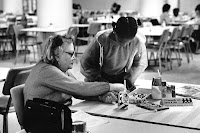
This is something I've thought about for a long time. Senior citizens have been volunteers in tutor/mentor programs I led in Chicago between 1975 and 2011, but there's never been a strategy that would connect seniors systematically in youth tutor/mentor programs throughout Chicago.

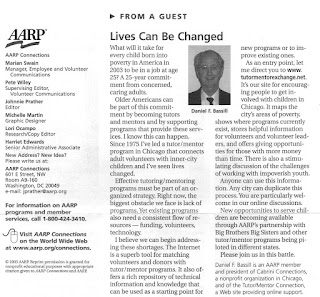
Below is a guest article I wrote for the AARP magazine in 2002.


I've followed the Churchill Fellows program for more than 20 years and hosted three different fellows between 1998 and 2006.  One was Clair Kime, who wrote this article summarizing her visit with myself and other tutor/mentor leaders in Chicago, Boston and New York in 2005.

AARP does encourage senior citizens to volunteer with youth, through programs like Experience Corps. However, I don't see a map-based strategy that connects seniors with youth the way the Churchill Fellows article envisions.  

When I say "map based" I mean leaders in different sectors should be innovating ways to make mentor-rich non-school tutor and/or mentor programs available in every high poverty area, for  many years.  

Such programs need a mix of volunteers working directly with youth, and working with program leaders to operate the program, raise needed funds, and build constant improvement.  Seniors have many work-backgrounds and a range of talents and could not only support individual programs, but lead city-wide efforts.

As you're doing your planning, take a look at the Churchill Fellowship article and think of ways you can involve seniors in many of the ways they describe. 

I'm on Twitter, LinkedIn, Facebook and Instagram. Let's connect and talk about these ideas. Find links here.


Tuesday, August 17, 2021

Share News of Youth Tutor/Mentor Programs

We're surrounded by news of disasters. forest fires, hurricanes, earthquakes, Covid19, Afghanistan, floods, political chaos, you name it. Within this tsunami of negative news, how do we keep attention flowing to youth tutor and/or mentor programs throughout Chicago and other cities?

In September 2005 I wrote an article titled "Disaster Challenges all of Us".  In that article I wrote, 

"We created the Tutor/Mentor Connection in 1993 because we recognized the problem charities have of consistently attracting donors. While a few programs are great at getting funds, not every program is as good, thus there is a poor distribution of good programs in all places where they are needed."

Step 2 of our four-part strategy focused on building public awareness and drawing volunteers and donors directly to various youth tutor and/or mentor programs in the Chicago region.  

Getting media attention for youth tutor/mentor programs in a world where the latest negative news can put your story on the back page, or out of the news all-together, is a problem I've dealt with for many years.

At the right is a photo from the 1999 Chicagoland Tutor/Mentor Volunteer Recruitment Campaign kick-off press conference, held at the James Thompson Center in Chicago. We had media from every major news station. Yet, our story did not make it into the news because on the same day the Mayor was attending an event hosted by a major corporation. On a different year, it was news about President Bill Clinton that knocked our event out of the electronic news.

If we'd had the Internet then we could have off-set this by creating and sharing our own stories. 

I wrote about this in an August 2013 article. I'm sharing part of that below, with updates. 

 
On Wednesday, August 14, 2013 I attended the Why News Matters Summit in Chicago where a variety of speakers talked about "news literacy" and ways to make news literacy education available to youth and adults in more places.

As I registered for the summit I was congratulated by several people for my "letter to the editor" which had been posted in the August 12 issue of Crain's Chicago Business. A couple of people said "I passed this on in my network."

As I listened to the Why News Matters speakers I made notes to myself about how news literacy, and other forms of learning, might be made available to youth in Chicago neighborhoods via non-school, volunteer-based tutor/mentor programs. Last week I used this graphic in an article, to illustrate how volunteers from different work backgrounds could help build learning activities in different programs that would help build youth aspirations and skills for careers not modeled consistently by family or community in high poverty neighborhoods.

When I write about "business teams" my vision is that teams from media, arts, video, banking, engineering, etc. might work as a "virtual corporate office", with goals of identifying existing examples where youth already are exposed to different types of learning, such as the WhyNewsMatters program at Erie House, then recruit and support volunteers from their industry who would help embed these types of learning activities in other programs throughout the Chicago region (or in other cities).

I've already created a section of my web library with links to Chicago tutor/mentor programs, and with links to organizations that include health, STEM or arts as part of their activities. Existing programs can learn from what other programs are already doing. They can bring these ideas into their own programs if volunteers and business partners will help make that happen.

I hosted a Tutor/Mentor Leadership and Networking Conference in Chicago every six months from May 1994 to May 2015.  Its goal was to share ideas that work in some programs so that they can be duplicated in other programs, reaching more kids throughout the Chicago region. 

Its goal was also to find people who are looking at this from a much larger scale than a single program, or a single youth and volunteer. If you're WalMart, or any other big corporation, your "big question" is how to put profitable stores in thousands of locations. Through the conferences, social media, and constant network building, I'm trying to connect with people who are engaged in this kind of thinking.

How do we make mentor-rich programs available to K-16 youth in all place where they are needed? This can only become a reality if businesses, and business volunteers, help make that happen.

How do we get attention for this message within the ocean of other news?  

Anyone reading this can share it on social media, in their own newsletters, or in one-on-one conversations with others.  If those people do the same we create a chain reaction that reaches people throughout the world.

 I created this graphic more than 10 years ago to visualize how an idea shared by one person, and shared by a few followers, can reach throughout the world. 

This Tutor/Mentor blog provides 15 years of templates that others could use to create their own articles, focused on helping youth in different cities, or in different parts of the Chicago region.  If others were writing such stories, and linking to each other, and amplifying each other's articles, more would be seeing these.  

I did this a few days ago, reTweeting a Mentoring New York post with a link to their blog. 
You can do this, too.  

If you're writing a blog share it on Twitter, LinkedIn, Instagram and/or Facebook.  If I see it, I'll try to amplify it to my own network. 

Thanks for reading.  All of the issues the media point to are important and need attention.  However, kids need constant attention too.  Without millions of dollars for advertising we need to be creative and consistent in telling our stories. 

Tuesday, July 20, 2021

Multiple Site Tutor and/or Mentor Programs in Chicago Metro

 Since 1993 the Tutor/Mentor Connection and Tutor/Mentor Institute, LLC have attempted to maintain a comprehensive directory showing every non-school, volunteer-based tutor and/or mentor program in the Chicago region.  That list now includes many school based programs, too.  These are all shown on the map below, which you can find at this link.  

If you know programs that should be added to the map, or programs that no longer offer tutor/mentor services, please help me update the database.  Email updated information to tutormentor2@earthlink.net.  

What this map does not show very well are organizations who operate multiple locations throughout the city.  In some cases, such as Tutoring Chicago, we show all four of their locations. In other cases, such as Big Brothers Big Sisters of Metropolitan Chicago, we only show their headquarters (and website) on our list.  Visit this page to see the T/MI's  list of multiple site programs in the Chicago region. 
Below I show maps and web pages for four of the largest organizations who offer multiple sites of youth tutoring and/or mentoring.
Big Brothers Big Sisters of Metropolitan Chicago (https://bbbschgo.org/programs/)

Boys and Girls Clubs of Chicago (https://bcgcc.org/clubs


Union League Boys and Girls Clubs (https://ulbgc.org/our-clubs/)

Chicago Youth Centers (https://www.chicagoyouthcenters.org/)


Help draw attention, volunteers and donors to these programs, and to the many other tutor and/or mentor programs that serve youth in different parts of the Chicago region.   Use your social media and traditional communications to point to individual programs, or to articles like this where I point to programs throughout Chicago. If you're in another city someone should be duplicating what I've been trying to do in Chicago. 


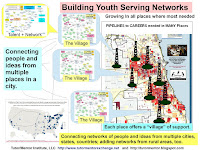
This graphic shows the public awareness strategy I've led since forming the Tutor/Mentor Connection in 1993.  Every day, or every year since then we've tried to connect "people who can help" to our list of programs and library of information, then directly to individual programs operating in different parts of the Chicago region.

In this concept map you can find the T/MI list of Chicago programs, organized by sections of the city, multiple-site and school-based. You can also find other resources that might help you located youth serving programs in Chicago, or any other city.


While most of these programs are recruiting volunteers and donors throughout the year, many work on a school-based schedule, so in August as schools are starting these programs are actively recruiting volunteers and students.

Visit their web sites. See where they are located. Look at what they do. (some websites are much better at communicating this than others). Find the "contact us" button and reach out to programs that interest you, to learn more, and to get involved.

If you're a foundation, philanthropist, or individual donor, look at maps that use indicators like poverty, poorly performing schools, violence, etc. to show where programs are most needed, then choose a neighborhood you want to help.  This concept map shows many platforms that you can  use. 


Then, use the T/MI map (or similar) to locate programs in that area. Visit their websites to see what these programs are trying to do and decide who, and how much, you want to help. Then send your contribution. 

DON'T WAIT FOR THEM TO SEND YOU A PROPOSAL.  If they have a program, and a website, they do need help from you, and many others, on an on-going basis.  They can't wait six to nine months to decide if you will, or will not help them.  Their website IS their proposal. 


When you look at websites you may feel that the program you're looking at is not as good as programs operating in different parts of the city. However, if that program is in the area you want to help, then use your talent to help them grow to become great at what they do.  If you're someone with communications, marketing, web design or other skills, you and your company could act like a "virtual corporate office" helping multiple youth tutor and/or mentor programs throughout the city.

Thanks for reading this and past articles. Almost everything I've posted since 2005  has this goal in mind.  It "takes a village" to raise a child and that means people from throughout the Chicago region need to help non-school youth tutor, mentor and learning programs be available to k-12 kids with high quality learning opportunities and adult support systems.

I'm on Twitter, Instagram, Facebook, Pinterest and LinkedIn. See web addresses here. I hope you'll connect with me and share these ideas.