Yesterday I wrote an article pointing out how the Polk Bros retail stores used advertising to build attention and draw customers to their stores, and how they used events, sales promotions, give-aways, etc. to motivate customers to buy something when they came to those stores.
I also told of my participation in a DEEPER LEARNING MOOC, #dlmooc, connecting more than 1000 people. Last January I participated in an Education Technology and Media MOOC (#ETMOOC) and this week participants like Paul Signorelli, have written reflections showing all the benefits of participating.
I created the Tutor/Mentor Connection in 1993 with a goal of helping constantly improving, volunteer-based tutor/mentor programs reach youth in more places. In this 4-part strategy map, you can see that step two of the strategy is to increase the frequency of media stories that would lead to greater volunteer and donor support of growing tutor/mentor programs.
One strategy to achieve this goal was to create map-stories following negative news stories in local medial.
These are a few examples of map-stories created in the 1990s. If you browse through articles on this site tagged 'media', 'maps' or 'violence' you will see many more examples, created in the 2000s. Visit the Mapping For Justice blog and you'll see many more examples of maps used to draw attention and resources to areas with high crime and violence, high concentrations of poorly performing schools, and high violence.
The result of this campaign should be maps that show more programs in more places, along with charts showing programs like the Lawyers Lend A Hand to Youth growing in more industries, and growing the amount of money and volunteer involvement from their industry on a year-to-year basis.
However, that has not happened. Why?
I can not find evidence that any leader, from any industry in the Chicago region, has devoted consistent advertising resources to draw attention to tutoring/mentoring, and to draw volunteers and operating dollars to programs throughout the city, or to programs near places where they do business, or where employees or customers live.
I can not find evidence that the current, or former mayor of Chicago, or any alderman, state elected official or county president, has led a weekly, yearly campaign, intended to draw needed volunteers, dollars and technology resources to the tutor/mentor programs operating in various Chicago neighborhoods. Even the occasional public declarations of support for Chicago's kids don't work like a Polk Bros ad to draw attention to tutor/mentor programs all over the city, and to motivate people to volunteer time, or give operating dollars, to support existing programs, or to help new programs start in neighborhoods with great need, but too few programs.
This Village Map shows that people from many sectors need to be involved in helping kids grow up and be prepared for 21st century jobs. If leaders post on their web sites what they do to build successful tutor/mentor programs, using maps to show where they are helping, and charts to show how many volunteers, dollars are involved, and how that grows from year to year, we could put links on the village maps to their web sites.
When we show leaders in every sector, leading a Polk Bros type advertising campaign, over a 10 to 30 year period, we will begin to see the number of mentor-rich programs grow in more places, and we'll begin to see more stories of how young people were helped through school and into a job by a mentor and/or a business.
Until that happens we'll continue to have media stories showing tragedy and high profile people, but not ending with a "call to action" that points to places throughout the city where help is needed and where people can get involved.
What's needed to support this data collection, map making, etc.? How can youth take a meaningful role? Let's meet to talk about this.
Showing posts with label advertising support. Show all posts
Thursday, January 23, 2014
Tuesday, January 21, 2014
Lessons from Polk Bros – Power of Advertising!
On January 8 I attended the Polk Bros Foundation’s 25th Anniversary. I wrote about that in this article.
While leaving the event I was given a copy of a book titled “I Bought It at Polk Bros: The Story of an American Retailing Phenomenon”. It’s available on Amazon. Free copies might be available from the Polk Bros Foundation.
This is the story of the growth of a Chicago retail giant, starting with a very, very small appliance store, in the 1930s. It’s the story of an immigrant family, and the vision of one man, Sol Polk, the company’s founder and president until he died in the 1980s.
This story resonated with me because from 1973 to 1990 I held retail advertising management positions with the Montgomery Ward Corporation, a competitor of Polk Bros in the Chicago market. Being part of the advertising department, I and the writers, artists and production people who worked with me, were constantly frustrated by how the merchandise people would change ads often, and frequently at the last minute.
In reading about Sol Polk’s commitment to advertising, and how he watched competitor ads and made last minute changes to TV and Radio scripts and print ads so Polk Bros could have a lower price, I recognized what was happening in my own company, and how savagely each business competed for customers every day.(This is the front cover of one supplement I created for the Automotive Department at Wards)
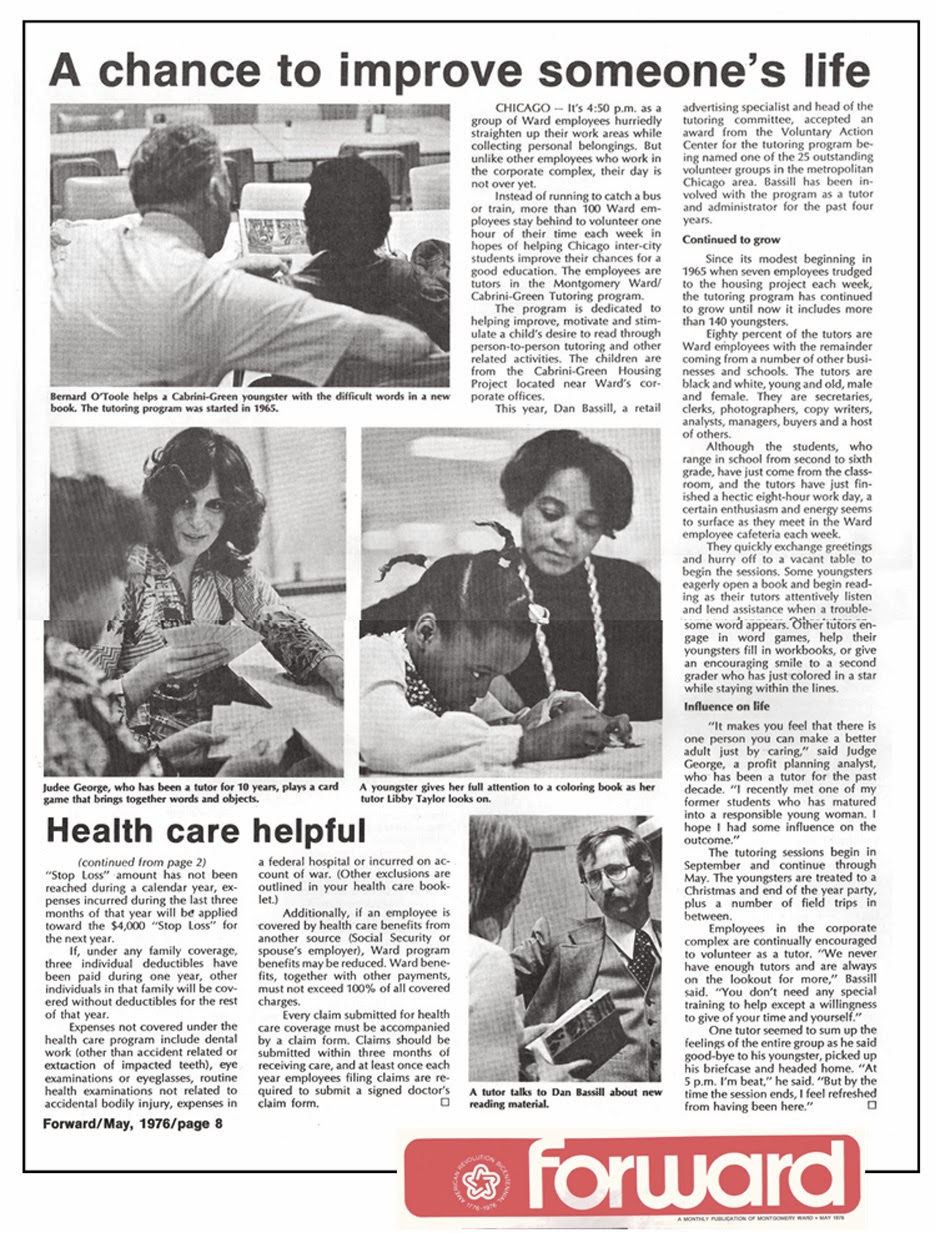
So what does this have to do with volunteer-based tutoring/mentoring? I led the tutoring program at the Montgomery Ward headquarters in Chicago from 1975 to 1990, as a volunteer while holding advertising roles with growing responsibility. By the early 1980s I was in charge of creative development of all national print advertising.
Thus, leading a volunteer program with 200-300 pairs of kids/volunteer meeting weekly, and virtually no paid staff, was a real challenge.
I learned very early that there was no way to provide enough training to volunteers to solve every problem they would face as a tutor/mentor. All kids were different. All volunteers were different. They all were constantly changing.
Thus, I began to borrow from my advertising experiences to share ideas and motivate actions within my volunteer world. Every week I created a one or two page “newsletter” which included tips for tutors, announcements of weekly activities, and an encouragement to dig deeper into our resource library to understand why the tutor/mentor program was needed, and ways volunteers could support the overall program’s growth.
Initially my “mass communications” was a mimeograph machine to make copies, and my own two feet to pass out these copies each week to our volunteers. The format for making copies changed as we moved to desk top publishing and copy machines in the 1980s and 1990s, but what really changed was the Internet becoming a place where we could host ideas that any of our teens, volunteers and donors could find them. By 2002 I was sending a weekly email newsletter to our volunteers, and a monthly email newsletter to all of our supporters.
While this works within a single program, if you have the time to create a newsletter, and to research ideas that you would put into it, not every program has people who can do the design, writing, formatting, publishing and distribution of electronic communications.
What’s more significant, motivating people to read the communications weekly and dig deeper into the research, and to form small groups to discuss the ideas with peers and other volunteers, is a challenge that still has not been solved.
Busy volunteers, staff members, directors, donors, etc. have many other priorities in their lives beyond their involvement in the tutor/mentor program. Even people paid to do the job spend so much time with day-to-day challenges of supporting youth and volunteers and keeping funds coming in, that there is very little “flexible time” to spend reading and “learning”.
I’ve written about MOOCs in the past year and this week I’m participating in a Deeper Learning MOOC, that engages more than 1000 people from around the country around the topic of “Deeper Learning”, which according to the William & Flora Hewlett Foundation, is…..“students engaged in deeper learning—are using their knowledge and skills in a way that prepares them for real life.
They are mastering core academic content, like reading, writing, math, and science, while learning how to think critically, collaborate, communicate effectively, direct their own learning, and believe in themselves (known as an “academic mindset”.”
Over the past week I’ve read several hundred introductions, mostly from educators. What concerns me, is that too few of these are people working in big city school districts, such as Chicago, Detroit, New York, Houston, LA, etc. If leaders and thinkers from these cities are not engaged in “deeper learning” how can we expect to bring higher quality learning experiences to inner city youth.
I’ve also seen very few participants in my MOOCs from people who lead non school tutoring and/or mentoring programs. If representatives from programs, and from those who support these programs, are not engaged in “deeper learning” how can they find ways to constantly improve the impact of their programs, or the flow of operating resources and talent that are essential to program improvement?
Sol Polk understood the power of advertising. He also recognized that he could get other people to pay for a large part of the costs of his advertising. The people who manufactured the merchandise sold in Polk Bros stores provided dollars for advertising costs. There’s an entire chapter on this in the book.
In his TED talk, Dan Pallotta talks about the power of advertising, and shows how donors are not willing to pay the costs for non profits to advertise. Read more here.
When I started Tutor/Mentor Connection in 1993, one of the key goals was to increase the frequency of news stories talking about tutoring/mentoring programs in Chicago. That’s still a goal.
Tutor/Mentor Connection and Tutor/Mentor Institute, LLC will never have millions of dollars for advertising. Thus, companies, churches, college groups, athletes, etc. need to become our “advertising partners” using their own media, visibility, in-store displays, etc. to build awareness and draw “customers” --- youth, volunteers, donors, etc. --- directly to the different tutor/mentor locations operating in Chicago or other cities.
Polk Bros did not just spend millions of dollars on advertising and promotions without a clear purpose. They ran “sales” and “events” throughout the year, which were intended to motivate customers to come to their stores. VOLUME was the goal of Sol Polk.
VOLUME is also the goal of Tutor/Mentor Institute, LLC. We must dramatically increase the number of people who are thinking about tutor/mentor programs every day, and who are visiting web sites to learn more about where, why and how they can help programs in different neighborhoods of Chicago.
National Mentoring Month is in January every year. Events throughout the month have encourage people to post articles on blogs, comments on Twitter and Facebook. New stories have shown how mentors can change a youth’s life. This needs to be happening 12 months a year, not just in January.
Every story needs to end with a “call to involvement”. A “hook” as Sol Polk would have described it, that motivates a customer to come to a store, or to support a tutor/mentor program in one of Chicago’s neighborhoods.
If you’re an advertising professional, a retail executive, a PR manager, etc. this is a strategy you certainly should understand, and that you can support in your own efforts to help Chicago become a place where EVERY child has the opportunities and support to find work, establish a career, and raise a family out of the grip of poverty.
If you are a foundation established using wealth created by entrepreneurs who started their companies in the early part of the 19th century, why not go beyond giving grants. Why not spend some of your own capital to create “advertising” that draws other donors, volunteers and leaders to support the same programs you are funding?
Few foundation grants provide more than 5% of the total operating costs for any non profit. Many don’t even cover costs of general operations…which is the cost of keeping the doors open and constantly improving. Thus, it would seem to make sense that using foundation dollars (in addition to advertising and sales promotion from others) would help attract more (up to 100%) of the dollars every non-school tutor/mentor program needs to operate effectively every year.
Where are people talking about this? Is anyone hosting a “Deeper Learning” MOOC that engages donors, business leaders, advertisers and shows them more ways to help draw on-going customer support to all of the different non profits needed to enrich a city like Chicago? During the National Mentoring Summit, being held in Washington, DC on January 30 and 31, many of the sessions will be available on line (for $20 fee). Maybe some of us can connect via that forum.
Who wants to help fund the Tutor/Mentor Leadership and Networking Conferences so they can attract leaders and support this type of conversation, face to face, and via online communities? The next conference is May 19 and sponsors and workshop presenters are encouraged to step forward and introduce themselves.
While leaving the event I was given a copy of a book titled “I Bought It at Polk Bros: The Story of an American Retailing Phenomenon”. It’s available on Amazon. Free copies might be available from the Polk Bros Foundation.
This is the story of the growth of a Chicago retail giant, starting with a very, very small appliance store, in the 1930s. It’s the story of an immigrant family, and the vision of one man, Sol Polk, the company’s founder and president until he died in the 1980s.
This story resonated with me because from 1973 to 1990 I held retail advertising management positions with the Montgomery Ward Corporation, a competitor of Polk Bros in the Chicago market. Being part of the advertising department, I and the writers, artists and production people who worked with me, were constantly frustrated by how the merchandise people would change ads often, and frequently at the last minute.
In reading about Sol Polk’s commitment to advertising, and how he watched competitor ads and made last minute changes to TV and Radio scripts and print ads so Polk Bros could have a lower price, I recognized what was happening in my own company, and how savagely each business competed for customers every day.(This is the front cover of one supplement I created for the Automotive Department at Wards)
So what does this have to do with volunteer-based tutoring/mentoring? I led the tutoring program at the Montgomery Ward headquarters in Chicago from 1975 to 1990, as a volunteer while holding advertising roles with growing responsibility. By the early 1980s I was in charge of creative development of all national print advertising.
Thus, leading a volunteer program with 200-300 pairs of kids/volunteer meeting weekly, and virtually no paid staff, was a real challenge.
I learned very early that there was no way to provide enough training to volunteers to solve every problem they would face as a tutor/mentor. All kids were different. All volunteers were different. They all were constantly changing.
Thus, I began to borrow from my advertising experiences to share ideas and motivate actions within my volunteer world. Every week I created a one or two page “newsletter” which included tips for tutors, announcements of weekly activities, and an encouragement to dig deeper into our resource library to understand why the tutor/mentor program was needed, and ways volunteers could support the overall program’s growth.
Initially my “mass communications” was a mimeograph machine to make copies, and my own two feet to pass out these copies each week to our volunteers. The format for making copies changed as we moved to desk top publishing and copy machines in the 1980s and 1990s, but what really changed was the Internet becoming a place where we could host ideas that any of our teens, volunteers and donors could find them. By 2002 I was sending a weekly email newsletter to our volunteers, and a monthly email newsletter to all of our supporters.
While this works within a single program, if you have the time to create a newsletter, and to research ideas that you would put into it, not every program has people who can do the design, writing, formatting, publishing and distribution of electronic communications.
What’s more significant, motivating people to read the communications weekly and dig deeper into the research, and to form small groups to discuss the ideas with peers and other volunteers, is a challenge that still has not been solved.
Busy volunteers, staff members, directors, donors, etc. have many other priorities in their lives beyond their involvement in the tutor/mentor program. Even people paid to do the job spend so much time with day-to-day challenges of supporting youth and volunteers and keeping funds coming in, that there is very little “flexible time” to spend reading and “learning”.
I’ve written about MOOCs in the past year and this week I’m participating in a Deeper Learning MOOC, that engages more than 1000 people from around the country around the topic of “Deeper Learning”, which according to the William & Flora Hewlett Foundation, is…..“students engaged in deeper learning—are using their knowledge and skills in a way that prepares them for real life.
They are mastering core academic content, like reading, writing, math, and science, while learning how to think critically, collaborate, communicate effectively, direct their own learning, and believe in themselves (known as an “academic mindset”.”
Over the past week I’ve read several hundred introductions, mostly from educators. What concerns me, is that too few of these are people working in big city school districts, such as Chicago, Detroit, New York, Houston, LA, etc. If leaders and thinkers from these cities are not engaged in “deeper learning” how can we expect to bring higher quality learning experiences to inner city youth.
I’ve also seen very few participants in my MOOCs from people who lead non school tutoring and/or mentoring programs. If representatives from programs, and from those who support these programs, are not engaged in “deeper learning” how can they find ways to constantly improve the impact of their programs, or the flow of operating resources and talent that are essential to program improvement?
Sol Polk understood the power of advertising. He also recognized that he could get other people to pay for a large part of the costs of his advertising. The people who manufactured the merchandise sold in Polk Bros stores provided dollars for advertising costs. There’s an entire chapter on this in the book.
In his TED talk, Dan Pallotta talks about the power of advertising, and shows how donors are not willing to pay the costs for non profits to advertise. Read more here.
When I started Tutor/Mentor Connection in 1993, one of the key goals was to increase the frequency of news stories talking about tutoring/mentoring programs in Chicago. That’s still a goal.
Tutor/Mentor Connection and Tutor/Mentor Institute, LLC will never have millions of dollars for advertising. Thus, companies, churches, college groups, athletes, etc. need to become our “advertising partners” using their own media, visibility, in-store displays, etc. to build awareness and draw “customers” --- youth, volunteers, donors, etc. --- directly to the different tutor/mentor locations operating in Chicago or other cities.
Polk Bros did not just spend millions of dollars on advertising and promotions without a clear purpose. They ran “sales” and “events” throughout the year, which were intended to motivate customers to come to their stores. VOLUME was the goal of Sol Polk.
VOLUME is also the goal of Tutor/Mentor Institute, LLC. We must dramatically increase the number of people who are thinking about tutor/mentor programs every day, and who are visiting web sites to learn more about where, why and how they can help programs in different neighborhoods of Chicago.
National Mentoring Month is in January every year. Events throughout the month have encourage people to post articles on blogs, comments on Twitter and Facebook. New stories have shown how mentors can change a youth’s life. This needs to be happening 12 months a year, not just in January.
Every story needs to end with a “call to involvement”. A “hook” as Sol Polk would have described it, that motivates a customer to come to a store, or to support a tutor/mentor program in one of Chicago’s neighborhoods.
If you’re an advertising professional, a retail executive, a PR manager, etc. this is a strategy you certainly should understand, and that you can support in your own efforts to help Chicago become a place where EVERY child has the opportunities and support to find work, establish a career, and raise a family out of the grip of poverty.
If you are a foundation established using wealth created by entrepreneurs who started their companies in the early part of the 19th century, why not go beyond giving grants. Why not spend some of your own capital to create “advertising” that draws other donors, volunteers and leaders to support the same programs you are funding?
Few foundation grants provide more than 5% of the total operating costs for any non profit. Many don’t even cover costs of general operations…which is the cost of keeping the doors open and constantly improving. Thus, it would seem to make sense that using foundation dollars (in addition to advertising and sales promotion from others) would help attract more (up to 100%) of the dollars every non-school tutor/mentor program needs to operate effectively every year.
Where are people talking about this? Is anyone hosting a “Deeper Learning” MOOC that engages donors, business leaders, advertisers and shows them more ways to help draw on-going customer support to all of the different non profits needed to enrich a city like Chicago? During the National Mentoring Summit, being held in Washington, DC on January 30 and 31, many of the sessions will be available on line (for $20 fee). Maybe some of us can connect via that forum.
Who wants to help fund the Tutor/Mentor Leadership and Networking Conferences so they can attract leaders and support this type of conversation, face to face, and via online communities? The next conference is May 19 and sponsors and workshop presenters are encouraged to step forward and introduce themselves.
Labels:
advertising support,
collective action,
DLmooc,
media,
MOOC,
resource flow
Friday, December 28, 2012
Keeping Attention Focused Throughout Year
I worked in retail advertising for a big company in the 1970s and 1980s and we spent millions of dollars every week to keep potential customers coming to our stores. If we want to do more to help kids in poverty we need to find ways to keep expanding the number of people who are offering time, talent and dollars to support schools and non-school tutor/mentor programs in thousands of locations.
In the social sector we don't have millions of dollars for advertising, thus we need to find other ways to build and sustain public support and the flow of needed operating resources to all of the places where people are working to help kids move through school and into careers. I created this video to illustrate the need for 12-month strategies that repeat from year-to-year. I hope you'll find time to view it and share it with others.
As you view the video, keep in mind the following two images:
Birth-to-work is a 20 to 25 year journey. It's difficult for most kids, but much more difficult for kids born into neighborhoods of highly concentrated, segregated poverty. Kids only grow a day and a year at a time. There are no quick fixes. Thus, we need to find innovative ways to keep attention focused and support available in thousands of locations.
Instead of focusing on single solutions, focus on the big question: "What are all the things we need to be doing to assure that youth born in 2013 are starting jobs and careers by 2038?" This question needs to be asked over and over, by leaders in business, politics, universities, faith groups, philanthropy, and by individuals who are concerned with the future of our democracy, our economy, and the millions of young people born in high poverty neighborhoods every year.
As you talk with others, read books and articles, and come up with information that supports this "birth to work" goal, find a way to share your thoughts by posting links or ideas in web libraries, blogs or social media forums. Below is a map of the information library of the Tutor/Mentor Connection, which has been growing since the late 1970s.
You can find this graphic here.
Collecting, organizing and drawing attention to this information on a regular basis is a huge job. It cannot be done by a single person, or a single small organization. Other owners are needed to support this strategy. Sponsors are needed to keep it going in 2013 and 2014.
View this page to learn more of ways you can help.
In the social sector we don't have millions of dollars for advertising, thus we need to find other ways to build and sustain public support and the flow of needed operating resources to all of the places where people are working to help kids move through school and into careers. I created this video to illustrate the need for 12-month strategies that repeat from year-to-year. I hope you'll find time to view it and share it with others.
As you view the video, keep in mind the following two images:
Birth-to-work is a 20 to 25 year journey. It's difficult for most kids, but much more difficult for kids born into neighborhoods of highly concentrated, segregated poverty. Kids only grow a day and a year at a time. There are no quick fixes. Thus, we need to find innovative ways to keep attention focused and support available in thousands of locations.
Instead of focusing on single solutions, focus on the big question: "What are all the things we need to be doing to assure that youth born in 2013 are starting jobs and careers by 2038?" This question needs to be asked over and over, by leaders in business, politics, universities, faith groups, philanthropy, and by individuals who are concerned with the future of our democracy, our economy, and the millions of young people born in high poverty neighborhoods every year.
As you talk with others, read books and articles, and come up with information that supports this "birth to work" goal, find a way to share your thoughts by posting links or ideas in web libraries, blogs or social media forums. Below is a map of the information library of the Tutor/Mentor Connection, which has been growing since the late 1970s.
You can find this graphic here.
Collecting, organizing and drawing attention to this information on a regular basis is a huge job. It cannot be done by a single person, or a single small organization. Other owners are needed to support this strategy. Sponsors are needed to keep it going in 2013 and 2014.
View this page to learn more of ways you can help.
Subscribe to:
Posts (Atom)