Showing posts with label celebration. Show all posts

Monday, April 11, 2022

Religious Holidays - Time for Reflection

For the millions of people in the world who have strong religious beliefs Easter weekend is one of the most powerful celebrations of the year. Millions of people around the world will gather and renew their faith over the next few days. This year the Jewish Passover is also this weekend. 

I've written about this almost every year since 2005 so instead of writing a new story, I encourage you to read some of the articles I've written in the past.

I could have created a brand new article, but I' only be repeating the same themes that I've talked about in the past. I don't think the Christians create a new Bible every year. The scripture and themes that will be in sermons this Sunday will be the same scripture and themes that faith leaders have pointed to for over 2000 years.

If you click into some of the tags on the left side of this blog, such as poverty, public health, violence, etc. you'll see that the level of suffering in the world has not changed in the past year. It has grown with the Russian invasion of the Ukraine. 


The only thing that has changed in my own activities over the past year is that the www.tutormentorconnection.org site is no longer working and all links point to the http://www.tutormentorexchange.net site.  This is now where my web library is hosted.

When I first started writing this blog in 2005 I was leading a direct service tutor/mentor program, which I had done since 1975.  That continued until 2011 when I left that role and formed the Tutor/Mentor Institute, LLC.

I miss the direct involvement in a tutor/mentor program, but not the stress of trying to find funding to keep the bills paid and the program operating from year to year. I have even less cash coming in now than before but I'm only responsible for myself and my family. I'm still depending on others for the money and talent needed to keep the Tutor/Mentor Connection operating.

I continue to draw from my experiences of leading a single tutor/mentor program to share ideas that others can use to help similar, volunteer-based tutor, mentor and learning programs grow in high poverty areas of Chicago and other cities. 

I hope that as you reflect on your faith you will also spend time reading past articles and take on a role that helps these programs do more to help kids move through school and into adult lives.

In the Easter article I wrote in 2008 I talked about the "Give us this day our daily bread" part of the Lord's Prayer.

I still look for this "daily bread" as well as a "bakery" that might provide enough "bread" to help me build out the ideas of the Tutor/Mentor Institute and provide more consistent daily operating support and talent to thousands of small volunteer-based tutor/mentor programs operating in neighborhoods of Chicago and other big cities.

I do a lot with a little.
I've been blessed in many ways because of the work I do. Many young people and volunteers have also been blessed because of the tutor/mentor programs I've led and that are led by others.

I have hope that in the coming months others will step forward with the talent and resources needed to continue to do this work. Visit this page if you'd like to make a contribution. 

Note: the graphic at the top of this article was created by one of the Korean Interns who worked with me in January/February 2012. Read about this project here.

Sunday, July 07, 2019

Congratulations to Women's World Cup Soccer Champions

I joined with millions of others today in offering congratulations to the Women's World Cup Soccer Champions. I did so with the post shown below.

It takes the dedication and hard work of many people to put a winning team on the field. I've written many articles over the past 14 years comparing this effort to what needs to be done to build and sustain world-class tutor, mentor and learning programs for k-12 kids in high poverty areas of the US.

I followed my first Tweet with a second showing an article I'd written in 2014 following another World Cup event.


This is a photo of me from the 1990s, using a map of Chicago to show where poverty is concentrated, and where high quality, long-term tutor/mentor youth development programs are most needed.

My goal is writing this blog and Tweeting those posts is to enlist athletes and leaders from every sport to take my place, becoming the leaders who share these ideas and mobilize others to do the work needed to build great youth programs in more places.

Your visibility, talent and influence can do more to make such programs available than anything I've been able to do over the past 25 years. 

I'll help you as long as I'm able to.

Sunday, February 26, 2017

Oscars Tonight. Take a Look at Tutor/Mentor Videos From Past.

Tonight the world will tune in to a celebration of movie making, and I'm sure I'll be watching, too.  As you view this, think of where each of these actors and movie makers got their starts. Also listen to the social, environmental and political activism built into films, and into acceptance speeches of winners.

If you've time today, I hope you'll look at videos interns have made in past years, helping me tell the Tutor/Mentor Connection, T/MC strategy story.  Then look at a few videos I made. Think you can do better? I'm sure you can. In fact, I hope you'll try.

War on Poverty video - by Kyungryul Kim from South Korea.


This video was created,  drawing from this PDF presentation from the Tutor/Mentor Connection library (note: since 2011 T/MC has been operated by Tutor/Mentor Institute, LLC. Same goals and strategy. Different tax structure. Same lack of funding.).


The PDF presentation began as this blog article, written in 2008.

From 2005 through 2016 I've hosted interns from various colleges at the Tutor/Mentor Connection and Tutor/Mentor Institute, LLC sites. I've encouraged them to read articles on my blogs, then created their own interpretations. You can see five pages of presentations done by past interns at this link.

I tried my hand at creating videos in 2010 and 2011. I posted a few of these on Vialogues recently so I could annotate them and show changes in my organizational structure and contact information. Below is one.


Earlier this week, Janice Cho, Design Director at DevMynd Software spoke at Chicago Hack Night, about human centered design.


Among the list of tips she offered was one talking about how 'what it looks like' matters, and creates a positive or negative first impression.  In a 1998 Chapin Hall case study of the Tutor/Mentor Connection, the writers commented on the "low budget" production quality of our materials and said that many potential supporters might not look, due to the lack of "professionalism" in the printed materials and due to the lack of a high profile spokesperson.

Without money to hire talent, or volunteers to provide talent, this has continued to be a handicap, which persists through 2017.

All of my blog articles are an invitation for big and small, local or national, leaders to adopt the ideas and strategies as their own.

Thus, as you watch the Oscars, think of ways you might become a producer, writer or actor, communicating the strategies of the Tutor/Mentor Connection, through use of your own talent, time and dollars.


This article appeared in the Chicago Tribune in 1994 showing my goal of creating more frequent attention drawing support to non-school tutoring, mentoring and learning programs in Chicago's high poverty neighborhoods.  That's still needed.

Can you win your own Oscar for doing this work?


Friday, February 10, 2017

A Little Friday Motivation - You Gotta Swim

Below is a video that was in the final panel of a Terry Elliott presentation that I just finished viewing. Click here and you can see the 20 slides and collection of music that Terry uses to comment on a blog article posted early this week by Simon Ensor. Terry is in Kentucky. Simon is in France.

Take a look. Take a listen.


Thanks Terry. Thanks Simon.


Tuesday, January 17, 2017

#InternationalMentoringDay - Connect Cities, Volunteers Throughout World

My Twitter feed is full of #internationalmentoringday motivational messages. So is my Facebook feed. This is an annual day of celebration that recognizes people involved in mentoring and (hopefully) encourages others to give a donation, their time, their talent, or even a hug to support people involved in local and global youth serving organizations.

Since I led a volunteer-based tutor/mentor organization for 35 years that has depended on the contributions of time, talent and dollars from many people, I’m delighted to write about this.

In fact, I’ve been writing about the challenges of making mentor-rich non-school tutor/mentor programs available in hundreds of locations for the past 23 years in my role as leader of the Tutor/Mentor Connection (T/MC) and Tutor/Mentor Institute, LLC (T/MI).

I hope you’ll take some time to read some of the past articles.

The challenge of a non-profit leader is the same challenge I had when I worked as a retail advertising manager of the Montgomery Ward Corporation between 1973 and 1990, yet larger.

At Wards during the 1980s we had a $250 million advertising budget to reach out to 20 million people three times each week with advertising intended to draw customers to our 400 stores located in 40 states. In these ads we provided a range of merchandise and services that we knew some people were looking for each week. We also provide incentives to motivate people to come to our store instead of someone else's store. These included HALF PRICE, NO MONEY DOWN, LIMITED TIME ONLY and many similar messages.

In the non-profit sector each organization competes with each other on a daily basis for dollars and volunteers and public attention and few have the advertising budgets that are available in for profit corporations. At the same time as they are searching for dollars to pay the expenses they also are innovating ways to use the dollars effectively to provide public benefit.

Few non-profits have the ability to say HALF PRICE SALE, or THIS WEEK ONLY.
Thus most don’t have the consistent involvement of volunteers and donors that are essential to build and sustain the work each program is trying to do.

That’s why events like International Mentoring Day are important. Someone is taking the lead on January 17 to motivate people all over the world to seek out and support mentoring-based organizations, locally, or globally. The many messages on social media fill an important role by encouraging bloggers, Instagram, Twitter and Facebook people to write about mentoring, thus expanding the “advertising reach and frequency” that is needed to attract the attention of millions of people who might make small donations of time, talent or dollars to fuel the work of non-profit tutoring and/or mentoring programs.

The Tutor/Mentor Connection supports the involvement of volunteers and donors by maintaining a map-based Directory of Chicago organizations that offer various forms of tutoring/mentoring in different neighborhoods of Chicago. T/MC also hosts a library of links to web sites of these organizations and to information that people can use to understand why and where tutor/mentor programs are most needed.

Since 2011 I've led this effort through the Tutor/Mentor Institute, LLC. I've not had much financial or volunteer support to maintain the on-line resources as well as they need to be updated and so forth, and still don’t yet have a giving feature tied to the maps that works like crowdfunding platforms, but we’d like to add this if we can find the money, or a technology partner.

If #InternationalMentoringDay and the weight of many on social media can draw a few more donors and volunteers to tutor/mentor programs in Chicago and other cities, this is a good thing.

However, it will be even better if the following happens.

a) Groups of people who support the goal of tutor/mentor programs will begin to innovate ways to duplicate Wards Sears, McDonalds and other businesses, to create events 365 days of the year that draw the attention of the world to small charities doing needed work

b) Some of these groups will see the value of map directories and portals like the T/MC and will add their own time, talent and dollars to help innovate more ways that we can draw volunteers and donors directly to programs, the way mass merchants draw shoppers to stores. Help us build this capacity and help us share this with people in other cities.

c) People focused on other social benefit causes will see that the T/MC concept can duplicate in other sectors and will reach out to partner with us for their own self-interest

d) Some people will begin to use visualizations, such as concept maps, to show program design, planning processes, and the need to build public will and long-term support for mentor-rich programs in thousands of locations, and these will be shared in future events like #InternationalMentoringDay.

Margaret Mead talked about how a “few people can change the world”. Events like #InternationalMentoringDay can reach millions of people and inspire them to spread their time, talent and dollars to all corners of the earth where they can become part of the few, the proud, the difference makers.

I hope the resources I share can  help that happen.

Tuesday, December 20, 2016

Thanks for 70th Birthday Greetings

My 70th birthday was Monday and my wife and two kids hosted a party at my home on Saturday, with neighbors and family attending. We had a great time.

During the weekend more than 150 people offered birthday greetings to me, mostly on Facebook. I  hope you'll browse my timeline and read some of these.

What delights me is that 20 Facebook comments came from former students of the tutor/mentor programs I've led, from as far back as 1973.  Seven were from former volunteers, again extending back to the 1980s.

One student wrote:

Wishing one of the coolest guys a happy birthday...you've taught me so much and gave me the opportunity to be apart of something that was important to a lot of us kids who didn't have anything else to look forward to as a kid growing up in cabrini green...thank you so much and have a bless birthday

Another wrote:

Happy Birthday Mr. Dan! Thanks for being so significant in the Cabrini Green culture!

37 comments came from  Chicago and national people who I've connected with via the Tutor/Mentor Leadership Conferences I've hosted, or events they have hosted, or through on-line networking.

And 13 comments were offered by members of Acacia Fraternity at Illinois Wesleyan, who have been consistent in providing financial support since the 1990s.  Two of my IWU fraternity brothers were part of the original start-up of Cabrini Connections and the Tutor/Mentor Connection in 1993.

One of my favorite greetings came from Terry Elliott, from Western Kentucky. He posted this message on Twitter, with an inspirational animation to go with it:


12 greetings came from family located in Chicago and around the country and 3 came from men in Africa who I've shared ideas with for many years.

At the right is a graphic that shows people I was connected to on Facebook in 2012, and puts them in categories similar to the mix who offered birthday greetings over the weekend. I've not done a similar analysis recently, but I should, just to illustrate how the outreach I do, even my birthday celebration, intends to reach people in many different sectors and connect them to information they can use to help solve some of the problems we face in Chicago and the world.

I appreciate the greetings, and value the complements. However, it's to financial support provided by a few who help me keep doing this work.  Visit this link and offer your own contribution if you are able.

Sunday, October 23, 2016

Cubs Win! Let's Talk About Building Great Youth Support Teams

I was born in December 1945, just a few months after the Chicago Cubs last went to the World Series. I started watching the team in the late 1950s, and remember a 7th or 8th grade writing project where my theme was "Why the Cubs will win the World Series". That dream has been with me for a long time.

Last night I saw the first step of that dream achieved.

I've been writing articles on this blog, and in my printed newsletters, for nearly 20 years, about what it takes to build great teams of volunteers, donors, program leaders, youth and others who work to help young people move from a birth in poverty, to an adult life free of poverty.

I hope you'll spend some time thinking about this as you read countless media stories about how the owners of the Chicago Cubs built the team that is now headed to the World Series.

As you do, look at graphics that I've used to visualize "total quality mentoring" and support systems.


You can find this graphic in this presentation.  You can see ideas for building youth serving teams with a diverse mix of volunteers and learning experiences, in presentations like this. 

I've used concept maps to create visualizations similar to blueprints that architects use to support construction of big and small buildings. This is my "mentoring youth to careers" map.  It can be a starting point for many who want to build a birth-to-work support system in their own city, state or country. 


 Using concept maps, you can link to additional maps or web sites where additional ideas and information are available. For instance, at the far left, I show a green box, indicating a need for a "birth to first grade" map to be created, showing the types of supports that might shape a young person's lifelong thinking and learning habits, before he/she even enters first grade.

Over the past 40 years I've been building a library, with a wide range of information, intended to answer one question: "What are all the things we need to know, and do, to assure that every child born or living in a high poverty neighborhood is starting a job/career by his/her mid 20's.?"

Part of that library includes links to research, such as this Social Impact Research Center Report on Illinois Poverty.   The report is full of maps showing where poverty is most concentrated.

If you browse articles on this blog, and on the MappingforJustice blog, you'll find many more maps, and web sites with indicators of where youth, families and schools need extra help, for many years.

Using concept maps, systems thinking tools, and other visualization tools, teams working in many places could be developing a set of shared maps, that show with greater and greater depth what it takes to help young people and families overcome poverty and segregation, and roles anyone can take to help such supports be available in one or more high poverty neighborhoods of the world.

As you look at these graphics, and think of the Cubs victory last night, focus on the planning that went into building a pennant winning team. When you watch the nine players on the field and the others in the dugout, you're not seeing the owners, investors, scouts and development people, who spent tons of money and countless hours thinking of ways to build this team.  Nor are you thinking of the role fans in the stands, and at home watching TV, or listening to the radio, had in building the team, which includes buying tickets and supporting advertising sales revenue.

Thus, as you look at the graphics I'm sharing, including this one which shows signatures of NFL and MLB greats, think of ways to build teams in businesses,  faith groups, colleges, and social/civic groups, who do the behind the scenes work of understanding where great tutor/mentor programs are needed, what it takes to design, build, and sustain a "mentor rich, Total Quality Mentoring" program reaching K-12 youth in every high poverty neighborhood of Chicago and other cities, as well as in rural areas and Tribal lands throughout the country.


While sports is a competitive business, that seeks to produce one champion, helping youth through school and into careers requires thinking that produces winning teams in thousands of locations.

The spokes of the Total Quality Mentoring chart point to different industry sectors, where companies compete for customers and market share, trying to be the best in their field, just like sports teams compete to be the best.


Building great  youth support teams in thousand of locations requires different thinking. Solving other complex problems, such as environmental, and health issues, requires similar teams and long-term commitment.

This work of reducing poverty, racism and inequality requires the involvement of many people, for many years, and in many places.

As I meet people in different events that I attend in Chicago, or in on-line events, I encourage them to visit my blogs and web site and spent time, on an on-going basis, reading and reflecting on the ideas I share. The tag cloud above shows topics I've focused on in blog articles written since 2005. Note the emphasis on planning, leadership, network building, learning and visualization.

These are all part of what needs to be  understood and applied in actions that build great youth support teams and make them available in all high poverty neighborhoods.  

I hope the Cubs path to a World Series Championship inspires you and your team to look into some of these ideas.


Monday, August 15, 2016

Want To Make a Difference? Spend Time In Deeper Learning


Saturday I included this graphic in this article, and pointed to an annotation platform called NowComment, where I highlighted sections of the map, and offered comment to try to help readers build their own  understanding.

As my #clmooc friends Terry Elliott and Kevin Hodgson took a look and added their own comments, I responded. Thus, we've started a conversation around this strategy map, using the NowComment annotation platform.

It takes a certain level of commitment, and time, to create these maps, explain them, and read them. They are not 140 character sound bytes.  Yet, unless people spend that time, they won't know what is being offered and how the ideas might be used by them in their own efforts to help reduce poverty and inequality in big cities like Chicago.

After posting my blog on Saturday I came across an article by the Global Priorities Project,  with the graphic shown below embedded as a Prezi presentation. You can see it at https://web.archive.org/web/20230427060638/http://globalprioritiesproject.org/2015/09/flowhart/


Just looking at this graphic will probably cause a lot of people to move on to something else. I spent about an hour reading each node and following the lines that helped me move from one point to another. I did not open the links that were provided, and dig even deeper into the ideas, but that would be the next step.  I did respond to the invitation to share my own ideas.

When I started  using the Internet in 1998 I was excited by the potential for putting complex ideas on a web site that other people, from anywhere in the world, could find and read...at their own pace.

I use concept maps the way this group uses a Prezi, to try to guide people sequentially from one part of the map to another.  If you visit this page, you can find a few Prezi presentations done by interns working with me from 2005 to 2014. They work the same way.

In order to teach, and motivate, people to spend time looking at these documents, I think we need to be teaching young people to create them, as part of their own classroom and non-school learning experiences. I've invited others to look at my presentations and create their own interpretations, applying the ideas to their own community, or to the work they are doing in their own tutor/mentor program.

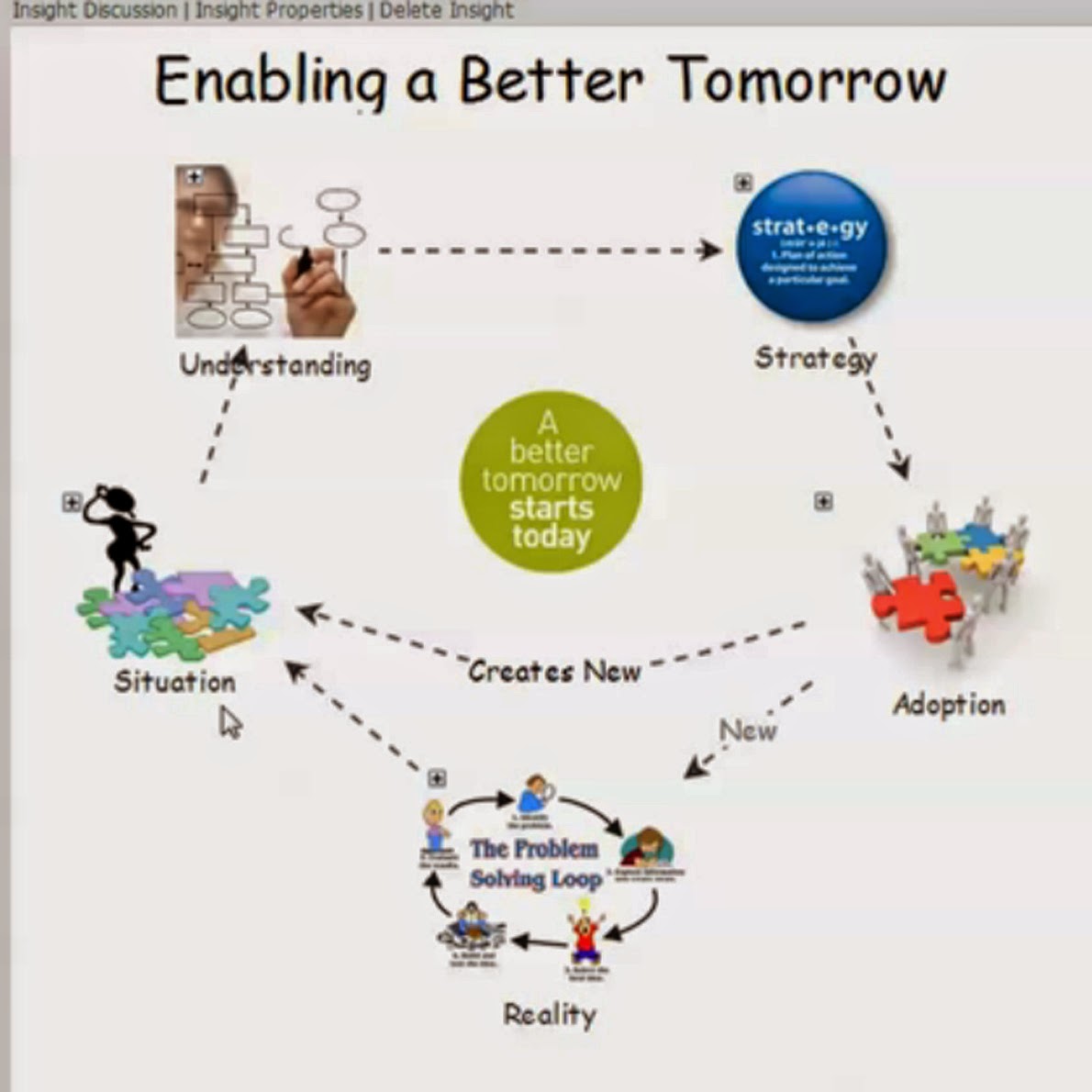
As you do your research, take a look at this article where I introduce systems thinking work being led by Gene Bellinger and apply it to my own efforts.  The graphic is a screen shot from one of Gene's videos.

I hope some of  you will spend some time looking at these presentations and reading the linked blog articles. Then take me up on that offer as you begin a new school year over the next few weeks.

As your students create new understanding through their own work, let's aggregate that work so others will find it and learn from it.

Wednesday, March 02, 2016

Memories from 50 years of tutoring in Chicago

Tutoring Chicago is celebrating it's 50th anniversary this year, as are Midtown Education Foundation and the Chicago Lights Tutoring Program at 4th Presbyterian Church.  I began my tutor/mentor career as a volunteer tutor at the Montgomery Ward-Cabrini Green Tutoring Program in 1973, and became it's leader (as a volunteer) in 1975. I led that program until 1992 then created Cabrini Connections, to help kids who aged out of the first program, continue mentoring and tutoring support through high school. I left Cabrini Connections in 2011.

One tradition of the Montgomery Ward Tutoring Program was the creation of  yearbooks, showing students, volunteers and activities, which were distributed at an annual year end dinner from 1972-1992.  I was the photographer, designer, writer and producer for these from 1974 on.

Today on Facebook I saw a montage of photos from the yearbooks, created by former student Victor Dawson (who was in elementary school in the mid 1970s). I hope you enjoy it as much as I do.


As you look at these photos, look at the articles and maps I've shared on this blog, and the Mapping for Justice blog, for many years. Every high poverty neighborhood of Chicago and other big cities should have icons on maps indicating locations of non-school volunteer based tutor/mentor programs who also have 20-30 year histories, and who are connecting students and volunteers from the past in an army of people who support the continued operation and growth of these programs in the present and the future.

This mobilization of volunteers, talent and resources to support tutor/mentor programs throughout Chicago was the reason I created the Tutor/Mentor Connection in 1993 and the Tutor/Mentor Institute, LLC in 2011. It's the purpose of the articles I share on this blog, my web sites and my social media posts.

I can't do this alone and I can't do it forever. I constantly look for others, in Chicago, and in other cities, who share the vision, the ideas and the strategy that I've developed over the past 40 years, who will provide time and talent to help me spread these ideas now, and who will take the lead to spread them in the future.

There should be hundreds of slide shows like this showing kids and volunteers from the past, and showing them in the present.

The boy I first connected with in 1973 when I became a tutor/mentor is now an adult and we're still connected. He invited me to Nashville last year to celebrate his 50th birthday. He paid my expenses!  That's the reversal of fortune that I hope results from many of the tutor/mentor connections being formed all over the country.


The graphic below includes a photo at the left of kids who joined the Cabrini Connections program in 1993 and 1994. Most had been part of the Montgomery Ward program when younger. The photo at the right shows me with one of these students, in 2010 when she attended our annual golf benefit, as an alumni, a college graduate, a full time employee at a Chicago area company. 


Unless we provide a support system that extends from pre school through work many of these kids might not make it all the way, or might not have the skills or network needed to get jobs out of poverty, when they do become adults.

I created this "shoppers guide" presentation to show what I feel should be on the web site of every youth serving tutor/mentor program, showing their history, where they are located, their theory of change, and their alumni.  

I hope volunteers, donors and program leaders will use ideas like this to help build and sustain more programs who can create long-term connections with youth and celebrate it with photo albums like this.

Wednesday, July 15, 2015

Constant Improvement - Inspired By Others

I've written about MOOCs in the past, and I'm taking part in the 2015 Making Learning Connected MOOC right now. Participants are encouraged to "make" digital images, trying out new tools. Learning from others is part of the fundamental goal of MOOCs like this. I just looked at an article by Kevin Hodgson, with a new graphic. It reminded me of the graphic I've shown at the left.

I've used the image of a "carrot" to represent a "good idea". Someone who is inspired by the good work being done by others, is represented by the "rabbit" who is always looking for good ideas, or better ways to operate. In this graphic, the "rabbits" are the most aggressive innovators. The dogs, chasing the rabbit, are other organizations, who are following the example provided by "rabbits", and trying to use the same good ideas to improve their own organizations.

I've used this graphic to illustrate the goal most of us want as a result of the work we do to help young people, as well as the work we need to do to achieve those results.

In this graphic I compare the innovation and constant learning needed to help schools and non-school youth serving organizations have a long-term impact on the lives of kids (and volunteers) to the thousand experiments that led Edison to invent the light bulb. In this graphic I also try to remind leaders of the resources they need to provide for many years, for light bulbs (great programs) to be available in all of the neighborhoods where they are needed, and for all the years they need to be in place.

I started building a library of research and peer tutor/mentor program information in the 1970s, to stimulate the thinking and innovation of volunteers working with me to build the tutor/mentor program I was leading at the Montgomery Ward Corporation in Chicago. As I created my library, began sharing it with peers, leading other programs. I formalized this information collection/sharing in 1993 when I created the Tutor/Mentor Connection. Now I host an extensive web library of information, with links to more than 2000 other web sites, that anyone in Chicago, or the world, can dig into to find "carrots" that inspire their own innovation and constant improvement.

In the Scribd.com pdf below, I show how the information in web libraries can stimulate constant innovation and improvement, if given support by others who take on intermediary roles and champion the work we do to help kids move through school and into careers.

Using Ideas to Stimulate Competition and Process Improvement - Concept Paper by Daniel F. Bassill


Over the past 10 years interns working with me in Chicago have created new visualizations re-interpreting some of the ideas and graphics I've introduced in this blog. See a collection of these here. Kevin created his graphic using an app called Comic Head. I'd love to see others, not just interns working with me, make their own versions of the ideas I share in my blogs, focusing on their own communities and causes, not just Chicago, or volunteer-based tutor/mentor programs.

I've participated in Making Learning Connected MOOC and others like it because thousands of innovative educators are meeting and sharing ideas for inspiring students. I learn new ideas and ways of communicating from my participation in these events. That's how I've built my web library over the past 20 years.

I hope some will inspire their students to become intermediaries like myself, using the ideas I and others share, to motivate adults in their communities to do the work needed to assure an equal opportunity for the American Dream for everyone in their community, not just those lucky enough to have been born out of poverty, or to be in a classroom with a super inspired teacher.

If you do create a version of one of my ideas, just give me credit and send me the link so I can share it with others.

Friday, June 05, 2015

Closing Opportunity Gaps - Expanding Involvement

If you've followed the articles I write you'll see that I focus on poverty and inequality and that I think volunteer-based tutor/mentor programs can be part of the solution.

The photo on the left is from the Cluster Tutoring Program's year end celebration. Thank you to Connie Henderson Damon for letting me share her photograph. This program is located in the Austin area on Chicago's West side. Note the diversity in the room. This is an organization that is bringing together people who don't live in poverty with children and youth who do. They've been doing it for a long time.

I've always thought of volunteer-based tutor/mentor programs as a form of adult service-learning, a form of bridging social capital. The volunteers who get involved often say they think they learned more than the kids. What this means is some are learning about poverty and inequality, and many move beyond their personal involvement and try to get others involved.


This graphic illustrates this service-learning idea. In 2011 it was converted into this animated presentation by one of my interns from IIT and South Korea.

I found the photograph of Cluster Tutoring Program's year end event on Facebook. At this time of the year, many tutor/mentor programs are celebrating and some are sharing their photos on Facebook. Here are a few more:

Chicago Lights Tutoring Program - click here

East Village Youth Program - look at photos

Inspired Youth - visit page

Partnership to Educate and Advance Kids (PEAK) - see page

Midtown Education Foundation - see photos

These are just a few of the Chicago area tutoring/mentoring programs using Facebook to show the diversity of youth and volunteers who they connect every year. You can find nearly 130, organized by section of the city, on this list.

I created this graphic to illustrate the potential for a site-based tutor/mentor program to connect inner city youth with volunteers, ideas and opportunities in every industry in the Chicago region.


Such programs don't start with this diversity. It takes many years to build participation. It takes consistent support from volunteers, donors, media to help programs grow, build and sustain this diversity of participation.

I've been trying to maintain a Directory of non-school tutor/mentor programs in Chicago since I started the Tutor/Mentor Connection in 1993. In addition, I've been trying to plot locations of site-based programs on maps, so leaders, planners, media and researchers can see where programs are most needed, and where existing programs are located. This information would show voids where too few programs exist.

I've used print newsletters, then email newsletters, for nearly 40 years to help volunteers and leaders find information that would help them be more effective tutors, mentors and leaders, but also to help them think of ways they could support the growth of long-term, mentor-rich programs in more places.

If you're reading about inequality, racism, violence, workforce readiness and education issues, think of the role tutor/mentor programs can be in expanding the network of people who are joining in this effort...who might never have become involved if not for the invitation of a tutor/mentor program to become a volunteer.

Then visit the web site of Cluster Tutoring Program or the others I point to and look for ways to get involved. Help them do this work next year, and in years to come.

Saturday, April 04, 2015

Turning the Pope's message into Action Plan

As Christians and Jews celebrate this religious holiday I add my own hope for peace in the world, at home, and in the hearts of men and women. I'm thrilled by Pope Francis and his emphasis on the poor. This Wall Street Journal article is one of many that you can read to see his impact. Here's an article I wrote in 2013.

A first step in reducing poverty and the opportunity gap is for highly visible leaders to draw attention to the problem, and call on the rich and privileged to be a greater part of the solution. However, the next step is for leaders to map how we get from where we are now (here) to where we want to be in the future (there).

This PDF is one that I hope Christians, Jews and people of other faiths will share in their congregations. Form study groups to understand this. Then implement the strategies so a growing percent of every congregation is growing their involvement in activities that make more and better non-school tutoring, mentoring, learning organizations and safe spaces available to youth in big cities of the US and the world.

Network Building. Role of Faith Community by Daniel F. Bassill


This is one of many strategy and idea articles I've posted in the Tutor/Mentor Institute, LLC library and written about on my blogs.

Start a study group. Read these. Discuss them in groups. Come to the May 8 Tutor/Mentor Leadership and Networking Conference in Chicago and connect with others who already lead tutor/mentor programs, or who are trying to start new programs.

Create your own maps to show what congregations may already be hosting programs and what congregations have study groups, or marketing programs, to engage members, and the places where they work, in efforts that help programs grow throughout the Chicago region, or in any other urban area.

On the next major religious celebration, create your own blog and show your own maps and blueprints for getting from "here to there".

Friday, January 16, 2015

Who Shares the Passion for Building the Infrastructure needed to help social organizations have greater impact?

I attended the Chicago Hive five year celebration last night and heard CEO Sam Dyson say something like, "If you're serious about helping kids you need to be serious about mobilizing the resources needed."

Earlier in the day Dan Pallotta sent me an email asking me to look at a Boston Globe article showing his efforts to revolutionize how philanthropic organizations are funded. I've written about Dan's work before and adopted this to my own vision. See article.

The day before I attended a Generation ALL Chicago event, where leaders talked about mobilizing stakeholders from all parts of Chicago to focus on building great public high schools in every neighborhood of Chicago.

Then this morning I responded to a consultant who coaches businesses on volunteer engagement, with an email showing my own "dream". I finished by saying since this is the day everyone's honoring Dr. Martin Luther King, Jr., it's appropriate that I share my own vision and dream: Here's what I wrote:

---------------------------------------- The recent outrage about unequal coverage of the tragedy in Nigeria vs the tragedy in Paris show how difficult it it to attract people (and donor) attention and keep it focused for any length of time on places where help must be consistently provided.

I've maintained a newspaper clip file going back into the 1970s with articles on education, poverty, race and violence in Chicago. I'm digitizing those articles over the coming year and as I do I'm finding article calling for action from the 1990s to solve problems we still have not solved 20 years later.

In my blog articles and on-line networking I'm looking for people who express a passion for solving this problem, and who are willing to work with me to find others, and to innovate actions, that can create a reach and daily frequency of messages that draw support to non profits and social entrepreneurs the same way business draws customers to their stories, on-line market place and products and services.

I reach out to you because you express some of the same ideas, and in the "food chain" you're closer to the business leaders who need to use their own communications tools to carry this message to the public.

I think I'm older than you, but I think we both have grey hair. I want to leave something in place when I die that I think builds a better future for my grand kids and other people's grand kids. It take money to do this, but even more it takes a shared effort of people who have talents and networks that I don't have.

----------------------
In another email conversation I shared my vision of having "Tutor/Mentor Connection student-led teams form on college and high school campuses throughout Chicago and in other cities. Here's what I wrote:

I encourage you to browse the articles by interns, at this page.

Each of these interns has spent time learning what the Tutor/Mentor Connection strategy is, then communicating it via blog articles, visualizations and videos. If formal "tutor/mentor connection" teams formed on campuses and schools, their first role would be to learn what I'm trying to do, so they can see their role of duplicating everything I do, but focused on a smaller geographic region (around a college or high school) or focused on a specific network of people, such as students, faculty, alumni of a college.

In short, they learn to connect people they know to information those people can use to support places in their neighborhood which are trying to help kids move through school and into careers, via tutoring, mentoring, social/emotional support, jobs training, and a wide range of other activities.

As student teams form, and learn to do this work, they become organizers of networking events on their campus, and at citywide and national events, that connect groups from one campus with groups from other campuses. The Tutor/Mentor Conferences, are just two events out of a 365 day calendar when people could be gathering to share ideas and inspire actions.


----------------------------

I also shared an idea with one of the other organizations building networks of people to focus on violence in Chicago. I wrote:

Your organization is already using its blog to share ideas and spotlight people it works with, and you're using your events to bring people together. I encourage you to read this article, and dozens like it that I've posted since 2005. 

These talk about what it takes to build and sustain great programs in all high poverty neighborhoods. They call on readers to be volunteers, donors, leaders, etc. and to reach out and get more people involved...in programs all over the city, which are represented in databases like the one I maintain at  https://www.tutormentorexchange.net/chicago-area-program-links

I think your organization and others, such as Chicago Hive, and Generation All, etc., could write similar stories, even better than I do, and with the ability to reach people who I don't reach.

This is not something you or I need to have an agreement to do, but it is something I'd be happy to talk with you and brainstorm ways others might take on the same role so more voices are out there every day calling on resource providers, volunteers and other needed talent to become strategically involved in supporting programs all over the region.


As I learn about intermediary organizations in Chicago I've been adding them to this concept map. Click here to see the live version, where you can click on nodes to find web sites for each group.

One role that Tutor/Mentor Teams on campuses would have is to create a map showing organizations and assets in their neighborhood who should know each other and be working together to support youth as they move SAFELY from birth to work. Such maps could be shared on web sites just the way I do, to help each group connect with each other, and to draw donor support to all of the intermediaries on an on-going basis. Generation ALL's leader talked of a 10+ year vision. For that to be achieved, consistent funding needs to be secured.

However, just funding the backbone is not enough. Each of the organizations these intermediaries support also require consistent flows of talent, dollars, ideas, etc. If someone hosts a map of participating organizations, I want to see consistent messages calling on visitors to their web site to go through the map, find an organization, and become a supporter. I point to this list of Chicago non-school tutoring/mentoring organizations all the time and from most of my web sites.

So much for today's soap box. I guess on ML King, Jr's anniversary it's fair for me to share my own "dream".

Sunday, November 23, 2014

Involve Youth: Thanksgiving Message

Over the coming week millions of people throughout the USA will gather with family and friends to celebrate and give thanks for the blessings of living in this country. However, a small percent of citizens don't share many of those blessings because they live in high poverty areas of big cities and rural parts of the country.

I've been blessed to be able to lead volunteer-based tutor/mentor programs in Chicago from 1975 to 2011 where inner city youth and volunteers from many different backgroundsconnect on a weekly basis throughout the school year, with a goal of transforming the future for both groups of people involved. I've also been frustrated by how difficult it is to find the consistent operating dollars needed to sustain on-going, constantly improving programs.

I created the Tutor/Mentor Connection in 1993 and the Tutor/Mentor Institute, LLC kin 2011 to help draw needed resources to every non-school tutor/mentor program in the Chicago region, based on the way corporate office teams at big companies like Montgomery Ward (where I worked from 1973-1990) help stores grow all over the country. At Wards I had an annual retail advertising budget of over $250 million to reach out to over 20 million people a week with invitations and motivation to shop at our stores.

As the leader of a single tutor/mentor program, and the leader of the Tutor/Mentor Connection, I had almost no money for advertising, yet the need to attract attention and resources was the same. Thus, as I've created a list of Chicago youth organizations, I've also enlisted volunteers and interns to help build the public awareness of our work.

The Thanksgiving graphic above was created by one of our Cabrini Connections students in 2009. Visit this blog and you can see two graphics created as part of a technology club led by volunteers.

I've had interns from various colleges working with me since 2005, creating visualizations with the same goal. I think youth in many programs could be creating visualizations, videos, blog articles and other forms of "advertising" that could be drawing the attention of potential volunteers and donors on a daily basis, not just during Thanksgiving and the year-end holidays.

If you're doing this kind of work, and showing it on your web site, please send me the link so I can give you attention and help you attract needed resources to your organization, while inspiring others to duplicate your efforts. While you're thinking about this, and counting your blessings, I encourage you to visit this Illinois Gives Big event web site, and browse the list of organizations that you can support on December 2, 2014. Many of these are also listed in my list of Chicago youth orgs. They all can benefit from your help as we move into 2015.

While we don't have traditional advertising we have tremendous talent within our youth and volunteer networks who could be helping attract support to tutor/mentor programs so that every year when we give Thanks, more people have something to be thankful for.


Sunday, September 28, 2014

Celebrating achievements of Chicago tutor/mentor programs

Over this past weekend I had the pleasure to be the guest of two Chicago youth serving organizations who were celebrating milestones.

One was the Youth Service Project (YSP) which operates out of a converted storefront at 3942 West North Avenue. Their Facebook page shows they have been active since 1975.
YSP was celebrating a youth technology/job training program, called "igniTechLab" which it had operated this past summer. About 30 people, including youth, parents and volunteers were treated to an overview of the program, and three presentations by youth, who showed what they had learned from the program. Two teens showed how to build a web page without using formats like DreamWeaver or FrontPage.
Two others talked of the music lab they had set up on the second floor and the documentary of life in Humboldt Park that they were working on. The project leader described how she had built the curriculum from scratch after receiving a government grant. She was not sure how the project would continue since no source of funding has yet been found.

On Saturday, I attended the 50th year celebration of the tutoring program at 4th Presbyterian Church on Michigan Avenue, right across from the Water Tower shopping center. The celebration was held in a elegant new building which must have cost several million dollars to build. When I first connected to this program in 1974 it was not known by its current name of Chicago Lights Tutoring.

From 2 till 3pm myself and 200 to 300 former and current volunteers, friends of the program and current and former students were encouraged to walk through the classrooms devoted to the tutoring program on the 5th floor of the Gratz Center which is the new addition to the church's mission. This program serves more than 400 pairs of youth and volunteers annually, and has had that enrollment for over 40 years at least.

I was delighted to see the timeline posted on the wall of one of the classrooms showing roots going back to the mid 1960s. The program I led at the Montgomery Ward headquarters on Chicago Avenue started at about the same time. This time line shows how I joined it in 1973 as a volunteer and became the leader in 1975. It shows that in 1976 I began inviting leaders of area programs, including 4th Presbyterian Church, to gather monthly for lunch and to share ideas. This networking eventually led to the formation of the Tutor/Mentor Connection in 1993.

At 3pm all of the guests of the Chicago Lights Celebration gathered in a large chapel where we first heard Alex Kotlowitz, author of There Are No Children Here: The Story of Two Boys Growing Up in the Other America, talk about how important mentoring and the attention of just one caring adult can be in the life of a child growing up. When I sat in my seat at the start of the 3pm session I was surprised to find myself sitting next to Bob Greene, a former Chicago Tribune writer, who wrote some great stories about the tutoring program at 4th Presbyterian Church, like this one.

Two of the veteran volunteers who spoke gave direct credit to Bob's stories for their becoming involved in the program. I'm not sure what percent of total volunteers stay with the program 5, 10 or 15 years, but it seems that they have many long-term veterans, demonstrating a well organized program. I kept hearing from volunteers "I've gained more from this than I think my mentee did."

During the next 90 minutes I heard volunteers and student alumni talk about how important the Chicago Lights Program had been in their lives. This resonated with me because every year since 1973 I've been part of a similar gathering of youth, parents, volunteers. This video is from one of those.


Find more videos like this on Tutor/Mentor Connection
You can see many more Cabrini Connections videos here.

When I sat next to Bob Greene I reminded him that I had reached out to him in the 1990s asking him if he'd tell stories of the other tutor/mentor programs in Chicago, not just the great one operating on Michigan Avenue. When I've met with leaders and organizers of the 4th Presbyterian Church program over the last 40 years I've encouraged them to build an active outreach to motivate and teach faith groups from the entire Chicago region to partner and support the growth of well funded, mentor rich programs like the one they operate.

This is one of many maps I've made showing the density of faith groups in the Chicago region. Many of those operating in poverty areas don't have the wealth of churches operating on Michigan Avenue or in the North, West and South suburbs of Chicago. However, those who do have such wealth, of talent, not just money, could make a commitment to help at least one high poverty neighborhood build a program that in 50 years would be considered one of the best in the country of helping kids from poverty connect with a wide range of adults who helped them grow up and move into adult roles and careers.

Alex Kotlowitz said of the Chicago Lights program "It's a miracle that uses shared time to turn strangers into families" and "this program changes lives of youth and volunteers".

One of the later speakers said "It's not so important to bring a child into the world as it is to make a difference in the life of a child."

It takes the vision, and commitment, of many people from many sectors to help make this happen. As we move through this school year I hope many will read the ideas I've shared on this blog and look at web sites of different youth tutoring/mentoring programs in Chicago and make a commitment to help at least one.