Showing posts with label strategy. Show all posts

Thursday, September 17, 2026

Building strong volunteer-based tutor, mentor and learning programs

School has started and volunteer-based tutor, mentor and learning programs in Chicago and across the country are at different stages of volunteer and student recruitment, orientation, training and matching. 

Ideally, most of the planning that for this year's activities began last spring and continued through the summer. My focus is on helping programs with their planning so they are even better when they start again in the coming year.


I led one volunteer-based tutor/mentor program in Chicago from 1975 to 1992, then with the help of six other volunteers, started a new program in November 1992, which I led until June 2011.  These were hosted at the Montgomery Ward Corporate Headquarters on Chicago Avenue until 1999.  

When I say "volunteer-based" I'm not just talking about the adults who serve as tutors and mentors, but those who do more, helping to organize and operate the program.  

The program I started leading in 1975 was already 9 years old when I became its leader. It had 100 pairs of volunteers and elementary school-age youth participating by the fall of 1975, after starting in 1965 with just a small group of corporate volunteers.

I had started as a volunteer in 1973, then joined the leadership committee in 1974. I took over when the previous leader decided to take off for Europe, saying "Dan should lead, since he talks the most!"  

The graphics below illustrate the growth of the program from 1974 to 1992. 

The committee in 1974-75 had nine members. It was led by Roger Kennedy, a copywriter in the MW Catalog Advertising Department.

By 1976-77 I had increased the committee to 13 people.  I was a retail advertising copywriter. 


By 1987 the program had grown to over 250 pairs of kids and volunteers. 33 volunteers, including students in grades 7 through 12 who were graduates of the program, were offering time and talent to lead the program.  We had a part-time paid staff, of three students from Moody Bible Institute.  My own jobs had grown and I was now a divisional advertising manager. 


In the spring of 1990 I left my corporate job with Montgomery Ward and we converted the program to a non-profit, named Cabrini-Green Tutoring Program, Inc.  This enabled me to raise money to pay myself a salary to continue leading the program and to hire others to help.  The 1991-92 volunteer leadership structure reflects the growth of the program to 440 kids and 550 volunteers by June 1992. More than 60 volunteers, including student alumni, were involved in planning and operating the program.  I was the only full-time employee.  We had three part timers helping. 


As we ended every school-year, starting in 1975 I had to recruit new volunteers to take on leadership roles. While this was a year-round process it peaked in April-May.  My year-end speech always included a "help me" message. We spent the first part of every summer teaching new committee members about the work involved in operating the program and then the rest doing the work of starting the next year's program. 

I starting a written annual plan in the late 1970s and rather than starting each new year from scratch, we built on what we'd done before, getting better, adding new elements, discarding what was not working. Here's an example of this annual plan. This is from 1984-85.  

That's one of the secrets of growing a tutor/mentor program from "good to great" over many years. 

I was able to lead a program for so many years because I was constantly learning from how other programs in Chicago were operating.  My primary goal of building a list of all tutor/mentor programs was a) to help draw attention and resources to each; and b) to help each program "see" what others were doing, and to borrow good ideas for their own program.  The idea was to build from "good to great" rather than constantly start from a limited range of ideas.

My departure from the CGTP in October 1992 was painful, and the result of a lack of agreement on how the program should operate and what its future growth would be, between myself and the volunteers who I had recruited to be our Board of Directors in 1990 when we created the non-profit.

It was during this timeframe that 7-year-old Dantrell Davis was killed in Cabrini-Green.  While Chicago media were "demanding action" I remember driving down the Kennedy Expressway and saying to myself, "I don't need to lead an under-funded, under-supported program with over 900 participants, to share what I've learned to help similar programs grow in all parts of Chicago."

I immediately began to focus on what had divided myself and the other program. First was the decision to expand and serve 7th to 12th grade kids who had graduated from the original program at the end of 6th grade.  Second was to help similar programs grow in all high poverty areas of Chicago.


We created Cabrini Connections to help kids from the original program go from 7th grade through high school. Starting with 5 teens and 7 volunteers in January 1993 we grew to 80 teens and 100 volunteers by 1998 and due to the limited space we had, we stayed around that number until I left in 2011.  We used our first grant in 1993 to hire two part time staff (veteran volunteers from the original program).  As we raised more money in 1994 I began to draw a salary. We never had more than 3-4 full time staff members and 3-4 part time staff and interns between then and 2011. 

I never earned as much as I was earning during my final years at Wards.  And, since forming the Tutor/Mentor Institute, LLC in 2011, I've drawn no salary.


We spent all of 1993 planning what became the Tutor/Mentor Connection and launched it in January 1994.  In 2011 I created the Tutor/Mentor Institute, LLC to continue to operate the T/MC in Chicago and help similar intermediaries grow in other cities.

In both versions we drew upon volunteers to help.  

In both cases we applied the "Good to Great" principles that Jim Collins made famous in his book, "Good to Great and the Social Sector".  


I first used the graphic at the right in the late 2000s, then in a 2011 article, which I updated in 2022.  If you have read this far, I urge you to visit the 2022 article and read more about "Good to Great" and what it takes to build constantly improving tutor/mentor programs. 

Then read this article about re-thinking philanthropy.  If we don't change how programs are funded there will be too few great programs and far to few programs of any kind reaching K-12 kids in high poverty areas of Chicago and other places.


This 1994 Chicago Sun-Times article shows how I traded my advertising job at Montgomery Ward to build Cabrini Connections and the Tutor/Mentor Connection.

I've shared much of what I learned over those years in the articles on this blog and in the information I share on the www.tutormentorexchange.net site.

However, the details of what I learned and how I did this are in my archives.  I hope that someone who reads this will recognize the potential value of this history and will recruit a university to take ownership, so students can learn from what I've learned and more systematically share it to help "good to great" youth programs grow in more places, reaching more kids. 


You can connect with me on Twitter, Facebook, LinkedIn, Instagram, Mastodon and a few other places (see links here).

If you want to help me pay the bills, please visit this page and make a small contribution.  


Tuesday, August 25, 2026

One strategy to support them all

This graphic shows a strategy that I've led since late 1992.

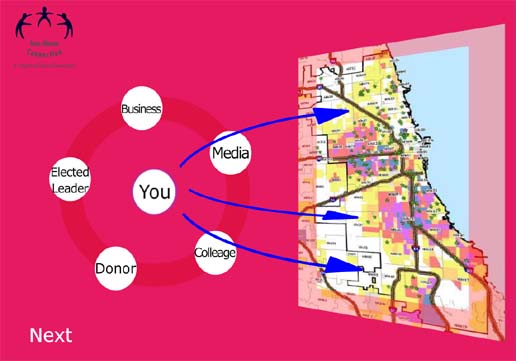
I and six other volunteers created a new volunteer-based tutor/mentor program in late 1992 to support teens who had aged out of the 2nd to 6th grade program at the Montgomery Ward headquarters in Chicago. We called that Cabrini Connections. The map shows its location on the Near North side of Chicago. 


The map also shows that the area we served was just a small part of the city. We recognized that one more small program would not have much impact on the 200,000+ kids living in high poverty areas of Chicago, so in 1993 we created the Tutor/Mentor Connection (T/MC), to gather and share information and build greater public awareness of EVERY tutor/mentor program in Chicago, not just our own.    I've supported the T/MC via the Tutor/Mentor Institute, LLC since 2011.

The T/MC is an "information-based problem solving strategy".   One part is my lists of Chicago area youth serving programs, which I urge people to point to regularly to draw volunteers and donors to each.


The larger part of  the information I share are steps people can take to build and support tutor/mentor programs in more places and information that shows why these programs are needed and where they are most needed.

In this section of the Tutor/Mentor library I point to articles like this, focusing on wealth inequality in America, or this blog, which focuses on breaking the cycle of poverty in America.  Another article describes "How the racial wealth gap has evolved -- and why it persists".   Many articles on this blog focus on these issues. Just open the tabs at the left and scroll through past articles. 

Many of the articles in my library are from 10 to 25 years ago. They demonstrate that the problems we face now are deeply rooted, and still need solutions. 

Helping kids to careers
The issue I've been focusing on is helping kids born or living in high poverty areas move through school and into adult lives with jobs and careers, and support networks, that enable them to live and raise their own children where ever they want.  The graphic at the right shows to teens who were part of the tutor/mentor program I led in the 1990s. One is shown at the lower right. She's now Director of Support Services for Housing Opportunities for Women.  I'm still connected to both of these teens, and many others, nearly 30 years after we first met.

Today another alum boosted one of my post on Facebook, saying "This program helped shape who I am today and I'm forever grateful."


My goal is that more youth from high poverty areas have similar support systems.

I've created a library of concept maps over the past 20 years that visualize commitments, strategies and resources, with this one showing that helping kids to careers means providing a wide range of needed supports at each age level as they move from first grade through high school, college/vocational training into jobs.

View Mentoring Kids to Careers cMap

In the bottom left part of this cMap I show the role that volunteer tutors, mentors, coaches, etc. take, as "extra adults" to help kids access these resources and as a form of "bridging social capital" that provides expanded networks and opportunities for kids living in neighborhoods defined by concentrated poverty.

Building such systems of support and making them consistently available for 20 to 30 years in thousands of locations will require a huge commitment of public will, something this country has little history of success in generating.

This is a graphic that I've used often over the past 25 years to show that the outcomes we all want for kids requires work done at the bottom of this pyramid.  You can find this graphic in this PDF.

Below I've created some images that focus in on different elements of this graphic.  The ideas apply in building systems of support for inner city youth, and for solving any other complex problem.

At the bottom of the pyramid is the knowledge that we draw upon to propose solutions to problems.   While we each have our own personal experiences, and some have studied an issue for their entire lives, most don't have a broad reference base that they draw upon to support where and how they get involved.  Building a knowledge base that supports the decisions of others who need to be involved in solutions to problems is an essential first step. Keeping this up-to-date is an on-going challenge.

That knowledge base is the web library and directory of non-school tutor and mentor programs that I've been building since the early 1990s. Initially I did this to support youth, volunteers and leaders in the tutor/mentor programs I led in Chicago from 1975 to 1992. As I formed the Tutor/Mentor Connection in 1993 I began to share this information more consistently with others throughout Chicago.  The knowledge collection role is Step 1 of the 4-part strategy we created in 1993.  

Competing for attention.  Drawing users to library.  Building and sustaining a library of information and ideas is one thing.  Creating daily advertising and public education that draws a growing number of learners and users to the information is a very different challenge.

Most youth serving organizations don't have powerful marketing teams working to draw attention and resources to them on an on-going basis. Innovating ways that more people take roles in building public awareness and draw viewers to information in the library has been a priority of the T/MC since it was formed. This is Step 2 of the 4-part strategy.

I find too few conversations that focus on this step.  With the Internet we have a growing "Crisis of Attention", which is described in this article.  With the White House and Federal government now run by an unelected immigrant billionaire and a convicted felon, getting attention on social media for youth development issues is more difficult than ever before, especially when one has no money for advertising (that's me). 

I keep looking for conversations where people are thinking about challenges of competing for people's attention in an environment where so many others have far more resources.  I've written many articles focused on "creating attention". Take time to read through them.


Building the network. Part of my web library focuses on "who needs to be involved" which includes a directory of non-school tutor and mentor programs in Chicago and around the country and a data base and collection of more than 2000 links that point to others who are involved in some way in efforts to help kids move through school and into jobs and careers.

Getting representatives of these organizations and resource providers together to learn, share, build relationships and innovate shared solutions to problems is what I focus on in this stage of the pyramid.  Unless people in business, philanthropy, faith groups, media, politics, etc. are coming together on an on-going basis, for face-to-face and on-line learning, it will be difficult to create and sustain collaborations that helps build and sustain high quality youth supports in all the places where they are most needed. I tried to do this through the Tutor/Mentor Leadership and Networking Conferences that I help in Chicago from 1994 to 2015.  

In this blog article I show that a "village" of people with different talents and networks needs to be involved helping every tutor/mentor program grow, as well as helping many programs grow in specific neighborhoods and entire cities.    This is part of Step 3 in the four-part strategy.

These first three steps need to be happening on an on-going basis, reaching people throughout Chicago, Illinois and the world. However, they are just the start.

Better information, read and understood by more people, creates a better understanding of what types of youth support programs have the best chance of having a positive impact on youth and volunteers. Better information also helps people understand the challenges involved, which are many.

This needs to lead to actions that support programs in more places. If more of the stakeholders, including resource providers, are looking at this information, they can develop a set of actions that generate a flow of on-going resources (talent, dollars, ideas, technology, Etc.) into every high poverty neighborhood, to every tutor and mentor program operating in those neighborhoods.

T/MC map created in 2008
It is essential that maps be used to support this process. With a map leaders can focus on all areas of a city where kids need extra help. At the same time, neighborhood groups can focus on their part of the city. Many groups need to be doing this.  With a map we can add overlays that show indicators of need, existing youth tutor/mentor and learning resources, and assets (business, hospitals, faith groups, universities, Etc) who could be helping youth programs grow in different areas....because they are also invested in these areas!

I think this is the weakest link in this process. Most programs compete with others for scarce resources. Most foundations use requests-for-proposals and competitive grants and competitions to decide who gets funded. There are only a few winners and many losers. Often prizes and grants are one-time gifts, not repeated from year-to-year.  No business could grow to be great on this type of funding stream. Yet, I see few leaders using maps to show a need to draw resources to all poverty neighborhoods, and to all of the organizations working in these areas.  Few cities have a map based leadership effort, intended to help great programs grow in every part of the city. 

However, if we could solve this problem....

A better flow of needed resources to youth serving organizations (Step 4 in 4-part strategy) leads to more and better programs serving k-12 youth in more of the places where they are needed.  I can't tell you how often people ask about "outcomes" without talking about the work needed to build well-organized, mentor-rich non-school programs.

This leads to the final graphic.

It can take several years for a business to become profitable, or for a youth-serving organization to build the team of staff, leaders, volunteers, parents and youth that makes it a "great" program.  

However, that's only the start. If a youth enters a great program in first grade, or 7th grade, it will still take 12 years for the first grader and six years for the 7th grader, just to finish high school!  It will take four to six more years for that young person to move on into adult lives and roles, and to jobs and careers that enable him/her to raise their own kids outside of the negative influences of high poverty.

Long-term; many places
I used this birth-to-work arrow in many other articles, such as this one, which is a discussion of the costs involved in a program intended to create jobs for 32,000 young men in a few Chicago neighborhoods.

I created this 'race-poverty' concept map to illustrate the many other factors that influence life outcomes for kids born or living in high poverty areas.  


Here's the challenge. As a nation we're not very good at keeping the focus (and flow of resources) on problems and solutions to the time it takes to actually begin to solve the problem.  While this 1993 Chicago SunTimes article includes a map, very few leaders in 2026 are using maps to emphasize all of the places where kids, families and schools need help to aid youth as they move through school and into adult lives. Read more.   Read this article about "building public will".

Poverty is a complex problem, requiring many different types of resources in the same place at the same time.  If we want more youth to stay in school, be safe in non-school hours, graduate from high school and move on to jobs, careers and adult responsibilities, we need to do the work shown at the bottom of this pyramid.

There is a great deal of uncertainty as we move into spring 2027, mostly centered around the November elections.     While the nation still deals with a lingering Covid19 pandemic, bird flu, floods, hurricanes, wildfires, etc., we now face massive layoffs of government workers and drastic reductions of Federal funding of programs that help keep us safe and help those who need extra help get that help.  These are just a few of the problems that I see as I scroll my social media feeds each day.  

In my own work I've never been able to get enough people together for an on-going basis, just to talk about ways we create and share the knowledge I've been collecting with more potential users. From 2009 till now, I created lists on Twitter with accounts of many organizations in the Tutor/Mentor library, but very few of these are using social media to connect with each other, or discuss issues I address in articles like this. I'm now trying to build a similar network on BlueSky and Mastodon. 

If you're interested in learning more I urge you to read more about what I've been trying to do in this Tutor/Mentor Learning Network presentation.  The please read these articles about establishing a Tutor/Mentor Connection at one or more universities. 

I invite others to create and share their own versions of my articles, to build Tutor/Mentor Connection-based strategies in your own communities.  I'd love to help you while I'm still able.

You can find me on any of these social media platforms.  I'm available for an on-line conversation on a daily basis.

We need everyone's help.


Can you help me do this work? Visit my FUND T/MI page and add your support.  Thank you.

Wednesday, July 22, 2026

Turning Research into Active Problem-Solving


Every month I see a new report showing the impact of concentrated poverty on school performance, health, economic well-being and other issues.  Last year A Better Chicago released a new report titled "State of Chicago Youth, 2025". I wrote about it in this article.  They issues an update in 2026 - click here

Below is a message I've shared often, in different articles, for the past 30+ years.

I’ve been collecting similar information since I became a volunteer tutor in 1973, showing where people need extra help, why, and what type of help could be offered to youth via organized, on-going, volunteer-based tutor/mentor programs.

From 1993 to 2003 I shared this information via printed newsletters. Then on a website since 1998.   I’ve been pointing to that research in articles on this blog since 2005.

I’m sharing a few below. I hope you’ll open the links and take a look, then share the ideas through your own blogs, videos, etc.

Here’s an article where I use maps to show where people need extra help.


It’s one of dozens where I show the four-part, information-based problem-solving strategy that I’ve piloted since forming the Tutor/Mentor Connection in 1993, and Tutor/Mentor Institute, LLC in 2011. It’s one where I point to a section of my library with hundreds of links to articles and research about poverty, racism, inequality and social justice. And, it’s one where I encourage others to share this information in their network, so more people find it and use it.


When I formed the Tutor/Mentor Connection the goal was to help every existing tutor/mentor program in the Chicago region get the operating resources, volunteers and ideas each program needs to grow. Here’s one of many articles that focus on the challenges of finding on-going funding for mentor-based programs.

My leadership of a single volunteer-based tutor/mentor program from 1975 to 1992 and a second program starting in 1993, along with my career in retail advertising with the Montgomery Ward corporation, provided the foundation ideas for the Tutor/Mentor Connection.

These experiences led me to understand that organized volunteer-based programs were a way to connect kids in high poverty areas to people, experiences and opportunities that were not readily available in their own family/neighborhoods, due to extreme poverty. Over time, I began to understand this as a form of ‘bridging social capital’ and visualized it in graphics like the one shown below.


Here’s one of many articles where I write about mentoring as a form of social capital.

In my work at Montgomery Ward’s corporate headquarters, from 1973 to 1990, I learned how my department, and other functional teams, supported more than 400 retail stores spread in 40 states. We helped each store be good at attracting customers, selling merchandise and earning a profit. (at least we tried)

Thus, when we formed the Tutor/Mentor Connection plan in 1993 our initial strategy was to learn what programs existed in Chicago, then to build a public awareness strategy that would attract more attention, volunteers and donors to each program, and to every high poverty neighborhood.


This article shows how we began publishing a Directory of programs in 1994 and how this information was used to support programs.

In this article I describe an on-going information-based planning process, that uses information like I’ve been collecting.

This could be led from institutions who have deep roots in geographic areas, like hospitals, universities, businesses, etc.

To do this research, someone needs to host a library like mine, with lists and directories of youth serving programs, then use that information in an on-going planning, program development and public education and resource generation strategy.

This is a missing step in most of the research I’ve seen for over 25 years. Researchers get the money to do the research and produce a report, with a big event that shares it with the public, but then don't have the money to continue to share that research and draw people together to use it over the following years.  What I do is aggregate links to that research and try to motivate people to use it to support youth tutor/mentor and learning programs in every high poverty area of cities like Chicago.

I encourage you to look at articles, like this, where I point to work being done by Daniel Max Crowley, who I met on LinkedIn.  He calls on universities to go beyond collecting research to helping communities use it. 

Over the past 30 years I've piloted actions that I share on my website and that anyone can borrow and apply in their own geographic area.

While I do find a few who host lists of youth serving programs, and even plot the list on interactive maps, I don’t find any with multi-year public awareness efforts aimed at drawing volunteers and donors to every youth-serving program within their city.  If you know of any who do this, please share the link and I'll add them to my library.

Furthermore, I don’t find any doing the deeper research asking “what youth programs exist in your area”.

Doing such research and maintaining a list of programs is a big job, especially in cities as large as Chicago. That’s why, for many years, I’ve tried to motivate universities to build a Tutor/Mentor Connection-based strategy on their campus. This is one of several articles where I share this invitation. 


Here’s an article where I show 30 years of effort to build strategic alliances with universities. You can see a wide range of interactions with many universities, but no long-term initiative led by, and funded by, any university.

Why wasn’t I successful?
Money. Reputation. Clout.

I never had much of any of these so when I met with someone at a university, I’d receive polite nods, with a “I’m already over extended. Find a younger professor.”

 The answer: ultra wealthy donors


Here's one of several articles where I show the potential of strategic investment by one or more wealthy donors.  Here's another. 

How might we find such donors? 


They are all around us. Do you watch NFL football games? How often do you hear players praised for their philanthropic work? I posted this on Twitter in 2024 sharing the idea from this post.

What if a university aggregated this information and then used it to recruit a group of athletes who support the same cause, to support a Tutor/Mentor Connection strategy at the university that was building the database of athlete involvement?

What if? What if? What if?

What if you share this article in your networks? Maybe someone will read it and adopt the idea and actually take the next steps.

That’s why I write these articles.

If you're connected to a university, or looking to put your name on a building at your alma mater, I hope you'll make this your mission.


Thanks for reading.
  There's a lot here, so bookmark the page and return often.  Then, look me up on LinkedIn, BlueSky, Instagram, Facebook, Twitter, etc. and let's connect.  If you're writing similar articles, which I hope you will, please share them.

Finally, if you're able, please visit this page and make a contribution to help fund my work. 

Tuesday, July 07, 2026

What's Needed in an on-line Tutor/Mentor Program Locator?

This week I posted a new article on Substack.com that shows how I've been using GIG maps since 1993. I hope you'll read it. click here


I pointed to articles on the MappingforJustice blog, such as this one, that show examples of how I've used maps, and how others are doing similar work. 

And, I encouraged universities, and others, to borrow from my history  and build their own platform to support youth-serving programs in their community, and to help them reach more K-12 kids in every high poverty area.  

So what is involved.  Take a look at this concept map.

From left to right I show

a) boundary layers - city, zip code, community area, state and federal legislative districts, etc.

b) indicators layers - poverty, violence, poorly performing schools, etc.

c) programs - while I focus on tutor/mentor programs, this could also show arts/science, or other types of services which need to be located close to consumers, meaning many are needed throughout the city.  The programs layer can be sorted by age group served, type of program, time of day

sample map
d) this shows the goal of the program locator, and the Tutor/Mentor Connection/ Institute, LLC.  We want to help leaders use this to build support for existing programs and help new ones form where needed.  At the right is an example of a map view that can be created using the program locator, then adding additional annotation using Power Point

e) assets layers - in this section you can find sub sections for banks,  hospitals, universities, faith groups, drug stores, and insurance companies, with offices/branches in different locations throughout the city. 

sample map
Using this information a map of a small section of the city can be created that shows indicators of need, existing programs and assets who share the geography, and thus should be expected to support programs that help kids in that area.

Ideally an updated version of the Program Locator would find ways to pull data on assets from resource files on the Internet, making this a continually updated feature.

Two features were never built into the program locator.

a) I wanted to be able to connect data from indicators into a form that program leaders (or donors) could use to determine the need for tutor/mentor programs in specific neighborhoods.  Imagine clicking on a community area and getting a form showing number of kids; level of poverty, locations of existing programs, age group, type of program, etc. A program would just fill in their program information on the form and get a printed document to send to a donor.  View this PDF to see how a map might show the number of kids in a community area. 

b) I wanted to create another layer that could be used to raise money for programs shown on the map, and to track donations to do an analysis showing the different levels of funding going to different neighborhoods.  I describe what I have in mind on this page of my planning wiki.

In another concept map I've been sharing links to platforms that collect and map data, shown all the places in the country where people need extra help.


Most of these show where help is needed, but don't host a directory of organizations who are trying to solve those problems.  And, if a service needs to be close in order for people to participate, many such organizations would be needed in big cities like Chicago.

And they all compete with each other for scarce funding.

If you live in one of the cities where there are pockets of concentrated poverty and your newspaper headlines are showing "bad news" happening,  why not reach out to technologists in your community or at your local university.  Show them how I've been using maps and the Program Locator that was built in 2008. 

Encourage them to build a similar resource for your community.

If you'd like my help, just reach out on LinkedIn.

That's just one place where you can find me. Visit this page to see my social media links.

And, if you want to help me pay the bills, visit this page. 

Tuesday, June 30, 2026

Tutor/Mentor Learning Network - What is it?

I shared the two visual essays shown below in a new article on Substack.com.  I hope you'll take time to view it and dig into the essays.

The first shows how I've been collecting and sharing information for the past 30+ years, via the Tutor/Mentor Connection (1993-present) and the Tutor/Mentor Institute, LLC (2011-present).  This slide shows how I link to other organizations that represent specific areas of expertise.


My goal is not to have links to "everything" on my website, but to point to other websites who aggregated information about specific topics, or specific groups of organizations.

Open the PDF at this link. 


The second essay shows more of what the Tutor/Mentor Connection has been building since 1993.  I call it a "capacity-building" network.

Note the "mentoring to careers" graphic in the first image and the map of Chicago in the second. Both have photos of kids and volunteers who were part of the programs I led.  These signal an intention to help similar programs grow in every high poverty neighborhood of Chicago and other places.

While many intermediaries collect and share information, I’ve found few who host a list of programs that do similar work, then constantly try to draw attention, volunteers and donors to EACH of these places. That’s what makes the Tutor/Mentor Connection unique, and difficult to understand.

Click here to view the visual essay.

While I've piloted this work since 1993, via a small non-profit (until 2011), I've constantly reached out to convince colleges and universities to adopt the strategy, as a teaching tool, and for their own self-interests.   The second visual essay shows roles students could take.  Many articles on this blog do the same.


This is becoming a much more urgent concern.  I'm 79 and in the early stages of a lung disease that will ultimately end my life.  This blog and the sites it points to are just one entry point into what started for me in 1973 when I became a volunteer in the Tutoring Program hosted by employees at the Montgomery Ward Headquarters in Chicago.  

I studied history in College then spent three years in U.S. Army Intelligence. Both taught me to look for best-available information to support my efforts to constantly improve my work in retail advertising at Wards and my volunteer-role as a tutor, then leader, of the program at Wards.

Through the Tutor/Mentor Connection (1993-present) and Tutor/Mentor Institute, LLC (2011-present) I've been sharing this library with others in Chicago and throughout the world!

These visual essays show much of what I've been doing.  

If you have been blessed with great wealth, and you care about helping solve complex, long-term problems, please consider making a gift to a university, focused on building a Tutor/Mentor Connection-type program, including taking ownership of my archives, websites, blogs and all the work I've been doing.

I'd love to connect on ZOOM with anyone who is interested in helping make this happen.

These photos show me in 1973 with Leo Hall and in 2014 as he celebrated his 50th birthday. We're still connected in 2026.  It's one of many reasons I keep trying to help mentor-rich programs grow in more places.

Thanks for reading.  Connect with me on LinkedIn, Facebook, Instagram, Twitter, BlueSky and/or Mastodon.  See links here.

Finally, I don't charge people to use these ideas and resources, but there is a cost to me to keep doing this work.  Visit this page if you'd like to help me pay the bills.

Wednesday, May 20, 2026

Influencing Career Aspirations - Role of Business & Mentoring

I originally wrote this article in 2013.  Since the ideas still apply, I'm sharing it again, with a few edits and additions.

--- begin 2013 article ----

In this UK report titled "Nothing in Common: The Career Aspirations of Young Britons Mapped against Projected Labor Market Demands (2010-2020)" the authors show that career aspirations for many youth do not align with available jobs and call for greater business involvement with education efforts to change this.

This lack of alignment is probably as common in the US as in the UK. So what are businesses and mentoring programs doing about it? Since I've led a volunteer-based tutor/mentor program for over 35 years I've come to believe that having mentors from different business and professional backgrounds involved with young people can expand the types of career choices youth might aspire to. The image below shows young people in the Cabrini Connections program engaged in performance activities. One of those young people, Tramaine Montel Ford, is now a professional actor in New York, who says his "acting bug" started with the video program at Cabrini Connections.


At Cabrini Connections every teen was in a one-on-one match with volunteers from different business backgrounds. However, since this was a site-based program, other volunteers were also able to participate, organizing small learning groups (we called clubs) focused on technology, art, video, writing, dance, etc. These never had funding for consistent staff support so the level of activity from year to year was inconsistent, but they all provided a range of extra learning opportunities for the teens who participated.

In the mid 1990s I tried to create a new term for this type of mentoring program. I called it "Total Quality Mentoring (TQM)" borrowing from the business concept of Total Quality Management. I was describing a type of mentoring that had many different influences, and was constantly looking for ways to improve its impact by engaging the talents of volunteers and youth in all phases of program operations. This graphic was created to demonstrate this program model.

The center of the "wheel" is a youth, with the spokes representing the different types of influences that a program might expose the youth to via the volunteers who participate and the activities the program offers. This graphic also is the model for a "program" which recruits volunteers from different work backgrounds and recruits youth in elementary or middle school and works to keep them involved all through high school. As the Internet became available, this vision extends to building a life-long network connecting youth and volunteers with each other in a virtual support system.

Each spoke of the wheel has an arrow going both ways. Every time a volunteer interacts with a youth in a weekly tutor/mentor session he/she is learning something about that child and the community he/she lives in. Every week that volunteer informally shares what is learned with his friends, family and co-workers. The longer the volunteer stays involved, the greater his empathy/understanding grows and the more he is willing to do to support the youth, and often the program. This animation illustrates this service-learning loop. If volunteers are well-supported by consistent staff involvement, they will stay involved longer and many will begin to bring other volunteers, other learning opportunities, and even financial support, to the organization.

Read this 2013 Education Week article about the "eight conditions for student success" and see how "belonging" and "heroes" influence student aspirations.  I was first introduced to this in 1999 at a conference in Portland, Oregon.  It changed my termination from "motivating" students to "building student aspirations".   

Every spoke in the chart also points to a specific industry cluster that has different workforce readiness needs. In this graphic I emphasize the 12 years it takes to go from first grade through high school and the ways business could support this journey with volunteer involvement, technology, ideas and on-going funding. If companies were to look at this strategically, they could be supporting volunteers with ideas they could take to their tutor/mentor sessions. Thus, volunteers from engineering and manufacturing could be using clay and animation to teach thinking skills to elementary school kids, that might motivate aspirations for these types of careers. They also might organize field trips and job shadowing during middle school years. In addition they might offer part time jobs and internships during high school years, and even provide scholarship money and summer jobs during college years.

Here's a visual essay showing the Total Quality Mentoring idea - click here

In the above graphics you'll see inserts with maps showing high poverty areas of Chicago.  While this article shares ideas for helping individual tutor/mentor programs constantly improve, the overall goal of my articles is to help motivate donors, policy-makers and business leaders to provide the on-going resources needed to make mentor-rich non-school learning programs available to K-12 youth in every high poverty area of the Chicago region.  


If political leaders recognized the importance of this strategy they could be recruiting and recognizing companies from every industry who were adopting this strategy. The result would be that volunteers and financial support would be coming to each program in the city from many different sectors, creating a broader base of funding needed to ensure that each program had talented staff that would stay with these programs longer, and that youth were surrounded with volunteers modeling many different career aspirations, not just one or two.

If you are a volunteer, alumni, student, parent, donor, etc. you can share this idea with people in your network who are involved in different industries, or who are in media, entertainment and/or politics and who might provide encouragement for companies to adopt the Total Quality Mentoring model.

If you're being asked to contribute $50 million for a new anti-violence strategy wouldn't it make sense if this was also a workforce development strategy?

--- end 2013 article ---

I wrote this 13 years ago yet, the need is as great, or greater, today than it was then.  And with COVID, distance learning, and artificial intelligence, there are new issues to understand.

Since last December I've been posting graphics like this, showing who participated in one, more more, of the Tutor/Mentor Leadership and Networking Conferences that I hosted in Chicago every six months from May 1994 to May 2015. Browse these articles to see some of these. 

As I post articles like this one, my goal is that readers will share it with their networks and that this leads to people using the Open Source Mapping Tool created by the Fall 2025 IVMOOC team at Indiana University, to show who's connecting around these ideas.  

If  you're using these ideas or creating your own versions please connect with me on LinkedIn, BlueSky, Instagram, Mastodon, Facebook and/or Twitter to share your work. 

Finally, I depend on contributions from a small group of supporters to keep doing this work. If you'd like to help, visit this page.