Showing posts with label resource flow. Show all posts

Saturday, September 28, 2024

Disaster Recovery, Mentoring Kids to Careers - Long Term Commitment Needed

The Southeast part of the United States has been hit by a massive hurricane, with rain and flooding extending into several states, affecting millions of people. 

This map is from The Weather Channel, in this article posted on Sept. 27, 2024. 


The flooding is on-going as I write this. Clean-up, recovery, then re-building will come in the next few weeks, months and years.  

This reminded me of an article I wrote in September 2017, following the hurricane that hit Texas and Louisiana.  My message now, is the same as it was then. I hope you'll read it.

---- begin 9-2017 article ----


Recovery efforts are now taking place in Texas, Louisiana and other places in the world where floods have caused recent human tragedy.
At the same time, school is starting in Chicago and other places, including in flooded areas, and kids living in high poverty areas are facing an on-going human tragedy of too little support from home, community and school.

There are some common challenges in both areas.

see this map
I launched the Tutor/Mentor Connection (T/MC) in 1993 in an effort to build a master data-base of non-school tutor and/or mentor programs operating in the Chicago region, in an effort to provide information that leaders in business, politics, education, philanthropy, etc. could use to determine if there were enough programs serving different age groups in all of the city's high poverty neighborhoods.  My goal was that the maps and database I was hosting would be used to support on-going public education and marketing plans intended to draw ideas and resources to programs, while helping programs network and learn from each other.

The goal was to have great programs in every neighborhood, not a few great programs in only a few places.

 You can find my list of programs and most updated map here.

In the years since it has served as a resource for parents, social workers, librarians, etc. to help parents find services for their kids.  Just last week I received a message saying,
"Looking for Mentoring programs for young girls and boys  from the age of 7-16 years of age in the Near North Area."

Over the past 23 year's I've responded to these requests by pointing people to the directory and list of programs, so they could shop and choose from what was available. I've often had to say "none there", which means you and your community need to start programs if your kids are to be served. I've offered the information on my web sites as a resource for such efforts.

I've never had much help doing this, and even less since 2011, however, the need still exists.  Thus, I seek volunteers and partners who will help me keep the information up-to-date and help build awareness so more people use the resource. View this presentation then read more below.


Without a map showing where help is needed and what organizations are providing services, with layers showing age group served and type of programs offered, it's impossible to know if a city has enough needed services in all the places where they are needed.

I seek people who will:

a) adopt a section of the city and review youth program web sites; make sure they are working; tell me of broken links, or new programs that I need to add. Get to know what these programs do, and how they differ from each other. Share news about these programs via social media, blogs, church bulletins, company newsletters, etc.

b) dig deeper into the theory of change and design of programs. Look at similar programs throughout the country/world and build a list of "what looks best" type programs that others can learn from.  Update this regularly.  Build an understanding of what type of program design is best for the needs of different age groups and client groups.

c) help me update my own technology and communications capacity. Look for ways to share ownership and carry this into the future.  This is all part of a four-part strategy described in this article.

Now, how does this relate to disaster relief?

https://weather.com map
Without maps showing the areas flooded by the recent Hurricane, with overlays showing service providers needed at different stages of recovery, high profile areas like Houston will draw most of the recovery resources while lesser visibility areas will receive too little.  Even within Houston it's likely that more affluent neighborhoods will attract greater support than the high poverty areas.

2024 note: To illustrate the difficulty of keeping attention focused on disaster areas for many years, the links in this 2017 article that are in bold face, are no longer working. 

For instance, https://weather.com and  this ESRI site provides numerous maps showing flood areas.  The maps are professionally done and provide great information about where the damage was greatest.  However, they don't include overlays of recovery support organizations who need volunteer and donor help to do their work.

Here's a site, called "harvyneeds.org" that is showing resources people are looking for, with a map showing shelters.  SketchCity, a tech group in Texas, has been creating some information-based maps, like the one showing shelters.

This is all useful, but is it enough?

What help do kids in poverty need? What help do disaster recovery areas need?  I've been using cMaps to create a visual blueprint that shows different supports kids need as they move through school and into jobs and careers.

http://tinyurl.com/TMI-K-CareerMentoring

These supports are needed in every high poverty neighborhood for many years. Thus far, I know of no one collecting and mapping such information, like I describe in the presentation shown above, to show availability,  and provide support, for all of these needed services.

Here's a HBR article talking about the impact of Harvey on poor people and advocating for prevention efforts, before the disaster occurs. Here's another from the Washington Post. Many issues mentioned in these articles represent nodes on a concept map like mine.

Concept maps and other visual tools could be used to show the various short and long-term disaster recovery support needed, not just in Houston, but throughout the world.

Visualizations like mine might already be available some place within the US and worldwide disaster-relief ecosystem.  If they are I don't see people on social media pointing to these and calling on volunteers and donors to use them to guide their efforts.

I don't know. Maybe readers who do know will share links.

What I do know is that many volunteers, donors and leaders are needed to collect, organize and maintain such information, and keep it updated for many years.  And many more are needed to build the daily and on-going marketing and communications needed to draw volunteers and donors to the information, and then to all of the areas where kids, or disaster victims, need help, now, and will need help many years more into the future.

---- end 2017 article ---

If you're creating websites with links that connect recovery efforts with resources and provide maps that encourage a distribution of resources to all the affected areas,  please share links in the comment section of this article and on social media.  Hopefully such websites will still be active five or six years from now.

This is not the first time I've written about using maps to distribute resources to all areas affected by natural or man-made disasters.  I wrote this article in 2005, the first year of hosting this blog.

While it's too early to have this conversation, Hurricane Helene comes just five weeks before our national and state elections, which will determine the future direction of the United States.  The disaster area covers such a large area of a few key states that I expect to find articles soon that try to figure out which candidate will be hurt the most, or will benefit the most.  

That's crazy to be thinking about now, but one party wants to cut public funding for disaster relief and climate action. The other wants to invest in solutions and build opportunity in communities across the country.  People who have lost their homes, and maybe all personal identification, will struggle to vote.  What states will make it easier for them?  

If you've read this article, thank you.  Our consistent, on-going, attention to these issues will be needed in the next few years, and the next few decades.

While disaster relief will be seeking donations, and political campaigns seek donations,  I also seek your help to enable me to continue to host my library and share ideas like this. Visit this page if you want to help me. 


Wednesday, January 10, 2018

Drawing More Attention to Youth Serving Organizations - Since 1993

When I and six other volunteers created a new direct service tutor/mentor program serving teens in Cabrini-Green in 1993, we also created the Tutor/Mentor Connection. Our goal was to gather and share information that people could use to help mentor-rich programs (like our own) grow in every high poverty area of Chicago.

We launched a four-part strategy in January 1994 with a survey to locate other tutor/mentor programs in Chicago and build a master data-base, which I still update on an on-going basis.  This was the heart of what has become a huge web library 24 years later.

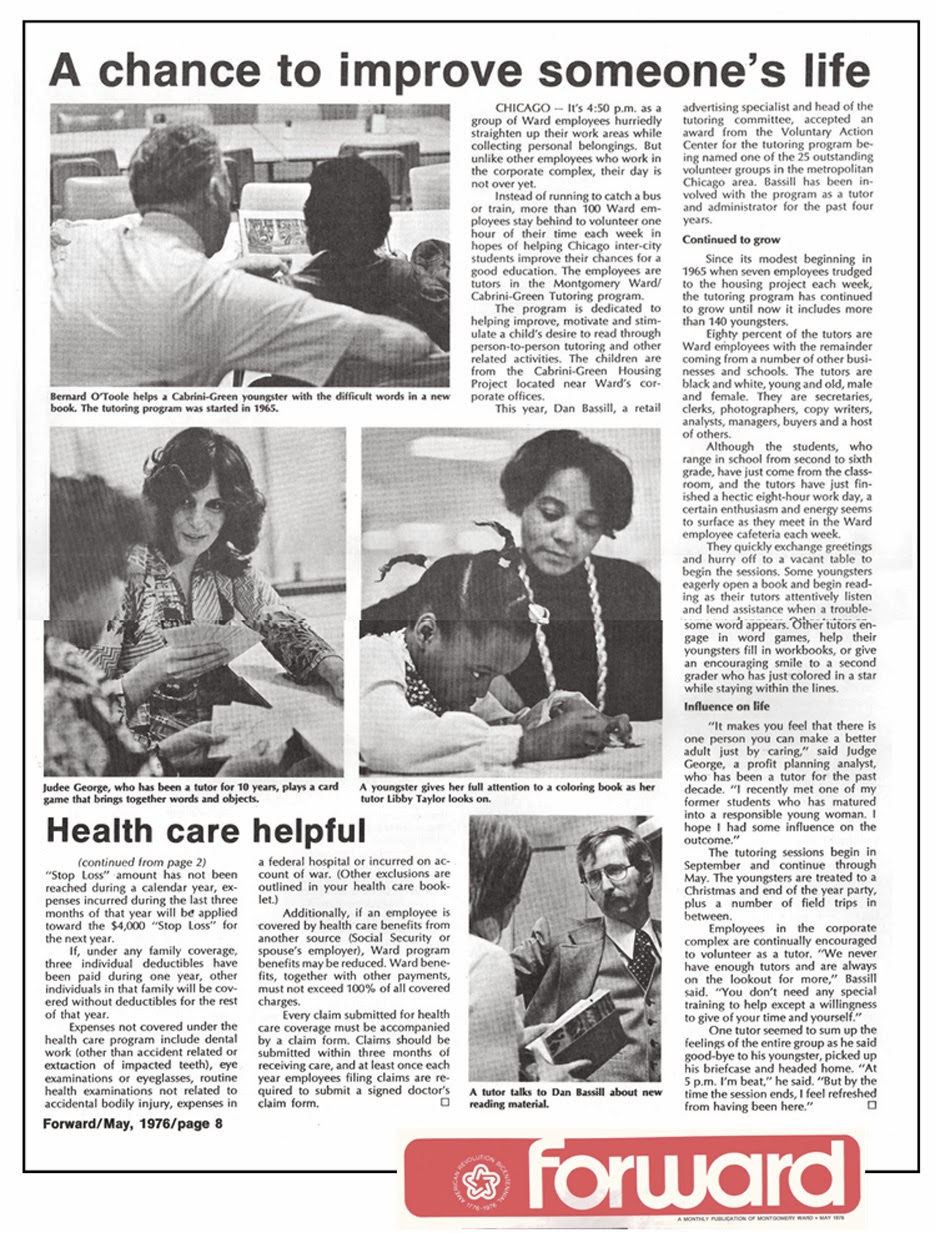
Having led a volunteer based tutor/mentor program since 1975 I knew how much work program leaders had to do to attract and retain volunteers. Having started a non-profit in 1990, I was learning how hard it was to attract and retain donations and operating dollars.  However, from 1973 to 1990 I held retail advertising jobs in the corporate headquarters of Montgomery Ward. I knew what people on different functional teams were doing to help all 400 of our stores get the resources and talent each needed to be great (and profitable).

Thus, while step 1 of the 4-part strategy was focused on collecting and organizing information, step two was focused on generating more frequent media stories intended to draw attention to all of the tutor/mentor programs in our data base, and to motivate people from throughout the region to adopt programs and support them on an on-going basis with time, talent and dollars.

Between 1994 and 1996 we developed an event strategy, anchored by conferences in May and November, and  a citywide volunteer-recruitment campaign in August/September. These drew programs together and drew volunteers and donors to programs, while also motivating media to write more frequent stories about the work we were doing.  Visit this page and you can view print stories generated over 24 years.  Below is an example:

Chicago Tribune, May 1995
In 1998 we began putting our library and stories on web sites and as we struggled from 2000 through 2010 to find funds to support our kids program and the T/MC we relied more and more on the Internet, blogs and social media to attract attention to programs, and our web library, since we had far fewer dollars and greater expenses after losing Wards in 2000 as host for our activities and our major donor.  I've had even fewer resources since 2011 when I created the Tutor/Mentor Institute, LLC to keep the T/MC operating after support the strategy was dropped by the original non-profit.

Chicago SunTimes, 1994
If you browse through articles on this blog, which I started in 2005, or the MappingforJustice blog, which was started in 2008, you'll see a consistent use of maps and visualizations and a consistent invitation for the T/MC strategy to be adopted and led by many leaders, in Chicago, and in other cities with similar problems.

You'll find many stories where I show that students as young as middle school and as advanced at PhD programs, could be duplicating my efforts to build a web library of local youth programs and create an on-going effort to draw needed resources to all of those programs.


I recognized in 1993, and continue to understand, in 2018, that unless we find ways to build and sustain public interest and involvement we'll not make much of a dent in the poverty, segregation, class and race-related issues that are the root causes of many of our problems.  I also recognized that without a map we would provide millions of dollars and still be missing most of the kids needing consistent, on-going help.

Since 2011 I've not not had the money to organize events and host the mapping, or have a team of people working with me on this. I've not drawn a salary. I've cut expenses to site hosting and use my time to continue to maintain the web library and list of programs and to draw people to my blogs, web library and list of  youth serving organizations.

View blog article
I've been interviewed often over the past 20 years. At the right is screen shot of talk about empathy, between myself and Edwin Rutsch who created the Center for Building a Culture of Empathy.

At this link you can find a few other interviews.   And, if you look at the links that I point to on this concept map,  you'll find many others who have been helping tell the stories I'm telling.


I keep looking for leaders who are thinking and acting the same way I do. They could be in Chicago, or in any other city. You'd recognize them by reading blog articles they write, looking at their web sites, and seeing what they post on social media.  There are many who do part of what I do.  I can't find any who apply the four-part strategy.  If you think you know one, send me the link to their web site and send them the link to my blog.

For 24  years I've gotten out of bed in the morning and spent the day doing whatever I could to draw attention and resources to youth serving organizations in Chicago so more kids could have the support they need. I'm still doing that, just with a lot fewer resources.

You can help change that by creating your own stories, using my blog articles and visualizations as thought-starters.  If you're in a business, university, hospital or faith group, you can form a group and adopt the T/MC strategy. If you're really ambitious you can reach out and form a partnership with me, that will lead to your ownership of these ideas and commitments over the next few years.

Connect with me on one of these social media platforms. I look forward to hearing from you.

Monday, March 28, 2016

What is Information-Based Problem Solving?


While many of the articles I've written since 2005 use maps and visualizations they are all intend to influence what people do to help make well-organized, non-school, volunteer-based tutor/mentor programs available in the lives of K-12 youth living in high poverty neighborhoods of Chicago and other cities.


At the right is a graphic that I'll refer to below. Read on..

If you do a Google search for many leading advocates for mentoring, then look at the images page, you'll see photos of youth and adults, which provide an emotional appeal for people to become involved as tutors and mentors.

If you search for the words "tutor mentor" my web sites will be on the first page. If you look at the images page, you'll see maps and graphics like the one shown at the right. which represent strategies that make great programs available in more places, and help you define what "great" means. You can find this graphic explained in this article

It shows that if we want kids in high poverty neighborhoods of big cities like Chicago to connect with adult mentors and experiences not common in their own neighborhoods, we need to help well-organized programs operate in these neighborhoods. If we want well organized programs we need to help build strong leadership teams that stay in place for multiple years and are constantly trying to improve their organization, based on what they learn from their own performance, and what they learn from others doing similar work.

For this to happen we need to influence what resource providers do, so talent, dollars and ideas flow more consistently to every program, in every neighborhood.

For that to happen we need more people looking beyond the images and logos and at other information, with maps and visualizations.


We're in a presidential campaign right now. How many voters are visiting campaign web sites to read position papers? How many of these web sites include maps and graphics like you see on this blog?  Yet, just about every hour of every day someone is doing something that encourages us to pay attention to the campaign based on what candidates are doing or saying and what others are writing.

How much of this is drawing people together to learn ways they can support needed k-12 learning and mentoring programs in one or more high poverty neighborhoods of Chicago and other cities?

How many millions of dollars in advertising, public relations and media attention are being devoted to these campaigns? How much of this actually translates to manpower at well organized tutor/mentor programs helping kids in poverty areas move through school and into jobs?

I've been writing these articles in one format or another for over 20 years. In every article I include hyperlinks, pointing to other articles that I've created or to articles hosted in the Tutor/Mentor web library, with over 2000 links to ideas of other people and organizations.

I don't have dollars to advertise so I depend on other people to give the articles attention and to forward them to people in their own network. If more people look at these ideas daily, more people will eventually do what's needed to provide operating resources to youth programs in more places.

At least, that's the goal.

So the article, or the idea, represents a "carrot". The presentation below illustrates how good ideas can be given attention in ways that they influence what others do to copy those ideas and apply them in other places.


I started building my web library almost 40 years ago, as ideas I was using to support my own involvement as a tutor/mentor working with a 4th grade boy in Chicago's Cabrini-Green neighborhood. When I was tapped to be the leader of that program in 1975, I used the library as a source of ideas to help me sustain and grow the program.


By 1990 I was beginning to share this information with others, to help other tutor/mentor programs grow in Chicago. Ultimately that's what led to the formation of the Tutor/Mentor Connection in 1993, then the Tutor/Mentor Institute, LLC in 2011.

 Over the years since 1993 I've come to understand my role as an "information intermediary". The ideas I collect and share can be used by anyone else in Chicago or other cities to locate individual tutor/mentor programs (see list of Chicago programs) which they can support with time, talent and/or dollars. The can also be used to build new programs in areas where none now exists, or where specific age groups are not being served with existing programs. (Read more about knowledge management.)

Since 1993 others have entered this space, doing similar work. In many cases that has resulted in fewer resources to help me in my own efforts. I created the map below so others could find other intermediaries in Chicago and learn what they are doing. In many ways this is intended to help the intermediaries connect with each other, and with my own efforts.


In 2010 a team of Net Impact volunteers did a short survey, comparing what the Tutor/Mentor Connection in Chicago was offering, to what mentoring partnerships in other cities were offering. They created this report after 3 months of work, recognizing that this report was only a beginning, or an on-going effort that should be updated every year.

I've not had the resources to do that, but I don't know of anyone who is trying to create this type of information, intended to help intermediaries compare what they do with what others are doing, so that all of them could constantly improve.

In the years since this report was completed, some of the mentoring partnerships, such as the Mentoring Partnership of Minnesota, have added many new mapping, public awareness and training features to their web sites. You can find a list of Mentoring partners here. If someone is looking at the various sites and creating a comparison report, similar to that started in 2010, please share this information.

One of the things to look for when you look at these organizations, or the intermediaries in Chicago, is how they point to each other from their web sites, and whether or not they point to an in-depth web library like the one I host. Do they show an on-going calendar of events, intended to draw attention and resources to the individual organizations in their network?

Look at the Donate page on most of these web sites, and it says donate to them, without any feature that encourages donors to support all the members of their networks.

A second thing to look at is what strategies are in place to motivate a growing number of people to look at this information, so that more people are providing time, talent and dollars to help well-organized programs grow in more places.


As we head toward the end of this school year, we all need to be looking forward to the start of the next school year in August/September and to what we'll do to help kids and volunteers connect for the following nine months.

We can learn from each other. We need to find ways to motivate more people to dig into this information and to form study groups so others are also using the ideas to help great, constantly improving youth programs, grow in more places.

Over the past six years I've had very limited resources, yet I've continued to share ideas that could be used by individual organizations, and by intermediaries. While anyone can borrow these ideas, I keep hoping a few will find ways to help me develop them and apply them in more places.

This concept map shows what I've been building, what I'm trying to maintain, and what needs to be built to support the growth of tutor/mentor programs in cities like Chicago.

Here's a page where you can make a contribution to support my own efforts. If you'd like a tour of the web library I've created, or talk about this concept map, just introduce yourself via Twitter, Facebook, or Linked in or the comment section of this blog.

Wednesday, January 27, 2016

Career Opportunity for Urban Youth - Data Story Tellers


Since 1994 I've been using maps to tell stories and encourage more people to be involved in helping build and sustain mentor-rich tutor/mentor programs in high poverty neighborhoods.  In many articles on this and other blogs I've suggested that this is a skill that youth living in high poverty neighborhoods could learn, supported by teachers and/or volunteer tutors and mentors.  We know that youth possess  unlimited pools of creative talent. This just has not been focused in this direction.

Last week I saw an article on my @tutormentorteam Twitter feed titled "Data Storytelling: Big Data's Next Frontier", written by James Kerr.  It emphasizes the talent needed to make sense of the big data that is becoming more and more available.   Over the past decade, I've connected to organizations like WEAVE, a new web-based visualization platform, to encourage them to enlist volunteers and youth to use their data visualizations in stories that make sense of the data, and point readers to actions they can take to build solutions to problems indicated by the data. This is an emerging field, thus, it's something  urban youth could enter on the ground floor.


If you're a parent, volunteer tutor or mentor, teacher or policy maker, I encourage you to look at a map of Chicago, or any other major urban area, and envision icons showing up in all the high poverty areas of the map, indicating that part of the mentoring and learning strategy of such programs is to teach youth leadership and communications skills, using data storytelling, to draw attention and resources to support these programs, and to help fill the map with more.

That can happen if more people use blogs, newsletters, web sites, etc. to include maps and other visualizations to educate and motivate others to take roles that lead to such results.

This PDF shows a variety of map stories I've created since 1994.  If you're a business, or philanthropist, I encourage you to become a sponsor of the Tutor/Mentor Institute, LLC, so I can update our maps, keep the map platform available, and keep this resource free to all who might be inspired by the stories. 

Saturday, January 02, 2016

Using Better Data to Support Innovative Problem Solving

I read this article, from the Stanford Social Innovation Review (SSIR) today, titled,"Bridging Communities and Government Through Data".   It shows how better data can point people and resources to places where complex problems require investment and on-going effort to create solutions.   This would be part of Step 1, from this 4-part strategy (see presentation)  that I've been sharing , and applying through my own efforts, since 1993.


The SSIR articles calls for government funding of the data gathering part of this process. I think that's part of the solution, but before we get consistent, on-going funding for everything that I include in this strategy map, we need to influence many people in the private sector to do much more than they do now.

The visualization below is one that illustrates a need to influence what resource providers do in order to also influence how government and social benefit organizations do.  Without building a flow of resources, to support innovation, learning, and stronger organizations in more places, the efforts to document and measure outcomes will be too few, and to limited. 


I don't know if you've set a New Year's Resolution yet, of if you ever do. However, unless more people share the ideas I write about, or that SSIR posts on their web site, too few people will be involved in doing the "influence" work needed to get more people involved, more resources involved, and better on-going distribution of talent, dollars, ideas and other needed resources into all of the high poverty areas which are the root of many of the problems we see written about in the daily media.

I've written more than 1000 blog articles since 2005 and I have hosted ideas like this on web sites since 1998. I included these ideas in printed newsletters before the Internet became my tool for sharing ideas.


Leaders in every sector, in every city, need to be writing blogs with the same information I'm sharing, and for the same purpose.

Among the data we need to be collecting would be data that recognizes, on an industry-by-industry, or faith group-by-faith group basis, who is actually taking this role.

In this presentation I show the potential of using the information we collect to inspire and influence constant, year-to-year improvement in what we're all doing to solve complex problems.

While I think this role can be adopted in many types of organization, I continue to seek partners, funders, investors who will help me continue my own efforts.  Click here and make a 2016 contribution to support my work. I'm not a 501-c-3, so I cannot offer a tax deduction.

I can offer to continue to share these ideas, at no cost, to you and other users if you'll help me. 

Tuesday, June 23, 2015

What Are You Doing to Support Volunteer Recruitment for Back to School?

I know it's still June, but what are your plans to help mobilize volunteers to be part of organized tutoring, mentoring and learning programs for the 2015-16 school year? School starts in September. Tutor/Mentor Programs should be sending out email to ask veteran volunteers to sign up for another year, and new volunteers to join, as we enter August.

However, what are YOU (business, faith group, political leader, media, celebrity, etc) doing now to help programs in Chicago and other cities recruit volunteers so more youth are able to benefit from a mentor and being part of an organized program?

Here's a presentation with tips for mobilizing volunteers. If teams of volunteers in business, faith groups, media, etc. look at this, there are many ways your team can help mobilize volunteers for various tutor/mentor programs serving your city.

Strategies for recruiting volunteers for tutor/mentor programs by Daniel F. Bassill


Don't wait until August. There is work that already should have been started. For instance:

Help programs build staff to support volunteers. If we were able to organize a massive volunteer recruitment campaign that doubled the number of volunteers we would fail in our mission if we had not also increased the staff available in different programs to support those volunteers. The worst campaign is one that inspires someone to volunteer, who then finds out there is no room for them, or get into a program where they are poorly supported. That volunteer turns around and tells others "Don't do this."

One way to help programs attract talent, is to help them get the operating dollars they need to hire and pay staff. Consider adding organized tutor/mentor programs to your company's workplace giving campaign choices, and to programs like "dollars for doers" and matching gifts. Encourage employees who already volunteer or serve on boards to tell other employees about the value of these programs and to encourage donations to support operations.

Help programs improve the way they tell their stories on their web sites. Volunteers and parents who are shopping to find a place to volunteer should be able to look at a web site and see if the program is close to where they live or work, has a history of success, is well organized, and meets at a time frame convenient for the volunteer and youth to participate regularly. View this shoppers guide for some ideas of what should be on a web site.

Teams of volunteers, or individual volunteers, can offer their talent to help programs improve their web sites, tell their stories, and even organize events that support learning and participation of youth and volunteers. This essay, shows roles of talent volunteers.


While its only June, now's the time to plan ways to include volunteer recruitment ads in fall media and business publications. Non profit tutor/mentor programs have few advertising dollars, yet it is reach and frequency of message delivery that finds potential volunteers (and donors) and encourages them to shop and become involved in tutor/mentor programs in different neighborhoods. Create ads that show your company logo, and point to web directories where people can learn about volunteer opportunities in their city.

One role volunteers can take is to help get tutor/mentor organizations listed on as many volunteer matching services as you can. This graphic is the Tutor/Mentor Institute, LLC's concept map showing a range of web sites where you can list your program. This includes the Illinois Mentoring Partnership, the One Good Deed Chicago and VolunteerMatch sites.

Do this work now and many kids will have the special opportunity of being part of an organized, volunteer-based tutor/mentor program this fall and for many years to come. You can help change the future through your actions.

If you'd like to meet or talk with me about actions you can take to support volunteer recruitment, just email tutormentor2 at earthlink.net or reach out to me on Twitter @tutormentorteam.

Monday, September 29, 2014

Can Billionaires Adopt Neighborhoods of Chicago?

I just saw a story in the Chicago Tribune showing that 17 people from Illinois are on the 2014 Forbes list of the wealthiest people in the US. A CBS report lists these people.

Now I understand that I've been tilting at windmills for a long time, but what if these 17 people divided the Chicago region and each pledged $10 million a year to support general operations of youth and family serving organizations in different sections of the Chicago region? This map illustrates the idea.


This money would not go to hospitals, universities, museums, religious groups (unless it is to operate a youth organization), nor would it go to political campaigns. The money would focus on high poverty areas using maps being produced by many different organizations to show health, education, poverty, violence, unemployment and other indicators. The money would not go to schools, either. If we change the support systems around the schools I feel more kids will come ready and motivated to learn. Maybe they will already have learned to learn, with the help of mentors in a non-school program that has a technology lab and volunteers from Google, Microsoft, Bank of America and other companies in the region.

If the richest people anchor such a commitment, those slightly less wealthy, like CEOs who earn more than 330 times low paid workers and more than 774 times what minimum wage workers earn, might also make on-going financial commitments to the same neighborhoods. See CEO Pay articles here and here.

How would donors choose who to support? This Shoppers Guide suggest information that could be on an organization's web site. Many of the youth serving organizations in Chicago neighborhoods may not collect this type of information, or have the ability to put it on web sites and in blog articles. The investments made by financial leaders should be intended to help every existing organization get the ideas, talent and resources to grow to be considered world class at what they do. That includes communicating what they do so volunteers, parents and donors can decide who to support, and so other programs can learn from what the best programs have already figured out how to do.

New organizations should form, using this investment, to fill voids in places where more programs, or certain types of programs, are needed. Maps should show where donor commitments are being made, and should show a growth of needed programs over the next 10-15 years, then a decline in the need for such programs as a result of this consistent investment.

Perhaps after 30 years there will be new problems that need this investment, but providing a support system that helps families and neighborhood schools help kids be better prepared for 21st and 22nd century roles, should not be needed in many places if such consistent, flexible investment is made for so many years.

Esquire Magazine has launched a Mentoring Project, with highly visible people talking about "who mentored them". Maybe they could champion my idea of wealth people adopting poverty neighborhoods with consistent financial support that matches their verbal support.

If ideas like this appeal to you, why not come to the next Tutor/Mentor Conference in Chicago on Friday, November 4 and introduce yourself. Or connect with me on one of these social media spaces.

Perhaps one of these wealthy leaders would want to put their name on the Tutor/Mentor Institute? If you dream it, maybe it can become a realty.

Thursday, May 29, 2014

Strategic Support for Black Male Achievement

A couple of weeks ago I read this report, titled “Building a Beloved Community: Strengthening the Field of Black Male Achievement”, which was produced by The Foundation Center, with funding from the Open Society Foundations’ Campaign for Black Male Achievement.

As I read the report I copied some of the text and graphics into a worksheet that I used to add my own endorsement for some of the ideas, along with suggestions from my own efforts to build mentor-rich support systems for inner city youth.

I encourage you to read the full report. Then take a look at my own comments.

In the introduction section, “Emmett Carson, president of the Silicon Valley Community Foundation, explains why a focus on supporting black men and boys is not just a “black issue,” but one that is in the national interest: “If you want America to remain great, if you want America to remain globally competitive, if you want an America which continues to innovate and have exciting job opportunities so the next generation will be better off than the last, if that’s the America you want, we can no longer afford for people of color in general, black men and boys in particular, to have the life outcomes that they do.”

The report is divided into sections, so the information can be read in an organized fashion. Yet, all sections are interrelated.

In the section about funders, one this message stood out: "the success of the Alliance rests on “a commitment by the presidents (of foundations) to deeply engage on this issue and sustain their level of enthusiasm—and match that enthusiasm with resources, both financial and human."

In the section about non profit organizations focusing specifically on the achievement of Black men and boys, one statement said “A wide range of nonprofit organizations are working in the area of black male achievement,representing an array of issue areas and approaches."

In the section focusing on research, these statements resonated with me "there is no shortage of research on black men and boys.“ “In order for scholarly findings to impact programs and policies, it is important that this work be translated for a broader audience.”

In a section titled, LEVERAGING RESOURCES ACROSS SECTORS, this is what you'll read:

“In addition to coordinating efforts, networks and partnerships can break down silos and contribute to sustaining the work by helping to leverage resources across sectors. States Ron Walker, executive director of COSEBOC, “We need to find synergies across the playing field. If we don’t connect the dots, then it will be one more example of an opportunity missed, reinventing the wheel, or wasting time.” There are so many interesting possibilities when you elevate something to a national conversation, but then there’s got to be some resources that begin to flow at the local level to really implement some of those ideas.”

If you look at my comments, and articles I've written on this blog, I suggest that the field of organizations working on this issue, as well as those doing related work, be plotted on maps, showing where programs are located, along with what zip codes have the greatest number of youth needing extra support.

In addition, I encourage the use of concept maps, like the one below, to create an understanding of the different types of supports needed at different age levels, and in every community, to help youth develop their full potential, or to change the narrative about how Black men are perceived.

Each node on a map like this represents a practice that is working in some places but needs to be available in many places. An on-going research project would be needed to create and maintain a map like this, along with maps showing service providers in different communities.

If such maps are available on web platforms, then the strategies using social media, collaboration and collective action can enlist more people in "awareness building" and more people in "resource mobilization" so that dollars, talent, ideas and other resources become more consistently available to youth-serving organizations and intermediaries on a continuous basis. All of the organizations working to help youth move through school and into jobs and careers require the same on-going support. Building a coalition of leaders and partners who can generate this flow of resources for a decade or longer is a huge, but essential, challenge.

HOW DO WE KNOW WHEN WE HAVE SUCCEEDED? WHAT DOES SUCCESS LOOK LIKE?

This was the last section of the report, and I hope most readers get this far. It's the most important. Below I've pasted part of the text from this part of the report, along with my comments. I hope it generates some discussion.

“As our report highlights, there is much work to be done. But there are also indelible signs of success. Success looks like the 100 percent college acceptance rate—for five years running—at Urban Prep Academies, a network of all-boys public schools that serves students from economically disadvantaged households. Success looks like BMe, a group of more than 7,000 black men and their friends of all races and genders who build community together and who provided services to more than 130,000 neighbors in 2013 alone. Success looks like the launch of the Institute for Black Male Achievement, which boasts more than 2,500 members contributing to black male achievement. Success looks like the Young Men’s Initiative in New York City, an unprecedented public–private partnership that works comprehensively across city agencies to reduce disparities faced by young men of color. Success looks like leading foundation presidents coming together to form an alliance, and success looks like the President of the United States stepping out to pledge support to transform the life outcomes of black and Latino young men.“

"Success looks like the President of the United States stepping out to pledge support to transform the life outcomes of black and Latino young men.”

To me, other than the college acceptance rate of Urban Prep Academies, which is the result of four years of high school support, none of these other definitions of success show the impact on young men after 5 or 10 years of continuous support. Most of these indicators of success are steps toward a goal.

If these are not sustained, the goal is not met.


In this blog article Shawn Dove, manager of the Open Society Campaign for Black Male Achievement, writes "While this report has generated a good deal of activity in just the first days of its release, the overriding message woven through it is that we must not confuse activity with progress."

The report concludes: “The collective impact of these initiatives (and so many others in the field) will get us closer to the Beloved Community Dr. Martin Luther King, Jr. envisioned, one which recognizes the value and humanity of every individual. This community encompasses the full and active participation of every member of a democratic society and is based upon justice, equal opportunity, and love.“

“This vision is not wishful thinking; it is attainable through the efforts of committed individuals, dedicated organizations, and partnership and collaboration. So where do we go from here? Let’s build the Beloved Community, together”


In his blog article Dove invites others to share their own ideas on How do you measure this?

My first recommendation is to create maps showing where help is needed, and what organizations already operate in those areas who are providing help. Then create maps showing who is providing funding, volunteers, tech support and other supportive assets in each area. This graphic is from the Foundation Center web site, showing that they have the capacity to map the flow of philanthropic donations.

Second, as I suggested above, create a library of information showing the types of programs that need to be available in every area with high concentrations of Black men and boys. At the same time, teach programs to use their web sites to show what service they provide, where they are, what they do, what impact they have, what help they need. A version of this "shoppers guide" could be created and used by this Alliance.

The maps are part of a process intended to make constantly improving, long term support programs available in all places where they are needed. Filling in the maps over a period of years is just one measures of success:

My work focuses on helping youth in high poverty areas move through school and into jobs and careers. Unless we build the information base we can't provide support to all of the organizations who are already working in this field. However, this is still only part of a process.

How do we measure success?

In every city and state a version of this map could be created. Links in the map should point to individuals, corporate and faith leaders, political leaders, etc. who have demonstrated their own commitment to this challenge, by putting a strategy map like this on their web site, and by documenting actions they take to build public awareness, draw people together, and draw resources directly to the youth serving organizations shown on the map of providers.

If the number of leaders, from every sector, grows from year to year, this Alliance will be on the road to success.

Here are a couple of other potential measures of success:

As a result of this Alliance, our prisons are empty. There are no high school drop outs. Every Black baby born in 2020 will be fully employed in 2050, earning a living wage, voting in every election, serving in leadership and volunteer roles helping younger boys grow up.

The "narrative" will have changed. (see page 38 of the report) Public perception surveys taken between now and 2020 and taken every five years until 2050 will show positive gains in all of the indicators that are important to achieving a just society. In addition, surveys of youth in 3rd grade, 8th grade, 12th grade show hope and optimism, at much greater rates than surveys taken in the 2014-2020 period.

In the section of the Report titled "Re-Thinking Philanthropy" the writers say

“This field has been particularly and acutely subject to waves of waning philanthropic interest.” "Patient funding over time is what’s needed.”

I started leading a volunteer-based tutor/mentor program in Chicago in 1975, serving Cabrini Green area elementary school youth. 99% were Black boys and girls. I created Cabrini Connections in 1992 to help 7th grade youth from Cabrini-Green and other neighborhoods move through high school and toward jobs and careers. 95% of these youth were Black. I created the Tutor/Mentor Connection in 1993 to help constantly improving, mentor rich programs, grow in all high poverty areas of the city, including those neighborhoods with high concentrations of Black youth. I've been thinking of this problem for nearly 40 years and have created a huge research library that connects people who visit my web sites with work being done by thousands of others.

Thus, I've developed a lot of ideas that others might borrow.

Read: problem solving strategy, year-round strategy, collaboration strategy and other PDF essays in the Tutor/Mentor Institute, LLC library. I've created a map-based directory of Chicago tutoring/mentoring organizations. I've hosted a networking conference every six months since May 1994.

If my ideas or ideas from others are to be fully implemented, many new investors and benefactors will need to step forward, championing this effort in every part of the country where it is needed.

I hope to help others understand and apply these ideas. I hope others will help me continue to develop them.


Tuesday, January 21, 2014

Lessons from Polk Bros – Power of Advertising!

On January 8 I attended the Polk Bros Foundation’s 25th Anniversary. I wrote about that in this article.

While leaving the event I was given a copy of a book titled “I Bought It at Polk Bros: The Story of an American Retailing Phenomenon”. It’s available on Amazon. Free copies might be available from the Polk Bros Foundation.

This is the story of the growth of a Chicago retail giant, starting with a very, very small appliance store, in the 1930s. It’s the story of an immigrant family, and the vision of one man, Sol Polk, the company’s founder and president until he died in the 1980s.

This story resonated with me because from 1973 to 1990 I held retail advertising management positions with the Montgomery Ward Corporation, a competitor of Polk Bros in the Chicago market. Being part of the advertising department, I and the writers, artists and production people who worked with me, were constantly frustrated by how the merchandise people would change ads often, and frequently at the last minute.

In reading about Sol Polk’s commitment to advertising, and how he watched competitor ads and made last minute changes to TV and Radio scripts and print ads so Polk Bros could have a lower price, I recognized what was happening in my own company, and how savagely each business competed for customers every day.
(This is the front cover of one supplement I created for the Automotive Department at Wards)

So what does this have to do with volunteer-based tutoring/mentoring? I led the tutoring program at the Montgomery Ward headquarters in Chicago from 1975 to 1990, as a volunteer while holding advertising roles with growing responsibility. By the early 1980s I was in charge of creative development of all national print advertising.


Thus, leading a volunteer program with 200-300 pairs of kids/volunteer meeting weekly, and virtually no paid staff, was a real challenge.

I learned very early that there was no way to provide enough training to volunteers to solve every problem they would face as a tutor/mentor. All kids were different. All volunteers were different. They all were constantly changing.

Thus, I began to borrow from my advertising experiences to share ideas and motivate actions within my volunteer world. Every week I created a one or two page “newsletter” which included tips for tutors, announcements of weekly activities, and an encouragement to dig deeper into our resource library to understand why the tutor/mentor program was needed, and ways volunteers could support the overall program’s growth.

Initially my “mass communications” was a mimeograph machine to make copies, and my own two feet to pass out these copies each week to our volunteers. The format for making copies changed as we moved to desk top publishing and copy machines in the 1980s and 1990s, but what really changed was the Internet becoming a place where we could host ideas that any of our teens, volunteers and donors could find them. By 2002 I was sending a weekly email newsletter to our volunteers, and a monthly email newsletter to all of our supporters.

While this works within a single program, if you have the time to create a newsletter, and to research ideas that you would put into it, not every program has people who can do the design, writing, formatting, publishing and distribution of electronic communications.

What’s more significant, motivating people to read the communications weekly and dig deeper into the research, and to form small groups to discuss the ideas with peers and other volunteers, is a challenge that still has not been solved.

Busy volunteers, staff members, directors, donors, etc. have many other priorities in their lives beyond their involvement in the tutor/mentor program. Even people paid to do the job spend so much time with day-to-day challenges of supporting youth and volunteers and keeping funds coming in, that there is very little “flexible time” to spend reading and “learning”.

I’ve written about MOOCs in the past year and this week I’m participating in a Deeper Learning MOOC, that engages more than 1000 people from around the country around the topic of “Deeper Learning”, which according to the William & Flora Hewlett Foundation, is…..“students engaged in deeper learning—are using their knowledge and skills in a way that prepares them for real life.

They are mastering core academic content, like reading, writing, math, and science, while learning how to think critically, collaborate, communicate effectively, direct their own learning, and believe in themselves (known as an “academic mindset
”.”

Over the past week I’ve read several hundred introductions, mostly from educators. What concerns me, is that too few of these are people working in big city school districts, such as Chicago, Detroit, New York, Houston, LA, etc. If leaders and thinkers from these cities are not engaged in “deeper learning” how can we expect to bring higher quality learning experiences to inner city youth.

I’ve also seen very few participants in my MOOCs from people who lead non school tutoring and/or mentoring programs. If representatives from programs, and from those who support these programs, are not engaged in “deeper learning” how can they find ways to constantly improve the impact of their programs, or the flow of operating resources and talent that are essential to program improvement?

Sol Polk understood the power of advertising. He also recognized that he could get other people to pay for a large part of the costs of his advertising. The people who manufactured the merchandise sold in Polk Bros stores provided dollars for advertising costs. There’s an entire chapter on this in the book.

In his TED talk, Dan Pallotta talks about the power of advertising, and shows how donors are not willing to pay the costs for non profits to advertise. Read more here.

When I started Tutor/Mentor Connection in 1993, one of the key goals was to increase the frequency of news stories talking about tutoring/mentoring programs in Chicago. That’s still a goal.

Tutor/Mentor Connection and Tutor/Mentor Institute, LLC will never have millions of dollars for advertising. Thus, companies, churches, college groups, athletes, etc. need to become our “advertising partners” using their own media, visibility, in-store displays, etc. to build awareness and draw “customers” --- youth, volunteers, donors, etc. --- directly to the different tutor/mentor locations operating in Chicago or other cities.

Polk Bros did not just spend millions of dollars on advertising and promotions without a clear purpose. They ran “sales” and “events” throughout the year, which were intended to motivate customers to come to their stores. VOLUME was the goal of Sol Polk.

VOLUME is also the goal of Tutor/Mentor Institute, LLC. We must dramatically increase the number of people who are thinking about tutor/mentor programs every day, and who are visiting web sites to learn more about where, why and how they can help programs in different neighborhoods of Chicago.

National Mentoring Month is in January every year. Events throughout the month have encourage people to post articles on blogs, comments on Twitter and Facebook. New stories have shown how mentors can change a youth’s life. This needs to be happening 12 months a year, not just in January.

Every story needs to end with a “call to involvement”. A “hook” as Sol Polk would have described it, that motivates a customer to come to a store, or to support a tutor/mentor program in one of Chicago’s neighborhoods.

If you’re an advertising professional, a retail executive, a PR manager, etc. this is a strategy you certainly should understand, and that you can support in your own efforts to help Chicago become a place where EVERY child has the opportunities and support to find work, establish a career, and raise a family out of the grip of poverty.

If you are a foundation established using wealth created by entrepreneurs who started their companies in the early part of the 19th century, why not go beyond giving grants. Why not spend some of your own capital to create “advertising” that draws other donors, volunteers and leaders to support the same programs you are funding?

Few foundation grants provide more than 5% of the total operating costs for any non profit. Many don’t even cover costs of general operations…which is the cost of keeping the doors open and constantly improving. Thus, it would seem to make sense that using foundation dollars (in addition to advertising and sales promotion from others) would help attract more (up to 100%) of the dollars every non-school tutor/mentor program needs to operate effectively every year.

Where are people talking about this? Is anyone hosting a “Deeper Learning” MOOC that engages donors, business leaders, advertisers and shows them more ways to help draw on-going customer support to all of the different non profits needed to enrich a city like Chicago? During the National Mentoring Summit, being held in Washington, DC on January 30 and 31, many of the sessions will be available on line (for $20 fee). Maybe some of us can connect via that forum.

Who wants to help fund the Tutor/Mentor Leadership and Networking Conferences so they can attract leaders and support this type of conversation, face to face, and via online communities? The next conference is May 19 and sponsors and workshop presenters are encouraged to step forward and introduce themselves.