Showing posts with label tutoring. Show all posts

Sunday, February 12, 2023

Super Bowl, Tutoring and Mentoring

Today's the big football game. It will be watched by millions of people from around the world.  I hope a few of those from every city will find, and read, this and other articles I've posted on this blog since 2005.

My friend Brian Banks, who posts on LinkedIn, sent me an article about a virtual tutoring company called Paper.  I read the article, visited the website and added it to this collection in my library.  

I led a volunteer-based tutor/mentor program in Chicago from 1975 to 2011 (joined as a volunteer in 1973).  I created the Tutor/Mentor Connection in 1993 to try to make this type of program available to more kids in high poverty areas.  

Two things stood out in the article about Paper.  

1) the $40 cost per student is paid by the school, not the family, but there are still many schools that cannot afford this cost.  (I did not find cost information on the website, such as how long the $40 fee applies. Is it for a full school year? A shorter time frame?)

2) according to the article "the biggest hurdle is 'awareness'.  If students don't know the service exists, the district buys it, and it sits on a shelf. It's not good for Paper and it's not good for the school, or the students. So building that awareness is the number one most critical thing."

Below is a graphic I've shared often on this post.  


The map in the lower left corner shows high poverty areas of Chicago. As kids grow up different events in their lives influence their learning, and their motivations to learn. This could be lack of reinforcement at home, traumatic events such as shootings, or deaths from health issues. It could be a growing awareness of poverty and racism as the youth moves from middle school to high school. It could be the change in adult support as they move from elementary school, to middle school, then high school. It could be the influence of street gangs, in their own family, and/or in their neighborhood.

These affect each youth differently, at different times.  

Open the concept map shown below and look closely at the supports kids need at each grade level as they move through school and into jobs and careers. 
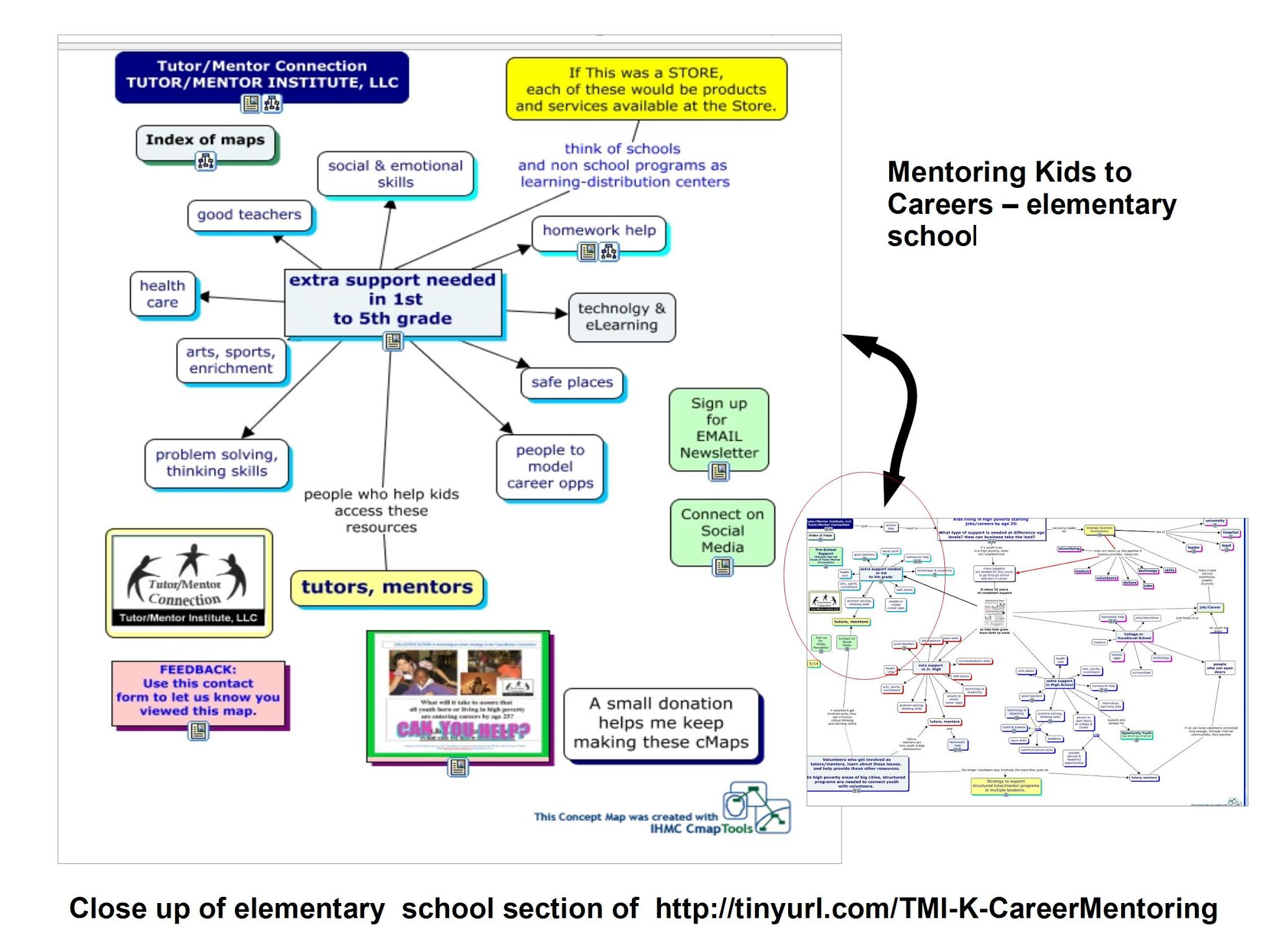
I've not found a similar map for Chicago or any other city.  Nor have I found an analysis showing on a school-by-school basis, which of these supports are available.  However, at each level homework help and good teachers are needed. Thus a virtual learning option like Paper could be really valuable...if it was available, and if they knew about it.

This is where organized, non-school, volunteer-based tutor/mentor programs can make a difference.


In the programs I led kids came to our site once a week throughout the school year, where they met with a primary one-on-one tutor/mentor, and connected with a variety of other volunteers and learning experiences.  View some of the yearbooks to see the range of activities and volunteers.  

Many students continued for multiple years, often with the same volunteers.  Staff and program leaders provided additional continuity.  
I would have loved to have had access to a learning tool like Paper.  Our volunteers could have coached kids to use it, when they needed extra help, solving part of the awareness problem.

In addition, since our volunteers came from many different companies in the Chicago region, and often from families with significant wealth, they could have helped raise funds for schools to afford services like Paper.

Take another look at the concept map shown above and consider the role volunteers can take to help draw needed resources to schools and families. 

A few days ago I posted an article that included a 2013 map showing participation in an Education, Technology and learning MOOC.  


On Friday evening I participated in a ZOOM reunion with a few of those people, who've stayed connected for the past 10 years. This was posted on Twitter following the gathering.
When I look at a participation map like the ETMOOC map I'm thinking of all the people, from so many different places, who are gathering to talk about ways to help kids.

Imagine a similar map showing Super Bowl viewers.  What would it take for hundreds, or thousands, of people in every city to be looking at information and sharing ideas for building mentor-rich, birth-to-work support systems for kids in every high poverty area, including virtual tutoring resources like Paper offers? 

Below is an animation that illustrates a role athletes could take on a regular basis to mobilize fans and owners to support constantly improving youth programs in high poverty areas.


This animation, and other videos in my library, could be re-produced in many ways, with hundreds of different athletes, celebrities, etc. giving the message.

I hope you'll think of these ideas as you watch the Super Bowl and reflect on it in coming days and weeks.  


Thanks for reading. Enjoy the game.  My family has roots in Philadelphia, so I'm rooting for the Eagles!

Connect with me on Twitter, LinkedIn, Instagram, Mastodon and/or Facebook.

Help me pay the bills!  Check out the Fund T/MI page

Thursday, February 07, 2019

Tips for Tutors Video from School on Wheels - Indianapolis

Thanks to Tutoring Chicago for sharing this video on LinkedIN. And thanks to School on Wheels - Indianapolis for creating it.

If you're a volunteer tutor, tutor/mentor or staff in a program, this short video is a useful resource.


I added this to the 'training links" section on the Tutor/Mentor Connection web site. 

Monday, July 16, 2018

Find a Program and Volunteer Time, Talent or Dollars

Every year since 1995 I've pointed people to a list of Chicago area volunteer-based tutor/mentor programs and said "choose one where you can use your time, talent and dollars to make a difference".

Almost every article on this blog focuses on helping well-organized, mentor rich non-school k-12 youth programs reach kids in every high poverty neighborhood.  As we move through July I invite you to browse through past articles written during this time of  year and apply the ideas to helping kids in Chicago and other cities.

Since there is no single master list showing every youth serving organization in Chicago or any other city I created this concept map to point to my lists, and to other sites which also serve as resources for learning about youth organizations in Chicago and other cities.

Take some time to get acquainted with the information, then spend time weekly encouraging others to do the same.

These are some of the kids you'll be helping.

Sunday, September 24, 2017

Resources for Volunteer Tutors and Mentors

School started a few weeks ago and volunteer-based non-school tutoring, mentoring and learning programs have been recruiting, screening, training and preparing matches as they start their programs for the 2017-18 school year.

In most site based programs there will be one or more computers and almost all volunteers will  have their own phones, and perhaps laptops, too.  That means that all of the information on the Internet is available to support what volunteers and students do every week.

I've been building a web library to support tutors and mentors since 1998, which I started in the 1970s when I was leading a site based program in Chicago. Below is a concept map showing the homework help sections of the web library.


I created the short video below to guide you through this concept map and to encourage you to use it to find resources that tutors, mentors, students, parents and educators can use on an on-going basis.


Toward the end of this video I encourage youth and volunteers to use blogs to write about the on-line resources they use, showing what they like and how they were used. This is a great way to reinforce the habit of learning and sharing what you learn. It also reinforces what is being learned.

I created this concept map, and this blog article, to show how schools and youth organizations should focus on building student and volunteer habits of visiting web sites continually to get and give information.

This is not only important now, as students are in school, and connected to a volunteer tutor/mentor, but it is important for the future. Programs who can attract alumni to their web sites in future years can collect information that shows long-term impact, and can draw alumni into efforts that support the program, and support youth who will still need tutor/mentor program support in future years.

These resources are constantly updated. If you see broken links let me know. If you find new resources that should be added, let me know. If you write about these on your blog, I want to add your blog to the list that I follow.

Finally, if you want to provide some financial support to help me continue to keep this resource on-line, click here and add your support.

Saturday, April 01, 2017

Use Website to Communicate Youth Program Design

 I point to nearly 200 Chicago youth serving programs in the links section of the Tutor/Mentor Institute, LLC web site.  On many web sites there is a list of services, and tutoring and/or mentoring might be included. On others there is a page on the web site with a message something like this.
School-Age is a program that provides educational support, cultural enrichment, and recreational development activities to student ages 6 - 12. It’s open five-days-a-week and full-time during the summer and on school holidays. The program is for low-income parents who are either working, in school, or job training.
Other web sites seem more fully devoted to youth tutoring and mentoring, and the first page on the web site uses photographs of youth and volunteers to signal this purpose. Some provide a great deal of information showing program design, history, alumni, etc. Others show far less information.

What I see frequently in the youth development field, and on Chicago programs' web sites,  is an emphasis on the act of "tutoring" or "mentoring" or arts, technology and/or video making,  but not a strategy that weaves those acts into a long-term web of support that helps kids in poverty areas move through school and into careers.

I think of non-school volunteer-based tutor/mentor programs as a potential "learning distribution system", like a retail store, with a wide range of age-appropriate mentoring and tutoring and experiential activities, made possible by volunteers from different work/life backgrounds and a consistent flow of flexible operating dollars.  Such programs are needed in every high poverty neighborhood.

A few years ago I created a presentation that I titled "shoppers guide" to show some things that I think parents, volunteers and donors might want to see on a youth tutor/mentor program's web site, to help them decide whether or not to get involved with that program.  Here's the presentation:


I created another presentation, titled "Virtual Corporate Office", to show how volunteers from different industries, trade associations and universities could help programs build a mentor-rich program design, and communicate it effectively on their web sites.


In most of my presentations and many of my blog articles I use GIS maps, showing where comprehensive, long-term, tutor, mentor and learning organizations are needed, based on high rates of  poverty, segregation, crime and violence, etc.  While there are a few really well designed programs doing great work, programs in every poverty neighborhood need to be great, and constantly getting better.

For that to happen businesses and other assets in a neighborhood, and in the city, need to form teams of volunteers who work to help programs become great, by working to help employee volunteers and corporate dollars become involved as long-term support systems.

I attended a presentation yesterday where the President of a Chicago business emphasized the importance of leadership commitment to partnerships with youth serving organizations.  In this Role of Leaders presentation I emphasize that commitment, but also show how this can lead to the growth of an employee led team of volunteers who work to engage the company, and its industry, effectively in support of youth programs that have long-term career-focused strategies.


In many past articles I've focused on the need for leaders in every industry, university, hospital and faith group to make a long-term commitment to help kids move through school and into careers.


A version of this concept map should be shown on the web site of every leader who makes this type of long-term commitment, and supports the four-part strategy needed to make great programs available in more places.

The Mayor of a city, and Governor of a state, should be the number one cheerleaders, recognizing leaders who make this commitment and show it on their web site, and arm-twisting others who don't take a similar role.

Hosting a list of youth serving programs is a huge challenge, but it's really only the first step of building an information base that helps us understand the different types of youth serving programs available to youth at different age levels, in different zip codes.  I've reached out to people in business and  universities over and over for many years, seeking others who would dig into the list of youth programs I host, and build a deeper level of understanding about what's available in Chicago (or other cities) and what more is needed.

That type of research is still needed, in Chicago, and in other cities. 

I'd be happy to help you walk through the ideas I share on my web sites.  If more leaders take the roles shown, more youth program web sites will begin to show a comprehensive theory of change, a long-term program design, and alumni who are now working as a result of support the program provided during k-16 years.

Friday, December 02, 2016

Steps for Starting a Volunteer-Based Tutor/Mentor Program

I saw a Tweet this morning from MentoringUSA, saying, "9 million children in the US do not have a #mentor"

This graphic is part of a logic model pdf.  If we believe connecting a youth to extra adults and a wide range of learning an enrichment activities is important, then we need to build and sustain youth serving organizations in all places where kids need extra help, so that volunteers can more readily connect with these young people. This requires leadership from business, universities, religion, media, politics, entertainment, etc.

I led volunteer based, non-school tutor/mentor programs in Chicago from 1975 to 2011. The first program was already started when I joined as a tutor in 1973, then became its volunteer leader in 1975. At that time about 100 pairs of 2nd-6th grade youth and volunteers, mostly employees at the Montgomery Ward Corporate Office in Chicago, were starting the year, but only about half were staying the entire year. By 1990 the number was up to 300 pairs, with the number growing from the start of the school  year till the end.

In November 1992 I and six other volunteers formed Cabrini Connections, to help kids who aged out of the first program have a support system helping them from 7th grade through high school and beyond. The program started with 7 volunteers and five 7th and 8th graders in Jan 1993 and reached about 90 pairs by 1998. It stayed at that level through 2011 due to limits of space.  Many alumni are now college graduates, working, and raising their own families.

While the program at Montgomery Ward was not a non profit and primarily led by volunteers, the Cabrini Connection program was a non profit, and each year we had to raise money to fund our operations. By 2011 we had raised over $6 million dollars, funding both the direct service tutor/mentor program, and the Tutor/Mentor Connection (T/MC), which we launched at the same time (1993). This is a 1965-1990 timeline that shows some milestones in that growth.


Based on this long experience of operating a program, I've created three presentations that show steps to starting and sustaining a program.

I'm writing about Steps to Start a Program today.

In this I emphasize some of the reasons programs fail, and listed some points made by Mark Freedman in a 1991 book titled, "The Kindness of Strangers: Reflections on the Mentoring Movement.". These include - missing infrastructure; -  poor program models; -  missing follow-up; - emphasis on marketing and recruitment instead of program support; - poor or no coordination

Then I provide a set of visualizations and ideas that can overcome these obstacles, such as the one below.

4-color graphic created by Wayne Berg, artist at WANYiMATION 

Over my 35 years of leading a tutor/mentor program, I've developed a commitment to comprehensive, mentor-rich programs, which build connections early in a youth's education timeline and try to sustain them as the youth moves through school, toward college and a career.

This idea is communicated by the small graphic in the lower left and by the two larger 4-color graphics. As you look at these, I want to emphasize another point. While I created the smaller graphic, Wayne Berg, artist at WANYiMATION, working with Sara Caldwell, a former tutor and long-term supporter, created the four-color interpretation. You'll see several of these in the presentation. What this means is that students from many places could be creating their own versions of these presentations.  Interns from IIT in Chicago have been doing such work with me since 2005.


When I say "mentor-rich" I mean volunteers should be recruited from a wide range of business and work occupations and experiences, so youth have many role models they can aspire to achieve, and so the organization has many talents to draw upon to help it grow, as well as many sources of potential funding and support.  I illustrate this in another presentation that I titled "Total Quality Mentoring".

In Steps to Start a Program I use a version of this same graphic to describe the "team" of volunteers (some may become members of your Board of Directors) who need to be recruited to support the work of starting a program, then sustaining and growing it. This Talent Map is a worksheet anyone can use to see that they fill all of the needed functional roles. You'll see an updated version of that talent map in the PDF presentation.

While I was  a volunteer, leading a tutor/mentor programs with 100 pairs of kids/volunteers in 1975, that grew to 300 pairs by 1990, I also held full time retail advertising management roles with Montgomery Ward. I did not have a lot of time to reach out and "teach" every volunteer everything they needed to know.


So I began to create a "resource library" that I encouraged volunteers to draw from to support their own learning and innovations.  That library has grown extensively over 40 years and now is available at this link.

In Steps to Start a Program I emphasize the need to draw your volunteers and co-organizers into this learning process. Look at research showing where and why programs are needed. Look at web sites of other programs, in Chicago, and around the world, to see what ideas they include in their programs that you want to include in your own. This learning, comparison and constant improvement should be an on-going part of your operating philosophy.

The result of this learning should be a definition of mission, goals and a theory of change, which will guide your program development and future operations.


Throughout my blog articles and in Steps to Start a Program I use graphics to illustrate program design principles. In this one I talk about the role of programs, volunteers, parents, peers, etc. as one of "pushing" kids to make the right choices, practice the right habits, etc. to  enable them to stay safe and have the lives and careers they aspire to. Don't we all wish kids would listen to everything we tell them?  

In this graphic I also show the role of businesses, and their volunteers, dollars, technology and jobs in "pulling" kids through school and into careers. In the research section of the web library are countless articles showing how poverty, and the need for income to support a family, lead kids off the path to college and careers. Program designs that include business as full partners can "influence" choices and aspirations and provide experience, income, jobs, apprenticeships and much more.


In Steps to Start a Program program design then leads to program location.  Finding a place to operate, that is easily and safely accessible to kids and available to volunteers when they are heading home from work is essential in creating a program that will attract and retain a growing number of participants.

Once  you have a space to operate then you decide dates and times when the site is going to be open and when kids and volunteers will meet.  If you have a facility that you can keep open during non-school hours, the staff become mentors and glue that attracts kids and volunteers. While a volunteer might only meet with a youth two hours a week on one day, the youth might visit the site on other days to  use the computers, meet in group learning activities with other volunteers and/or just "hang out" with peers.


Next you need to determine strategies for recruiting volunteers and students.  These are two different challenges.  If your planning process resulted in a team of volunteers from local businesses, faith groups and/or colleges, you have people to help you recruit volunteers. If your facility is easy to get to, and hours of operation fit time frames when volunteers are available on an on-going basis, and you design an on-going communications program that encourage volunteers to participate, you should be able to build a corps of volunteers, who as they build loyalty to your organization, will then encourage other volunteers to join you.  This is a process. It can take several years for a program to grow. 


Having a reliable source of student participants is essential to attracting and keeping volunteers. If kids don't show up regularly volunteers will become discouraged and not continue to participate. Thus, your planning needs to develop partners in schools, public housing, and faith groups who will help you with your initial recruitment.  Once students start to participate you should build a direct connection to parents and care-givers, support on-going  participation.

So you want to start a program. Are you including all of these steps in your planning? 


We're in December now. If you use Steps to Start A Program and have success building a team and doing your research, hopefully you're ready by mid June to set a start up schedule and launch your program by recruiting kids and volunteers.

Wait! What about funding?  Have you found some donors who will provide the money needed to pay rent, insurance, staff, supplies, office equipment, etc?  If you've recruited a team from different businesses, they can help open doors for funding opportunities. If you're really lucky, you have a wealthy patron. You may be seeking a government grant, but those come with restrictions and don't cover all your costs.  In the Tutor/Mentor web library are many articles to read about fund raising.  Do your homework. Know what challenges you face and what resources are available.


Hopefully, next August you're starting to recruit kids and volunteers and by mid September you've done the screening, orientations and matching and kids and volunteers are starting to meet.

Do you have a plan to track participation, provide feedback, coaching and follow up on a regular basis?  How will you evaluate what you're doing so  you can learn what works, what is not working and find ways to keep improving?  That needs to be part of your planning process.  This Shoppers Guide PDF shows some things you should be thinking about before you start your program, and focusing on as you move through the first year toward your 50th  year some time in the future.

Summary:
Every child who is helped by a volunteer-based tutor/mentor program to become a tax-paying adult represents a savings and an investment.  We are offered with the choice of a 12 to 16-year investment as a child becomes and adult and becomes a taxpayer, vs the potential lifetime costs of public services associated with children who live adult lives that are a drain on social resources, and who raise future children who re-enter the cycle of poverty.

Volunteer-based tutoring/mentoring programs can not-only help individual inner-city children have a wider range of possibilities for long-term personal fulfillment, but they can also engage adults who don’t live in poverty, and educate them to become more personally involved as they build their bonds with the kids they connect with in tutor/mentor programs.

These programs enrich the lives of the volunteers, as much as they support the growth of  youth skills and aspirations.

Building strong programs and making them available in more places is a huge challenge. Do your planning. Do it right.

I've only highlighted some of the information in the Steps to Start a Program guide.  If you want to view the entire pdf, it's available on Scribd.com and on Slideshare.com.

If you'd like my help in understanding and applying these ideas, I'm available for monthly conversations for a small consulting fee. Of course I'm sharing these ideas regularly on my blogs, and most of the pdf presentations I point to are available at no cost.

If you value this information, visit this page and consider making a contribution to support the Tutor/Mentor Institute, LLC. 

Sunday, August 28, 2016

Help Urban Youth Connect with Tutors, Mentors, Extra Learning

School has started, or will be starting in the next two weeks. Volunteer-based tutoring, mentoring organizations in Chicago and other cities are now in the process of recruiting, screening, training and matching volunteers with youth.  There's much you can do to help this process.


When I launched the Tutor/Mentor Connection in 1993, my goal was to build a library of existing programs, and create more frequent media stories, so more people would be motivated to volunteer time, talent and dollars to help existing programs grow, or help new programs start where more are needed.

The information in the library was intended to help existing programs see what others were doing, so they could borrow ideas to help improve their own program.  However, it's also intended to be used by people in business, faith groups, media, politics, high schools, colleges, etc. who should be much more proactive in helping good programs grow in more places.

One way I stay informed about tutoring/mentoring in Chicago and around the country is by looking at what Chicago area tutoring and/or mentoring programs are putting on Twitter and/or Facebook, as well as what they are putting on their web sites.

I maintain two lists of Chicago area programs on Facebook

Connecting with other Programs on Facebook.

The easiest way to learn what other programs are doing is to look at their Facebook pages. The way I've done this is to look at web sites of programs I maintain on this list. I find their Facebook link, and then visit their page and click on the "like" button. I've created a list of programs on Facebook, so this would be easier for others to do.

Then, on a regular basis, daily or weekly, I just click on the Pages Feed button, on the left side of my home page, and scroll down through the listings to see what's being posted.


Several Chicago youth organizations are very consistent, and creative, in sharing photo stories on a regular basis. Spend time looking at these and add the ideas to your own communications strategy.

Then, go a step further. Create graphics that feature some of these programs and share them in social media, to build greater visibility for the entire sector of youth tutor/mentor programs in your neighborhood, or in the entire city.

You can also follow what Chicago and national youth serving organizations are sharing on Twitter, by clicking on my TMPrograms list, then scrolling through what's being posted. Unfortunately, only a few Chicago programs are active on Twitter. My list includes organizations from around the country, so don't limit where you look to find ideas for your own organization.

Note: If you're a volunteer, board member, parent or student in a tutor/mentor program, and active on Twitter, you could be posting messages regularly, pointing to your organization's web site or Facebook page.

Looking at program web sites (here's my list) provides the most information about individual youth serving organizations in the Chicago region. I organize my list by sections of the city and suburbs to make it easier for parents, volunteers, donors, etc. to find programs near where they live or work. Many of the web sites are full of information. Some don't have as much.

I also point to other youth programs around the country. See my list.

My vision has been that a program's web site should serve as its grant proposal, and that donors and volunteers should be educated to seek out programs in different parts of the city and suburbs, in response to negative news or other reminders. I created this SHOPPER'S GUIDE PDF to show a list of things that I feel should be included on a web site, to fully inform site visitors. Very few organizations actually include most of this information on their web sites.

Note. If you've web design, communications, marking and/or PR skills, you could volunteer time to help programs update their web sites and tell their stories more effectively.

One opportunity that most programs miss, is using blogs to share their vision, successes and challenges with each other and with the public. If you browse articles I've posted since 2005, I'm pretty open about what I'm trying to influence. If you look at this AllStars Project blog, you'll see a clear statement of some of the challenges non-school youth development programs face. I would like to be able expand this list of blogs, which I've been building for the past 10 years, where leaders of tutoring and mentoring programs are sharing their own ideas in a similar way. Send me your blog address and I'll add it to the list.


As we start this school year, and move toward the year-end holidays and into 2017, we need more people to fill the RED circle in this graphic, using their personal visibility, their social media, their blogs and company/faith group web sites, to tell the story of youth serving programs in different parts of the city, with the goal of attracting needed talent, dollars, ideas and technology support to every program, on an on-going basis.

Are you taking this role?

Thursday, July 30, 2015

Does your Tutor/Mentor Program Have a Written Plan?

School starts in a few weeks and every volunteer-based tutor/mentor program in Chicago and the country is beginning to send out appeals for volunteers. I've created this list of Chicago program links and this list of Facebook pages for Chicago area programs so that prospective volunteers, students, and even donors, can shop and choose programs to support.

I created this image many years ago to illustrate that we all have a common goal, but that there are few building libraries like I do, with a goal of leading marketing and public education programs that draw more volunteers and donors to all of the different programs in Chicago and help each use these resources to constantly improve.

Today I don't want to write about volunteer recruitment. I want to ask if each program has a written plan, or calendar of weekly activities, showing what the volunteer will do from September through next June and how they will support students and volunteers so more stay connected throughout this year and into next year.

I started writing an annual plan in 1977 and updated it every year from then till 2011 when I stopped leading a single program. With a written plan you don't start from scratch each year, you just repeat activities that worked in the past, with little improvements that you hope make them work better. You add new ideas that make sense (when you have the funding and talent to add them). You delete things that don't seem to work.


Here's the 1989-90 written plan for the program I had led from 1975-1992. This program had a nearly 175 active volunteers by 1980 and 300 by 1989 so there were many veteran volunteers who could be recruited to take leadership roles. This program had only 3 part time college students as paid staff. All leaders were volunteers with full time jobs at Montgomery Ward and in other businesses in the Chicago region.

Here's the calendar of activities from a program I led from 1993-2011. This program started with 7 volunteers and grew to have 80-100 active volunteers each year from 1998 to 2011. While a few became long term, this was too small a base for many to take on the type of committee roles in the earlier program, thus, a small paid staff took on more of the organizational roles.

Planning should be a year-round process. By August, most 2015-16 plans should be in place and the work is now focused on recruiting students and volunteers and doing the screening, training, matching and orientations that enable students and volunteers to be meeting weekly by late September. However, if you think of year-to-year growth, the planning calendar shown below may be useful to you.

Planning Calendar for Volunteer-Based Tutor/Mentor Programs by Daniel F. Bassill


This calendar is one that could be adopted by any tutor/mentor program in the country. I hope many do and that they create written plans and share them on their own web sites so that others can learn from them and so that volunteers, parents and donors can have a deeper understanding of the work you do to help their kids.

This is long-term work. The program at Montgomery Ward started in 1965 with just a few volunteers. It took 15 years to reach a point where an extensive volunteer-based committee structure could be put in place. It took another 10 years for that to mature. The second program I led started with 7 volunteers in 1993 and grew to average 80-100 a year. Since we were a non-profit we were able to raise money and pay a small staff to take on roles our volunteers did in the earlier program. Due to space limits it was never able to grow beyond 80-100 volunteers thus did not reach the size which enabled the first program to build such an extensive volunteer involvement structure.

However, both of these programs have been working for decades. The graphic showing Thomas Edison illustrates that it's really hard to build and sustain an well-organized tutor/mentor program and keep it going for 20 to 50 years. However, it's even more difficult for a city to build and sustain such programs in all high poverty neighborhoods.

This is the challenge I and the Tutor/Mentor Connection began focusing on in 1993 and that I now continue to focus on via the Tutor/Mentor Institute,LLC. Browse other articles on this blog, the Tutor/Mentor Institute, LLC web site and other blogs, to see ideas for helping well-organized, volunteer based tutor/mentor programs grow in all high poverty neighborhoods of urban areas like the Chicago region.

I think every major city in the world has areas of high poverty, just like Chicago. Thus a T/MC strategy would work in these cities, too. That means the people who help build and sustain the ideas I share could be located in different parts of the country or the world and the work done in each city from year to year could be inspiration motivating what happens in every other city.

Let's connect if you agree with this.

Tuesday, July 31, 2012

Planning your Impact

I was camping over the weekend so did not have Internet access. Now that I'm back it's time to really focus on what I can do during the coming six months to draw attention to volunteer-based tutor/mentor programs in Chicago and other cities and to the information I share on the web sites I host. This information can be used by existing programs, volunteers, youth, donors, etc. to help thousands of young people in many neighborhoods connect with networks of extra adults in well-organized non-school programs.

School starts in less than a month, so anyone who writes a story about their experience in a tutor/mentor program, or about the need for such programs in more places, can help attract volunteers and donors to these programs if they just add links to portals that enable people to search for programs by zip code and type of program.  In this concept map I point to the Chicago Tutor/Mentor Program Locator and Chicago Links Library as well as to other volunteer search engines that anyone can use.

While school starts soon the next event I'm organizing comes on November 19 when I host the next Tutor/Mentor Leadership and Networking Conference at the Metcalfe Federal Building , 77 W. Jackson, Blvd, in Chicago.  During the June 2012 conference we recorded three panel discussions. Below you can find a video from the first of these. During the November 19 Conference there will be more panels like this.


In order to host these conference and keep fees low to all participants we need volunteers to step forward to offer workshops or be part of panels. This is a list of suggested workshop topics. Speakers can come from businesses and universities or from non profits. If you're interested in hosting a workshop use this form to present your idea. I also need one or two sponsors to help cover the costs.

While we  hope we can bring together 100 to 150 people at the November conference I hope we can attract even larger numbers to our web sites or to internet meeting places such as the Tutor/Mentor Forum, Facebook, or Linked in. Furthermore, I hope others will use their own media to write articles and encourage volunteers, businesses and philanthropists to support volunteer-based tutor/mentor programs in different locations throughout Chicago and other big cities.

By showing how important tutor/mentor programs are to inner-city youth and how such programs depend on donor generosity to operate, the November conference can stimulate year end charity giving if enough people will make an effort to write about tutoring/mentoring in their own media.

That's what I'm focusing on now that I'm back from my camping trip. I hope you can help me find others who are focusing on the same topics.


Tuesday, September 13, 2011

New School Year. New Role. Same Goals.

This is the first time in 37 years that I've not led a tutor/mentor program and been organizing student and volunteer orientations this week. As I've written in these articles I'm no longer directly involved in leading the Cabrini Connections program. Yet this week and next week they and almost every other tutor/mentor program in the country will be going through the annual ritual of interviewing and screening students and volunteers, organizing orientations, and doing the initial matches and start up activities that launch the new school year.

Through the Tutor/Mentor Connection, which was formed in 1993, I've tried to help these programs get volunteers and operating dollars. I've tried to help them find and use information they can use for training and supporting volunteers. I've aggregated information the students and volunteers can use in their own weekly activities.

I've created the Tutor/Mentor Institute, LLC to provide some structure to continue this work. Read the blog articles I've written in the past month and in past years and you'll see that my commitment to helping inner city youth from birth to work has not changed, just my financial resources and ability to support this effort.

If you're reading this article please keep this visual image in mind. Every tutor/mentor program in your community needs the same resources. Not everyone can be a one-on-one or group tutor or mentor. However there are many ways everyone in the entire metropolitan area can help build visibility for these programs, provide infrastructure support, and provide the operating dollars each program needs to build and sustain strong on-going programs.

Visit the Program Locator and use the maps or search screen to find information about tutoring and/or mentoring programs in the Chicago region. Research the programs. Learn what they do. Make a commitment to help one or many.

If you find out of date information or if you know of programs not in the directory email me at tutormentor2@earthlink.net to help me keep the information updated. If you're a tech person/company become my partner and help me develop and maintain these tools. If you want recognition become a sponsor and help me hire staff to do this work.

I'm not leading a single tutor/mentor program as we start this new year. I am continuing to lead a strategy intended to help high-quality and constantly improving tutor/mentor programs reach youth in more high poverty areas.

I need your help. So do each tutor/mentor programs in Chicago and in other cities.

Good luck to all of you as you launch this new school year.

Tuesday, April 12, 2011

Networ Building - On-Line Test Prep

The Tutor/Mentor Connection seeks to connect for profit and non profit organizations who are working to help kids in high poverty areas get more support to move through school and into careers.

There are many for-profit tutoring centers and some have asked to exchange links with me or to be listed in the T/MC web library.

I turn down most of these because it's a one-way street. If you visit the web site they don't do much to help volunteer-based tutor/mentor programs operate, and thus poor kids have a harder time getting their services.

I connected with one group called Parliament Schools recently and had a slightly different experience. My initial negative response led to a conversation, which resulted in being introduced to the Kids With a Promise Program in New York City.

I'm happy to write about business groups who are actively trying to help us build the Tutor/Mentor Network. I encourage you to visit the Parliament Schools web site to see how they have "recently launched the Parliament Scholars campaign to help prepare students with high-potential and financial need for the SAT & ACT exams."

There are many people in business doing things that support volunteer-based tutor/mentor programs. I'd like to find a partner who would help us aggregate information about these companies and create an annual award that might recognize the ones that are doing the most. If we can make this award visible and show what that company is doing, maybe we can show how others can do as well or better. On a year-to-year basis that could stimulate a growth of good practice in every industry.

Who wants to sponsor this idea?

Sunday, November 28, 2010

Tribute to "life of tutoring and kindness"

Today's Chicago Tribune front page featured a stirring tribute to Sue Duncan, who "reached across segregated Chicago a half-century ago and through tutoring and uncommon kindness has changed thousands of lives".

While she is the mother of Secretary of Education and former Chicago Public Schools CEO Arne Duncan, Sue Duncan is the hero of this story, as are all of the other volunteers who spend time in inner-city neighborhoods serving as tutors and mentors.

The story ends with the statement "you only get so much time to do something positive with your life."

If you read this I hope you'll think of three actions you might take:

a} Use the Tutor/Mentor Program Links Library to learn about different organizations providing tutoring and/or mentoring in different parts of the Chicago region

b) Reach out to offer your time and talent to one or more of these programs. You can be a tutor/mentor, or can help with technology, fund raising, accounting, etc. Set up a group at your church or company to learn ways you can help programs throughout the city last long enough that they all can boast of long-term volunteers like Sue Duncan.

c) Send a holiday donation to one, or more, and make a commitment to do so each year, in memory of the nearly 50 years that Sue Duncan has continued in her role as tutor/mentor. Make a bequest if you can, to assure long-term operations of the program you support.

Tutoring Chicago and Chicago Tutor Connection are on that list, along with nearly 200 other youth serving organizations. Most don't have any wealthy benefactors supporting their efforts. They depend on an orchestra of donors and a variety of private sector grants.

We also operate the Tutor/Mentor Connection, which maintains this list of tutor/mentor programs, and also depends on donor dollars to offer this free service.

Don't wait until the end of December to get involved or send a donation. Do it today, or tomorrow. Add your own tribute to this life of "tutoring and kindness".

Thursday, January 28, 2010

What is a Tutor/Mentor Program?

With so much emphasis on tutoring and mentoring, I wonder what the "mental picture" is in the minds of people who hear these words? I think that depending on where you live, how you were raised, what level of education your parents and neighbors have, you will see a different image in your mind when these words are said.

That makes if difficult to develop a national strategy that would make the "right kind" of tutor/mentor program available for the different circumstances that youth are dealing with in neighborhoods across America.

I created a short power point essay a few years ago, which I call Defining Terms. I encourage you to read it.


However, I also encourage you to look at the blogs I've listed below. Each one shows an activity that some of the teens at Cabrini Connections engage in each week. Each activity is led by different volunteers. Kids can participate in these for one or more years while they also have a separate one-on-one mentor/tutor who they meet with each week on either Wednesday or Thursday evening.

It's the combination of all of these activities, where everyone is focusing on helping kids go through school, college or vocational school, and into jobs and careers.

Art Club blog
Tech Club blog
Video Club blog
Writing Club blog
Profiles of students and volunteers.

This is all part of a strategy shown here on the Cabrini Connections web site.


Finding the money to pay the rent, salaries of our small staff of leaders who coordinate the work of more than 90 volunteers and 75 teens, is extremely difficult and constantly frustrating. Thus we need to be creative. This month we've launched Cabrini Madness, where teams of students, volunteers, staff and friends are each competing with each other to see which team can raise the most money by April first.

If you want to borrow ideas from what we do, to build or expand your own tutor/mentor program, please do. If you'd like to support us to help us keep helping the teens and alumni of Cabrini Connections, make a donation to support one of the Cabrini Madness teams, and encourage your friends to do the same.

Thursday, August 06, 2009

Preparing to be a mentor or tutor


While school does not start for another few weeks, and mentors and tutors may not be matched with kids until mid September, now is a good time for volunteers and leaders to be doing their own learning, so they are better prepared to be a mentor and tutor this coming school year.

Here are some links to sections of our web site, which have links to other web sites where you can build your skills.

• Tutor Training links http://tinyurl.com/T-MCLibrary-tutor-training

• Mentor Training links http://tinyurl.com/T-MCLibrary-mentor-training

• Various types of tutor/mentor programs in other cities - http://tinyurl.com/T-MCLibrary-programs-network

This last link is important because we point to tutor/mentor programs and support networks in other parts of the country, not just Chicago. If leaders and volunteers learn to benchmark what they do in their own program with what others do in their programs, you can begin to see opportunities for constant improvement.

If someone else is doing something that seems to work, why not try to implement it in your own program. If someone else has great training materials on their own site, why not use these for your own volunteer learning.

Here's an example. I lead the Cabrini Connections tutor/mentor program in Chicago. On our web site we provide information to coach our own students and volunteers. Some of this is reference material, such as volunteer handbooks and procedures. Some of it is weekly coaching, such as our email newsletter.

If you're operating a tutor/mentor program with the same goals as Cabrini Connections, you could coach your own volunteers using the material we post every week on our own site.

If you look at dozens of web sites of other programs, you will have an even wider range of information to draw from in making your program the best in your city, and in the country.