Showing posts with label philanthropy-a. Show all posts

Wednesday, February 11, 2026

Leverage Billionaire Funding - Tipping Point

Today I saw an article showing How Melinda French Gates Plans to Fund "Chronically," "Unconscionably" Underfunded Programs for Women and Girls.  

In addition, I've seen many articles showing how MacKenzie Scott donated more than $740 million to HBCUs in 2025 and already more in 2026.  This is just part of her 2019 pledge to "donate the majority of  here billions in wealth to charity."

And, this week I saw posts on social media suggesting that these two women team up to create a new media ecosystem.  That would be fantastic.

But, I think there's another opportunity. What if MacKenzie Scott and Melinda French Gates teamed up to fund the idea shown below, at several universities?  Let's dig into the graphic:


In the middle of the graphic is the birth-to-work arrow that I've  used since the mid 90's to visualize age-level supports that volunteers and businesses could provide to youth, via well-organized tutor/mentor programs as well as schools. 

At the top of this graphic is the question. What can universities do differently, that might be a tipping point in terms of making well organized programs available in more places, for more years, reaching more youth, and helping them through school?


I answer by saying "build a pipeline of leaders, who work in these programs, and who work to provide the talent and resources needed by each program on an on-going basis".

So I added an overlay to the Birth to Work arrow to suggest this idea.


If you strip away the arrow, this is what's left.


Imagine a four to six year masters or PhD level college program, starting the freshman year of college.  Then visualize on-going practical learning, in which college students serve in existing programs, reaching youth as young as elementary school, with their service tied to course work being studied on campus at different points over their college career.

Imagine part of what college students are teaching youth in middle school and high school, is drawn from the same "how to" lessons that college kids are studying. If students begin thinking of what it takes to make the programs available to them, which they are part of, they will have momentum if they choose to pursue this course of study in college, and as a career.

If colleges just did the first part of this suggestion, they would  be reaching youth in neighborhoods surrounding the college and enlisting their students and alumni in various roles that help PULL kids through k-12 school, and into college, then on into jobs and careers.  If this were a continuous program, lasting for decades, it might dramatically close the opportunity gap.

This certainly would support Gate's goal of supporting programs for underserved women and girls.  And HBCUs receiving funds from Scott could dedicate some of those funds to building this type of curriculum. 

However, that's not enough. Youth and volunteers need a safe, well-organized place where they can connect, build relationships, and stay connected for many years.  Such places are constantly seeking dollars, volunteers and other resources, but are not equal in their abilities to attract those resources. Thus, too few programs are available.

Here's the TIPPING POINT:  The curriculum I am suggesting is not limited to just those going into direct service. It's a college wide humanities type course that engages students studying in different fields, most of whom will go into the business world.


Imagine that each year's class of graduates from a university include a few with degrees showing them to have a full knowledge of how to build and lead a mentor rich youth serving organization.  And then imagine another group of graduates, leaving college with an understanding of what it takes for such programs to succeed, and the role they can take in PROACTIVELY providing dollars, talent, technology, volunteers and other resources needed, including jobs, internships and learning opportunities for youth in organized tutor/mentor programs and public schools.

Then, imagine that people from both groups spend time daily, or weekly,  in on-line affinity groups, supported in part by universities, and students who are working toward their degrees, where they keep learning, from the college, and from each other, so they are constantly seeking to do more and do better, at helping kids move out of poverty, or helping solve other complex problems facing the world.

No matter how many billions Gates and Scott donate, it's too little. They need to leverage their giving so others join in.

I've attempted to communicate this idea in the past using this graphic, which you can find in this series of articles.

The problem, as I see it, is that most adults don't have time to dig through my articles and learn what has taken me 50 years to learn.  Most are not motivated to do this, nor guided through this mountain of information, they way faith leaders and college professors guide students through other information resources.

So what types of curriculum would students study?  I started building a list which I show in the graphic below. I suspect that others could add more, if they just spent time thinking about it.


As you look at the list of skills needed, compare them to courses required by colleges preparing teachers, social workers and/or business leaders.  I doubt that many are required to learn spatial thinking tools like GIS mapping, or concept mapping. Or that they are asked to learn basic coding, so they can oversee a web site or blog, to communicate ideas. I doubt that many are learning ways to support digital learning in on-line communities, or the creation of digital content that can be used to share ideas and promising practices.

Visit this section of the Tutor/Mentor library and find lists of websites that share skills which should be part of this curriculum. 

To me, this graphic also represents how students, alumni and community members, including youth, would be connecting in on-going learning to better understand complex problems, and learn about actions being taken in some parts of the world, that might be applied in other places, if resources were readily available.  If alumni who are working or have been blessed with wealth are in these conversations they would be ready and able to offer support where needed.


I've been reaching out to universities in Chicago and beyond since the 1990s to find one that would adopt the Tutor/Mentor Connection/Institute, LLC as a strategic partner.  Here's one of many articles showing this invitation.

It just takes one college to pilot this, and one wealthy benefactor to provide the financial incentive for a college or university to take this role.

Look at the graphic below. Imagine each of those red school icons being a place where an alumni with a Tutor/Mentor Institute degree from your university were on the staff and that others were volunteers, board members and/or donors.  Can you visualize having such an impact?  

This is not intended to help one, or even a few, great youth programs grow. It's intended to fill a growing number of high poverty areas across the US and the world with great, constantly improving, well-supported youth tutor/mentor programs that are recognized as world class, by the degrees of their leaders and by the work they are doing.


No matter how many billions of dollars wealthy donors give, it won't be enough.  However, if some of these dollars are intended to support effective, constantly improving organizations, and others are intended to educate donors, so they learn to search for organizations to support based on where they are located, who they serve, and what they show on their websites.  No Letter of Inquiry or Grant Proposal needed!

If you've read any articles on this blog, or followed my @tutormentorteam posts on LinkedIn, Facebook, BlueSky, Twitter or Facebook, you've seen graphics like the one below.


The message in both graphics is the same. We need to reach kids as they enter school and support them with a wide range of mentors and learning experiences as they move through school and into adult lives. While all kids need this support, for most kids, it's naturally available through family, neighbors, faith groups and community.

For each child this is at least a 20-25 year journey, starting in preschool. 

To make that happen we need to create a pipeline of new leaders.  Wealthy donors can fuel that.

Thanks for reading. Please share it. Maybe someone in wealthy circles of influence will take time to read it.  And pass it on, up the chain of wealth!

If you appreciate what I'm sharing, visit this page and send a contribution. 

Tuesday, April 15, 2025

A way forward for philanthropy. A path out of darkness.

My main website is still not working so I'll use my articles to point to the type of links I include in the library.

Here's an article titled, "Funders, here's the blueprint for saving democracy".    It's written by Vu Le, who I've followed for several years.  I urge you to read it.  


I've used the term "blueprint" in many articles, to show a range of actions that donors, leaders, policy-makers, etc. need to be taking to help make sure well-organized, long-term, volunteer-based tutor, mentor and learning programs are available in EVERY high poverty area of Chicago and other places with concentrations of persistent poverty.

I've also used visualizations to communicate ideas, like this one, which I used this in 2021 in an article where I first quoted Vu Le.  


Again, I urge you to read Vu Le's current article.  

You want a plan to save democracy? He says we already have many blueprints, but donors don't use them.  In his current article he says,  "You want a plan to stop fascism? Here it is, broken down into two parts:"

He starts out with "First, stop the bleeding" and list 8 steps that donors should take.  

I love the first step, which I show below:

"Change your founding charters so you can give out more money and fund differently and more effectively, such as funding progressive individuals, movements, mutual aid, LLCs, religious orgs, 501c4s, PACs, and so on. Stop letting policies written during different times and by people who are less likely to suffer under this regime dictate your actions in the present moment."

I've operated as an LLC since 2011 and if donors had been following this thinking since then all of the content that we created through the Tutor/Mentor Connection (1993-present) in the 2000s would still be working, with many upgrades that would draw youth programs together and draw volunteers and donors more consistently to every youth tutor/mentor program operating in defined geographic areas.

His second set of strategies come under the heading of "Fight Fire with Fire".

He wrote, "Gather your team and read Sally Covington’s report that spelled out all the strategies conservatives have been using for decades that liberal-leaning funders have largely avoided, which has contributed greatly to the situation we find ourselves in today. (This report is so vital, I’ve created a link you can easily remember: tinyurl.com/rightwingfunding)

It’s time we use conservatives’ strategies, which focuses on FIVE KEY AREAS, which I summarize here but overlay a progressive lens. These strategies need to be funded through Multi-Year General Operating Dollars (MYGOD), for 20 or 30 years at a time, which is what the right has done, which is why they’ve been so effective."

When Vu Le says "Gather your team" I think of the graphic below. Share Vu Le's article, and mine, and start discussions with friends, family, co-workers, etc. and figure ways to adopt the blueprint he's shared.


While I focus on  helping mentor-rich youth-serving organizations grow, which help kids through school and into adult lives, the graphic below shows many other issues that also need long-term, flexible funding.


A similar concept map could be created to show all of the issues we need to address to not only save Democracy, but to move closer to the ideals expressed in the forming of America, which have made this a land of hope, and opportunity, for immigrants of all backgrounds, since the day the first European set foot on these shores.   

Such a strategy would also address the challenges facing the people who occupied the North American continent before the arrival of Europeans.

I have used cMapTools since 2005 to create concept maps like the one shown above (click here).  Since my website is not opening, I can't point you to the page with my entire collection.  However, I invite you to skim these articles and open the maps I've been sharing.

Furthermore, I encourage you to skim the collection of articles I've written about philanthropy (click here).


Then, read these "tipping point" articles. 

And, read my "blueprint" articles.

In many you'll see that I believe this information needs to be aggregated, and taught from universities and high schools as kids move from first grade through school and through their adult lives.  It needs to be part of on-going learning, just as conservative radio and TV had been embedded for the past 60+ years in an on-going public education and influence program.

Donors need to fund this, too.

Thank you Vu Le for your articles.  If people share these in their networks that's the first step toward making them a reality.

6-3-2025 update - here's another article by Vu Le, titled "Funder-inflicted trauma and how it affects nonprofit leaders and our sector - click here

11-26-2025 update - here's another article by Vu Le, where he compares funding of conservative efforts to that of progressive efforts. - click here

Monday, November 25, 2024

What comes after the election?

We lost. America lost. What's at risk? You may have heard of Project 2025, the radical right agenda to reshape America.  This site was created by comic book artists and writers to help people better understand what's in Project 2025.  Take a look.  These are things we need to fear and fight against in the coming years.

However, there's a battle that has been going on far longer.  

Helping kids to careers
The issue I've been focusing on for the past 50 years is related to economic justice. If we help kids born or living in high poverty areas move through school and into adult lives with jobs and careers, and support networks, that enable them to live and raise their own children where ever they want, we do much to create economic justice. 

Since 2005 I've created a library of concept maps that visualize commitments, strategies and resources, with this one showing that helping kids to careers means providing a wide range of needed supports at each age level as they move from first grade through high school, college/vocational training into jobs.

View Mentoring Kids to Careers cMap

In the bottom left part of this cMap I show the role that volunteer tutors, mentors, coaches, etc. take, as "extra adults" to help kids access these resources and as a form of "bridging social capital" that provides expanded networks and opportunities for kids living in neighborhoods defined by concentrated poverty.

This is extremely important because if we don't find ways to get thousands adults who don't live in poverty personally connected to youth and families that are in high poverty areas, we'll never build the empathy, and public will, to invest in the long-term efforts I describe in posts like this.

Building such systems of support and making them consistently available for 20 to 30 years in thousands of locations will require a huge commitment of public will, something this country has little history of success in generating.

This is a graphic that I've used often over the past 20 years to show that the outcomes we all want for kids requires work done at the bottom of this pyramid.  You can find this graphic in this PDF.

Below I've created some images that focus in on different elements of this graphic.  The ideas apply in building systems of support for inner city youth, and for solving any other complex problem.

At the bottom of the pyramid is the knowledge that we draw upon to propose solutions to problems.   While we each have our own personal experiences, and some have studied an issue for their entire lives, most don't have a broad reference base that they draw upon to support where and how they get involved.  Building a knowledge base that supports the decisions of others who need to be involved in solutions to problems is an essential first step. Keeping this up-to-date is an on-going challenge.

I've been building a web library and directory of non-school tutor and mentor programs since the early 1990s. Initially I did this to support youth, volunteers and leaders in the tutor/mentor programs I was leading in Chicago. As I formed the Tutor/Mentor Connection in 1993 I began to share this information more consistently with others throughout Chicago and use it to try to draw more consistent attention and resources to EVERY tutor/mentor program in the region, not just the most visible.  

The knowledge collection role is Step 1 of the 4-part strategy I've led since 1993.  Read more about what I've been trying to do in this Tutor/Mentor Learning Network presentation.

Competing for attention.  Drawing users to library.  Building and sustaining a library of information and ideas is one thing.  Creating daily advertising and public education that draws a growing number of learners and users to the information is a very different challenge.

Most youth serving organizations don't have powerful marketing teams working to draw attention and resources to them on an on-going basis.  The way philanthropy works, most programs compete with each other for scarce dollars. That does not encourage collaboration. Read this "Drain the Swamp" article to see what I mean.

Innovating ways that more people take roles in building public awareness and draw viewers to information in the library has been a priority of the T/MC since it was formed. This is Step 2 of the 4-part strategy.

I find too few conversations that focus on this step.  With the Internet we have a growing "Crisis of Attention", which is described in this 2017 article.

I keep looking for conversations where people are thinking about challenges of competing for people's attention in an environment where so many others have far more resources.  I've written many articles focused on "creating attention". Take time to read through them.


Building the network. Part of my web library focuses on "who needs to be involved" which includes a directory of non-school tutor and mentor programs in Chicago and around the country and a data base and collection of more than 2000 links that point to others who are involved in some way in efforts to help kids move through school and into jobs and careers.

Getting representatives of these organizations and resource providers together to learn, share, build relationships and innovate shared solutions to problems is what I focus on in this stage of the pyramid.  

Unless people in business, philanthropy, faith groups, media, politics, etc. are coming together on an on-going basis, for face-to-face and on-line learning it will be difficult to create and sustain collaborations that help build and sustain high quality youth supports.

In this blog article I show that a "village" of people with different talents and networks needs to be involved helping every tutor/mentor program grow, as well as helping many programs grow in specific neighborhoods and entire cities.    This is part of Step 3 in the four-part strategy.

These first three steps need to be happening on an on-going basis, reaching people throughout Chicago, Illinois and the world. However, they are just the start.

Better information, read and understood by more people, creates a better understanding of what types of youth support programs have the best chance of having a positive impact on youth and volunteers. Better information also helps people understand the challenges involved, which are many.

When I talk about the need for "better information" read some of the articles I've posted about program design and how many programs are needed.   

This needs to lead to actions that support programs in more places. If more of the stakeholders, including resource providers, are looking at this information, they can develop a set of actions that generate a flow of on-going resources (talent, dollars, ideas, technology, etc.) into every high poverty neighborhood, to every tutor and mentor program operating in those neighborhoods.

T/MC map created in 2008
It is essential that maps be used to support this process. With a map leaders can focus on all areas of a city where kids need extra help. At the same time, neighborhood groups can focus on their part of the city. Many groups need to be doing this.  With a map we can add overlays that show indicators of need, existing youth tutor/mentor and learning resources, and assets (business, hospitals, faith groups, universities, etc.) who could be helping youth programs grow in different areas....because they are also invested in these areas!

I think this is the weakest link in this process. Most programs compete with others for scarce resources. Most foundations use requests-for-proposals and competitive grants and competitions to decide who gets funded. There are only a few winners and many losers. Often prizes and grants are one-time gifts, not repeated from year-to-year.  No business could grow to be great on this type of funding stream. Yet, I see few leaders using maps to show a need to draw resources to all poverty neighborhoods, and to all of the organizations working in these areas.  Few cities have a map based leadership effort, intended to help great programs grow in every part of the city. 

However, if we could solve this problem....

A better flow of needed resources to youth serving organizations (Step 4 in 4-part strategy) leads to more and better programs serving k-12 youth in more of the places where they are needed.  I can't tell you how often people ask about "outcomes" without talking about the work needed to build well-organized, mentor-rich non-school programs.

This leads to the final graphic.

It can take several years for a business to become profitable, or for a youth-serving organization to build the team of staff, leaders, volunteers, parents and youth that makes it a "great" program.  However, that's only the start. If a youth enters a great program in first grade, or 7th grade, it will still take 12 years for the first grader and six years for the 7th grader, just to finish high school!  It will take four to six more years for that young person to move on into adult lives and roles, and to jobs and careers that enable him/her to raise their own kids outside of the negative influences of high poverty.

Long-term; many places
I used this birth-to-work arrow in many other articles, such as this one, which is a discussion of the costs involved in a program intended to create jobs for 32,000 young men in a few Chicago neighborhoods.

I created this 'race-poverty' concept map to illustrate the many other factors that influence life outcomes for kids born or living in high poverty areas.  In 2017 I read an article titled "Why do we keep insisting that education can solve poverty?" It still applies.


Here's the challenge. As a nation we're not very good at keeping the focus (and flow of resources) on problems and solutions to the time it takes to actually begin to solve the problem.  While this 1993 Chicago SunTimes article includes a map, very few leaders in 2017 are using maps to emphasize all of the places where kids, families and schools need help to aid youth as the move through school and into adult lives. Read more about this.   Read this article about "building public will".

I started this article with this graphic, and pointing to this presentation from my library of visual essays.

Poverty is a complex problem, requiring many different types of resources in the same place at the same time.  If we want more youth to stay in school, be safe in non-school hours, graduate from high school and move on to jobs, careers and adult responsibilities, we need to do the work shown at the bottom of this pyramid.

Who should take the lead? Universities.


I've been reaching out to universities for over 30 years but never had the leverage (money and clout) to motivate busy faculty members to adopt the Tutor/Mentor strategies as their own.  Here's one article and here's another that show my invitation.  Read this "Tipping Points" article to see what's possible.

I just read today how Warren Buffet is making billion dollar donations around Thanksgiving and how MacKenzie Scott has doubled her giving in response the 2024 election.  People like these could fund long-term Tutor/Mentor Connection strategies at universities in every city in the country (or the world) and ensure they share ideas and learn from each other, so they constantly improve their impact.

They don't even need to involve me! They can  motivate people to spend time reading and learning from my blog and visual essays, just by providing the money needed to fuel such efforts!

I wrote an article in 2021 about "Learning from others. Don't re-invent the wheel".  This is the thinking behind the work I've done for so long. It is the reason for my library. I hope someone with higher visibility than I have will build an even larger library, and include links to my website in it. 

Finally, I wrote this article in January 2024 showing how one person was raising money for Democratic candidates throughout the country.  This is an example that could be duplicated to support youth serving programs in multiple locations.  This is another project that a billionaire could easily fund.

In my own work I've never been able to get enough people together for an on-going basis, just to talk about ways we create and share the knowledge I've been collecting with more potential users.    If you're interested in taking a role please reach out to me. You can find me on any of these social media platforms.  I'm available for an on-line conversation on a daily basis.

We need everyone's help.
Thanks for reading. I know this is a long article and the links take you deeper and deeper. So don't try to read it all in one day. Make it part of on-going learning.  

Or make it a learning competition, as I describe on this page. You don't even need to be a billionaire to fund this!

I've been critical of Project 2025 and the billionaires behind it, but what if a few billionaires adopted the ideas in this article and supported them for the next 50 years.  This needs continuous support beyond one President.  

Can you help me do this work (and pay my bills)? Visit my FUND ME page and add your support.  Thank you.

Saturday, July 22, 2023

New Research on Mentoring Shows Funding Challenges

This week I received a new report from MENTOR, titled "Opportunities to Invest in Long-Term Social Capital for Our Youth: A Philanthropic Agenda."  You can download the report from this page. 

Below is a passage from the report's introduction:

I highlighted the part that said "A striking data point from the study's survey showed that most funders want to invest in long-term positive changes (71%), yet none expected outcomes to take five to ten years.  Instead, the majority of funders said they expected to see outcomes in just one to two years."

I've used the graphic below for many years to show that kids in middle school require four to six years of continuous support just to finish high school and another four to six to get through college. Even then, if they don't have people in their network who can help open doors to jobs, that degree may not be enough to help them reach their full potential.

The kids in the photo on the left were part of the Cabrini Connections program in the mid 1990s. We operated in the third time frame, after 5pm, when workplace volunteers were more consistently available to serve as tutors and mentors and program leaders.  The photo at the right is one of the teens shown on the left, who was the graduation speaker in 2010.  I'm connected to her and many other alumni on Facebook, and thrilled to see many of them with advanced college degrees and many showing photos of their own kids finishing high school and college.

I could not have convinced donors in the mid 1990s that this was the long-term outcome we wanted. Thus we struggled each year to patch together the funds needed to operate.  Ultimately, this was the fundamental reason I left Cabrini Connections in 2011 and formed the Tutor/Mentor Institute, LLC to try to continue supporting the city-wide strategies of the T/MC. 

If you read the MENTOR report you'll see that many other programs, in 2023, are struggling the same way.

This entire blog, written since 2005, and the www.tutormentorexchange.net website, launched in 1998, offer ways to change how programs are funded, and how this can lead to constantly improving non-school tutor, mentor and learning programs that reach kids in more high poverty areas....which is where long-term, mentor-rich programs are most needed.


This graphic was created by an intern from South Korea nearly 10 years ago, who was prompted by a similar graphic in articles like this from 2009.  

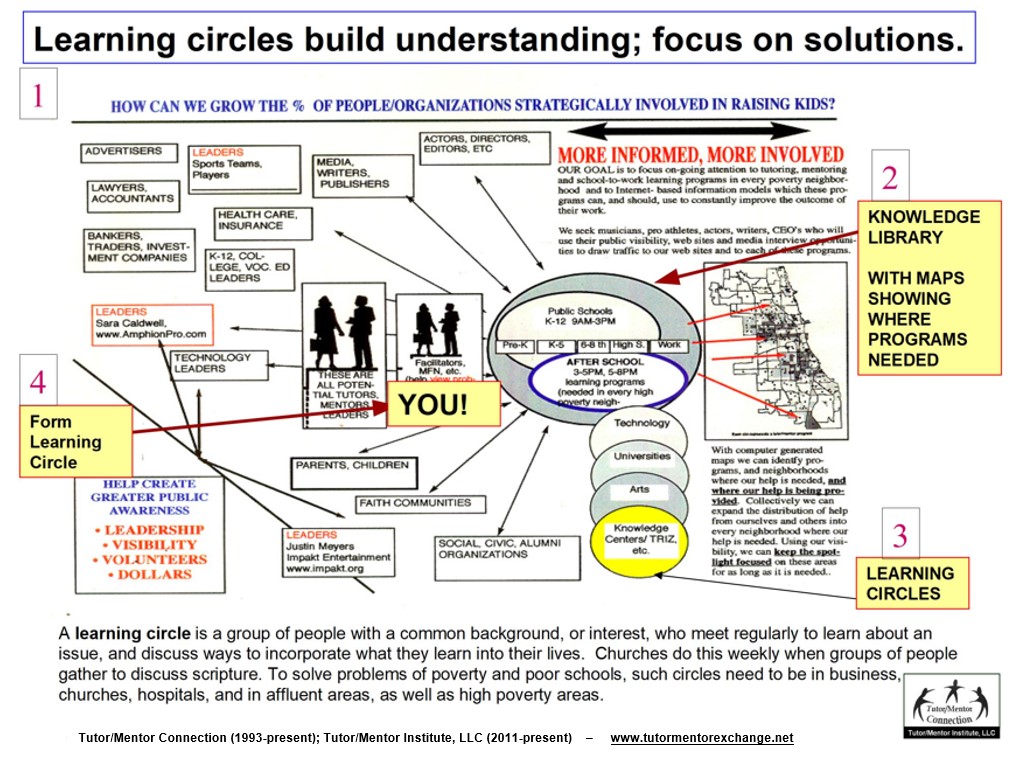
The goal is that groups of people gather regularly, like people in faith groups do, or people in high school or college classes, or in business, to look for ways to solve problems, using information that I and others aggregate in web libraries and share in articles like this.

Below is a graphic showing part of a Tutor/Mentor blog article written in 2009, 25 years after the murder of Ben Wilson in Chicago.


I highlighted "We are still having this conversation 25 years after the death of Ben Wilson because the writers ..... don't focus on ways to build a consistent flow of operating dollars to help constantly improving youth serving programs be in all the neighborhoods where kids need this help, for dozens of years, not just for one workshop, or for one intensive intervention...."

That's just about what the MENTOR report was saying.  

So what can you do? Form a learning circle, just as the graphic above suggests.  Read something every week, then talk about what it means and how the ideas might apply where you are, and based on who you are.  

Every one of my articles has tags at the bottom, which you can see at the left side of this blog.  You can use these to focus your discussions.

Or you can go to my Wakelet page and look at collections of blog articles. 


Or, you can visit this Tumblr site and look at the articles I've posted there, which represent most of the key ideas I've been sharing.


As you do your learning share your understanding and ideas with your own graphics, concept maps, videos, etc.  

8-19-2024 update - here's another article that focuses on the funding issue. It's titled "Should we pay for relationships? Why philanthropy needs to invest in social capital?"

Connect with me on Twitter, Facebook, Instagram, LinkedIn, etc. and share your work with me so I can learn from you and share your ideas with my own network.


The MENTOR research shows the challenges and a path forward.  It's not a new path, because I and others have pointed to these challenges for many years.

The question is, will you say ENOUGH, and begin to take actions so we're not having this conversation again in 25 years? 

Thursday, March 25, 2021

Want to make a difference? ReThink Philanthropy

 One of the people I follow on Twitter is Vu Le, who posts Tweets like the one below:

I've focused on improving the flow of operating dollars to non-school, volunteer-based tutor, mentor and learning programs in every high poverty neighborhood of Chicago since starting the Tutor/Mentor Connection in 1993.  In one section of the Tutor/Mentor web library I focus on fund raising challenges faced by non-profit organizations.  

I've been using this "Mentoring Kids to Careers" graphic, along with various versions, since late 1990s to emphasize the on-going support kids need from pre-school through high school, then beyond, to assure that more of the youth who are born in high poverty areas are starting jobs and lives free of poverty when they are adults.

In the lower left corner is a map of Chicago, with high poverty areas shaded grey. These are the areas where mentor-rich programs are most needed.  In this article you can find my list of programs and see how I plot them on a map. This helps people find existing programs in different parts of Chicago and hopefully is used by planners to determine where more are needed.

Below I've created another version, highlighting one stage on this career ladder.

Kids grow one year at a time. Support  needed for many years.

It's great to be able to provide a youth tutoring and/or mentoring activity that lasts for one, or two years, but it takes 12 years to move from first grade through high school and four to six more years beyond that to be starting a job and career.

The challenge Chicago and other places face is building and sustaining k-12 support programs in every high poverty neighborhood.  

This means we needed to find money every year to pay the bills. That was always a challenge. The graphics below illustrate this challenge.


Note the inclusion of maps in these graphics. Unless donors use maps to assure a distribution of dollars into areas with high poverty, they may make billions of dollars in gifts and still miss  most of the areas where help is most needed. I've devoted the entire MappingForJustice blog since 2008 to show ways maps can be used. You can also see uses of maps in articles on this blog.

In past years a GIVING TUESDAY campaign has attempted to draw donor attention and increase giving to non-profit organizations.  I created the graphic at the lift a few years ago to visualize the need for year-round giving, making every day a "Giving Tuesday".  Much of what I write about on this blog focuses on ways to build the on-going public attention that would motivate such giving habits, as well as the program directories and maps needed to guide giving into every high poverty area, not just a few high profile programs. 


Between 2005 and 2015 interns spent time viewing articles like this, then created their own interpretations. You can find many at this link. Others who I've met via the Internet have also tried to help share these ideas. On this concept map I post links to some of their articles.
 
More people need to do this. Read this and other articles I've written, then create and share your own version. Let's join Vu Le in advocating for changes in how philanthropy works.

 
There's a tremendous amount of wealth in Chicago, and the US, but much of it is not yet being focused on helping build and sustain great learning and mentoring opportunities in all high poverty neighborhoods, reach kids at school, and in the non-school hours.

If these graphics resonate with you then let's find places on the Internet, and in Chicago, where we can begin to connect and look for solutions.  I'm on Twitter, Facebook, Linkedin and Instagram (see links). 

If you value what I'm writing about please consider a small contribution to help me keep doing it.