Showing posts with label commitment. Show all posts

Wednesday, February 05, 2025

Stay focused. Do what you can every day.

We've all heard the story of the "tortoise and the hare". The rabbit gets off to a fast start then runs out of gas. The tortoise just keeps plodding along, passing the rabbit as it keeps on its own journey."

Each one of us can be the tortoise, by what we do every day.

However, the "hare" in this case is the on-going challenges we and other social-benefit organizations face from events we cannot control without working with many others. Maybe not even then.

I've been posting articles on man-made and natural disasters almost since I began this blog in 2005. One section of the Tutor/Mentor library focuses on the man-made disaster of racial inequality and class divisions in America, which has brought us to the tsunami that occupies the White House and is taking over functions of the US Government. 

In September, 2005 I wrote an article titled "Disaster Challenges us All". What I said then is as true today as it was then.

We need to educate the world to create three pools of generosity and compassion, as represented by the chart below.

One part of this budget focuses on responses to disasters (the hare in my story). Another part focuses on personal/family disasters, such as a child with cancer. The final third, focuses on the on-going funding needed to solve complex problems that I describe in my articles.  

In March 2011 I wrote this article, using the tortoise/hare graphic, under the headline "Another War. Another Tsunami. Another Day".

In November 2015 I wrote this article with the headline "Keeping Focus Amid a World on Fire".

In November 2016 I wrote this article with the headline "Stay Focused. Do What You Can Every Day".  I used the Tortoise/Hare graphic in that article, too.

In August 2019 I wrote this article, with several versions of the graphic shown below. 


Then, last November I wrote this article, with the introduction shown below.


In each of these I showed complex problems facing each of us and shared strategies for learning and connecting with others, with the encouragement to do what you can every day to keep helping kids. 


But to focus on other problems, too. 

This graphic illustrates that while I focus on helping kids living in urban poverty have support systems of mentors, tutors and extra learning that helps them move from birth-to-work, I realize there are other issues that also require day-to-day attention. Focus on these systemic challenges is also disrupted with every natural and man-made disaster.

My heart bleeds and I shed tears every time I read about local, national and corporate corruption and greed that causes these problems or lets them exist.  Now with a felon President and an out-of-control immigrant billionaire dismantling the Federal government, and Project 2025 taking us back to the 19th century or earlier, the world no longer can count on the USA for leadership in time of crisis. The poor and marginalized in America not only can't count on help, they fear for their safety.

The "do what you can" message is more important than ever.   So is the 'tortoise/hare' message.  And the "connect with others" message. At some point those now in power are going to run out of steam. The people of America and the world need to be waiting with new solutions that undo the damage and build a brighter future for the entire planet.

I've used the Internet to connect with others since the 1990s. I've used a variety of social media platforms.  Due to the quality of interaction on some of these, I am finding it more and more difficult to find people who are sharing ideas, resources and solutions to the issues I focus on.  

I've started using BlueSky and Mastodon more than Twitter, Instagram and Facebook. I still use these, and LinkedIn, too.  (see links on this page).  Due to my health I've not been to many face-to-face gatherings in the past few years. That makes my dependence on the Internet even more of a concern to me.

But, I keep trying. I hope you will too.    If you've found an active on-line community where people are discussing some of the ideas I've been sharing in this blog and on the Tutor/Mentor Institute, LLC website, please share links to those groups with me. 

Thank you.  

Thursday, March 28, 2024

What motivates me

If you've read any of the articles posted on this blog since 2005 you'll see that I'm constantly advocating for the growth of comprehensive, long-term, volunteer-based tutor, mentor and learning programs that operate in non-school hours and connect k-12 kids living in high poverty areas with adults who work in a wide range of industries and have many different backgrounds.

What drives this passion?  Experience.

I led one volunteer-based program from 1975 to 1992. It served 2nd to 6th grade kids. I led it as a volunteer while holding a full-time retail advertising job until 1990, then became the first paid executive director when we turned it into a non-profit organization in mid 1990.

Below are two of the yearbooks that I created for that program.

The first if the 1976-77 yearbook.   View at this link. About 100 pairs of kids and volunteers were involved.

The second is the 1988-89 yearbook.  View at this link.  Over 280 2nd to 6th grade kids and 300 workplace volunteers were involved that year. 

When I joined as a volunteer tutor in 1973 the program was already eight-years-old.  I became its leader in the 10th year.  We grew over the next 15 years because of the organization I brought to the program and the way we engaged volunteers as leaders, not just tutors and mentors.  

I left that program in October 1992 and with the help of six other volunteers we formed a new program, called Cabrini Connections, to help kids who aged out of the first program after 6th grade have continued support all the way through high school.

Below is the 1994-1995 annual report for Cabrini Connections. View at this link


Below is the annual report for 2008-09.  We stopped doing print versions around 2000 and did PPT reports through 2010.  Here is the link.


Here's a folder with Cabrini Connections-Tutor/Mentor Connection Annual Reports from 1995 to 2010. Each report shows the activities that we offered to support student and volunteer involvement.  If you lead a program you might duplicate some of this work in your own program.

We held the first sessions of the Cabrini Connections program in January 1993, meeting with some teens monthly at Wells High School and others every Saturday morning at St. Joseph's Church on the North side of Cabrini-Green.  We were reaching 42 kids by June of 1993.

Then in the fall of 1993 Montgomery Ward gave us an entire floor of their corporate tower, over 20,000 sq ft of space, and we began expanding. 

If you view page 6 of the 1994-95 annual report you'll see how the number of students enrolled grew from 42 in June 1993 to 90 in the fall of 1995.  Page 7 of the report shows similar growth in the number of volunteers, from 30 in spring 1993 to 103 in the fall of 1995.

By 1998 our graduating class of high school seniors included five teens.  In 1999 it was nine. Thus the size of the program did not grow much since seniors were graduating each spring. 

In 1999 everything changed. Montgomery Ward was sold and we had to move to rented space in Cabrini Green to continue operating.  We lost Wards as our major donor in 2000 after they went out of business. And we lost many more donors in 2001 and 2002 due to the financial crisis after the 9/11 attack and the Dot-Com melt-down. 

Our move to rented space meant we had a much smaller facility for two years. Then we moved to a bit larger space on Huron, near the intersection of Halsted and Chicago Avenue. Our average enrollment from 2000 to 2010 remained at about 80 teens and 100 volunteers.   Open this PDF and see photos showing the 10 years from 1993 to 2003. 

In 2010, I created a report showing a decade of work. On page 10, I show HS graduates each year from 1997 to 2010. View that report at this link


We did all of this while also building the Tutor/Mentor Connection, to help similar  programs grow in all high poverty areas of Chicago. 

In November 1992 when we decided to form Cabrini Connections we realized that one more small non profit could be life changing for a few teens, but would have little impact on the more than 200,000 kids living in high poverty areas of Chicago. So we decided to split our resources and create an intermediary that could help tutor/mentor programs grow in many places.  We spent all of 1993 doing research and planning and launched in January 1994 with our first survey to learn about other tutor/mentor programs in the city and suburbs.  That led to our first published Directory of Programs and first Tutor/Mentor Leadership and Networking Conference in May 1994, and first citywide Tutor/Mentor Volunteer Recruitment Campaign in August/September 1995.

In each of the annual reports from 1995 through 2010 you can see work done to help tutor/mentor programs, including our own, get the resources they need.  If  you look through the articles I've tagged with "history" and "archives" you can see more evidence of what we were doing.

Then browse through the sections of www.tutormentorexchange.net and see everything that is available to help tutor/mentor programs start and grow and to help leaders be more consistent and strategic in supporting them.  


I often said that I was an effective leader of the Tutor/Mentor Connection because I also led a single tutor/mentor program. I knew how hard it was to attract kids and volunteers and keep them coming week-to-week and year-to-year. I knew how difficult and frustrating it was to attract and keep donors.  

Yet I've often heard from parents and alumni how important our program was to them.  I often heard from people in other places how much they appreciated what the Tutor/Mentor Connection was doing.


In all these years I've really only had one mentee, which was Leo Hall, who I was matched with in the fall of 1973, when he was entering 4th grade. We met weekly during the school year for the  next 3 years.  After 6th grade Leo continued to volunteer to help the program as one of the Junior Assistants who passed out milk and coffee. So we stayed connected.

I did not take another single youth as a mentee because as leader of the program, they ALL were my mentees.

I received a call from Leo this morning. He spotted a scam on Instagram, where someone had set up a duplicate account, using my profile picture. I reported it, and so did a couple of other people and that account has been removed.  I'm at https://www.instagram.com/danielf.bassill/ on Instagram. 

As we talked Leo told me to expect a call from an event organizer who was putting together his 60th birthday celebration. He wanted me to be there, or to record a video, if I could not be there.


Thus, my own experiences leading a single tutor/mentor program drive my passion and make me a credible advocate for cities building and sustaining  volunteer-based tutor/mentor programs.

The other thing driving my work is this front page from the October 15, 1992 Chicago SunTimes, following the shooting death of a 7-year-old boy in Cabrini Green.   The headline says "7-Year-Old's Death at Cabrini Requires Action".

If you open this folder you'll see many similar stories that I've collected over the past 30 years. They "Demand Action" but very few follow that with the type of on-going effort I have modeled.

Which is not enough.

As I talked to Leo today I again encourage him to use his own talents to amplify my "call to action" and to encourage other alumni to do the same.  As I write my blog articles I encourage you to share them and get other people involved.

Be like Dan.

You can't just say "ENOUGH". 

You need to act regularly to draw people to information they can use to be better informed and to be motivated to use their time, talent, dollars and votes to build and sustain volunteer-based tutor/mentor programs in more places and to help remove the structural racism that has roots extending back over 300 years in America.

I think I've written enough for today.  Please connect with me on Twitter, Facebook, LinkedIn, Instagram and other platforms and share my posts with your network.  

And, if you can spare a dime, please visit this page and make a contribution to help me keep these archives and my library available to you and others. 

Tuesday, December 12, 2023

These "Calls to Action" Need New Energy

Yesterday I took a look at the first newsletter sent in June 1993 by the new organization I and six other volunteers had created in late 1992.  The message below was included.

This was the first page.

You can open and read the PDF at this link.  I put a President's Message in my newsletters in each issue from 1993 through 2002. After that I put the message in email newsletters and starting in 2005, in this blog.   In this issue I started by saying "There are kids all over Chicago who don't have anyone taking an interest in them. Cabrini Connections is changing that."

The headline of the newsletter was "Do the Right Thing!".  

I was prompted to form Cabrini Connections, and the Tutor/Mentor Connection in October 1992, following the shooting death of 7-year old Dantrel Davis in Cabrini Green, the neighborhood served by the tutor/mentor program I had led from 1975 to September 1992.

The Chicago SunTimes front page said "7-Year Old's Death at Cabrini Requires Action"

Sadly, I've seen editorials like that in Chicago media often over the past 30 years. I've seen a lot of action, and a lot of money spent, but nothing strategic and on-going that would reach kids in all high poverty areas and do more to help them through school and into adult lives.

I put this 1993 Chicago SunTimes article and graphic in this 2015 article


Here's another from the same article


The 1993 SunTimes article concludes "While Chicago has “had all these sincere people making good efforts, one group working on poverty, one on education reform, one on community policing, these problems are too interwoven and too immense. The city needs all anti-poverty efforts “at the same table”.

Here's something more recent:

I included this in an April 2023 article with the headline "Crime and Violence in Chicago - Not New".  If you take time to scroll through the media articles on this blog, you'll find dozens of similar stories.

Below are two graphic you'll find in many articles, showing the need to build a distribution of youth tutor, mentor and learning programs in every high poverty area of the city, with non-school locations where kids and volunteers can meet regularly.  


Here's another graphic with the same idea


A citywide strategy needs to recruit and support teams of leaders who support individual programs, neighborhoods full of programs and a city full of programs.  Such a strategy needs to be part of a "learning organization" where everyone involved is constantly learning from the work being done by others, so they innovate improvement from year-to-year, rather than constantly starting over.  And such a strategy has to be supported by business, philanthropy, politics and every other sector, so their is a distribution of resources to fund every part of this ecosystem.

Such a "learning organization" is supported by libraries and websites such as the one I host at http://www.tutormentorexchange.net 


I've been sharing these ideas for over 30 years, since launching the Tutor/Mentor Connection in 1993.  However, now I'm turning 77 and don't know how many more years I have left to do this.

Thus, new leaders who share this vision need to step forward and take ownership, preferably by putting my archives in a university structure where the articles and PDF essays are curriculum that students learn from in preparation for leading this strategy during their adult lives.

I've posted several articles in the "A New T/MC" collection that will give you an idea of what is needed. I hope you'll read these, share them, or encourage others to do the reading and sharing.


In the short term, please consider a contribution to help me pay the bills and keep sharing these ideas in 2024.

You can contribute to my 77th birthday campaign - click here

Or to the Fund T/MI campaign - click here


Thank you for reading and sharing. 
 

Friday, February 03, 2023

Candidates for Mayor - take a look!

On February 28th Chicago residents (or a very small percent of them) will elect a new Mayor, or re-elect the current one.  Here's one website with a list of candidates

The only candidate I have had much interaction with is Paul Vallas, who was very supportive of the Tutor/Mentor Connection in the mid 1990s when he was CEO of Chicago Public Schools.  He spoke at two of our conferences and one, or two, of our Aug/Sept Citywide Tutor/Mentor Volunteer-Recruitment Campaigns.

So you'd think I would be endorsing him.  I'm not.  He's had 20 years to follow what I write on this blog and incorporate the ideas into his own leadership and I've not seen evidence of that 

Of course, I've not seen indicators that past Mayors or candidates have borrowed my ideas either, although if you browse through this set of articles you'll see that I've been sharing them for many years since starting this blog in 2005. Prior to that I shared them in print newsletters. 

I've participated in the current Mayor's MyChiMyFuture meetings and shared ideas. I like the map they have created. They could be doing more.  No one has asked to learn more from me. 

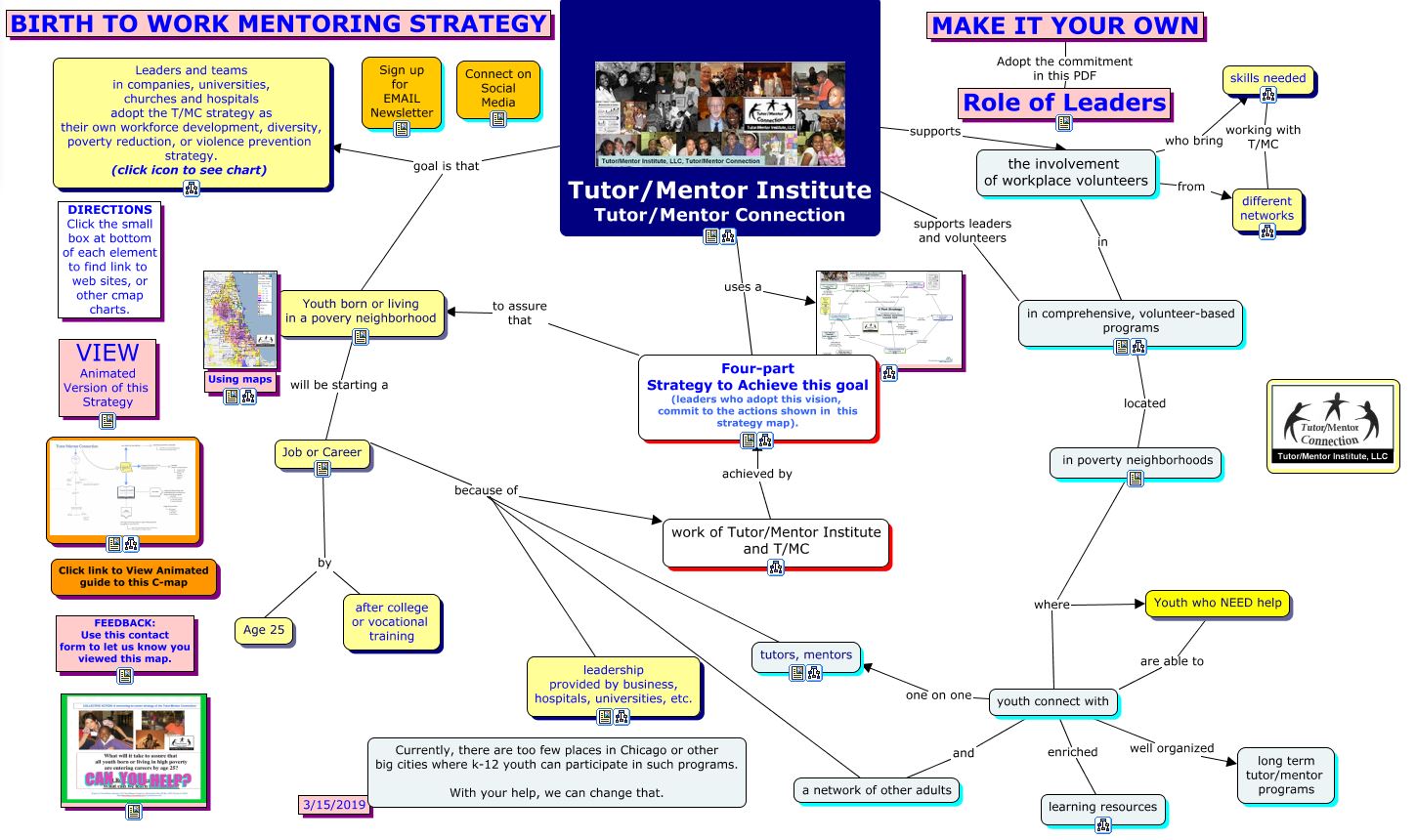
How would you know if they were borrowing these ideas? You'd see a version of this concept map on their own website.  


Here's one article they could read to understand what this map is showing.  If they adopted this strategy they'd be doing three things regularly.

1) recruiting other leaders to also adopt the strategy map and its commitments

2) support the four-part strategy (see middle node on the map).  This article describes the 4-part strategy.

3) they'd be reading current and past articles and encouraging others to do the same, just like a preacher in a religious group or a teacher in a classroom.  In doing so they'd find many graphics that visualize the commitment they would be making. 

They would emphasize a long-term birth-to-work strategy that has roots in every high poverty neighborhood.


They would be calling for a "learning distribution system" that reach kids in school and non-school hours, and on the Internet.


They would be using their public visibility to draw volunteers and DONORs directly to websites of youth serving programs to offer on-going support.  They would be filling the blue box in the middle of this graphic, drawing "people who can help" to information they can use to locate places in neighborhoods where help is needed. 


Every day they would be challenging the residents of the city and suburbs, asking "How can we do this better?"


It's not enough that they might put these ideas on their campaign website.  They should have a personal and/or organizational blog that shows they have been sharing this commitment and performing these actions for many years.

I'd vote for someone who demonstrated this leadership and these ideas.
(While my focus has been on the city of Chicago and I lived in Rogers Park for 17 years, and led a tutor/mentor program serving kids in Cabrini-Green for 35 years, I currently live in Arlington Heights, so cannot vote in the Chicago election.)

But this message is aimed at potential Mayors of any big city in America.  View this map in this article.

The map shown above is from a Brookings Metro report.  Highlighted are metro areas with concentrations of  poverty.  Each of these cities could use the map/information-based strategy I've piloted since 1993.

It's available for FREE.

Of course, I'd be happy to help anyone understand what I'm proposing and guide you through the ideas I've been sharing on this blog and on the www.tutormentorexchange.net website. 

One of my first recommendations would be to set up a student-learning program in high schools and colleges, where students spend time reading articles then sharing them using various media tools.  View this blog to see how interns did this between 2006 and 2015. 

Thanks for reading. If you're helping someone run for office, share this with them.  Maybe they will adopt the ideas, even if they don't win in 2023.  

I'm on Twitter (still) and other social media platforms (click here for list). Let's connect. 

If you want to help me keep sharing these ideas and hosting my library please visit my Fund T/MI page and send a contribution. 

Friday, August 19, 2022

Visual Thinking. Are You Asking?

Below are some images that I've created over the past decade to focus attention on the planning needed to make mentor-rich youth supports available to K-16 youth in every high poverty area of Chicago and other places.  Click on each image to enlarge and read what is shown.  

Three elements in this graphic. The "mentoring kids to careers" shows need for 12 years of continuous support. The "challenges" map in the middle shows barriers that need to be removed.  The map of Chicago emphasizes the need to use maps to show where kids need extra help, the availability of existing programs, and the flow of resources, etc.


This further emphasizes "mentoring kids to careers" is a long-term goal. It's not enough to have a great program serving kids at one grade level, or in one neighborhood. 


Think through the entire process.  Stories about violence or poverty lead us to want to connect kids with tutors and/or mentors. However, to reach kids in high poverty areas of big cities for many years we need organized programs.  Many are needed. Maps can show this. So  how do we generate the flow of resources to build and sustain great programs in more places? 


Tipping points. Are you thinking of how many talented, dedicated, informed people are needed to staff the many tutor/mentor programs needed in big cities like Chicago. Or in rural areas and reservations? Are you also thinking of ways to educate people in business, philanthropy and/or politics so they become more proactive in providing the operating resources each program needs?   This needs to be a degree program at one or more universities.  


Visualize the planning process.  At the right is the goal of helping kids in all high poverty areas get the support they need to move from birth-to-work. At the left is a reminder that we need to influence leaders and build public will to provide operating resources to support needed programs for many years.


YOU can make a difference.  Be the YOU in this graphic. As you look at my articles and visuals find ways to share these with your family, co-workers, friends and wider network. 


These images have been used in past blog articles along with hundreds of others.  You can find some collections of images on my Pinterest page.   

Maybe the easiest way to find specific images is to do a search on Google using "tutor/mentor" plus any word on this Tag cloud.

Then look at the images page.  Many will be ones that I have created ( or interns working with me have created) and used in blog articles or PPT essays.  

Below is a presentation showing some of the graphics I've created. 


As you look at my visuals I encourage you to copy those you like into Power Point, then share them with others. Or create your own versions. Share them with me and others on one of these social media platforms. 

If you know of other websites and/or blogs where people are sharing visualizations like I do, especially focused on helping kids in poverty areas, please share them with me.  Ideally there will be at least one person or group in every city doing exactly what I've been doing.

Want to help?  Visit my "fund T/MI" page and send a small contribution.  

Monday, August 17, 2020

Building Public Will to Invest in Racial Justice

Today I listened to an Instagram conversation hosted by the Schott Foundation, featuring their president, Dr. John Jackson ( @DrJohnHJackson ) and Keron Blair (@Keronblair). Below is a Tweet from that conversation. If you listen to this you'll see a focus on the political will needed to generate a sustained distribution of resources into all Black and Brown neighborhoods that lead to social justice over a period of many years.

In several past articles I wrote about "building public will".  Below I share what I wrote in 2015.

----- begin 2015 article -----

I scratched out the outline for this story a couple of days ago as I was riding the train and thinking about the challenges we face in solving complex problems like poverty. I hope you'll follow along with my thinking. 


This graphic is part of a strategy graphic that shows the planning steps needed to solve complex problems or roll out a new business strategy. See the full graphic and explanation here

Every year, millions of dollars are spent by social benefit organizations trying to attract resource to support their work. The money is spent directly on fund raising, marketing and public education. It's spent indirectly on training programs and consultants.

Regardless of where an organization operates or what cause it focuses on, we're all competing for a slice of the same donor pie. That pie seems to be shrinking, either because of economic circumstances, or because of the rise in organizations competing for a share of the pie. Natural disasters that occur randomly around the world exert a huge pull on discretionary donor dollars every time they happen.  Covid19 has added a new level of challenges.


Thus, it's unlikely that great programs, doing similar work, but in different places, will be available in a large percent of the places where such programs are needed. Since 1993 I've piloted uses of maps to show where non-school tutor/mentor programs are most needed, then using the maps to influence donor support of programs in every place where the map shows programs are needed.

In recent years there is a growing application of mapping and data visualization (see blog). However, I still don't see many who are trying to create maps of all service providers doing similar work in areas where that work is needed. Such maps would show a poor distribution of needed programs. Over time it would show change as new programs launch and some go out of business.

It's also unlikely that many organizations will attract on-going dollars to enable them to provide long-term support. In youth development, this is a serious issue. Kids take 12 years to move from first grade to first job. If they are living in high poverty areas, the support system needs to reach them early and stay with them through school and even into work. Such support systems are needed in many, many places.


What's the solution?

Building public will is step 7 on this map. Each step is important in solving complex problems. However, until more people from different places, with different talents, and different levels of influence get involved in brainstorming ways to build public support and keep it growing, I don't see many long-term solutions emerging.

I created this graphic (see article) to illustrate that while we want to help social benefit organizations and clients use the resources available to achieve their missions and/or overcome challenges they face, we also need to influence what people who don't live in poverty do to help them. This can include direct support such as funding, or public policy. It can also include indirect support, such as removing barriers and obstacles. 

Some (but certainly not all) of the actions we need to be focusing on include:

a) constant education of the public so they have deeper understanding of the problems and places where strong, constantly improving, social benefit organizations are needed

b) innovation of on-going advertising-type campaigns to influence what resource providers do

c) build growing understanding of how current systems of philanthropic and government support are not working. 

Just a small growth of the resource pie every year could make a huge impact on the availability of needed social benefit organizations (including tutoring/mentoring organizations) in more of the places where they are most needed. 

Building public will requires champions and leaders from every sector, in every city of the world. I'm certain that this discussion is taking place. I'm just not sure where this is an on-line forum, a cMOOC, or part of a web library that points to a wide range of places where this is being discussed. 

Use the comment section to provide links to open, on-line forums, Google groups, or cMOOCs that you're aware of, where "building public will" is the focus of the group. Or introduce yourself to me on TwitterFacebook or Linkedin.

---- end 2015 article ------

Now we're in the middle of a global pandemic, and facing a highly contentious November election. We've a climate crisis that threatens major disruption over the next century.  

As I listened to Dr Jackson and Keron Blair this morning I thought of this concept map. It shows the need for long term investments to help kids move from birth to work and shows many different issues that need to be addressed in every high poverty area of the country.  This requires a massive investment. Finding ways to build the public and political will needed will require finding ways to connect people from each of these sectors and innovate ways to cut through the noise of every other issue to draw daily attention to this challenge.


I share these graphics here and on Twitter (knowing that only 22% of people actually use Twitter!) with the invitation that others who are more appropriate, or more visible, spokespeople will borrow them for their own leadership.  

If you'd like my help understanding the meaning of these or any or my articles just reach out to me.