When I became the volunteer leader of the Montgomery Ward/Cabrini-Green Tutoring Program in 1975 I was holding a full-time retail advertising job with the company. The program started that year with 100 pairs of 2nd-6th grade kids and workplace volunteers.
There was no way I could personally train every volunteer, so I tried to create a "learning" organization by providing information they could use via our monthly newsletters and weekly handouts.
I continued that practice through email newsletters, blogs, a website and social media through 2011 when I stopped leading a single program. I've continued that practice through the Tutor/Mentor Connection (1993-present) and Tutor/Mentor Institute, LLC (2011-present) in an effort to build more consistent support to help volunteer-based tutor/mentor programs reach K-12 kids in every high poverty area of the Chicago region and beyond.
I've posted articles on this blog since 2005 and on the MappingforJustice blog since 2011 (it was started by Mike Trakan in 2008). I've posted on the Intern blog since it was started by an intern from Hong Kong in 2006.
They are represent a curriculum of ideas that could be embedded in any leadership training program.
Since last fall I've posted a series of articles on Substack.com that aim to highlight featured ideas. Below you can see images for these posts.
Open this 1984-85 Montgomery Ward/Cabrini-Green Tutoring Program archive and you'll find copies of several newsletters like the one I shared at the top of this article.
While the maps and much of the research points to Chicago where there are thousands of kids living in highly segregated high-poverty areas, the ideas and strategies can be applied in any city in the world. I invite you to view them, and created your own versions, putting your own maps and ideas into them.
Then connect with me on LinkedIn, BlueSky, Instagram, Facebook, Twitter and other platforms and help build awareness and involvement with these ideas, and with youth-serving programs in more places. Find links on this page.
Thanks for reading. I depend on a few long-time supporters for small donations that help me continue this work. Visit this page if you'd like to help.
For the past few years I've delighted at seeing alumni of the tutor/mentor programs I led sharing photos of their own kids finishing high school, going to college and graduating. That was what we hoped would happen.
However, I'm continuing to see evidence that this success does not lessen the fear that these young adults will become victims of police violence and continued racism in the USA.
Below are two pages from my Sunday Chicago SunTimes, showing a story about how at "Illinois public universities, campus cops pull over Black drivers at higher rates." Read it here.
This story was also on the WBEZ.org site. You can find it here. I found this link on my BlueSky feed. I hope you'll join me there.
These articles show that "Black driver stops far exceed Black enrollment, population. At every Illinois four-year public college campus police department that reported stops in 2023, the share of Black drivers getting pulled over by campus police surpassed both the share of Black students enrolled in the institution in the fall semester of 2022 and the percentage of Black individuals in the surrounding community age 18 and up."
It is frightening to read stories of young Black men and women talking about being routinely stopped and ticketed by campus police and see the lack of response from police leaders. If you're a White parent, this is not something you worry about when you celebrate your child's high school graduation and college acceptance.
It should not be something Black and Brown parents fear either. But is is.
My Sunday SunTimes also had this story showing how "Sports was a major catalyst in the drive for equity after George Floyd’s murder, but time has erased all progress.."
A year ago I wrote a similar article to this one. It also pointed to athletes talking about racism. I included the graphic below, in that article with the same headline as I'm using today.
Last year's article also included this:
"This was reinforced yesterday when I watched baseball star, Reggie Jackson, talk about the racial discrimination that he faced when playing in the 1960s and 1970s. You can view the video on Twitter (x) at this link."
I wrote, "These are among many things happening locally, nationally and globally that scare me."
Locally, I see stories daily showing Black and Brown kids and adults shot and often killed in intentional and random shootings. I see growing evidence that our highest source of justice, the Supreme Court, is corrupt and under the control of religious extremists.
I see growing evidence of other forms of hate, from antisemitism to growing attacks on the rights of LGBTQ individuals and families, too.
Globally we're facing a range of complex problems from a climate crisis, to war and conflict and massive suffering. Yet, in too many places, including the USA, we're electing right-wing leaders who care less about the poor and the planet than they do about their wealth and privilege.
Last June I wrote, "While we're hopeful that November's US elections will bring control of the US House back to Democrats and Progressives, expand the majority in the Senate, and keep the White House, that's no guarantee that any of the terrible things happening in the US and the world will change."
That did not happen. A radical, greedy, cruel and careless man was elected President, progressives lost control of both the House and Senate, and Drump (you know who) has filled the top levels of government with radical extremists.
Read the rest of my June 2024 article at this link.
Expanding the choir of "those who care" and "those who speak out".
My own long term efforts to help well-organized, volunteer-based, non-school tutor and/or mentor programs grow in high poverty areas of Chicago, where adults connect with youth when they are as young as elementary school, then stay connected through high school, and into adult lives, has always aimed to influence what the volunteers do to get others involved, not just to be an effective tutor and/or mentor.
I created this concept map many years ago to show how volunteers who are recruited from a diverse economic-social-educational background to be tutors and mentors can grow their understanding of the challenges kids and families in high poverty, highly segregated, areas face. For some, this can lead to a much greater use of their talents and networks to help solve the root-causes and lead to a much brighter future for our kids and families, and ourselves.
This chart shows a cycle that takes place almost every day, in hundreds of locations throughout the country. However, it may be happening with less purpose and impact in most places, than is needed to change the flow of resources to tutor/mentor programs and the number of people who get involved in the broader issues.
Read this article to see a full explanation of the concept map, and see how interns from universities created animated versions.
Create a learning organization.
I've been building the Tutor/Mentor library since the 1970s. Over the past 10 years I've added more and more links to websites that focus on race, poverty, inequality, and prevention. Here's a cMap where I point to that section of the library.
Each node on this concept map opens to a collection of websites with an extensive range of articles that I wish I had had when I studied history, social studies and political science in high school and college in the 1960s.
I point to several hundred volunteer-based youth-serving organizations on this page of the Tutor/Mentor Institute, LLC website. I don't find many showing a strategy aimed at educating their volunteers and turning them into leaders...beyond building support for their own program. I'd love to have some look at my blog and website and see the value of duplicating my efforts.
Maybe this is happening in more places and I just don't see it. Thus, I invite readers to look at the websites in my library, or in their own communities, and point out pages that show how volunteer-based organizations are systematically educating their volunteers and motivating them to become evangelists who reach out and educate others.
If enough organizations did this consistently for 20 or 30 years it would grow a movement of people that might be large enough to actually create needed changes.
Thanks for reading this.
I hope you're saying "ENOUGH" and that you'll read and share my articles, and my library, with family, friends, co-workers, and others in your own network. Until more people are personally connected to these issues too few will speak out or do the organizing work needed to innovate long-term solutions.
Please connect with me on LinkedIn, Instagram, BlueSky, Facebook, Twitter and other sites (see links here).
And, if you're able, visit this page and make a contribution to help me do this work.
It's a new week, but with continuing problems based on past history and compounded by current leadership. I don't know all the issues, nor most of the solutions. However, while I've been trying to build my own understanding since I became a volunteer in a Chicago tutor/mentor program in 1993, I've also been sharing articles and resource links that I've found in a library that enables other people to find and use the same information.
Below is what I wrote in May 2023. I've added a few additional links in the text.
--- begin ---
In early May I watched a presentation hosted by the Urban Institute, featuring Matt Desmond, author of a new book titled "Poverty in America". Open this link to view the video of the presentation.
In a follow up email the Urban Institute summarized some of the key points of the webinar. They wrote: While no one policy is a silver bullet, Desmond suggests keeping these ideas in mind:
Social justice: “It’s impossible to write about poverty in America without writing about racism in America,” Desmond said. Black and Latinx families have lower incomes, a lower homeownership rate, less in savings, and ultimately less average wealth than white families. Therefore, any steps forward must come from the position of breaking down segregation and structural racism.
Targeted universalism: Rather than targeting one solution to each group or each problem, Desmond recommended identifying the desired societal outcome, then implementing many universal solutions that could address it.
Then, on May 21, an opinion article in Politico, by Sheryll Cashin, a law professor at Georgetown University and author of several books on racial justice and American democracy, provided an in-depth analysis in an article titled: America’s Poverty Is Built by Design: How did the U.S. become a land of economic extremes with the rich getting richer while the working poor grind it out? Deliberately."
I added links to Matt Desmond's website to the Tutor/Mentor Library. You can find them here, and here.
I also encourage you to skim through some of these articles.
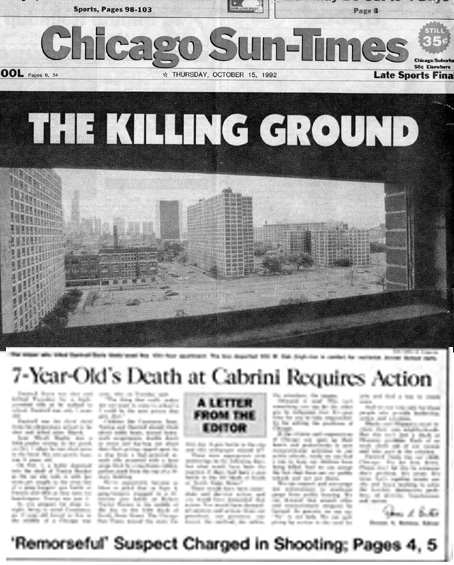
I and six other volunteers created Cabrini Connections (a site-based tutor/mentor program) and the Tutor/Mentor Connection in November 1992 following the shooting death of a 7-year old boy, in the Cabrini-Green area of Chicago. I've used this front-page story from the October 1992 Chicago Sun-Times as a reminder and motivation every year since then.
In the summary above Desmond is quoted as saying "individual actions can build political will for larger changes".
This is not a new problem. However, it's a problem that our leaders can't stay focused on every day, because there are so many other problems.
That's why I think it's important for another level of leaders to emerge, who are totally focused on building a better community understanding, and response, to the problems and solutions.
I've been issuing this invitation for the past 25 years, since we formed Cabrini Connections, Tutor/Mentor Connection, in the weeks following the shooting of Dantrell Davis in Chicago back in October 1992. I keep the front page of this Chicago SunTimes story in my office, as a reminder of my responsibility.
I've developed my own actions steps, and posted them on this blog in the past. Here they are again:
If we want to stop this violence, we have to act now, and keep acting to solve this problem for many years. We have to think spatially, that is, look at the entire city and suburban problem, not just one neighborhood. At the same time, we need to act locally, because none of us has the time, or the resources to help each of the kids in the entire Chicago region who live in neighborhoods where poverty is the root cause of the violence.
This animation was done by one of my interns after reading this article.
Here are some ways to remind yourself. Think of ENOUGH, is ENOUGH
E – educate yourself – most of us do not live in high poverty neighborhoods, so we only understand the root causes of senseless shootings from what we read in newspapers. We also only read negative news in the media, so we’re not really well informed on where these events are taking place most frequently. Finally, while there is a perception that there are plenty of youth programs, we really don’t have a good understanding of the distribution of different types of youth programs, to different age groups, in different zip codes. The only way this will change is if each of us pledges to spend one hour a week reading books, articles and web reports, that illustrate the root causes of these shootings, or of poor performance in schools. Through our learning we can draw ideas that we use in our own actions. We can also begin to contribute information that other people use to support their own decision making.
To help with your learning about race, poverty and inequality in America browse the different sections of the Tutor/Mentor library, shown on this concept map.
N – engage your network – find ways to draw others who you know into this shared understanding. Recognize people who volunteer time and talent, or who help kids through the programs they operate. If you are a business leader, or a church leader, engage your corporation or your congregation. You can use your web site, advertising, point of purchase materials, etc. to point to web sites that show all of the agencies in the city who do tutoring/mentoring, such as www.tutormentorexchange.net. If you do this weekly, year after year, your friends, coworkers and customers will become involved in solving this problem with you.
O – offer help, don’t wait to be asked. As you build your understanding of where poverty is most concentrated, and what social services are in those areas, choose a neighborhood, and reach out with offers of time, as a volunteer, talent, help build a web site, do the accounting, or offer Public relations services, and dollars, if the web site of an organization shows they do good work, you don’t need to ask for a proposal of how they would spend your donation, you need to send them a donation so they can keep doing that good work
U – build a shared understanding. Form groups of peers to share reading and learning assignments, just as you meet every Sunday to read passages of scripture and build the group’s understanding of the Word of God. Use the many different resources of the T/MC Links library as the starting point for your search for wisdom, and understanding.
G – give until it feels good – people who generously donate time and dollars to causes they believe in feel good about their giving. If we’re going to surround kids living in poverty dominated neighborhoods with extra learning and adult mentoring networks, donors will need to give more than random contributions of time, dollars and talent.
H – form habits of learning, and pass these on to your kids. Imagine how much more successful teachers were if youth came to school every day asking questions about where to find information, or how to understand information they had researched on the Internet the previous day? We can model that habit if we build it into our own activity. Keep a chart where you can document actions you take each week to same sure that this time ENOUGH, really means ENOUGH.
If you document actions, you can review what you’ve done at the end of each month, and each year, and begin to see a growing mountain of actions you have taken to solve this problem. Some of these will be actions that got other people involved, so that the good work you do is multiplying because of the good work others are also doing.
Through this process you help build this shared understanding, which will lead to better public policy. Without this habit of learning, and without learning to use the Internet to find good ideas from people in all parts of the world, we won’t be able to problem solve as well as we need to, and we won’t be able to teach this habit to our kids.
Share this post and the links I point to. Start discussions in your own circles of influence. Be the YOU in the graphic shown above.
If we do this, we’ll not only reduce the root causes of youth on youth violence, we’ll also address one of the growing issues facing America in a global economy. We will begin to create a nation of learners, problem solvers, creative thinkers and innovators, who use learning and information as the basis of creating opportunity and keeping America great.
In the above article I talked about "creating new leaders". In one of the research articles I include this graphic, visualizing a strategy led by universities, funded by mega donors, that creates, and provides on-going support, for such leaders.
You can find this graphic in this article. You can find more articles showing a sophisticated, long-term strategy, that universities could apply. They just need donors to provide the motivation.
Thanks for reading and sharing this article.
Find me on BlueSky, Twitter, Instagram, Mastodon, LinkedIn and Facebook (see links here).
If you want to help support my efforts please visit this page and send a small contribution to help Fund the Tutor/Mentor Institute, LLC.
I saw this post on Twitter this morning, from the Prison Policy Institute, which I point to from my newsletters and my library.
You can follow their posts on Twitter, or on BlueSky, at this link. If you don't live in a high poverty area you probably have never given a lot of thought to how the prison-industrial complex harms people in vulnerable situations and contributes to the on-going problems of persistent poverty. Follow posts by Prison Policy Institute and others to expand your own understanding. Share these links with your network to increase the number of people who understand the problem and are willing to provide time, talent, dollars and votes toward solutions.
I started collecting newspaper clips and research articles in the 1970s to expand my own understanding of why a volunteer-based tutor/mentor program was needed and how to lead a constantly improving program.
I was digitizing some files yesterday when I found this 1994 opinion article by Mark Freedman, who wrote the book Kindness of Strangers. It's titled "To Help the Young, We Need More Than Mentors".
Click on this link to view the article in my Google Drive file.
I've built my understanding of the challenges facing kids and families living in areas of concentrated, persistent poverty over the past 50 years. And, I've been sharing the resources I was learning from with volunteers in the tutor/mentor programs I led, so they could also expand their understanding.
Because, mentoring alone is usually not enough. And, volunteers who become informed and empowered can do much to remove many of the barriers, while also helping the tutor/mentor programs they serve sustain and constantly improve their efforts. Which means doing more to help the youth they mentor.
I created this concept map as a guide to articles in the Tutor/Mentor library. Anyone can access this map and dig into the library. Many of the links I point to are extensive resources themselves.
You can find a link to the Prison Policy Initiative on this page along with many other related resources.
And, I created this concept map to show how volunteers grow over multiple years of involvement in well-organized tutor, mentor and learning programs. It shows my own efforts, and hopefully inspires the design and activities of other programs, in Chicago, and around the country.
In this "Steps to Start a Tutor/Mentor Program" visual essay I quote Marc Freedman's comments about the potential and the difficulties
of mentoring and his suggestion that without infrastructure and
support for mentors and mentoring programs, the movement
will never reach its potential.
Much of my work since forming the Tutor/Mentor Connection in 1993 and the Tutor/Mentor Institute, LLC in 2011 has focused on helping programs get the on-going resources needed to provide that infrastructure.
I've used my website, print and e-mail newsletters and blogs to share this information and to try to motivate volunteers to spend time learning and building a greater depth of understanding of why tutor/mentor programs are needed, where they are needed, what types of programs are needed, based on who the mentee is, and what other issues need to be addressed.
The goal has been to build a greater public commitment to the actions that need to be taken, and sustained for many years, to solve the problems that Prison Policy Institute and others highlight in their own media.
View this set of articles to see how I've written about "building public will".
I point to several hundred youth serving organizations in lists on the Tutor/Mentor Institute, LLC website. I try to open every link, at least once a year, to make sure they work and to see what the program is doing to educate volunteers and donors. Some point to research showing why their programs are needed. Very few point to my library, or show "educating volunteers" as part of their core strategies.
That might change if donors looked for such information on a program's website.
I actually created a visual essay a few years ago which I titled "Shopping Guide".
This shows some, but probably not all, of the information you should find on an on-going youth tutor, mentor and learning program website. Programs won't put this information on line unless donors, volunteers and parents are looking for it and unless they have staff and/or volunteers who can put the information on-line. If you know of programs doing a good job sharing similar information, please share links with me.
Let's connect. You can find me on LinkedIn, BlueSky, Facebook, Instagram, Treads, and Twitter (still). Find links on this page.
Thanks for reading. If you value the information I'm sharing, and the resources on the Tutor/Mentor website, please visit this page and make a contribution.
This is me for the past 30 years. I'm pushing a huge boulder up the side of a mountain, without much help.
Yet, I've been motivated by a phrase given to me in 1994 by former WGN TV's Merri Dee, who said, "If it is to be, it is up to you and me." Here's a 2011 article where I combine her message with a quote from Steve Jobs, saying "Don't let the noise of others' opinions drown out your own inner voice."
What's my inner voice been telling me? Why is this so difficult?
I want people to spend time learning about issues and potential solutions from libraries like I've been building for the past 50 years.
I started building the Tutor/Mentor information library in the 1970s long before I knew of the Internet. I had majored in history in college in the 1960s then spent three years in US Army Intelligence. I was sort of "hard wired" to seek out 'best available information' to use it for innovation and problem solving.
When I became a volunteer tutor in 1973 I started seeking ideas to support my weekly tutoring. When I became the leader of that program in 1975 I expanded my search for ideas, reaching out to leaders of other programs in Chicago to see what I could learn from them (and what they could learn from me).
I held a full-time retail advertising job at the Montgomery Ward corporation with responsibilities that grew from 1973 to 1990. When I started leading the tutoring program there were 100 pairs of elementary school kids and workplace volunteers. That number grew to 300 pairs by 1990. There was no way I could personally train each of them to know all they needed to know, so I began to try to motivate them to be "active learners", digging into the library of information I had started collecting.
I tried to create a culture of learning, engaging youth, volunteers, staff, board members and donors
The library at the Montgomery Ward program started as four metal file cabinets, filled with learning materials and games for our elementary school students, then from 1980 to 1992 expanded to a 40-foot wall of shelves.
When we moved to the 20th floor of the Montgomery Ward HQ tower in 1993 we had about 400 sq ft of space, just devoted to our library. It was open to our own volunteers and students, and to leaders of other tutor/mentor programs in Chicago.
That physical library now is down to a few books on shelves in my home office. The library is now all on-line, which has been happening since 1998, while the space (and funds) available to operate began to shrink. There's some sadness there, but to me, this is a blessing. The information is available to far more people now than it ever was in the 1990s.
Home Page T/MC website - 1998
We started moving all this on-line in 1998 when one of the volunteers at the tutor/mentor program I was leading offered to build a website for us. We developed the graphic at the right for this first website to show our goal of connecting people from different backgrounds to the information, to each other, and to the Tutor/Mentor Connection. The page design was used help people navigate the information on the site. You could click on any of the blue circles and go to a section where we hosted lists of information/links to other people's websites.
From 1993 to 2000 I used printed newsletters to tell people about some of this information and encouraged them to visit the library at our Wards location. Many of the tutor/mentor programs launched in the mid 1990s borrowed ideas from that library. I hosted conferences every six months in Chicago and these became a place to gather new information and to help people understand the information and ideas within the library.
I've used email newsletters, on-line forums, websites and social media since the early 2000s to point people to the web library. It's now at http://www.tutormentorexchange.net
In many of my articles I've shown media stories from the 1990s that show the same problems facing Chicago 20 years ago are the same as we are facing now. My comments focus on the lack of consistent, long-term, strategy that engages people from throughout the region in solutions.
At the same time, I've used graphics like this to illustrate the constant learning and innovation needed to bring comprehensive learning supports to youth in all high poverty neighborhoods of urban areas like Chicago, and keep them in place for many years.
In articles focused on learning, I point to the massive amount of information available, but the lack of time and motivation limiting most people from digging deeply into this information.
Others are thinking and writing of the same problems. I encourage you to visit Harold Jarche's blog and learn about Personal Knowledge Mastery. I've been following his ideas for more than 20 years. I was also pleased to see an article on Twitter several years ago, titled "Personal Learning Networks: Learning in a Connected World". I read it, and added it to this section of my web library, so others could find it and read it, too. The article emphasizes the importance of building your own PLN (personal learning network), saying,
"Social learning and collaboration is a mindset, an attitude and not just a set of tools."
As the Internet library grew, the habits of personal learning did not grow nearly as fast as I hoped. Adults who have grown up without the internet, and without learning habits of Personal and Social Learning, are slow and resistant to spending time in on-line learning.
I created the graphic below in 2006 or 2007 to visualize the goal I hoped leaders at the tutor/mentor program I was leading would adopt and that donors would support. You can find it here.
I think this strategy could be supported in many formats, ranging from public school, to non-school tutoring/mentoring and learning, to home and to work. Some of the links I point to in my web library show that this is already happening in many places.
However, if we want to solve complex problems, I feel we need to teach learners to dig into web libraries, like the one I've been building, so that we're all looking at the same maps, and same range of information. If such libraries are supported by cMOOCs and other formats that encourage people to connect and share ideas with each other, I feel they can accelerate the relationship-building among people who already are concerned about the same issues...because they made the effort to enter the MOOC or the library in the first place.
We're now in the first week of the second term in the White House of a person who should be in jail, not moving the country into a dangerous future. Yet, he was re-elected because millions of people did not spend time learning about the problems the USA and the world faces, and the dangers of political demagogues and self-enriching leaders.
One of the sections of the Tutor/Mentor library is visualized with this concept map.
Each node opens to a library of links and/or additional concept maps. The links point to hundreds of websites with information that people can be learning from. Many websites I point to are libraries themselves. It's a worldwide web of knowledge.
Only if it is used.
And, only if it stays freely available to the world. The rise in censorship makes it possible that my entire library, along with those of many others, could be taken off line.
While I've been collecting and sharing these ideas for more than 45 years, this work is far too large for any single person. The problems we face are complex, and will take decades of consistent effort to be reduced. Thus, while I seek partners, volunteers and donors to help me maintain my own web platform, I also seek philanthropists who might bring the Tutor/Mentor Institute into one or more universities, where more people can do the work I've been doing, in many more ways.
New platforms, secure from censorship, need to emerge. If you find one, can you add a copy of my blogs, my library and archives to it?
Learn more in these visual essays: - Tutor/Mentor Learning Network - click here - Form a Tutor/Mentor Connection Team on College Campuses - click here
- Role of Leaders - click here
If you're interested in these ideas connect with me on BlueSky, Mastodon, LinkedIn, Instagram or Facebook and make me part of your own PLN. I keep reaching out through the same network to find others who I can learn from.
I created this graphic many years ago to visualize all of the work that needs to be done to create high quality, volunteer-based tutor, mentor and learning programs and make them available for 10-20 years to youth living in ALL high poverty neighborhoods of Chicago and other places with concentrations of persistent poverty. I've used it often. One place was in this article about building personal learning habits.
In that article I also showed a concept map created in the mid 2000s to show Internet-based learning goals that I was trying to embed in the Chicago tutor/mentor program I was leading at that time. I updated it today. You can open it at this link.
I circled three additions I made to the cMap today.
One points to the Social Emotional Learning (SEL) goals of the Collaborative for Academic, Social, and Emotional Learning, CASEL. On their website they say, "We envision all children and adults as self-aware, caring, responsible, engaged, and lifelong learners who work together to achieve their goals and create a more inclusive, just world. How? Through a commitment to SEL."
The other two point to articles by my Connected Learning (#CLMOOC) friend, Terry Elliott, who is a retired college teacher from Western Kentucky. We've connected via the Internet since we first met in 2013.
The "Tips for Deeper Learning" node points to this article on my blog, and this article on Terry's blog. Neither of these is a "short read".
That brings me to the node on the concept map titled "Invisible Practice". I read this article on Terry's blog a few days ago. Then I posted this comment:
In this article you describe “invisible practice” and how do we practice it? My question is “How do we reach every newborn and coach them to develop these habits, during the first few years of life, so they are embedded and used for the rest of their lives?
I’m reading a book titled “The Bitcoin Standard”, by Saifedean Ammous. It talks about the role of money in developing economies and the quality of life. In one section he talks about people who defer immediate reward to invest in future productivity. He says “the most important economic decisions to any individual’s well-being are the ones they conduct in their trade-offs with their future self.”
Your description of “invisible practice” would fit the description of this deferred investment.
At the bottom of Terry's long article I saw the link to a podcast. I listened to it and it was a man and a woman talking about what Terry had written about "invisible practice".
Then, I looked at an article Terry had written prior to the one about "invisible practice". It included the graphic below, which includes another podcast discussion of the poem on Terry's blog.
I encourage you to listen to these. They sound like real people taking a deep look at blog articles Terry wrote.
So I posted this comment. Terry, was the podcast generated by AI? Two people talking to each other, making sense of your poem? If yes, that is amazing!
I’d love to have a couple of people reading my blog articles and discussing them with the depth and insight that this video offers.
Thanks for sharing it.
Within a few hours Terry sent me an email, with a link to a new article he'd written, titled, "Daniel's Query". He said "it took him less than an hour to pull this together".
Terry started his article saying, "One of my wonderful online colleagues, Daniel Bassill, asked me previously to run one of his blog posts through Google Notebook LM.
I did so using this prompt:
“Please connect these sources and explain how they fit into the idea of small voices.” There were two sources: his blog post and the book “The Bitcoin Standard“.
For those who know little (or nothing) about Bitcoin, or "The Bitcoin Standard" book, Terry's AI query provided quite a lot of information. And, the podcast discussion does a lot to help you understand what's in the book.
The podcast focused totally on the book, and not the Tutor/Mentor blog article, so Terry created another prompt, saying: Please analyze this source and explain how it might fit into the idea of bitcoin.
The podcast generated by that prompt is at the bottom of the article. I really hope you'll read it. It is an example of the type of conversation I'd love to see happening all over the world.
I said earlier that these are not short reads. However, what the author of The Bitcoin Standard, and what the "invisible practice" article is saying, is that if you spend the time now, you'll be rewarded later.
I added these links to the concept map because these are habits that need to be embedded and modeled in every youth serving program and every public school. Kids as young as one or two-years-old need to be introduced to these habits.
Figuring out how to do that and how to pay for it is the type of problem Thomas Edison might have loved to solve.
I've been sharing these ideas for over 30 years. And I keep learning. I read Terry's blog, and those of other #CLMOOC educators regularly, because they are always introducing new ideas to me. I've a section in the Tutor/Mentor library with links to many valuable blogs.
I hope you'll spend some time reading this and try your own hand at creating podcasts using Google Notebook LM. I've more than 1000 articles on this blog that you could be sharing with others!
It's a new year and my FundT/MI campaign starts again. I received my first 2025 contribution last week from one of the volunteers who built the computer lab at the Montgomery Ward/Cabrini-Green Tutoring Program back in the 1980s. It's greatly appreciated! I hope I'll hear from many others as we move through January and the rest of the year.
I've been sharing ideas for ways people can start and sustain volunteer-based tutor, mentor and learning programs that help kids in high poverty areas move through school and into adult lives since forming the Tutor/Mentor Connection in Chicago in 1993 (and the Tutor/Mentor Institute, LLC in 2011).
As I searched past articles for inspiration for this article, I initially was going to share an article showing work interns had done in past years to help share the ideas I launched in PDF essays and blog articles.
That brought me to an article I wrote on this blog in 2018, which I'm going to repost, with comments.
Start 2018 ---
My first line was "In this article I'm going to write about the Thinglink360 video created by Kevin Hodgson, a middle school teacher from Western Massachusetts, and more than 20 other people starting in February 2018."
However, Thinglink360 no longer is open for public viewing so the video by Kevin, and the projects I created, no longer work. Furthermore, my link to Kevin's profile on Twitter does not work either, because Kevin deleted his Twitter account due to the actions of its owner. He's not the only one.
Then I wrote about this cMap which I created in 2018, inspired by the project Kevin is describing. I hope you'll follow along and see the connection.
I first met Kevin in 2013 as part of the Connected Learning #CLMOOC, and have grown to appreciate and value the ideas he shares on his blog. Thus, I visit often. So in early April 2018 I opened this article, which was the first of a three-part reflection under the title of "Creating a Virtual Gallery of Digital Art".
It all started about three months ago (mid February?) when Kevin got an idea. "What if the (open and university) folks dabbling in Networked Narratives (#NetNarr) together created a collaborative piece of trans-media artwork together?"
Kevin brainstormed the idea with a few other on-line friends and soon created this site as an invitation for others to join in the fun. He titled this the NetNarrAlchemyLab.
In his blog Kevin wrote, "Early on, we had a vision of an immersive virtual lab that visitors could wander around in, like a museum." He went on "We wanted to create a "doorway" in and a "doorway" out.
Over six to eight weeks 20 people from different parts of the world (Australia, Scotland, USA, France, etc) created more than 50 projects. The project began with a group from the #NetNarr ecosystem, but soon spread to folks in the #DS106 and #clmooc groups.
I encourage you to visit Kevin's blog and read his description of what worked, what did not, and see how he keeps drawing attention to the work he and others have been doing.
Another change I learned about today is that Kevin has reformatted his blog. No longer does it show past articles or links to other blogs on his side bar.
As I said, I've been engaging with the #clmooc world for five years and have shared some of these interactions using graphics and concept maps posted in more than 30 articles.
As of December 2024 that number is up to 75.
I've watched Kevin and many others from several on-line communities connect with each other and amplify the work they are each doing via their own blog articles, Tweets and Facebook posts. The motivations for these interactions are many. For instance, if you visit this #clmooc home page you can see how such interactions have been stimulated in that group.
Since late 2023 many of the people who I met on Twitter are now using Mastodon and BlueSky to connect and share ideas.
As you do you'll see a few examples of where I've tried to draw members into the work I've been doing since 1993, helping non-school tutor/mentor programs reach k-12 youth in high poverty neighborhoods.
So far, I've not found many of the Chicago tutor/mentor programs on this list on Mastodon and BlueSky. Few use Twitter any more. Some are on Instagram. Some on Facebook. Some on LinkedIn.
That means people looking for information about programs and ways to help them are going to have a more difficult time.
I liked Kevin's description of his goal, "to create an immersive virtual lab that visitors could wander around in, like a museum." That's the way I think of the web library I've created, and it communicates my own goal that people come in, wander around, do some reading, then share what they see with others.
As I looked at the Thinglink360 I wanted to create something similar to show work interns have done while working with Tutor/Mentor Connection and Tutor/Mentor Institute, LLC between 2006 and 2015, with the goal that some of these educators would duplicate these intern efforts and for the same purposes. Since I don't have a paid account with Thinglink (or the talent) I could not do what Kevin did, so I used my free cMapTools account and created the concept map shown above.
Each graphic on the cMap comes from a project done by one of the many interns who work on the Tutor/Mentor Connection/Institute, LLC project. Below each graphic you can find one or more links that open blog articles and/or videos that show the project, or show how the project was created and how I coached the interns along the way.
As I spent time last week reviewing work interns had done to collect images and links for the cMap I was reminded again of the immense talent of the students who worked with me. More than half came from South Korea and Hong Kong, while most of the others were from Chicago area universities.
Much of the work being done in these on-line communities focuses on "cultivating connections" and "strengthening networks". My goal is to draw people from the non-school #tutor #mentor, youth and workforce development and anti-poverty ecosystems together in similar on-line communities...and to connect them with the people and networks I'm already following.
As participation grows I hope to recruit a few people from different places who will spend time building their own understanding of what I've been trying to do. I hope some then begin to duplicate my own 25 year history, by creating libraries of content, and recruiting students from as early as middle school to spend time reading, reflecting, hacking and re-making work that I and my interns have done, to mobilize the time, talent and dollars of more people to help kids born or living in high poverty areas get the extra adult support they need to not only move successfully through school, but to have help moving into adult lives with jobs and careers that enable them to raise their own kids in any place they choose.
In many of the links on the cMap, like this one, I show how interns created their own projects after reading PDF essays, or blog articles, that I've written. That represents more than 1000 articles, a mountain of content and ideas, that educators and social innovators from all over the world could draw from.
Throughout this and other articles I've included #hashtags with links to Twitter. If you open these and scroll through past Tweets, you'll open yourself to a wide network of people and ideas. For instance, here's a Tweet Kevin posted to draw attention to one of the projects in the Alchemy Lab.
A starfish in the Alchemy Lab? Of course, if it leads to a poem by @inspirepassion. And, yes, if the poem is giffed up. We’re surfacing media in the #netnarr Alchemy Lab, and you can wander amidst the words of the shelves at any time: https://t.co/b2W1oiR53O Doors always open. pic.twitter.com/TQK5YAkfsi
Note: Due to people like Kevin leaving Twitter hundreds of my past articles will have a "not found" message. Fortunately, the text still appears.
In another cMap I've been aggregating links to Twitter conversations I've been following. My vision is that at some point in the future I could find Tweets within each of these groups, pointing to my articles and work interns have done with me in Chicago, with new visualizations, videos, articles, etc. that apply those concepts in Chicago neighborhoods, or in neighborhoods throughout the world.
I'm not sure how much value this cMap will have in the future, unless their is a dramatic reversal in ownership and operations at Twitter.
Furthermore, while my articles focus on helping kids living in poverty connect with extra adults and learning via organized non-school programs, this graphic visualizes a wide range of complex problems that need to be concurrently addressed in Chicago and throughout the world.
The "how do we do this" needs many people's ideas and what better way to communicate those than through the type of work Kevin is describing and that I've been trying to do.
Finally, if you are re-making and hacking the ideas I share, let me know. In the lower right corner of the intern map, you'll find this map, shown below, which I'm using as another 'museum' that showcases others who are already helping share Tutor/Mentor Connection/Institute, LLC ideas.
I don't find enough people writing about my work. Yet, I keep encouraging alumni and others to take ownership and carry this effort into the future.
Share the link in the comments section or on social media. You can connect with me on many platforms. Open this page to find links to each.
--- end 2018 article w 2024 comments ----
Thanks for reading my posts, and for sharing them with others.
If you find value in what I'm sharing please consider a gift to support my 78th birthday - see this page
Or a contribution to my annual "Fund the T/MI" campaign - see this page.
This helps me keep my library and ideas on line for another year.
How to use this blog: Each article includes graphics. Click on them to get enlarged versions. Each article has many links (which are often broken on older articles). Open the links to dig deeper in the ideas and strategies I share. On the left side are tags which you can click to find articles that focus on the same topic.
Note: the PO Box address shown w many graphics no longer is active.
Learn more about me at http://www.tutormentorexchange.net/dan-bassill.
I combine 17 years of retail advertising, 3 years in Army Intelligence and 40 years of leading site-based tutor/mentor programs, the Tutor/Mentor Connection and the Tutor/Mentor Institute, LLC. Few people in the US have a similar depth of involvement and experiences.
I describe my work as information-based problem solving and host a library of my own ideas plus links to more than 2000 other sites which people can use to build and sustain volunteer-based non-school tutor, mentor and learning programs in high poverty areas.
You meet me in Twitter, LinkedIn, Facebook or other links shown below.




 Posts
Posts


