Showing posts with label cabrini. Show all posts

Wednesday, December 15, 2021

Cabrini-Green - Broken Promises

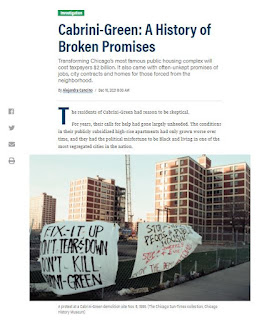
This story about Cabrini-Green was published today by the Better Government Association (BGA).  It tells of the re-development of the Cabrini-Green area of Chicago and the broken promises that government leaders made to residents who lived there before the development began.  Click here to read.

4/20/2022 update: Alejandra Cancino, the author of the BGA report spoke at the 4/19 ChiHackNight event. The video will be found here in a week or two. 
I came to the Cabrini-Green area in 1973 to be a retail advertising copywriter with the Montgomery Ward Corporate Headquarters, bordering  Cabrini-Green's West border.

I joined the company sponsored tutoring program that fall and was matched with a 4th grade boy named Leo Hall. A year later I became part of the volunteer leadership team, and in 1975 I became the program's volunteer director. I led this program until 1992 then formed a new version, called Cabrini Connections, which I led from 1993 to 2011.  

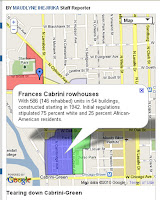
The map of Cabrini-Green, shown at the right, was part of a story I wrote in 2010 about the re-development of the area.   I talked about the promises that were being made and the prospect of them not being kept.
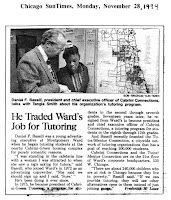
Below I show the front page of the Chicago SunTimes, from October 1992, following the shooting of a 7-year old boy in Cabrini Green.  The headline reads "7-year old's Death at Cabrini Requires Action".


I've kept a copy of this story for the past 32 years as a reminder of the commitment I and others need to make to kids born or living in high poverty neighborhoods of Chicago and other parts of the country.

I've used it in many blog articles, such as this from 2008,  encouraging others to get involved. 

Today's BGA story reminds me to repeat this call to involvement.

As we formed Cabrini Connections to help a small group of teens, we created the Tutor/Mentor Connection to help a city full of kids living in high poverty areas. I've used maps since 1993 to emphasize the need for investment in every high poverty area, not just the Cabrini-Green area.

Thus, the broken promises that affect kids and families who once lived in Cabrini Green, are broken promises affecting thousands of people.

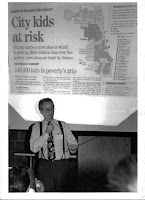
Look at the photo of me standing in front of a map, with a microphone in my hand.   Then look at this article with a map in the background. 

If you read my blog articles or some of the printed newsletters from the 1990s, you'll see a constant invitation for others to take a lead, sharing the same call to involvement, using their own media, talent and visibility.

As we head toward Christmas, remember how Jesus recruited 12 disciples and told them to go forth and multiply.   I've been trying to have the same influence for many, many years.  

Today's story is just another reminder that we've a long way to go. 

I'm not the only one working to help kids and families in poverty areas, not the only one calling for others to be involved.  But I'm one of the few using a map of Chicago and calling on people to support tutor/mentor and youth development programs in every high poverty area, not just the program I led in one small part of Chicago.

We need more leaders using maps like this, to draw people they know to places where those people can help. 

Use my articles as a template. Then create your own.


Friday, August 17, 2018

Lessons Learned from Leading Tutor/Mentor Program for 35 Years


When I started leading a volunteer based tutor/mentor program in Chicago in 1975 I held a full-time retail advertising job and the program already had an enrollment of 100 pairs of elementary school age kids and workplace volunteers to begin the school year.

With so little time available to lead the program I had to learn to recruit volunteers to help me and delegate roles for them to take.  Over time I learned that many volunteers often over-commit, and for various reasons could not complete the project assigned. Often this led to them disappearing from the program instead of asking for help.

Thus I learned that I needed to follow up, and help volunteers succeed. The result was that volunteers became more committed to the program and often took greater roles in the future.

However, I also learned one more thing. As the leader of the program my vision and commitment was usually greater than that of most volunteers. Because of my constant learning from other programs I often saw opportunities that others did not see. Thus, I had to LEAD. I had to share my visions in ways that volunteers might want to give their time and talent to make those visions a reality.

This led to me coining the formula of "R&D+F&L=Success".  

I applied what I learned as the tutoring program grew from 100 pairs to 440 kids and 550 volunteers by June 1992.

Here's a photo showing the leadership committee supporting the 1976-77 program.


Here's a photo showing the leadership team for the 1991-92 program, which had converted to a non profit structure at the start of the 1990-91 school year.


Click on each photo to enlarge. Look at the difference in the number of people involved and the organizational structure between 1976 and 1991-2.

Between 1975 and 1981 I had to recruit a new team of leaders ever spring, with just a few carry-overs from the previous year. We had no paid staff  until 1979 when we were able to hire a student from Moody Bible Institute for 10-15 hours a week.

In 1981 we began to change how the committee was organized and recruit leaders for different functional roles. By this time the program size was nearly 200 and more and more volunteers were coming from companies beyond Montgomery Ward (Partly due to downsizing and closing of the MW catalog business.  As volunteers went to different companies they continued to tutor, and often began bringing co-workers).

You can see in the second leadership group photos that some volunteers served as formal representatives of the companies they worked at. I used an Excel spreadsheet to record volunteer enrollment and listed the companies they worked at, occupation, and number of years they volunteered. Thus, as I saw groups of five or more from the same company, I began to reach out to veteran volunteers and asked them to become a mentor to co-worker volunteers and a contact point for reaching into the company for donations (we were not a non profit, but still needed food and snack donations, and gifts for the annual Christmas party).

This structure took time to develop. It took more than 15 years. The program was already 10 years old when I became its third leader. At the end of the 1989-90 school  year, as we begin creating a non-profit structure, the program already had 300 pairs of kids and volunteers meeting weekly. It still only had a paid staff of three part time college students who worked a total of less than 30 hours a week. 

Thus it was a 25 year journey to developing this volunteer leadership structure. The R&D+F&L=Success strategy really worked.   I created a concept map to visualize this growth.

Growth of Tutoring Program - 1965-1992 - map

In this section of the Tutor/Mentor Institute, LLC site  you can find three PDF essays that share my experiences and can help you start and grow a volunteer based tutor/mentor program in Chicago or elsewhere.  While these and all of the resources I share are free, I'm available for a small consulting and/or retainer fee, to help you understand and apply these ideas.

I created the Tutor/Mentor Connection in 1993  (and Tutor/Mentor Institute, LLC in 2011) as we were starting a new program to serve 7th to 12th grade youth who aged out of the first program. The T/MC's vision was to help high quality programs grow in all poverty areas of Chicago. Thus, my goal is that city and business leaders reach out to me for the experiences and ideas I share, and that they provide funds needed for me to collect, organize and share this information.

So far I'm not having a lot of success at this.

If you value the experiences and ideas I've been sharing please consider a contribution to help me continue to do this. Use the PayPal button or mailing address on this page.

Sunday, November 11, 2012

Cabrini-Green: What You Don't See. 1990 Video

In December 1988 during the annual volunteer gathering of volunteers from the Montgomery Ward/Cabrini-Green Tutoring Program, I was telling one volunteer about my goal of having a book written to tell the story of the 25 year growth of the tutoring program at the Montgomery Ward headquarters in Chicago. The volunteer, Sara Coover Caldwell, said "Why not make a video?"

Being a corporate advertising manager at Wards I realized the high costs of creating videos so responded with a bit of pessimism. Sara said, "I can do it. Let me put together a plan."

She came back a few weeks later with a budget of nearly $30,000, for talent, equipment, materials, editing, etc. all donated by friends of hers, along with a production schedule.

I did not realize at the time how much my life was going to change over the coming year. In January of 1990 my wife announced we were going to have our first child. In February I was called into a VP office at Wards and told that I no longer had a job with the company.

In late February, or early March, this video was shown on Channel 11, WTTW in Chicago:


By April 1990 a plan to convert the volunteer-based tutoring program into a non profit Cabrini-Green Tutoring Program, Inc. was in place, and in October 1990 while my first daughter was being born, I was filing papers for our 501-c-3 tax status so we could begin raising money to pay for my salary and a staff to operate the continued efforts of the tutoring program at Wards along with an effort to help similar tutor/mentor programs grow in other parts of the city.

In 1993 that effort became the Tutor/Mentor Connection. In 2011 that became Tutor/Mentor Institute, LLC.

Much has changed since 1990 but I'm still connected to Sara and many of the youth and volunteers who were part of the Montgomery Ward and Cabrini-Green Tutoring Program, Inc as well as those from Cabrini Connections, which Sara helped me launch in October 1992.

What has not changed is my belief that volunteers from different workplace backgrounds can become deeply involved in tutor/mentor programs and the lives of inner city youth and that some volunteers will use their talent and time to help such programs grow. This video created in 1989-90 by a volunteer demonstrates this potential.

Now we only need leaders from business, politics, religion, education, etc. to embrace this idea and help build an infrastructure where such programs are operating in thousands of locations around the country.


Friday, October 12, 2012

I've not forgotten Dantrell Davis. Have you?

Today in the Chicago Tribune you can find a half-page story by Mary Schmich titled "Dantrell Davis shouldn't be forgotten.   If you don't know the name Dantrell was a 7-year old boy shot to death in Cabrini Green as he walked to school in October 1992.

At the left is the front page from the ChicagoSunTimes of October 15, 1992.  The headline says "7-Year Old's Death at Cabrini Requires Action".  I've kept this page in my office as my own reminder and I've posted it in my newsletters and blog at least once a year to remind everyone else.

Mary Schmich has written about life in Cabrini Green for almost 20 years. Her stories are emotional and focus on the struggles and triumphs. However, like most stories in the major media, they don't focus on all of the neighborhoods in Chicago and the suburbs where kids live in fear of violence and attend poorly performing schools.  The don't point to databases of tutor/mentor programs, like the one I host, where volunteers, donors, public leaders, etc. can learn about existing programs working to help kids succeed in school and avoid gangs, or where there are neighborhoods of high poverty, but few or no existing non-school tutor/mentor programs.

It's been 20 years and not enough has changed to improve the lives of youth in poor neighborhoods.  One story in one newspaper on one day is not enough. Stories that don't point to on-line discussion forums, libraries of deeper information, or call on people to volunteer time, talent and dollars TODAY, and every day, tug on the emotions but don't move people to action like a good 50% off Sale at a local retailer does.


Anyone can look at maps of Chicago to see where poverty is concentrated, where poorly performing schools are located, where incidents of violence occur most frequently.  Using the Program Locator or Chicago Program Links library you can identify nearly 180 youth serving organizations who each constantly seek operating dollars, talent, leadership, volunteers and public attention.

If you are want to remember Dantrell Davis pick a neighborhood near where you live or work, or along the route you travel as you go from home to work and adopt a tutor/mentor program. Use the information in the Tutor/Mentor library to build your own understanding of what these programs do, how they differ and how volunteers and donors and third-party supporters can help each program constantly improve over many years of YOUR consistent support.

Dantrell Davis was 7. He would have been 27 now. Because he lived in a high poverty neighborhood he might still be needing people from Chicago's extended business community to serve as mentors and to open doors to jobs and careers for him. Or he might need the same people to be operating a tutor/mentor program in one of Chicago's neighborhoods for his own kids to be enrolled.

In yesterday's article I quoted General Colin Powell as he called on business to become strategically involved. He said "This isn't charity. You're doing it in your own self-interest."

I also pointed to a Wiki Page with quotes from Abraham Joshua Heschel .  One says "Remember that there is a meaning beyond absurdity. Be sure that every little deed counts, that every word has power. Never forget that you can still do your share to redeem the world in spite of all absurdities and frustrations and disappointments."

We all have personal power to change the world. Unleash yours.  

Saturday, March 17, 2012

Writer? Publisher? Tell This Story.

Today I posted an essay title The Tutor/Mentor Business to my Scribd.com account. This was written in 1997 by Sara Coover Caldwell, who was one of the original founders of Cabrini Connections, Tutor/Mentor Connection.

When Sara wrote this in 1997 she also wrote a script for a TV show centered around what happens from August through May in a tutor/mentor program. Our goal was to expand the essay into a book and to use the TV show to build visibility for tutor/mentor programs and raise funds to support our efforts as well as those of other programs in Chicago.

I also posted a second essay, talking about the network-building that I continue to do through the current Tutor/Mentor Institute, LLC structure. In this essay I show how connecting networks using maps, links libraries, conferences and on-line communities can increase the power of people around the world who are trying to give a voice to youth who have no political power in this world.

After you read the Tutor/Mentor Business I hope you'll also read the Network Building story.

On the final page I point to this blog and other places where part of this story is available on line. However, it's not yet compiled in a book, or in a course outline being taught at some university. We still don't have the TV show, even though we do now have a Tutor/Mentor Institute YouTube channel.

If you'd like to be the writer, producer, publisher or benefactor who helps me compile this information into book form, or in a TV series, just introduce yourself and join the network.

Thursday, June 16, 2011

Where Else in Chicago?

The map below shows the location where Cabrini Connections will be holding its 18th annual year-end dinner tonight. More than 250 guest are expected, including parents, volunteers, students, donors, alumni, etc.


This slideshare shows images from the 2010 dinner. Visit the video section on the Cabrini Connections web site to see more like this.

Where else will events like this be taking place this month, connecting people who don't live in poverty with kids and families who do?

I've been leading this effort for 18 years and I'm leaving the organization next month because we've not been able to convey the benefits of tutor/mentor programs to enough philanthropic investors who will provide the on-going resources for programs to retain leaders for 10 and 20 years and build organizational knowledge that supports the growth of these programs.

I'll not be leaving this mission even though Cabrini Connections and Tutor/Mentor Connection are separating into two different organizational structures. Through the T/MC I will continue to use this blog, networking, and the ideas and resources shared on the T/MC web site to help leaders in business, religion, politics, sports and media build a collective understanding of a tutor/mentor program as a place connecting a wide range of people and ideas in a long term effort to help kids move through school and into jobs and careers.

I have not yet determined a structure for the future Tutor/Mentor Connection. I could become an institute within a university. I could become an independent think tank. I could become a consultant and charge fees for the ideas I've been giving away for free. Or I could create a non profit and try to compete for donor attention with the same frustration I've had for the past 18 years.

I hope you'll help me make the right decision and support me in this effort for the next decade. I also hope some of you will become partners and owners so you carry these ideas forward when I'm no longer able.

It's been an honor and an ever-day reward to be part of Cabrini Connections and the Montgomery Ward/Cabrini-Green Tutoring Program that came before it. I hope we can help millions of others get involved with this journey so they can share the same rewards.

Monday, April 25, 2011

A New Tutor/Mentor Connection


In the fall of 1992 a young boy name Dantrell Davis was shot and killed in Cabrini Green. I've posted this image of the front page on my blog often and used it as a reminder of a commitment I and the founders made during the weeks following this event, as we created Cabrini Connections and the Tutor/Mentor Connection.

Over the years we have realized that we had two "brands" and that many people did not understand the Tutor/Mentor Connection and why it was important to Cabrini Connections and every other tutor/mentor program in the Chicago region. I've created PDF essays like this to try to educate donors, and our own volunteers and leaders.

Because we have not been able to attract philanthropic investors to provide consistent support for the Tutor/Mentor Connection, the burden of raising funds has been with the volunteers and leaders of Cabrini Connections. It has been a single small tutor/mentor program trying to support the infrastructure needed to support all tutor/mentor programs in the entire region. A big challenge, and ultimately, too much of a burden.

Our funding challenges of the past decade and changes in leadership have finally caused the Board of Directors to decide to focus only on the Cabrini Connections part of the organization. I will be reforming the Tutor/Mentor Connection into a new organizational structure that I hope can do a better job of attracting investors and philanthropic support so we can have a greater impact in Chicago and share this impact in other cities. If we succeed, it will do more to provide support to Cabrini Connections and its students, volunteer and alumni, than if I stay with the organization for another few years.

We have a unique opportunity. The T/MC is recognized in many parts of the world and appreciated by many. The web resources including the Chicago Tutor/Mentor Program Locator and on-line documentation system are unique, and not available in this format or strategy in any other city. The year round event strategy and web library have been developed over a period of 18 years. It would be impossible, or financially improbable, for any city or any group in Chicago, to rebuild this from scratch. Thus, a new structure may enable us to find the capital needed to fully develop these resources and to make them available in more places than Chicago.

That structure is not yet clear. Instead of starting a new organization, we could move under the umbrella of another organization, or a university, or even a city like Chicago. However, if you know me you know that I have a wealth of ideas that only need volunteers and/or investors to bring them to life. By mid July I need to find donated space from which to operate, and a team of volunteers, advisers and supporters in place.

Thus I'm inviting any current and/or former Cabrini Connections volunteers and student alumni, as well as those I have connected with via the T/MC network who value the Tutor/Mentor Connection and have an interest in helping it move into the future to email me at tutormentor2@earthlink.net to offer your ideas.

To learn more about the goals and activities of the Tutor/Mentor Connection, review the essays in this Tutor/Mentor Institute web site.

Follow this blog over the next few months to see this exciting new structure develop.

Thursday, March 24, 2011

Shining light on Cabrini Green

I encourage you to read this Chicago Tribune article about a creative light show that will highlight the demolition of the last high rise building in Cabrini Green.

"On the eve of its demolition next week, the last standing high-rise affiliated with the Cabrini-Green public housing project will be illuminated with 134 LED lights, one in each of its vacant apartments, programmed to blink in "conversation" with one another — with the goal of speaking to the experiences of former residents. Lights will fall as the building does during its month-long razing, scheduled to begin March 30."

Cabrini Connections students were part of this project (see blog) , and Bradley Troast was quoted in the Tribune article.

Does this also signal "Lights out at Cabrini Connections" which has been connecting Cabrini Green teens to tutors/mentors since 1993?

It could. Our grant funding has declined over the past few years and we feel some of this is from donors making choices between funding a program serving Cabrini Green, and programs in other neighborhoods with high poverty.

However, this map from an October 2010 Chicago SunTimes article shows that nearly 400 families still live in the Row Houses of Cabrini Green and more than 1200 low income families are expected to be living in the redeveloped areas by 2014. (see this article)

If you read letters from our teens, they think we're still needed in their lives.

During the coming month as you view the light show, think of ways Cabrini Connections is not only helping teens living in Cabrini Green and in neighborhoods of the web and south side of Chicago as this map shows, but is also using its web site to share information about what we do that others can use to build programs like Cabrini Connections in other places..

If you have been part of Cabrini Connections in the past, present or want its help in the future, please send donations to help keep our lights on as we move into the 2011-12 school year. Donate here. See more about ways to help.

Tuesday, February 22, 2011

Be like Mike. Be like El.

Starting a tutor/mentor program is easy. Keeping it going for a decade or more and constantly finding ways to get better is the hard part. This video was created to inspire volunteers and donors to raise money for the Cabrini Madness Fund Raising tournament.

Maybe from Cabrini Connections on Vimeo.


El Da'Sheon Nix and Bradley Troast,the leaders at Cabrini Connections, collaborate to lead the weekly program activities and to create these videos. The inspiration for this one came from the video below, featuring Michael Jordan.


It takes the work of many people, over many years, to help programs like Cabrini Connections become a fixture in the lives of inner city kids. I wrote this article last week to show how important Cabrini Madness is to our fund raising, and to increasing volunteer involvement and ownership in the overall vision of Cabrini Connections and the Tutor/Mentor Connection.

I use graphics like this to emphasize that we seek the engagement of people from every industry sector in this on-going process of innovation and program development, not just the people who are current tutors/mentors at Cabrini Connections.

If we want more kids born in poverty to have adult lives free from its chains, able to raise their own kids in diverse communities of greater hope and opportunity, we must "be like Mike" and "be like El" with the work and commitment we're willing to bring to the game every day.

Wednesday, January 26, 2011

Little Organization. Big Vision.

Last night the President ended the State of the Union address by quoting an employee of a small Michigan company who said "We're a little company but we do big things."

If you've read any of the articles I've posted you'll see that Cabrini Connections, Tutor/Mentor Connection is a small organization with a big vision, and a growing impact.

On the national level, a Mentoring Summit just ended in Washington, DC, and big corporations have made a pledge to support mentoring. First Lady Michelle Obama was quoted as saying "The idea that we have behind all these initiatives isn’t simply to create a series of one-time experiences for just a small number of kids. It’s about encouraging more caring adults to step up and make mentoring a part of their lives."

At Cabrini Connections we're launching our 2nd Annual Cabrini Madness event,where volunteers, students and friends form teams and compete to see which team can raise the most money for CC, T/MC by the time the NCAA basketball championship game is held in early April. Last year 112 students/volunteers raised over $23,000.

I was invited to be part of one team, and sent the following message to the leaders. I hope that this will be passed on to corporate leaders who are making a national commitment to support mentoring.

First, I hope that our team and other teams will draw from the ideas in the blog articles I post and the essays at http://www.tutormentorexchange.net

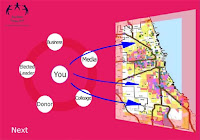
These use the "wheel" as a common image. Below is a chart I first created almost 16 years ago. It still is the model for a mentor-rich organization that seeks to have a long-term impact on youth and volunteers involved.


One way to look at this is as the "student" at the hub of the wheel. In this case the spokes would be pointing to the different people and different influences that would help that student through school and into a job.

Note that if you start mentoring a youth in first grade it takes 12 years for that student to finish high school. The major challenge to non-profits offering mentoring and learning support is to find the on-going FUNDING needed to provide consistent, age-appropriate learning and mentoring for this many years.

Another way to look at the "wheel" is that the hub is a "place" like Cabrini Connections and the spokes are all of the volunteers who participate each week. Together we reach more kids and offer more diversity of career modeling and support. This video gives a tour of Cabrini Connections.

Program walkthrough from Cabrini Connections on Vimeo.


In Cabrini Madness the hub of the "wheel" is each student, volunteer and team and the spokes lead to the people they know and networks they are part of (work, family, college, faith, etc.). If during the first three months of each year we can show people in our networks how important it is for them to help us, some will send donations, and some groups may organize activities on a year-round basis that help us.

One example of this is the Lawyers Lend A Hand Program in Chicago which is now raising money and visibility and awarding over $200,000 in grants to different tutor/mentor programs each year. In 1994 when I first reached out to them with a vision of supporting tutor/mentor programs all over the city , they were giving one $2k grant.....which went to Arne Duncan's Ariel Tutoring Program in Hyde Park.

We need a "lawyers for Cabrini Connections, T/MC" group that has people in the legal community working each week to recruit volunteers and donors to support our efforts. We also need support from every other industry shown on our "business wheel" so we have a diverse mix of volunteers mentoring our kids, and a diverse mix of funders making sure we have the resources needed to support their employee volunteers and constantly improve our impact on kids.

However, Chicago and America, need corporate and political leaders who use maps like we show here and here to develop leadership and program support strategies that enable tutor/mentor programs to grow and reach youth in all of the neighborhoods with high poverty and poorly performing schools. Using business maps in their planning, companies can develop strategies that reach many parts of a city, instead of just supporting a few well-known programs.

As this article says "The problem is not public schools, its poverty".

If our students and volunteers tell their stories of involvement in Cabrini Connections, or in any other tutoring/mentoring program, using blogs and videos and in other creative ways, they can attract the attention of growing groups of people who may support us throughout the year.

However, if corporate American and the President, Governor and Mayor adopt these ideas they will begin to provide the consistent resources that every tutor/mentor program in America needs to connect kids and volunteers with each other, and with extra learning and enrichment (see our Success Steps) so that by 2015 the nation will begin to see an eruption of kids from poverty neighborhoods who are leaving high school better prepared for 21st century adult responsibilities and jobs.

Mr. President, we're in your home town. You spoke at the Tutor/Mentor Leadership and Networking Conference in 1999. Your Secretary of Education led a non-school tutoring program. I introduced the T/MC concept to your wife almost 15 years ago when she was at the University of Chicago.

I'd be happy to help you learn to adopt and use these ideas. You can help us do big things with them.

Tuesday, January 11, 2011

Want to help youth living in high poverty?


The Tutor/Mentor Connection (T/MC) collects and shares information that anyone can use to build personal and/organizational strategies that reach more k-12 youth living in high poverty areas and help them stay in school, stay safer in non-school hours, expand their network of adult support, and move toward graduation, advanced education and to jobs and careers.

We focus on actions that need to be repeated over and over for many years in many places of Chicago and other cities. Such actions would lead to high-quality, mentor rich programs operating in inner city neighborhoods. The information we share is intended to be used by our own volunteers, students, staff, leaders and donors at Cabrini Connections, the program we lead.

It's also intended to be use by others in the for-profit world, education, and the non-profit world. In fact, if leaders in business, religion, health care and universities adopt this leadership strategy, employees can form tutor/mentor support teams using the ideas we share.

As we enter a new year and a new decade staff and volunteers at Cabrini Connections are beginning to plan 2011 events.
In a meeting last night someone asked "what roles are we looking to fill on the year-end dinner committee?"

Since we want to empower many teams of volunteers and students to support different activities and events throughout the year, I thought I'd share some ideas that I've learned over the past 35 years of leading a volunteer-based tutor/mentor program.

I'm not going to write a long blog article, instead I encourage you to open this "Steps to Start a Program" pdf and use it as a guide in forming teams that want to have an impact.


Here's a screen shot of one of the pages in this "Operating Principles" pdf which focuses on good planning.


This page of the "Operating Principles" pdf focuses on types of talents that need to be part of an effective committee.


Do you have someone who can be the project manager for your committee? Or someone who is an effective communicator? Perhaps the most important role is that of a "recruiter" who can find people with these talents and bring them onto a committee or a board.

If you want to help Cabrini Connections, Tutor/Mentor Connection please take a look at this planning guide and identify the skills and talents you might contribute to one or more of the project described on this list.

If you're with a company and can form teams like this, your team can help Cabrini Connections and every other tutor/mentor program in Chicago and other cities by the way it mobilizes resources and points them to individual organizations.

If you find these ideas useful please let us know. If you can help us share them, or can help provide the funding that goes into developing them, we'd like to hear from you.

Wednesday, December 15, 2010

Looking back at last 10 years - Cabrini Connections

Our mission at Cabrini Connections is to connect youth and volunteers in a structured set of activities where the volunteers serve as tutors, mentors, coaches, friends and make a life changing difference. Our roots go back to 1965 when employees from the Montgomery Ward Corporation in Chicago began to tutor elementary school kids in the Cabrini-Green area. View this chart to see growth from 1965 to 1992. View this chart to see growth since the formation of CC, T/MC in late 1992.

The two teens in this photo are 1999 graduates of Cabrini Connections. Both now have Master's Degrees and one is pursuing here MBA. Over the next two weeks I'm going to write a few articles showing what Cabrini Connections and Tutor/Mentor Connection have accomplished and the challenges we have faced in the effort.

Below is a chart that shows the number of teens on our active roster each spring since 2000. In 1999 we left 20,000 sq ft of donated space at the Montgomery Ward Corporate Headuarters in Chicago and began to rent about 2500 sq ft of space in Cabrini Green for the operations of Cabrini Connections. Thus, the number of students who could participate was reduced to a maximum of 80. Through the decade we've started each year with 75-80 students and kept most of them till the end of the school year.


This chart shows that 40-70% of the students in each year's class had participated for three up till six years. That means that not all kids who joined in 7th or 8th grade continued through high school. Some moved. Some went to scholarship programs like Highsight, with our help. Some decided this was not right for them.

Teens vote with their feet.
However, research shows that "Although the benefits of afterschool programs for older youth are abundant, and awareness of the need for afterschool is growing, many programs still struggle to recruit and retain older students." Thus, for Cabrini Connections to recruit these 7th to 12th grade students and keep so many participating for 3-6 years, the program must be offering perceived value to the youth who participate.


This next chart shows the number of seniors who finished high school each year. Many of these students have already finished college.


A study by Mark Cohen and Alex Piquiero from Vanderbilt Owen Graduate School of Management said, “We estimate the present value of saving a 14-year-old high risk juvenile from a life of crime to range from $2.6 to $5.3 million. Similarly, saving a high risk youth at birth would save society between $2.6 and $4.4 million.”

That means that based on the number of students who have participated in Cabrini Connections, and just those who we know have graduated from high school, we've potentially saved society $120 to $300 million dollars.

However, look at this chart that shows the money we've spent each year to provide Cabrini Connections. The amount we spend is based on how much we can raise. There were seven volunteers when Cabrini Connections started in 1993. They had no money to fund the organization. Every year we've had to raise the money to fund the operations of that year. While we had support from the Montgomery Ward corporation, and free space, until 1999, we lost that support when the company went out of business in 2000. Then the dot.com bubble burst, 9/11 happened, and then came tsunamis, hurricanes, earthquakes and a 10 year war. While we had $200,000 for operations in 2000 and 2001, we've spent between $150,000 and $175,000 each year since then....and almost 25% of this was for rent, insurance and utilities.


This final chart shows total expenses (including fund raising and administrative costs, which are under 20% of total expense each year). The chart shows that we spent more than we raised in 2003, so we cut costs dramatically for the next five years. We received several gifts of $30,000 to $60,000 in 2007 and 2008 that enabled us to invest more in our programs, but we've in the past two years we've spent more than we've raised.

That means unless we can find donors who value the long-term impact of a program like Cabrini Connections, and who will provide significant donations, we will cut back on staff, and services, and not be able to help these kids realize their great potential.


Please send your donations to Cabrini Connections, Tutor/Mentor Connection, 800 W. Huron, Chicago, Il. 60642. See our donation page at http://www.cabriniconnections.net/donate

Next I'll show the story of the Tutor/Mentor Connection and how the last decade has presented numerous challenges to our efforts.

Tuesday, December 07, 2010

Volunteers and Students Appeal for Donations


This is the link to this week's Cabrini Connections email newsletter.

Look at the different ways our volunteers and students are working to help raise needed year end donations. I hope you'll help if you can.

Read student letters to donors and see how they describe Cabrini Connections as a family.

Santa's Naughty or Nice Charity Pub Crawl
HO HO HO - What better way to feel the joy of the season than to fill yourself with HOLIDAY SPIRITS and give a little something back to the community? For a donation of $10 (or more), you will get the company of some very fine individuals and a big red Santa hat (first 45 attendees). -Elena Lugo and Melanie Munsey

Beard For Kids
This holiday season I’m participating in the Beards For Kids 2010 Challenge. I’ll be growing a beard from now until the end of the holidays and have a goal of raising $10 per day for Cabrini Connections. Please help me reach my goal by donating here today: http://beardsforkids.org/ -Gabriel Chapman

Matt Golden's Fundraising Page
I have asked family and friends to help me raise $2,000 for Cabrini Connections in the month of December. I have set up a website on FirstGiving and have already raised $270! Hopefully, our contributions can help Charles Hill and other students continue to succeed at Cabrini Connections. http://www.firstgiving.com/mattgolden -Matt Golden

One Month's Rent Campaign
Please support my cause by contributing an amount toward one month's rent for next year. We have a beautiful 4500-square foot space near downtown Chicago where all of our youth come to meet with their mentors. You can get a good sense of it here as I walk through in this video: http://vimeo.com/16755309. -Bradley Troast

Alumni Fund Page
I graduated from the program back in 1992 and I'm troubled to hear that it is in financial peril and there is the real possibility that it can close. This program was a key factor in my finally seeing what possibilities lay out there for me to be successful... They are currently doing that for so many of the Children of Cabrini and I'm not aware of many programs that do it in a grass root, no nonsense kind of a way. -Isaiah Brooms

Holiday Mapping For Justice
Help Mike raise money to support the mapping project at Cabrini Connections, Tutor/Mentor Connection.

I even have added my own Birthday Wish on Facebook. I'll be 64 on Dec. 19 and I hope you'll donate to help me celebrate

Tuesday, November 23, 2010

Understanding impact

Visit Bradley Troast's blog to see the latest report showing impact of Cabrini Connections, a Chicago based non-school tutor/mentor program.

You can also see a graphic showing 2009 revenue and expenses.

Friday, November 12, 2010

This is Cabrini Connections, This is Chicago.

Program walkthrough from Cabrini Connections on Vimeo.

Please watch this video and show it to friends, co-workers and potential sponsors. For Cabrini Connections to be a place where inner city youth and volunteers from a wide range of business backgrounds can connect, we must find a wide range of donors and benefactors who help us pay the costs of rent, utilities, insurance, staff and program support.

Once you look at the video and see what is happening in the Cabrini Connections space each week, visit our web site to see activities that take place throughout the year.

Then look at the map below.

Cabrini Connections served teens living in one small part of Chicago. The city has more than 200,000 k-12 youth living in poverty neighborhoods. The suburbs have a growing number of youth living in families where there are not adults modeling college and career opportunities that youth can aspire to, and that the nation needs to fill.

When you look at a map like this you should be able to click on the icons representing tutor/mentor programs, and go to web sites with videos just like this one, to see a wide range of mentors and learning supporting youth in that neighborhood. Note. you can visit the Tutor/Mentor Program Locator's interactive map and click on the green stars to learn about existing tutoring and/or mentoring programs in Chicago. You'll not find many with videos on their web sites showing how volunteers and youth are connecting to each other.

Right now that's not possible because too many neighborhoods don't have programs like Cabrini Connections, and too few leaders in media, politics, religion, business and/or philanthropy are taking a proactive role in trying to provide the resources programs like Cabrini Connections need to get started in a neighborhood, then grow over 15 or more years to become established and effective at connecting youth with a wide range of volunteers.

As we get set to elect a new Mayor and a new set of aldermen, look for evidence that these people can, and will, mobilize volunteers and donors to help build and sustain tutor/mentor programs in their districts, and in all of the high poverty neighborhoods shown on our maps.

Next week we'll host two events focused on helping all tutor/mentor programs, including Cabrini Connections, find needed resources.

Mapping Solutions, at Webster Wine Bar, starting Monday, Nov. 15 and running through Nov. 27.

Tutor/Mentor Leadership and Networking Conference, Nov. 19 at U.S. Cellular Field from 8:30 am till 5:pm. At the end of the day a Waiting for Superman Panel will discuss the documentary movie and talk of how non-school volunteer-based tutor/mentor programs fit into the broad strategy of helping kids grow up and prepare for adult lives.

If you want to come to the conference just for the panel discussion, we will not charge fees for anyone coming after 3:30pm. The panel starts at 4pm.

Thursday, November 11, 2010

Cabrini Alum Stars in Toronto Film Festival


LaFaye Garth, a 2009 graduate of Cabrini Connections, was one of the featured artist presenting films in Toronto's 2010 Regent Park Film Festival. See PDF announcement.

LaFaye represented the student film makers who created “Cabrini Green, ‘This is What I Know’: Our Lives, Our Truths, Our Stories

This is an article from a publication called Canadian Immigrant

CBC Radio Show interview with LaFaye (scroll down the page to: Regent Park through foreign eyes)

Visit the Cabrini Connections Video Club blog and this page to learn more about how volunteers and youth are connecting and creating these opportunities.

Donations from individuals, corporations and foundations make this possible. Please help. Read more.

Friday, October 29, 2010

Cabrini-Green Gone? Are you sure?

On Thursday I received a call from an CBS News research in New York, who was looking for people to talk to following a story in the Chicago Sun Times titled: Cabrini Green Last Stand

I agreed to reach out to alumni of Cabrini Connections for some people that he might talk to, but also challenged the reporter to dig deeper. I dug up the article myself and found that it had a really informative map. I encourage you to take a look at these.

The first map shows the entire Cabrini-Green area. You can see an icon showing the location of the final high rise that was the focus of the SunTimes article. If you click into the shaded sections you will get a pop up window, providing an estimate of the number of new units being built, and the number being set aside for public housing.

This is the section of two story buildings known as the "row houses". According to this article, "Only the 54 buildings of the row houses -- 586 units built in 1942 in the area between Chicago, Hudson, Larrabee and Oak -- are to remain at Cabrini. Eerily empty, a third are boarded up for rehab promised but now uncertain, as CHA reconsiders keeping this section 100 percent public housing."

Do the math. If 2/3 (390) of the row house unites are occupied and there are an average of 3 kids per family, that means about 1200 kids are living in that area. If 40% are 7th -12th grade, that means there are 480 who might benefit from a program like Cabrini Connections. We only have capacity for 80.

This is the Cabrini-North area. It "will host 700 units for former tenants out of 3,641 planned in at least 15 different developments."

This is the area called Cabrini Extension South, where "600 new units, one-third market-rate, affordable, and public housing" will be built.

This is the area North of Division Street called the William Green Homes. "This area will host 900 new units, one-third market-rate, affordable, and public housing, respectively. However, the first 100 units for former CHA tenants won’t be ready until 2013."

The Sun Times article said, "According to CHA's FY 2010 annual report to HUD, when Cabrini's transformation is complete, it will boast 5,141 privately developed, mixed-income units -- 1,200 as public housing, 932 for working-class families, and 3,009 for sale or rental at market rates."

Do the math. If there are an average of 3 kids per family, there will be 3600 low-income kids living in the public housing units in the "new" Cabrini Green. If the public thinks those kids are going to magically turn into high achievers, and their parents are going to be able to find well-paying jobs to support the education of their kids, they are not going to see any reason for tutor/mentor programs like Cabrini Connections to be in the area, and we won't be able to find the funds to continue to operate.

But the people building these projects are not educators, or social workers. Are the people who purchase the market rate properties, or the "working class family" properties, going to launch programs to connect the kids in the public housing units with mentors and learning resources that are available to their own kids?

Cabrini Connections has a history dating back to 1965 and operates a mentor-rich program (although poorly funded). When people in Cabrini Green realize there needs to be programs like this will they start from scratch and try to relearn all that we've learned over 45 years?

Take a look at the Cabrini Connections web site and meet our teens. We have nearly 80 7th to 12th grade student enrolled in the 2010-11 program. Most come from the Cabrini Green area. It will be six years before the 7th graders are high school graduates.

Here's a message posted on Facebook by one of our former students:

I graduated from the program back in 1992 and I'm troubled to hear that it is in financial peril and there is the real possibility that it can close. This program was a key factor in my finally seeing what possibilities lay out there for me to be successful.... They are currently doing that for so many of the Children of Cabrini and I'm not aware of many programs that do it in a grass root, no nonsense kind of a way.

I am throwing out a challenge. I will match donations to the program up to a total of $600. I wish I could do more. But unfortunately, I can't. However together, we can turn each others dollars into a significant amount. Facebook me if you want to join this challenge with me. If all goes well, we should be able to give the program at least $1200 dollars that they do not have right now and desperately need.


We hope many people will respond to this challenge so we can try to help them reach this goal and be prepared for the next step to college and a career.

With a good job, and a good education, they can choose where they want to live.

Tuesday, October 26, 2010

Help at Halloween

Read about this Saturday's Halloween Bake Sale, organized by one of our Cabrini Connections students and her mentor. You can help make this Halloween special if you make a donation yourself.

Friday, September 10, 2010

What's possible in non-school programs

This is a second video created this summer by video club teens and volunteers at Cabrini Connections, a non-school tutor/mentor program operating in Chicago.

Yu-Gi-Oh! Final Battle - Music Video from Cabrini Connections on Vimeo.


This Back to School blog written by Karina Walker of the Tutor/Mentor Connection, illustrates how we share what we learn at Cabrini Connections with leaders and volunteers in tutor/mentor programs operating throughout the Chicago region.

On the Mapping for Justice blog, Mike Trakan of the T/MC shows how we use maps to focus volunteer and donor attention on all of these programs, and how we organize events, like the Tutor/Mentor Jam concert, to try to draw more attention to tutor/mentor programs.

This is made possible by donors who make large, and small donations to fund our work. Please read this appeal, and add your own support.

Sunday, August 22, 2010

Many voices. Common goal.

In today's Chicago Tribune, three pages were devoted to telling the stories of 303 shootings in Chicago during July 2010. These are tragic stories and are certain to capture reader attention.

While the Tribune team of writers, editors, web site designers, etc. were assembling the Sunday Paper, I was in Indianapolis sharing some of my ideas for creating community collaborations and non-school tutor/mentor programs, that might help prevent such violens. Here's the presentation that I delivered.

However, while I was in Indiana, the Cabrini Connections, Tutor/Mentor Connection team was putting together their own stories. El Nix wrote about "The Big Score" in one of his comparisons of a tutor/mentor program to a college or professional football team. Karina Walker compared the T/MC to Henry Ford's assembly line. Bradley Troast talked of how universities can partner with tutor/mentor programs.

At the same time, Mike Trakan kept spreading the word about the August 29 Tutor/Mentor Jam Concert in Chicago.

We don't have the distribution of the Tribune, but our stories focus on actions and ideas that can help Chicago be a better place to live. I hope you'll read these and pass them on to friends.