Showing posts with label knowledge. Show all posts

Monday, February 12, 2024

Multiplying Good - Map the Network

Over the past few months and years I've seen many posts on social media, showing a professional athlete's support for mentoring. During last week's Super Bowl I saw players from each NFL team nominated for the 2023 Walter Payton NFL Man of the Year Award, given for outstanding community service. You can see them here.


It's great to see the generous, community-focused, work these people are doing. 

As I watched the NFL Honors program I posted this Tweet.
It shows a map of Chicago with high poverty areas indicated.  It was signed in the mid 1990s by eleven retired professional athletes to indicate their support of an "Adopt-a-Neighborhood" idea that I began promoting in the 1990s.   

As I looked at the many posts about athletes supporting mentoring, and the NFL Honors videos showing athletes supporting many different efforts in their communities I wondered if anyone had tried to create a web library, and/or concept map, building lists of athletes/celebrities from every sport, focused on specific issues.

Below are two examples of what I am thinking about.

This concept map shows organizations in Chicago who serve as intermediaries, supporting multiple youth-serving organizations who provide specific types of support, such as STEM, Arts, tutoring and/or mentoring.  Under each node is a link to the organization's website. 


This next concept map shows issues that affect people in every community, both affluent and economically challenged. Note that in the lower left corner I show the UN Sustainable Development Goals (SDGs) graphic. That shows issues many athletes/celebrities already support. 

Now, what if someone were creating a map like the first one above, showing athletes and celebrities in each major city, and/or the foundations they support.  For instance addiction and drug abuse is on my map and it affects rich and poor people, in some similar ways, but in many different ways.  Many athletes have adopted addition as their cause.  A map like the one above would show all of those.

A map like the one below would have links to web libraries, or other concept maps, that aggregated this information from every city across the country.

Here's a page from my library, showing links to websites with information about Black history.  This could be a list of athletes/celebrities who focus on addiction and drug abuse, or self esteem, or mentoring, or any of the many different issues shown on my concept map and the SDGs map.  It could be focused on a single city, or nationally and internationally.  


And below, is a concept map showing the categories of homework and learning resources that I host in the library.  


The nodes on this map could be the same as the ones in the Race-Poverty map I show above. The links would point to other concept maps showing athletes/celebrities in different cities who support that cause, and to web libraries that contain lists of websites with the same information.

Why collect this?  To learn from each other and improve work being done.

This should be a no-brainer for sports professionals. Coaches are constantly learning from each other. They have libraries of film that they study to spur innovation and constant improvement.

Why can't something like this support what athletes and celebrities do to help create a better world?


Who could be doing this work?  

This could be a project of students in any school, starting in middle school and continuing to PhD work at a local university.  

I've posted articles in the past about universities adopting the Tutor/Mentor Connection strategy, which is based on this type of information gathering and sharing. 

I hope you'll read some of these and that local sports stars will also take a look. Maybe the NFL, NBA, WNBA or another sports business will provide the funds for this research and will host it on websites where they honor athletes for the good work they do.

Maybe an award will go to those doing the best work of aggregating and sharing this information.

5-1-2024 update - here's an example of aggregating and mapping information about athletes.  This is a map showing where NHL players were born. 

8-7-2024 update - in this article I show some other tools for mapping networks. 

3-8-2025 update - here's an example of how network mapping might be used.  This looks at the 2023 NIFA Woman's World Cup teams. 

7-26-2025 update - I started a list of sports philanthropy websites in the Tutor/Mentor Institute, LLC library.  Find it here.  These show that there already is a certain level of aggregation.  They also show the type of websites I'd like to find and add to the list.

Like the idea? Share it.  

Skim through articles I've posted in the past about the role athletes and celebrities could be taking, beyond the good work they already do.

Connect with me on social media and let's talk about ways we can use information to support problem solving.  You can find links to my social media platforms on this page.

If you value the ideas and information I'm sharing, please make a contribution and help Fund the Tutor/Mentor Institute, LLC. 


Sunday, October 29, 2023

Information-based problem solving

I've used concept maps since 2005 to visualize ideas and resources that I've been aggregating and sharing since forming the Tutor/Mentor Connection in Chicago in 1993 (and the Tutor/Mentor Institute, LLC in 2011). 

Open the one below and look at all the challenges facing kids and families in high poverty areas.  Most of these affect all of us, but more affluent people have greater resources to cope with these challenges. 

When I first became a volunteer tutor/mentor in 1973 I knew little about what I was supposed to do. However, I began to look for ideas that inspired my weekly connections with a 4th grade boy named Leo.  In 1975, when I became the volunteer leader of the tutor/mentor program hosted at the Montgomery Ward headquarters in Chicago, I expanded this process of learning, to find other tutor/mentor programs who I could borrow ideas from.

When we formed the Tutor/Mentor Connection in 1993 we developed a 4-part strategy, shown on the concept map below.

Step #1 focuses on collecting and sharing information that others can use.  Step #2 focuses on increasing public awareness so more people use the information we collect and Step #3 focuses on helping people find and use the information collected in Step #1.   Step #4 is motivating people to use that information and their own resources to help organized tutor, mentor and learning programs reach more K-12 kids in high poverty areas with on-going support that helps them move through school and into adult lives.

Below are a few concept maps that show how to apply this information in on-going, information-based problem solving.  

At the center of the concept map below is a graphic showing use of information to fight the war on poverty. 


At the far right my graphic focuses on building "great programs in each neighborhood" and the need to "organize and train" volunteers, donors and leaders.   At the far left are graphics that show a need to build "public commitment" and to "influence" resource providers, not just non-profit leaders, youth and volunteers.  At the bottom of these nodes are links to other articles and other maps.  

Below is another concept map that focuses on the on-going planning and action cycle.


Follow this from left to right.  Planning starts with choosing a "place" where a problem (or opportunity) exists that you want to focus on.  Then draw people together and begin to look at information available that builds a deeper understanding of the issue and shows how other people in different places area already trying to address this issue.  The whole idea is to "not reinvent the wheel, or start from scratch" but to learn from others and innovate your own solutions based on what you learn, and what your own experiences are.

As you put together a plan, and try to implement it, build in tools to collect information that shows what works, what does not work, why, and how you might make it work better.  As you end one cycle you are already starting a new one, adding what you have learned from your own efforts and what you are constantly learning from others.

Visualize your goals, what success looks like, and steps to get from where you are now, to where you want to be in the future.  I created the graphic below to emphasize this process. View in this article.


I actually added the STEMM annotation last year to emphasize how this graphic applies to STEMM 2050 goals, and included it in this article.  

While I focus my efforts on helping kids in high poverty areas, the challenges I point to applied to people throughout the world, rich, and poor. 

The 4-part strategy that we piloted since 1993 can be applied in any place, to any issue.

Below is another concept map, which points to a section of my library that ANYONE can use to try to solve complex problems.

The nodes on this concept map point to collaboration, process improvement, knowledge management, innovation, mapping and visualization sub-categories in the Tutor/Mentor library.  These are ideas from around the world, from business, universities, non-profits, and others that give tips on solving problems.  Make it a regular resource.

I started this blog in 2005 and have posted more than 1000 articles since then.  If you're in a university you could create a graduate level curriculum just using this blog and the links I point to.  I've you're a donor like MacKenzie Scott, I wish you'd provide funding to incent one or more universities to take this role.  

It really does not matter what your formal role is. You can bookmark this site and return to it often, just like faith leaders return to their scripture, to build a deeper, and deeper, understanding of these ideas.


Thanks for reading. I hope you find this useful.  And thank you to those who have visited my Fund T/MI page and sent a contribution to help me do this work.

I share links to these posts on many social media platforms and find new ideas that I add to the library.  I hope you'll connect with me and share my posts with your own network.  

Tuesday, September 20, 2022

New additions to Tutor/Mentor Library

Since 1970s I've been building a library of information that supports my efforts, and those of others, who are involved with organized, volunteer-based tutor/mentor programs.  

I used this graphic in the 1990s to show what type of information was being collected.

In the mid 2000s when I started building concept maps I created a set of maps to show the four main sections of the library.  

Open the concept map below then click on the small boxes at t he bottom of each node. 

These will open new maps showing the type of information in that section, and provide links to the actual library.  For instance, the map below shows the research section of the library.

The links in the library are in alphabetical order, which means you need to scroll each list to find what's included or to find specific articles.  It's not ideal, or as interactive as the library I hosted between 2006 and 2016, but with limited resources, it's the best I can do.

I keep adding new links and set up a page in July 2022 to list those, as I add them.  You can see the most recent additions below.

Under each description I include a link to the section of the library where I've placed that link.  I hope it helps.  Of course, after a few months, or a year, this list might become too long to be of value.

Between 1995 and 2015 I was supported by interns from various universities. However, I was never able to establish a formal, on-going program, at any university, that would take ownership of the library, my archives, and the goals and strategy that I've piloted.


Here are a few articles where I've shared this invitation. I hope you'll share it with colleges and universities in Chicago and around the country.  I also hope you'll share it with people like MacKenzie Scott, who has been making multi-million dollar gifts to non-profits in Chicago and around the country.


The Tutor/Mentor Institute, LLC is not a non-profit, so does not qualify for such a gift.  However, a university who wants to adopt the Tutor/Mentor Connection strategy, library and archives, could qualify. 

MacKenzie Scott could make that happen, and in doing so leverage all the other gifts she has been making to youth serving and violence prevention organizations.  

View the concept map below, showing work interns did to help me in past years. Visit this blog to learn more about these. 

These projects demonstrate how interns have spent time learning about the Tutor/Mentor Connection and Tutor/Mentor Institute, LLC, then have created visualizations and blog articles to share what they have learned with people they know.

These are examples of how anyone who is still reading could share this article with people who might provide the money and leadership to create a new T/MC on a college campus.

I'm on Twitter, Facebook, LinkedIn and Instagram (see links) and hope you'll connect with me. 

Thanks for reading.  If you're able to support me with a small contribution, click on this page. 

Monday, May 16, 2022

Kids not living in high poverty need mentors, too

If you've followed my work for any length of time you see how my focus has been on helping kids living in high poverty areas connect with adult volunteers in organized non-school tutor, mentor and learning programs.  Open the graphic at the left and you can see a 10-point strategy developed in 1993 that I have followed for over 20 years.

For the past few years as I've watched horrendous tragedy of youth using AR-15 rifles to murder groups of people, as in Buffalo this past weekend, I've begun think that there is another category of young people who need a lot of extra mentoring and adult support.


Since launching the first tutor/mentor survey in January 1994 I've tried to build a segmented understanding of existing tutor/mentor programs in Chicago, sorting by age-group served, type of program and location. 

At the right is a graphic showing a vision that I've had for many years, of creating a much more detailed understanding of what types of programs are available within a geographic area.  You can see this graphic in this blog article. 

Below is a view of the Tutor/Mentor Program Locator which we launched in 2004, based on the printed Directory we had published since 1994.  It enabled people to search by type of program, age group served and location, to find programs in different parts of Chicago.


This has been an archive since 2018. You can read about it here.  If someone creates a segmented understanding of programs in their area, this is a way to share that information and help those programs attract volunteers, donors, students and media attention.

Below is an updated version of the graphic shown above.  


I've added another sub-category focusing on youth growing up surrounded by adults who have adopted anti democratic conspiracy theories, religious extremism, White Supremacy thinking, etc.  


At the left is a graphic that I include in a presentation titled "Defining Terms".  The graphic shows five categories of youth who could benefit from help provided by volunteers in organized, on-going, tutor, mentor and learning programs. The large light blue area in the middle, showing youth living in high poverty areas, has been where I've focused my efforts for more than 40 years.... helping kids in high poverty areas get extra support that aids them in the journey from birth-to-work.

I updated this graphic yesterday.  

I added a circle to show "all youth" need support of mentors and extra adults. This is similar to the graphic at the top of this article.  I included elements from the original graphic, showing youth with special needs and youth living in high poverty areas.

However, I added two more shaded areas. One focuses on children of the super-rich, who grow up living in a far different reality and level of experiences than do most other kids.  Can they empathize with the challenges other kids face, and use their wealth,  power and influence to help society overcome these challenges?

The second shaded area is more troubling. This includes all youth who are growing up surrounded by adults who have adopted anti democratic conspiracy theories, religious extremism, White Supremacy thinking, disinformation from FOX News and other sources, etc.   The terrorist who murdered 10 people at a Buffalo supermarket was clearly influenced by such an environment.

In an organized, non-school tutor, mentor and learning program youth can connect with a wide range of adults and experiences.  Not all programs have this design, and few offer all of the possible learning opportunities that might attract kids and keep them coming back every week for many years.

But that's the goal I've shared for 20+ years.
Now I think we need to be finding ways to reach kids who don't live in poverty (without reducing our on-going efforts to provide more and better programs and support to kids who DO live in poverty areas).  

I don't even know where to start.  

Well, I do, really,  I need to find a place where someone is collecting articles and research about this and also aggregating links to organizations working to combat the formal and informal grooming that is turning so many young people into disenchanted, destructive human beings. 

The graphic below shows categories in the Tutor/Mentor web library at https://tutormentorexchange.net/resource-links.  I can add another category but I'm not sure what to name it yet.  


I'll share this article on my social media posts and look for suggestions and recommended links from my network.  I don't intend to make this the primary focus of the library, but hope to be able to point to others who do make this the primary focus of their work.  

This page shows links to my social media pages, such as LinkedIn, Twitter, Instagram and Facebook.  I look forward to connecting with you there. 

Tuesday, February 15, 2022

Birth-to-Work Goal and Use of Knowledge Base

I'm going to show four graphics from my collection in this article.  I hope you'll take time to dig through the links.

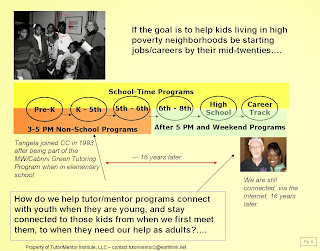
1) This graphic shows three time frames when we can connect with kids and the number of years we need to be doing this. 

It shows a group of kids and an adult volunteer who were part of a tutor/mentor program I led in Chicago in the 1990s and myself with one of those kids in 2010 when she came back as a guest speaker at our end-of-year dinner. I'm connected to almost all of these former students and the volunteer on Facebook and now see them posting stories of their own kids finishing high school and going to college.  That's the generational impact possible from well-organized volunteer-based tutor/mentor programs who build and sustain long-term connections with kids.

I focus on the after-five PM timeframe because in big cities like Chicago, that's when workplace volunteers are more able to meet with kids in community locations on a weekly, on-going basis. 

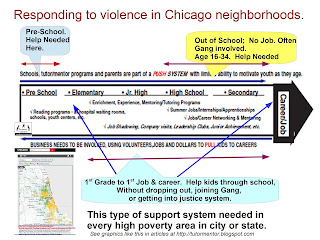
2) This next graphic includes a Birth-to-Work arrow that I've used in many past articles and in a variety of graphics. I show many in this Pinterest collection.  

This graphic includes a map of Chicago, showing high poverty areas were kids need mentoring-based support during school and non-school hours, from pre-school through high school and beyond.  Click on the image to enlarge and look at some of the types of activities that could be made available to kids at different age levels.  If you were to stand the arrow on end, like a tall building, it would emphasize how these supports are needed consistently for 10-20 years, in every neighborhood with high levels of poverty, meaning too few people to model the wide range of career choices kids have, and to help them through school and into those opportunities. Volunteers in organized tutor/mentor programs can help make some of these learning opportunities available, even if they are not available in local schools. 

I started building a library in the 1970s to support the volunteers in the tutor/mentor program I led at the Montgomery Ward Headquarters in Chicago. When we created the Tutor/Mentor Connection in 1993 we systematically expanded that library and made it available to program leaders throughout Chicago (before the internet) and then to volunteers, donors, policy-makers and program leaders throughout the world (starting in 1998, with the Internet). 

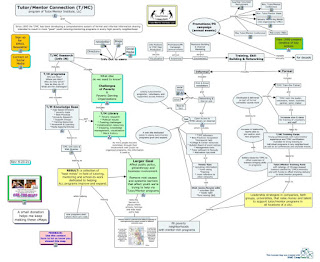
3) This concept map shows how we created events throughout the year to draw users to the information, and how we hoped the information would be used.

Read the map starting in the  upper left, with the box that says "T/MC Research (Info IN)". Across the top we show ways we share the information on an on-going basis since 1993. The columns from left to right show the type of information that's in the library and "formal" and "informal" uses of the information.  It's all intended to help well-organized volunteer-based tutor, mentor and learning programs be available to K-12 kids in more places.  That means it has to be used by donors, policy-makers, business, media, universities and more who need to take proactive, and on-going roles, to help tutor/mentor programs have the resources and talent needed to constantly improve. 

Access the library at this link. 

I started reaching out to leaders of other tutor/mentor programs in Chicago in 1974 and continued through the 1980s. I was looking for ideas to support my own efforts. This began to turn into a networking effort where each program was learning from the others. 

From my retail advertising jobs I knew how we created weekly advertising intended to draw customers to our 400 stores in 40 states, and how other corporate office teams worked to help each store have the staff and merchandise needed to serve those customers and keep them coming back.

I applied this in my leadership of a single program, and applied this strategy via the Tutor/Mentor Connection (1993-present) and Tutor/Mentor Institute, LLC (2011-present).  Since I did not have many dollars for advertising I created a strategy of quarterly annual events that would draw media attention and focused on ways business, universities and others could use their own human capital and dollars to help programs grow in different places.

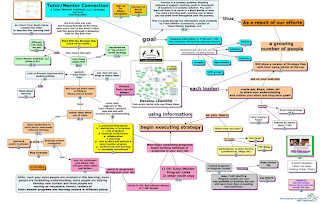
4) I created this concept map to help people understand the Tutor/Mentor Connection.

Follow the path from the left side of the concept map, downward, to understand the Tutor/Mentor Connection. Follow the path at the right, starting with "as a result of our efforts" to see ways others can use the information and ideas we've been collecting and sharing.  As you go through this learning path, begin executing the strategy, by using your own media to draw attention to tutor/mentor programs in Chicago or in other places.  

Here's a video, created in 2015 by an intern from South Korea, to guide people through this concept map.  It is an example of how anyone reading my articles can create and share their own interpretation. 

I share these graphics and articles from my blogs on Twitter, LinkedIn, Instagram and Facebook (find links here) and website and monthly eMail newsletter. 


Maintaining this library and my outreach is an on-going effort.  I keep inviting others to do the same.  

Unfortunately, the problems that we were addressing in the 1970s are still present as we move through 2022. Thus, the work I've been doing needs to continue. 

I just turned 75 so it becomes more and more important that a university or institution reach out and take ownership of my archives, blogs, websites, etc.  Student, faculty and alumni talent can do much more than I to update, analyze and share the information and draw attention and resources to area youth programs.

They can rebuild the sites that are now only archives and innovate new efforts to build public will and draw attention through the maps to EVERY neighborhood that needs Birth-to-Work support for its kids.  Reach out to me if you're interested in taking this role, or helping me find someone who will.

There were only 4 graphics in this article. There are more than 100 on this and other blogs. Take your time reading and thinking about what I'm sharing. Invite others to join you.  Create your own versions and share your interpretations, as my intern from South Korea did. 

Thanks for reading and sharing. 


Friday, September 24, 2021

Building knowledge-based ecosystem

I'm fascinated by their potential for bringing people together in ways that's not possible face-to-face. I've wanted to build this capacity into the Tutor/Mentor Connection for more than 25 years. 

I and six other volunteers created the Tutor/Mentor Connection in 1993 to "gather and organize all that is known about successful non-school tutoring/mentoring programs and apply that knowledge to expand the availability and enhance the effectiveness of these services to children throughout the Chicago region."

It's 2021. I'm still leading that effort, via the Tutor/Mentor Institute, LLC


1998 Crain's Chicago Business

I'd been leading a tutor/mentor program in Chicago since 1975 when we formed the T/MC. So I already had an extensive database of other programs in Chicago, as well as of foundations, businesses, volunteers and media. We did our research and planning, and developed a 4-part strategy in 1993. Then, we launched our first Chicago tutor/mentor program survey in January 1994 to systematically learn who else was offering non-school tutor and/or mentor services.


As we started reaching out to learn about programs we began sharing what we were learning with other programs, and with resource providers and other stakeholders, via printed newsletters. We began drawing stakeholders together to share and learn from each other via organized conferences in May 1994 and started organizing an annual Aug/Sept Chicagoland Tutor/Mentor Volunteer Recruitment Campaign in 1995.  You can view the goals of the conference here. See recruitment campaign history here.

We began sharing our list of Chicago tutor/mentor programs in a printed directory in 1994, but never circulated more than 500 copies a year. As we put our library on line in 1998, we also put our list of programs on line.

In 2004 we were able to launch an on-line portal where people could search for information about Chicago area tutor and mentor programs by zip code, type of program and age group served. In 2008 we launched a map based version of this.

With the maps we could show all the places where programs were needed, as well as what places already had service from existing programs.  Thus, our conversations were focused on a) helping existing programs get a more consistent flow of resources needed to constantly improve, while b) helping new program start where more are needed, borrowing ideas from existing programs, rather than starting from scratch.

The conferences and annual recruiting events we organized helped us generate a flow of print news stories, drawing attention to tutor/mentor programs throughout Chicago, not just to our own program (which I led until mid 2011). While we stopped our printed newsletter in 2002 we've been sending email newsletters every month since 2000. With our maps we crated map-stories following negative news, in an effort to draw more attention and resources to neighborhoods where help was needed.

I created this concept map many years ago to visualize how we were building a library of information that anyone can use to a) build and sustain volunteer-based tutor/mentor programs in high poverty areas; and b) understand root causes that created a need for tutor/mentor programs and placed challenges that made it more difficult to move safely from birth to work; so (c) more people who first became involved as tutors or mentors would become involved in building solutions that reduced, or removed, these systemic barriers.


Below I'm showing some elements of this concept map.

When I first created this chart I only included information that people could use to build and sustain volunteer-based tutor and mentor programs. (#1) on the graphic.  I updated that with the set of green boxes (#2) showing that the Tutor/Mentor library includes a much wider range of information about poverty, racism, inequality, challenges of funding, ideas for learning, and ideas for collaboration, knowledge management, etc.

Just getting a youth into a tutor/mentor program is often not a powerful enough influence to assure a successful  journey from birth-to-work. In high poverty areas there a many systemic barriers that need to be reduced, or removed.  Getting more people personally involved in the work needed to understand, then remove the barriers, can be one by-product of getting more  people involved as tutors/mentor and leaders in organized youth programs.  My own 40 year journey is an example of that.


The right side of the concept map shows two forms of learning, one formal, and the other informal.  Each are intended to support volunteer involvement that leads to a better understanding of the information in the library and the growth of more and better tutor/mentor programs in places where they are most needed.  

It also results in more people working to create systemic changes where those are needed.

Now look at the line across the top of the concept map.


Building the library is an on-going process, but it's only the first step in our 4-part strategy.  Getting people to look at the information in the library is an advertising and public awareness effort.  

Thus we published our list of programs in a printed directory from 1994-2002, then in an on-line map based directory through 2018. It's now available in an on-line list and a Chicago programs map.  I've used newsletters, blogs, social media, along with conferences and media events to draw attention to the library.

We began to use GIS maps in 1993 to show where tutor/mentor programs were most needed and where existing site-based programs were located.  We also started a "rest-of-the-story" strategy using maps to show where media stories focused on incidents of violence, or locations of poorly-performing schools.  We used these to who what assets (business, university, hospital, etc.) were in the area where the incident took  place, who could help tutor/mentor programs grow. This was part of our effort to draw greater attention to programs throughout the city.

We (#3) then organized May and November conferences to draw programs together to learn from each other and to provide information to help support volunteers and students in every program. This information was part of on-going formal and informal learning.  We organized annual August/September Chicagoland Tutor/Mentor Volunteer Recruitment campaigns to help programs find volunteer talent.  

Finally, we repeated this for 20 consecutive years.  

At the top right of the concept map I show events that we created in August, November and May to draw programs together and draw attention and resources directly to programs.  The May and November conferences were held every six months for 20 years. The Volunteer Recruitment campaign was a multiple-site event every year from 1995 to 2003 and has been an on-line activity, drawing attention to our on-line lists of Chicago area programs continually since 2003.

5-15-2026 update - see an updated description of this concept map in this Substack.com article. 

Ultimately my goal is that people from different sectors and different places are forming study and learning groups which draw from information libraries they find on line. While these groups engage in on-going face-to-face learning, they also engage in on-line conversations, with each other, and with people in other groups, expanding their  understanding of problems and solutions and building relationships with people who who might help...

....all with the goal of filling high poverty areas with needed programs and services that help kids move safely through school and into adult lives, jobs and careers  (see strategy map).

If you've read this far, thank you! I hope you'll visit some of the links and build your own understanding of the strategy I've piloted.  I hope you understand how this supports my own on-going learning and efforts to do "better today than I was able to do yesterday". 

While there are many intermediary  organizations in Chicago and around the country who focus on youth well-being and do some of the things the Tutor/Mentor Connection/Institute, LLC, have piloted, I don't yet see anyone including all of these steps, supported by a library with as much information as is included in the Tutor/Mentor Library.

Nor do I find anyone using concept maps as extensively as I have since 2005 to visualize strategy, process and information available.  

Yesterday the Ryan Family made a $480 million commitment to Northwestern University.  I dream of someone making a $100 million commitment to build a Tutor/Mentor Connection in every major city, supported by student/alumni teams from a local university.

That needs to happen soon so I can pass on all of my archives and enable people to build from what I've started, rather than start from scratch.  

If you'd like to help make such a community a reality, let's connect.

Thursday, April 15, 2021

Recipe for Success – Who’s in Your Kitchen?

I first used this idea in an April 2007 article. I've updated it, but the ideas are the same. Nothing has changed.

Are you developing a program to help kids in your community? What’s your recipe? Do you have all the right ingredients? Who’s helping you? Who are you learning from? Read on if you’re concerned about the way your state is helping poor kids in your community move through school and to jobs and careers. 

The graphic at the left illustrates four issues that each have an impact on the nation’s ability to reach youth living in high poverty neighborhoods and help more of these kids grow from first grade into jobs and careers. 

For instance, we may all want to reduce drop out rates, or increase the number of minority men and women entering careers in law, medicine, engineering and the sciences. But do we have a DISTRIBUTION of programs reach kids in poverty neighborhoods?


Do we start these programs when kids are just entering school? Do we keep them going, with age-appropriate learning supports and career focused mentoring? Do we build student aspirations? Do we connect kids with men and women who can mentor the excitement and opportunities of these careers on an on-going basis, then open doors to scholarships and jobs? 

We all want better educated kids, but the No Child Left Behind (NCLB) program of the early 2000s focused primarily on test scores, not the additional learning and enrichment and social/emotional support that many kids living in high poverty neighborhoods need. Following the lead of NCLB, donors put too much emphasis looking for test score evidence from youth mentoring and youth development programs. Furthermore, many of the advocates for a system of learning supports are still only focusing on the school as the place kids connect with mentors and extra learning. 

Read this April 2021 article where I share information from the Christensen Institute, focused on relationships as a valuable outcome of youth tutor/mentor programs. 


Why not use the non-school hours as another channel of learning and enrichment. In big cities like Chicago, this is perhaps the most likely time when a busy business volunteer will make a long-term mentoring connection with a youth living in a poverty neighborhood. 

Finally, we can’t have good programs in all the places we need them with the current level of FUNDING and the current focus on project funding vs. program and operations funding. In one section of the Tutor/Mentor library I focus on challenges facing non-profit organizations. These are the same struggles of volunteer-based tutoring/mentoring programs that operate in the non-school hours. 

Below is a graphic I created to emphasize the need for on-going, flexible operating dollars to support youth tutor mentor programs that had a strategy that connects youth and volunteers for many years. Read the article at this link. 


Every time you visit a Tutor/Mentor Connection web site, or look at one of our maps or graphic illustrations, we want you to be thinking of the many different ingredients that go into the recipe for helping kids in poverty grow more successfully from first grade to first job and a career. 


This is a conversation that needs to be taking place in thousands of circles. In businesses, universities, hospitals, k-12 schools, and in churches and political organizations. In truth, we know these are taking place. However, the T/MC goal is to connect these conversations, just like we combine butter and sugar with other ingredients to make cookies. 

 We can make some of these connections at face to face conferences. However, the only way to keep these connections growing, and to keep learning from all of the research that is being generated each year, is to build our connections and learning on the Internet. This way we can learn and collaborate with people in other cities and countries, not just our own neighborhood. 


I've been building lists of Chicago tutor, mentor and learning programs on Facebook, Twitter and Instagram. The only place that works well to view the programs on a list is Twitter. View my list here.   The only problem is that too few programs are actually posting on Twitter, or attempting to engage in conversations that identify what works and the challenges that every program faces.  It takes a commitment from every organization to build a network. Donors are not encouraging this from what I can see. 

 Who’s in your kitchen? How are you connecting different stakeholders in your own community? Can you connect your network to the T/MC, via one of the places where we're on social media?

In articles on this blog that I've posted since 2005,  I’ve linked to sections of the Tutor/Mentor Library with articles on each of the key issues that we need to understand, discuss and innovate new ways of doing the business of helping kids grow up and become part of the 21st century economy.

I encourage you to visit past articles and incorporate these into a curriculum that develops future leaders and supporters of youth tutor, mentor and learning programs throughout Chicago and America.

If you'd like my help in understanding the ideas just reach out to me on one of the social media platforms where I'm active. 

If you value the ideas I'm sharing, consider a small contribution to help me keep doing the work.