Showing posts with label program locator. Show all posts

Tuesday, July 07, 2026

What's Needed in an on-line Tutor/Mentor Program Locator?

This week I posted a new article on Substack.com that shows how I've been using GIG maps since 1993. I hope you'll read it. click here


I pointed to articles on the MappingforJustice blog, such as this one, that show examples of how I've used maps, and how others are doing similar work. 

And, I encouraged universities, and others, to borrow from my history  and build their own platform to support youth-serving programs in their community, and to help them reach more K-12 kids in every high poverty area.  

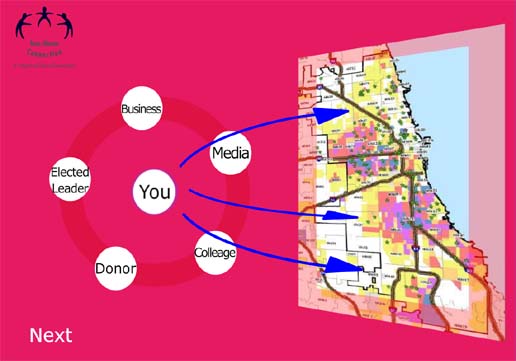
So what is involved.  Take a look at this concept map.

From left to right I show

a) boundary layers - city, zip code, community area, state and federal legislative districts, etc.

b) indicators layers - poverty, violence, poorly performing schools, etc.

c) programs - while I focus on tutor/mentor programs, this could also show arts/science, or other types of services which need to be located close to consumers, meaning many are needed throughout the city.  The programs layer can be sorted by age group served, type of program, time of day

sample map
d) this shows the goal of the program locator, and the Tutor/Mentor Connection/ Institute, LLC.  We want to help leaders use this to build support for existing programs and help new ones form where needed.  At the right is an example of a map view that can be created using the program locator, then adding additional annotation using Power Point

e) assets layers - in this section you can find sub sections for banks,  hospitals, universities, faith groups, drug stores, and insurance companies, with offices/branches in different locations throughout the city. 

sample map
Using this information a map of a small section of the city can be created that shows indicators of need, existing programs and assets who share the geography, and thus should be expected to support programs that help kids in that area.

Ideally an updated version of the Program Locator would find ways to pull data on assets from resource files on the Internet, making this a continually updated feature.

Two features were never built into the program locator.

a) I wanted to be able to connect data from indicators into a form that program leaders (or donors) could use to determine the need for tutor/mentor programs in specific neighborhoods.  Imagine clicking on a community area and getting a form showing number of kids; level of poverty, locations of existing programs, age group, type of program, etc. A program would just fill in their program information on the form and get a printed document to send to a donor.  View this PDF to see how a map might show the number of kids in a community area. 

b) I wanted to create another layer that could be used to raise money for programs shown on the map, and to track donations to do an analysis showing the different levels of funding going to different neighborhoods.  I describe what I have in mind on this page of my planning wiki.

In another concept map I've been sharing links to platforms that collect and map data, shown all the places in the country where people need extra help.


Most of these show where help is needed, but don't host a directory of organizations who are trying to solve those problems.  And, if a service needs to be close in order for people to participate, many such organizations would be needed in big cities like Chicago.

And they all compete with each other for scarce funding.

If you live in one of the cities where there are pockets of concentrated poverty and your newspaper headlines are showing "bad news" happening,  why not reach out to technologists in your community or at your local university.  Show them how I've been using maps and the Program Locator that was built in 2008. 

Encourage them to build a similar resource for your community.

If you'd like my help, just reach out on LinkedIn.

That's just one place where you can find me. Visit this page to see my social media links.

And, if you want to help me pay the bills, visit this page. 

Friday, August 29, 2025

Create a New Tutor/Mentor Program Locator

With the help of others I created the Tutor/Mentor Connection in 1993, with the goal of helping volunteer-based tutor, mentor and learning programs grow in every high poverty area of the Chicago region.  I've led it since 2011 through the Tutor/Mentor Institute, LLC.

We launched a survey in January 1994 to learn what programs were already operating in Chicago and I've tried to keep a current list of those programs available for the past 27 years.

While we published a printed directory from 1994 to 2002 we launched this on-line directory in 2004. It shows how we attempted to categorize programs by a) type of program; b) age group served; c) time of day service was provided; and d) location (zip code or community area).


The image above shows the search page of the Program Locator, which you can find at this link. The results of each search were shown on a Google map. Thus, searchers could see any tutor/mentor programs in a specific zip code of Chicago and find a website address they could use to go directly to each organization and learn more of what they do.

A map-based Program Locator was created in 2008, drawing from the same data.  You can view the archive at this link.  

Program Locator - 2008

This worked from a global perspective, showing the entire Chicago region and all of the tutor/mentor programs in our database, then enabled visitors to narrow their search by type of program, age group served, and location. It also included layers of information showing demographics, public school performance and assets (business, universities, hospitals, universities, faith groups) who shared the same geography and could be doing more to help programs grow.

While the Program Locator has not been updated since 2011, and some features do not work properly, it still is a template and model of the type of platform that is needed in every city. It was designed to provide decision support for community, business and philanthropic leaders while also helping parents, volunteers, educators, etc. find programs located in different parts of the Chicago region. 

View this concept map to learn more about the Program Locator. 

Their is a much wider range of youth-serving programs than just volunteer-based tutor/mentor programs.  Below is a graphic that you can find in this article. It calls for a segmented understanding of youth-serving programs. 

Over the past 15 years I've expanded the range of youth programs that I share in the Tutor/Mentor library, and if I had ever had the resources, I might have included a broader range of programs on my maps and in the searchable program locators. 

Over the past decade I've often wondered if anyone was using IRS 990 data to build a much more comprehensive understanding of existing tutor/mentor programs along with other types of your services. 

Today a LinkedIn post pointed me to this article, titled:  MapAgora, civic opportunity datasets for the study of American local politics and public policy.  


It's a detailed description of the process of building datasets that provide a comprehensive view of civic life across America.  The data they have collected  "illuminates where civic opportunities are available and which types of organizations provide them". 

The article says, "This entire pipeline is reproducible and relies on the two open-source R packages we developed: MapAgora (v0.08 https://github.com/snfagora/MapAgora) for parsing and integrating administrative data, and autotextclassifier (v0.05 https://github.com/snfagora/autotextclassifier/tree/main) for machine-learning-based text classification."

I did not see an maps showing this data, or anything like the Program Locator platforms we built in 2004 and 2008.  Yet, the data collection process is a blueprint for doing this and the datasets they built are available for anyone who might want to take this next step.

1-19-2026 update - Here are two links to efforts aimed at mapping the nonprofit ecosystem:

- Nonprofit Ecosystem Mapping - click here

- Project 990 - Building a comprehensive data analytics platform that integrates information from millions of tax filings, grants, and other sources related to philanthropic giving. click here

4-29-2026 - Chicago Social Impact Atlas, is a "free, searchable map of Chicago's nonprofits, funders and support organizations - built from IRS 990 filings and public data."  Most of the nonprofits shown have budgets of $250,000 or larger. click here


Do you know anyone doing this type of data collection/analysis?  Or drawing from this information to build platforms like the Program Locator? Or, anyone who wants to?  Please share the links.

Connect with me on LinkedIn, Instagram, Twitter, Facebook, BlueSky and/or Mastodon (see links here).

Thanks for reading.  I depend on contributions to help fund the Tutor/Mentor Institute, LLC.  Visit this page if you'd like to help. 

Wednesday, July 01, 2020

Helping Youth Tutor/Mentor Programs Grow

Below is a map of the central part of Chicago on which I've plotted locations of a few youth tutor and/or mentor programs. I've combined it with a graphic showing Twitter accounts of a few Chicago programs. You can find my list of programs and the map platform I used at this link.

I've posted this to illustrate my 25 year commitment to helping volunteer-based tutor/mentor programs grow in all high poverty areas of the Chicago region.

Yesterday I included the concept map shown below in an article on the MappingforJustice blog, showing the layers of information that were included in a Chicago tutor/mentor programs directory that we started building in the 1990s and put online in 2004.

Layers of information needed on a program locator - click here
Today I had a short ZOOM meeting with someone from the World Economic Forum in Zurich, Switzerland in which I described the program locator layers and how a platform like this can be used in cities throughout the world.  I also told of my goal of finding developers to help rebuild the Program Locator, as open source technology, so the template could be adopted in more places.

Take a look at yesterday's article and look at other articles on this blog, and the MappingforJustice blog showing uses of maps that could be duplicated in thousands of locations.

You can connect with me on any of these social media platforms.  I'd like to hear from you.


Saturday, April 04, 2020

Lessons from the Field - Staying Connected

Below is a post from LinkedIn showing how one Chicago tutor/mentor program, Friends of the Children-Chicago,  offers a unique model of providing first grade through high school support for inner city youth, and how they are continuing that support during #COVID19.


I point to nearly 200 Chicago area youth tutor and/or mentor programs in this section of my web library.  Too few of them share their strategies and theory of change on their web site, or via a blog.  Too few are getting researched by media, thus stories like this are infrequent.

Friends of the Children-Chicago is part of a national organization that started in Oregon more than 20 years ago. It has a long history of success.  Technically, it's not a volunteer-based tutor/mentor program, since it's mentors are paid, full-time staff members who are supported by the program's headquarters staff in each city. 

In programs where volunteers are the mentors and tutors, the depth of contact maintained with youth and families is far less, yet in many programs maintaining two or more hours of contact a week is normal.  Some keep youth and volunteers involved for many years.  In these programs it's usually a small paid staff who coordinate the work of volunteers and work with youth and families to help them overcome challenges.

The Tutor/Mentor Connection (T/MC) was created in 1993 to build a base of information about existing volunteer-based tutor/mentor programs, to share this information with the public, and to help attract volunteers, donors, and ideas to each program. Since 2011 the T/MC has been operated by the Tutor/Mentor Institute, LLC, which has the same goals, but a different tax structure.

While we published a printed directory from 1994 to 2002 we launched this on-line directory in 2004. It shows how we attempted to categorize programs by a) type of program; b) age group served; c) time of day service was provided; and d) location (zip code or community area).

View archived version of this page at this link

The image above shows the search page of the Program Locator, which you can find at this link. This was launched in 2004.  A map-based Program Locator was created in 2008.  You can view the archive at this link.

The T/MC never was well funded, or consistently funded, thus just collecting and updating this information each year for the past 25 years has been difficult. Updating the technology has been even more difficult.  The Program Locator has not been updated since 2013, and is now available only as an archive.

Not having funds meant that many questions that dug deeper to learn what programs were doing, and what impact they were having, ways always beyond our capacity.  At the same time, we never were able to recruit a university or other partner to do needed research, other than in 1997 when the Associated Colleges of Illinois and Human Capital Research Corporation used our list of programs in a comprehensive survey.

During COVID19 that need is even greater.  I really don't know with any degree of accuracy, what the different organizations are doing to stay connected to youth and families during this crisis, nor how their funding has been affected. How many will soon need to lay off staff?  Who has had funding cut?  What programs will close and never re-open their doors?  What will it take for all programs to re-open, whenever that happens? 

It's too early to ask some of those questions.   But it's not too early to be looking for people with market-research skills, and technology skills, who might help plan for the work that needs to be done.

Program Locator - 2008
While the Program Locator has not been  updated, and some features do not work properly, it still is a template and model of the type of platform that is needed in every city. It was designed to provide decision support for community, business and philanthropic leaders while also helping parents, volunteers, educators, etc. find programs located in different parts of the Chicago region. 

Browse articles in this section to learn more about my vision for using maps.

While the original Program Locator is not up-to-date, I continue to maintain an updated list of programs, plotted on a map, which you can find at this site.

If you'd like to know more or discuss ways to help collect and share information, connect with me on one of these social media sites.

If you'd like to help fund this work, click here

Wednesday, February 06, 2019

Chicago Tutor and/or Mentor Programs on Social Media

In this article I'm sharing some of what I've been seeing on Twitter and Facebook from Chicago based youth Tutor and/or Mentor programs. You can look at this the same way I do, by following this list of programs on Twitter.

This from Starfish Learning @StarfishChicago


this from Chicago Lights @chicagolights


this from Daniel Murphy Scholarship Fund @MurphyScholars


this from By The Hand @ByTheHandClub


I'm seeing more than this in every 24 hour cycle, but only selected a few from the top of my feed for this post.  I encourage others to do exactly what I've done. View the list, then write a story pointing to posts from some of the different tutor/mentor programs in Chicago, or in a different city, if yoiu don't live here.

Facebook also has posts by Chicago tutor/mentor programs, but it is really difficult to find them. What I mean by that is on Twitter,  you can open my list, and scroll the feed, and see what's been posted in the past day or week. If programs are sharing what they do, you'll see it. 

The Facebook news feed does not have a list/sort feature like Twitter has. On your news feed you get everything from all of the friends and pages you like. Thus, seeing what youth tutor/mentor programs in Chicago are doing is really difficult.


This graphic is in the NOTES section of my Facebook page, and includes a list of Chicago youth tutor/mentor programs. You can scroll the list, and click on a page, to see what that program is sharing. But you don't get a list showing what all of these programs are sharing. LinkedIN works the same way.

(Note: in 2020 Facebook removed NOTES. You can now find my list of programs on Facebook at http://tutormentorexchange.net/tm-programs-on-facebook}

Thus, unless you are looking at Facebook or LinkedIN for hours every day,  you won't see much of what's posted by Chicago tutor/mentor programs.  In a few minutes on Twitter,  you can see what's been posted over the past 24 hours.

Now, the other part of this story is that TOO FEW PROGRAMS ARE POSTING ON ANY SOCIAL MEDIA, AND TOO FEW HAVE BLOGS ON THEIR WEB SITES

Volunteers, donors and media can't find you and tell your story if you're not helping them.

Note: If someone is using Facebook or LinkedIN and has found a way to view lists of Chicago tutor/mentor programs, please post a comment with instructions for doing this.


Tuesday, November 07, 2017

What Tutor and/or Mentor Programs Operate in Chicago Area?

Since 1993 I've led a small organization with a huge vision. I think every k-12 youth living in a high poverty neighborhood should have access to a well-organized, mentor-rich, non-school tutor, mentor and learning program. When I say access I mean it needs to be close enough that elementary school kids can walk there and safe enough that youth of all ages, and volunteers from different parts of the region, will participate weekly, for a year or longer.

I launched the first Tutor/Mentor Program Locator survey in 1994 and 120 organizations responded. Thanks to donated software and volunteer talent, I've been plotting that information on maps for the past 24 years, so that people could see which areas have programs and which still need more programs.

I never had much help to do this and since 2011 I've had no help. Thus, keeping the program list updated has been a challenge, and keeping the web sites updated and working properly has been an even greater challenge....which I'm currently losing.

However, you can help.  Below is a map I created in Jan 2016 to show programs in my web library. I updated it today to show the number of organizations I have in my web library, for each section of the city and suburbs. 

click here to see 2016 map and click on icons to see name of organization
I've divided the region into sections, and for each section I've shown the number of web sites that I have in this library on the Tutor/Mentor Connection site.

Thus, you can see that I have 13 web sites for Evanston and the North and Northwest suburbs. I have seven web sites for every area West of Chicago out to Elgin and Aurora.  I show 13 web sites in the South and Southwest suburbs and one (1) for NW Indiana.

In Chicago I show 23 web sites for the North part of the city, 46 for the middle, 29 for the South Central and 21 for the far South.

Some organizations are community based or have multiple locations, so I include them in a separate category. It includes 31 organizations.  Other organizations only offer services at schools, meaning youth who don't attend that school don't get those services. I show 27 organizations in that category.

There are at least 200,000 high poverty youth in Chicago who could benefit from organized tutor, mentor and learning programs and thousands more in the suburbs and Northern Indiana (where I only find one program).   There must be more.

I'm sure there are other organized non-school tutor and/or mentoring programs in the Chicago region. 

That's what I hope you will help me with.

Here's a map showing police districts in Chicago.  If you click on this article you'll see schools. If you click on this article you'll see libraries. And, if you click on this article you'll see maps of faith groups.

Volunteers from any of these groups could adopt a neighborhood of the city and suburbs and determine if there are any organized tutor/mentor programs in that area. If you find one, send me the link and I'll check it out and add it to my list.

Volunteers can also review sections of my web library and look at the web sites. If you see one that no longer is operating, or that I've placed in the wrong area, please send me an update.

Here's the survey I was using in the 1990s to collect this information.  You can see the level of detail I was looking for.  You don't need to fill this out, but it  might help you as you look at youth program web sites.

Building Better Understandi... by Daniel F. Bassill


Here's another presentation that shows what I think volunteers, donors and parents should see on a program's web site. Many show some of this. Few show all of it.

As you learn about programs in your area help draw regular attention to them by talking about them on social media, or in company and faith group newsletters and blogs.

If we have better information on who is already operating we can do more to help each program become world class in how great it is at helping kids.  We can also provide better information that groups in other places can use to start new programs where too few exist.

I'm not able to do this by myself, but I don't think I'm the only person who cares about the well-being of youth in our region and the quality of life and future workforce. I think many can help me do this work.

Send updated to me at tutormentor2  at  earthlink dot net.

Now, if you have tech skills and want to help update the tutor/mentor program locator I could really use your help.  The map I created in 2016 does not sort by age group served, type of program or zip code and does not include overlays showing where programs are most needed (based on poverty or school performance).  The Program Locator has those features, but I've not been able to add info since 2013 and the census data is from the 2000 census.  I don't have the  money to hire help, and so far have not found volunteers who would help. 

If you're interested or would like to partner and/or sponsor this work, and help carry it into the future, please reach out via the email above.  


Sunday, September 15, 2013

Arts Education in Chicago - A Collective Effort

I attended a Chicago Arts Partnership meeting on Friday, hosted by Ingenuity, Inc and the Arts Education Department of Chicago Public Schools. Ingenuity, Inc. is led by Paul Sznewajs, who founded Snow City Arts Foundation in the 1990s, which is when we first met.

Much has been written about Collective Impact in the past couple of years. Paul and his group have done much to bring together more than 600 arts education groups in Chicago with a vision that "all Chicago Public School students, from the day they start school until the day they graduate, will receive quality arts education at every grade level"
During Friday's meeting Paul and others provided a history of how arts education organizations have come together in this effort and a vision for the future. One of the resources Inginuity, Inc. has created is an Arts Look portal that maps locations of arts education providers, with layers of information showing providers of different types of arts education.
This network building started many years ago and has reached out to engage many different arts initiatives. It's supported by the Mayor, and has generated a $1 million a year commitment to fund arts education programs in schools. Friday's meeting was a celebration of progress and an announcement of next steps. Very impressive. Well done.


I'm impressed by what Ingenuity, Inc has accomplished because this is much of what the Tutor/Mentor Connection has been attempting to do since being formed in 1993. Our focus has been to help mentor-rich non-school tutoring, mentoring and learning organizations reach k-12 youth in high poverty neighborhoods. Our strategy has been to build a directory of existing programs and a library of information, then a larger on-going public eduction effort that would draw more consistent operating support to existing and emerging organizations. This strategy has been share in on-line maps, essays, graphics, etc. since 1998. It's a strategy that needs many leaders, but can be supported by a few who build knowledge libraries and tools that support collective efforts.


We've also built a map-based directory, launched in a printed version in 1994. In 2004 we launched an interactive, map based tutor/mentor program locator, with layers of information showing different types of non-school tutoring and mentoring programs, and age group they serve. In addition we added demographic and school performance information to the maps so users could see where these programs are most needed. We also added an "ASSETS" section, so businesses, faith groups, hospitals, universities, etc. in the same community areas might connect and work collectively to support these programs.


Beginning in 1994 we invited leaders and supporters of tutor/mentor programs to gather every six months in a leadership and networking conference, and in the 2000's we've invited people to gather in virtual meeting spaces. While Mayor Daley and then State Senator Barack Obama attended the Tutor/Mentor Conference once in the past, we never were able to build the type of support for the Tutor/Mentor Connection that Ingenuity, Inc. has been able to build for arts education groups.

Since launching a web site in 1998 the T/MC has build an extensive library of information, with links to more than 2000 other organizations in Chicago and around the world. Anyone can use this information to support their own efforts to help kids through school and into to careers.

As we move into the 2013-14 school year the Tutor/Mentor Connection is now part of a Tutor/Mentor Institute, LLC structure. With so many organizations seeking leadership positions in helping kids get the attention, support and education they need to move through school and into jobs, I see my role as a catalyst, consultant, idea share, and potential partner to any of the other organizations who have been able to obtain better funding and better civic support for their efforts than I have.

We all want the same end results. Finding ways to connect all of the different organizations who are doing this work will take the on-going efforts of many organizations like Ingenuity, Inc., and it will take extraordinary efforts to connect these networks with each other, and to teach leaders, donors and policy makers to use maps to help build community coalitions, and to build on-going revenue streams to support the work of everyone who is involved.

I've created dozens of graphics that compare the collective effort of helping kids to careers to that of building a hotel or tall building. At every stage of construction people with specific talents need to work together so the project can move to the next page. Everyone needs to be paid and everyone needs appropriate skills. Thus, we need to innovate ways to create public involvement and commitment to this effort, in every part of the Chicago region.

To me this is where volunteer based tutoring and mentoring becomes part of the strategy. I got involved in this work almost 40 years ago when I first committed a couple of hours a week to tutor a 4th grade boy. Over time my involvement transformed my understanding and fueled my commitments. If volunteer-based tutor/mentor programs around the Chicago region are recruiting volunteers and keeping them involved, and transforming them into leaders who look at everything that needs to be done, we can mobilize the leadership and on-going support this collective effort will require.

I hope you'll browse other articles I've written, visit the Tutor/Mentor Institute web site, view the graphics on Pinterest and the essays on Scribd.com. I'd be happy to be part of your effort, and would gladly mentor other leaders to support these ideas through their own efforts.


Sunday, September 01, 2013

Mentoring. Network Building - Labor Day Reminder

Every week throughout the year I meet personally with three to four people, such as on Friday when I met with Rev. Mitchel Sholar, Executive Director of City Harvest Headstart Outreach Ministry (CHHOM) and Dr. Betty J. Allen-Green, Executive Director of the Chicago Lawndale Amachi Mentoring Program (LAMP).

Friday's meeting, like many, was scheduled by Mitchel, who has been hosting workshops at Tutor/Mentor Leadership and Networking Conferences for the past two years. Mitchel was introduced to me and the conference via Bishop Steven Braxton,Light of Illinois Diocese, who first connected with me almost 6 years ago, also via the conferences.

As we've built our relationship Mitchel has learned more about how intermediary organizations can help bring people together in a community area to support the growth of mentor-rich tutor/mentor programs that support a growing number of youth as the move from birth to work. We met at my offices at HIGHSIGHT in April, prior to the June 2013 conference, and I provided an overview of resources and demonstrated uses of maps.

For example, this is one of a series of maps showing the number of high poverty youth age 6-17 living in community areas on the West Side of Chicago. 4717 youth in this age range are in North Laundale, which represents 55% of the total youth population of that age range. The green stars on this map represent locations of organizations known to provide some form of volunteer-based tutoring and/or mentoring in the non-school hours. I showed Mitchel how this map was created using the interactive Chicago Tutor/Mentor Program Locator.

While at first glance, one might think there are many tutor/mentor programs, when you sort by age group served, or type of program, you see fewer programs in each age group. If we had the resources to survey programs to know how many were enrolled, we'd be able to show that a very small percent of all the youth in North Lawndale are being served by the existing programs.

Next I showed how maps could also be created showing assets in the neighborhood --- banks, faith groups, hospitals, colleges, insurance and pharmacy companies, etc. --- who could be supporting existing programs, and helping new ones form, by engaging their own people, talents, dollars, technology and ideas as part of a community wide collective effort.

All it takes is for a group of people to begin to invite others who are already part of the neighborhood to gather and begin to learn ways they can help make the youth serving programs in the neighborhood the best in the city, and in the country by borrowing ideas from work already being done in non profits and for profits throughout the world! Mitchel is trying to take that role and meeting with leaders of existing community organizations is the first step in building partnership with others already operating in the area.

Since most adults are already deeply involved in what they are already doing and have too little time to spend learning what others are doing, and ways they might innovate ways to make programs serving youth and helping them to jobs, I also showed work youth have done with me that could be duplicated by young people in their own programs, local schools and faith groups. This graphic is one started in 2006 by an intern from Hong Kong and later revised by an intern from Korea, via IIT. You can see both versions here, along with many other visualizations done since then.

Mitchel's goal is to bring a group of people from North Lawndale to the November 4th Tutor/Mentor Leadership and Networking Conference, where they can discuss these ideas, build relationships, and connect with others from different parts of the Chicago region who are focusing on building tutor/mentor programs in their own neighborhoods.

I support this by mentoring Mitchel and others as they take on leadership roles in their own programs and communities. While I'm able to meet with a small number of people each week, I exchange email communications with fifty to 100 people each week. I share ideas in on-line communities with several thousand each week.

Following the meeting Mitchel set up a profile on the Tutor/Mentor Connection, Ning. forum. If you visit the forum you can connect with more than 450 others who have joined since 2007. If you connect with me on Linked in, Facebook or Twitter you can connect with more than 5000 others who I am friends with, and thousands of others who I connect with in on-line communities.

This is labor. It's a strategy of network building that I've engaged in for over 40 years. It's work that I've been blessed to be able to do full time for over 23 years and as a volunteer for 17 years prior to that.

It's work that many are called to share since so many places need mentor-rich youth serving programs, and an infrastructure of volunteers, talent, dollars and technology to support them.

As you celebrate this Labor Day I hope you'll begin looking for ways you can take on a role in this effort.


Monday, April 22, 2013

Class War in America?

As we begin to celebrate National Volunteer Week, I share this video which I watched earlier today. The gaps between rich and poor are wider than ever in America. When I talk about volunteering in a tutor/mentor program, I'm not just talking about how that helps kids rise from poverty through education and expanded networks, I'm describing a strategy that connects people beyond poverty, in on-going, personal interactions, that help build understanding, empathy and a commitment to change.

In Chicago there are more than 600,000 youth between age 5 and 19 and half live in poverty. The total youth served in all of the existing tutor/mentor programs is probably less than 5% of this number and the distribution of programs in different neighborhoods is poor. As you reflect on this video, take a look at this list of organizations. Find one or two that you can support with your time, talent and dollars so that we find ways to reach more kids, and engage more adults. It's one strategy that can lead to more people involved in closing the inequality gaps.


Sunday, March 17, 2013

FOCUS on Mentoring in Crain's Chicago Business

I was contacted a few weeks ago by Shia Kapos, who was researching a story on Mentoring for Crain's Chicago Business. I'm pleased to see that the March 17th issues has a FOCUS on Mentoring. I encourage you to read these stories and be informed, and inspired.

How Chicago execs are transforming schools — and students, too - click here

The view from Brad Keywell's window turned an investor into an activist - click here

Veteran Mentors Share Tips and Perspectives - click here

From Mentee to Mentor. One CEO's Journey - click here

What you don't see in these stories is any of the information I provided when I talked to Shia, or from the web links I sent here. I talked about how I've been trying to collect and aggregate information on tutor/mentor programs reaching youth in the non-school hours, and to create maps that show where these programs are located and where more are needed. I told her that I've never had the funds to do this as well as it needs to be done, nor to try to understand the distribution of school based mentoring.

Yet I did invite her to look at the maps and write about what businesses could do to support the growth of mentor-rich programs in all parts of the Chicago region. This is THE REST OF THE STORY.

I encourage you to visit this section of the Tutor/Mentor Institute, LLC web site to read how maps can be used to support the growth of mentor-rich programs, and to see graphics that illustrate the long-term support needed to help young people go from elementary school through high school and college into jobs and careers.

Visit the Program Locator to create your own maps and build a strategy that supports tutor/mentor programs around places where you do business.

Big companies support multiple stores with central office strategies, and with long-term commitments. A business publication like Crain's would be an ideal partner to talk about business strategies that would help volunteers from different companies connect with youth in many well organized programs throughout the city, which are good because they are supported by on-going flows of business talent, dollars and technology.

This is a deeper story than just the heart-warming stories of a few people connecting with a few kids. This is more than a sound-byte. It takes time to read, reflect, think, and innovate ways that the business community can do more than the good work it is already doing to reach more kids in more places with mentor-rich strategies.

Thank you Crain's Chicago Business for posting these stories. Please use your editorials and on-going media ownership to lead an effort to tell the REST OF the STORY, over and over.

Wednesday, February 20, 2013

Mayor wants Business to raise $50 million to support kids

I saw this article in today's Sun Times and posted my own comment to it, encouraging the Mayor to use some of the ideas I've shared on this blog so he supports constantly improving tutor/mentor programs in every high poverty neighborhood, not just the traditional high profile programs that attract the most support.

My first suggestion was to use maps, such as provided on the Tutor/Mentor Program Locator, to identify and support programs in every high poverty neighborhood, and to encourage new programs to support where none exist.

My second suggestion was to support programs that show a strategy that supports youth for multiple years and engages volunteers from the business community as tutors, mentors, tech support, organizers, communicators, advocates, etc. Look for a "theory of change" or a "logic model" on the organization's web site with graphics and history that demonstrates this commitment.

My third suggestion was to encourage every industry and professional group to build a strategy that provides volunteers, operating dollars, technology and other needed support to volunteer-based tutor/mentor programs in every part of the city, such as the Lawyers Lend A Hand to Youth Program has been doing since 1994. Note. the Lend-A-Hand Program launched it's on tutor/mentor program a few years ago and discontinued the grants to other tutor/mentor programs in 2021.

This ROLE of LEADERS PDF is one of many created by the Tutor/Mentor Connection since 1994 that the Mayor could share to encourage leaders in business to support the growth of mentor-rich programs.

This STRATEGY MAP is one the Mayor could adopt and put on his own web site, and that he could encourage other leader in business, religion, higher education and public health to adopt as part of their own commitment.

In a few years will we look back and see a few million dollars distributed to a small group of organizations or will we see a "virtual corporate office" created where volunteers and leaders from every sector are taking roles that support the growth of mentor-rich youth programs in every zip code of the Chicago region where kids have economic disadvantages that most kids don't face?

Or will we see a model of support that is being duplicated in every city in the country?


Saturday, January 19, 2013

Expanding, Sustaining Funding – New Thinking Needed

I’ve been part of an Education Technology MOOC (#ETMOOC) this week where more than 1000 people from around the world are connecting on-line and sharing ideas about uses of technology in education, learning, media and network building.

I’ve been trying for the past 20 years to build this type of learning community, connecting all of those who are concerned with the gap between rich and poor in America, the education system, workforce diversity, social justice, violence, public health, and a number of other reasons to be involved. Some people talk about the "village" it takes to raise kids. I write about it and try to bring members of the village together.

I started leading a volunteer-based tutor/mentor program in 1975 (see history) while I held a full time job with the Montgomery Ward company. While our program grew to include over 300 pairs of youth and volunteers by 1990, funding was not an issue because all of the leaders were volunteers.

However, in 1990 when I converted this program to a 501-c-3 non profit and needed to raise money to pay salaries for myself and others to stay involved, the funding of non profits began to become a real issue. Over the years I’ve aggregated a wide range of personal frustration on the challenges small non profits face in finding consistent operating funds, and I’ve built a library of articles that show how others think on this topic.

I illustrate my thinking visually so let me show some maps that I think many of you will find interesting, and useful.


This is a map showing nearly 400 foundation (corporate and private) in the Chicago region and Eastern part of the United States who I put on my mailing list between 1993 and 2005.

Every year I send copies of my printed newsletters to these people, showing why tutor/mentor programs were needed and what I was doing as a direct service provider, and as leader of the intermediary Tutor/Mentor Connection.

The green icons on the map are foundations that funded my organization at least one time. Few funded me more than 2-3 years in a row. Some, like Montgomery Ward, funded me for seven consecutive years, then went out of business, and thus were not able to continue their support. None of the grants was larger than $50,000 and most were in the $1,000 to $10,000 per year range. Some were for general operating expenses, which I could use flexibly to build the organization, while many focused specifically on activities of the Cabrini Connections direct service program or the Tutor/Mentor Connection. In total I raised more than $6 million between 1993 and 2011, with a peak of $500,000 in 2000. This money split with 40% funding the Cabrini Connections direct service program, 40% the Tutor/Mentor Connection, and 20% funding operating and fundraising expenses. With no multi-year commitments, each year since about 1998 I started from zero in raising $300 to $400,000 from a wide range of donors.

This map shows a close up of the Chicago region so you can get a better sense of how many foundations I was reaching out to.


My organization never had more than 3 or 4 people on staff, and never had a full time professional development officer. I was CEO, chief innovator, chief marketing officer, newsletter writer, grant writer, janitor. Yet every year I was challenged to write letters of introduction, letters of inquiry, grant requests, grant reports, each with different requirements and different questions.

Yet we all were focused on helping expand the network of non-school hours support for inner city kids. By 1998 I was using web sites to show the work I was doing and what I was trying to do.

This map shows the Chicago LOOP area.

When I begin using maps I started following media stories about kids being killed in Chicago with maps showing where this was happening, and with links showing what tutor/mentor programs were operating in those areas,
and what knowledge was available to community leaders, business and foundations so they would work to build programs that would provide more mentoring, tutoring, learning opportunities. Visit this Map Gallery to see a collection of maps created in the past.

This week I attended a Dr. Martin Luther King, Jr. celebration at the University of Chicago, where panel members were asked to talk about their experiences with mentoring.


They each talked about mentors who “helped them stay in school” and who provided life lesions, such as “never, ever forget where you come from”. Here are some other quotes from the event:

“Who ever is talking to them and showing an interest is a mentor.”

“We need to mentor each other’s kids since our own don’t listen to us enough”

“Foundation of mentoring is caring.”

“Mentoring is a two-way street. Mentors learn from youth.”

“Students who are successful have great networking skills.”

“Since the middle class has left the inner city, how are we going to connect mentors with youth living in inner city neighborhoods” “How do we reach those kids.”

“The politicians don’t care. These kids and parents don’t vote.”

“Why are there only 30 people attending this event when this is National Mentoring Month?” Why don’t more people care?”

I handed out business cards to each of the participants and said “Let’s find ways to change this.” I share these ideas on my blog, and in MOOCs so that people in more places will come together to find ways to support the growth of mentor-rich programs in more places where they are needed.


I host a Chicago Tutor/Mentor Program Locator with maps that show where tutor/mentor programs are needed. Why can’t leaders in these foundations use my maps, or similar directories, to adopt neighborhoods, then adopt tutor/mentor programs in those neighborhoods and make long-term commitments to help each program become the best in the world by borrowing ideas from each other and using a constant flow of operating/innovation dollars and volunteer talent to implement these ideas.

Here’s an interactive version of the map of foundations. You can enlarge the map and zoom in and see the name and location of each. Some no longer exist since this list was last updated in 2005. (2023 editor note: this map may not show up in your Chrome browser. It does show up when I view it from my phone. It also can be seen if you use Microsoft Edge browser.)
  

With more than 200 youth serving organizations in Chicago offering various forms of tutoring, mentoring and non-school support, we can have 200 development officers and/or Executive Directors reaching through this list to find foundations who will give them funds each year, which is a tremendous redundancy.

Or we can build strategies that educate and motivate donors and business partners to reach out and build proactive support systems for tutor/mentor programs in neighborhoods that need such programs.

We can discuss ideas like this in face to face events, like the May and November Tutor/Mentor Leadership and Networking Conferences. We can also connect in on-line events like the Education Technology MOOC.

We can do both. We can do better.

Tuesday, July 31, 2012

Planning your Impact

I was camping over the weekend so did not have Internet access. Now that I'm back it's time to really focus on what I can do during the coming six months to draw attention to volunteer-based tutor/mentor programs in Chicago and other cities and to the information I share on the web sites I host. This information can be used by existing programs, volunteers, youth, donors, etc. to help thousands of young people in many neighborhoods connect with networks of extra adults in well-organized non-school programs.

School starts in less than a month, so anyone who writes a story about their experience in a tutor/mentor program, or about the need for such programs in more places, can help attract volunteers and donors to these programs if they just add links to portals that enable people to search for programs by zip code and type of program.  In this concept map I point to the Chicago Tutor/Mentor Program Locator and Chicago Links Library as well as to other volunteer search engines that anyone can use.

While school starts soon the next event I'm organizing comes on November 19 when I host the next Tutor/Mentor Leadership and Networking Conference at the Metcalfe Federal Building , 77 W. Jackson, Blvd, in Chicago.  During the June 2012 conference we recorded three panel discussions. Below you can find a video from the first of these. During the November 19 Conference there will be more panels like this.


In order to host these conference and keep fees low to all participants we need volunteers to step forward to offer workshops or be part of panels. This is a list of suggested workshop topics. Speakers can come from businesses and universities or from non profits. If you're interested in hosting a workshop use this form to present your idea. I also need one or two sponsors to help cover the costs.

While we  hope we can bring together 100 to 150 people at the November conference I hope we can attract even larger numbers to our web sites or to internet meeting places such as the Tutor/Mentor Forum, Facebook, or Linked in. Furthermore, I hope others will use their own media to write articles and encourage volunteers, businesses and philanthropists to support volunteer-based tutor/mentor programs in different locations throughout Chicago and other big cities.

By showing how important tutor/mentor programs are to inner-city youth and how such programs depend on donor generosity to operate, the November conference can stimulate year end charity giving if enough people will make an effort to write about tutoring/mentoring in their own media.

That's what I'm focusing on now that I'm back from my camping trip. I hope you can help me find others who are focusing on the same topics.