Showing posts with label do-over. Show all posts

Tuesday, October 22, 2024

Tell this story in your own words


In October 1992, this was the front page of the Chicago SunTimes

The headline said "7-Year-Old's Death at Cabrini Requires Action".  

I had led a volunteer-based tutor/mentor program serving Cabrini-Green 2nd to 6th grade kids since 1975, so this hit hard.  I was in the process of creating a new program to help kids who aged out of the first program after 6th grade have similar support to help them from 7th grade through high school.  We called that program Cabrini Connections and launched it in January 1993. I led it until mid 2011.

However, this shooting was the catalyst for our creating a second program as we launched our site-based program.  That was the Tutor/Mentor Connection (T/MC). It's goal was to help on-going, volunteer-based tutor, mentor and learning programs reach K-12 youth in every high poverty area of the Chicago region.


As I write today's article, most attention is focused on the coming election and a variety of natural and man-made disasters taking place in the USA and the world.  

So how do we get a share of that attention focused on this issue?

Over the weekend I had a chat with a person on BlueSky after I accepted his request to follow him. He asked me to tell him more about my work and after a short exchange he observed,  "Your vision of empowering others to build on your work is a powerful one. By sharing your knowledge and experiences, you’re setting the stage for future leaders to step up and make a difference.

That prompted me to look at a few past articles where I had explained what I was trying to do and encouraged others to create their own versions of my articles, visual essays and videos, and share them in their own networks.


This led me to three articles that pointed to the "execution death of 11-year-old 'Yummy' Sandifer in 1994".  

The first was written in September 2012.

It included this paragraph:


Today on page 2 of the Chicago Tribune was a story about the execution death of 11-year-old ‘Yummy” Sandifer in 1994. The writer reports “Since Yummy’s death, other child victims have fallen within walking distance of where he was killed.” He goes on to say “Neither I nor anyone else has an easy solution to the city’s gunfire.”

I wrote, I have a suggestion if anyone cares to listen.

My article described my use of maps to show where tutor/mentor programs were most needed and where existing programs were located and included this message.

I wrote, 

Yet, had Chicago’s civic, political, philanthropic and political leaders provided the leadership and funding I’ve asked for every year since 1995 when I sent this Chicago Tutor/Mentor Program Directory to many of them, perhaps the Program Locator map that is now on my web site would show more “world class” programs in high poverty neighborhoods where kids could be connected with people, ideas and facilities that were inspiring them to learn and make the most of their lives.

It concluded with this message.

I have a clip file of dozens of editorials and newspaper columns written since 1990. I link to hundreds of blogs, research papers and other reports where people who are far more talented than I are sharing their ideas. 

My goal is that some of these writers look at my blogs and pdf essays and rewrite them using their own talents, but with a shared purpose of increasing the number of people who become involved and stay involved in this effort to help kids who need extra help for a long time.

I wrote about "Yummy" again in August 2019 after another Chicago Tribune editorial. I included copies of 1994 news articles about "Yummy's" death that I had saved. 

In that article I included one of the first maps the T/MC had created to show the Roseland area of Chicago where the shooting took place. 

I included this text.

Over the next 25 years our maps became more sophisticated yet the purpose remained the same.  I've been using maps in stories for 25 years, in my print newsletters, on my web sites, email newsletters and blog articles. If you read the stories about kids in poor schools, kids in gangs, kids in poverty and kids killing each other, and look at maps showing where these are taking place, you begin to understand that there is a need for solutions in many parts of the city.

I ended that article with this graphic and message.

What I started 25 years ago has left many footprints that others could follow, but as we enter 2020 I don't have any resources to go beyond maintaining an information base and posting articles like this to build on stories I see in the media and try to stimulate more strategic thinking by more people.

I followed that August 2019 article with another a few days later.  In it I wrote:

Since the mid 1990s I've been using visual tools to try to show "systems" of support that need to be available in every high poverty neighborhood, using graphics like the one at the right. I've embedded these in print newsletters, web sites and my blog articles, as well as in my own posts on social media.

I ended that article with the text below:

That's what I was trying to communicate in this graphic (which was created by an intern from South Korea, using the graphic shown below).  We talk about the "village" that needs to be involved in raising kids.  I show that the "village" consists of many groups.  Each needs to be looking at these graphics, and maps of their city, and asking "What can we do?" and "Where can we help?"

The graphic below shows this in two earlier visualizations.  The top one shows the network of support that helps kids grow from birth to adult lives. Where you are born determines the range of support and opportunities your network makes available to you. Kids born in high poverty don't have as diverse a network modeling hope and opportunity. 

I believe organized tutor/mentor programs can provide such support. They need to be available in every high poverty zip code.  Here's my list of programs that I'm aware of

The second graphic shows how any person can invite people she knows into a discussion using the graphics and articles I've been sharing.  Many need to be doing this. 

I mentioned that an intern from South Korea created the first graphic, using the second as inspiration. Youth from schools across the world could be looking at my graphics and then creating their own interpretations and sharing them via social media, YouTube, Instagram, BlueSky, Mastodon, etc. with the same goals as I have.  If you're doing that, let me know!

Chicago SunTimes 4-7-1997
While weekly media stories focus on one killing, there have really been thousands over the past 30 years.  At the left is a story from 1997 with a map we created at that time.  We did not have the Internet then to communicate these. Now we do.

Now we're heading into 2025, with a new President and with me several years older.

The three articles I've pointed to are just a fragment of the articles I've posted in print newsletters, email newsletters, blog articles and list serve conversations over the past 30 years.  I've digitized many of these conversations for any researchers who'd like to learn what I was doing and teach others to duplicate it, using their own time, talent and resources.

Visit this blog where I've posted stories showing work of interns who created videos, animations, blog articles and visualizations to show their  interpretations of my articles and graphics.   A site like this should be available in every city with areas of concentrated poverty.  

I'd be happy to talk with any group and explain the meaning of my graphics or show how they could be creating and sharing their own.

Here are the links to the three articles I referred to

- September 2012 - click here
- August 26, 2019 - click here
- August 31, 2019 - click here

Thanks for your interest.  Visit this page and find links to social media sites where you can connect with me. 

And, if you can help me pay the bills, please visit this page and make a contribution.  

Tuesday, April 16, 2024

What if political campaigns raised money for youth programs?

I've been sharing archives from the work I've done since 1993 to help volunteer-based tutor, mentor and learning programs grow in high poverty areas. Today I'm going to point to email newsletters I wrote in the early 2000s.

Below is the President's Message from the August 24, 2004 newsletter (open PDF here).

This text says:

Editorial: Which candidate is helping you get volunteers and dollars for your tutor/mentor program? Most of the tutor/mentor programs that I know of don't have large advertising and PR budgets. Many, like Cabrini Connections and the Tutor/Mentor Connection, struggle to find money for rent and payroll. Thus, during the election season it is even more difficult to get our call for volunteers heard.

That's a reason we created the T/MC. Its strategy is to create a larger public awareness of tutoring/mentoring by connecting tutor/mentor stakeholders via the Internet and face-to-face meetings. As hundreds of individual programs, networks, and business and professional partners take the lead in calling for volunteers, links to web site portals, like http://www.chicagovolunteer.net or http://www.tutormentorexchange.net create a larger flow of potential volunteers and provide multiple choices of where they might volunteer. If you use these services and participate in the campaign, you should be more effective at recruiting volunteers for your individual program.

As leaders in other cities and states build their own T/MC type strategy we hope to link web sites and link campaigns so that we ultimately have a voice during August and September that is as loud as those of commercial advertising and political candidates. If our strategy works we can create this level of public awareness at a fraction of the money being spent on the fall elections by our major political parties.

Maybe we'll even reach a point where the VOLUNTEER NOW button of a political candidate's web site has a link to the local volunteer center, not just to the candidate's campaign committee!!

In another part of the newsletter, this is what I wrote:


It says:

TRAINING VOLUNTEERS, ONCE YOU HAVE THEM
The Tutor/Mentor Connection web sites have hundreds of links to resources that programs can use to improve quality and support volunteers. In 30 years of leading a tutor/mentor program I've learned that every student and volunteer is different, and they are constantly changing. No training program or manual can provide everything each person needs. Thus, I've focused on building a library of materials that volunteers can use to develop their own skills. The focus of our training and communications is to lead our volunteers, staff and leaders to this information so they begin to use it on a regular basis.  

These messages are as relevant in 2024 as the were 20 years ago.


With the 2024 election season in full swing, millions (billions?) of dollars are being raised to fund political campaigns, just to get people elected or re-elected.  

In 2004 I called for part of that money to be used to support needed youth programs and other important causes.  That's still the case.

In 2004 I also pointed to the resources I was aggregating to help volunteers in tutor/mentor programs become more effective tutors, mentors and advocates, helping their own students and programs, and helping others in different parts of the cities where they live or work.   That's still the case.  Except, the library is much larger today than it was 20 years ago.

Last week I posed this article, sharing my 30 years of reaching out to universities.  And yesterday on the Mapping for Justice blog I posted an article showing my 30 years of using maps to draw attention and resources to every high poverty area of Chicago.

As I look at my archives I'm embarrassed by the number of spelling and grammar errors.  I could have benefitted from having a proof reader!

I can't change that, but you can.

As I share this archive, I also point out that too few people ever saw what I was publishing, because I never had the money to buy advertising, and never was a high profile celebrity who could attract readers just by asking.

Thus, everything I'm sharing would be "new" to most people.

In my final slides on the "Reaching out to Universities" presentation I included a map showing cities in the US with high concentrations of poverty.   Skim through past articles on this blog and you'll see many more stories showing that Chicago is not the only place where a Tutor/Mentor Connection type strategy is needed.

Thus, my archives represent a resource that anyone might use to create and lead a new campaign (with better editors and writers, and more high profile leaders), using my past work as a starting point for their own articles and visual presentations.

The starting point is your own curiosity and learning.  Dig through my archives. Find stories that resonate with you. Re-write them. Post them on your own blog. Share them with your own network. 

Repeat. Repeat. Repeat. 

Maybe in 10 or 20 years you'll be able to share a similar archive.  Maybe you'll be able to point to thousands of kids who you've helped.  Maybe you'll have made a bigger impact on reducing poverty concentrations.

That's the goal.


Do you ever feel like my articles are similar to the messages I gave each year to youth and volunteers in the tutor/mentor programs I led from 1975 to 2011?   

Thanks for reading, and sharing.  

Connect with me on social media.  You can find link on this page.

If you're able, please make a contribution to help fund the Tutor/Mentor Institute, LLC and help me continue this work.  Visit this page

Friday, March 15, 2024

Tutor/Mentor Connection needed in many places

I've been digitizing my files to further downsize and preserve my history. Hopefully someone(s) in the future will use these to teach new leaders to build information-based problem-solving intermediary organizations like the Tutor/Mentor Connection, which I launched in 1993, and which has been led by the Tutor/Mentor Institute, LLC since 2011.

This week I found this email, sent to me in 1999 by a community leader from a rural part of Washington State.  Click on the image to enlarge it and read it.


It starts by saying "I have been visiting your tutor/mentor website and am very impressed with what I see there."    That's the goal of the website and thousands of people have visited since the late 1990s.

Then she says, "I would like to see more of what your organization is doing, being done out here and within rural communities.  Even though the numbers of youth within rural communities are smaller, the issues are often similar.  The needs and barriers that youth and families face require "villages" of all types to rase a child."

She finishes by saying, "Thank you for your input, resources, ideas and time that you give to those of us who are on the Mott AfterSchool list serve. Your information is extremely valuable."

During conferences that I hosted every six months from May 1994 to May 2015 I've had others tell me of the need for something like the Tutor/Mentor Connection in rural areas.  I've also had similar conversations with people from Africa, South America and Europe.

I've encouraged all of them to duplicate the Tutor/Mentor Connection and build something like it in their area.

My goal is that in every place where there is persistent poverty there would be blogs and news reports showing someone holding a "Directory" listing youth programs in that region, and inviting volunteers, donors and business leaders to support them.  

I never found consistent donors, or high profile people to help me do that.  But if you read letters sent to me in the past, you'll see an appreciation for the Tutor/Mentor Connection.  That should motivate you and others to borrow my ideas and build T/MC type strategies in  your own community.

Here's one more reason.  

My friends at the UCLA Center included a link in their latest eMail, to this article, titled "The Soft Bigotry of High Expectations"  It starts by saying, "To combat the black-white school achievement gap, worry about their persistent segregation, don't hope for miracle teachers."

I've been putting links to articles like this in my library for over 20 years.  For instance, the graphic below was created in 2013. 


At the left, is a Chicago Tribune map showing shootings in 2013. In the middle is one showing areas where the Get In Chicago group was focusing their efforts. At the right is the Tutor/Mentor Connection map showing poorly performing schools from the 2006 Illinois schools on probation list.  The Tribune map, and T/MC map, both highlight areas of high poverty.

The graphic below shows similar maps, which I shared in Tutor/Mentor Conferences held in the 2000s. These also highlight areas of high poverty. 


Here's another graphic, using the three maps above, with a "birth-to-work" timeline.


This graphic emphasizes the long-term investment needed to help kids in high poverty areas move from "birth to work" and shows a goal of connecting youth in these neighborhoods with adults from a wide range of business, professional and educational backgrounds.

That is a strategy for building "bridging social capital" which expands the community assets supporting kids and helps them through school and into adult lives.

Read this article titled "Maps, Time and Social Capital" which I posted in 2022.  It's one of many in this collection that talks about expanding the "village" of support for kids living in areas of persistent poverty, which usually are also highly segregated. 


A couple of people recently expressed interest in helping me pass the Tutor/Mentor Connection and Tutor/Mentor Institute, LLC on to others. As I've said in the past to other people, "Start reading my blog articles and browsing my website."

Then, start sharing what you read with others,  using your own social networks and creativity. Browse articles at the T/MC Intern blog to see how college students did this for 10 years.  

I think this is the hardest lesson. To duplicate my efforts you have to be willing to become an evangelist, to do all you can to spread the message and draw attention to the information hosted in web libraries like mine.  


Furthermore, you need to focus on drawing operating dollars, talent and ideas to every area with high poverty, and to every youth serving program in those areas.  You need to be committed to doing this for a decade or longer, then passing that commitment on to others, just as I am trying to do.


That's enough for today, don't you think?  

Thanks for reading.  Please connect with me on social media (see links here). 

Finally, if you value what I'm writing and want to help me continue, please visit this page and make a contribution to help Fund the Tutor/Mentor Institute, LLC. 

Tuesday, April 19, 2022

April Newsletter. What if....

I sent out my monthly newsletter today.  You can read it here.  


I've been sending out a newsletter, in print or email version, since forming the Tutor/Mentor Connection in Chicago in 1993.

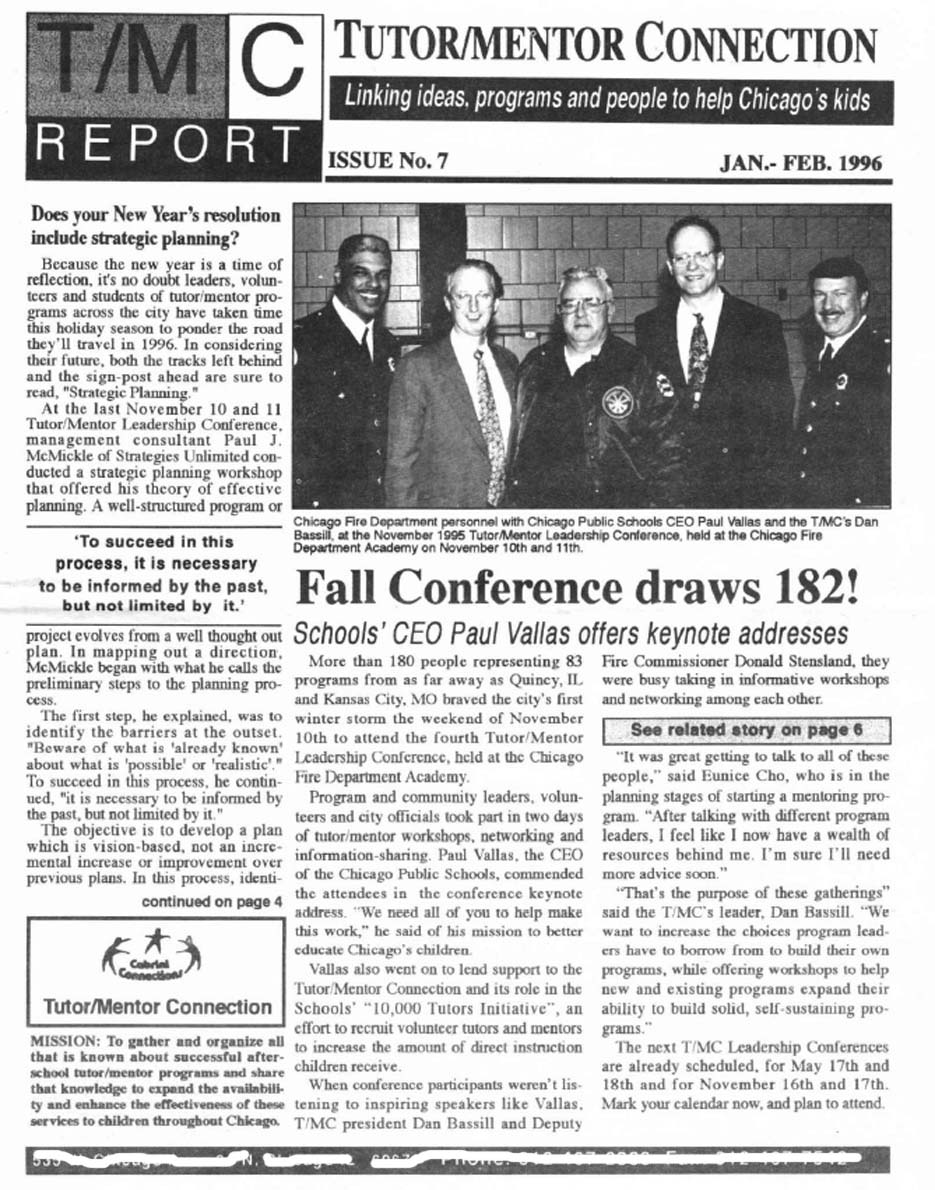
At the right you can see the first page of the Jan/Feb 1996 newsletter, featuring a photo of Chicago Public Schools CEO Paul Vallas and leaders of the Chicago Fire Department.  This was taken at the November 1995 Tutor/Mentor Conference, held at the Fire Department Academy.  Vallas was the keynote speaker. 

Below is a photo of former President Barack Obama, from 1999 when he was a speaker at another Tutor/Mentor Conference held in Chicago.  See it on page 5 of this newsletter

You can find archives of past newsletters on this page.  

Here's another Chicago leader. When Arne Duncan was CEO of Chicago Public Schools he gave small grants to support the Tutor/Mentor Connection and spoke at the volunteer recruitment campaign kickoff in 2001. You can see this image in a 2016 blog article I wrote. 

If you search for Arne Duncan, Barack Obama or Paul Vallas on this blog you'll find many articles where I've pointed to them. 

There's a common theme. I point to information people can use to help build and sustain volunteer-based tutor/mentor programs in high poverty areas of Chicago.  I point to research showing where and why such programs are needed.  I point to articles showing how current fund raising practices don't do enough to support long-term programs.  And I encourage people to use the information. Or if they pointed to maps the way I've done in more than 250 articles.

Below are recent Tweets featuring Obama, Duncan and Vallas.

Now imagine how much more they might have accomplished over the past 25 years if they had been the authors of the newsletters I wrote, and the articles on this and the MappingforJustice blog.  Of if they had consistently read the articles and then encouraged people they influence to also read them and apply the ideas.

Would more people have been investing in programs reaching K-12 youth in high poverty neighborhoods, helping kids through school and into jobs and careers?


Would more people "who can help" be responding to their appeals, and reaching out to offer time, talent and dollars to support school and non-school youth tutor, mentor, learning and jobs programs in every high poverty area of Chicago?  Would this strategy have been duplicated in other cities and countries?


We will never know because they did not take that role, nor has anyone else of influence, celebrity status and power.  

Well, it's never too late. Start now. Maybe in 2040 we'll see less poverty and violence, less structural racism and inequality, because of what our leaders, and others, do consistently, every week, for the next 20 years.  

This blog will remain available, either at this address, or in the Internet archive

The www.tutormentorexchange.net will also remain available via the Internet archive

Thanks for reading. Please share. And let's connect on Twitter, Facebook, Instagram and LinkedIn.  


Thursday, January 03, 2019

What the Heck Am I Trying to Do? Annual Reflection.

Every year I start out with a reflection, aimed at clarifying to myself, and others, “What the hell am I trying to do?” Why should anyone listen, or give me support?

Thus, this annual reflection is as much for my own reinforcement as for readers, but I hope you'll take the journey with me.

I found out more than 20 years ago that my words were not clearly communicating my ideas, in large part because too few others had the same background as I did, and too few others were thinking the same way. My college and Army background in history and intelligence gathering, and my corporate career in retail advertising for a company with 400 stores in 40 states, armed me with a commitment to collect and share best available information to support my decisions, and those of other people and to use daily communications to try to draw people to the ideas I was sharing...which focused on helping hundreds of big and small youth tutor and/or mentor programs grow, not just the single small program I was leading.

Thus, I started creating visualizations to share my ideas. I've been doing that for over 20 years. I'm going to post a few today.

Let's start with this one.

In this graphic, the photo on the left, from the mid 1990s, is a group of 7th and 8th graders. The photo on the right is one of those kids who came back in 2010 to speak at the annual year end dinner. I'm still connected to her and many former students and volunteers on Facebook.

From leading a youth tutor/mentor program that served 2nd to 6th grade kids (1975-1992) then became a 7th to 12th grade program (1993-2011), I began to think of volunteer mentors and tutors as people who give extra help to young people as they move from first grade through high school, and college or vocational school, and into jobs and adult lives.

This has led me to focus on the role of organized programs, that create a safe space, and an opportunity for youth to connect with a wide range of mentors and learning opportunities over a period of years. I created this Total Quality Mentoring graphic in the 1990s to communicate that idea.

Read TQM description.  Read Virtual Corporate Office pdf.

On Facebook and Twitter I'm finding stories from a few programs about alumni who are doing great things. However, too few programs are doing this. Too many may not have program designs that make long-term support possible.

In the next graphic, I then ask “If we want to help kids move from 1st grade to careers, what are all the things we need to be thinking about to make organized tutor/mentor programs available to k-12 kids in more of the places where they are most needed?” Open the map and read it from top left to right, as a circle of thinking. On the bottom row you see a focus on program infrastructure, funding and learning.

View cMap - click here

Kids need a lot of different supports. Organized programs, with a mix of volunteers from different business, education and age backgrounds can be people who help make these extra supports available, if they are encouraged to think beyond the “what do I do with my kid when I meet with them this week” question. The concept map below shows various supports kids in elementary school need. It is is part of a larger “mentoring kids to careers” cMap which shows that kids in middle school, and high school need similar supports, plus a fee more.

View Mentoring Kids to Careers cMap

As a volunteer in 1973, I started each week asking “What will I do with Leo, my mentee, when I meet with him on Tuesday evening?” I'm certain that every volunteer is asking the same questions. My goal has been to provide a library of information and ideas that volunteers could draw from, and to help programs build a talent pool of veteran volunteers and staff, who could provide answers to this weekly question, and many others that arise.

Dan Bassill - year end graduation, 1970s

I became the leader of that volunteer-based program in 1975 and from then until 2010, I started each August with “How do I recruit 100-300 volunteers and kids?” then moved on to “How do I keep them involved from the beginning of the school year till the end?” and “How do I recruit some to volunteer time to help me do this?” The questions kept growing as I formed the Tutor/Mentor Connection in 1993. How do we help this happen at several hundred locations in Chicago, not just the single program I was leading?

Since becoming a non-profit in 1990 the questions expanded to “how do we find the money to pay for this?”

That's what this next graphic is focusing on.
Click on graphic to enlarge, and few in greater detail.

The questions keep growing and ultimately focus on “how do we build and sustain public and private sector support for hundreds of separate programs, and for intermediaries, like myself, who work to support the entire system, the same way people in the corporate office of big companies work to support a vast network of stores in different places, distribution centers, technology and logistics and an army of talented people?

How do we build and sustain the public will to support this?

Then I think of how helping kids grow up is just one of many many complex problems that people throughout Chicago and the world focus on every day. How do we find a few leaders who will give daily attention to the problem I focus on, while also helping leaders grow in other sectors and other places?

Open map - click here

I don't know all the answers to these questions. Heck, I don't know all the questions.

What I've been doing for the past 40 years is building a library of “other people's ideas” that I use to stimulate my own thinking, and that I share to help others become involved in this process. This PDF describes the graphic at the right.

This PDF describes the Tutor/Mentor Learning Network, which is what I've been trying to build through the leadership of the Tutor/Mentor Connection (1993-present) and Tutor/Mentor Institute, LLC (2011-present)

So I think what I do has value.

I collect information others can use to build and sustain programs that connect kids and volunteers in places where they are needed. I also lead a communications effort to increase the number of people looking at that information and reaching out to support programs with time, talent and dollars. And I spend time trying to help other people make sense of all of this.

I don't find anyone else who is writing articles like mine, hosting a web library like mine, or using maps and visualizations the way I do. If you find such people, introduce me. That's what keeps me going every year. 

Four Part Strategy


This graphic visualizes that process, showing a 4-part strategy that I've been following since 1993. Open the link and dig deeper into this cMap.

Below are a couple of more graphics to think about.

We all want every child born today to grow up and have a great life, and be a contributor to the well-being of others and the planet.
Common Goal - read more

If we don't collect the knowledge showing how some people are already doing this, we will constantly be starting from scratch, rather than learning from others. We'll never had the best information available to innovate solutions that we're willing to commit support to for many years.

Influencing Actions


Furthermore, if we don't figure out a way to influence both resource providers and program leaders and volunteers, as well as young people, we'll never have enough of the resources needed to build long-term solutions, nor will we have enough program providers looking at ideas they can use each year to improve work they are doing.

Is that all? 

In this article I've shown just a few of hundreds of graphics I've created to share what I'm thinking and what I'm trying to influence. Thanks for reading along with me.

Visit my page on Pinterest.com/tutormentor to see more.

Do a Google search for “tutor mentor” then look at the images, to see more.

Visit this article and find a list of links to all sections of my library, my cMaps and PDF presentations. Build these into a learning and planning curriculum in your community.

And for your viewing pleasure, I converted one of the power point files that I use when creating these graphics, into a pdf, which I posted on Slideshare.com/tutormentor


There are 36 slides with a progression of ideas. I have several similar PPTs with additional graphics like these. If you browse articles I've posted, you can see how they have been used.

If you think what I'm doing is worth doing, and has value, then, do one or more of the following things

*) read my blog weekly and spend time looking at articles written in past years

*) join me in on-line learning groups such as the #clmooc group on Twitter, or in one of the many conversations I point to in this concept map.

*) share this and other blog articles regularly with people in your network

*) start a conversation with me to explore ways you, your company, your classroom, or your college can take a meaningful role in doing this work, now, and in future years..

*) make a contribution to help me pay the bills – here's my FUND T/MI page

Visit this page to find places to connect with me on social media.

Thank you again for reading.

I wish all of you to have a boat load of health, hope, happiness, peace and good news in the coming year.

Saturday, August 11, 2018

Value of Tutor/Mentor Program - Alumni Update

Leo & Dan - 1973
I started volunteering in a tutor/mentor program in Chicago in 1973. That's when I first started meeting weekly with Leo Hall, a 4th grade boy living in Cabrini Green Public Housing, near the Montgomery Ward headquarters where I was starting an advertising career.

I became the leader of that program in 1975 and continued through mid 1992. Then I and a few other volunteers formed Cabrini Connections, to help kids who aged out of the first program at the end of 6th grade have similar support as they move from 7th grade through high school. I led that program till mid 2011.

Maps show all areas where
programs are needed.
As we created the direct service program in 1993 we also created the Tutor/Mentor Connection to help similar programs grow in all parts of Chicago and to try to increase visibility and the flow of operating dollars to all programs, including the Cabrini Connections program. I still lead that strategy through the Tutor/Mentor Institute, LLC.

I try to share my experiences, and those of others, by pointing to a list of program web sites that I've been maintaining since 1993.

At the Cabrini Connections program we maintained a blog from mid 2005 through 2011 that was a daily journal of what was happening in the program. I was scrolling through it today looking for information about one of the activities when I came across a message from Leo, posted in 2006.  I've re-posted it below:

Hi.. I'm Leo Hall - Dan Bassill's tutee and friend

Today, I got an email from my friend and former tutor, Dan Bassill, about the graduation ceremony going on tonight. It made me think about when I graduated from MWTP (Montgomery Ward Tutoring Program) or what some of you may call Cabrini Connections. 
See, I was Dan's first tutee, way back in 197??. It's been that long ago, I honestly cannot remember. But ask Dan about the one kid that changed his life and he will probably mention me (or maybe his daughter and son first, then me). But I digress. 
As a former tutee and volunteer, I want to say that you all have a great program working on your behalf. When I graduated from the program, it only went to the sixth grade, but you all get to stay until senior year of high school. 
That is so cool, cause high school can be a very stressful time in your life. I should know, I went to one of the largest high schools in the state, Lane Technical High School. Graduated with 1000 students, so I was basically a number. But the things I learned from Dan and the MWTP really kept my head on straight. 
See, Dan was at every major event in my life, with the exception of the births of my children. Now, how many people do you know would travel all over the country to see you graduate from college, then come back to see you get married. With gas prices today, I'd only expect a card. Dan has been my mentor and friend for over 30 years and I really respect his opinion on things. 
I also liked what he has done for the children in Cabrini Green, the children of Chicago, IL. But especially, the children on Cabrini Green. Dan has taken a lot of heat from a lot of people and he kept going. So, you all are the fruits of his labor. 
After graduating from high school, I went to Memphis State University (Univ. of Memphis) and graduated in 1988, on the Dean's List with a Bachelors degree in Engineering. I now have 2 sons, and am a movie producer and director. A lot of what I do with people is what Dan used to do with me, and that is mentor them. Teach them how to make good decisions and trust and believe in themselves. 
Presently, I am on the set of my new movie, and I asked Dan to send me some CC products, tee-shirts and stuff, so that my cast can wear them on the set. You never know, you may see CC on the big screen real soon. 
Well, time to get back on set, but I wanted to say this, keep your head up and never forget where you came from and the people that got you there. Thanks Dan and MWTP for everything that you have done for me.

Leo Hall
Leo & Dan, 2014

In 2014 Leo invited me to Nashville to celebrate his 50th birthday. He paid all of my expenses! I wrote this article following that.

The testimony by Leo is one of several alumni articles posted on the Cabrini Blog. I encourage you to read them.

Here's a 2016 article about mentoring, from The Atlantic, which featured myself and Leo. 

It's these stories, which I have experienced over and over for more than 35 years which drives my passion to help make well organized, non-school, volunteer-based tutor/mentor programs available in more places.

If you browse the Chicago Programs list, and this section of programs in other states, you'll find many who also have stories from alumni.  I was just looking at this page on the Higher Achievement web site (Washington, Baltimore) with 40 stories. Can these convince you to become strategically involved in helping these programs continue to do good work, while helping new programs start where needed?

I've been reaching out to alumni and others to help re-build the Tutor/Mentor Connection and carry it forward into the next decade, with them as leaders and people writing articles like this.  While a few have begun to show interest, there still is no new leadership team in place.

I've also been asking for financial help to keep me going. Click here to find a page with contributor information.

If you'd like to get involved or know more, just introduce yourself with a message in the comment box or connect with me on Twitter, LinkedIN or Facebook.

Friday, March 02, 2018

What Can You Do to Help?

I wrote a couple of "do over" articles a year ago after the Oscars. And since 2011 I've met with a lot of people.  I need to figure out a better answer to this question than what I've given in the past because too few conversations where someone asks "What Can I do to Help?" result in them actually doing work that helps me further the goals of the Tutor/Mentor Connection (and Tutor/Mentor Institute, LLC) which I started in 1993.

Let me try this. 


First. I'm trying to find people from different industries, universities, faith groups, etc. who will build their own understanding of the strategy map shown below, and put a version of it on their own web site, with their name/photo/web site, etc in the Blue Box at the top of the map.

People who make this commitment can be from any place in the world.
In the middle of the graphic, right below the blue box, is a node that says, "Four-Part strategy to achieve this goal". If you open the "four part strategy" link you'll see the concept map I'm showing below.

This article describes 4-part strategy


By making the commitment (to goals of strategy map) you're making a commitment to help build the information library, which includes GIS map directories showing location of existing youth tutor, mentor and learning programs in Chicago, or other cities. That's all part of step 1


Then you're also committing to "act like Dan" and help increase the number of people who read our blogs and look at the information in the library (step 2); and to helping form groups in colleges, churches, businesses, etc. that help people understand and apply the ideas and information in the library (step 3).

When I say "act like Dan" look at this concept map to see all the places I share information regularly. Imagine how many more people would see this information if 100 people were posting and tweeting and speaking at events and meetings every day.

Finally (step 4),  you're using your own visibility and communications tools on a daily basis to draw more people directly to youth and family serving organizations that information (step 1) shows are needed in every high poverty neighborhood of the world (also in step 1).

It's step 4 where I feel I differ from most others. I want to draw volunteers and donors directly to individual programs, with their web sites serving as their grant proposals and donation requests.  Here are a few articles to read about this goal.

If you are willing to make this commitment, demonstrate it by your actions, which include (a) putting the strategy map on your web site; and (b) using  your blog, web site, Tweets, etc. to explain in your own words what the Tutor/Mentor Connection is and what it's trying to do, and to draw people to the Tutor/Mentor library and blogs and web site.  See how interns did this between 2005 and 2015.

Talent Needed
At the left is a concept map that shows the range of talent that I hope some day is making this commitment.  I'd like to be able to put links in each node to point to people who are doing the two steps described above. 

On another concept map I point to blogs and videos where people are already writing about the Tutor/Mentor Connection and Tutor/Mentor Institute, LLC. If you're doing this, send me a link to your story and I'll add you.

Out of this network of leaders I need to find a small group who will provide future leadership for Tutor/Mentor Connection as a 501-c-3 non profit, and Tutor/Mentor Institute, LLC as a social enterprise.  I have not figured out how to do this, so finding someone who can bring together a team for this purpose is really important.

How do T/MC and T/MI differ, other than tax status? Take a look at this concept map

You don't really need to dig any deeper to look at the strategy map and decide if that's your commitment too, or to look at the 4-part strategy and decide if you can  help with one, or all four, steps.  You don't need any type of permission or formal alignment with me to do either.

However, if you want to dig a lot deeper, visit this wiki and read through it to see what has been done in the past, where help is needed, and ideas for what could be done in the future by a new set of leaders.

In the short term, you can also go to this page and make a small (or large) contribution to help me keep doing this work.