Showing posts with label conflict. Show all posts

Monday, May 16, 2022

Kids not living in high poverty need mentors, too

If you've followed my work for any length of time you see how my focus has been on helping kids living in high poverty areas connect with adult volunteers in organized non-school tutor, mentor and learning programs.  Open the graphic at the left and you can see a 10-point strategy developed in 1993 that I have followed for over 20 years.

For the past few years as I've watched horrendous tragedy of youth using AR-15 rifles to murder groups of people, as in Buffalo this past weekend, I've begun think that there is another category of young people who need a lot of extra mentoring and adult support.


Since launching the first tutor/mentor survey in January 1994 I've tried to build a segmented understanding of existing tutor/mentor programs in Chicago, sorting by age-group served, type of program and location. 

At the right is a graphic showing a vision that I've had for many years, of creating a much more detailed understanding of what types of programs are available within a geographic area.  You can see this graphic in this blog article

Below is a view of the Tutor/Mentor Program Locator which we launched in 2004, based on the printed Directory we had published since 1994.  It enabled people to search by type of program, age group served and location, to find programs in different parts of Chicago.


This has been an archive since 2018. You can read about it here.  If someone creates a segmented understanding of programs in their area, this is a way to share that information and help those programs attract volunteers, donors, students and media attention.

Below is an updated version of the graphic shown above.  


I've added another sub-category focusing on youth growing up surrounded by adults who have adopted anti democratic conspiracy theories, religious extremism, White Supremacy thinking, etc.  


At the left is a graphic that I include in a presentation titled "Defining Terms".  The graphic shows five categories of youth who could benefit from help provided by volunteers in organized, on-going, tutor, mentor and learning programs. The large light blue area in the middle, showing youth living in high poverty areas, has been where I've focused my efforts for more than 40 years.... helping kids in high poverty areas get extra support that aids them in the journey from birth-to-work.

I updated this graphic yesterday.  

I added a circle to show "all youth" need support of mentors and extra adults. This is similar to the graphic at the top of this article.  I included elements from the original graphic, showing youth with special needs and youth living in high poverty areas.

However, I added two more shaded areas. One focuses on children of the super-rich, who grow up living in a far different reality and level of experiences than do most other kids.  Can they empathize with the challenges other kids face, and use their wealth,  power and influence to help society overcome these challenges?

The second shaded area is more troubling. This includes all youth who are growing up surrounded by adults who have adopted anti democratic conspiracy theories, religious extremism, White Supremacy thinking, disinformation from FOX News and other sources, etc.   The terrorist who murdered 10 people at a Buffalo supermarket was clearly influenced by such an environment.

In an organized, non-school tutor, mentor and learning program youth can connect with a wide range of adults and experiences.  Not all programs have this design, and few offer all of the possible learning opportunities that might attract kids and keep them coming back every week for many years.

But that's the goal I've shared for 20+ years.
Now I think we need to be finding ways to reach kids who don't live in poverty (without reducing our on-going efforts to provide more and better programs and support to kids who DO live in poverty areas).  

I don't even know where to start.  

Well, I do, really,  I need to find a place where someone is collecting articles and research about this and also aggregating links to organizations working to combat the formal and informal grooming that is turning so many young people into disenchanted, destructive human beings. 

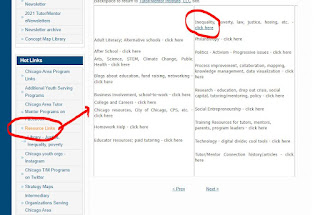
The graphic below shows categories in the Tutor/Mentor web library at https://tutormentorexchange.net/resource-links.  I can add another category but I'm not sure what to name it yet.  


I'll share this article on my social media posts and look for suggestions and recommended links from my network.  I don't intend to make this the primary focus of the library, but hope to be able to point to others who do make this the primary focus of their work.  

This page shows links to my social media pages, such as LinkedIn, Twitter, Instagram and Facebook.  I look forward to connecting with you there. 

Monday, March 07, 2022

Global conflict - local focus

 Below is a map showing ongoing conflicts around the world of concern to the United States, from the Council on Foreign Relations website

Click on any dot on the map and you can learn more about the conflict in that area. In Europe the conflict is the attack on the Ukraine that started in late February 2022.  While this one is dominating much of the news, we need to focus on all of these in efforts to reduce or end them.


At the same time we need to continue to work daily to help youth living in high poverty areas of Chicago and other cities have the extra support needed to help them move from birth to work. 

I've used this blog since 2005 to focus attention on the challenges facing youth living in high poverty areas and the potential help that can be offered by volunteers who connect with them in on-going,  tutor, mentor and learning programs.

Yet at the same time, I also have shared graphics that focus on surrounding issues that affect these kids, and others around the world.  The graphic below is from a Nov. 2020 article

As we start a new week, and continue to follow the tragedy unfolding in Ukraine and in other places I encourage you to create your own maps and blueprints, to help you keep track of all the different issues that you need to focus on daily, for this week, and many weeks to come.


If we can do this we can help kids in Chicago and US poverty areas move through school and through the journey of their adult lives.

And, we can build networks of support for kids and families who are being driven from their homes by man-made and natural disasters. 

While the graphic above shows me in 1974 with Leo Hall, and again in 2014 at his 50th birthday, it could also picture kids from any of today's conflicts, with adults who are helping them rebuild their lives and their futures. 

I'm on Twitter, Facebook, Instagram and LinkedIn (see links). I hope you'll follow me and share your own blog articles and graphics. 


Tuesday, April 23, 2019

When Have So Many Done So Little With So Much

I was looking for inspiration for writing today's blog and, as I do often, I looked at what I was writing during this same time frame in past years.

President's Summit
for America's Future
April 1997
I found an article from April 28, 2007, which I'm going to re-post below. 

Some background first. In April 1997 teams of 10 people from 150 cities gathered in Philadelphia, at the invitation of President Clinton, and former Presidents Bush, Carter and Reagan (via Nancy Reagan). The event was headlined by General Colin Powell.

I was there. I was part of the Chicago delegation.  The Tutor/Mentor Connection was one of 50 organizations invited to have a display at the Summit, as a Teaching example. I wrote about it in this 2017 article.

So it's now 22 years since promises were made to help America's 13.5 million kids living in high poverty.

Here's what I wrote in 2007

In this month's issue of Youth Today, Bill Treanor has written an article about the 10 year results of the 1997 President's Summit for America's Future, which gathered leaders from 150 cities and all living Presidents, to focus attention on the help needed by more than 13 million youth living in poverty.

Bill's article can be found here.  Bill points out that the America's Promise organization, which was established to implement the goals of the Summit, has raised more than $27 million since 1997. The question is what has been accomplished other than creating high paying jobs for the staffers at America's Promise?

I was one of Chicago's ten delegates. The Tutor/Mentor Connection was one of 50 organizations from around the country invited to have a display at the Summit, as a "teaching example". I still have newspaper articles, and the manifesto listing the commitments to helping the most at-risk youth in America.

As a leader of a youth serving agency in a big city, I left the Summit hoping for reinforcements. I know how small non profits struggle for resources to keep youth and business volunteers coming to non-school programs, and how difficult it is to influence aspirations of education, college and careers, when these aspirations are not modeled by many of the most visible people in high poverty neighborhoods. I was hoping that General Powell would use maps, and be recruit business and celebrity leaders, who will mobilize resources to support the non profits already on the battlefield in our war against poverty.

Instead, the war profiteers are those with high paying jobs, or who are earning big PR contracts. The troops are under-supported. The claims of success are over stated. As America's Promise itself reports in a 10 year report (no longer available online), there's much to do.

--- end 2007 article --

So Much Spent. So Little Accomplished

I went to Philadelphia with high hopes, of reinforcements for organizations like my Cabrini Connections program, which already was working with inner-city youth.

And for the Tutor/Mentor Connection, which was a strategy to help build and sustain mentor-rich non-school programs in every high poverty neighborhood.

That help never came. Instead there was a lot of re-inventing of the wheel, with new people starting new initiatives with limited information.  Of those in power, few have ever come to me to ask "Dan, can we learn from your efforts?"

Bigger picture.

In 2017 I used the map below in an article titled "Pain and suffering throughout the world - how do we respond?

Overlays on this map could show poverty concentrations. They could show health disparities. They could show environmental issues that cause people to leave homes looking for other places to survive and raise families. They could also show conflict zones, terror attacks, and many more  pain and suffering locations.

View this concept map and see examples of the type of information platforms that are available.

I suspect other versions of this map could show places where wealthy people are extracting profit from the suffering of others, either as manufactures of weapons of war, or as manufacturers and/or financiers who extract resources from the land and oceans. I don't have a map showing this.

 Below is one of my graphics, with a map of Chicago. The oil-well icons symbolize programs helping kids grow safely from birth to adult lives and jobs that enable families to live beyond poverty.


There are a lot of places, just in Chicago, where people need help, for many years. There are even more places, throughout the world where similar help is needed, along with many other kinds of  help.

So how do we motivate the people with wealth, as well as those who can only spare a few dollars, and a few hours of volunteer time, to get involved with one or more places, then stay involved for many years, or until the problem is solved.

I don't have an answer. And, unless people read my article and share it with others, my questions won't be seen, and I won't be in the thinking and conversation with others who are looking at the same problems as I am.

So, please read and share my articles.

Then, send me a contribution to help me pay the bills, so I can keep writing these and keeping my web library on line.

Monday, October 29, 2018

Plenty in Real World to Stoke Halloween Fear

Lots of real world things to be scared of.
I'm getting ready to start a new week. The last of October 2018. Halloween will be on Wednesday, and there are plenty of things to scare me.

It looks like Brazil has just elected an ultra right wing president and many of us are morning the massacre of innocent people at a Synagogue in Pittsburgh. While we're hopeful that next week's US midterm elections will bring control of the US House back to Democrats and Progressives, that's no guarantee that any of the terrible things happening in the US and the world will change.

I just read two articles that add to my sense of despair.   One article shows how right wing political movements and ideologies have grown around the world, fueled by social media and uses of the Internet.   A second article digs into the Wikipedia world and find a lot of things that stink.  Here's a cMap where I point to many more issues that concern me.

Thinking local. Fearing global.
It's in the context of thinking of the long-term impact resulting from how we're electing right-wing leaders in the US and throughout the world that I re-examine my own long term efforts to help well-organized, volunteer-based, non-school tutor and/or mentor programs grow in high poverty areas of Chicago, where adults connect with youth when they are as young as elementary school, then stay connected through high school, and into adult lives.

Birth to Work goal
That's what the graphic at the right visualizes.

The kids in the upper left were in 7th and 8th grade when this photo was taken  in the mid 1990s. I'm pictured at the right in late 2000s photo when one of these kids came back to talk at the annual year end dinner. It's 2018. We're still connected on Facebook. That's what I mean by "long-term".

Below is a page from the February-March issue of the printed newsletter that I was able to mail to about 10,000 people from 1994-2002.  Email and web sites took the place of this as I ran out of money to continue the printed newsletter.

Feb-March 2000 T/MC Report 
This article includes a map of Chicago, showing high poverty areas where organized tutor/mentor programs are most needed, as a way to expand the social capital, or network of people and experiences, for kids who have a limited based of work and career models, and people opening doors to opportunity, in their lives.

Connect your network to information
Here's a graphic that communicates the same idea. On both graphics the large circle represents the information library that I have been building since I started leading a single tutor/mentor program in Chicago in 1975.

The circle also represents a meeting place, or community of people, who gather on a regular basis, like people in faith groups do, and people in classrooms do, to learn from a central library information and ideas, and to innovate ways they could help tutor/mentor programs grow in different parts of the city and suburbs.

Anyone can take this role
I took this to another level when starting the Tutor/Mentor Connection in 1993. In my 1973-1990 retail advertising career at Montgomery Ward's corporate headquarters in Chicago we supported 400 stores in 40 US states, through the work of various central office teams.  They could do that because they knew where existing stores were located, and where there were potential customers for new stores.

By building a library of information, and a directory of existing tutor/mentor programs, my goal was that people in these learning and planning groups would begin to think of ways they could help all youth tutor/mentor programs within a geographic area get the ideas, dollars, talent, technology and other things each program needs to be great at what they do.

Instead of every program constantly reaching into a small pool of resources for what they need to operate, my vision has that others who care about what these programs were trying to do, would use their own time and talent to help mobilize these resources and push them to programs in every part of the city...based on the list of programs I was hosting (and still do),

My success over the past 20 years has been hindered by disasters like Montgomery Ward, our main sponsor, going out of business in 2000, and by the 9/11 terror attack, the following wars, natural disasters, then the financial melt-down of 2008.

Mayor Daley at 1997 T/MC Conference
However, I also was never able to get consistent, in-depth, support from Mayor Daley, major foundations, or other civic leaders. I had one business person visit my office in the 1990s and after I walked him through the strategy he said "I love what you're doing, but I'll never support you....because I want to start my own thing."

Since 2011 I've not had an organizational structure to help me continue the Tutor/Mentor Connection. I created the Tutor/Mentor Institute, LLC with the hope that I could generate revenue through consulting or by finding partners to invest in this strategy. That has not happened.  As I write this I'm wondering where the money will come from to keep my bills paid for the rest of this year...and into 2019.

Yet the need for non-school youth serving organizations reaching k-12 youth in high poverty areas is as great today as it was in 1993.

Enough is Enough - link
That brings me back to the start of this article. Kids entering school today will take 12 years to finish high school and another four to eight years to be starting stable jobs and careers.

That's 20 years.

What will the world look like in 20 years? Will people of color, people of different faiths or different gender identities, or who are fleeing conflict in their own countries, be seeking a refuge from the terror in America by then?

Or will we have gone through a third World War, fueled by nationalist leaders in different countries? Will there have been civil wars within the US and other countries, pitting extremist ideologies against each other?

Knowledge base needed - link

Local-Global Strategy.
While my local focus has been to help youth tutor/mentor programs grow in Chicago neighborhoods, the process I've piloted is knowledge-based problem solving. If someone aggregates information about a problem others can use that information to innovate solutions.

With this in mind I've begun to expand the knowledge base I host, pointing to articles about social justice, inequality, poverty, etc. I also point to articles about the climate crisis and about some of the political issues that I feel need to be better understood by more people.

To help people navigate the information I've been collecting, I created this article, which has a list of links to various sections of my web library.

Using this, anyone can start to do their own learning, and can begin to form a circle of friends, family, co-workers and faith group, who dig deeper into this information and try to create a different future than the one we seem to speeding into.

Is it enough? I feel that I'm pushing a huge rock up a steep mountain, with too little help, and too many other issues competing for attention. With the growth of right wing governments I fear the mountain itself will collapse, and what we do to build systems of support for disadvantaged youth will have no benefit.

Or, will this be the only thing that matters? Even if the entire world is in flames, our will to survive will continue to burn brightly, and our need to provide systems of support for our kids, and each other, will still be with us.

If you can help me keep this information resource available, visit my FundMe page

While I seek help, I also seek partners or a way to make the resources and ideas I've aggregated since 1993 a part of the work others are doing.  Visit this article describing "a bold experiment called MITx U.Lab" and compare what they are describing to what I've described in this and other articles on this blog.  How can I get this group to adopt the Tutor/Mentor Institute, LLC as one of its focus areas?