Showing posts with label birth-to-work. Show all posts

Sunday, February 01, 2026

Expanding "Who you Know" Networks

National Mentoring Month has just ended and Black History Month starts today.  Last week I watched a panel discussion, hosted by MENTOR Georgia (it's 90 minutes long, so watch it later).  In one segment the speaker talked about mentoring as a strategy to expand networks, or social capital. 

That takes time.  

Below is a graphic that I created several years ago.  I find very few mentoring discussions that use graphics to emphasize the long-term support kids in high poverty, highly segregated, areas need to move from first grade through high school and post high school and into jobs and careers.

If you work your way through it I hope you'll have a better idea, and commitment, to the work that needs to be done in many places.


At the top of the graphic I show an arrow that represents support all kids need, for the first 20-25 years of their lives, to help them through school and then, into and through their adult lives. Some kids, like Bill Gates, or Jeff Bezos, or Elon Musk, had much greater support propelling them to career success. Those are extreme examples, but most kids have a large natural network of support than kids in high poverty areas. 

That arrow comes from this "mentoring kids to careers" graphic, which I created in the late 1990s.  It shows first grade through 12th grade, then college or vocational training, as a series of steps. At each step kids need a variety of different supports and/or are influenced by people who work in occupations that youth might aspire to in their own futures.  If you open this concept map, you'll see a different version of this timeline.

As I said above, all kids need some of these supports and influences.  However, if you read many of the articles in this section of my library, you'll see plenty of evidence showing that kids living in high poverty areas don't have as many naturally occurring supports or career models as do kids in more affluent areas. That means someone, or many people, need to help make these supports available and keep them in place for 12 or more years.

This leads to the next element on the graphic, which are the maps.  


I've been using maps since 1993 to visually show areas of Chicago with high concentrations of poverty and many indicators showing kids and families need more help.  Without a map you could have a long list of places you're helping, but still be missing a large number of other places that need the same help.

You can find the maps shown above in this 2016 article. You can find hundreds of articles on this blog, and the MappingforJustice blog, showing similar maps and encouraging leaders to use them to guide resources into all of these areas for many years. 

The map graphic I've used is a mashup of maps from three sources.  In this concept map you can find many data platforms that could be used to create similar map stories. 

Why don't we see leaders using maps to show the growth of youth and family support programs in every high poverty area of the  USA?

Since starting the Tutor/Mentor Connection in 1993, and the Tutor/Mentor Institute, LLC in 2011, my focus has been on helping long-term, volunteer-based tutor and/or mentor programs grow in all high poverty areas as a way of expanding the networks of support available to kids, helping them through school and beyond. 

Thus, the arrow, or timeline, indicates multiple years of support. The map illustrates that many places need the same type of support for many years.

The graphic below visualizes the need for every industry to have strategies that distribute volunteers, technology, dollars and more into every neighborhood...and for school and non-school programs to be places where kids connect with a wider range of learning and career opportunities than might be normally available in their own family and neighborhood. 


While I led a tutor/mentor program from 1975 through 2011, which collected inner city kids to a wide range of workplace adults, I did not start to understand this as a form of bridging social capital until the early 2000s.  

Here's a link to one of the earliest articles that have influenced my thinking about social capital. One introductory paragraph says:

“Social networks that can bridge across geography, race and class are key to success in the new economy”, says Professor Manuel Pastor, Jr., University of California, Santa Cruz, who has studied social networks in Los Angeles among Latinos. ‘Hard’ skills are essential, but it’s the connections and mentoring that provide information about what skills are necessary and a vision of how acquiring them can lead to new opportunities for all our residents”.

This was written by Bob Pearlman.  The research he points to can be found at this link.  His current website is at this link

Since then I've aggregated links to many articles about social capital, which you can find here, and have posted 30+ articles on this blog that focus on social capital.

In this article I point to an earlier influence. It was a book that I read in the mid 1990s, titled American Apartheid: Segregation and the Making of the Underclass, by Douglas Massey. This book emphasized how disconnected people living in highly segregated, high poverty, neighborhoods were from the resources that might make lives in those communities better for residents.

MENTOR, the national intermediary, focuses on all types of mentoring, recognizing that every person could benefit from having a mentor at some points in their lives.  But that dilutes the focus needed to reach kids in every high poverty area with organized, on-going programs.

I've used maps showing high poverty areas to help people understand where long-term, organized, volunteer based tutor,  mentor and learning programs are most needed. I encourage MENTOR and others to do the same.

Why non-school programs?

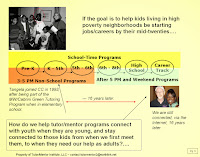
Find the graphic below in this visual essay.  It shows how organized, on-going programs are needed in high poverty areas of big cities, because of how difficult it is for kids and schools in these areas to make such connections and sustain them for many years.  We operated after 5pm because that was when workplace volunteers were more likely to make long-term commitments.

I've used a variety of graphics to visualize how organized programs can create extra learning opportunities by the involvement of volunteers who work in different industries and career fields.  This Total Quality Mentoring visual essay illustrates how such programs could be more available if they were strategically supported by leaders from different sectors.


I created this presentation more than 20 years ago to show why organized tutor/mentor programs are needed in high poverty areas and actions the Tutor/Mentor Connection had piloted since 1993 to help such programs get the attention and resources each needs to constantly improve.   The graphic I've included below visualizes some of the different types of learning, mentoring and tutoring that might take places in a site-based program.


These strategies have been based on the premise that areas of concentrated, high poverty, have too few people working in the wide range of careers that are modeled daily by parents, family and neighbors in more affluent places.  Thus, such programs need to be built in order to expand the social capital for kids in poverty areas.

However....  that does not mean there are "no people" living in high poverty areas who have jobs and careers.   That's the final element included in the graphic above.  Kids and adults need to learn "who you already know" who might be someone who can mentor them and help open doors to opportunity.


The need for social capital literacy is not really a new concept. Bob Pearlman's early 2000s article said, "Networking, or acquiring a social network, is a key skill of the 21st Century. It’s how you learn, and how you connect."  

I show another version of the "hub and spoke" graphics in a presentation titled "virtual corporate office" and in these blog articles.  


This shows how different industries could "distribute" learning and mentoring opportunities to kids in all high poverty areas, via school and non-school programs.  Social capital literacy could be a separate box, or could be a part of the mentoring coming from each industry.

The map reinforces the need for these forms of learning and mentoring in EVERY high poverty neighborhood. The timeline emphasizes the need for such learning to be consistently available for many years.  The other graphics emphasize that businesses in every sector could be supporting organized, volunteer-based tutor/mentor programs in multiple locations, not just one or two favored programs. 

Let's look at the timeline arrow once more.  If you click and enlarge it you'll see different types of learning activities that are appropriate for different age levels.

Here's another quote from Bob Pearlman's article:

"But the most significant finding in the study was that a student's social network can have a significant impact on his/her career choice. Students whose parents are both in high-tech careers are more likely to be interested in technology careers themselves. In addition, 83 percent of students rely on personal connections for career-related information and guidance."


I believe that the earlier a young person becomes involved in a well-organized, mentor-rich non-school program, the more benefit that program will have. Stronger bonds will be built with mentors, and with the program itself.  That's important because while a volunteer might leave after a year or longer, the program's ability to provide continuity, and a replacement mentor, helps keep the youth involved.  As a youth moves from middle school to high school the support offered can lead to part time jobs, internships, college access, scholarships and ultimately job and career opportunities. 

Kids in primary school where fundamental learning habits can be reinforced, and career aspirations nurtured, don't yet have the level of maturity needed to actively seek out mentors.  However, by middle school, and early high school, I think most kids would be ready to take more control over their own futures, if there were people helping them.  

We need to make that happen. 

This  has been a long post. Thanks for reading. I hope we connect on Twitter, Facebook, Instagram and/or LinkedIn.

If you want to support my work, please visit this page and use PayPal to send a contribution. 

Friday, January 13, 2023

I Have a Dream, too.

As we head into the 2023 MLKing Day weekend, I'd like to encourage all who will do service, to also do learning.  That means spending some time looking at ideas I've been sharing on this blog since 2005.

I led a volunteer-based tutor/mentor program in Chicago from 1974 to 2011. I formed Cabrini Connections in 1993 to help teens from the original 2nd to 6th grade program at the Montgomery Ward HQ in Chicago get the extra support they need from 7th grade through high school, in order to be prepared for college, vocational education, and the next steps to a job and a career.

When kids and volunteers joined us we made one promise: We will do everything we can to assure that each student who joins us will be starting a job/career by age 25. We are only limited by how much our students, volunteers, alumni and supporters are willing to share this responsibility.

I visualize that commitment with graphics like I'm showing in this article.  


Below is a message I shared with volunteers in the tutor/mentor program I was leading to start 2008.

This message can be just as relevant to volunteers in any tutor/mentor program, or to people looking to be elected to city, state and national office. 
 --------------------------- 

I hope that all of our volunteers have had great holidays and that you are looking forward to continuing your role as a tutor/mentor volunteer at Cabrini Connections, Tutor/Mentor Connection.

I've been a leader of a tutor/mentor program since 1974, and I've learned that every volunteer and student are different, and constantly changing. Thus, while I can provide a structure for your participation, I can't teach you everything you need to know, or everything I've learned. I can try to help you, and your student, form a learning strategy, where you know where to find information, and find help, so that as you meet weekly, you know where to go for ideas to stimulate and support your involvement. 

Last Christmas, Rebecca Parrish (a Cabrini Connections volunteer) gave me the book "The Starfish and the Spider" as a present. As I read it, I realized that this book was describing Cabrini Connections and the role of every volunteer, staff member, and leader. It also describes the role of alumni, and veteran volunteers. 

We are a decentralized organization in which each volunteer is the CEO of his/her own tutoring/mentoring business. We succeed in life by our own efforts and by what we can learn from others. Our networks are important. They expand opportunities, open doors and provide resources. 

As you go through the tutoring year, each volunteer is learning to individualize his/her weekly activities based on the needs of your student, your own abilities and time, and the level of experience you have gained. Veteran volunteers, alumni, staff and coordinators are able to support you with ideas, information, and structure, but it is your own learning and networking with other volunteers that gives you ideas for what you do. 

Each week I'm trying to coach you with this email, with my blogs, and with the information and networks available to you on the Tutor/Mentor Connection web site at http://www.tutormentorconnection.org 

You all already know how difficult it is to motivate many kids to do homework, do extra learning, and take charge of their lives. Imagine how difficult it is for me and the leaders of Cabrini Connections to recruit busy people like our volunteers, and convince them to spend time beyond their weekly tutoring/mentoring, learning how they can become more effective tutors/mentors, or giving help to others who are seeking help. 

Yet, this is the only way we can succeed in keeping the promise we make to our kids. Read more at http://cabriniblog.blogspot.com/2007/12/good-to-great-in-decentralized.html

I thank you all for your involvement in Cabrini Connections, Tutor/Mentor Connection. On behalf of our volunteer board of directors, I welcome you back for our 16th year of tutoring/mentoring since January 1993.

Dan Bassill
President/CEO
Cabrini Connections 
Tutor/Mentor Connection 

 ---- end 2008 article --------------------------------- 

In what ways will our elected leaders support the involvement of volunteers, donors, businesses and universities in programs like Cabrini Connections? Will they use maps to build a distribution of resources into every neighborhood where tutor/mentor programs are needed? Will they use their blogs, web sites, public speaking to connect volunteers with non profits in their district, using links to a Program Locator, so volunteers and donors can search for where to get involved? 

Or will the volunteer and donate button on their web site only point to themselves, in an effort to get elected, or stay elected? 

True leadership lifts up everyone. Real Generals understand the need to distribute troops in all places where the enemy is concentrated, and they understand the need to have an infrastructure that supports those troops with food, clothing, pay, training, weapons, etc. so they are better equipped than the enemy.


I created this graphic in 2011 and shared it in this 2012 article.  As you think of helping kids in high poverty areas include data maps and each of these steps in your planning. Next year, and each year after that, celebrate National Mentoring Month and MLKing Day by providing a review of actions you took to help more kids during the previous year and actions you plan to take in the coming year to build on past year progress. 


This graphic illustrates an information based problem solving strategy where groups of people focus on a section of geography where kids need extra help, then look at available information showing how some people have helped similar kids in different places. Then they brainstorm and create and execute their own plan. At the end of the year they review what they've accomplished, look at work others are doing, then launch a plan for the coming year, building on what was done the previous year. See the concept map here and blog article here

This type of planning needs to be happening in many places in order to fill all high poverty areas with comprehensive, on-going, birth-to-work mentoring strategies.


Which of our leaders are going to be demonstrating this type of leadership in 2023? Who already is sharing these type of ideas in other places? 

Let's connect.  Find me on Twitter, Facebook, Instagram, Mastodon, LinkedIn, etc. Find links on this page

Thanks for reading. Enjoy the weekend. Please make my vision, your vision, too. 

If you want to help Fund T/MI and the work I'm doing, please visit this page and use PayPal to send a contribution. 

Monday, February 21, 2022

Navigate the Tutor/Mentor Resource Library

Last week I started an article with this "birth-to-work" graphic, then shared concept maps that are intended to guide learners through the library I've built since the 1990s.

Below are a couple more concept maps intended to support this learning journey.

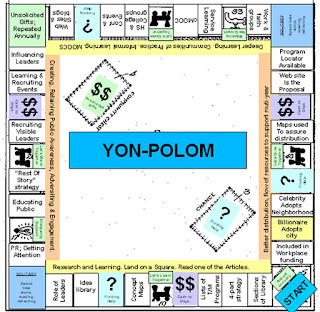
The first is a hack of the Monopoly game.  I mixed the letters to create YOM-POLOM (Youth Organizations Need Purposeful Ongoing Leadership and Operating Money).  

Open the concept map and zoom in to view the individual squares, and the links that take you from any square to a specific part of the Tutor/Mentor library.  I introduced this game board in this 2015 article

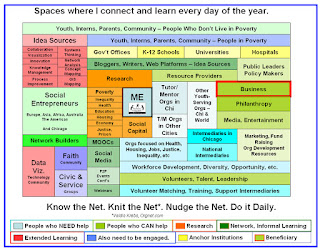
The second concept map shows sections of the Tutor/Mentor library.  

I created these using cMapTools and encourage others to create and share their own versions focusing on their own cities if they are not in the Chicago region.

The information from these concept maps and others in my collection is intended to support what people in business, philanthropy, religion, education, media, entertainment and other sectors do to help make well-organized, mentor-rich, non-school tutor, mentor and learning programs available to K-12 youth in more high poverty areas, and to help those programs constantly learn from each other so that all can do more to help kids move from birth-to-work and lives free of concentrated poverty.

I've been writing this blog since 2005 and have hosted a website since around 1998. I started creating visualizations to help people understand the strategies I was piloting and have shared these in printed newsletters, blogs, social media, Pinterest, etc. for almost 30 years. 

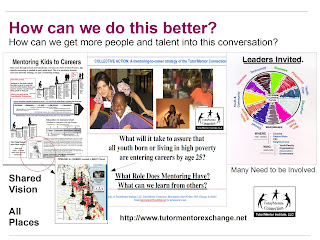
They all invite people to gather and learn from the ideas I'm sharing with one goal:  "How can we do t his better?"  


As we start a new week, in the second month of a new year, I keep looking for others who are asking the same questions and who use web platforms, maps and visualizations to draw others into this conversation and to encourage on-going actions that help youth programs reach more kids with constantly growing impact. 

You can find my social media platforms in this link.  I look forward to connecting to you and your own ideas and efforts. 


Friday, December 03, 2021

Building long-term mentoring support

 Former President Obama is in Chicago today.  I saw a Tweet showing that he made a surprise visit at a South Side YMCA.  It prompted me to create the graphic shown below.


The former President's visit gets a lot of attention, but it is just one small dot on the 12 year timeline from 1st grade through high school, or the even longer timeline of birth-to-work.  


If kids live in areas of highly concentrated, segregated poverty, there are too few people in their lives daily modeling all the careers they might have when they are adults, and helping them do the work every day to reach those careers.

I'd love to see a blog by President Obama where he talks about his visit, and then shows a map like the one on the left, and says, organized non-school programs that connect kids and volunteers from many industries and professions need to be in every high poverty area of Chicago, for many years.

Maybe more people would listen and begin to figure out how to make such programs available and keep them in place for 10 to 20 consecutive years.

He could borrow ideas I've been sharing on this blog since 2005.

Heck, he could even adopt the Tutor/Mentor Connection and make it a program of the Obama Foundation and the new Obama Library in Chicago.  

I'm on Twitter @tutormentorteam if he wants to reach out to me.


I share ideas I've developed over the past 40 years on the http://www.tutormentorexchange.net website.  

If you visit, take a look at my "FundTMI" page and my "75th Birthday" page.  

Help me keep sharing this information in 2022 and beyond, or until someone like President Obama decides to take ownership. 


Friday, November 26, 2021

Creating service and learning organizations

If you've read some of the messages I've posted to this Blog since 2005 you'll see that I led a small non profit from 1993 to 2011 that connected workplace volunteers with children and youth living in neighborhoods of highly concentrated poverty.


This graphic shows some of the people who we connected to each other. These were from 10 to 25 years ago. I'm still connected to many via Facebook. I'm now seeing some posting pictures of their own kids as they finish high school or head to college. That was the goal.


While we led one small tutor/mentor program (called Cabrini Connections) we also led the Tutor/Mentor Connection, which aimed to help similar volunteer-based programs reach k-12 kids in every high poverty area of Chicago. I'm still leading that via Tutor/Mentor Institute, LLC.

Since forming this two-part strategy in late 1992 our goal has been to create an organized framework that encourages volunteers to serve as tutors, mentors, coaches, advocates, friends, leaders in on-going efforts that make a life-changing difference for these kids. By life-changing, I mean that the kids will not be living in poverty when they are adults because they will have the academic, social/emotional and workplace skills needed for 21st century jobs, plus a network of adults who can and will open doors to jobs and mentor them in careers.

This graphic visualizes the type of programs I've tried to encourage, based on the ones I led.


We recruited volunteers from various business backgrounds to be on-on-one tutor/mentor support and many of these began to organize extra learning, such as a computer lab, a video club, a writing club and a college access group.

I have spent time almost every day for more than 40 years trying to figure out better, more efficient, and lower cost ways to accomplish this goal, first by leading one small program at the Montgomery Ward corporate headquarters in Chicago, starting in 1975, then by leading the T/MC since 1993.

I have learned to mine the knowledge and experiences of others to innovate strategies for tutoring/mentoring, rather than trying to develop my own solutions to problems. Using T/MC web sites, on-line networking and regular face-to-face training and mentoring, I am trying to share what I know, and the process of learning and service that I apply in my own daily routine, so that there are more people in more places accepting this role and responsibility.


This graphic visualizes a service-learning loop formed when a volunteer enters an on-going tutor/mentor program. This video shows the graphic.

So how do we make this vision a reality? We create a "learning organization", which is also the ideal of many of the best businesses in the world. We also create a "service culture" modeled after the work of heroes like Cesar Chavez, whose core values included sacrifice and perseverance, commitment to the most disadvantaged as well as life-long learning and innovation.

In a learning organization, everyone is engaged. In the world of Cesar Chavez, everyone is willing to make huge commitments, and sacrifices of time, talent and treasure to help disadvantaged people move to greater health, and greater hope and opportunity.

Our goal is to find ways to draw a growing number of our stakeholders into this learning process and to build an on-going commitment to service (as opposed to random acts of kindness). This process is intended to include our students and volunteers, our staff, donors and leaders, and members of the business, education, faith and media in the communities where our kids live. It also aims to engage leaders and volunteers from other tutor/mentor programs in Chicago and in other cities, plus people and organizations in the communities that don't have high poverty, but benefit from a world envisioned by Dr. M. L. King, Jr. as well as a 21st Century America where there are enough skilled workers to meet the future workforce needs of American industry.

I use concept maps like this to visualize this goal.


Anyone can adopt this vision and lead it using their own talent and resources.

The Internet is our meeting place. It's a virtual library of constantly growing knowledge. On T/MC web sites we collect and host information that shows why kids in poverty need extra help, where such help is needed, who is providing help, and what volunteer-based tutoring/mentoring programs can do to connect adults, kids and learning in an on-going, constantly improving process of mentoring kids to careers.

If we can find ways to increase the percent of our kids, our volunteers, and our leaders and donors who are drawing information on a weekly basis, and reflecting on this information in small and large groups, the way people in churches reflect on passages from the Bible each week, we can grow the amount of understanding we all have about the challenges we face and the opportunities we have. We can innovate new and better ways to succeed in our efforts.

This process has already started. We need to nurture and grow it in 2022.

Can you help?

Browse the articles shown in the list on the left side of this blog and start your own learning.  I tagged this article with "learning" just as I have more than 300 previous articles.  I encourage you to read some of these on a regular basis. I also encourage you to read some of the Power Point Essay I've written, such as the one that shows our Logic Model

This and other PPT essays in the Tutor/Mentor Institute library illustrate the T/MC vision and the community of organizations that we seek to engage. Then share your own knowledge, time, talent and dollars to help us build this service and learning organization.

Thank you all for reading my messages. I hope you share them with others. May God Bless you all with peace, good health and happiness in 2022 and beyond.

Daniel F. Bassill
Tutor/Mentor Connection (1993-present)
Tutor/Mentor Institute, LLC (2011-present)

Monday, June 28, 2021

Mentoring as a Workforce Development Strategy - Updated 2005 Article


I often look at articles I wrote in the past for inspiration for new ones. Today I'm reposting this article, which I wrote in 2005, as one of the very first articles on this blog.

I've not changed much, since what I wrote then is still needed today, in 2021.  I've just added a few graphics created since then such as this one showing that the "pipeline to careers" for kids in poverty has too many blockages. 

Here what I wrote: 

In a Sunday, April 10, 2005 Chicago Tribune article titled "Workforce needs polish, U.S. businesses declare", the secretary-treasurer of the New York State AFL-CIO was quoted as saying, "If we infuse education and job-training with an emphasis on 'employability skills,' then we develop workers who not only can get jobs, they can keep them as well."

This was  not a new issue in 2005.  My friend Edward Gordon, of Imperial Consulting Corp, has been writing about the job/skills crisis since the 1990s.  Below is a Tweet I posted last week, pointing to his latest White Paper.  
10-2021 update - Here's a YouTube presentation by Ed Gordon introducing his Job Shock book. 

That's a message the Tutor/Mentor Connection (Tutor/Mentor Institute, LLC since 2011) has been saying for more than two decades. We believe these skills need to be mentored, not just taught in short classroom sessions. Furthermore, we believe that youth living in inner-city poverty struggle to succeed in school and jobs because there are too few adults who have jobs and careers in diverse industries modeling the expectation that everyone works, and that there are many career opportunities available to those who develop their personal, academic and employment skills.
 
While the Tribune article shows the traditional approach of business and schools lobbying legislatures to develop and fund such initiatives, the T/MC believes that business has the most to gain or lose from any delay in the development of comprehensive mentoring-to-career strategies that parallel higher academic goals.

This graphic visualizes the role business needs to take, to "pull" kids through school and into jobs.


This graphic visualizes that businesses in every industry need to be leading strategies that help kids in every high poverty zip code move through school and into jobs and careers.


I encourage you to visit the Tutor/Mentor Institute strategies library and read some of the short power point essays that I started creating in the 1990s. From these you'll see that our focus is on helping comprehensive, volunteer based tutor/mentor programs be in all the places where they are needed and that we serve as an intermediary connecting people, ideas and resources from all over the world. In one power point we illustrate a PUSH and PULL strategy (see graphic above). Parents, teachers, tutors, mentors, coaches are all PUSHING kids to maximize their potential. If these resources are available consistently in the lives of kids, there's a good chance most will respond.


However, in neighborhoods of high poverty, most kids don't consistently have access to adult who are PUSHING them to do their best (view concept map above). Even when such programs exist, they compete against negative traditions and influences such as welfare, gangs, illegal income habits, etc. that reduce their influence as youth grow older. In these communities a vocational mentoring strategy needs to be in place, led by industry, unions, chambers of commerce, etc. Such a strategy uses business resources (people, ideas, technology, dollars, jobs) to create a PULL system, that reaches kids as early as first grade and stays connected with them in age appropriate mentoring, job shadowing, internships, etc. until the youth is an adult and in a job/career.

This graphic visualizes the idea of "mentor-rich" youth programs operating in every high poverty area of Chicago.  


Such programs are needed in every major city of the world, not just Chicago. If we wait for the school bureaucracy to recognize this as a responsibility, or if we wait for elected leaders to make this public policy, we'll still have this need 50 years from now and America may be a second class economy. Business must take the lead, innovating ways to reach kids in every neighborhood with programs that mentor kids through school and careers.

While the Internet can connect the T/MC with others around the world who want to learn about this vision, or who already incorporate these ideas in their own work, local intermediaries are also needed to lead and implement this vision in their own community, with their own business and universities as partners. While T/MC maps point to Chicago, Philadelphia maps should point to Philadelphia and Miami Maps should point to Miami.

That's what this graphic intends to communicate. Intermediaries like myself are trying to connect people "who can help" to information and ideas they can use, to support youth, families, schools and youth programs operating in places where help is needed.


Instead of leaders of networks and individual programs constantly competing with each other for resources, I want to create a meeting place on the Internet where we can talk of ways of working together to increase resources for each of us. In such communities we'll look at what works and try to innovate ways to make what works available in this network of tutoring/mentoring and education to careers programs.

In the graphic above I divided Chicago into sections, suggesting that teams of community/business and university partners could adopt sections of the city and take on the intermediary role that Tutor/Mentor Connection began piloting in 1993. 
 

No matter where you are in the world, you have the potential to be gathering people in your network to participate in this discussion, for the purpose of building more and better places on the East Coast, West Coast, in the UK or in Australia, where good programs meet more youth.

I created the concept map shown above a few years ago to share links to articles where people are writing about the ideas I've been sharing.  If you begin to do that, I'll add a link to your site. However, in the tutor/mentor web library I point to blogs and websites of more than 2000 others who are sharing their own information and ideas.  
 

Since 1993 I've maintained a list of Chicago non-school tutor/mentor programs. I show where they are located,  using maps like the one at the left, which you can see in this article.

As we locate programs working with youth and do more to help them get visibility, volunteers, dollars, technology, ideas, etc., we'll begin to stimulate the growth of better programs and that will soon accelerate the movement of more kids through school who are prepared for careers.
 
Are you already involved in such work? Let's find a way to connect. (when I wrote this in 2005, Twitter, Facebook and LinkedIn were not yet available). They are now. You can find my pages on these sites at this link

Dan Bassill
Tutor/Mentor Connection (1993 - present)
Tutor/Mentor Institute, LLC (2011-present)

Sunday, November 08, 2020

Helping Youth in Low Status Communities

Since March 2020 I've been watching a series of #PovertySolutions events, hosted by a group at the University of Michigan.  Last Friday's was titled "Talent Retention in Low Status America" and featured Majora Carter (majoracartergroup.com)

In her introduction (during first 10 minutes of the presentation) Majora said:

“I use the term 'Low Status Communities' vs low income, communities where there are more environmental burdens, higher rates of poverty, low educational attainment, higher rates of health problems, higher rates of people involved in the justice system, but most importantly there is a lack of hope, an assumption that inequality is just assumed, by both people inside and outside of the community. 

In our communities (low status) we're taught to measure success by how far we get away from them. No matter what type of low status community you were raised in, you're taught to measure success by how far you get away from them. 

These are the kind of things that repel people from a low status community. If they can find a way to leave, they do. 

There is no shortage of talent coming from low status communities. The challenge is to retain it and reinvest it in making those communities places where people would want to live."

Watch the full video at https://www.youtube.com/watch?v=kIMpDkzedjI

I've not heard the term “low status communities” used this way, describing communities like the ones on the West and South side of Chicago, and pockets like the Cabrini Green housing projects on the Near North side of Chicago, where I led youth tutor, mentor and learning programs from 1975 to 2011.

I've used maps for 25 years to point to low-status communities in Chicago with the goal of helping well-organized, long-term, tutor/mentor programs, like the ones I led, grow in these areas.  View this concept map to see a collection of platforms that map indicators of low status communities. 

I understand what she was talking about. As I listened to Majora, I thought about how the programs I led were focused on helping our inner-city students get the education and adult support they need to move through high school, college then careers...so they could live where ever they wanted, free from poverty. That means outside of the neighborhoods where they were living. 

As I listened to Majora I posted a few Tweets at #PovertySolutions to share my thinking.
The concept map I shared in that Tweet shows many of the challenges facing youth and families in low status communities. Until low status communities offer more reasons for their youth to live there, by reducing many of these challenges, those kids, like any other people, will choose to find other places to live where they are more comfortable, safer, with better schools.

I've written often of the challenges of operating a non-profit tutor/mentor program that depends on volunteer talent and inconsistent donor support. During my first 15 years leading a program that grew from 100 pairs of elementary school kids to 300 pairs, I also held a full time advertising job, with management responsibilities. Just keeping the program running and growing was a huge job.

The parents kept telling me they needed programs helping kids beyond elementary school, so in 1992 I created Cabrini Connections to do that. Over the next 18 years we helped many kids finish high school and move on to jobs. I'm now connected to many on Facebook and seeing them post stories showing the success of their own kids.

As with in my earlier years, just keeping the program in business during the ups and downs of the economy was a huge challenge.


However, we compounded that by launching the Tutor/Mentor Connection in 1993 to help all programs in Chicago get greater visibility and a more consistent flow of operating dollars. Helping everyone else, also was helping our own program.

Through the Tutor/Mentor Connection I began building a library that showed the conditions Majora described in her talk. I created concept maps showing that youth and families needed many other types of support, beyond tutoring/mentoring. 

However, I also attempted to show how recruiting adults from the workplace and beyond the geography of low status communities, created social capital ties that encouraged more people to take an interest in the conditions of these communities.  Doing so was intended to influence the growth of investors and innovators who would help re-build these communities to make them places the kids we were helping want to invest their own talent and lives.

Without  help from others, we're not able to offer long-term tutor/mentor programs. Without help from others, I think it will be pretty difficult for people like Majora to rebuild low status communities, wich are spread throughout the country.

The work of re-building communities takes decades. The work of helping a youth from first grade through high school also takes many years. But various tutor/mentor program strategies can reach kids in middle school and/or high school, to help influence that journey, in a shorter period of involvement.

In watching the Poverty Solutions session with Majora Carter I was reminded that those of us working directly with youth need to show our volunteers and supporters a larger strategy that might someday reduce the need for so many volunteer-based tutor/mentor programs.  

We need thousands of people filling the blue box in the middle of the graphic above, writing blog articles like mine, creating videos, Tweets and movies, to motivate more and more people to get informed, then get involved.  

I can be found in many social media places. See a list of links here.

If you value what I'm writing, visit this page and send me a small contribution to help fund the Tutor/Mentor Institute, LLC. 


Saturday, August 08, 2020

Investments needed in birth to work strategies

 View the graphics below and click into links to find more information. 

I included this graphic in this July 2018 article titled "After the march, do the planning".   It's one of more than 200 articles posted on this blog that focus on "violence" prevention and "planning".  My goal is that youth and adults from around the USA are are reading these articles and sharing their interpretations with friends, family and co-workers to help mentor-rich birth-to-work programs grow in every high poverty area of Chicago and other parts of the country.

You can look at the graphic above in several ways.

1) It includes a map, showing high poverty areas of Chicago. Programs that help kids through school and into adult lives need to be in every one of these zip codes.

2) The horizontal arrow shows the #birth-to-work timeline, which takes 20-25 years for EVERY  youth. Those in high poverty areas don't have the same range of natural support that kids in more affluent areas have, so those supports need to be made available through school and no-school hours programming.  I wrote an article last week focusing on some of the needed programming. 

3) You can also think of the graphic as a guide to investments needed.  Since the arrow, and the graphic above, shows stages kids grow through as they move from #birth-to-work, communities need to innovate ways to drive needed operating dollars, technology, talent and ideas into every high poverty neighborhood, making age appropriate programs available at each stage on the timeline.  Furthermore, at the right end of the arrow these supports need to be job training, interviews and JOBS!

M
aps need to be use for multiple purposes. They can show demographic and poverty data as layers of information, pointing to places where people need extra help. 

They can show access routes through neighborhoods which might help volunteers see more places where they can connect with youth in organized programs.

They can show locations of programs, and potential support, such as banks, colleges, hospitals, faith groups, etc. We created the Program Locator in 2004 and updated it in 2008 to enable people to create map view showing small sections of the city, that could be used in planning.  

Maps can also show who's involved, as these conference maps demonstrate.  

Most importantly, maps can show a distribution of dollars and involvement.  Foundations,  companies and government programs have the ability to create maps that show where their dollars are landing, and/or where company volunteers are involved as board members, or volunteers serving as tutors, mentors, tech support or marketing and fund raising support.  

So far I can find almost no examples of maps being used this way, thus, there is little accountability assuring that funds and resources support all stages of the #birth-to-work timeline, in every zip code where such programs are needed.

I no longer have the organizational capacity to update the program locator and implement these ideas. Instead, I want to be part of planning teams who read these articles and are trying to innovate ways to implement them in different locations.

I'm on these social media channels. If you're interested in knowing more and starting a conversation, just reach out to me.

If you want to help fund the work I'm doing, just go to this page and use PayPal to send your support. 

Thank you for reading.


Saturday, August 01, 2020

What's Included in Birth-to-Work?

Programs needed in every
high poverty area
I've used this graphic for many years to visualize #birthtowork support needed to help youth in every high poverty area of Chicago. It uses a map to show a wide range of places where programs are needed. It uses a "village" graphic, to show that teams with a wide range of talents and skills need to be working daily to make such programs available and help them connect to ideas and resources that enable them to constantly improve.

On the graphic I use an oil well icon to convey the idea of a growing birth-to-work programs anchored in every poverty area shown on the map. Below is another graphic that visualizes this differently.

age level support needed

The arrow and the "staircase" both signal the need to help youth move through school and into adult lives.  If you click and enlarge the graphic you'll see suggested mentoring and learning opportunities that need to be available at each grade level.

Within the horizontal arrow I list some of these:

* Reading help (elementary school level)

* Enrichment, Mentoring, Tutoring (starting in elementary school and continuing through high school)

* Job shadowing, leadership clubs (starting in middle school and continuing through high school)

* Summer Jobs, Internships, Apprenticeships (starting in high school and continuing through college)

* Jobs, career networking (starting in high school and continuing through lifetime)

Each site based program could
include many of these activities
The graphic at the left visualizes how many of these activities, including technology and STEM learning, could be part of many site-based non-school programs.  Such programs need to be available to k-12 youth in every high poverty neighborhood.

The website of a program should show that they have a strategy to involve youth and keep them involved in age-appropriate learning for many years.

If you look at the websites of Chicago area youth tutor and/or mentor programs that I include in my library, you'll find that very few show this strategy.  That may not mean they don't do it. It may mean they don't have the talent/time on their staff to communicate their strategies effectively on their websites.

strategic business support

The strategy of the Tutor/Mentor Connection, launched in 1993, was a) build a list of existing programs; b) increase public attention for each program; c) try to help programs recruit business volunteers; and d) educate these volunteers so they'd go back to their companies and networks to recruit other volunteers; so e) they could bring these needed learning opportunities to programs in more places.

For that to happen people need to be looking at these ideas, and then starting conversations within their peer group, their business group, their family and alumni networks, asking "How can we help programs in different zip codes become mentor-rich programs with a wide range of learning that helps more kids through school and into adult lives?   How can our volunteers be there to help kids as they grow through this journey and be there to help when they begin looking for jobs and/or career advice?

create learning circles
That's what this graphic represents.  Learning circles, composed of people from the same industry (tech, finance, legal, arts, etc), faith group and/or alumni group, could be meeting regularly to innovate ways to create and distribute learning opportunities that help kids aspire to jobs in their industries, or areas of expertise. They then could be doing the work of embedding these activities in programs throughout Chicago and many other places. As kids get old enough they could be providing part time jobs, internships, college and career advice, and then interviews to jobs in their companies.

During the #Covid19 pandemic these conversations need to focus on ways to create virtual learning and mentoring that reaches youth in all high poverty places, as well as ways to help programs re-open safely as the pandemic receeds.

I'm sure some of this is happening, but have had no ability to do the research and aggregate links to places where people show how they are doing this work.

Tutor/Mentor Conferences 1994-2015

Between May 1994 and May 2015 I hosted Tutor/Mentor Leadership and Networking Conference every six months in Chicago. These were intended to draw program leaders and staff together to share ideas, and draw media, philanthropy, educators and business partners together to connect with program leaders. They also were part of the strategy of building media attention for Chicago tutor/mentor programs.  I've not done this since 2015 due to lack of funds and too many competing organizations who decided to "do their own thing" rather than "help build what was already in place".

web library
As we launched the Tutor/Mentor Connection and began to build a library of Chicago area tutor/mentor programs we also began to collect articles the people could use to learn ways to build better programs. We started putting this on-line in 2008 and I still maintain it, now as Tutor/Mentor Institute, LLC.

I had support from Illinois Wesleyan University as we launched the T/MC in 1993/4 and have had interns from various universities working with me at different times through 2015.  However, I've never found a department within a university that would adopt the T/MC strategy and lead it through the university. We came close with IWU between 1993-1996, and in 2004-5, when IUPUI was interested, but while that led to rebuilding the T/MC web site in 2006, it did not result in ownership of the strategy. This "Explore Chicago"class for first-year students at DePaul is another example of a promising start that did not continue.

Create university T/MC
This graphic is one of many that I've used to invite universities to create a student-led Tutor/Mentor Connection and that might motivate a wealthy donor to provide the money needed to make this happen.

Read these articles to learn more about a Virtual Corporate Office

Read these articles to learn about university involvement

Read these articles to see invitations to billionaires in Chicago. This Tweet shows that MacKenzie Scott (Amazon.com fortune) is making major contributions to universities.  If you have her attention, please share this idea with her.


I've been sharing ideas like this for more than 25 years (on this blog since 2005).  Please share them if you're concerned about creating birth-to-work learning and career opportunities for kids in high poverty areas. Make this part of your own Black Lives Matter commitment.

I'm on social media at these places. Please connect with me. Share your ideas and strategies and let's draw more attention to work that needs to be done.

If you value the work I'm doing please consider a contribution to help fund it. Click here to find a page with a PayPal button you can use to send your support.